
Life, 1895-01-10 · page 10 of 14
Life — January 10, 1895 — page 10: what you’re looking at
What you’re looking at
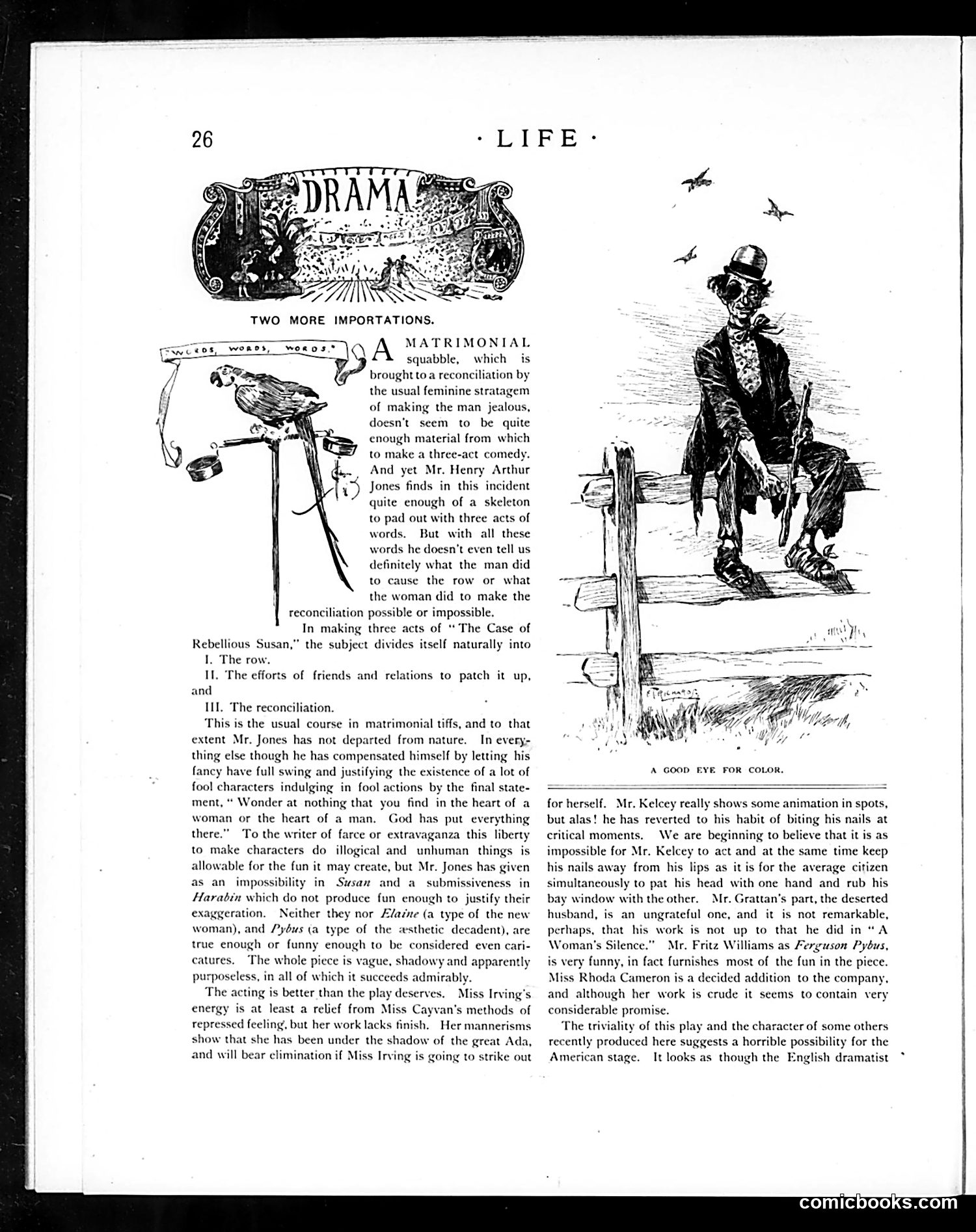
This page critiques three theatrical productions. The text reviews "Two More Importations"—plays brought to American stages. The left illustration shows a bird perched on a makeshift stand, accompanying discussion of a "matrimonial squabble" play by Henry Arthur Jones where a jealous man and reconciliation plot provide thin material for three acts. The right illustration depicts "A Good Eye for Color"—a man in a bowler hat and patterned clothing, likely a character from one of the reviewed plays. The text criticizes actor Kelcey for biting his nails at dramatic moments, and discusses other cast members' performances, including Miss Rhoda Cameron and Miss Williams, suggesting their work shows "considerable promise" despite the play's triviality. The overall tone is satirical, mocking the imported theatrical fare as shallow and the actors' occasionally amateurish execution.
📄 Transcribed text from this page (OCR, searchable)
Machine-transcribed from the original scan — historical spelling and the odd misread are preserved.
Vos, woaos, w 5 Fetes, wones, woeos.” |(\ IMPORTATIONS. MATRIMONIAL squabble, which is brought toa reconciliation by TWO MORE the usual feminine stratagem of making the man jealous, doesn’t seem to be quite enough material from which to make a three-act comedy. And yet Mr. Henry Arthur Jones finds in this incident quite enough of a skeleton to pad out with three acts of words. But with all these words he doesn’t even tell us definitely what the man did to cause the row or what the woman did to make the reconciliation possible or impossible, In making three acts of “The Case of Rebellious Susan,” the subject divides itself naturally into I. The row, Il, The efforts of friends and relations to patch it up, and III, The reconciliation. This is the usual course in matrimonial tiffs, and to that extent Mr. Jones has not departed from nature. In every> thing else though he has compensated himself by letting his fancy have full swing and justifying the existence of a lot of fool characters indulging in fool actions by the final state- ment, “ Wonder at nothing that you find in the heart of a woman or the heart of a man. God has put everything there.” To the writer of farce or extravaganza this liberty to make characters do illogical and unhuman things is. allowable for the fun it may create, but Mr. Jones has given as an impossibility in Swsanz and a submis in Harabin which do not produce fun enough to justify their exaggeration. Neither they nor Evazne (a type of the new woman), and Pyéus (a type of the wsthetic decadent), are true enough or funny enough to be considered even c: catures. The whole piece ind apparently purposeless, in all of which it succeeds admirably. The acting is better than the play deserves. Miss Irving's y is at least a relief from Miss Cayvan's methods of repressed feeling, but her work lacks finish. Her mannerisms show that she has been under the shadow of the great Ada, and will bear climination if Miss Irving is going to strike out A GOOD EYE FOR COLOR, for herself. Mr. Kelcey really shows some animation in spots, but alas! he has reverted to his habit of biting his nails at critical moments. We are beginning to believe that it is as ssible for Mr. Kelcey to act and at the same time keep ils away from his lips as it is for the average citizen simultancously to pat his head with one hand and rub his bay window with the other. Mr. Grattan’s part, the deserted husband, is an ungrateful one, and it is not remarkable, perhaps, that his work is not up to that he did in “A Woman's Silene Mr. Fritz Williams as Ferguson Pybus, is very funny, in fact furnishes most of the fun in the piece. Miss Rhoda Cameron is a decided addition to the company, and although her work is crude it seems to contain very considerable promise. ‘The triviality of this play and the character of some others recently produced here suggests a horrible possibility for the American stage. It looks as though the English dramatist