
A complete issue · 14 pages · 1894
Life — November 8, 1894
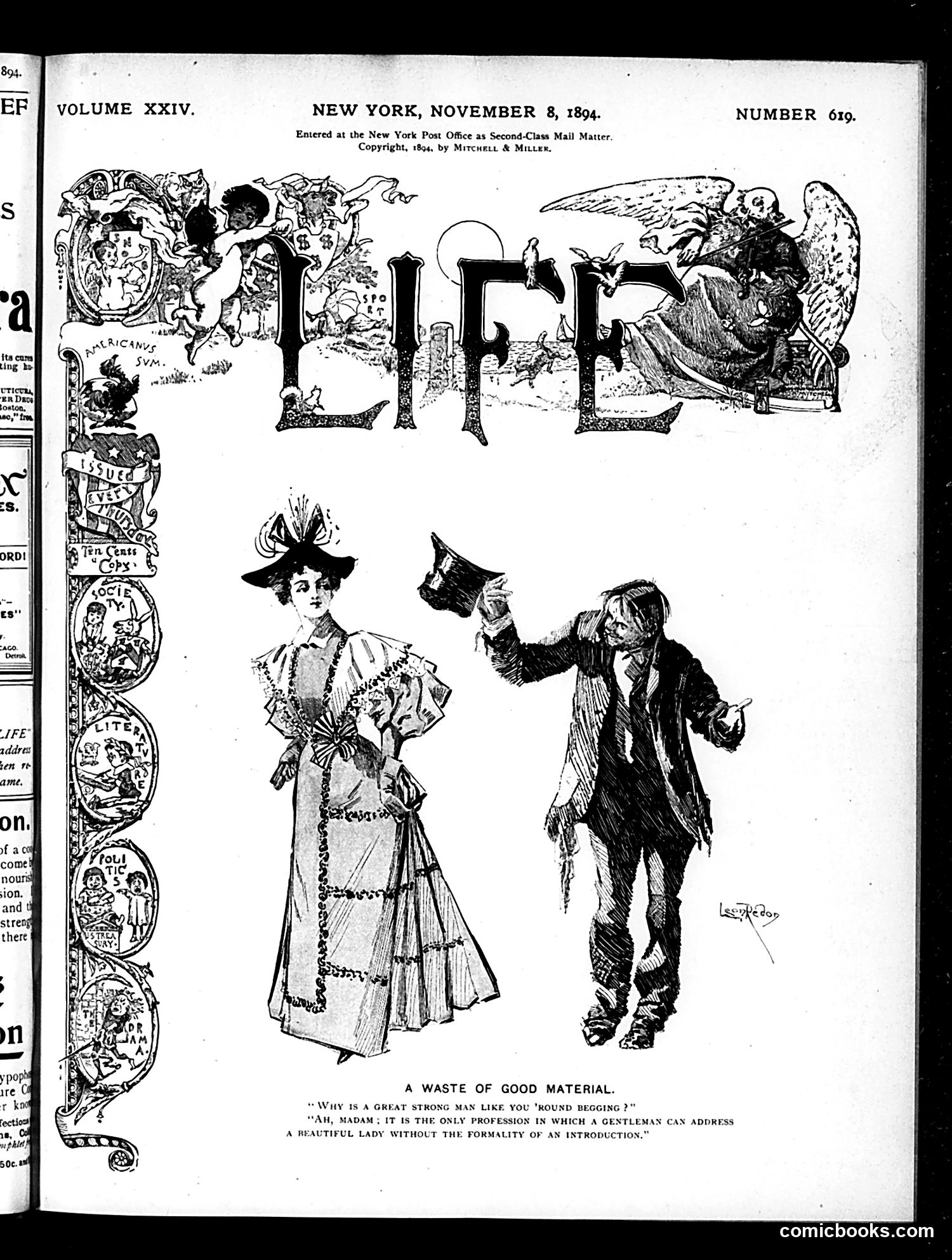
This satirical cartoon from Life magazine (November 8, 1894) critiques upper-class courtship customs. The caption quotes a man asking why a "great strong man" pursues "round begging" (marriage proposals), with his response: it's the only profession where a gentleman can address a beautiful lady without formal introduction. The cartoon shows a well-dressed woman in fashionable 1890s attire (with elaborate hat and layered dress) being approached by a disheveled man waving what appears to be a fan or handkerchief. The satire's point: the institution of courtship and marriage proposal etiquette allows otherwise improper social behavior—a man can be forward with a woman only when seeking marriage, making the whole system absurd and wasteful of "good material" (the woman's potential).
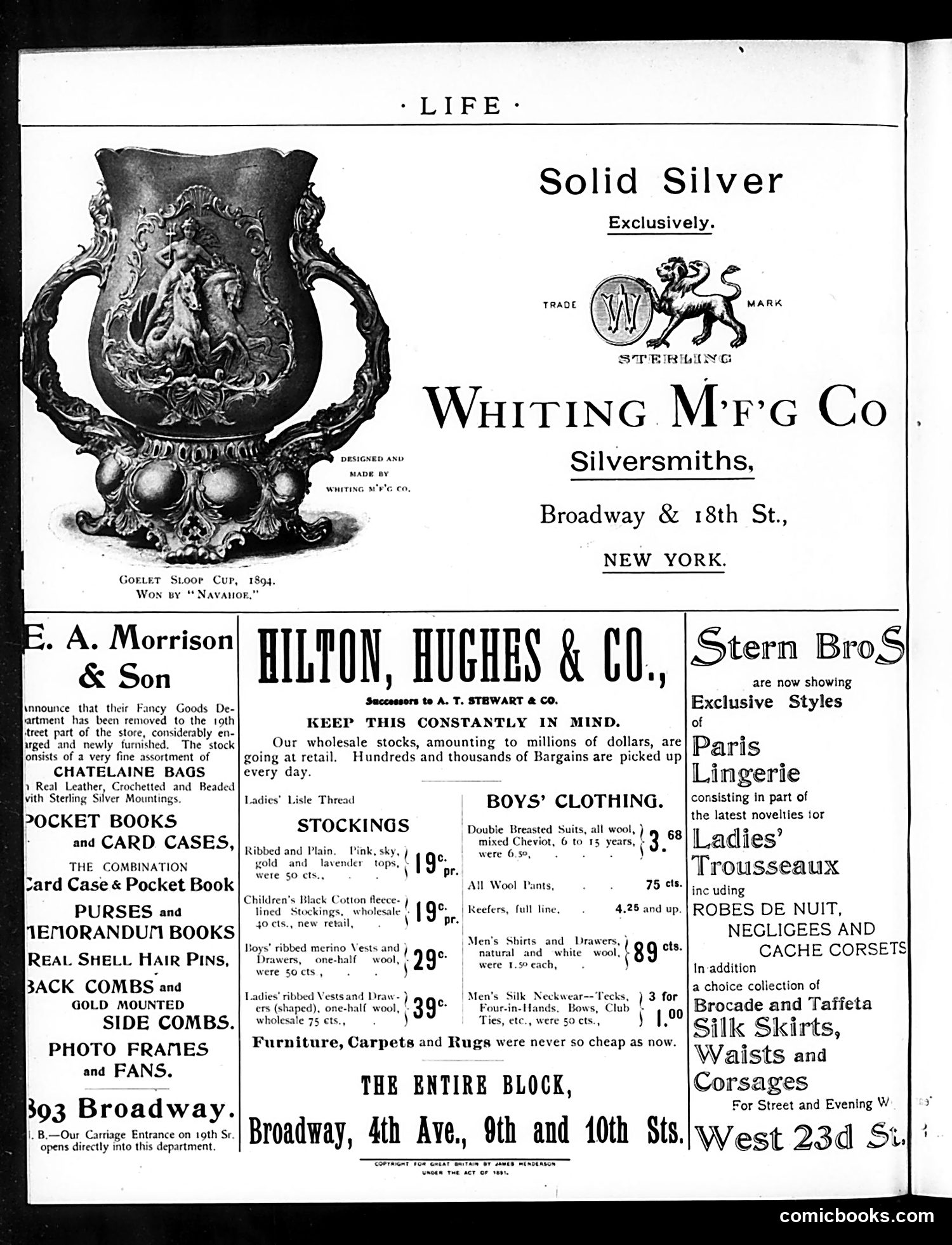
This page is primarily **advertising content** rather than editorial cartoons. The dominant image shows an ornate silver goblet—the "Goblet Sloop Cup, 1894, Won by 'Navahoe'"—advertising Whiting Manufacturing Company's solid silver goods. The remainder of the page consists of retail advertisements for various New York establishments: E.A. Morrison & Son (leather goods, pocket books), Hilton, Hughes & Co. (wholesale goods), and Stern Bros (Paris lingerie and women's clothing). There is **no political satire or social commentary evident** on this page. It represents typical turn-of-the-century Life magazine advertising, mixing luxury goods (silver, fine clothing) with practical items, reflecting the commercial ventures and consumer culture of 1890s New York City.
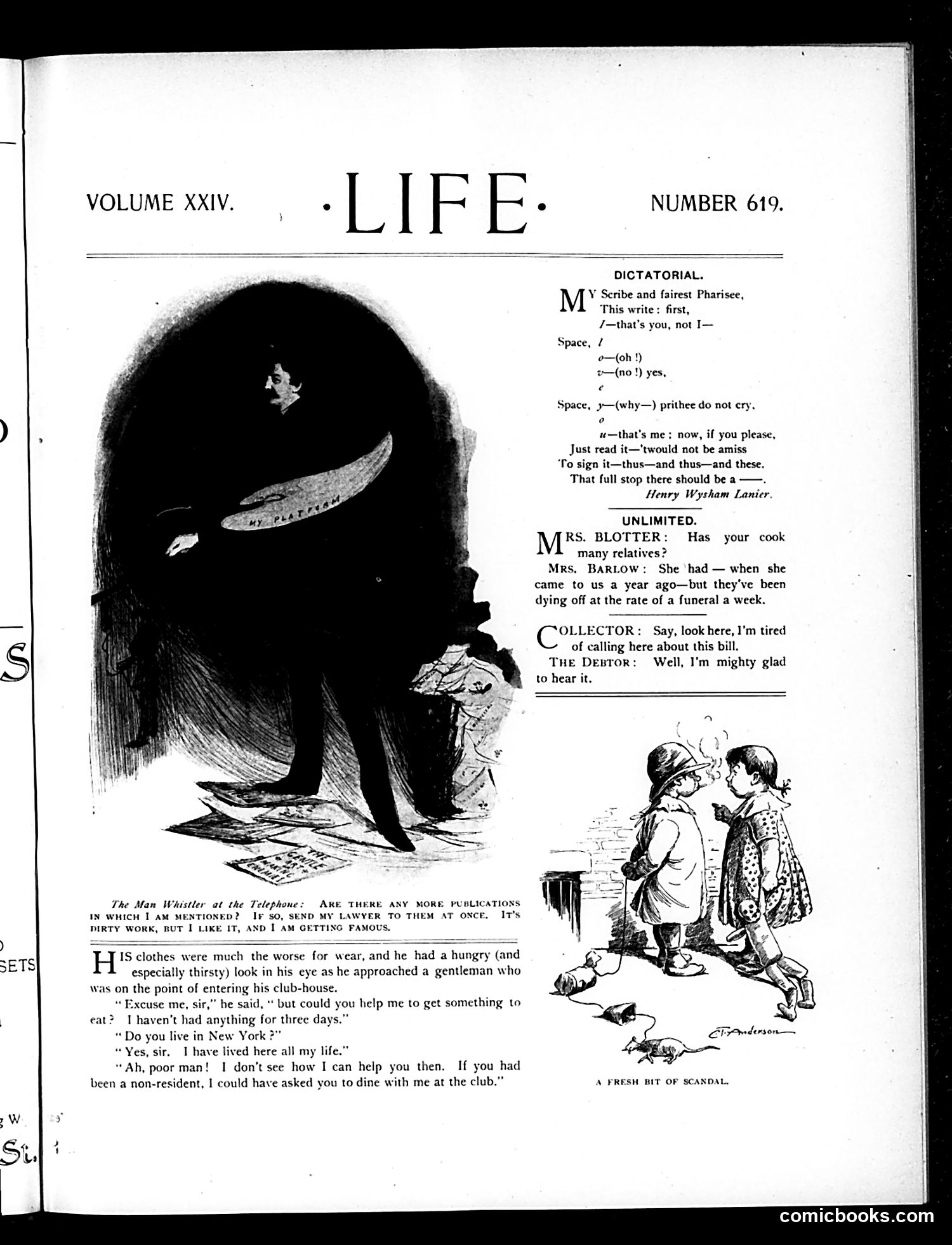
The page contains three distinct pieces: 1. **Main Illustration** ("The Man Whistler at the Telephone"): A large silhouette caricature depicting someone at a telephone, labeled as whistling while making a call. The satirical caption suggests this person is pestering publications for mentions, boasting about "dirty work" while seeking fame. 2. **"Dictatorial"**: A brief verse mocking a Pharisee's self-righteous written proclamation, attributed to Henry Wykham Lanier. 3. **"Unlimited"** and **"A Fresh Bit of Scandal"**: Comic dialogues—one about a cook's dying relatives, another between a bill collector and newspaper editor—depicting mundane social embarrassments and comedic misunderstandings typical of early-20th-century Life magazine humor. The overall tone is satirical commentary on vanity, social pretension, and petty human foibles.
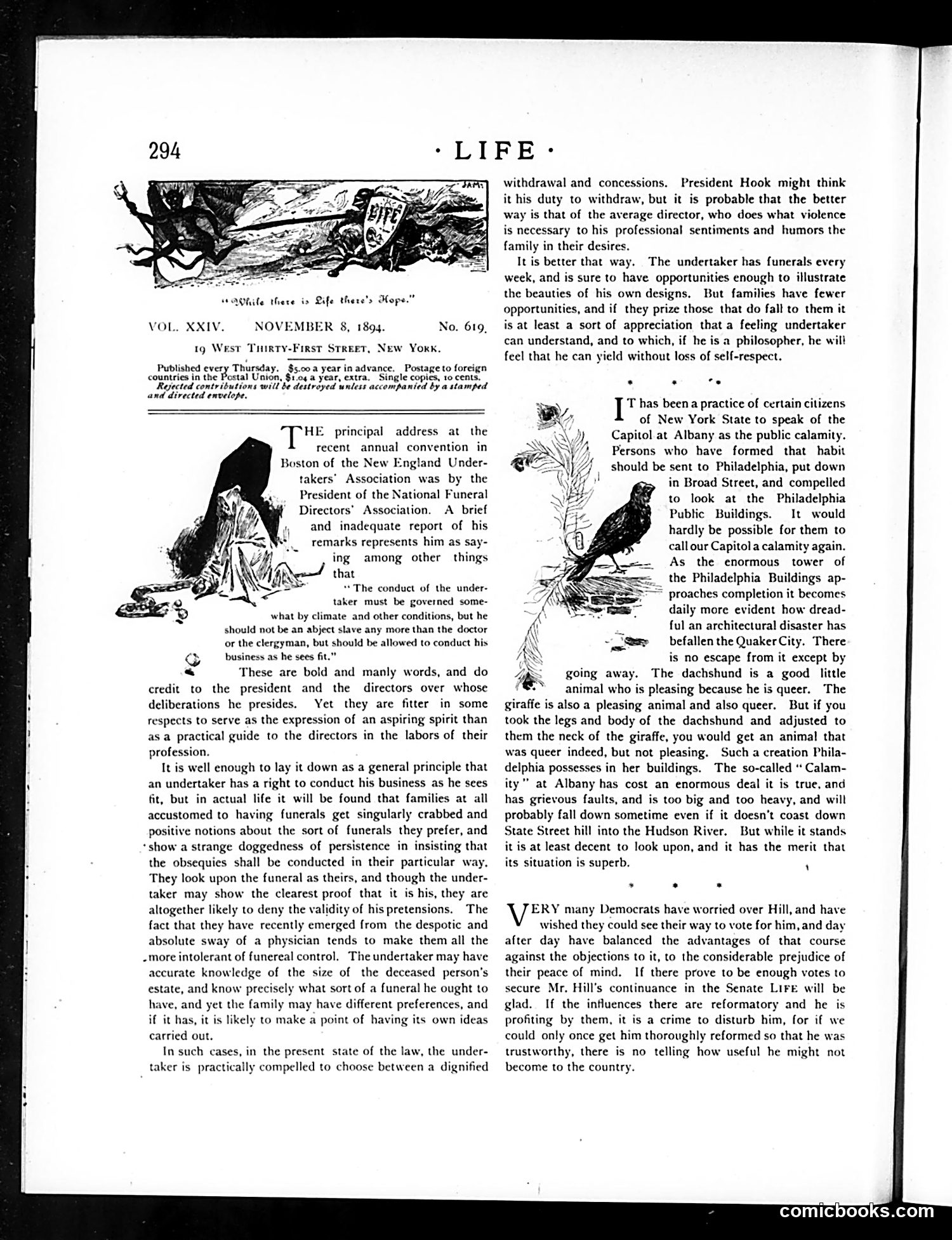
The main cartoon depicts Death (a skeletal figure in robes) speaking with an undertaker about conducting funerals. The text critiques undertakers' conduct, arguing they should have freedom to run their business as they see fit, yet asserting they've recently become "more intolerant of funereal control" from physicians and clergy. The second illustrated section discusses New York's Capitol building in Albany and Philadelphia's public buildings, comparing them unfavorably—particularly criticizing the Philadelphia structure as an "architectural disaster." The final section debates Senator David B. Hill's political future, with Democrats divided on whether to support his continued Senate service given concerns about his trustworthiness. The page combines editorial commentary on professional conduct with architectural and political criticism typical of 1890s satirical journalism.
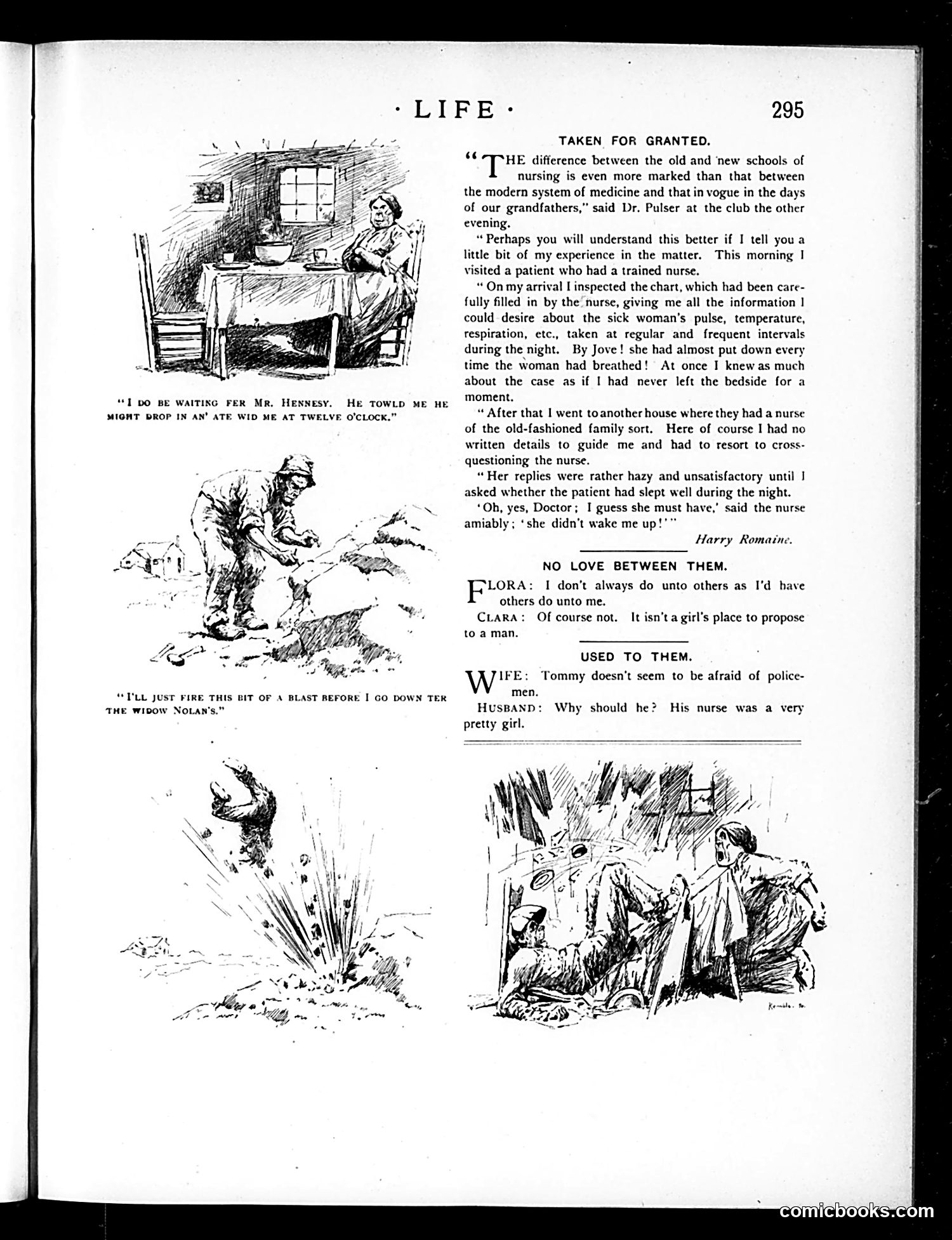
This page contains **three separate humorous sketches** rather than political cartoons: 1. **"Taken for Granted"** (top): Dr. Pulser discusses differences between old and new nursing methods, contrasting a trained nurse's detailed patient observations with an old-fashioned nurse's vague responses. 2. **"No Love Between Them" / "Used to Them"** (middle): Brief dialogue jokes about gender roles—Clara won't propose to a man; Tommy isn't afraid of policemen because his nurse was pretty. 3. **The three sketches at bottom-left**: Appear to depict slapstick or accident scenarios with explosions and physical comedy. These are **social humor** pieces poking fun at nursing practices, gender conventions, and domestic life—not political satire. The page represents Life's typical lighthearted commentary on contemporary American social customs.
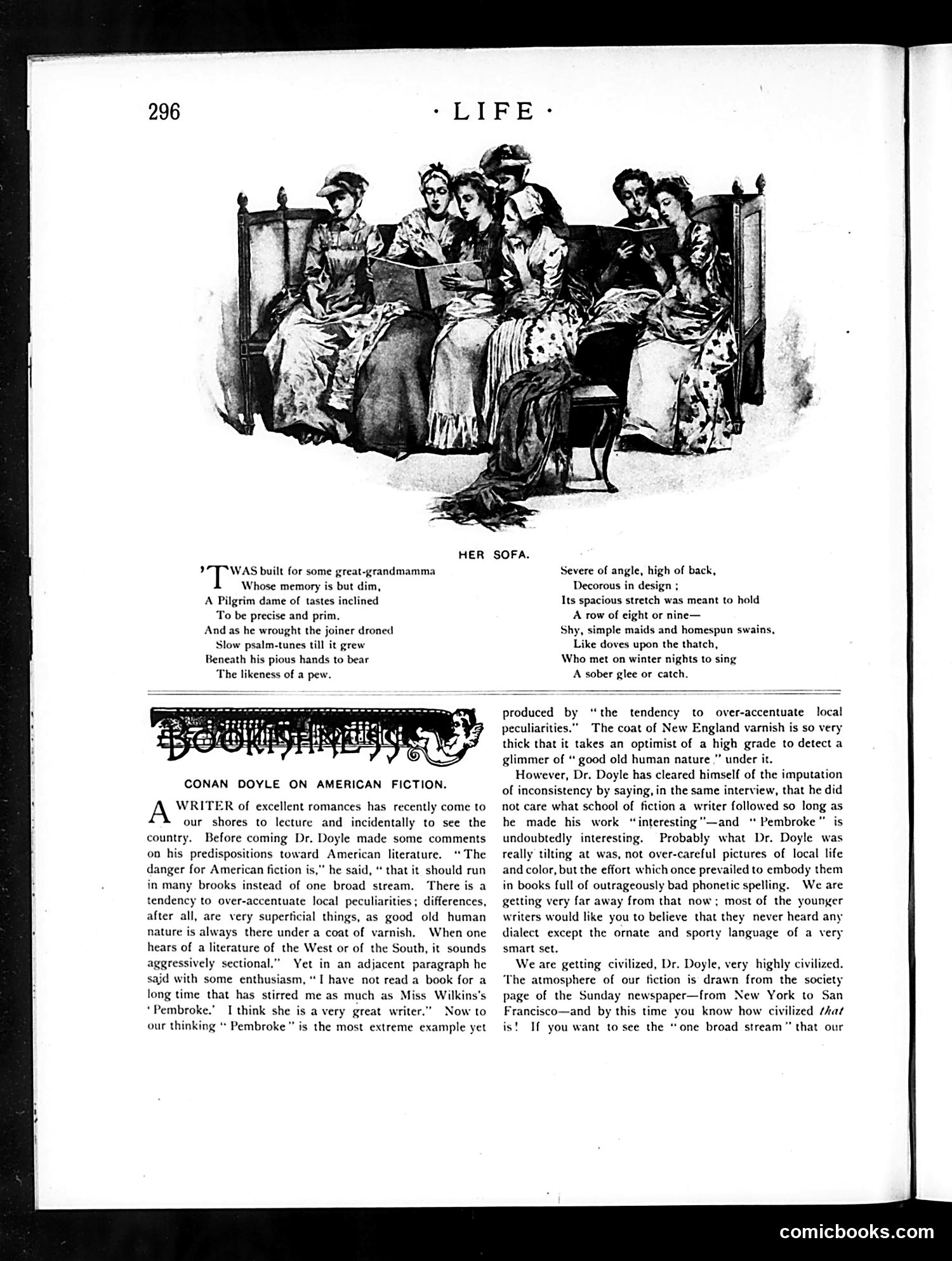
This page presents a humorous poem about an old sofa built for a "great-grandmamma," mocking Victorian domestic culture and furniture. The accompanying illustration shows eight women crowded together on an oversized sofa, satirizing how these massive pieces were designed to accommodate large Victorian social gatherings. The accompanying article discusses Conan Doyle's comments on American fiction, praising writers like Miss Wilkins's "Pembroke" while criticizing the tendency to over-emphasize local peculiarities and regional dialects in American literature. The piece contrasts "civilized" fiction drawn from urban newspapers (New York, San Francisco) with more provincial American writing. The page primarily satirizes Victorian domestic excess and literary regionalism.
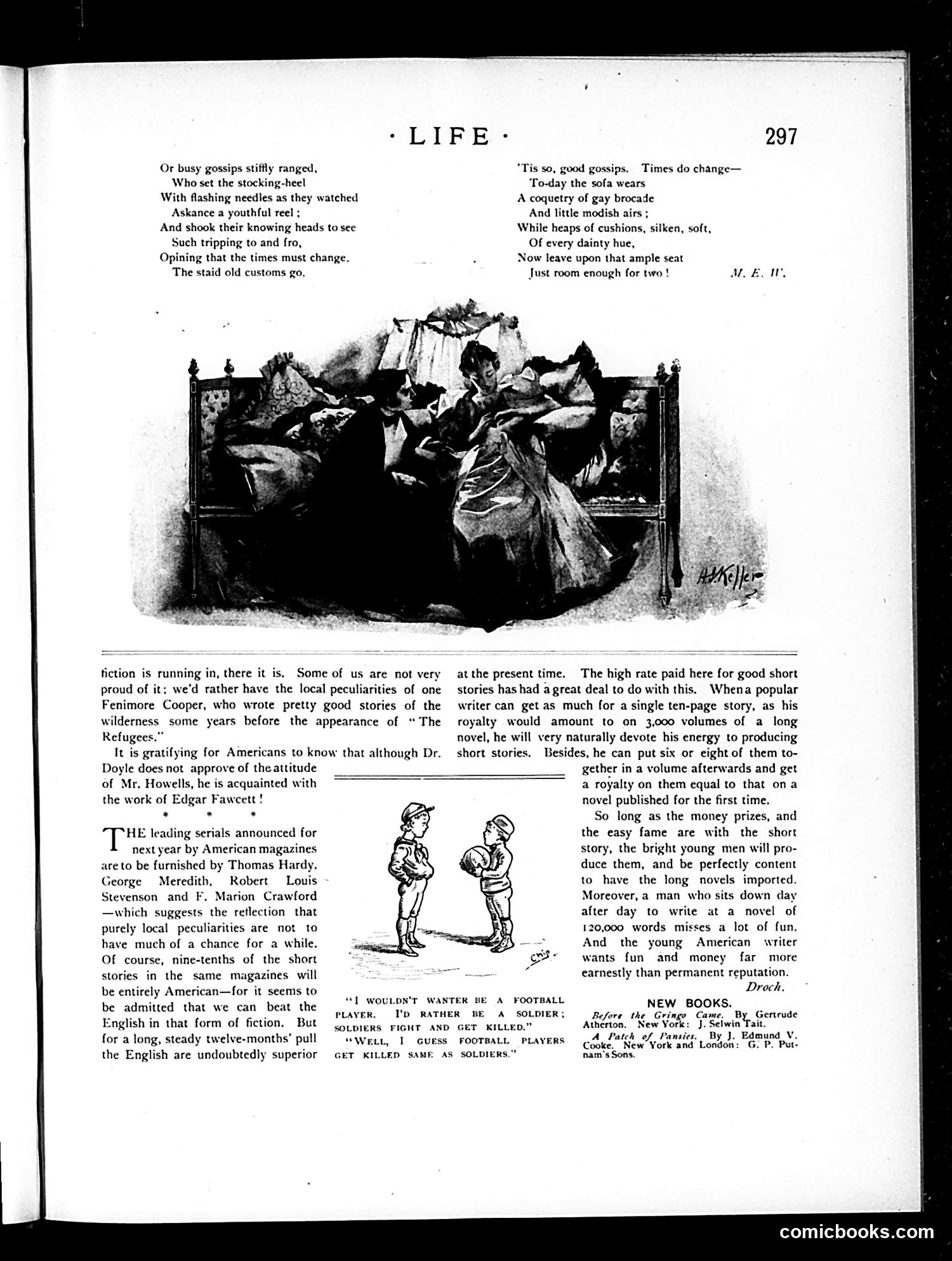
The main illustration shows two figures on a sofa in an intimate domestic scene, likely depicting a romantic or marital encounter. The caption reads: "I wouldn't wanter be a football player. I'd rather be a soldier; soldiers fight and get killed." / "Well, I guess football players get killed same as soldiers." This appears to be satirizing the dangers and brutality of American football circa this era (page 297 suggests early 20th century). The joke equates football injuries/deaths with actual wartime combat, suggesting the sport was extraordinarily violent or life-threatening by modern standards. The cartoon mocks the romantic notion that soldiers face greater danger than football players—implying both activities were comparably deadly and absurd to prioritize one over the other for reasons of machismo or prestige.
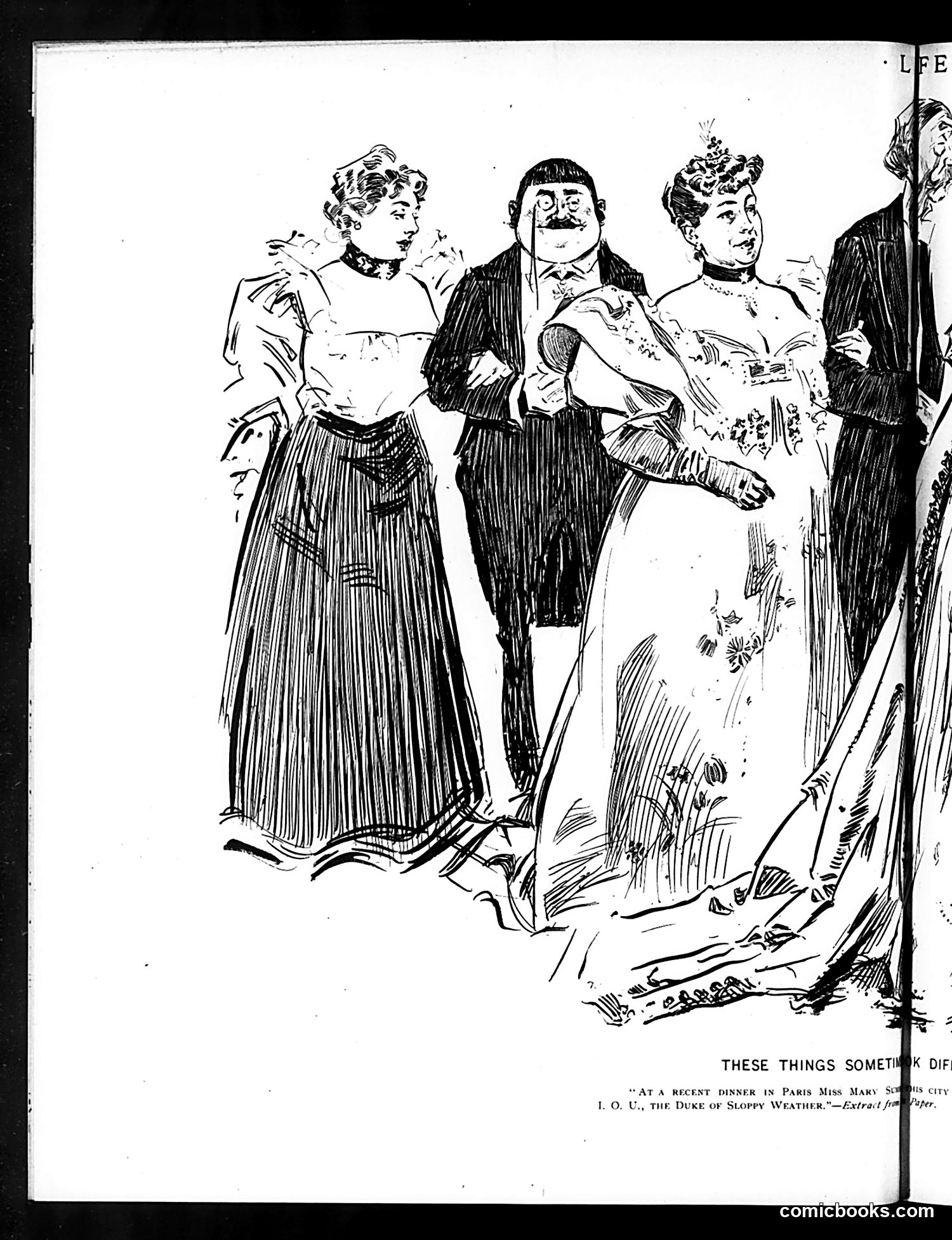
This is a satirical sketch about formal Parisian high society. The caption reads: "At a recent dinner in Paris Miss Mary S[?] of New York, I.O.U., the Duke of Sloppy Weather."—Extract from [source]." The cartoon depicts five figures in evening formal wear at what appears to be an exclusive dinner party. The satire targets American social climbers attempting to gain acceptance in European aristocratic circles. The joke seems to be that Miss Mary from New York (likely a wealthy American) is being introduced alongside absurd titles—"I.O.U." (suggesting financial debt) and "the Duke of Sloppy Weather" (a made-up, ridiculous nobility). The sketch mocks both the pretentiousness of American nouveau riche seeking European validation and the absurdity of fabricated aristocratic credentials being presented as legitimate in high society.
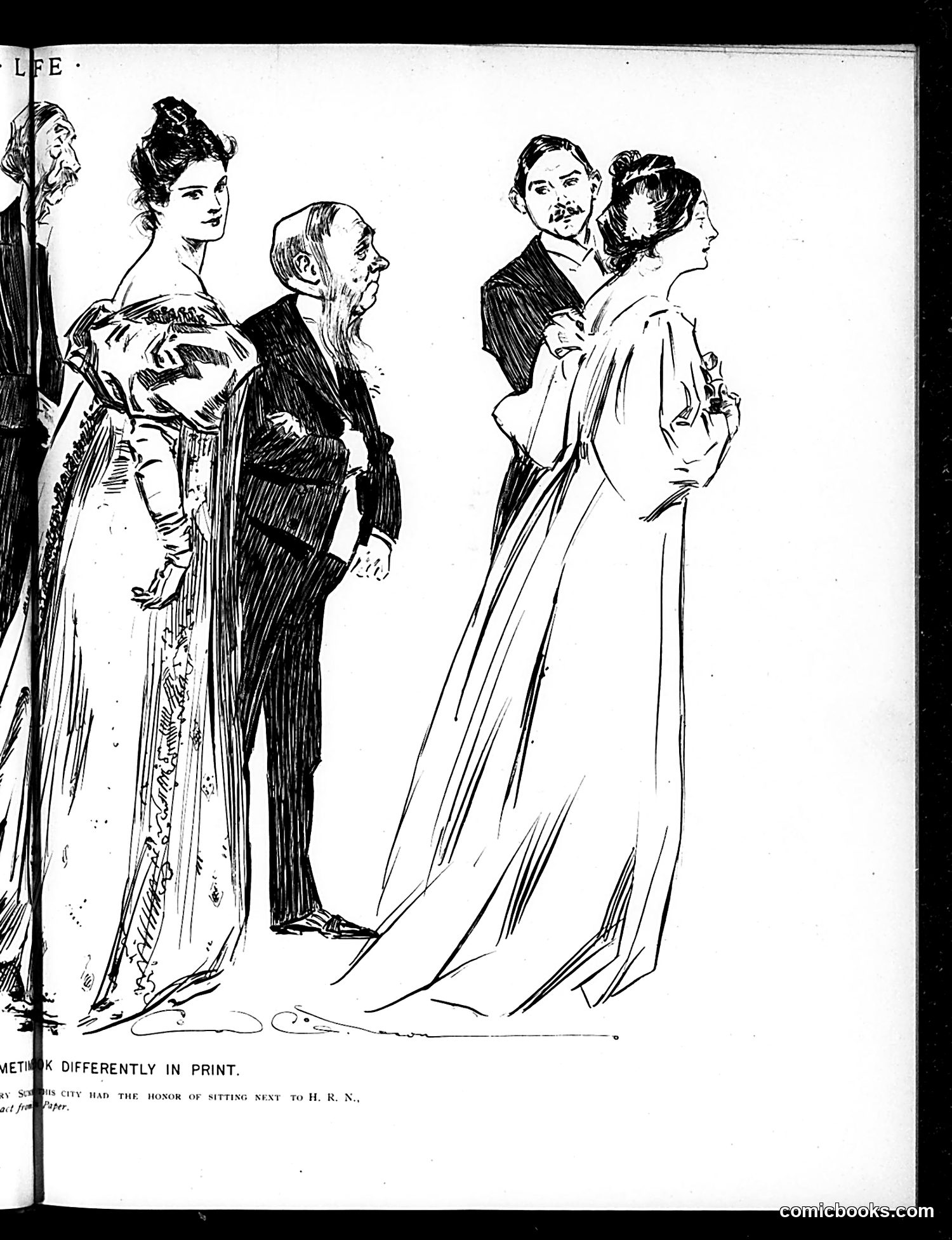
This appears to be a satirical illustration from *Life* magazine showing a formal social scene. The text references "the honor of sitting next to H.R.N." (likely an abbreviation for a royal or high-ranking personage). The cartoon depicts five figures in evening dress at what seems to be an official reception or state dinner. On the left, an elegantly dressed woman with an older gentleman and child; on the right, two women in formal gowns with a man between them. The style suggests early 20th-century social protocol. The satire likely mocks the pretense and social jockeying involved in securing prestigious seating positions at formal events—showing the considerable effort and positioning required to gain proximity to royalty or important dignitaries. The exaggerated poses and formal dress emphasize the artificiality of high society etiquette.
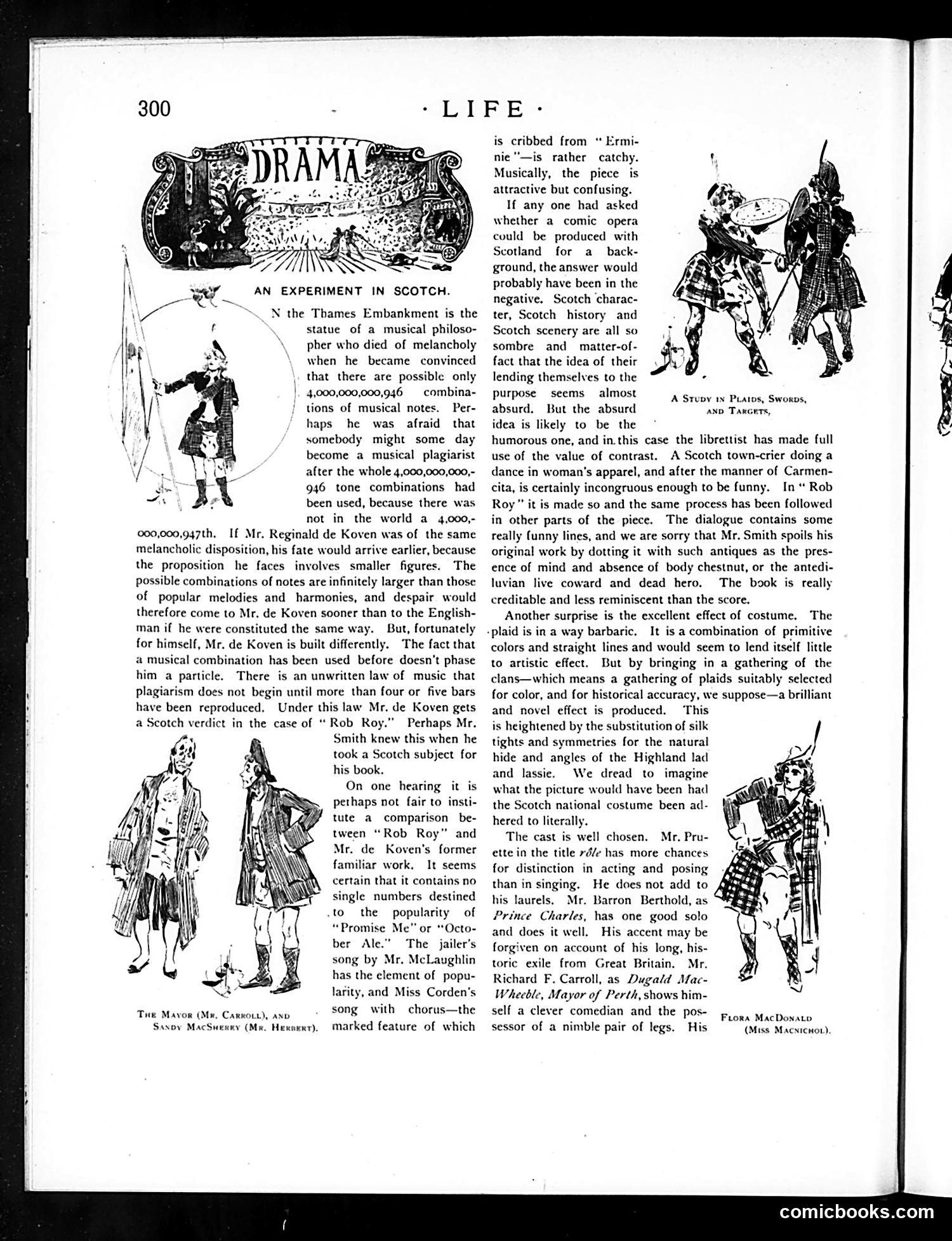
This page reviews a theatrical production, likely a comic opera, set in Scotland. The text critiques the show's musical composition, noting the composer worried about accidentally plagiarizing from 4,000,000,000,946 possible tone combinations. The illustrated figures show characters in Scottish dress (kilts and Highland attire). The review praises the costume design's effectiveness—stating that authentic tartans and plaids create visual appeal that compensates for the script's weaknesses. The critic notes the dialogue contains humor borrowed from other works, spoiling original comedic moments. Overall, the piece is a backhanded compliment: the production succeeds visually despite weak music and derivative comedy, making it entertaining rather than artistically distinguished.
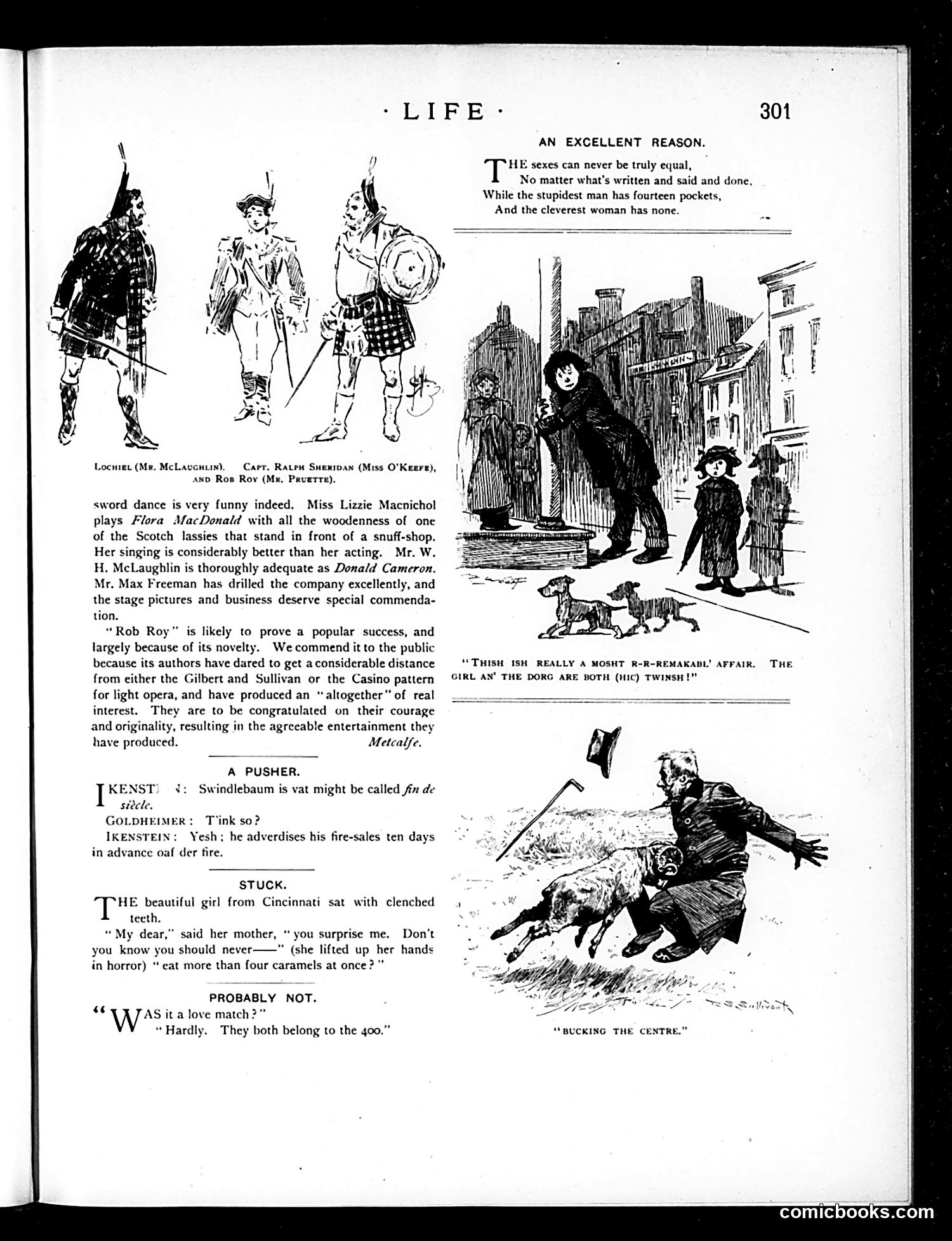
This page contains theater reviews and humor pieces from Life magazine. The main content includes: **"An Excellent Reason"** - A witty poem contrasting men's and women's intelligence, suggesting clever women lack pockets while foolish men have fourteen. **Theater Reviews** - Critiques of stage productions including "Rob Roy," featuring performers like Miss Lizzie Macnichol and Mr. W.H. McLaughlin as "Donald Cameron." The review praises the show's originality compared to Gilbert & Sullivan operettas. **Comic Sketches** - Several short humorous dialogues ("A Pusher," "Stuck," "Probably Not") featuring wordplay and situational comedy typical of early 20th-century satirical magazines. **Illustrations** - Period pen-and-ink drawings accompany the text, including a Scottish street scene and a figure on horseback, supporting the theatrical and comedic content.
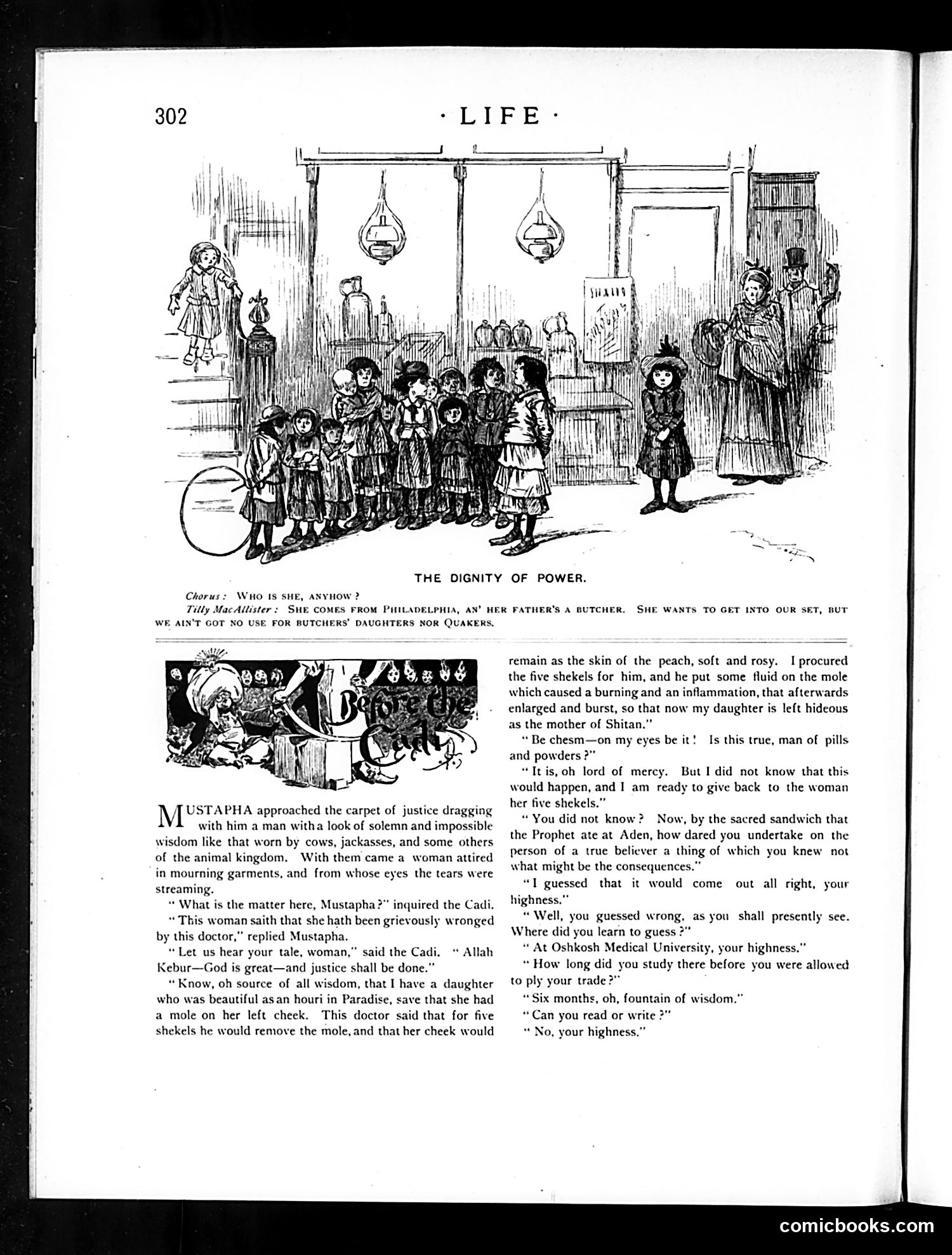
This page satirizes medical quackery and unqualified practitioners. The top illustration shows a street scene where children are being kept away from an disreputable figure—likely a charlatan doctor. The main narrative parodies orientalist tales (featuring characters like "Mustapha" and a "Cadi" judge) to mock a real problem: an American doctor from Oshkosh who claims medical credentials after only six months of study, cannot read or write, and caused permanent disfigurement to a patient through a botched cosmetic procedure. The satire's bite comes from the absurdist framing—using an exotic, formal court setting to expose the ridiculousness of allowing such an unqualified person to practice medicine in America. The joke implies that granting medical licenses to the barely-educated is as foolish as the fictional judge's bewilderment at the doctor's ignorance. The chorus lyric about "butchers' daughters" and social exclusion adds class commentary to the medical critique.
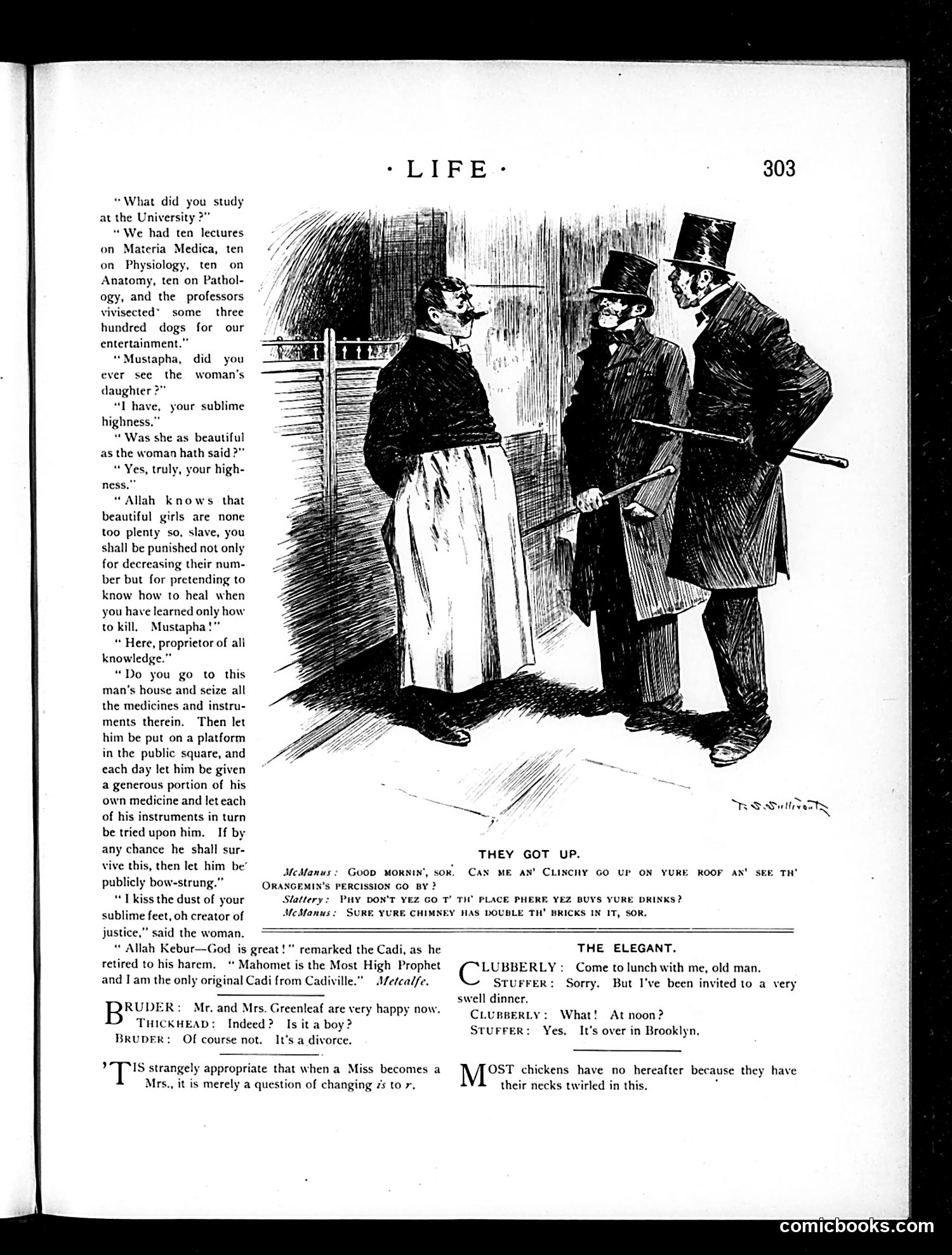
This page contains multiple brief satirical pieces typical of *Life* magazine's humor format: **"They Got Up"** (top cartoon): A street scene showing working-class Irish immigrants (identifiable by dialect spelling: "McManus," "Slattery") asking permission to watch an Orange Order procession from a roof. The satire mocks both the petty hierarchies of tenement life and sectarian tensions in Irish-American communities. **Classical/orientalist narrative** (left column): A lengthy passage mocking pseudointellectual medical education, presenting a fictional "Cadi" (Islamic judge) punishing a charlatan doctor. This satirizes both overly harsh justice systems and fraudulent medical practitioners of the era. **"The Elegant"** (bottom right): Brief exchanges lampooning social pretension—someone invited to a "swell dinner" at noon in Brooklyn (then considered unfashionable/working-class). **Other brief jokes**: Including one about divorce being merely changing "a" to "an," and chickens having no afterlife due to neck-twisting. The page exemplifies *Life's* mix of crude ethnic humor, satirical social commentary, and wordplay.
This page from *Life* magazine contains primarily **humorous anecdotes and advertisements** rather than political cartoons. The featured stories are **comedic tall tales and domestic humor**: 1. **"Am Scissors Am Nullus"** (header): A Welsh farmer's uncle responds to a young man's implausible sea story by suggesting he's the biggest liar in Montgomeryshire—a gentle, witty insult masked as compliment. 2. **Other brief humorous pieces** include: a near-sighted toddler wanting to remove her spectacles to cry properly; confusion over discovering Bermuda (a place named after its discoverer); and a girl with a "meat baby" (real infant) replacing her wax doll. 3. **"An Atchison Wife"** story: A political-activist wife neglects her hardworking husband; after witnessing his exhaustion and responding with kindness, she abandons her lecture circuit to stay home—a satirical jab at women's activism prioritizing public work over domestic duties. The **satire targets** appear to be pretentiousness, literal-mindedness, and (in the final piece) women's suffrage/activism movements.