
Life, 1894-11-08 · page 4 of 14
Life — November 8, 1894 — page 4: what you’re looking at
What you’re looking at
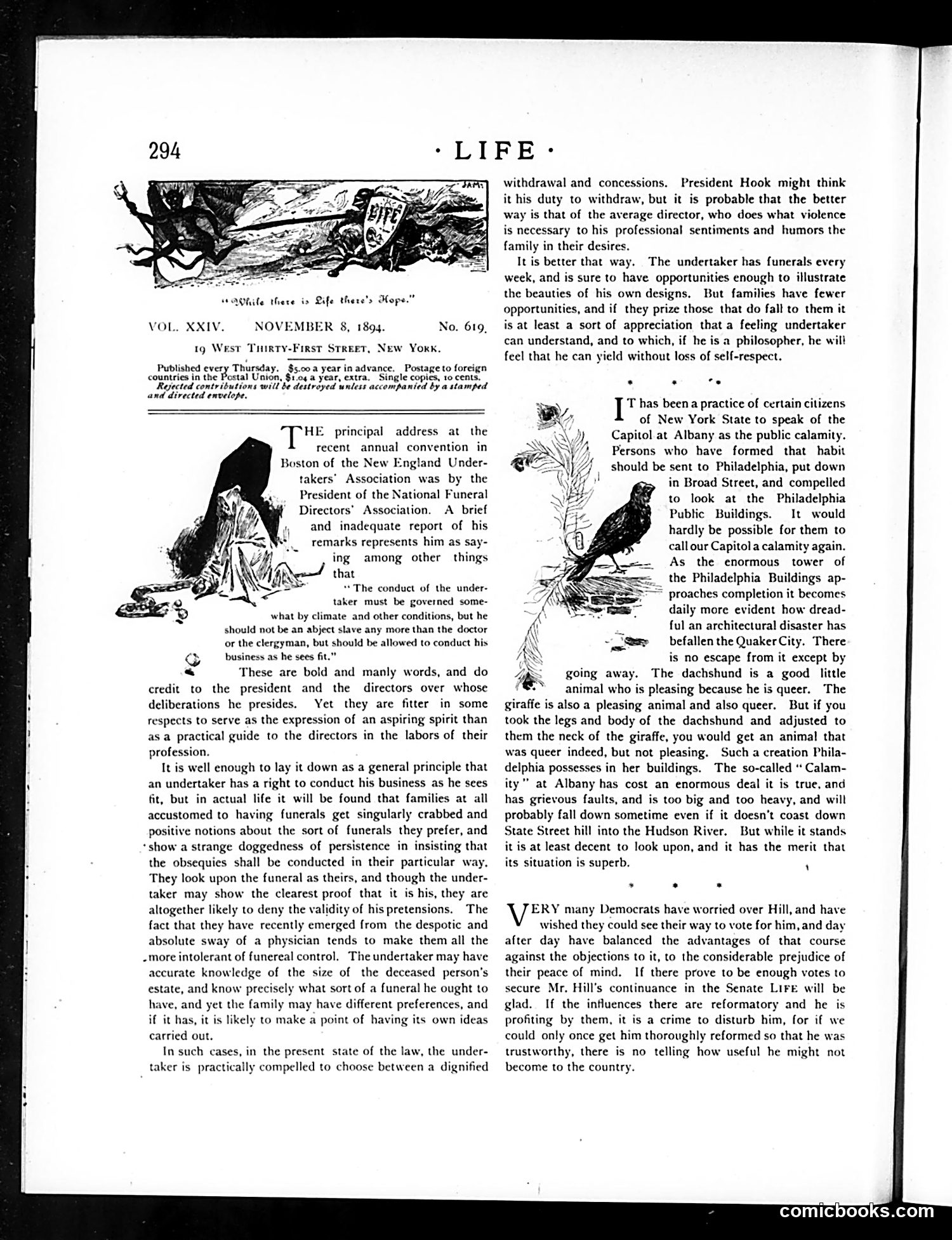
The main cartoon depicts Death (a skeletal figure in robes) speaking with an undertaker about conducting funerals. The text critiques undertakers' conduct, arguing they should have freedom to run their business as they see fit, yet asserting they've recently become "more intolerant of funereal control" from physicians and clergy. The second illustrated section discusses New York's Capitol building in Albany and Philadelphia's public buildings, comparing them unfavorably—particularly criticizing the Philadelphia structure as an "architectural disaster." The final section debates Senator David B. Hill's political future, with Democrats divided on whether to support his continued Senate service given concerns about his trustworthiness. The page combines editorial commentary on professional conduct with architectural and political criticism typical of 1890s satirical journalism.
📄 Transcribed text from this page (OCR, searchable)
Machine-transcribed from the original scan — historical spelling and the odd misread are preserved.
- LIFE: AOKfe there is Life there’s Hope.” VOL. XXIV. NOVEMBER 8, 1894. 1g West Tirty-First STREET, New York. No. 619, Published every Thursday. $5.00 year in advance. Postage to foreign countries in the Postal Union, $1.04 a year, extra. Single copies, ro cents. Rejected contributions will be destroyed unless accompanied by astamped and directed envelope. HE principal address at the recent annual convention in Boston of the New England Under- takers’ Association was by the President of the National Funeral Directors’ Association. A brief and inadequate report of his remarks represents him as say- ing among other things that “The conduct of the under- taker must be governed some- what by climate and other conditions, but he should not be an abject slave any more than the doctor or the clergyman, but should be allowed to conduct his > business as he sees fit.” « These are bold and manly words, and do credit to the president and the directors over whose deliberations he presides. Yet they are fitter in some respects to serve as the expression of an aspiring spirit than asa practical guide to the directors in the labors of their profession. It is well enough to lay it down as a general principle that an undertaker has a right to conduct his business as he sees fit, but in actual life it will be found that families at all accustomed to having funerals get singularly crabbed and positive notions about the sort of funerals they prefer, and +show a strange doggedness of persistence in insisting that the obsequies shall be conducted in their particular way, They look upon the funeral as theirs, and though the under- taker may show the clearest proof that it is his, they are altogether likely to deny the validity of his pretensions. The fact that they have recently emerged from the despotic and absolute sway of a physician tends to make them all the -more intolerant of funereal control, The undertaker may have accurate knowledge of the size of the deceased person's estate, and know precisely what sort of a funeral he ought to have, and yet the family may have different preferences, and if it has, it is likely to make a point of having its own ideas carried out. In such cases, in the present state of the law, the under- taker is practically compelled to choose between a dignified withdrawal and concessions. President Hook might think ithis duty to withdraw, but it is probable that the better way is that of the average director, who does what violence is necessary to his professional sentiments and humors the family in their desires. It is better that way. The undertaker has funerals every week, and is sure to have opportunities enough to illustrate the beauties of his own designs, But families have fewer opportunities, and if they prize those that do fall to them it is at least a sort of appreciation that a feeling undertaker can understand, and to which, if he is a philosopher, he will feel that he can yield without loss of self-respect. T has been a practice of certain citizens of New York State to speak of the Capitol at Albany as the public calamity. Persons who have formed that habit should be sent to Philadelphia, put down in Broad Street, and compelled to look at the Philadelphia Public Buildings. It would hardly be possible for them to call our Capitola calamity again. As the enormous tower of the Philadelphia Buildings ap- = proaches completion it becomes daily more evident how dread- ful an architectural disaster has befallen the QuakerCity. There is no escape from it except by going away. The dachshund is a good little animal who is pleasing because he is queer. The giraffe is also a pleasing animal and also queer. But if you took the legs and body of the dachshund and adjusted to them the neck of the giraffe, you would get an animal that was queer indeed, but not pleasing. Such a creation Phila- delphia possesses in her buildings. The so-called “ Calam- ity” at Albany has cost an enormous deal it is true, and has grievous faults, and is too big and too heavy, and will probably fall down sometime even if it doesn’t coast down State Street hill into the Hudson River. But while it stands it is at least decent to look upon, and it has the merit that its situation is superb. 1 . . . RY many Democrats have worried over Hill, and have wished they could see their way to vote for him, and day after day have balanced the advantages of that course against the objections to it, to the considerable prejudice of their peace of mind. If there prove to be enough votes to secure Mr. Hill's continuance in the Senate LiFE will be glad. If the influences there are reformatory and he is profiting by them, it is a crime to disturb him, for if we could only once get him thoroughly reformed so that he was trustworthy, there is no telling how useful he might not become to the country. comicbooks.com