
Life, 1894-11-08 · page 7 of 14
Life — November 8, 1894 — page 7: what you’re looking at
What you’re looking at
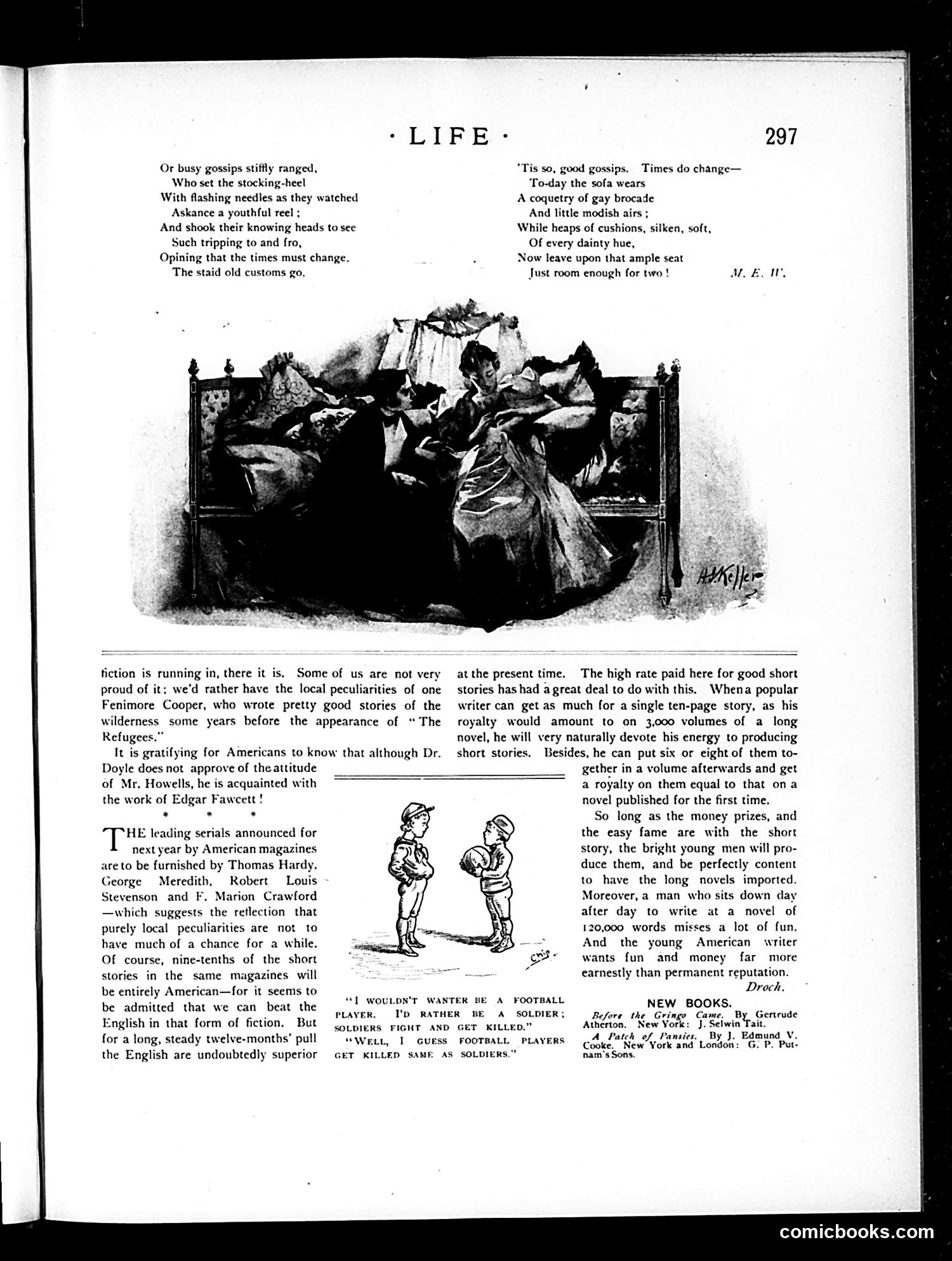
The main illustration shows two figures on a sofa in an intimate domestic scene, likely depicting a romantic or marital encounter. The caption reads: "I wouldn't wanter be a football player. I'd rather be a soldier; soldiers fight and get killed." / "Well, I guess football players get killed same as soldiers." This appears to be satirizing the dangers and brutality of American football circa this era (page 297 suggests early 20th century). The joke equates football injuries/deaths with actual wartime combat, suggesting the sport was extraordinarily violent or life-threatening by modern standards. The cartoon mocks the romantic notion that soldiers face greater danger than football players—implying both activities were comparably deadly and absurd to prioritize one over the other for reasons of machismo or prestige.
📄 Transcribed text from this page (OCR, searchable)
Machine-transcribed from the original scan — historical spelling and the odd misread are preserved.
Or busy gossips stiffly ranged, Who set the stocking-heel With flashing needles as they watched Askance a youthful reel ; And shook their knowing heads to see Such tripping to and fro, Opining that the times must change, The staid old customs go. fiction is running in, there it is. Some of us are not very proud of it; we'd rather have the local peculiarities of one Fenimore Cooper, who wrote pretty good stories of the wilderness some years before the appearance of “ The Refugees It is gratifying for Americans to know that although Dr. Doyle does not approve of the attitude so, good gossips. Times do change— To-day the sofa wears A coquetry of gay brocade And little modish airs ; While heaps of cushions, silken, soft, Of every dainty hue, Now leave upon that ample seat Just room enough for two ! Soe i) atthe present time. The high rate paid here for good short stories has had a great deal to do with this. Whena popular writer can get as much for a single ten-page story, as his royalty would amount to on 3,000 volumes of a long novel, he will very naturally devote his energy to producing short stories. Besides, he can put six or eight of them to- gether in a volume afterwards and get of Mr. Howells, he is acquainted with the work of Edgar Fawcett! * . ’ HE leading serials announced for next year by American magazines are to be furnished by Thomas Hardy, George Meredith, Robert Louis Stevenson and F. Marion Crawford —which suggests the reflection that purely local peculiarities are not to have much of a chance for a while. Of course, nine-tenths of the short stories in the same magazines will be entirely American—for it seems to be admitted that we can beat the English in that form of fiction, But for a long, steady twelve-months’ pull the English are undoubtedly superior “T WOULDN'T Wal PLA’ I'p oweit, 1 GET KILLED SAME | RATHER SOLDIERS FIGHT AND GET KILLED.” GUESS a royalty on them equal to that ona novel published for the first time. So long as the money prizes, and the easy fame are with the short story, the bright young men will pro- duce them, and be perfectly content to have the long novels imported. Moreover, a man who sits down day after day to write at a novel of 120,000 words misses a lot of fun. And the young American writer wants fun and money far more earnestly than permanent reputation. Droch. NEW BOOKS. Before the Gringo Came. Gertrude Athaton, New York: J. Selwin Tait, A Patch of Pansies. By J. Edmund V. Cooke, New York and London: G. P. Put- nam’s Sons. NTER BE BE A FOOTBALL A SOLDIER; FOOTBALL AS SOLDIERS,” PLAYERS. comicbooks.com