
Life, 1894-11-08 · page 6 of 14
Life — November 8, 1894 — page 6: what you’re looking at
What you’re looking at
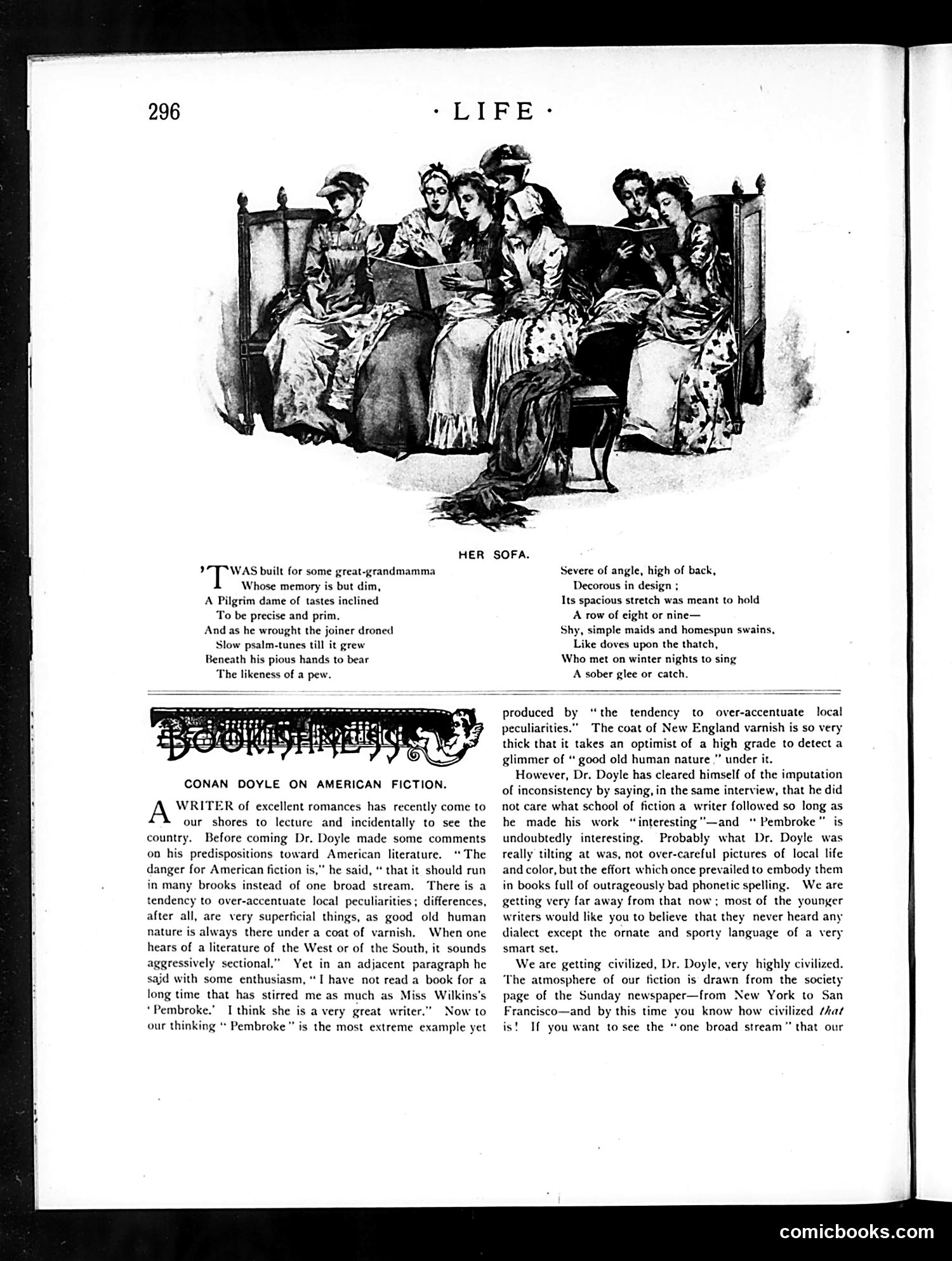
This page presents a humorous poem about an old sofa built for a "great-grandmamma," mocking Victorian domestic culture and furniture. The accompanying illustration shows eight women crowded together on an oversized sofa, satirizing how these massive pieces were designed to accommodate large Victorian social gatherings. The accompanying article discusses Conan Doyle's comments on American fiction, praising writers like Miss Wilkins's "Pembroke" while criticizing the tendency to over-emphasize local peculiarities and regional dialects in American literature. The piece contrasts "civilized" fiction drawn from urban newspapers (New York, San Francisco) with more provincial American writing. The page primarily satirizes Victorian domestic excess and literary regionalism.
📄 Transcribed text from this page (OCR, searchable)
Machine-transcribed from the original scan — historical spelling and the odd misread are preserved.
HER SOFA. Twas built for some great-grandmamma Whose memory is but dim, A Pilgrim dame of tastes inclined To be precise and prim, And as he wrought the joiner droned Slow psalm-tunes till it grew Beneath his pious hands to bear ‘The likeness of a pew. Severe of angle, high of back, Decorous in design ; Its spacious stretch was meant to hold A row of eight or nine— Shy, simple maids and homespun swains, Like doves upon the thatch, Who met on winter nights to sing A sober glee or catch. CONAN DOYLE ON AMERICAN FICTION. WRITER of excellent romances has recently come to our shores to lecture and incidentally to see the country. Before coming Dr. Doyle made some comments on his predispositions toward American literature. “ The danger for American fiction is,” he said, “ that it should run in many brooks instead of one broad stream. There is a tendency to over-accentuate local peculiarities; differences, after all, are very superticial things, as good old human nature is always there under a coat of varnish. When one hears of a literature of the West or of the South, it sounds aggressively sectional.” Yet in an adjacent paragraph he sajd with some enthusiasm, “I have not read a book for a long time that has stirred me as much as Miss Wilkins’s ‘Pembroke.’ I think she is a very great writer.” Now to our thinking “ Pembroke” is the most extreme example yet produced by “the tendency to over-accentuate local peculiarities.” The coat of New England varnish is so very thick that it takes an optimist of a high grade to detect a glimmer of “ good old human nature.” under it. However, Dr. Doyle has cleared himself of the imputation of inconsistency by saying, in the same interview, that he did not care what school of fiction a writer followed so long as he made his work “interesting"—and “ Pembroke” undoubtedly interesting. Probably what Dr. Doyle was really tilting at was, not over-careful pictures of local life and color, but the effort which once prevailed to embody them in books full of outrageously bad phonetic spelling. We are getting very far away from that now ; most of the younger writers would like you to believe that they never heard any dialect except the ornate and sporty language of a very smart set, We are getting civilized, Dr. Doyle, very highly civ ‘The atmosphere of our fiction is drawn from the society page of the Sunday newspaper—from New York to San Francisco—and by this time you know how civilized (hat is! If you want to see the “one broad stream” that our comicbooks.com