
Life, 1894-11-08 · page 10 of 14
Life — November 8, 1894 — page 10: what you’re looking at
What you’re looking at
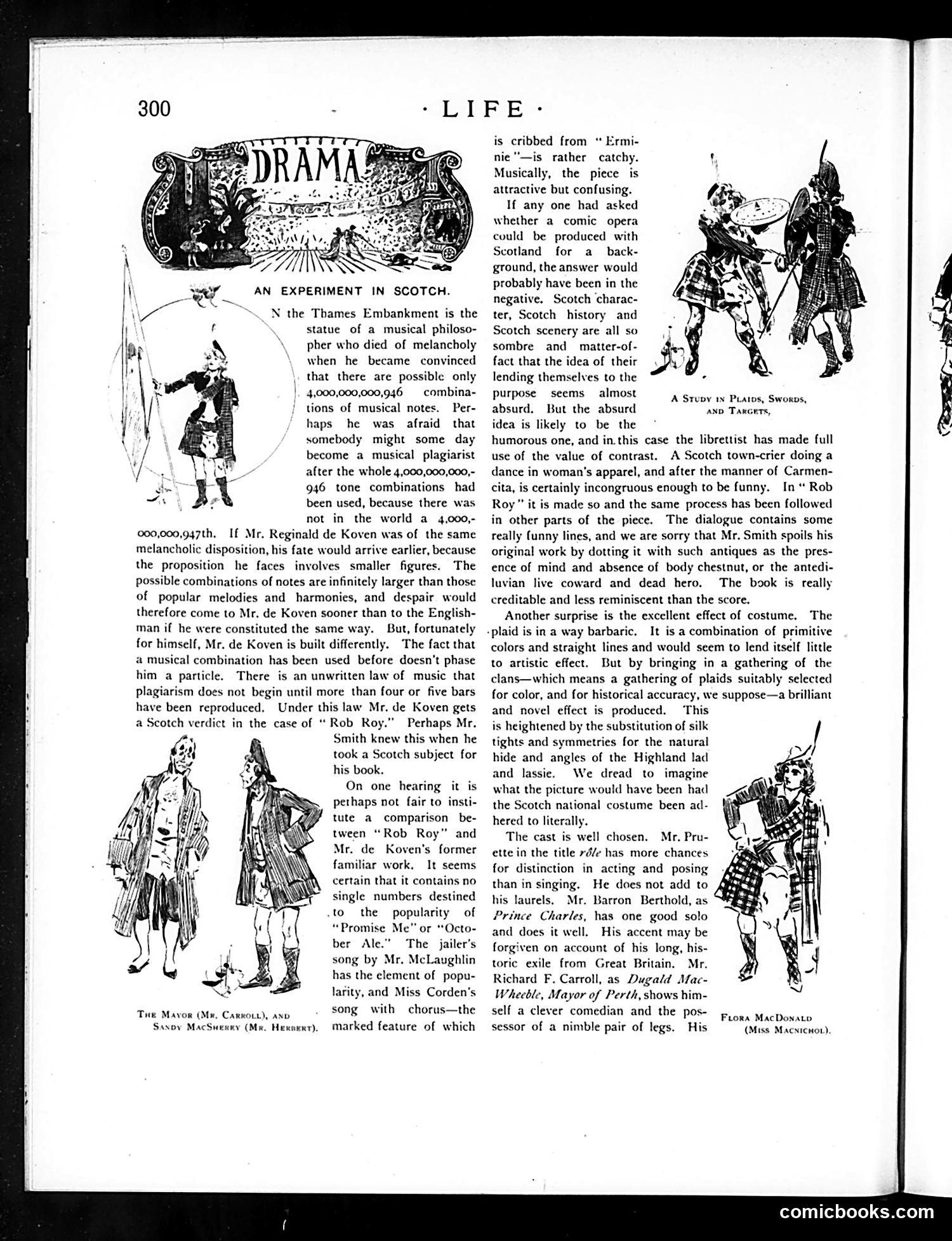
This page reviews a theatrical production, likely a comic opera, set in Scotland. The text critiques the show's musical composition, noting the composer worried about accidentally plagiarizing from 4,000,000,000,946 possible tone combinations. The illustrated figures show characters in Scottish dress (kilts and Highland attire). The review praises the costume design's effectiveness—stating that authentic tartans and plaids create visual appeal that compensates for the script's weaknesses. The critic notes the dialogue contains humor borrowed from other works, spoiling original comedic moments. Overall, the piece is a backhanded compliment: the production succeeds visually despite weak music and derivative comedy, making it entertaining rather than artistically distinguished.
📄 Transcribed text from this page (OCR, searchable)
Machine-transcribed from the original scan — historical spelling and the odd misread are preserved.
“ELE E AN EXPERIMENT IN SCOTCH. N the Thames Embankment is the statue of a musical philoso- pher who died of melancholy when he became convinced that there are possible only 4,000,000,000,946 — combina- tions of musical notes. Per- haps he was afraid that somebody might some day become a musical plagiarist after the whole 4,000,000,000,- 946 tone combinations had been used, because there was not in the world a 4,000,- 000,000,947th. If Mr. Reginald de Koven was of the same melancholic disposition, his fate would arrive earlier, because the proposition he faces involves smaller figures. The possible combinations of notes are infinitely larger than those of popular melodies and harmonies, and despair would therefore come to Mr. de Koven sooner than to the English- man if he were constituted the same way. But, fortunately for himself, Mr. de Koven is built differently. The fact that a musical combination has been used before doesn’t phase him a particle. There is an unwritten law of music that plagiarism does not begin until more than four or five bars have been reproduced, Under this law Mr. de Koven gets a Scotch verdict in the case of “Rob Roy.” Perhaps Mr. Smith knew this when he took a Scotch subject for his book. On one hearing it is pethaps not fair to insti- tute a comparison be- tween “Rob Roy” and Mr. de Koven's former familiar work, It seems certain that it contains no single numbers destined -to the popularity of “Promise Me” or “Octo- ber Ale.” The jailer’s song by Mr. McLaughlin has the element of popu- larity, and Miss Corden’s song with chorus—the marked feature of which Tue Mavor (Mx, Carkott), ano Saxoy MacSweeny (Me. Hexoxnt), «plaid is in a way barbaric, is cribbed from “ Ermi- nie ""—is rather catchy. Musically, the piece is attractive but confusing. If any one had asked whether a comic opera could be produced with Scotland for a back- ground, the answer would probably have been in the negative. Scotch charac- ter, Scotch history and Scotch scenery are all so sombre and matter-of- fact that the idea of their lending themselves to the purpose seems almost absurd, But the absurd idea is likely to be the humorous one, and in.this case the librettist has made full use of the value of contrast. A Scotch town-crier doing a dance in woman's apparel, and after the manner of Carmen- cita, is certainly incongruous enough to be funny. In * Rob Roy” it is made so and the same process has been followed in other parts of the piece. The dialogue contains some really funny lines, and we are sorry that Mr. Smith spoils his original work by dotting it with such antiques as the pres- ence of mind and absence of body chestnut, or the antedi- luvian live coward and dead hero. The book is really creditable and less reminiscent than the score. Another surprise is the excellent effect of costume. The It is a combination of primitive colors and straight lines and would seem to lend itself little to artistic effect. But by bringing in a gathering of the clans—which means a gathering of plaids suitably selected for color, and for historical accuracy, we suppose—a brilliant and novel effect is produced. This is heightened by the substitution of silk tights and symmetries for the natural hide and angles of the Highland lad and lassie. We dread to imagine what the picture would have been had the Scotch national costume been ad- hered to literally. The cast is well chosen. Mr. Pru- ette in the title 7é/e has more chances for distinction in acting and posing than in singing. He does not add to his laurels. Mr. Barron Berthold, as Prince Charles, has one good solo and does it well, His accent may be iven on account of his long, his- toric exile from Great Britain. Mr. Richard F, Carroll, as Dugald Mac- Wheeble, Mayor of Perth, shows him- self a clever comedian and the pos- sessor of a nimble pair of legs. His A Srupy 1 PLatos, Sworos, anp Taxcers, Frora MacDonato (Miss Macnicnot). comicbooks.com