
A complete issue · 16 pages · 1894
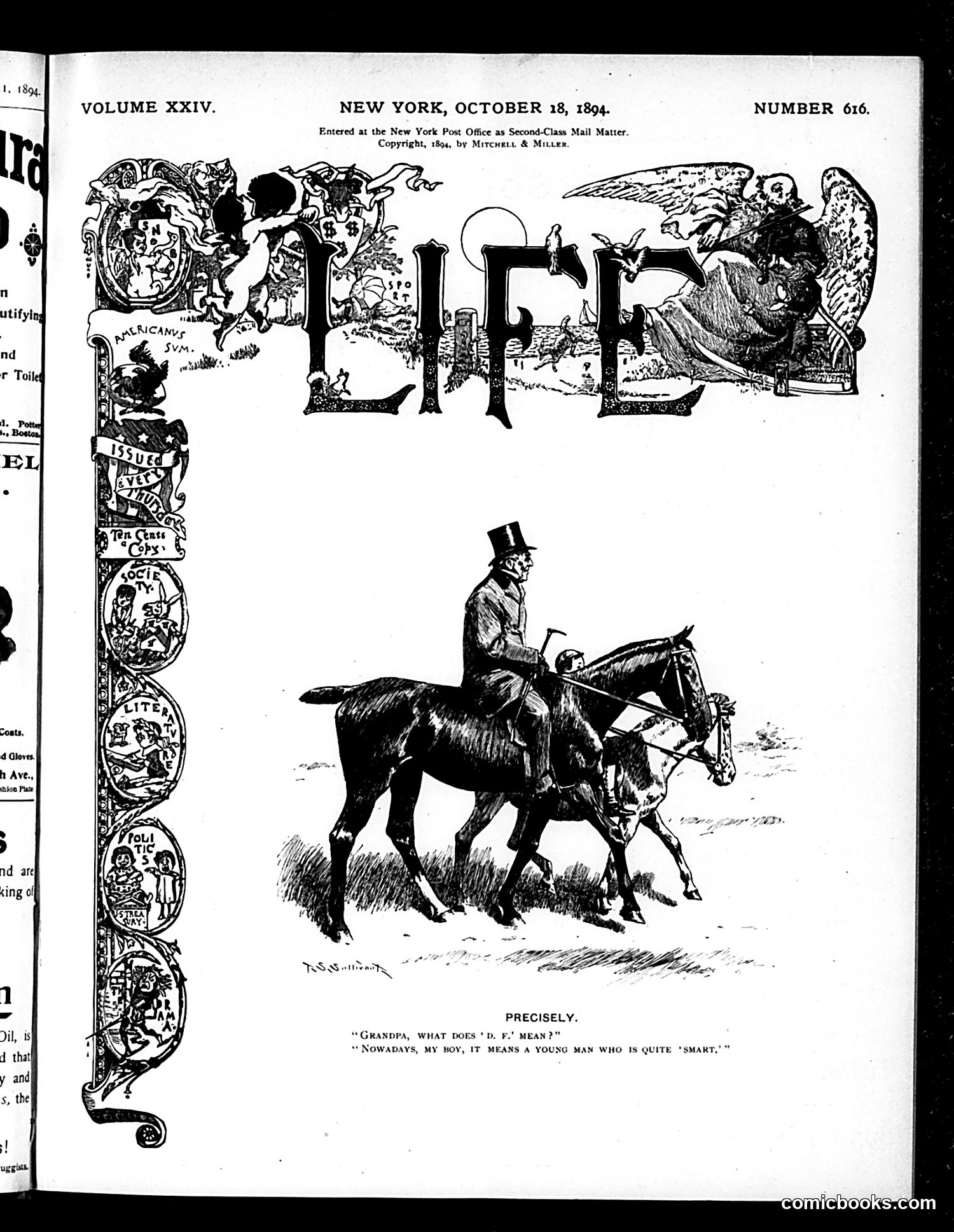
Life — October 18, 1894
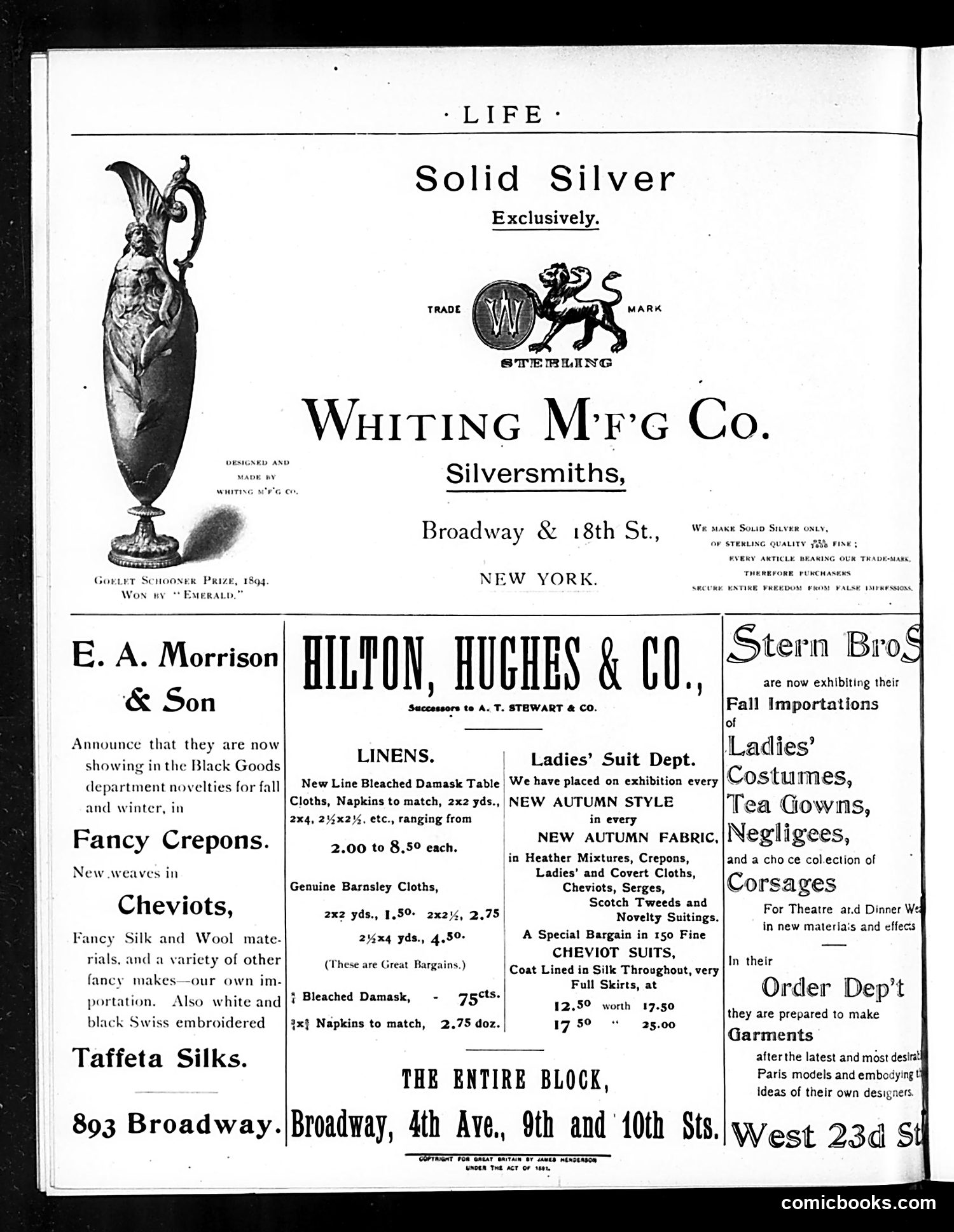
This page is **primarily advertising**, not satire or political commentary. It contains multiple advertisements for late 19th-century retailers: - **Whiting Mfg Co.**: A silversmith promoting solid sterling silver goods, displaying an ornate pitcher that won a "Goblet Schooner Prize" in 1894 - **Hilton, Hughes & Co.**: Selling linens, damask cloths, and ladies' suits - **E.A. Morrison & Son**: Advertising fancy crepons, cheviot fabrics, and taffeta silks - **Stern Bros**: Showcasing fall fashion imports including ladies' costumes, tea gowns, and theatrical wear The only potentially notable element is the ornate silver vessel shown as a prize-winning design, reflecting the era's appreciation for decorative metalwork. Otherwise, this is straightforward commercial content targeting affluent New York consumers shopping for textiles and luxury goods.
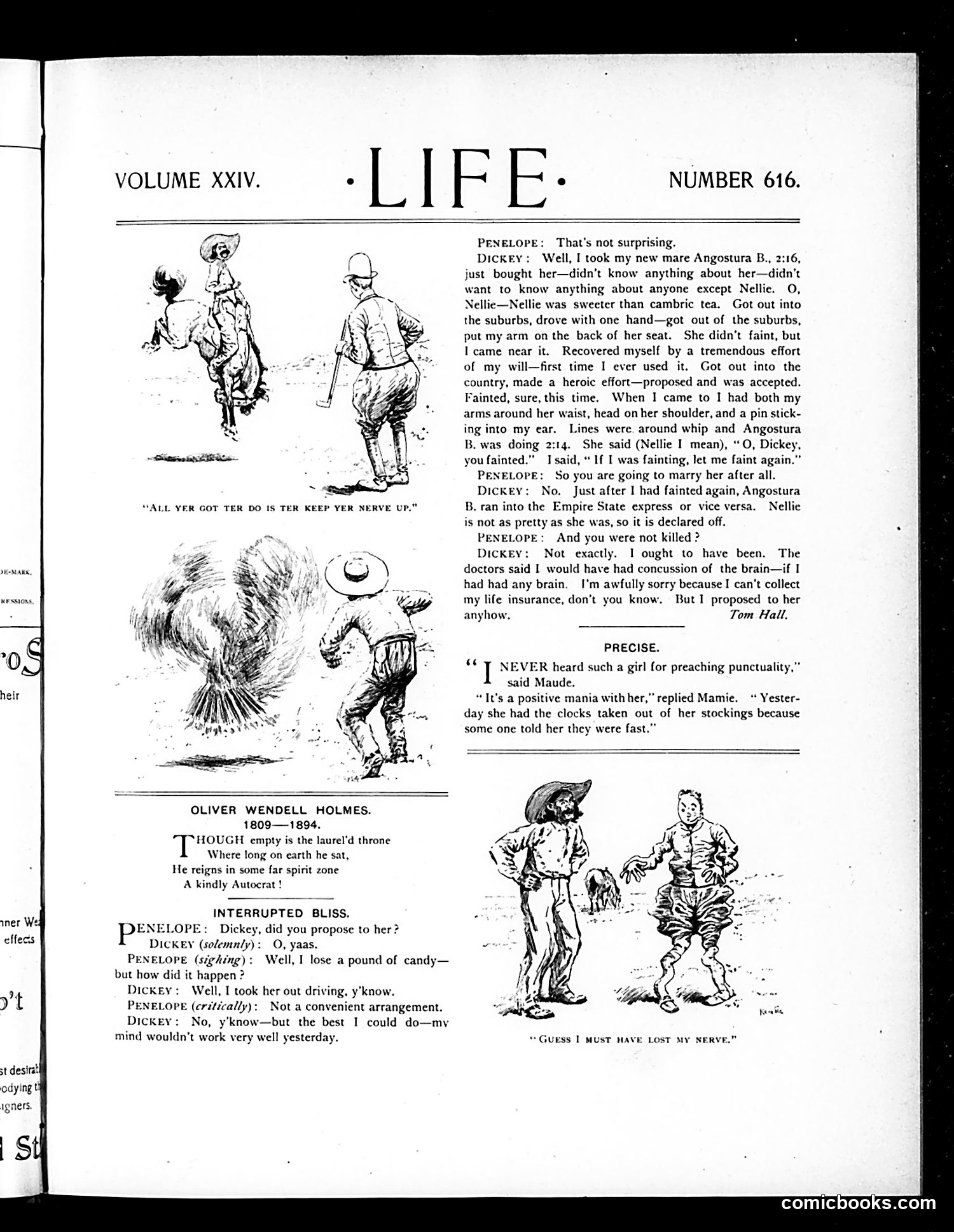
This page contains humorous dialogue and illustrations rather than political satire. The main content is titled "Interrupted Bliss," a comedic conversation between characters named Penelope and Dickey about a failed marriage proposal. The humor centers on Dickey's disastrous romantic attempt: he took his new mare "Angostura B." driving, lost consciousness (fainting), and proposed while semi-conscious. Penelope questions whether he was even aware of proposing. The joke plays on the absurdity of an accidental, unconscious proposal and its illegitimacy as a marriage commitment. A separate section titled "Precise" mocks a woman's obsession with punctuality, with illustrations of period characters. The cartoons are lighthearted domestic humor rather than political commentary.
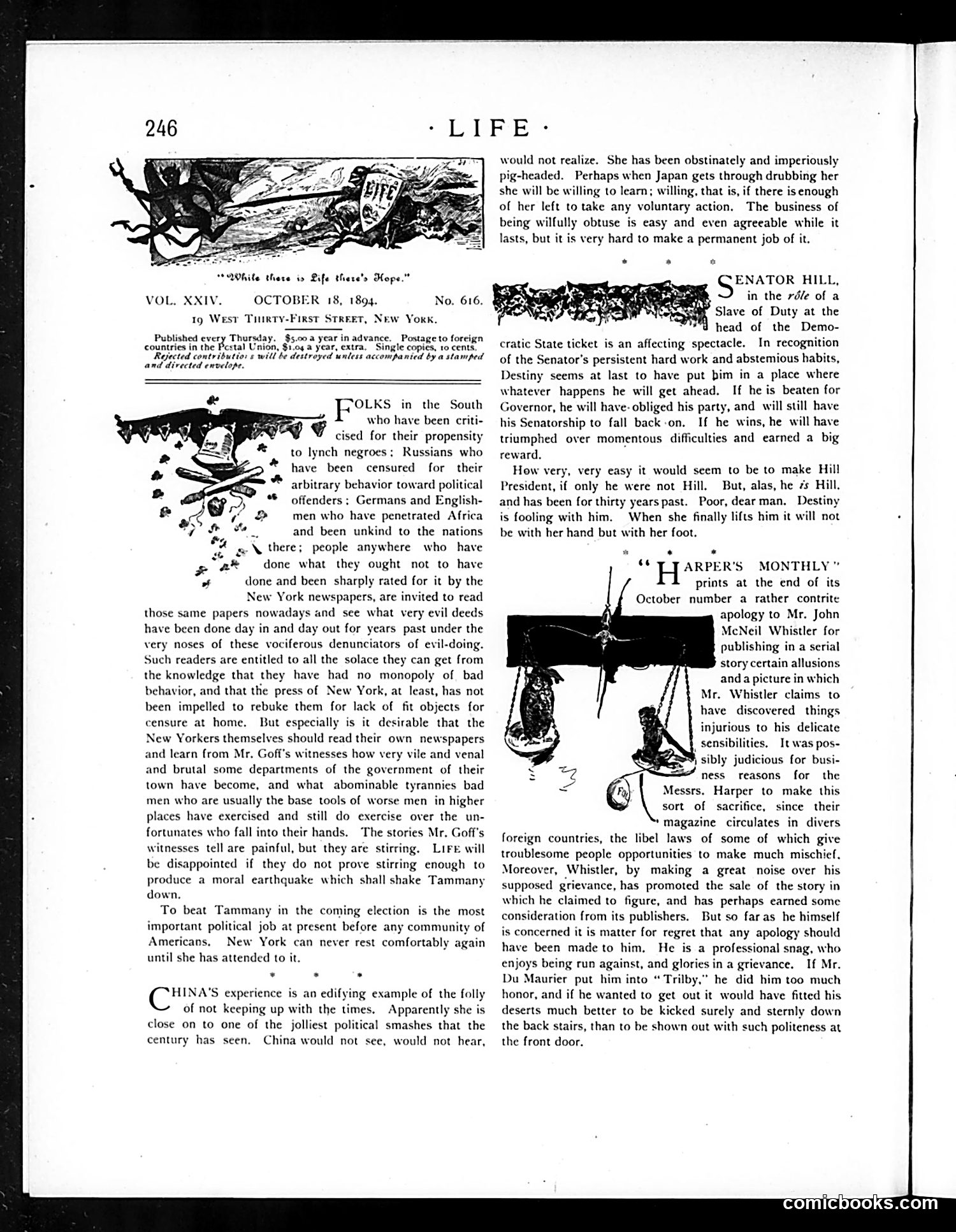
This page contains three distinct satirical pieces criticizing political figures and institutions of the early 1900s: 1. **Opening illustration** (top): Depicts the Philippines with a coffin, referencing American imperialism and colonial violence in the Philippine-American War (1899-1902). 2. **Main article** criticizes Southern lynching and press hypocrisy, urging New York newspapers to condemn such violence while acknowledging their own editorial failures. 3. **Senator Hill cartoon** (right): Mocks New York politician David B. Hill as a "Slave of Duty," suggesting his political survival depends entirely on manipulation by others rather than genuine principle—he cannot succeed or fail independently. The magazine uses satire to expose press corruption, imperial brutality, and political opportunism.
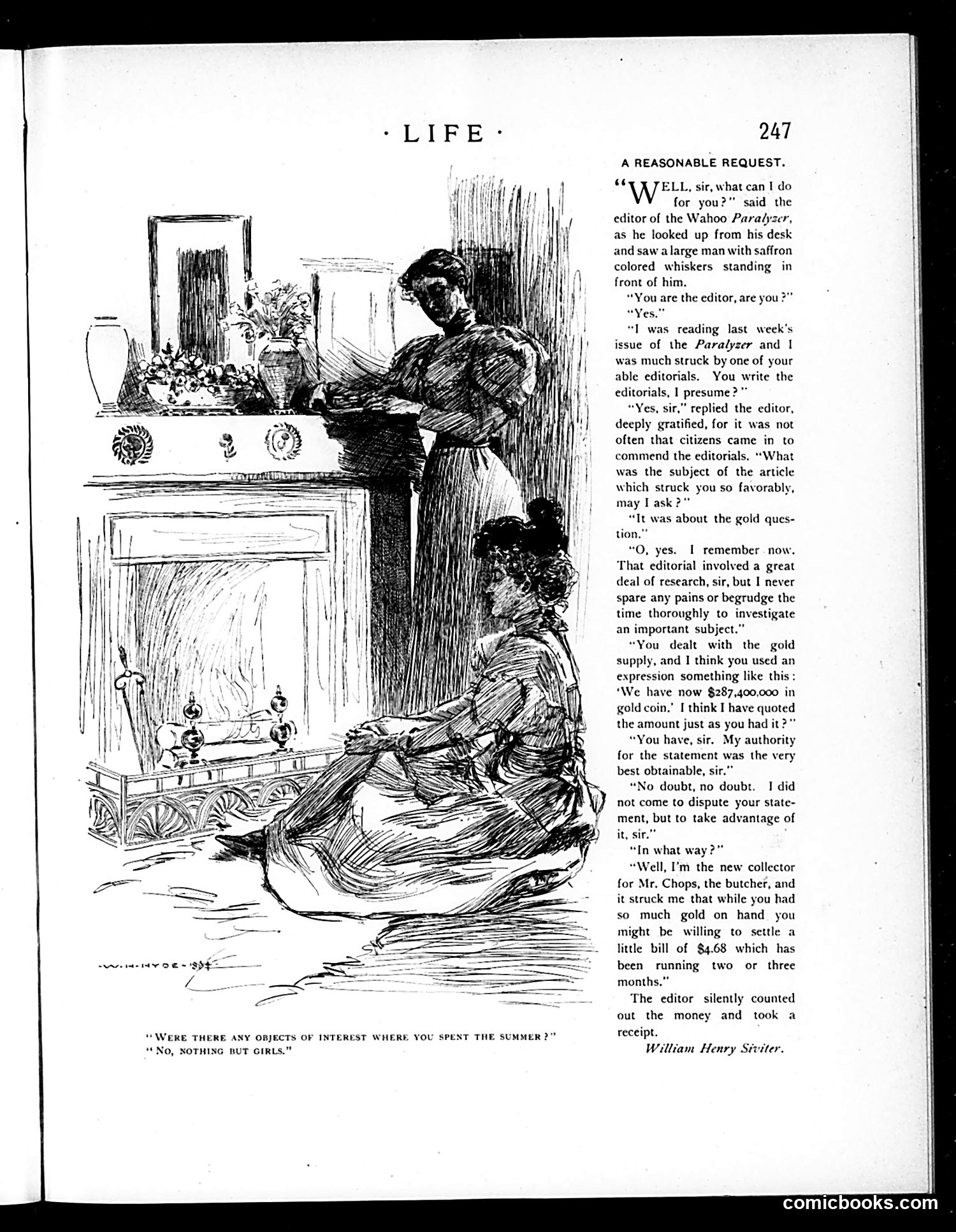
This satirical story by William Henry Sissler depicts a large man with "saffron colored whiskers" visiting the editor of the *Wahoo Paralyzer* (a fictional publication). The man is the new debt collector for a local butcher named Mr. Chops, and he's attempting to collect a $4.68 bill that has been outstanding for two or three months. The satire targets small-town life and the awkwardness of debt collection. The editor had previously written an editorial about gold supplies ("$287,400,000 in gold coin"), prompting the collector to suggest the editor should easily settle this small debt. The humor lies in the contrast between grand editorial pronouncements and the editor's inability to pay minor local debts—mocking pretentious journalism and financial hypocrisy.
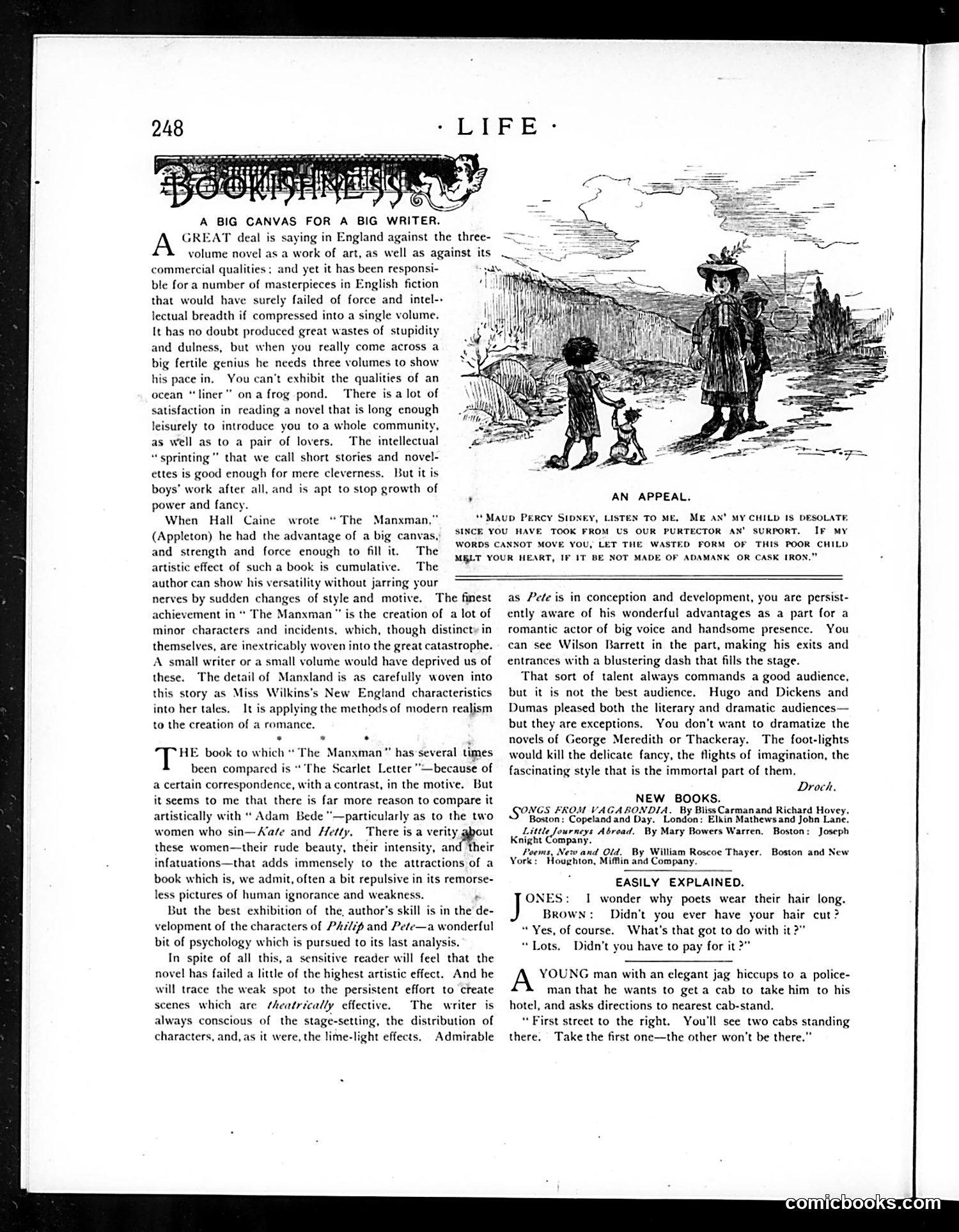
The page contains a literary book review titled "Bookishly" discussing a three-volume novel by an unnamed English writer. The review compares this work to Wilkie Collins's *The Moonstone* and *The Woman in White*, praising its character development, particularly the creation of characters named *Philp* and *Pete*. The illustration shows what appears to be a rural or countryside scene with three figures—possibly depicting a scene from the discussed novel. Below the main review are brief humorous anecdotes: one titled "An Appeal" (a dramatic plea about a desolate child), another called "Easily Explained" (a joke about poets wearing long hair), and a third untitled joke about a young man asking directions to a cab-stand. This is primarily a **literary criticism and humor page** rather than political satire.
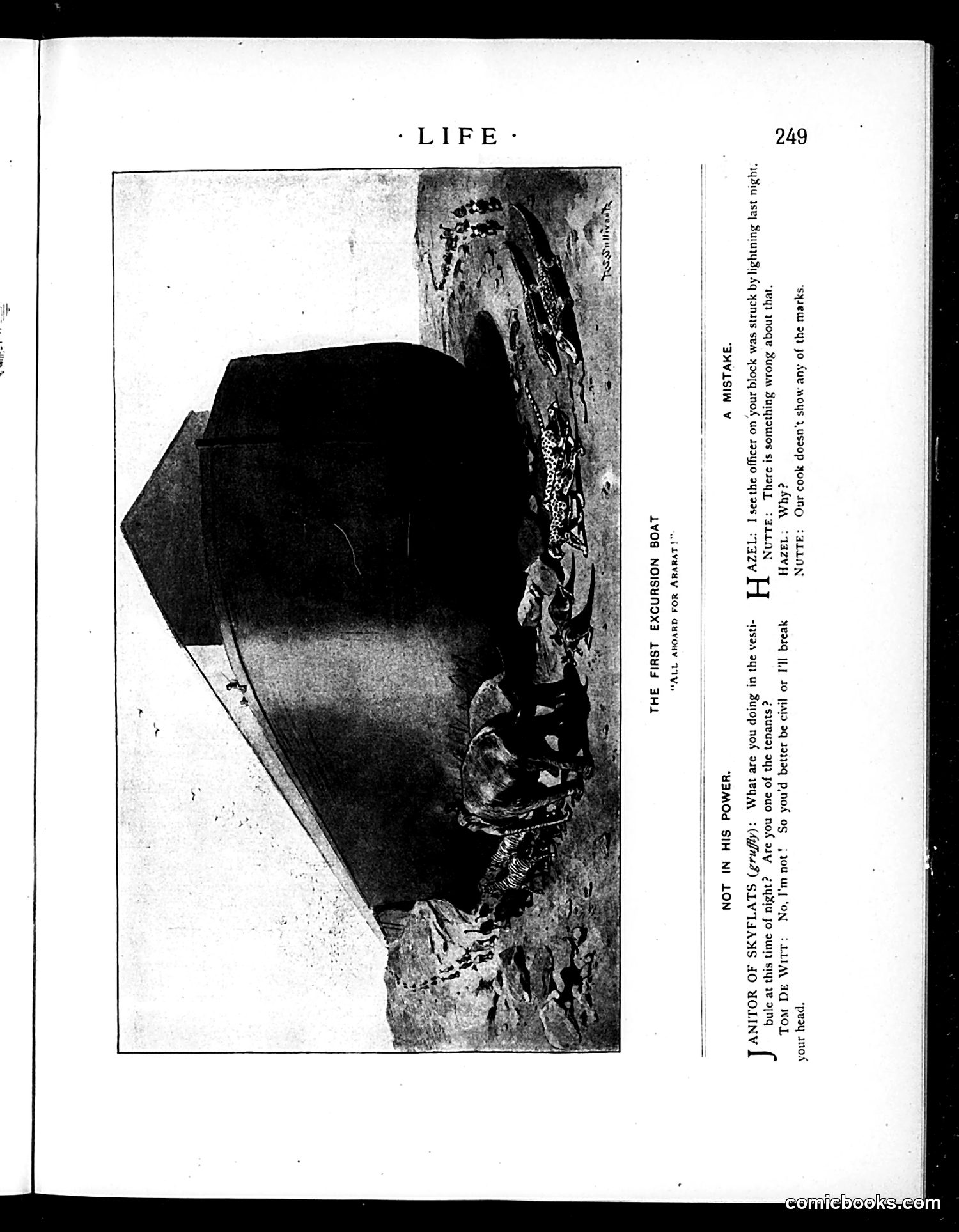
This page from *Life* magazine (page 249) contains a single political cartoon titled "A MISTAKE" showing a Harriet Beecher Stowe bust or sculpture. The accompanying text reads: "Author of Sketch arts gravelly: 'What are you doing in the ash-can? I see the officer on your back was erased by lightning last night. There is something wrong about this. One cool doesn't show any of the marks.'" The cartoon appears to be satirizing either the removal or desecration of a Stowe memorial—likely referencing contemporary debates about public monuments. The reference to "the officer on your back" and erasure "by lightning" suggests commentary on vandalism or neglect of commemorative statuary. However, without knowing the specific historical moment this appeared, the precise political point remains unclear—it could reference efforts to remove or preserve abolitionist memorials.
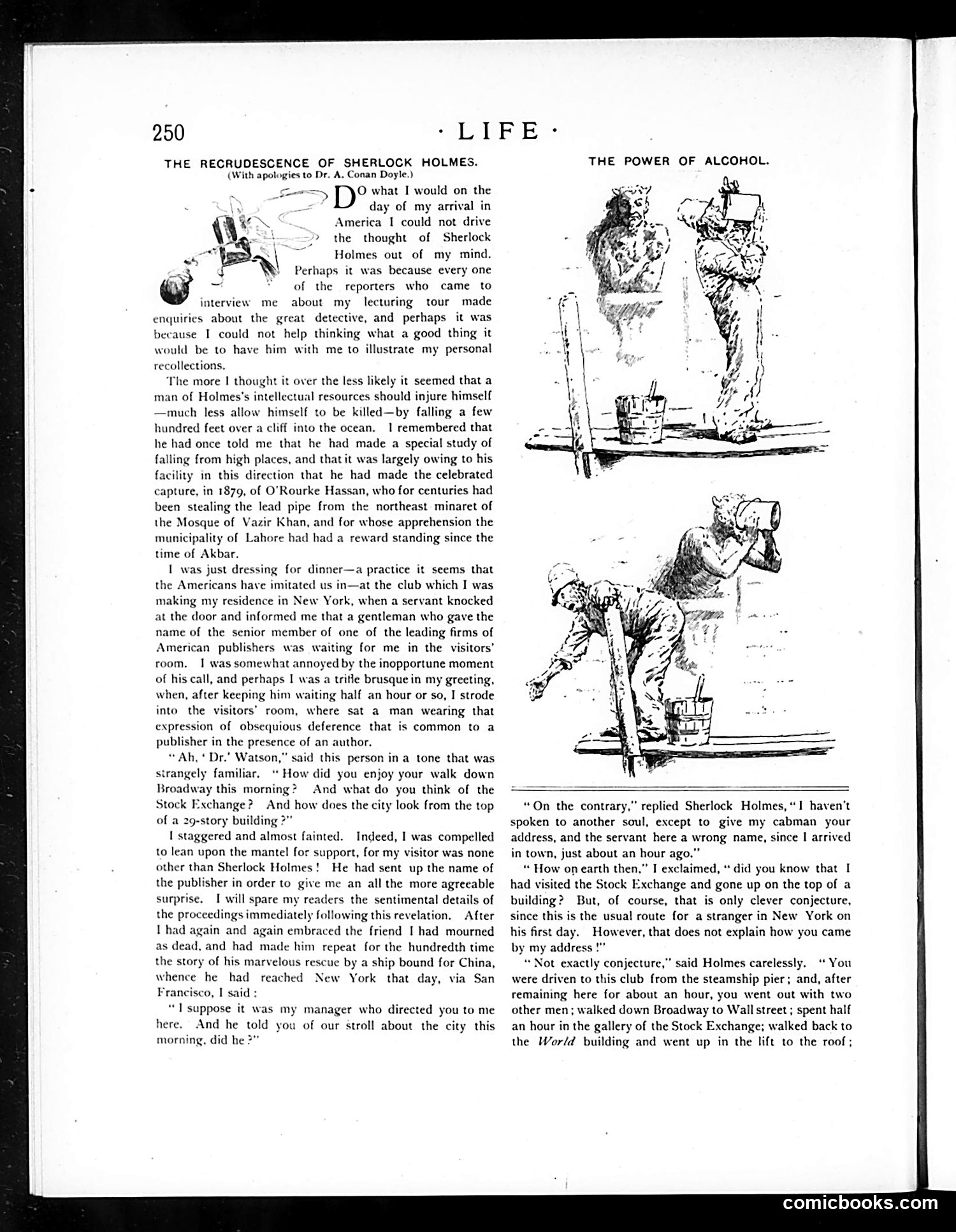
This cartoon series satirizes the physical effects of alcohol consumption. The three panels show a progression: a man in increasingly disheveled states, from standing upright (though wild-eyed) to lying prone on the ground near a wooden post and bucket. The title "The Power of Alcohol" is ironic—it depicts alcohol's literal power to incapacitate and degrade a person physically. The cartoons contrast sharply with the left page's text about Sherlock Holmes's intellectual prowess, suggesting a commentary on how alcohol destroys the very faculties (reason, coordination, dignity) that separate civilized people from degradation. This reflects late-19th/early-20th-century temperance movement concerns about alcohol's social dangers.
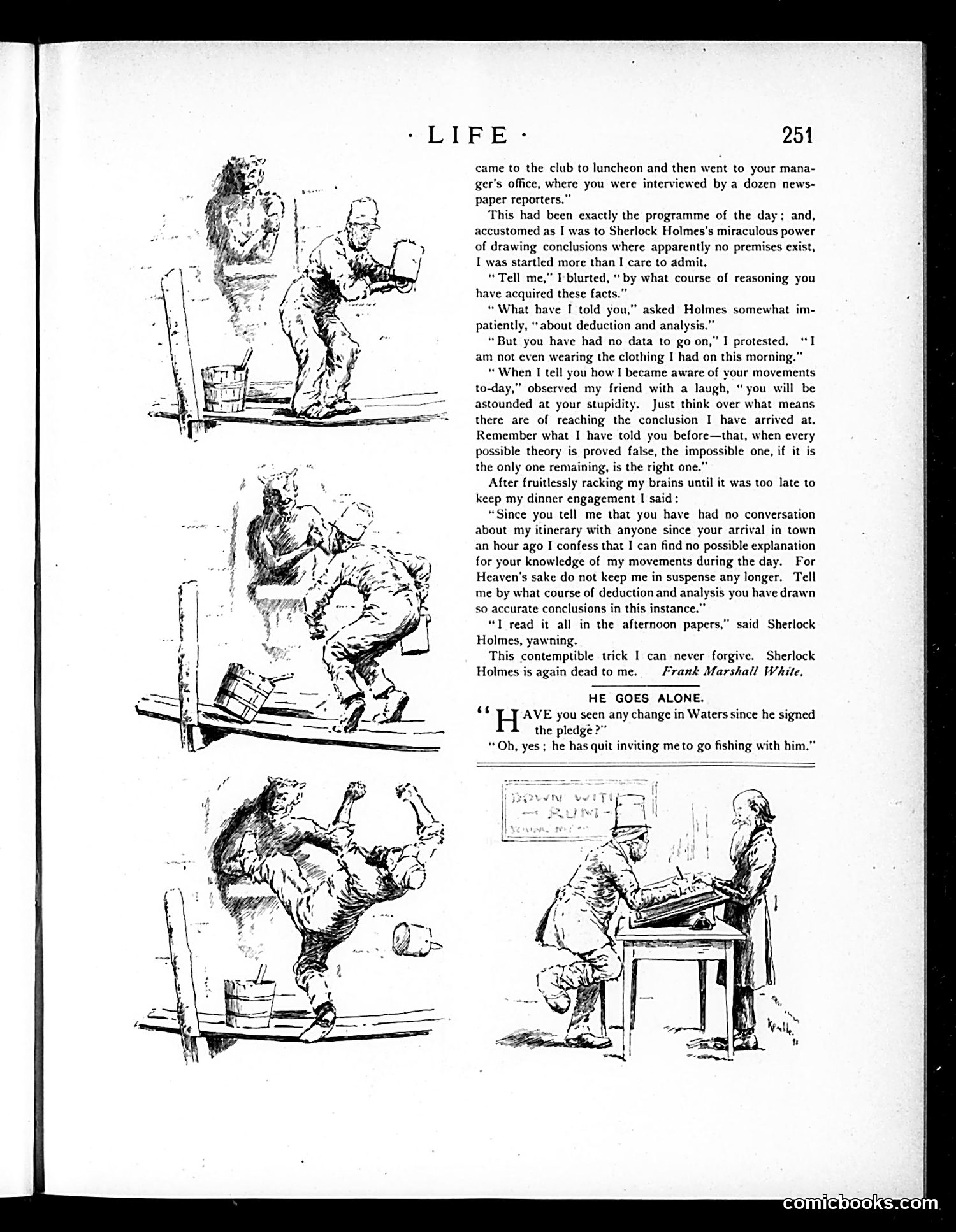
This page features a Sherlock Holmes parody titled "He Goes Alone." The text presents Holmes deducing someone's movements and activities through observation—a signature Holmes trope—but the narrator finds this "contemptible trick" infuriating rather than impressive. Holmes claims to have determined the person's itinerary based on their clothing and appearance, demonstrating his famous deductive method. The accompanying illustrations (by an artist whose signature appears present) show comical physical pratfalls—figures tumbling and falling in exaggerated positions. These visual gags likely satirize Holmes's overly confident deductions by suggesting that reality is messier and more chaotic than his logical framework allows. The joke appears to mock detective fiction's reliance on improbable reasoning, contrasting Holmes's intellectual pretensions with actual human unpredictability.
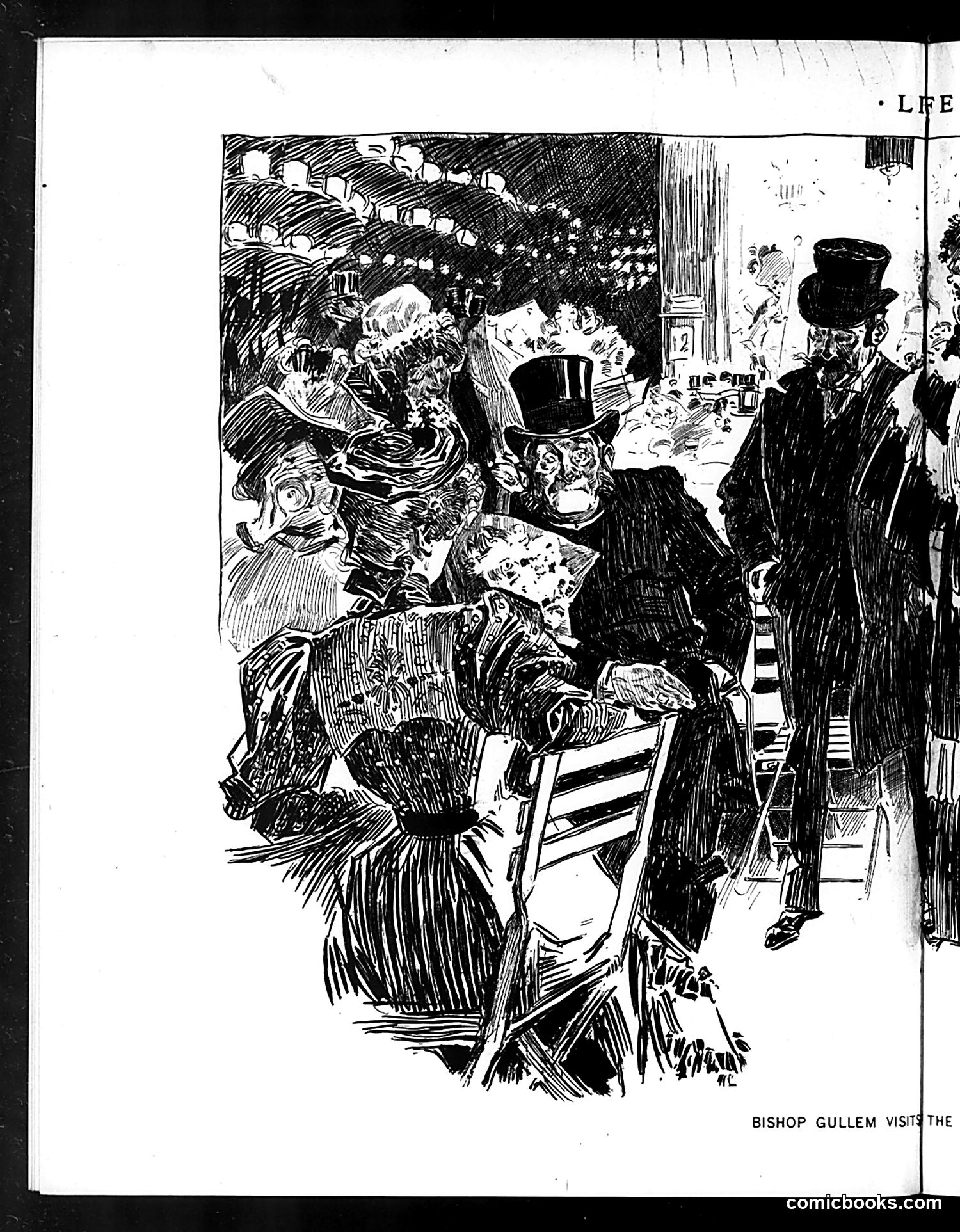
This Life magazine cartoon depicts what appears to be a formal social gathering or reception, with elegantly dressed figures in Victorian-era clothing. The caption identifies a "Bishop Gullem" as visiting somewhere (the text is cut off). The satire likely mocks either the bishop's pretensions or the superficiality of high society. The crowded, chaotic composition with exaggerated facial expressions suggests comedic chaos—perhaps the bishop's presence disrupts social order, or the event itself is absurdly theatrical. Without the complete caption or additional context, the precise target of satire remains unclear. However, the formal dress, religious authority figure, and crowded venue suggest commentary on either institutional hypocrisy or the artificiality of elite social rituals. The style indicates this is from Life's heyday as an illustrated humor magazine.
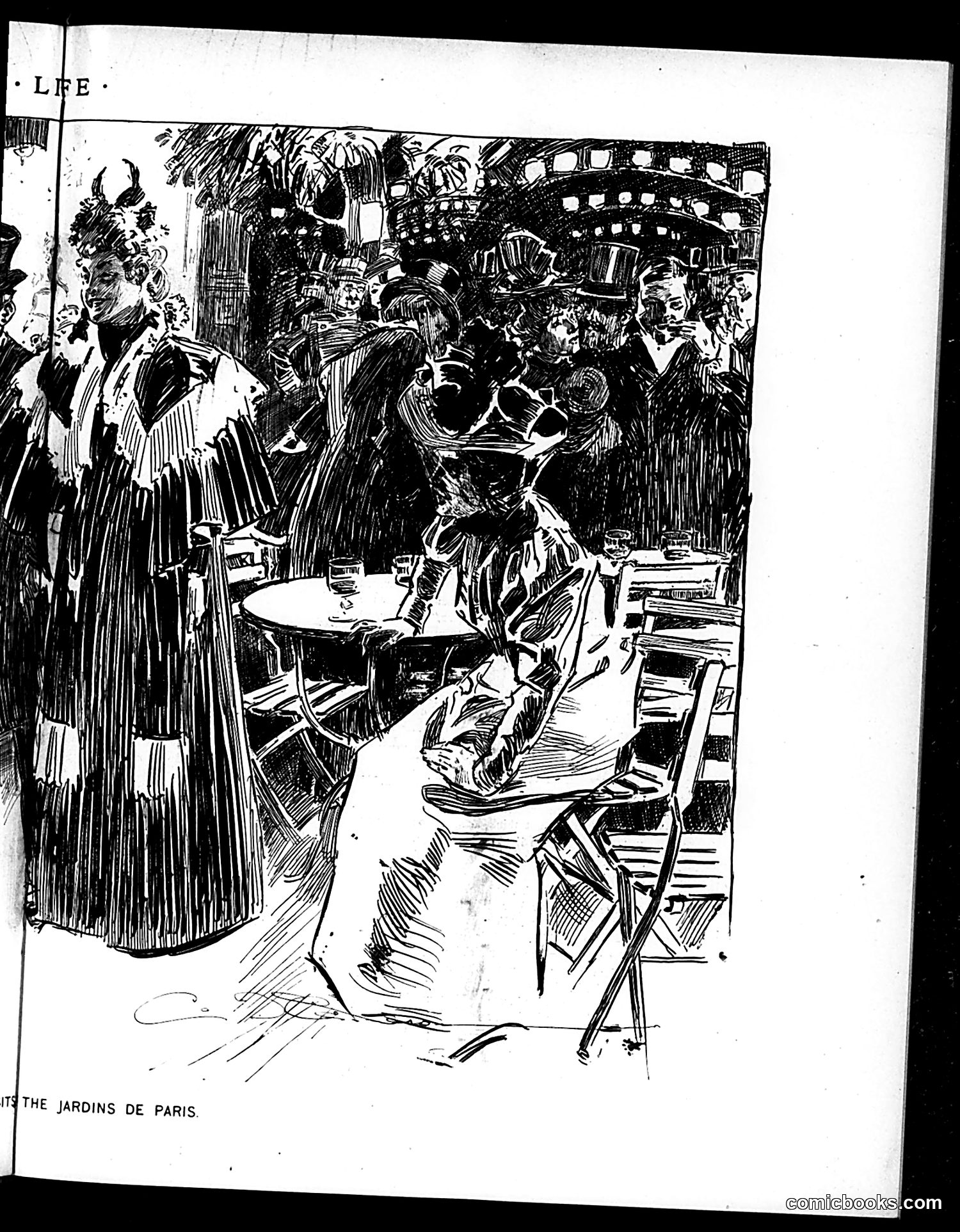
This sketch depicts a fashionable social scene in Paris's public gardens, likely from the early 20th century. The central figure is a woman seated at a small table, dressed elegantly and wearing a wide-brimmed hat. She's surrounded by well-dressed Parisians in formal attire—coats, hats, and fashionable clothing typical of the era. The satire appears to target the pretension and social posturing of Parisian leisure culture. The crowded, ornate setting (note the decorative architecture in the background) emphasizes the performative nature of public socializing among the wealthy. The woman's exaggerated pose and the overall theatrical composition mock the affectations of high society members who gathered in these gardens to be seen. The specific individuals remain unclear without additional context.
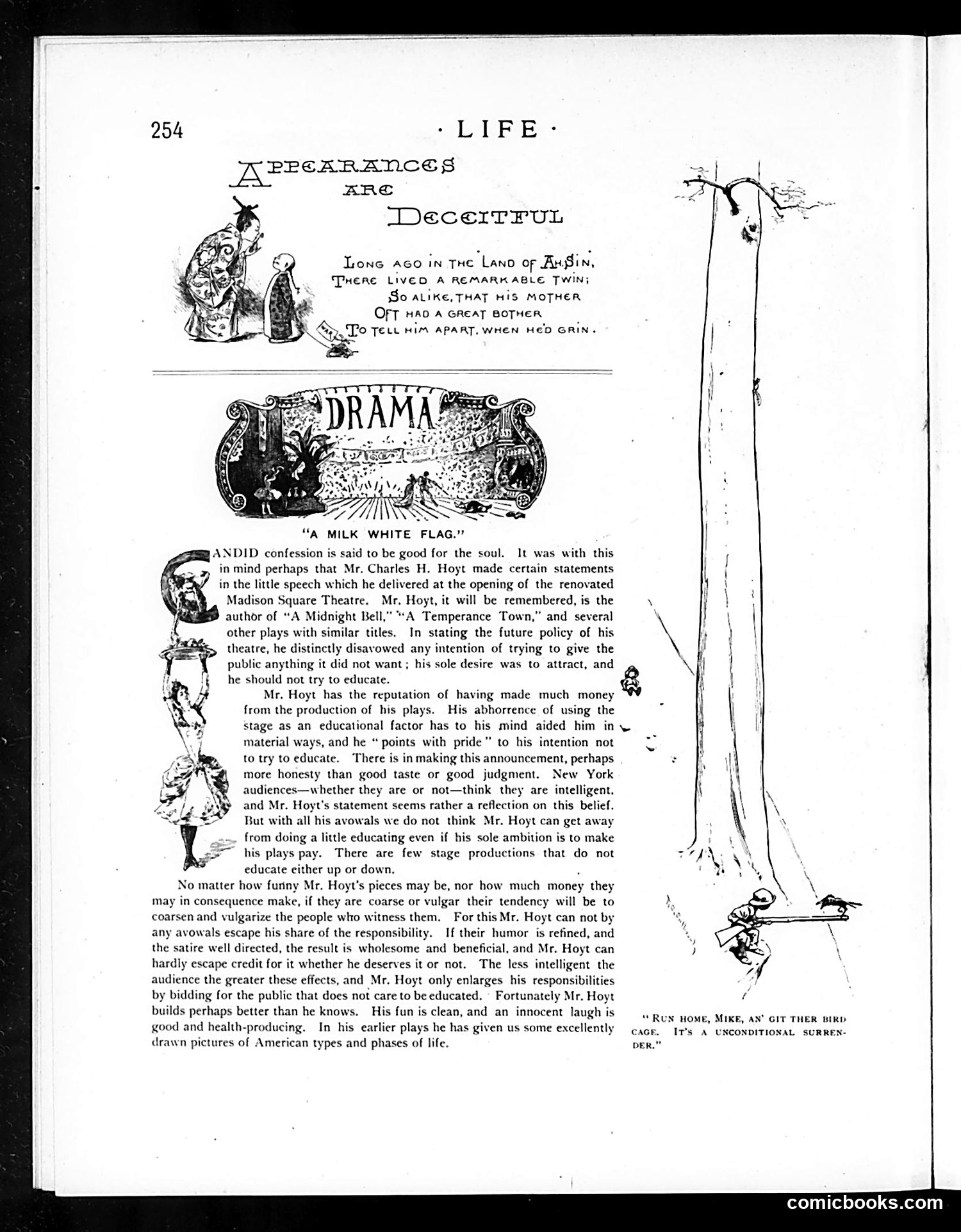
This page critiques playwright **Charles H. Hoyt**, who publicly declared he wouldn't try to educate audiences—his theater would simply entertain for profit. The article sarcastically agrees with his "candid confession," then argues he can't escape responsibility regardless: plays either elevate or degrade their audiences. The writer notes that while Hoyt's humor is "clean," his refusal to acknowledge theater's educational impact reflects poorly on his view of audiences' intelligence. The opening verse about indistinguishable twins in "Abstin" (likely fictional) appears decorative. The illustration captioned "Run home, Mike, and git ther bird cage—it's a unconditional surrender" depicts working-class characters, likely representing ordinary American types Hoyt portrayed in earlier plays. The satire targets theatrical commercialism: Hoyt's frank admission that profit, not uplift, drives his work—and his seeming contempt for audiences unwilling to "be educated."
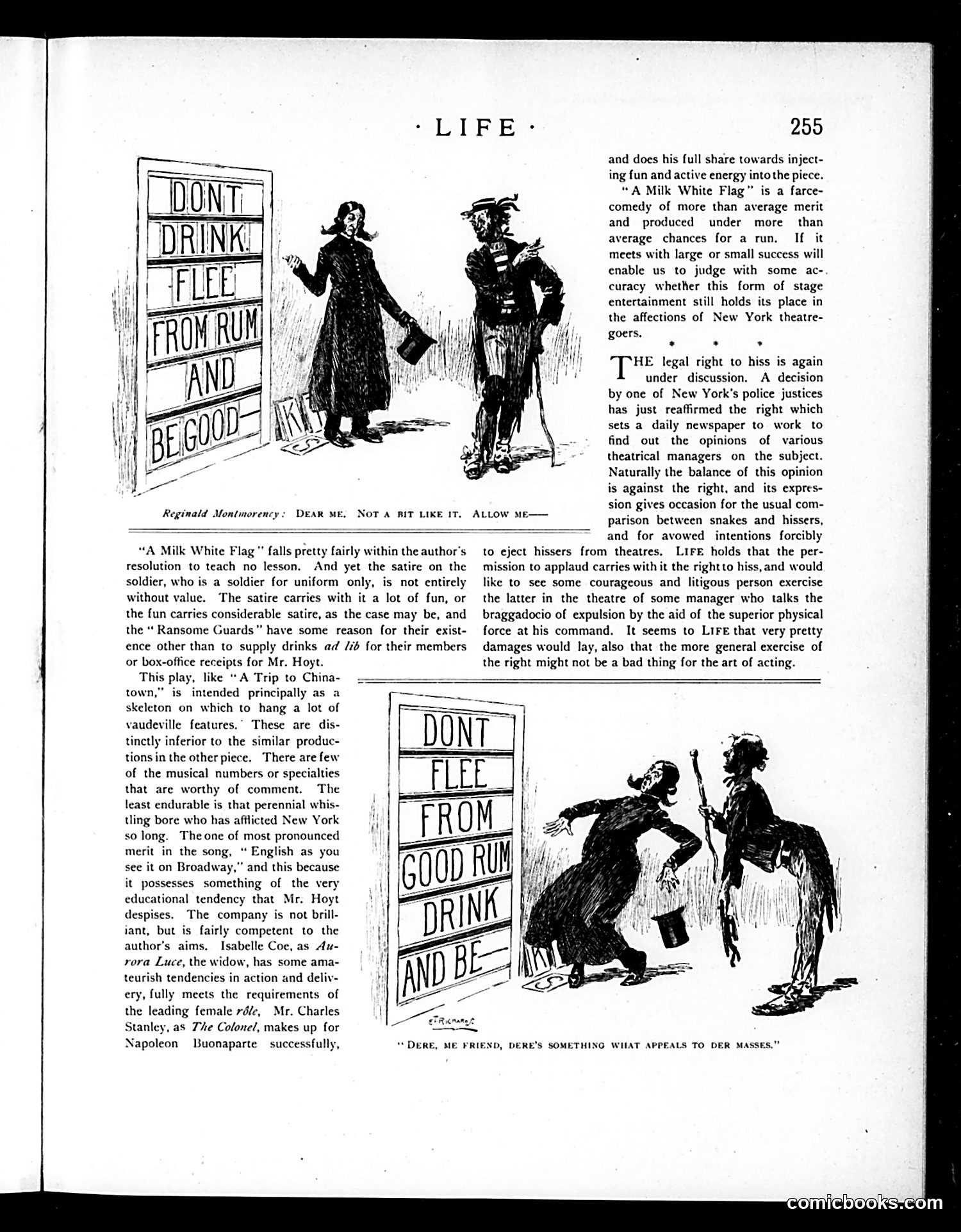
This page reviews "A Milk White Flag," a theatrical farce-comedy. The two cartoons illustrate the play's satirical premise: signs reading "Don't Drink/Flee From Rum and Be Good" represent moral temperance messaging, contrasted with characters—apparently soldiers or military types—who ignore such warnings. The review discusses the play's satire on soldiers motivated by uniform rather than principle. The cartoons mock this hypocrisy: characters reject temperance advice, with the second caption reading "There, he friend, there's something what appeals to der masses," suggesting the audience prefers entertainment over moral instruction. The page also addresses a contemporary debate: whether theater audiences have the legal right to hiss disapproving actors. Life argues that if applause is permitted, so should hissing, and criticizes theater managers who claim they'll physically eject hissers. This reflects tensions over audience behavior and free expression in early 20th-century theater.
This page contains three brief humorous anecdotes satirizing human absent-mindedness and misplaced caution: 1. **The Bookkeeper Reading Euclid**: A young woman employed at Fulton Market appears constantly absorbed in a book during work hours. Her employer assumes it's a novel (frivolous reading), but she's actually studying geometry—serious self-improvement the boss finds equally unsuitable for business hours. The joke mocks rigid employers who dismiss any focused study as inappropriate workplace behavior. 2. **Bank Closure Notices**: The author ridicules the obviousness of "CLOSED" signs on locked bank doors, sarcastically suggesting only the most obtuse person wouldn't realize a bolted door means the bank is closed. 3. **The Umbrella Negotiation**: A man sees "$0.75" price on display shirts, then confuses this with umbrellas priced at $6, and tries haggling down to 60 cents—misreading both the decimal point and merchandise categories. These are **not** political cartoons but rather gentle social satire about everyday human stupidity and confusion—typical content for Life magazine's humor section.
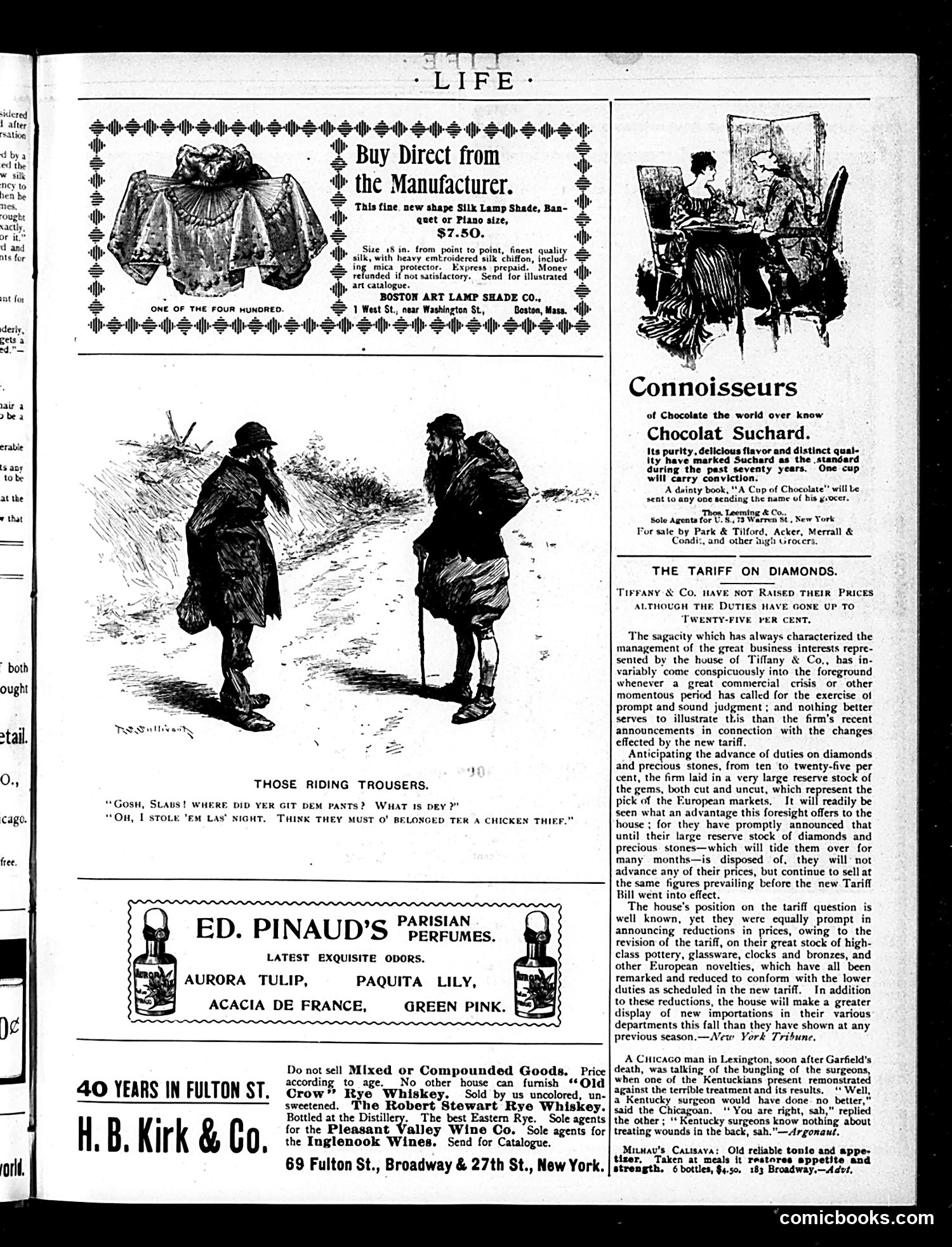
This cartoon depicts two poorly dressed men discussing stolen trousers, with the caption suggesting one stole them "las' night" from "a chicken thief." The figures appear to be caricatured as African American men using exaggerated dialect. The joke relies on a chain of moral degradation: the speaker stole from someone who steals from chickens—implying the original owner is so disreputable that theft from him is almost justified. This reflects late 19th-century (likely 1880s-90s) *Life* magazine's satirical humor, which frequently used racial stereotypes and dialect humor that was considered entertaining to its educated, white audience. The cartoon's crude racial caricature and minstrel-style dialogue exemplify how such imagery was normalized in American magazines of this era, even in publications aimed at sophisticated readers.
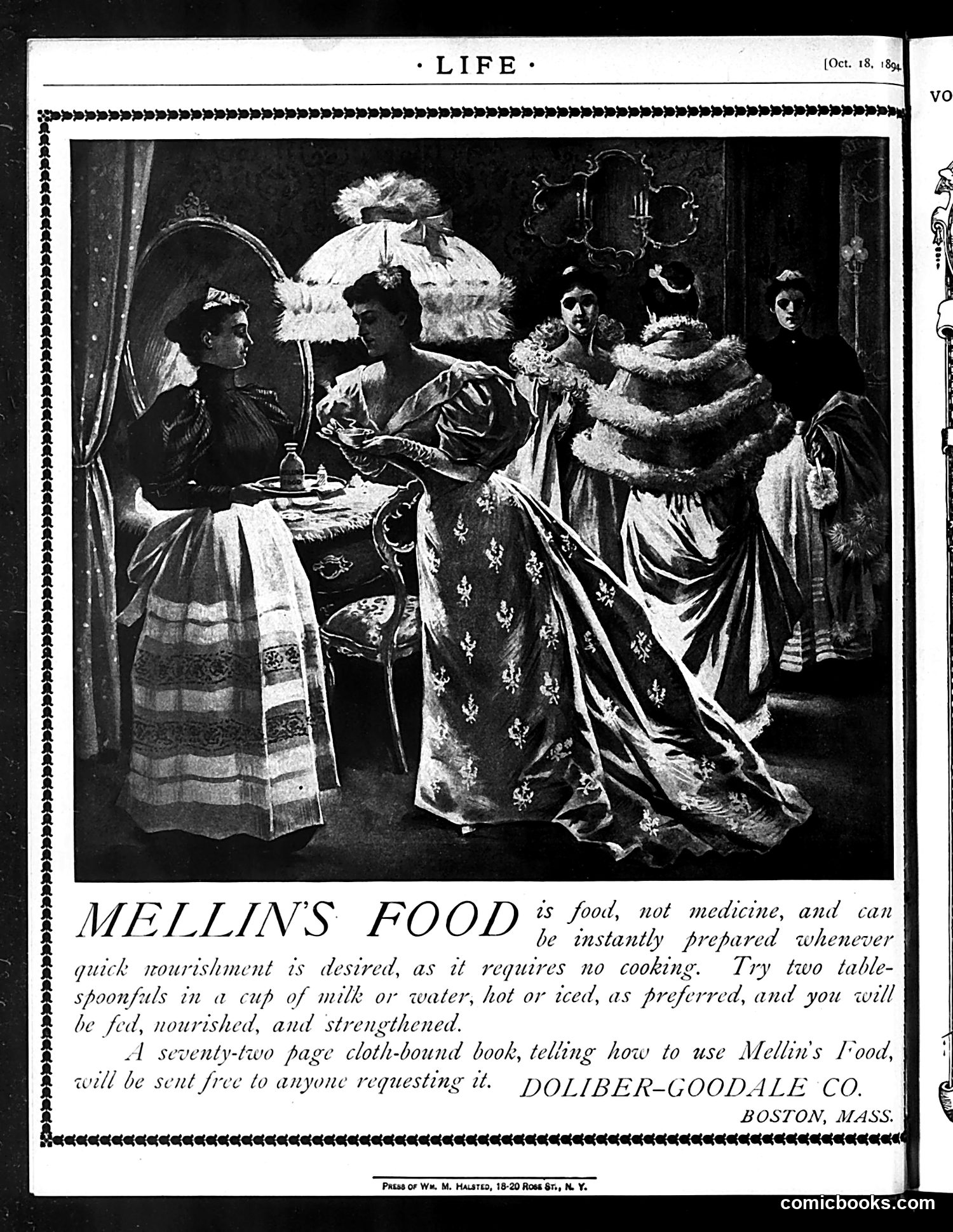
This is a **product advertisement**, not political satire. It depicts an elegant late-Victorian domestic scene where fashionably dressed women gather around a table. The image serves as aspirational lifestyle marketing for **Mellin's Food**, an infant nutrition product popular in the 1890s. The advertisement emphasizes convenience ("instantly prepared," "requires no cooking") and positions the product as essential nourishment for quick feeding. The offer of a free 72-page instructional book was a common marketing tactic of the era. The elaborate clothing and refined interior setting target middle and upper-class mothers who could afford commercial baby food—a relatively new consumer product. This reflects the period's emerging consumer culture and changing attitudes toward convenience foods and scientific childcare.