
Life, 1894-10-18 · page 6 of 16
Life — October 18, 1894 — page 6: what you’re looking at
What you’re looking at
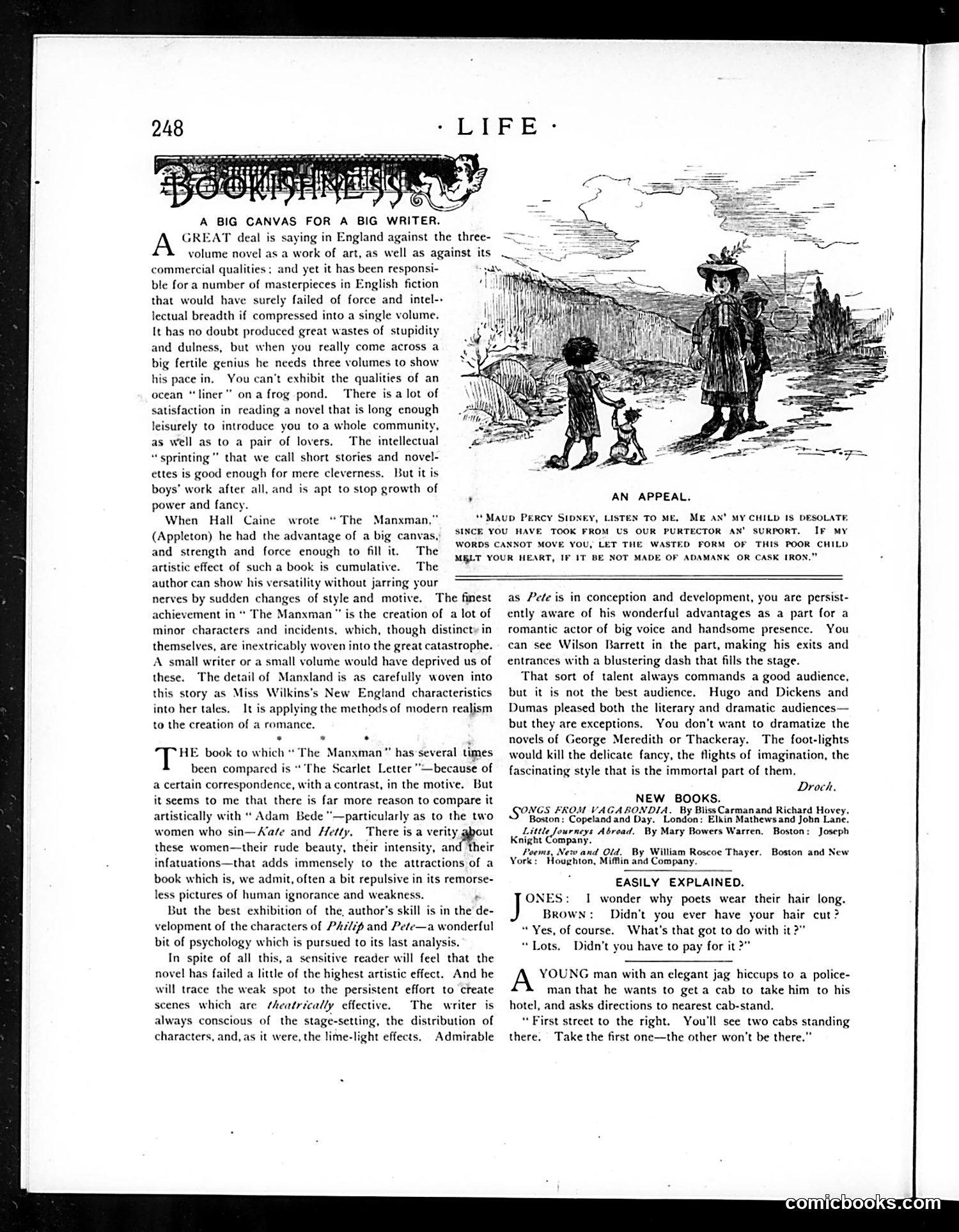
The page contains a literary book review titled "Bookishly" discussing a three-volume novel by an unnamed English writer. The review compares this work to Wilkie Collins's *The Moonstone* and *The Woman in White*, praising its character development, particularly the creation of characters named *Philp* and *Pete*. The illustration shows what appears to be a rural or countryside scene with three figures—possibly depicting a scene from the discussed novel. Below the main review are brief humorous anecdotes: one titled "An Appeal" (a dramatic plea about a desolate child), another called "Easily Explained" (a joke about poets wearing long hair), and a third untitled joke about a young man asking directions to a cab-stand. This is primarily a **literary criticism and humor page** rather than political satire.
📄 Transcribed text from this page (OCR, searchable)
Machine-transcribed from the original scan — historical spelling and the odd misread are preserved.
A BIG CANVAS FOR A BIG WRITER. GREAT deal is saying in England against the three- volume novel as a work of art, as well as against its commercial qualitie: nd yet it has been responsi- ble fora number of masterpieces in English fiction that would have surely failed of force and intel-+ lectual breadth if compressed into a single volume. It has no doubt produced great wastes of stupidity and dulness, but when you really come across a big fertile genius he needs three volumes to show his pace in. You can't exhibit the qualities of an ocean “liner” ona frog pond. There is a lot of satisfaction in reading a novel that is long enough leisurely to introduce you to a whole community, as well as to a pair of lovers. The intellectual “sprinting” that we call short stories and novel- ettes is good enough for mere cleverness. But it is boys’ work after all, and is apt to stop growth of power and fancy When Hall Caine “The Manxman, (Appleton) he had the advantage of a big canvas, and strength and force enough to fill it. The artistic effect of such a book is cumulative. The wrote *“Maup Percy SIDNEY, LISTEN SINCE YoU H WORDS CANNOT MOVE MBLT YOUR HEART, IF AN APPEAL. TO ME, ME AN’ MY CHILD IS DESOLATE, OUR PURTECTOR AN’ SURPORT. IF MY YOU, LET THE WASTED FORM OF THIS POOR CHILD T BE NOT MADE OF ADAMANK OR CASK IRON.” VE TOOK FROM author can show his versatility without jarring your nerves by sudden changes of style and motive. The finest achievement in “* The Manxman” is the creation of a lot of minor characters and incidents, which, though distincty in themselves, are inextricably woven into the great catastrophe. A small writer or a small volume would have deprived us of these. The detail of Manxland is as carefully woven into this story as Miss Wilkins's New England characteristics into her tales. It is applying the methods of modern realism to the creation of a romance. TT = book to which * The Manxman” has several times been compared is “The Scarlet Letter "—because of a certain correspondence, with a contrast, in the motive. But it seems to me that there is far more reason to compare it artistically with * Adam Bede "—particularly as to the two women who sin—Kave and Hetty, There is a verity about these women—their rude beauty, their intensity, and their infatuations—that adds immensely to the attractions of a book which is, we admit, often a bit repulsive in its remorse- less pictures of human ignorance and weakness. . But the best exhibition of the, author's skill is in the de- velopment of the characters of PAsdip and Pete—a wonderful bit of psychology which is pursued to its last analysis. In spite of all this, a sensitive reader will feel that the novel has failed a little of the highest artistic effect. And he will trace the weak spot to the persistent effort to create scenes which are ¢heatrically effective. The writer is always conscious of the stage-setting, the distribution of characters, and, as it were, the lime-light effects. Admirable as Pete is in conception and development, you are persist- ently aware of his wonderful advantages as a part for a romantic actor of big voice and handsome presence. You can see Wilson Barrett in the part, making his exits and entrances with a blustering dash that fills the stage. That sort of talent always commands a good audience, but it is not the best audience. Hugo and Dickens and Dumas pleased both the literary and dramatic audiences— but they are exceptions. You don’t want to dramatize the novels of George Meredith or Thackeray. The foot-lights would kill the delicate fancy, the flights of imagination, the fascinating style that is the immortal part of them, Droch. NEW BOOKS. SONGS FROM VAGABONDIA. By BlissCarmanand Richard Hovey. Boston: Copeland and Day. London: Elkin Mathewsand John Lane. Little Journeys Abroad. By Mary Bowers Warren, Boston: Joseph Knight Company. Poems, New and Old. By William Roscoe Thayer. York: Houghton, Mifflin and Company. EASILY EXPLAINED. ONES: 1 wonder why poets wear their hair long. J Brown: Didn't you ever have your hair cut? “ Yes, of course. “ Lots. Boston and New What's that got to do with it?” Didn't you have to pay for it ?” A YOUNG man with an elegant jag hiccups to a police- man that he wants to get a cab to take him to his hotel, and asks directions to nearest cab-stand. “ First street to the right. there, You'll see two cabs standing Take the first one—the other won't be there.