
Life, 1894-10-18 · page 12 of 16
Life — October 18, 1894 — page 12: what you’re looking at
What you’re looking at
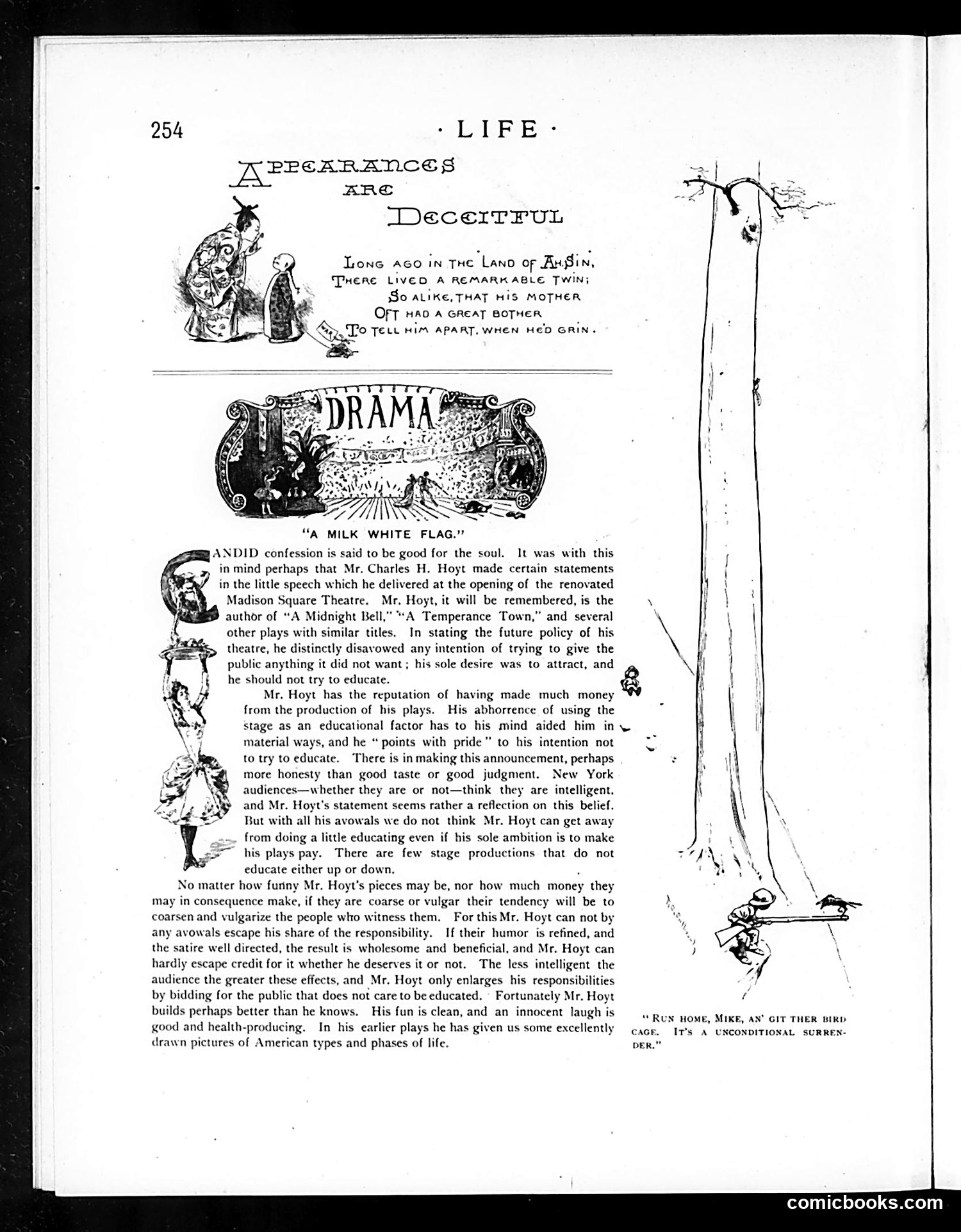
This page critiques playwright **Charles H. Hoyt**, who publicly declared he wouldn't try to educate audiences—his theater would simply entertain for profit. The article sarcastically agrees with his "candid confession," then argues he can't escape responsibility regardless: plays either elevate or degrade their audiences. The writer notes that while Hoyt's humor is "clean," his refusal to acknowledge theater's educational impact reflects poorly on his view of audiences' intelligence. The opening verse about indistinguishable twins in "Abstin" (likely fictional) appears decorative. The illustration captioned "Run home, Mike, and git ther bird cage—it's a unconditional surrender" depicts working-class characters, likely representing ordinary American types Hoyt portrayed in earlier plays. The satire targets theatrical commercialism: Hoyt's frank admission that profit, not uplift, drives his work—and his seeming contempt for audiences unwilling to "be educated."
📄 Transcribed text from this page (OCR, searchable)
Machine-transcribed from the original scan — historical spelling and the odd misread are preserved.
- LIFE: JK PECABANCES ARE MDecerrruLn Lone Aco in THE Lano of AnSin, rere Liveo A REMARKABLE TWIN; So ALIKE, THAT HIS MOTHER OFT HAO A GREAT BOTHER Ra Te TELL HIM APART, WHEN HED GRIN. “A MILK WHITE FLAG.” ANDID confession is said to be good for the soul. It was with this in mind perhaps that Mr. Charles H. Hoyt made certain statements in the little speech which he delivered at the opening of the renovated Madison Square Theatre. Mr. Hoyt, it will be remembered, is the author of “A Midnight Bell,” “A Temperance Town,” and several other plays with similar titles. In stating the future policy of his theatre, he distinctly disavowed any intention of trying to give the public anything it did not want; his sole desire was to attract, and he should not try to educate. Mr. Hoyt has the reputation of having made much money from the production of his plays. His abhorrence of using the Stage as an educational factor has to his mind aided him in material ways, and he “ points with pride" to his intention not to try to educate. There is in making this announcement, perhaps more honesty than good taste or good judgment. New York audiences—whether they are or not—think they are intelligent, and Mr. Hoyt’s statement seems rather a reflection on this belief. But with all his avowals we do not think Mr. Hoyt can get away from doing a little educating even if his sole ambition is to make his plays pay. There are few stage productions that do not educate either up or down, No matter how furiny Mr. Hoyt’s pieces may be, nor how much money they may in consequence make, if they are coarse or vulgar their tendency will be to en and vulgarize the people who witness them, For this Mr. Hoyt can not by any avowals escape his share of the responsibility. If their humor is refined, and the satire well directed, the result is wholesome and beneficial, and Mr. Hoyt can hardly escape credit for it whether he deserves it or not. The less intelligent the audience the greater these effects, and Mr. Hoyt only enlarges his responsibilities by bidding for the public that does not care to be educated. © Fortunately Mr. Hoyt builds perhaps better than he knows. His fun is clean, and an innocent laugh is good and health-producing. In his earlier plays he has given us some excellently drawn pictures of American types and phases of life. “RUN HOME, MIKE, AN’ GIT THER BIRD CAGE It's A UNCONDITIONAL SURREN- comicbooks.com