
Life, 1894-10-18 · page 13 of 16
Life — October 18, 1894 — page 13: what you’re looking at
What you’re looking at
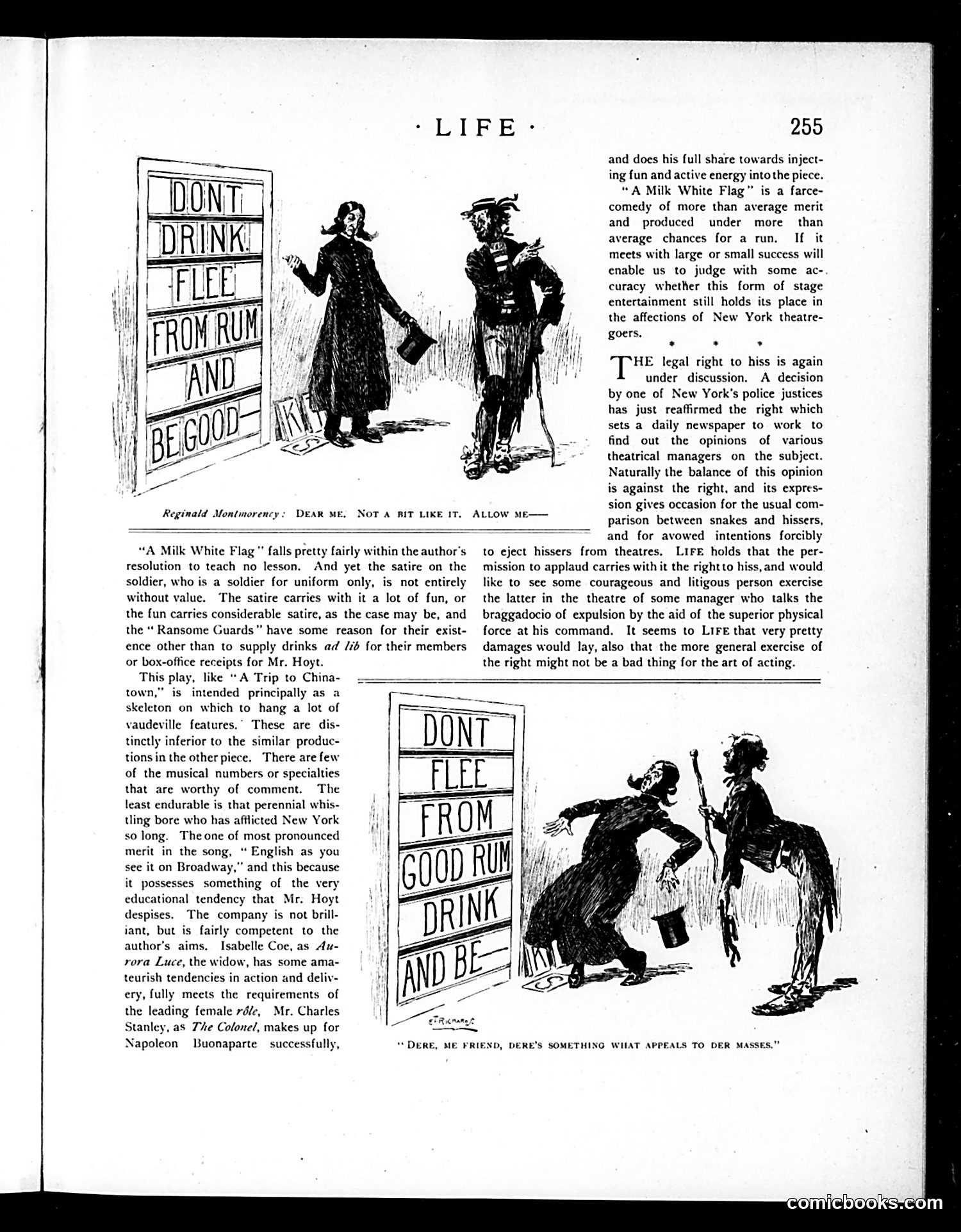
This page reviews "A Milk White Flag," a theatrical farce-comedy. The two cartoons illustrate the play's satirical premise: signs reading "Don't Drink/Flee From Rum and Be Good" represent moral temperance messaging, contrasted with characters—apparently soldiers or military types—who ignore such warnings. The review discusses the play's satire on soldiers motivated by uniform rather than principle. The cartoons mock this hypocrisy: characters reject temperance advice, with the second caption reading "There, he friend, there's something what appeals to der masses," suggesting the audience prefers entertainment over moral instruction. The page also addresses a contemporary debate: whether theater audiences have the legal right to hiss disapproving actors. Life argues that if applause is permitted, so should hissing, and criticizes theater managers who claim they'll physically eject hissers. This reflects tensions over audience behavior and free expression in early 20th-century theater.
📄 Transcribed text from this page (OCR, searchable)
Machine-transcribed from the original scan — historical spelling and the odd misread are preserved.
Reginald Montmorency: DEAR Me. NOT A RIT LIKE IT. ALLOW ME—— 255 and does his full share towards inject- ing fun and active energy into the piece. “A Milk White Flag" is a farce- comedy of more than average merit and produced under more than average chances for a run. If it meets with large or small success will enable us to judge with some ac- curacy whether this form of stage entertainment still holds its place in the affections of New York theatre- goers. . , HE legal right to hiss is again under discussion. A decision by one of New York's police justices has just reaffirmed the right which sets a daily newspaper to work to find out the opinions of various theatrical managers on the subject. Naturally the balance of this opinion is against the right, and its expres- sion gives occasion for the usual com- parison between snakes and hissers, White Flag " falls pretty fairly within the author's resolution to teach no lesson. And yet the satire on the soldier, who is a soldier for uniform only, is not entirely without value. The satire carries with it a lot of fun, or the fun carries considerable satire, as the case may be, and the * Ransome Guards” have some reason for their exist- ence other than to supply drinks ad /76 for their members or box-office receipts for Mr. Hoyt. This play, like “A Trip to China- and for avowed intentions forcibly to eject hissers from theatres, Lire holds that the per- mission to applaud carries with it the rightto hiss, and would like to see some courageous and litigous person exercise the latter in the theatre of some manager who talks the braggadocio of expulsion by the aid of the superior physical force at his command, It seems to LIFE that very pretty damages would lay, also that the more general exercise of the right might not be a bad thing for the art of acting. intended principally as a skeleton on which to hang a lot of vaudeville features.” These are dis- tinctly inferior to the similar produc- tions in the other piece. There are few of the musical numbers or specialties that are worthy of comment. The least endurable is that perennial whi tling bore who has afflicted New York so long. Theone of most pronounced merit in the song, “ English as you see it on Broadway,” and this because it possesses something of the very educational tendency that Mr. Hoyt despises. The company is not brill- iant, but is fairly competent to the author’s aims, Isabelle Coe, as Au- rora Luce, the widow, has some ama- teurish tendencies in action and deliv- ery, fully meets the requirements of the leading female ré/e, Mr. Charles Stanley, as The Colonel, makes up for Napoleon Buonaparte successfully,