
A complete issue · 16 pages · 1894
Life — September 13, 1894
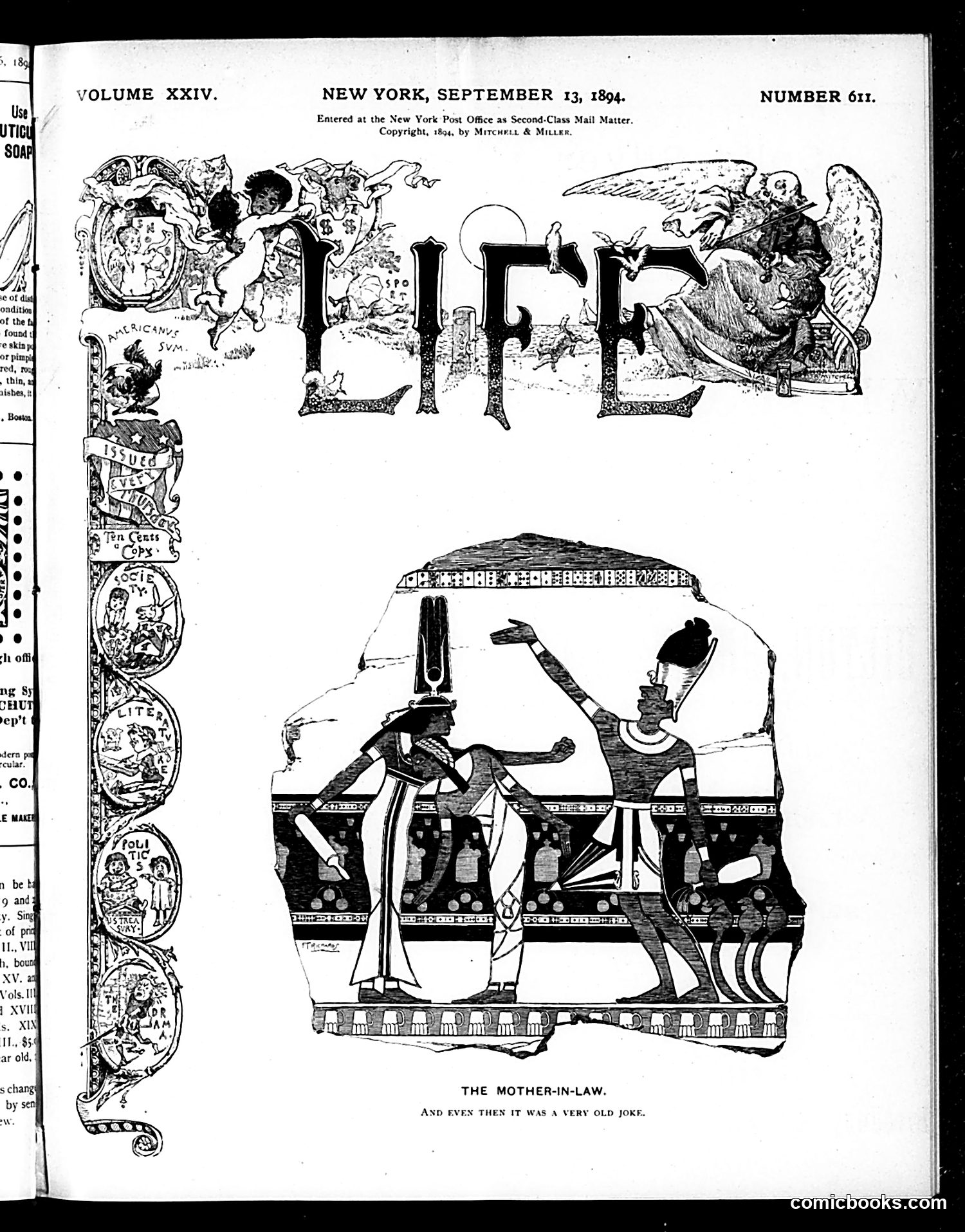
This is a humorous cartoon depicting an ancient Egyptian scene. Two figures in Egyptian dress appear to be presenting or arguing about a woman (likely a mother-in-law figure) to a seated official or authority figure. The elaborate Egyptian styling—hieroglyphics, period costume, architectural details—is the joke's setup. The caption states this joke is "a very old joke," suggesting that mother-in-law humor is so ancient it predates modern civilization itself. By placing the tired domestic complaint in pharaonic Egypt, *Life* satirizes how timeless and worn-out this particular joke has become. The point: even Egyptians were making the same stale mother-in-law jokes thousands of years ago. It's a meta-joke about the exhaustion of a comedy cliché.
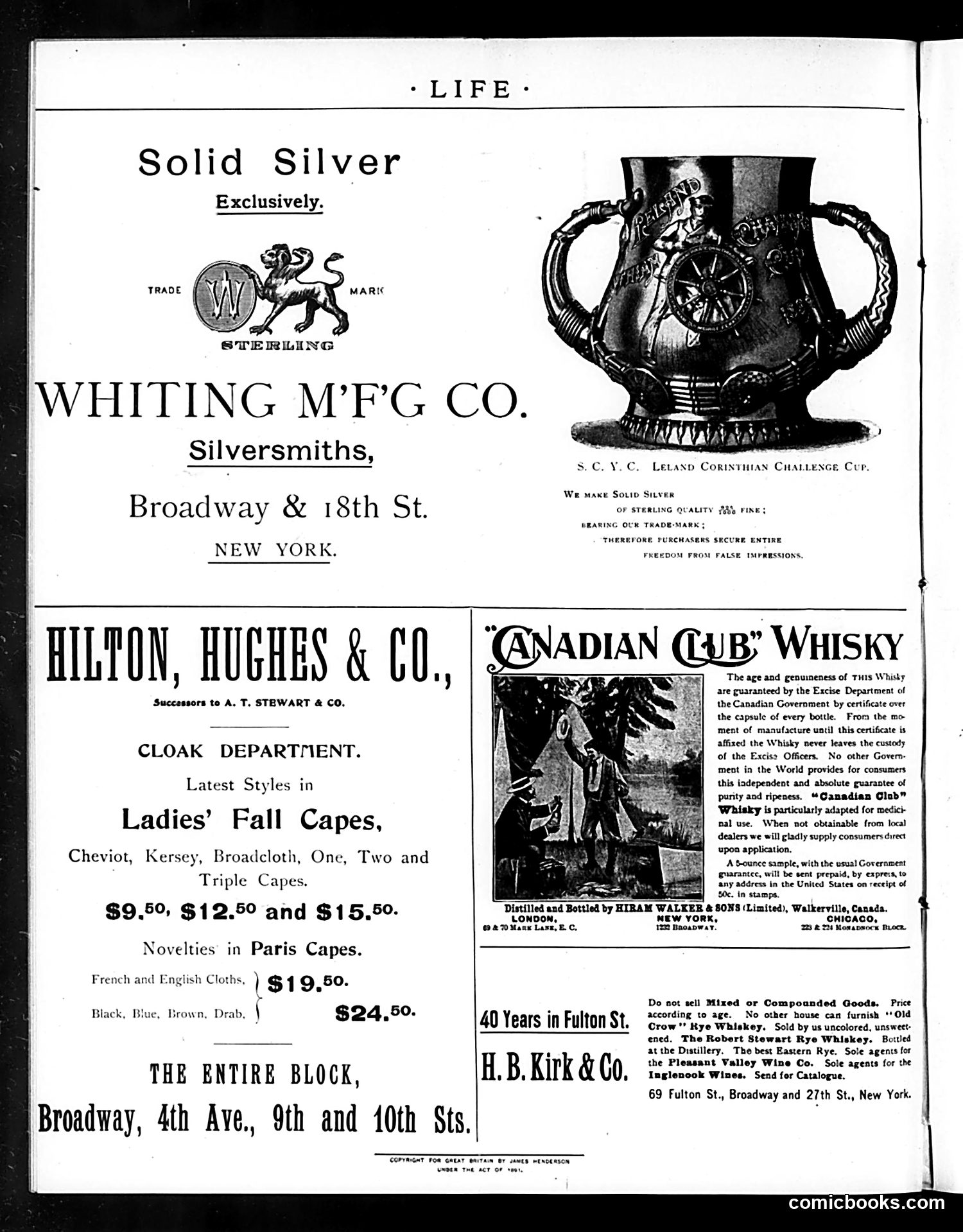
This page is **primarily advertisements** with no discernible political cartoon or satire. The content includes: - **Whiting M'FG Co.**: A silversmith advertising solid sterling silver goods, featuring an ornate trophy cup (the "S.C.Y.C. Leland Corinthian Challenge Cup") - **Hilton, Hughes & Co.**: A cloak department advertising ladies' fall capes at various price points ($9.50-$24.50) - **Canadian Club Whisky**: An advertisement emphasizing government certification of purity, with an image of a figure in period dress - **H.B. Kirk & Co.**: A whiskey merchant at 69 Fulton Street The page represents typical late 19th/early 20th-century magazine advertising. No political commentary, satirical figures, or social commentary is evident—this is straightforward commercial content from *Life* magazine's advertising section.
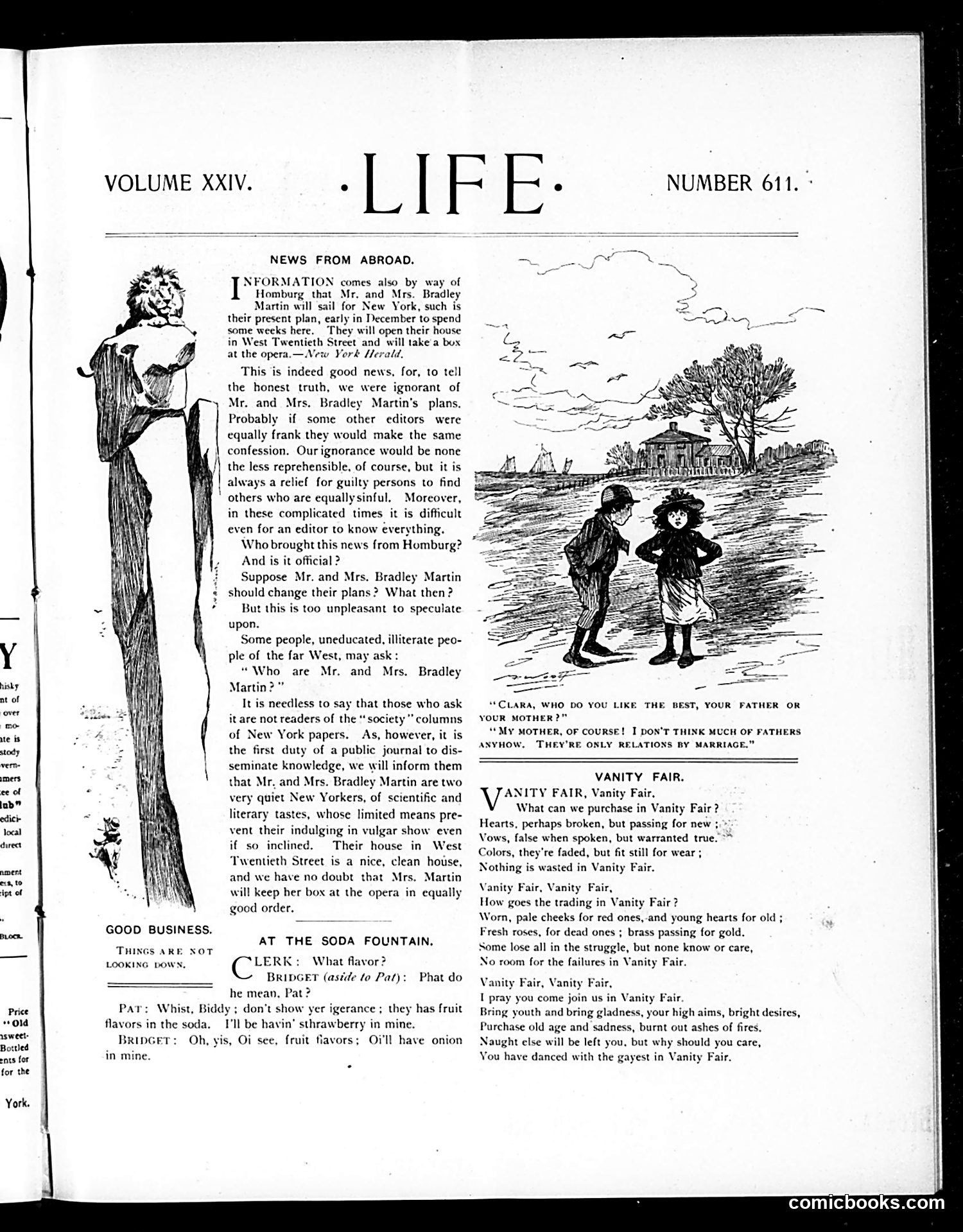
This page contains satirical commentary and humor rather than political cartoons. The "News from Abroad" section discusses Mr. and Mrs. Bradley Martin's plan to spend December in Europe—apparently news that surprised Life's editors, who confess their ignorance. The satire mocks the Martins as wealthy New Yorkers of "scientific and literary tastes" while noting their modest means prevent indulging in vulgar displays. "At the Soda Fountain" presents dialogue humor about drink flavors—a period working-class scene. "Vanity Fair" is a poem about romantic disappointment and lost youth, not political satire. The sketches show period illustration style but lack identifiable caricatures of specific political figures. This appears to be general society satire targeting wealthy elites and social pretension.
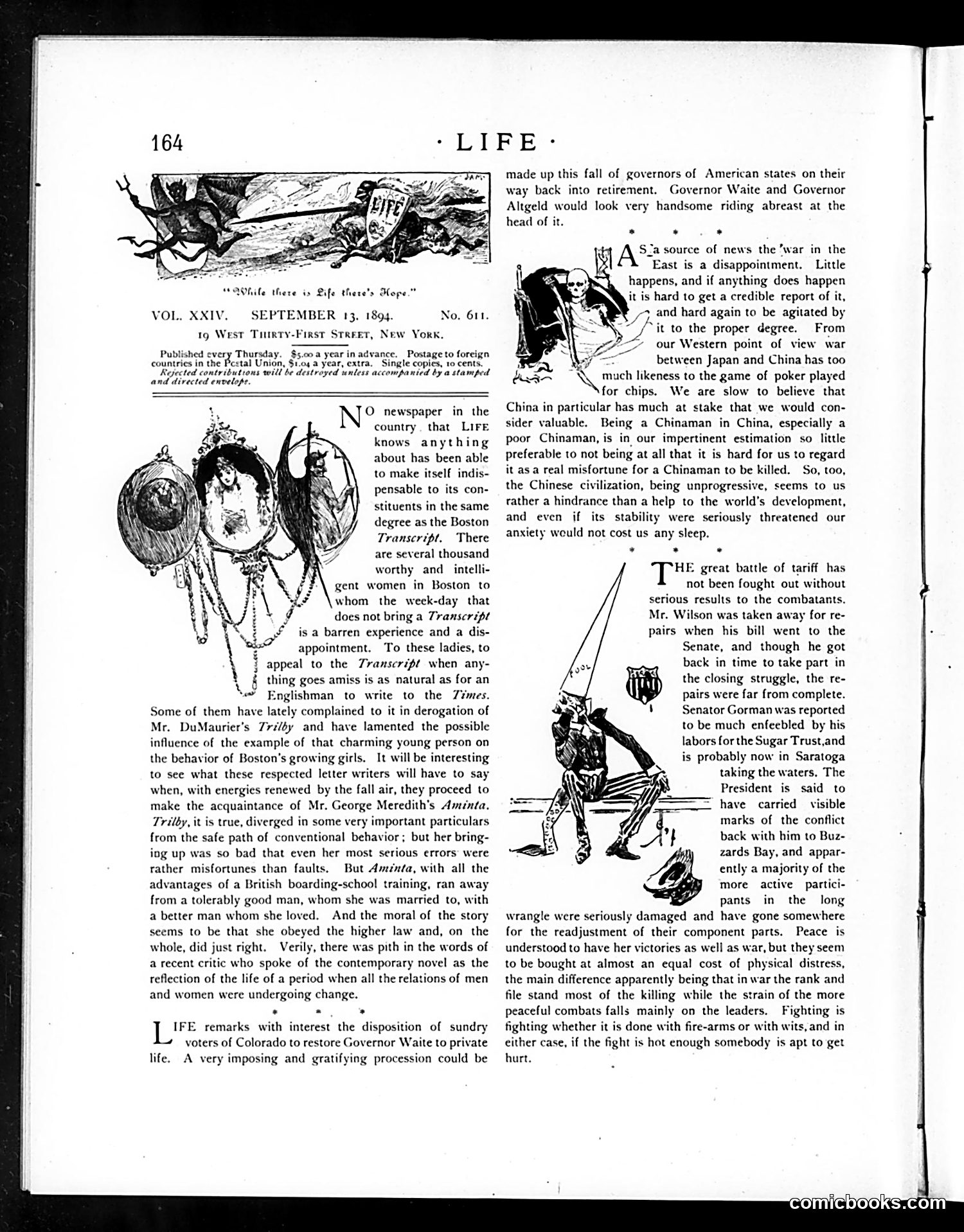
The page contains political commentary and illustrations. The main cartoon depicts a figure labeled "LIFE" (the magazine's mascot) riding what appears to be a donkey or mule, seemingly critiquing political or social issues of the period. The text discusses Colorado voters' efforts to restore Governor Waite to private life, suggesting his governorship was controversial. References to tariff battles mention Senator Gorman and the Sugar Trust, indicating 1890s trade policy debates were contentious enough to affect national politics. The article also critiques Boston women's engagement with transcription work versus newspaper writing, and discusses contemporary novels reflecting social change—particularly regarding women's roles and marital relations. The overall tone satirizes late-Victorian political conflicts and evolving social expectations, particularly around women's work and participation in public discourse.
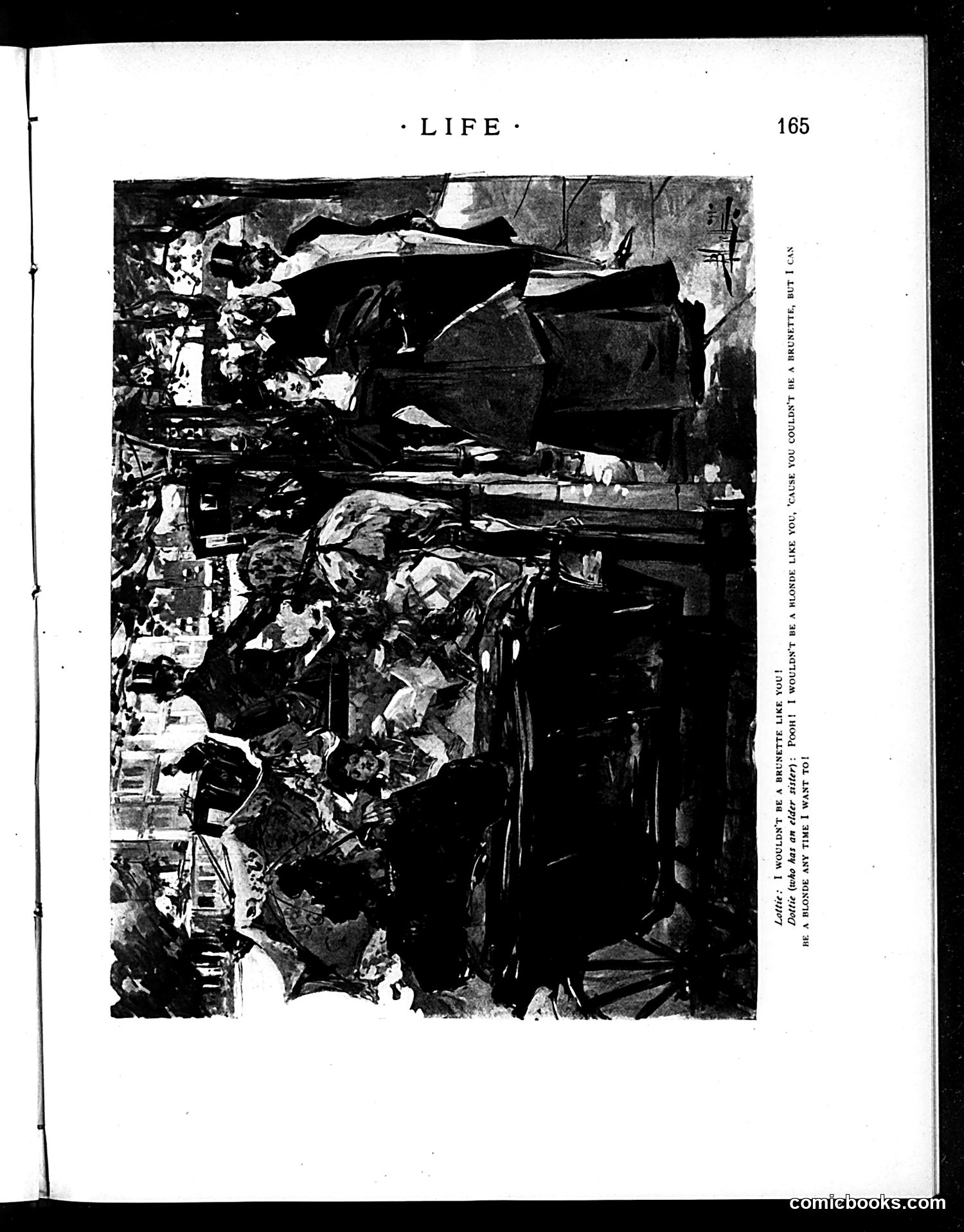
I can see this is page 165 from Life magazine, but the image quality is too poor for me to reliably read the caption text or clearly identify the specific figures depicted. The photograph appears to be a crowded indoor scene with multiple people, but the contrast and resolution don't allow me to distinguish individual faces or determine who is being caricatured or what specific political or social event is being satirized. To accurately explain the cartoon's meaning to a modern reader, I would need either a clearer image or confirmation of the caption text. I cannot responsibly identify the figures or explain the satire without being able to see these details clearly.
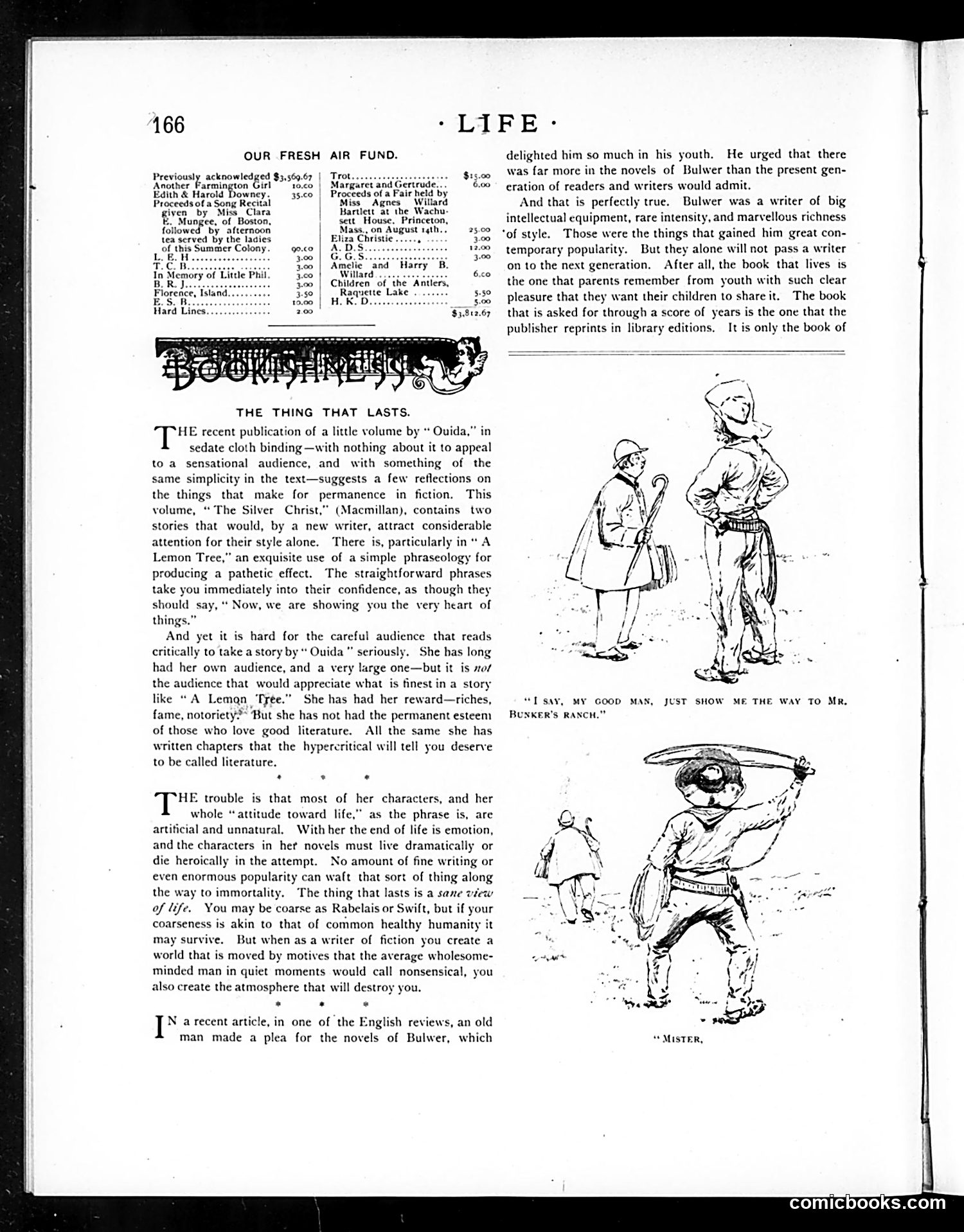
This page contains two distinct elements: **Upper section:** A "Fresh Air Fund" donation list—a charitable fundraising appeal for sending poor urban children to countryside retreats. The modest donations listed ($1-$9) represent typical reader contributions. **Lower section:** Two illustrated vignettes (untitled "Mister" and the first showing dialogue "I say, my good man, just show me the way to Mr. Bunker's ranch") appear to depict rural or frontier encounters. The sketches use a comedic illustrative style common to early 20th-century humor magazines, likely satirizing social interactions between city visitors and rural/ranch inhabitants—a frequent source of Life's humor addressing class and regional differences. The page juxtaposes charitable content with entertainment, typical of Life's editorial mix.
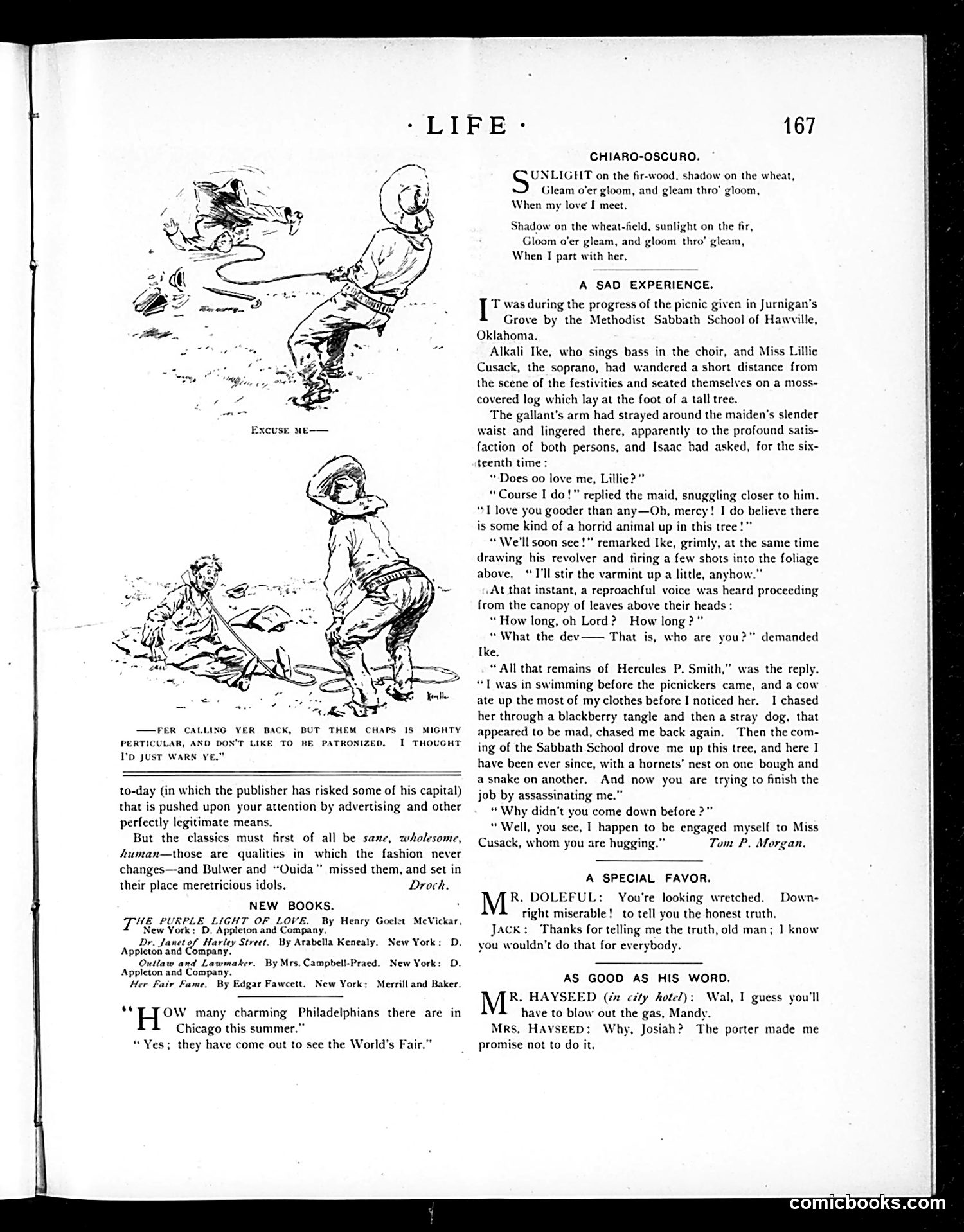
This page contains three separate humor pieces, not political cartoons. The top illustration titled "Excuse me—" shows a child being chased by another child, likely satirizing childhood rudeness or social awkwardness. Below that, "Per calling yer back, but them chaps is mighty peculiar, and I don't like to be patronized. I thought I'd just warn ye" depicts an adult warning about suspicious strangers, possibly mocking rural suspicion or class differences. The text sections are dialogue-based jokes: "A Sad Experience" describes a picnic mishap involving Ike shooting at a tree; "A Special Favor," "As Good as His Word," and similar titled pieces are brief comedic exchanges about everyday situations—broken promises, gas lamps, and porter services. These appear to be general-interest humor pieces rather than topical satire, typical of *Life* magazine's lighter content.
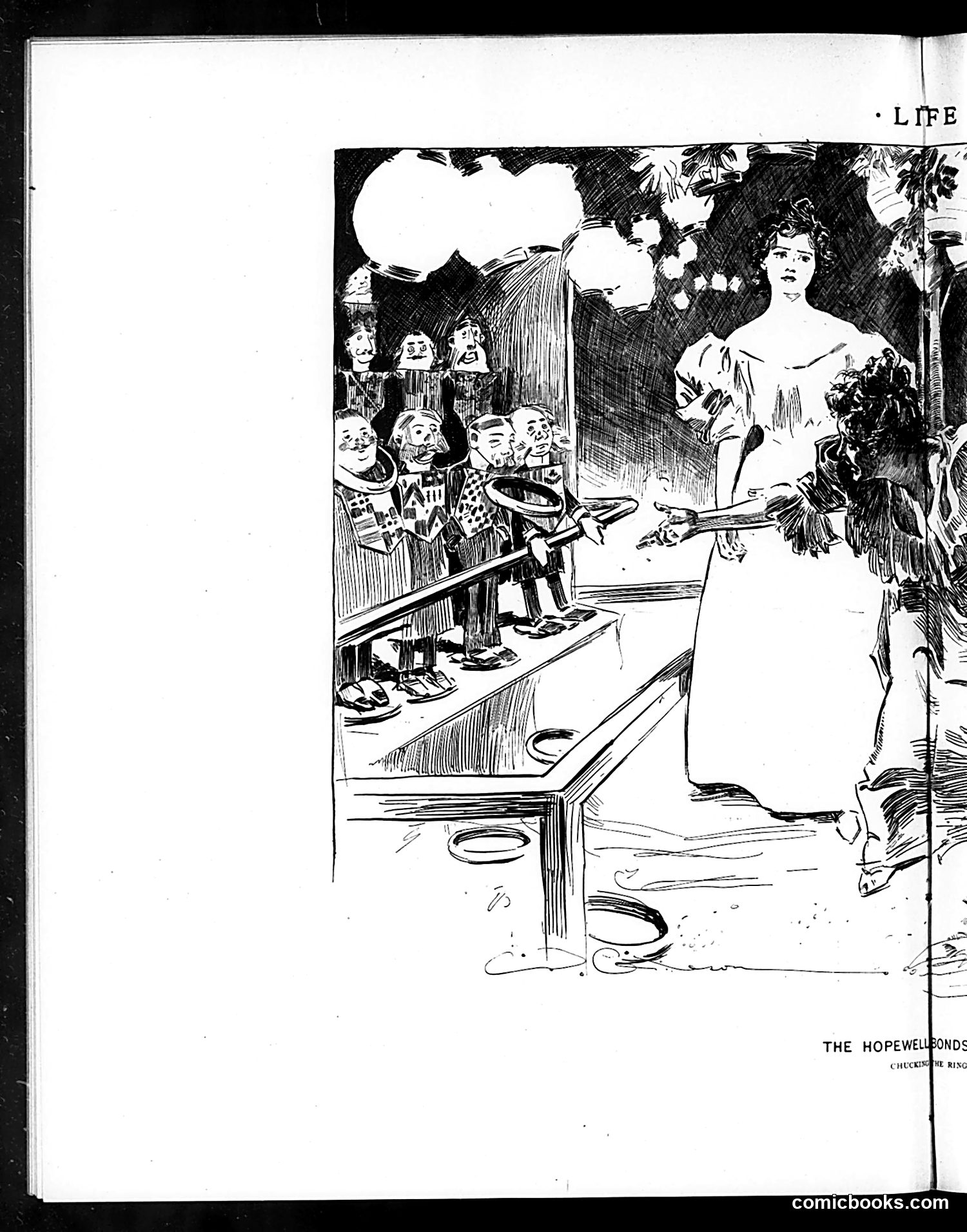
This satirical illustration depicts a woman presenting what appears to be chocolate or confectionery products to a group of well-dressed men in formal attire. The caption references "The Hopewell Bonds" and "Chocolate King," suggesting satire about commercial promotion or marketing schemes. The cartoon likely mocks aggressive sales tactics or financial schemes of the era, with the elegantly-dressed woman as a salesperson and the formally-attired men as potential investors or customers. The theatrical staging—with crowds and elaborate presentation—emphasizes the performative, perhaps dubious nature of the pitch. Without additional context about "Hopewell Bonds" specifically, the precise political or financial target remains unclear, though the satirical tone suggests criticism of either corporate promotion, investment fraud, or commercial excess common to Life magazine's editorial approach.
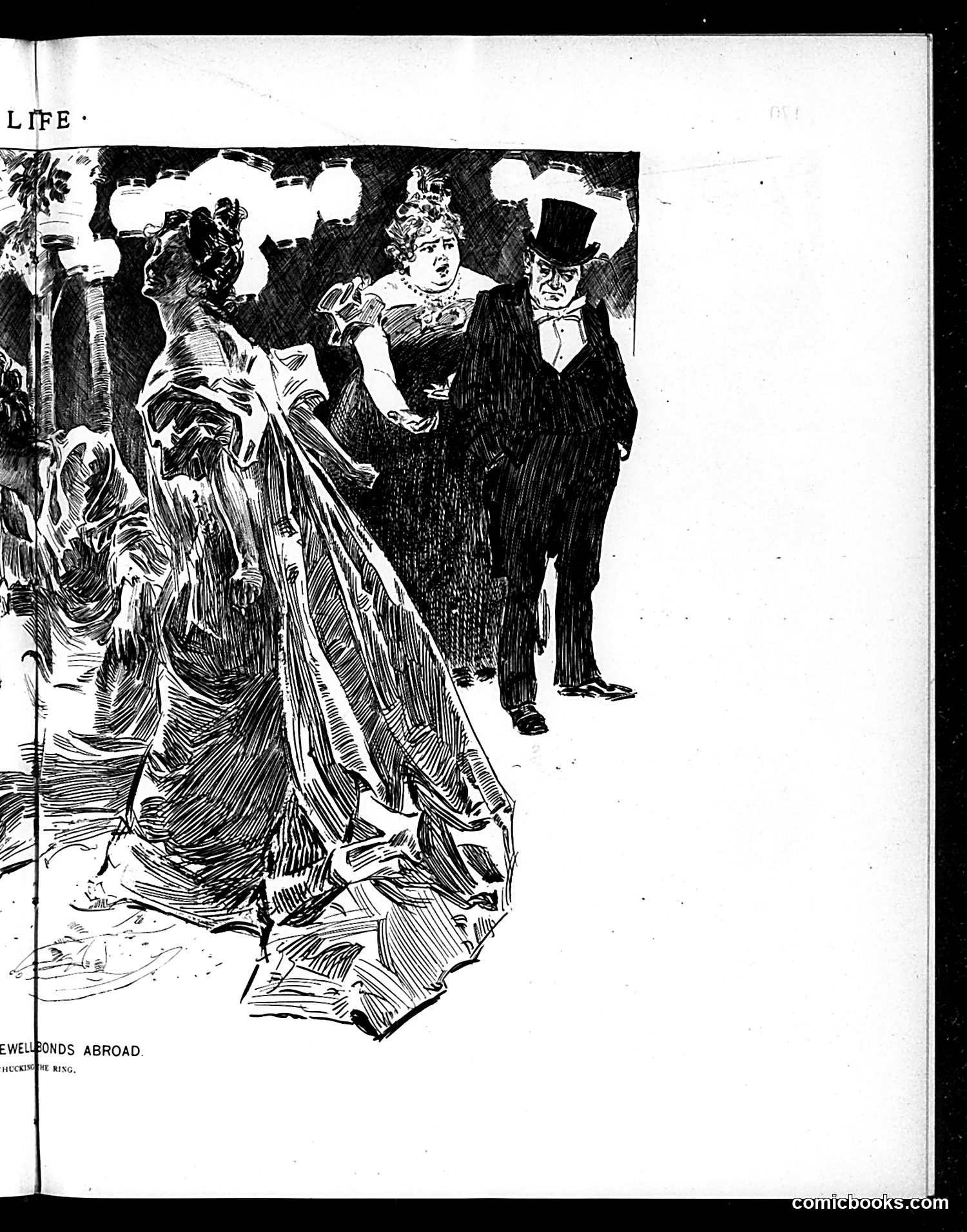
This satirical illustration depicts wealthy American socialites abroad, likely in Europe. The caption "Jewels Abroad" suggests commentary on American wealth display during international travel. The image shows an elegantly dressed woman in an elaborate gown with a long train, accompanied by well-dressed gentlemen in formal attire (top hats and evening wear). The exaggerated styling and detailed rendering emphasize opulence and ostentation. The satire appears to mock wealthy Americans who traveled Europe flaunting their jewelry and finery—a common target of Life magazine's social commentary. The phrase "Jewels Abroad" likely refers both to literal jewels worn and sarcastically to the wealthy Americans themselves as "jewels" being exported/displayed internationally. This reflects period anxiety about American wealth, materialism, and international reputation.
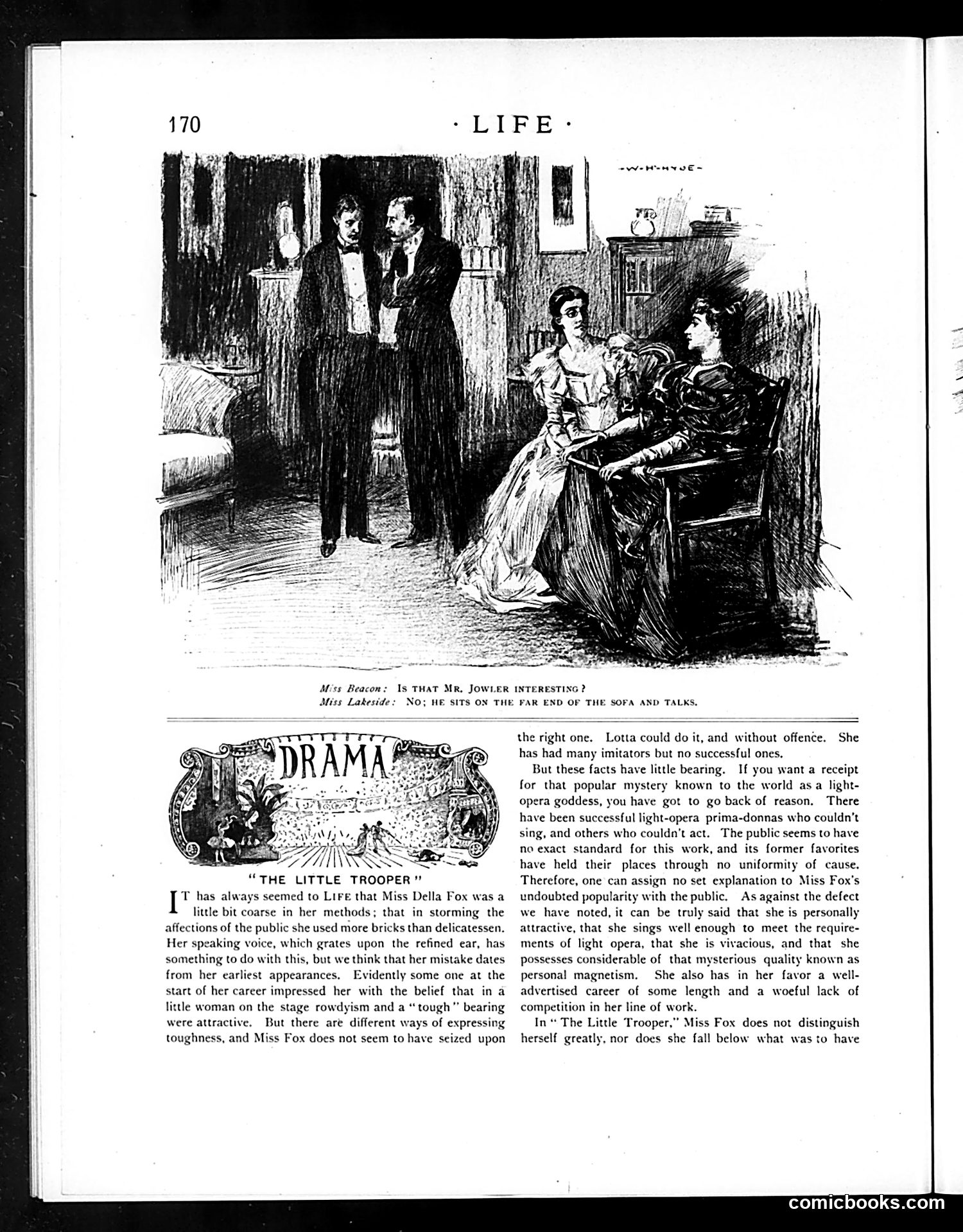
This page from *Life* magazine contains a theatrical sketch and drama column. The cartoon depicts a social scene where Miss Beacon asks Miss Labrside if Mr. Jowler is interesting; the reply is that he "sits on the far end of the sofa and talks"—a joke about boring conversation partners who monopolize discussion without engaging others. The main article reviews "The Little Trooper," a light opera starring Della Fox. The critic notes Fox was famous for playing "tough" female roles despite her small stature, establishing her reputation early in her career. The review acknowledges her popularity while assessing her performance neutrally—she succeeds without distinction, possessing "personal magnetism" but lacking the vocal excellence required for truly great light-opera work.
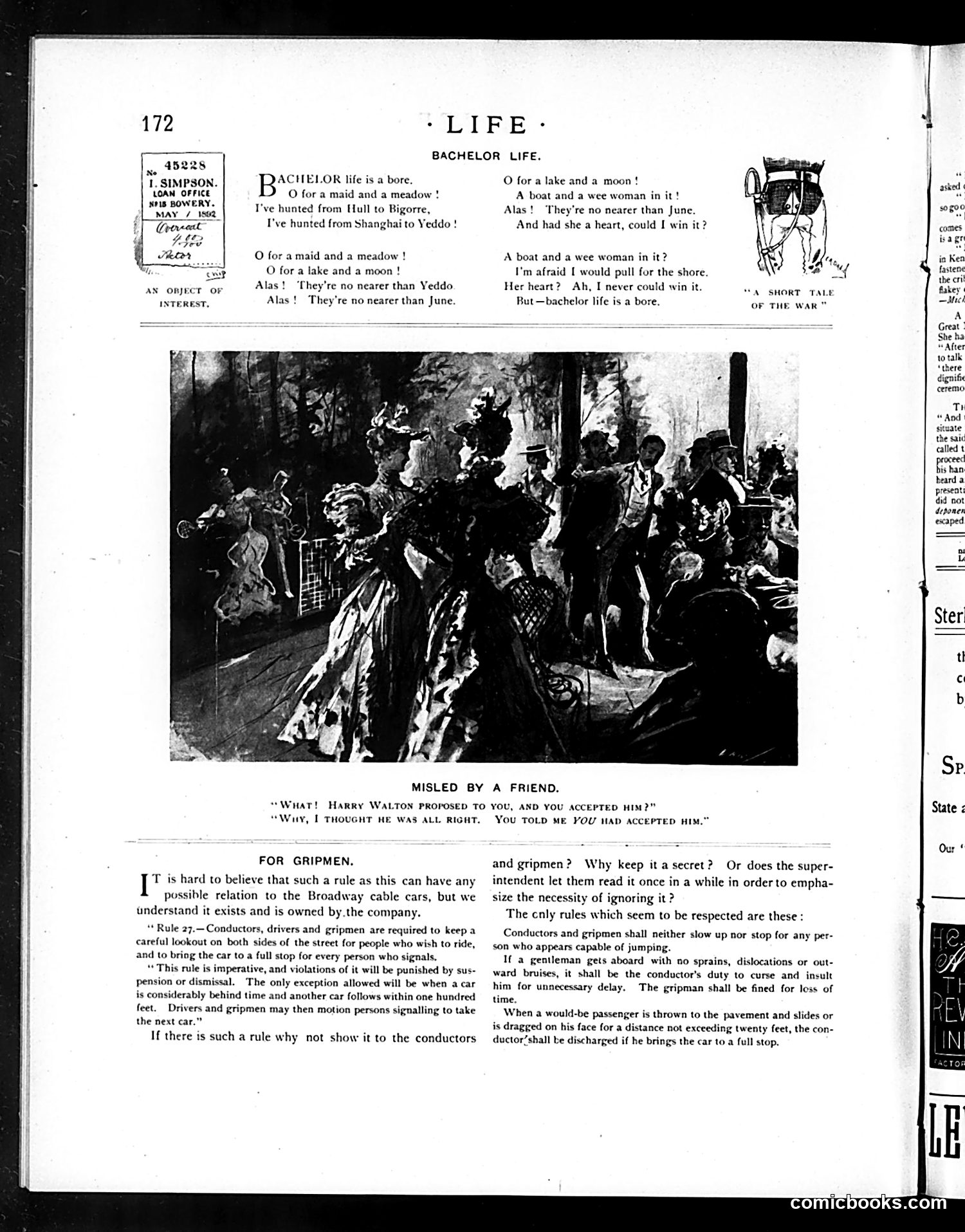
This Life magazine page contains three distinct pieces: **"Bachelor Life"** (top): A poem satirizing the complaints of unmarried men who romanticize domestic life (meadows, moons, boats, women) while traveling extensively ("Hull to Bigorre," "Shanghai to Yeddo"), only to conclude bachelorhood is tedious anyway. The joke: bachelor complaints are self-pitying and contradictory. **"Misled by a Friend"** (middle): A cartoon showing a woman who accepted a marriage proposal under false pretenses. The humor plays on miscommunication—she thought the man was "all right" based on a friend's recommendation, but he apparently wasn't. **"For Gripmen"** (bottom): Satirical mock-rules for Broadway cable car employees. Life exposes the *actual* practice of conductors ignoring passengers by sarcastically listing unofficial rules that contradict the company's stated policy—mocking both the transit company's hypocrisy and employees' deliberate disregard for service standards. The final rule about passengers dragged on pavement is dark humor criticizing reckless negligence.
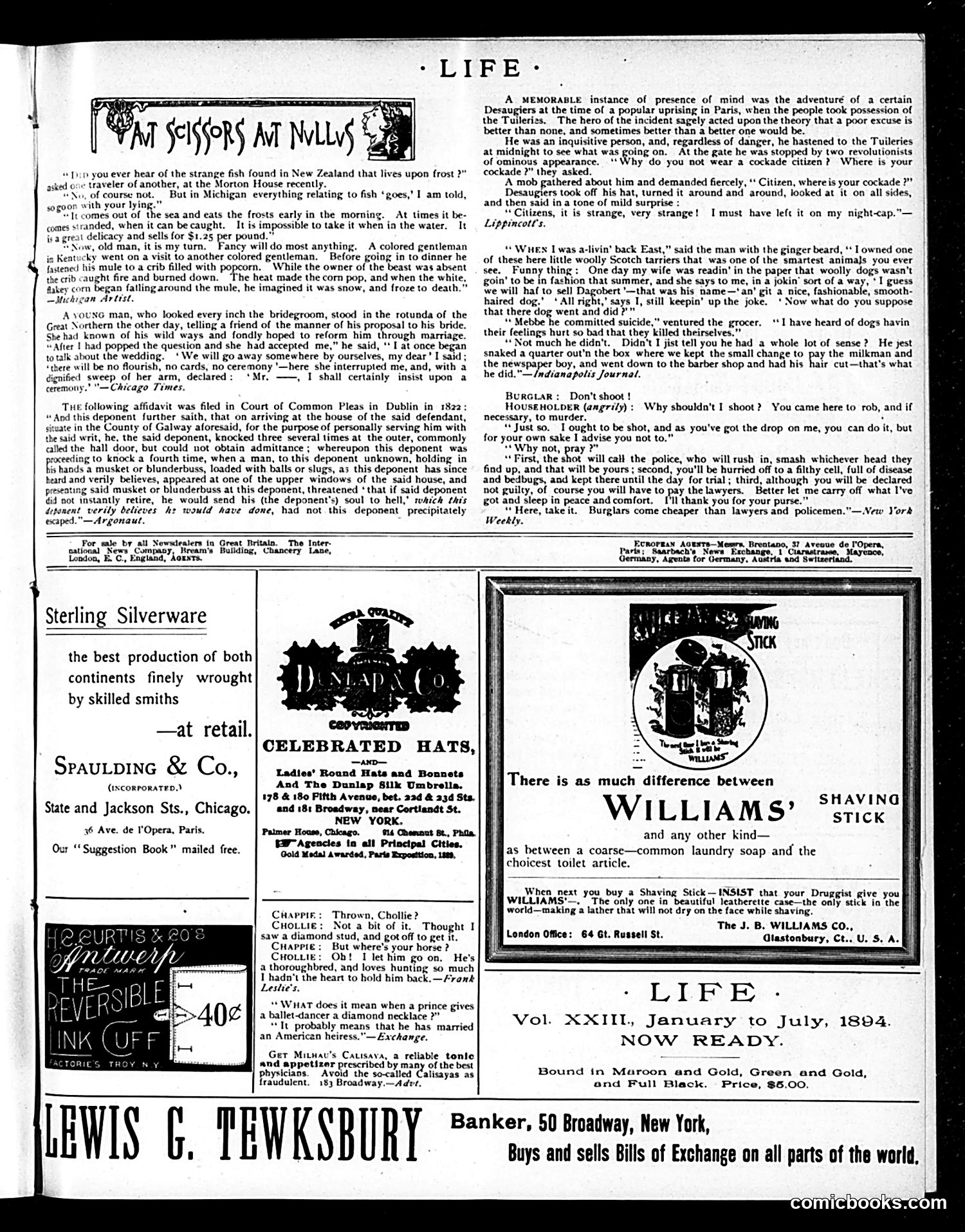
This page is primarily **anecdotal humor and advertisements** rather than political cartoons. The content consists of four distinct joke/story pieces: 1. **"At Scissors at Nulls"** (top): A tall-tale exchange where travelers compete with increasingly absurd stories—a fish that eats frost, a mule that freezes to death from popcorn snow. The humor relies on 19th-century American folk-tale traditions. 2. **The Proposal Story**: A young bridegroom's wedding tale mocking Victorian courtship conventions and his bride's insistence on proper ceremony despite his reform hopes. 3. **The Dublin Affidavit**: A legal document anecdote about a process server confronted by a man with a loaded musket—satirizing Irish legal absurdities and threats of violence. 4. **Desaugiers at the Tuileries**: A historical anecdote about the French Revolution where a man caught without a revolutionary cockade escapes danger through quick thinking and humor. The advertisements (Spaulding silverware, Williams shaving stick, Curtis reversible ink) occupy equal space. This appears to be a typical Life issue mixing genteel humor with commercial content.
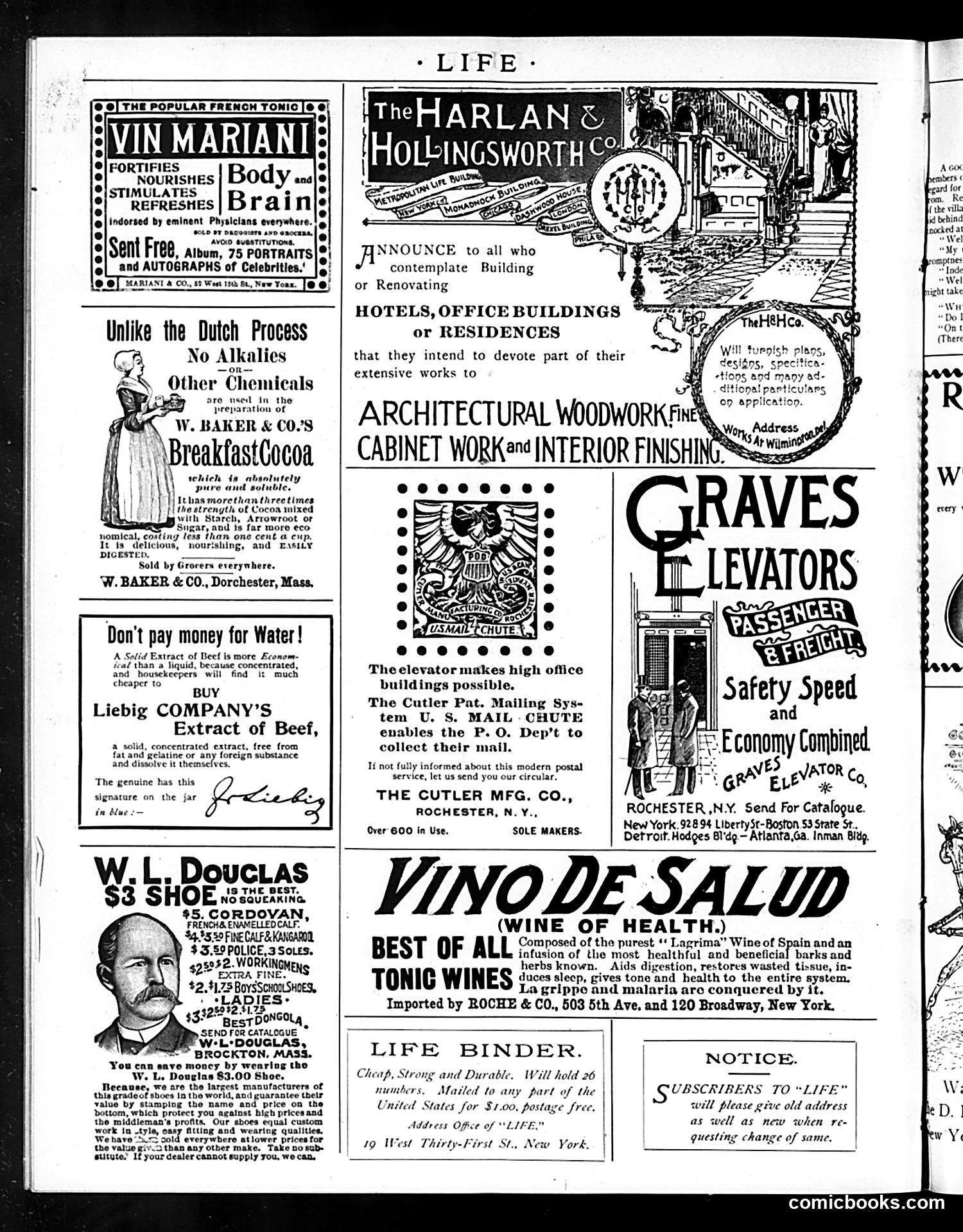
This is primarily an **advertising page** with no editorial cartoons or satirical content. It displays various product advertisements typical of early 20th-century American magazines. Notable ads include: - **Vin Mariani** and **Vino de Salud**: Patent medicines marketed as tonics and health restorers—products that today would be recognized as containing cocaine and alcohol, respectively. These were legal and heavily advertised then. - **W.L. Douglas Shoes** and **Liebig's Extract of Beef**: Standard commercial goods with straightforward product claims. - **W. Baker & Co. Cocoa**: Emphasizes purity compared to competitors using "alkalies" and other chemicals—reflecting contemporary anxieties about food adulteration. - **Graves Elevators**: Highlights technological progress (elevators making tall office buildings possible). The page reflects the era's unregulated advertising landscape and patent medicine industry, before FDA oversight and truth-in-advertising regulations. No satire is evident; these are sincere commercial pitches to consumers.
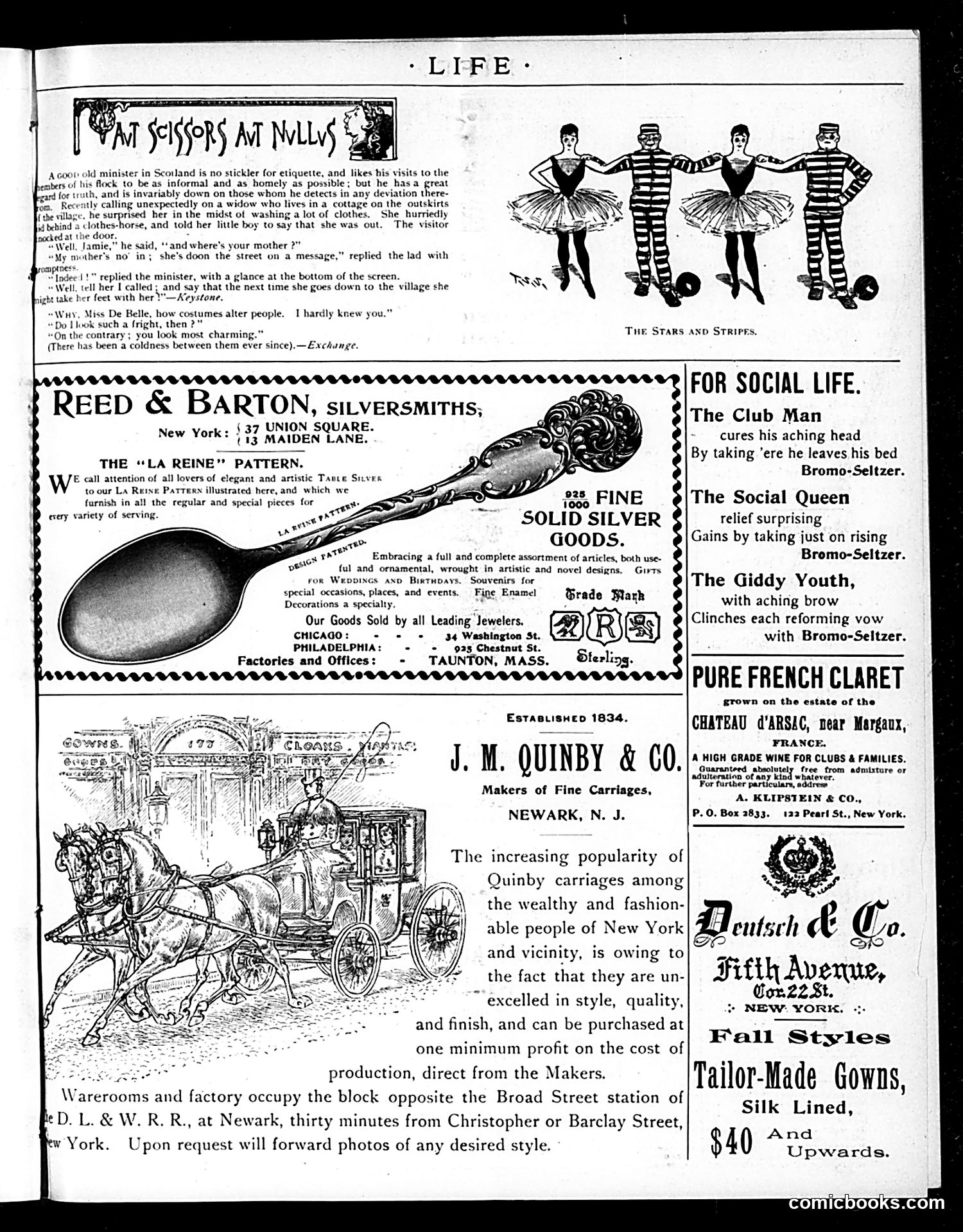
This page is primarily **advertising**, with minimal editorial content. The small illustrations and text snippets at the top appear to be humorous anecdotes rather than political cartoons. The most substantive visual element is **"The Stars and Stripes,"** showing four figures in coordinated costume—two in plain black dresses and two in striped outfits. The title suggests this is fashion commentary, likely satirizing either synchronized fashion trends or perhaps costume coordination among society women. Without additional context, the specific social critique remains unclear. The text anecdotes mock Scottish ministers' surprise visits and awkwardly insincere social compliments between acquaintances—gentle humor about etiquette and hypocrisy. The bulk of the page advertises luxury goods: fine silverware (Reed & Barton), expensive carriages (J.M. Quinby), tailor-made gowns ($40+), French wine, and patent medicines (Bromo-Seltzer)—all targeting wealthy readers. This reflects Life's audience and commercial model.
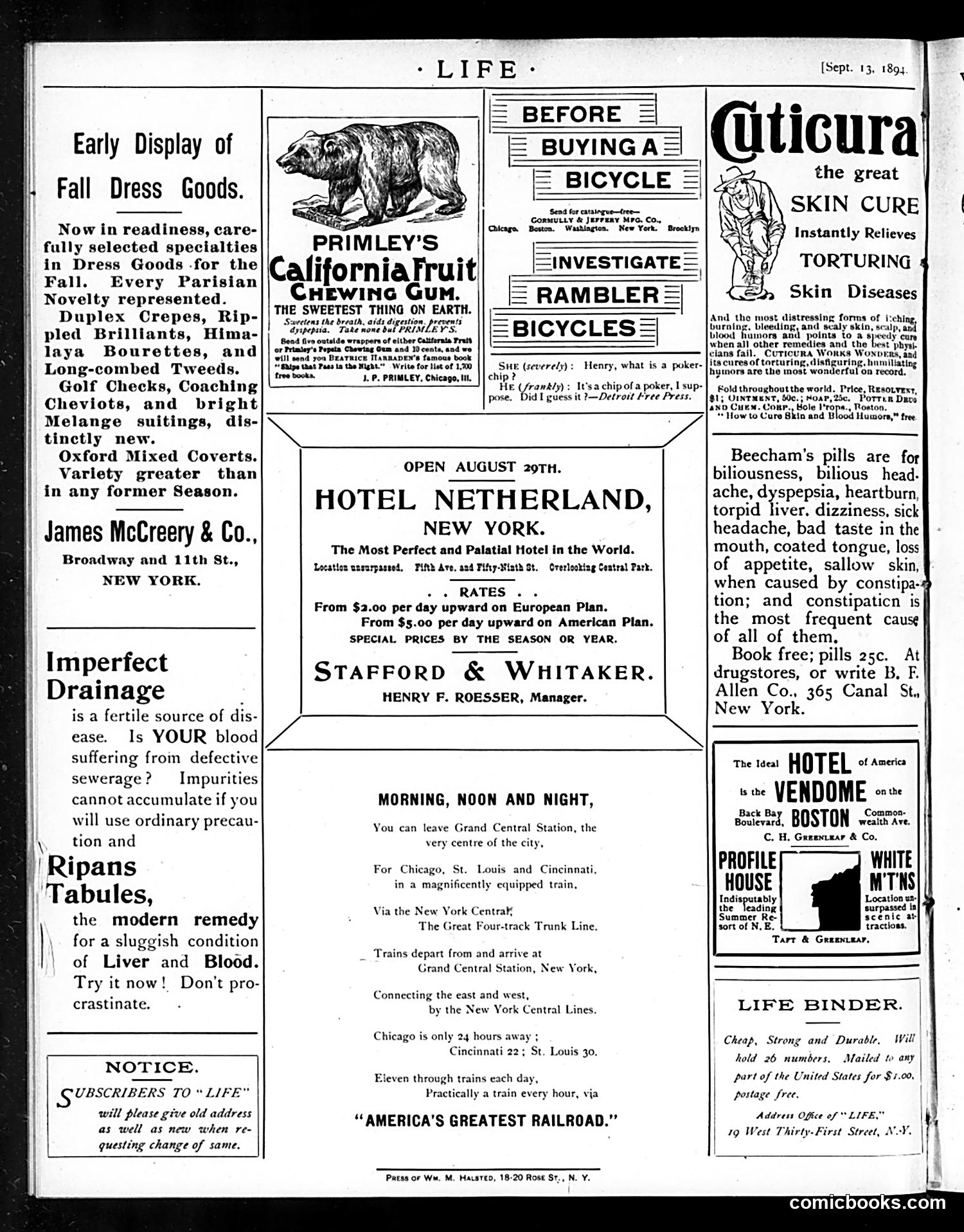
This page is primarily **advertisements and filler content** rather than satirical cartoons. The notable elements include: **The Poker Chip Joke** (center): A brief comic exchange where a wife asks her husband "what is a poker chip?" He replies it's "a chip of a poker"—a literal misunderstanding playing on the double meaning of "chip" (gambling token vs. a piece broken off something). The humor relies on feigned male ignorance or denseness. **Product Advertisements**: The page showcases typical 1890s patent medicines and products—Ripans Tabules for liver/digestive complaints, Cuticura for skin diseases, Beecham's pills—reflecting the era's unregulated medical advertising filled with dubious health claims. **Hotel and Rail Advertisements**: Prominent ads for luxury hotels (Hotel Netherland, Vendome) and the New York Central Railroad emphasize speed and modern convenience. The page reflects **1890s consumer culture and gender dynamics** more than political satire, with the poker joke representing period assumptions about male obtuseness in domestic situations.