
Life, 1894-09-13 · page 11 of 16
Life — September 13, 1894 — page 11: what you’re looking at
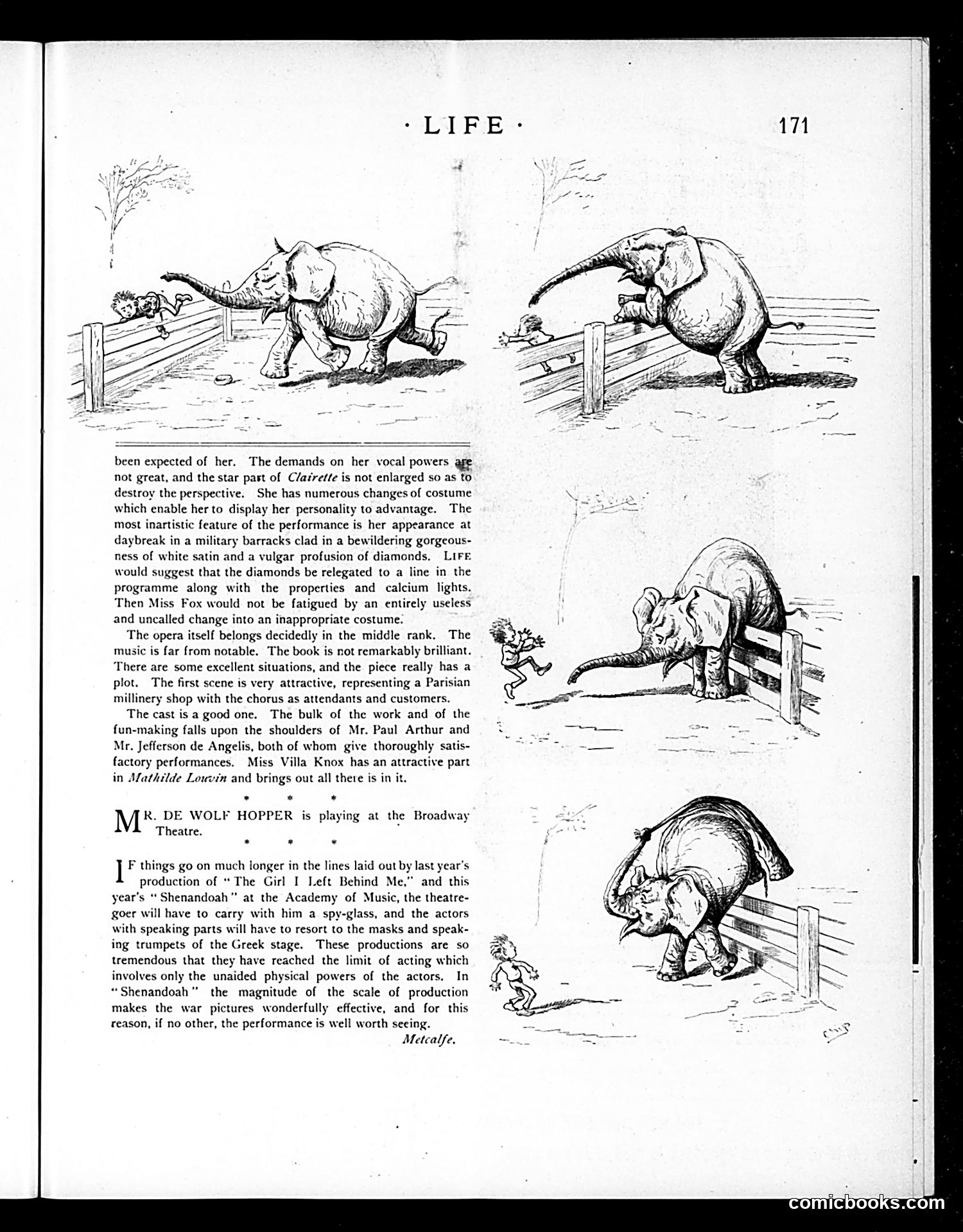
A restored page from Life, 1894-09-13. Page through the whole issue in the reader above.
📄 Transcribed text from this page (OCR, searchable)
Machine-transcribed from the original scan — historical spelling and the odd misread are preserved.
been expected of her. The demands on her vocal powers age not great, and the star past of C/a¢reéte is not enlarged so as to destroy the perspective. She has numerous changes of costume which enable her to display her personality to advantage. The most inartistic feature of the performance is her appearance at daybreak in a military barracks clad in a bewildering gorgeous- ness of white satin and a vulgar profusion of diamonds. LIFE would suggest that the diamonds be relegated to a line in the programme along with the properties and calcium lights. Then Miss Fox would not be fatigued by an entirely useless and uncalled change into an inappropriate costume. The opera itself belongs decidedly in the middle rank. The music is far from notable. The book is not remarkably brilliant. ‘There are some excellent situations, and the piece really has a plot. The first scene is very attractive, representing a Parisian millinery shop with the chorus as attendants and customers. The cast is a good one. The bulk of the work and of the fun-making falls upon the shoulders of Mr. Paul Arthur and Mr. Jefferson de Angelis, both of whom give thoroughly satis- factory performances. Miss Villa Knox has an attractive part in Mathilde Louwvin and brings out all there is in it. . * . R. DE WOLF HOPPER is playing at the Broadway Theatre. : . * . F things go on much longer in the lines laid out by last year's production of “The Girl I Left Behind Me,” and this year's “ Shenandoah” at the Academy of Music, the theatre- goer will have to carry with him a spy-glass, and the actors with speaking parts will have to resort to the masks and speak- ing trumpets of the Greek stage. These productions are so tremendous that they have reached the limit of acting which involves only the unaided physical powers of the actors. In “Shenandoah” the magnitude of the scale of production makes the war pictures wonderfully effective, and for this reason, if no other, the performance is well worth seeing. Metcalfe,