
Life, 1894-09-13 · page 6 of 16
Life — September 13, 1894 — page 6: what you’re looking at
What you’re looking at
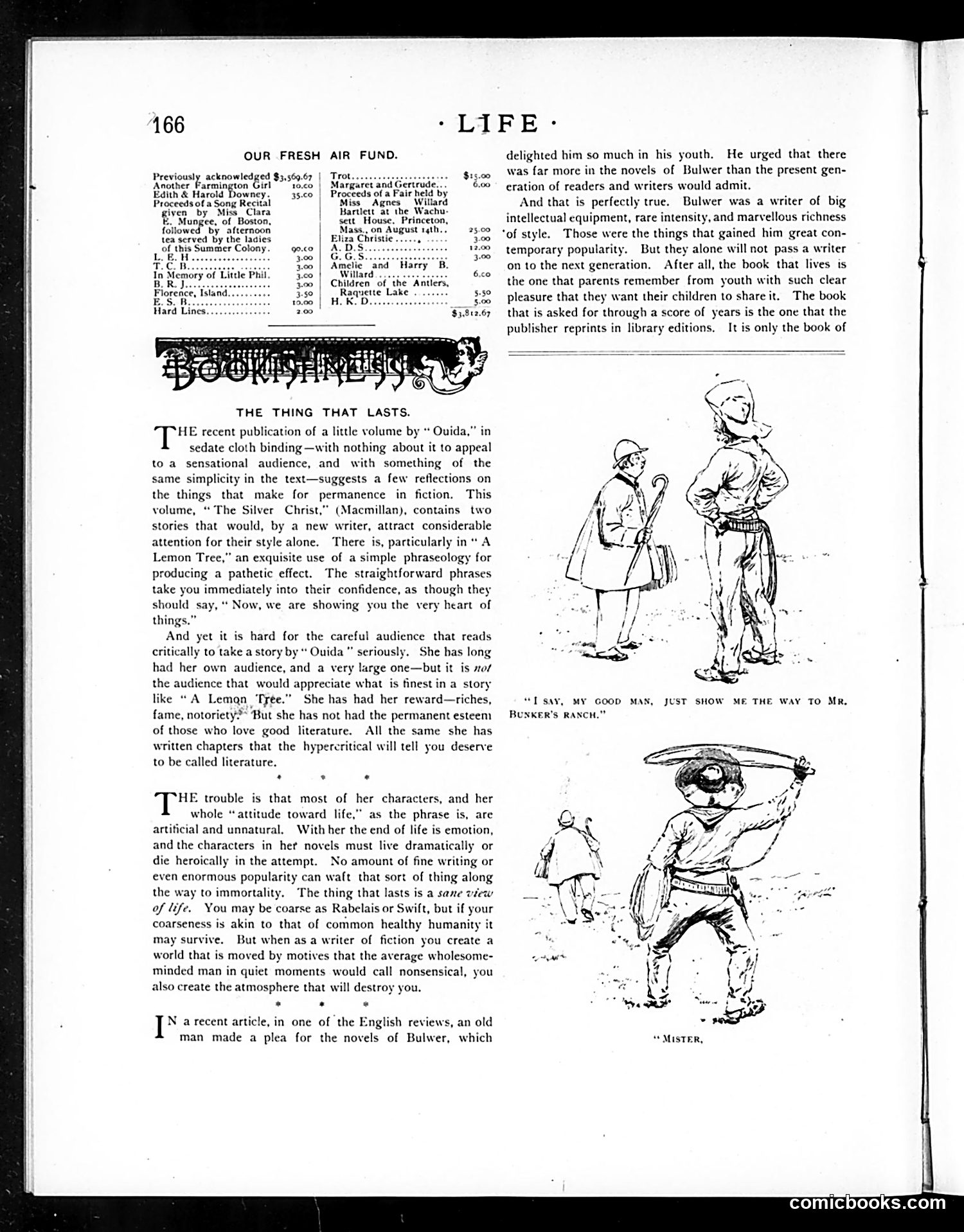
This page contains two distinct elements: **Upper section:** A "Fresh Air Fund" donation list—a charitable fundraising appeal for sending poor urban children to countryside retreats. The modest donations listed ($1-$9) represent typical reader contributions. **Lower section:** Two illustrated vignettes (untitled "Mister" and the first showing dialogue "I say, my good man, just show me the way to Mr. Bunker's ranch") appear to depict rural or frontier encounters. The sketches use a comedic illustrative style common to early 20th-century humor magazines, likely satirizing social interactions between city visitors and rural/ranch inhabitants—a frequent source of Life's humor addressing class and regional differences. The page juxtaposes charitable content with entertainment, typical of Life's editorial mix.
📄 Transcribed text from this page (OCR, searchable)
Machine-transcribed from the original scan — historical spelling and the odd misread are preserved.
- LIFE: OUR FRESH AIR FUND. delighted him so much in his youth. He urged that there Reeviously acknowledged $3.569.67 | Trotes.csee ee was far more in the novels of Bulwer than the present gen- Another Farmington Girl” ro.co | Margaret and Gertrud © eration of readers and writers would admit. Edith & Harold Downey. —_35.co_|_ Proceeds of a Fair held by 2 7 4 Proceeds of a Song Recital Miss, ‘Agnes Willard And that is perfectly true. Bulwer was a writer of big pT Sauagees Of Boston: i eat House. Princeton, intellectual equipment, rare intensity, and marvellous richness foll by afternoot Mass., on August 14th.. Oute she 5 - . zs = tea served by the ladies Bites Chelsie of style. Those were the things that gained him great con of this Summer Colon: . A. D.5....+ temporary popularity. But they alone will not pass a writer mole’ se Harry B. on to the next generation. After all, the book that lives is Children of the Antlers, the one that parents remember from youth with such clear Raneeite LANE sesa2n pleasure that they want their children to share it. The book that is asked for through a score of years is the one that the publisher reprints in library editions. It is only the book of THE THING THAT LASTS. HE recent publication of a little volume by * Ouida,” in sedate cloth binding —with nothing about it to appeal to a sensational audience, and with something of the same simplicity in the text—suggests a few reflections on the things that make for permanence in fiction. This volume, “ The Silver Christ,” (Macmillan), contains two stories that would, by a new writer, attract considerable attention for their style alone. There is, particularly in * A Lemon Tree,” an exquisite use of a simple phraseology for producing a pathetic effect. The straightforward phrases take you immediately into their confidence, as though they should say, “ Now, we are showing you the very heart of things.” And yet it is hard for the careful audience that reads critically to take a story by “ Ouida” seriously. She has long had her own audience, and a very large one—but it is sof the audience that would appreciate what is finest in a story like “A Leman ‘Tyee.” She has had her reward—riches, “Tsay, MY GOOD MAN, JUST SHOW ME& THE Way To MR, fame, notoriety?* But she has not had the permanent esteem — BUNKER’S RANCH.” of those who love good literature. All the same she has written chapters that the hypercritical will tell you deserve to be called literature. . . . HE trouble is that most of her characters, and her whole “attitude toward life,” as the phrase is, are artificial and unnatural, With her the end of life is emotion, and the characters in het novels must live dramatically or die heroically in the attempt. No amount of fine writing or even enormous popularity can waft that sort of thing along the way to immortality, The thing that lasts is a sane view of life. You may be coarse as Rabelais or Swift, but if your coarseness is akin to that of common healthy humanity it may survive. But when as a writer of fiction you create a world that is moved by motives that the average wholesome- minded man in quiet moments would call nonsensical, you also create the atmosphere that will destroy you. * * * N arecent article, in one of the English reviews, an old man made a plea for the novels of Bulwer, which “ MISTER, comicbooks.com