
Life, 1894-09-13 · page 4 of 16
Life — September 13, 1894 — page 4: what you’re looking at
What you’re looking at
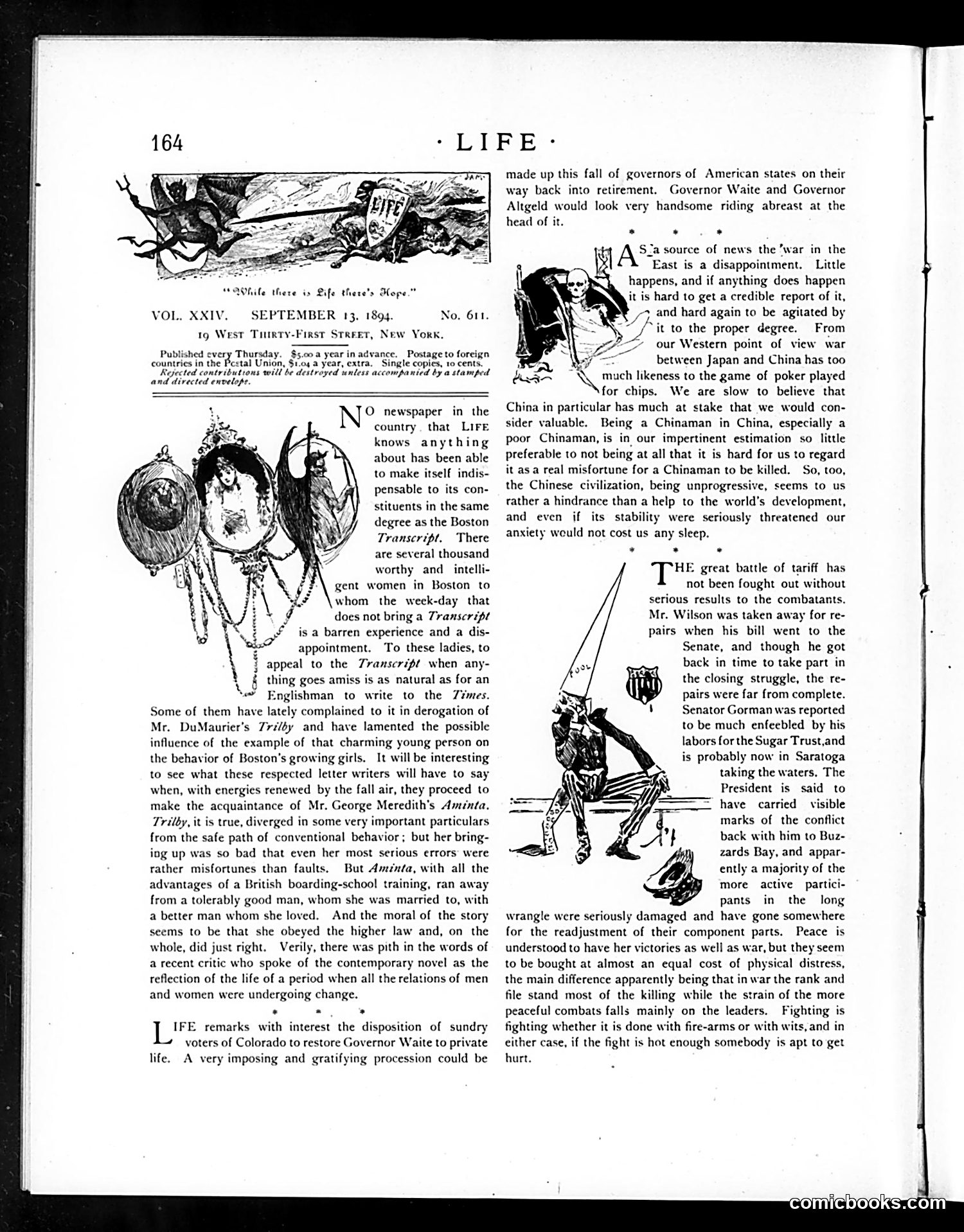
The page contains political commentary and illustrations. The main cartoon depicts a figure labeled "LIFE" (the magazine's mascot) riding what appears to be a donkey or mule, seemingly critiquing political or social issues of the period. The text discusses Colorado voters' efforts to restore Governor Waite to private life, suggesting his governorship was controversial. References to tariff battles mention Senator Gorman and the Sugar Trust, indicating 1890s trade policy debates were contentious enough to affect national politics. The article also critiques Boston women's engagement with transcription work versus newspaper writing, and discusses contemporary novels reflecting social change—particularly regarding women's roles and marital relations. The overall tone satirizes late-Victorian political conflicts and evolving social expectations, particularly around women's work and participation in public discourse.
📄 Transcribed text from this page (OCR, searchable)
Machine-transcribed from the original scan — historical spelling and the odd misread are preserved.
‘LIFE: “QMNie there is Life there's Hope.” VOL. XXIV. SEPTEMBER 13. 1894. No, 611. 1g West Tirrty-First Street, New York. Published every Thursday. $5.00 a year in advance. Postage to foreign countries in the Pestal Union, $r.ay a year, extra. Single copies, 1o cents. Rejected contributions will be destroyed unless accompanied by a stamped and directed envelope. O newspaper in the country. that LIFE knows anything about has been able to make itself ind pensable to its con- stituents in the same degree as the Boston Transcript, There are several thousand worthy and_ intelli- gent women in Boston to whom the weck-day that does not bring a Transcript is a barren experience and a dis- appointment. To these ladies, to appeal to the Zranscript when any- thing goes amiss is as natural as for an Englishman to write to the 7zmes. Some of them have lately complained to it in derogation of Mr. DuMaurier's 77z/éy and have lamented the possible influence of the example of that charming young person on the behavior of Boston's growing girls. It will be interesting to see what these respected letter writers will have to say when, with energies renewed by the fall air, they proceed to make the acquaintance of Mr. George Meredith's Aménta. Trilby, it is true, diverged in some very important particulars from the safe path of conventional behavior ; but her bring- ing up was so bad that even her most serious errors’ were rather misfortunes than faults, But 4mezxéa, with all the advantages of a British boarding-school training, ran away from a tolerably good man, whom she was married to, with a better man whom she loved. And the moral of the story seems to be that she obeyed the higher law and, on the whole, did just right. Verily, there was pith in the words of a recent critic who spoke of the contemporary novel as the reflection of the life of a period when all the relations of men and women were undergoing change. . . . j gs remarks with interest the disposition of sundry voters of Colorado to restore Governor Waite to private life. A very imposing and gratifying procession could be made up this fall of governors of American states on their way back into retirement. Governor Waite and Governor Altgeld would look very handsome riding abreast at the head of it. * * source of news the ’war in the East is a disappointment. Little happens, and if anything does happen it is hard to get a credible report of it, -> and hard again to be agitated by % cs “it to the proper degree. From ~ our Western point of view war ay between Japan and China has too aan \ much likeness to the game of poker played for chips. We are slow to believe that China in particular has much at stake that we would con- sider valuable. Being a Chinaman in China, especially a poor Chinaman, is in our impertinent estimation so little preferable to not being at all that it is hard for us to regard it as a real misfortune for a Chinaman to be killed. So, too, the Chinese civilization, being unprogressive, seems to us rather a hindrance than a help to the world’s development, and even if its stability were seriously threatened our anxiety weuld not cost us any sleep. * . . HE great battle of tariff has not been fought out without serious results to the combatants. Mr. Wilson was taken away for re- pairs when his bill went to the Senate, and though he got back in time to take part in the closing struggle, the re- pairs were far from complete. Senator Gorman was reported to be much enfeebled by his labors for the Sugar Trust,and. is probably now in Saratoga taking the waters, The President is said to have carried visible marks of the conflict back with him to Buz- zards Bay, and appar- ently a majority of the more active _ partici- pants in the long wrangle were seriously damaged and have gone somewhere for the readjustment of their component parts. Peace is understood to have her victories as well as war, but they seem to be bought at almost an equal cost of physical distress, the main difference apparently being that in war the rank and file stand most of the killing while the strain of the more peaceful combats falls mainly on the leaders. Fighting is fighting whether it is done with fire-arms or with wits, and in either case, if the fight is hot enough somebody is apt to get hurt.