
A complete issue · 16 pages · 1894
Life — September 6, 1894
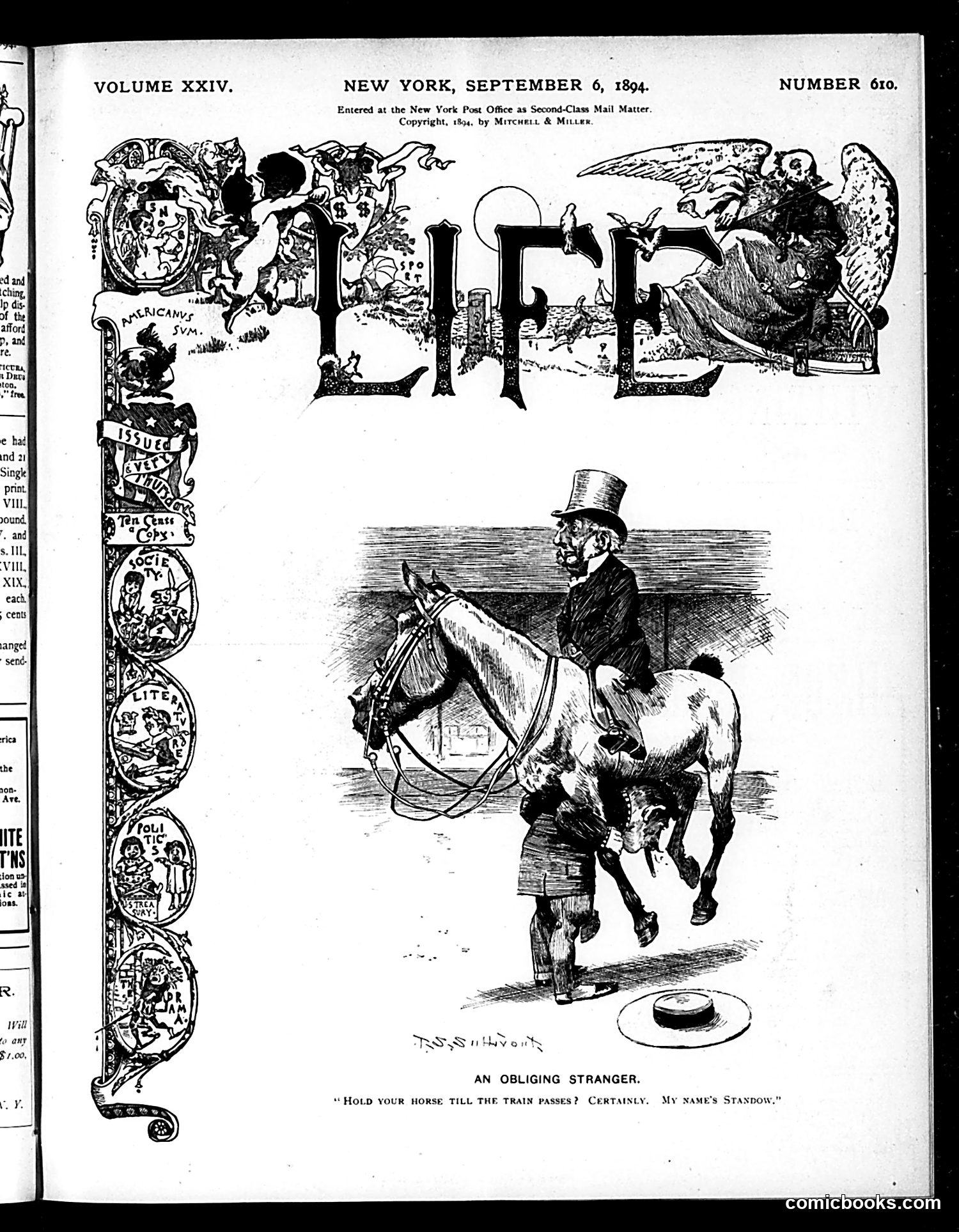
**"An Obliging Stranger"** The cartoon depicts a well-dressed gentleman in a top hat on horseback, holding the animal steady while a train passes. The caption reads: "Hold your horse till the train passes? Certainly. My name's Standow." This appears to be a visual pun playing on the name "Standow" (likely a reference to a contemporary figure, though unclear which one). The joke relies on the wordplay between "stand" and "standby"—the stranger is literally standing by, holding the horse steady while the train passes, making an obliging gesture that puns on his own name. The ornate decorative border on the left is typical of Life's design aesthetic from this era.
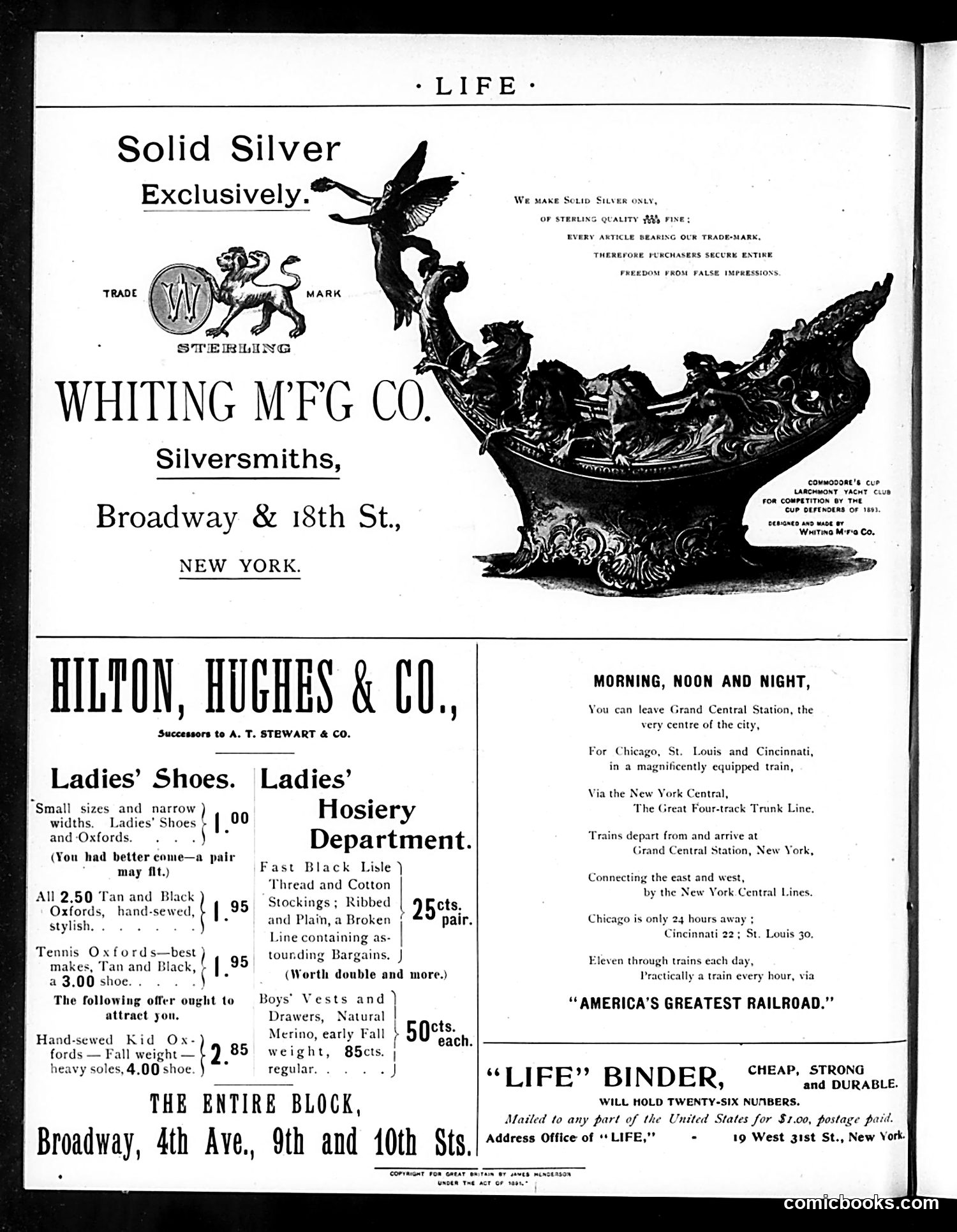
This page is primarily **advertising**, not political satire. The main content comprises: 1. **Whiting MFG Co.** - A sterling silver manufacturer advertising "solid silver exclusively" from Broadway & 18th St., New York. The ornate boat illustration showcases their craftsmanship and appears to reference the "Commodore's Cup" yacht race trophy. 2. **Hilton, Hughes & Co.** - A shoe and hosiery retailer advertising ladies' footwear and stockings with specific prices ($1.00-$2.85). 3. **New York Central Railroad** - Advertising train service to Chicago, Cincinnati, and St. Louis, emphasizing frequency and speed ("America's Greatest Railroad"). 4. **Life Magazine Binder** - A subscription offer for binding 26 issues. There is **no discernible political cartoon or satire** on this page—it is a straightforward advertising spread typical of early 20th-century magazines.
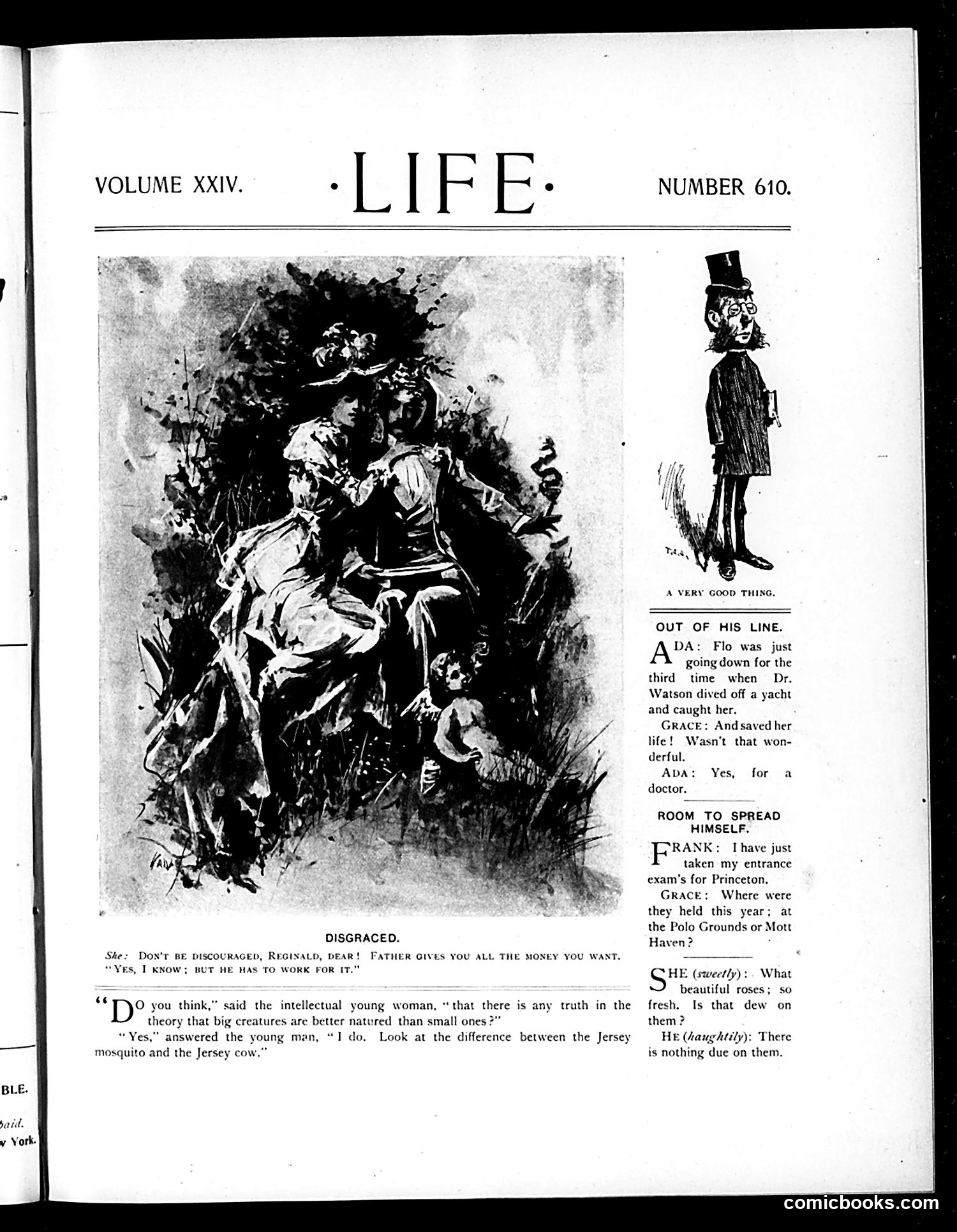
The main cartoon, titled "DISGRACED," depicts a chaotic scene with multiple figures in period dress. The caption quotes a man telling "Reginald" that his father provides money for work, suggesting commentary on idle wealthy youth or nepotism. Below is a dialogue between an "intellectual young woman" and a "young man" debating whether large creatures are better-natured than small ones. The woman references Jersey mosquitoes versus Jersey cows—a joke playing on New Jersey's reputation, likely mocking pseudointellectual dinner conversation of the era. The right sidebar contains brief comic dialogues ("Out of His Line," "Room to Spread Himself," "A Very Good Thing") depicting typical social awkwardness and misunderstandings among middle/upper-class characters. This is typical satirical humor targeting social pretension and intellectual posturing.
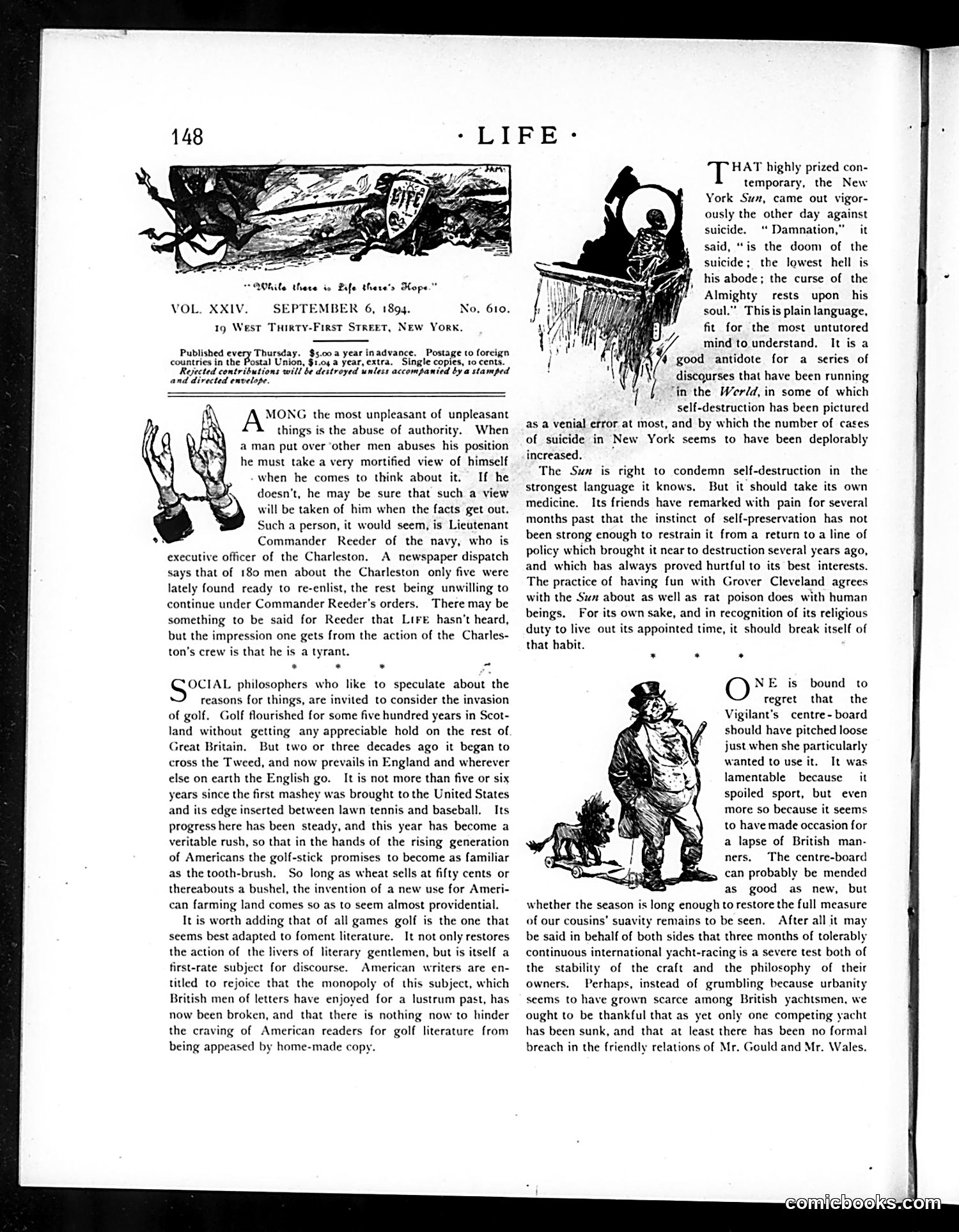
This page contains editorial commentary rather than political cartoons. The text criticizes Lieutenant Commander Reeder of the Charleston, a naval officer accused of abusing his authority and acting as a tyrant toward his crew. The piece defends Life's earlier reporting on this matter. The page also discusses the "invasion" of golf in Britain and America, satirizing how rapidly the sport has spread and become fashionable among the rising generation. The author notes golf's quick adoption in the U.S. since arriving from Scotland, comparing its meteoric rise to other cultural trends. A third section addresses yacht-racing etiquette and complaints about unsportsmanlike behavior among British yachtsmen, suggesting that competitive tensions have damaged previously friendly relations between participants like Mr. Gould and Mr. Wales. The illustrations appear to be generic decorative elements rather than caricatures of specific individuals.
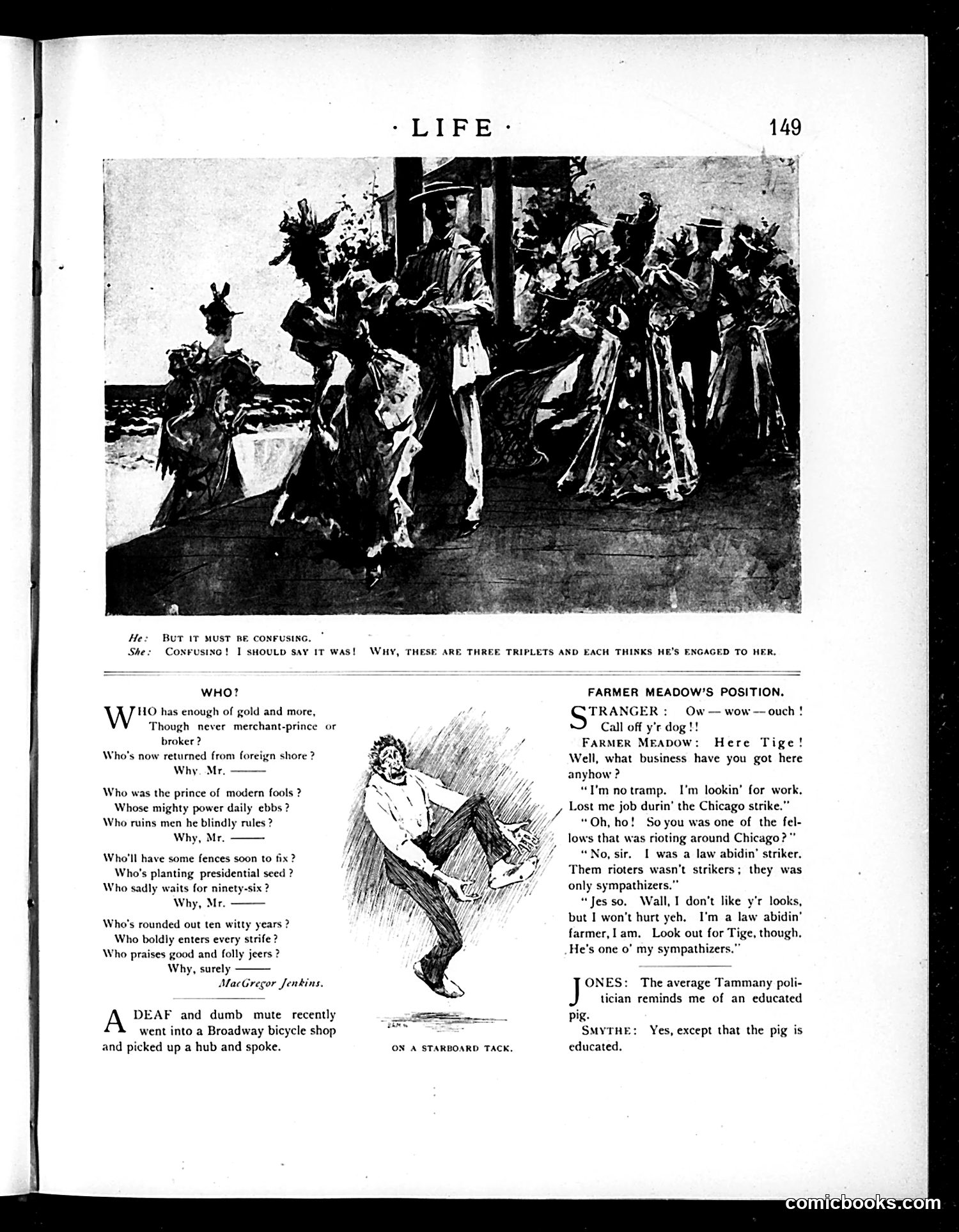
The top photograph shows an elaborate costume scene with multiple figures in ornate Asian dress, illustrating the dialogue below about confusion regarding engagements—three triplets each thinking they're engaged to the same woman. The middle section contains "WHO?" — a poem by MacGregor Jenkins posing riddles about unnamed contemporary figures: someone wealthy, recently returned from abroad, involved in politics, and praised by "tolly jeers" (likely "jolly jeers"). Without additional context, these figures remain unidentified. The bottom anecdote humorously describes a deaf and dumb mute entering a bicycle shop and purchasing a hub and spoke through pantomime—a simple slapstick joke playing on communication barriers. The right sidebar satirizes "Farmer Meadow's Position," depicting rural working-class sympathy during labor unrest, contrasting with urban sophistication.
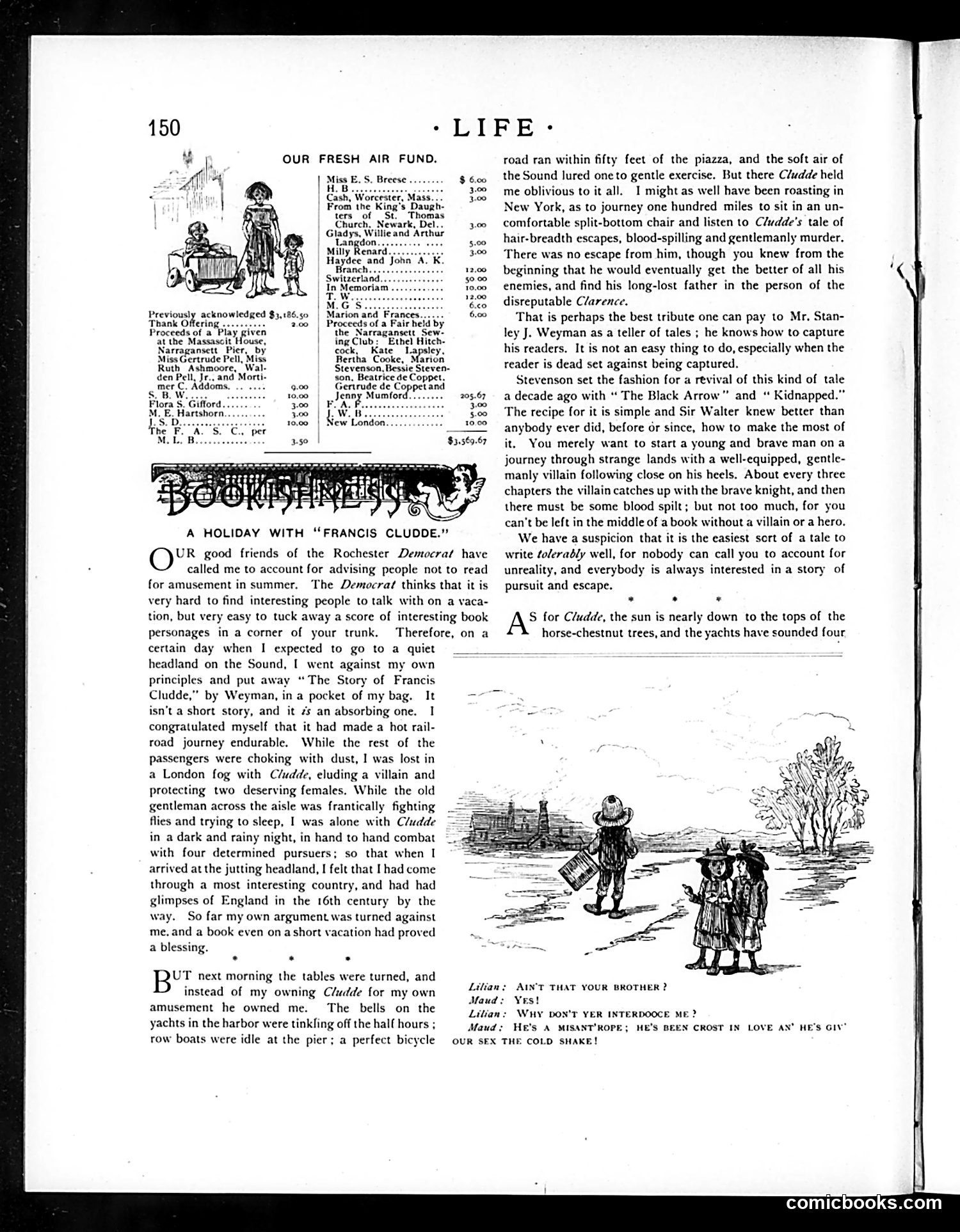
This page combines a charitable fundraising list ("Our Fresh Air Fund") with a book review of "The Story of Francis Cludde" by Stanley J. Weyman. The review discusses how Weyman revived the adventure tale genre, noting readers appreciate stories featuring villains, pursuits, and escapes. The critic praises Cludde as an engaging read, comparing it favorably to historical adventure fiction. The small illustration at page bottom depicts two figures—likely Lias and Maud from the story—in conversation by water, with a steamship visible. The dialogue references introducing a brother and romantic tension, suggesting typical plot elements of Victorian-era adventure romance. The "Fresh Air Fund" listing shows donations for sending urban children to the countryside—a genuine Progressive Era charitable cause addressing child welfare in industrial cities.
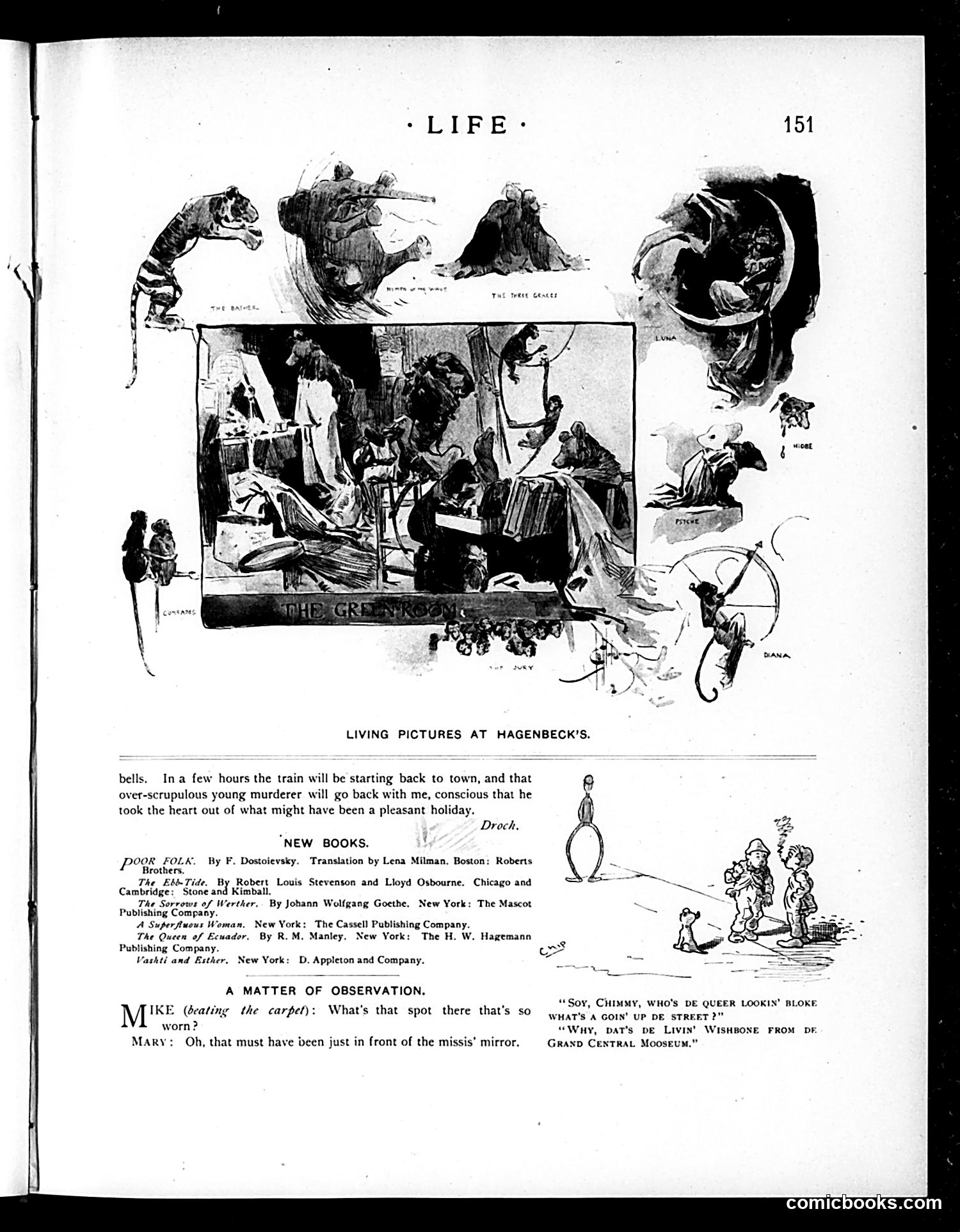
This page features a satirical illustration mocking the live animal displays at Hagenbeck's (a famous European zoo/menagerie). The central panel labeled "THE GREAT CONCERN" shows animals arranged like humans in a theatrical scene—apes and other creatures appear to mimic human social situations, drama, and behavior. The surrounding smaller sketches emphasize this anthropomorphization, depicting animals engaging in distinctly human activities. The satire suggests that visitors to such exhibitions project human characteristics onto animals, or that the spectacle itself presents animals as crude parodies of human society. Below are unrelated content items: book reviews, a brief comic dialogue about a carpet stain, and period advertising illustrations. The page overall demonstrates *Life* magazine's characteristic blend of social satire with miscellaneous content.
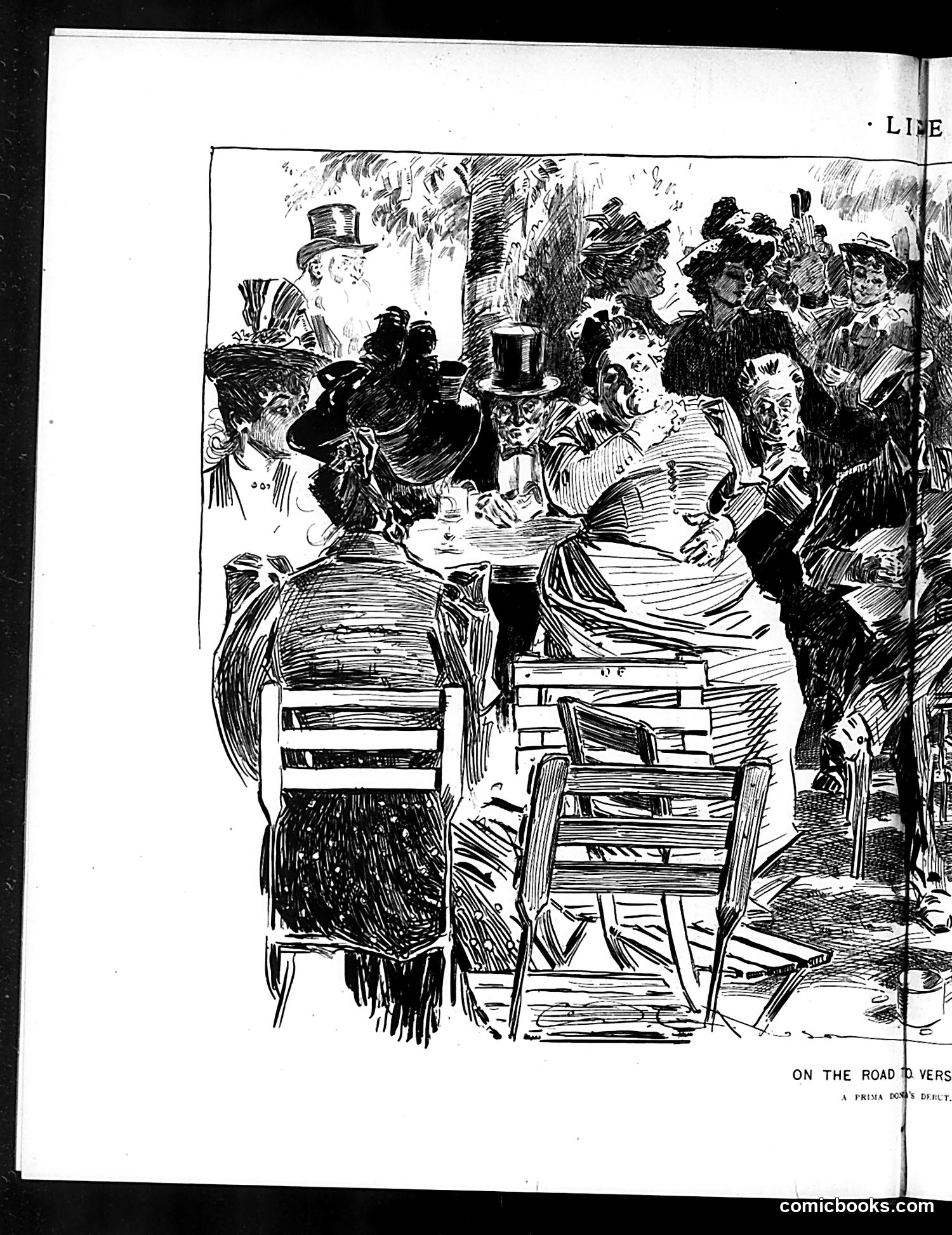
This is a satirical illustration from *Life* magazine showing an outdoor social gathering, likely from the late 19th or early 20th century based on the clothing styles and artistic technique. The caption reads "ON THE ROAD TO VERS[AILLES]" with a subtitle mentioning "A PRIMA DONNA'S DEBUT." The sketch depicts well-dressed figures at what appears to be a society event or garden party. The satire likely mocks either: - The pretensions of nouveau riche or social climbers aspiring to Versailles-level grandeur - A prima donna (opera singer) making her social debut and the affectations surrounding it The detailed clothing, top hats, and formal setting suggest commentary on upper-class society's conventions and vanities. However, without identifying specific individuals in the crowd, the precise satirical target remains unclear from the image alone.
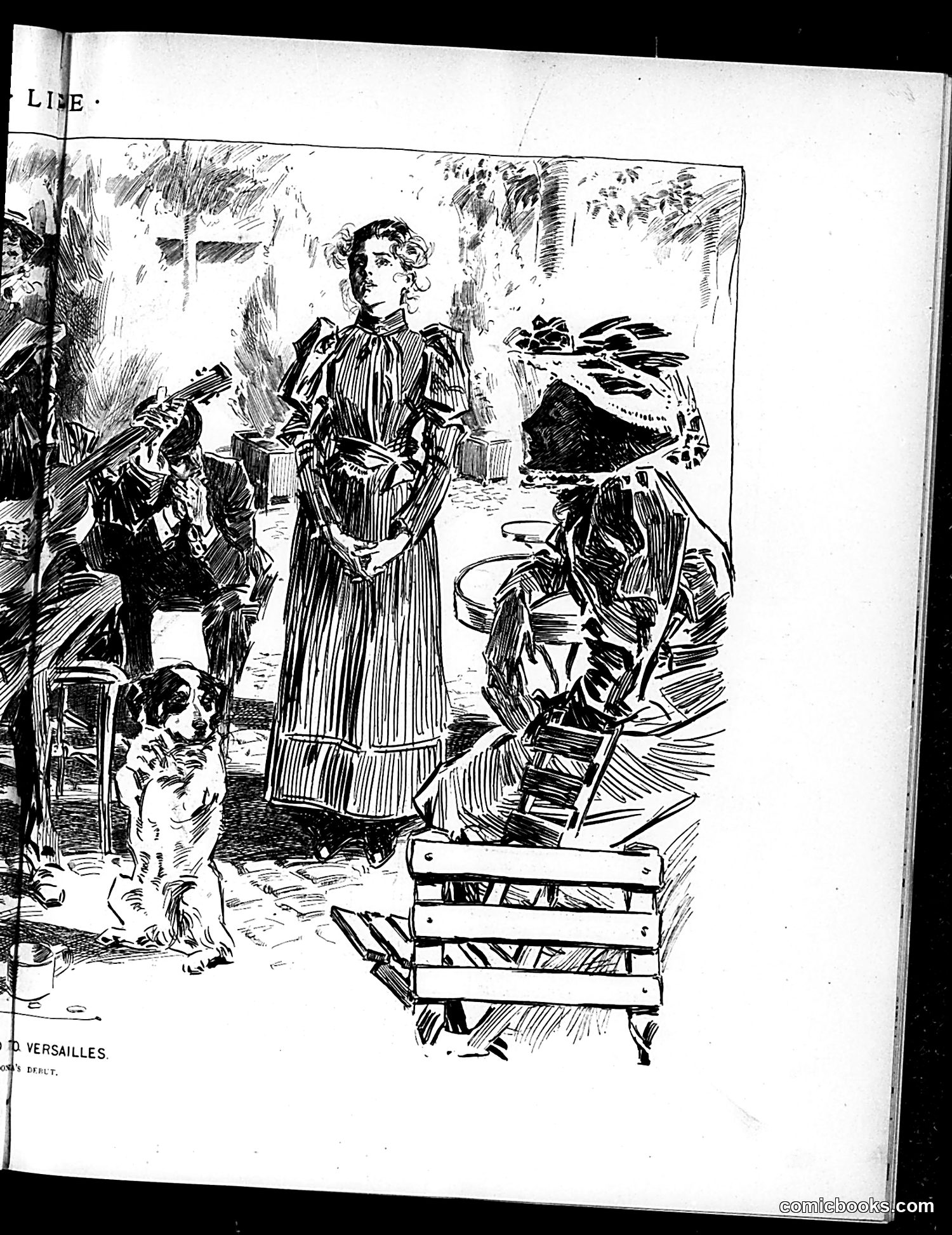
This appears to be a satirical illustration titled "D VERSAILLES" (likely referencing the Treaty of Versailles). The central figure is a woman in a long, striped dress standing among what appear to be children or smaller figures engaged in various activities. A small dog is visible at left. The satire likely comments on post-WWI diplomacy or peace negotiations, with the woman—possibly representing a nation, idealistic concept, or political figure—surrounded by chaotic or childish behavior. The contrast between her composed, dignified stance and the disorder around her suggests mockery of attempts to maintain order or control during turbulent political times. Without additional context, the specific identity of the central figure and exact satirical target remain unclear.
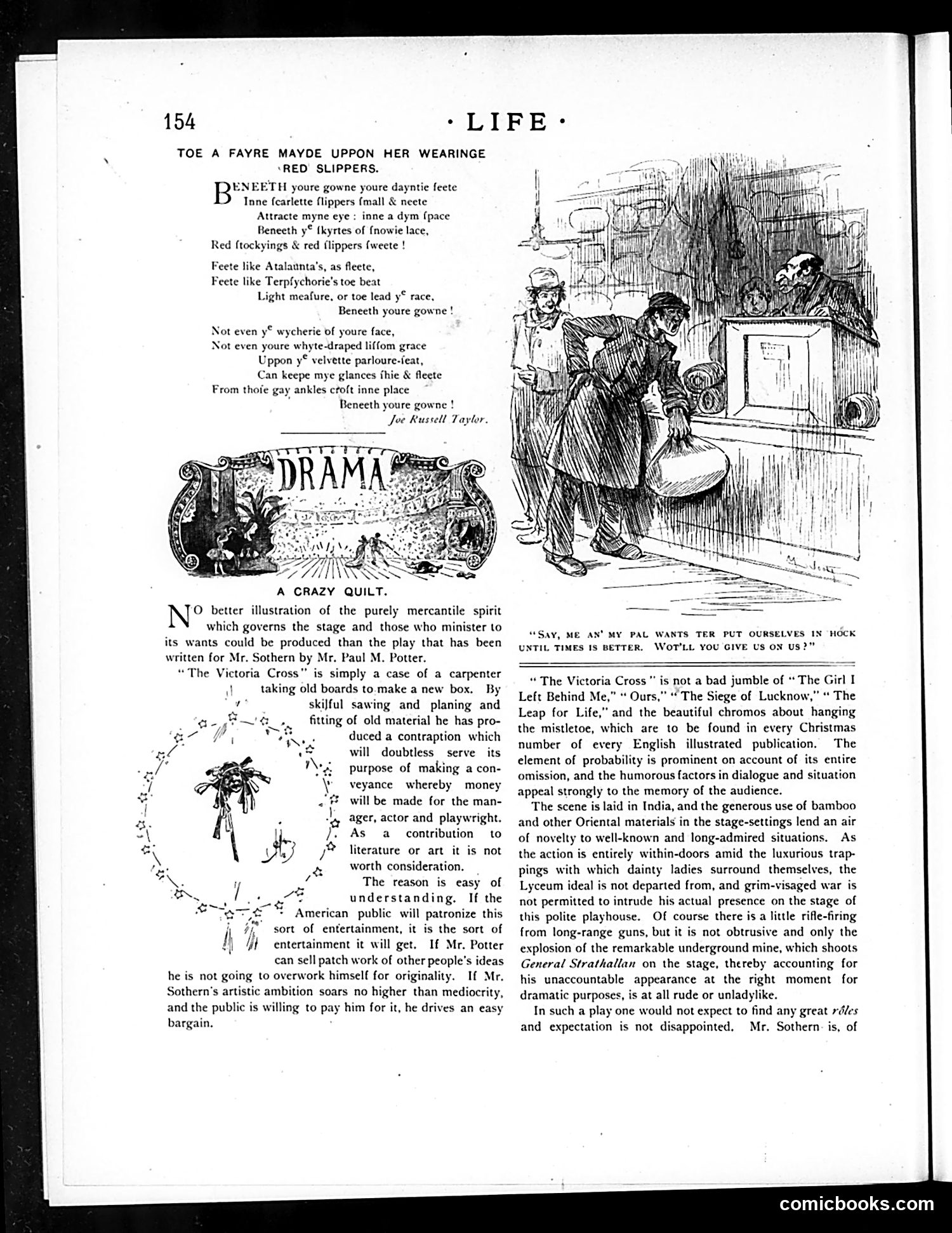
This page contains two distinct sections: **Upper section**: A poem "To a Fayre Mayde Upon Her Wearinge Red Slippers," credited to Joe Russell Taylor. It's a conventional romantic verse praising a woman's feet and ankles—typical Victorian-era gallantry that mixes classical allusions (Atlanta, Terpsichore) with flowery language about "red slippers" and "gay ankles." **Lower section**: A drama review of "A Crazy Quilt," a play by Paul M. Potter. The critic praises the production's theatrical mechanics and carpenter work, discussing how the play uses stage illusions to create novelty. He argues the public will patronize such entertainment if it's competently executed, even if artistically modest—essentially defending popular theater as worthwhile commercial entertainment despite lacking high artistic ambition. The illustration shows what appears to be a stage scene with figures in period dress.
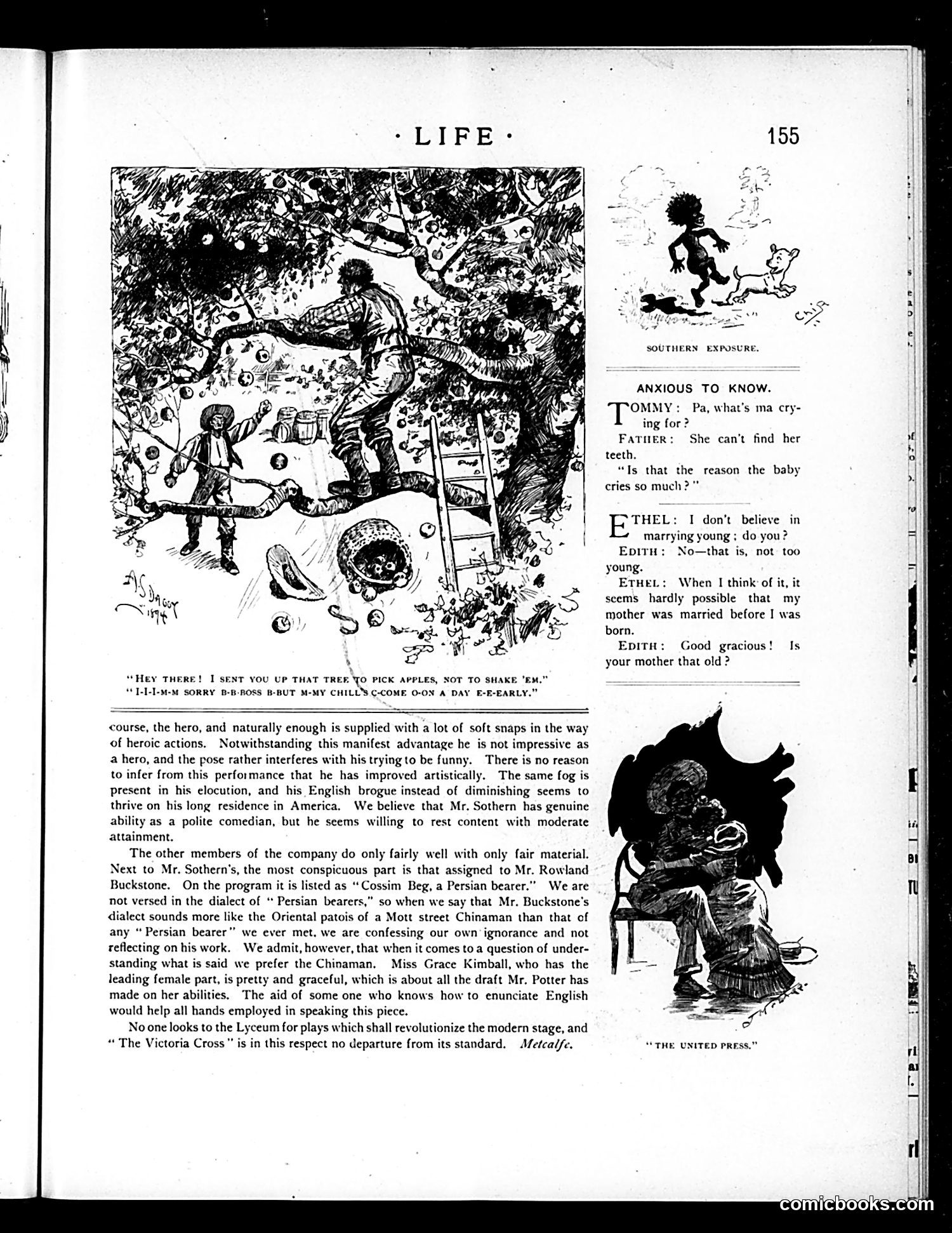
The main cartoon depicts a chaotic picnic scene where adults and children sprawl among food and scattered items. The caption reads: "HEY THERE! I SENT YOU UP THAT TREE TO PICK APPLES, NOT TO SHAKE 'EM. I'LL-I-M SORRY B-B-BOSS B-BUT M-MY CHILLS COME O-ON A DAY E-E-EARLY." This satirizes childhood mischief and parental frustration—a child sent to pick apples has instead shaken them down (likely ruining them). The stutter in the child's apology adds comedic effect. The accompanying text reviews a theatrical production called "The Victoria Cross," criticizing the lead actor Mr. Southern's comedic performance as unimpressive. The dialogue snippets mock overly formal English speech patterns among Americans. The smaller cartoon titled "The United Press" and "Southern Exposure" depict additional satirical commentary on American social pretensions and regional behavior.
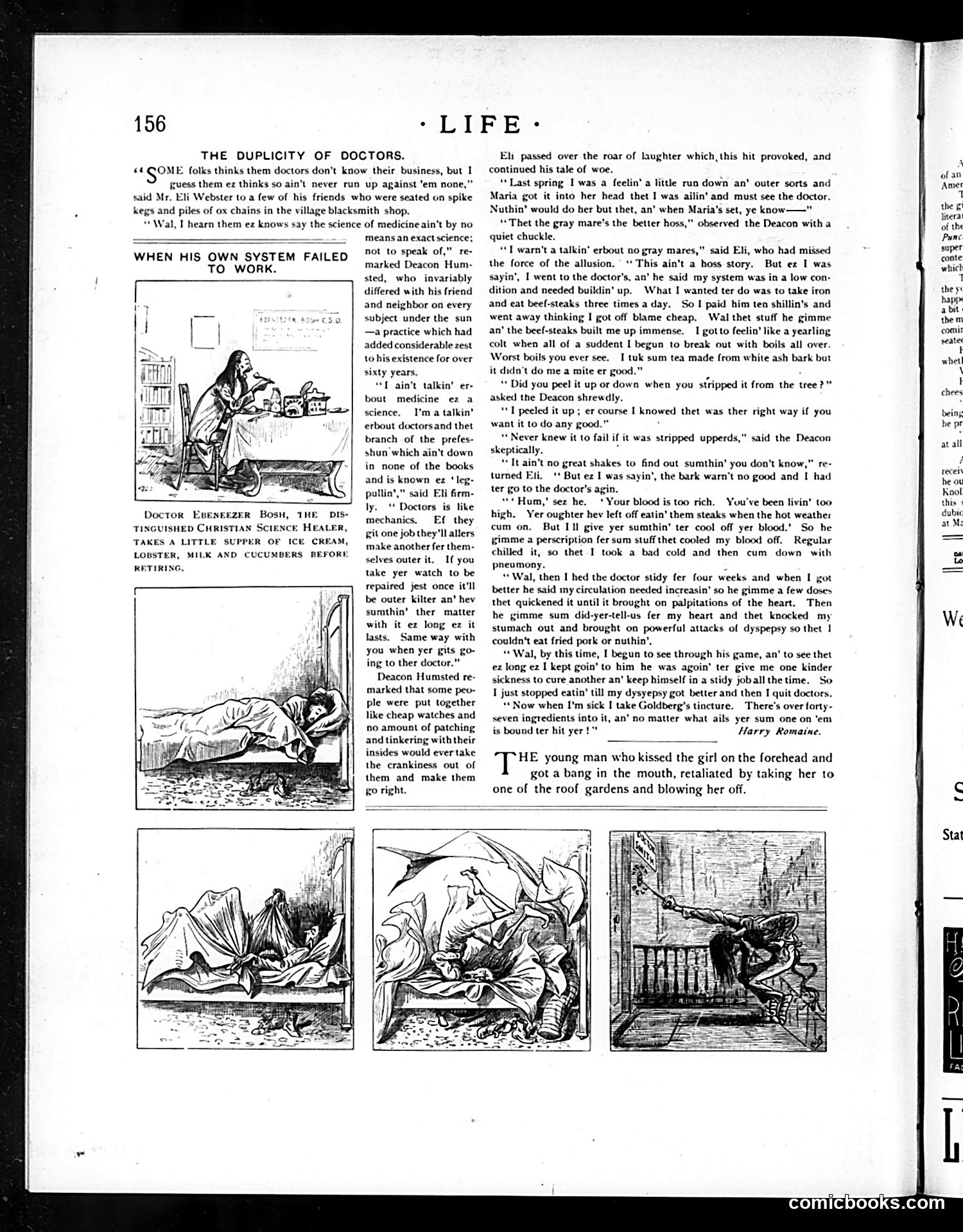
This page satirizes doctors' dishonest practices through a rural dialogue. Eli Webster tells friends at a blacksmith shop how a doctor deliberately created an endless cycle of illness to ensure repeat business—a common critique of the medical profession. The narrative shows the doctor's scheme: prescribing beef-steaks to build Eli up caused boils; treating those caused pneumonia; treating that caused heart palpitations. Each "cure" generates new ailments requiring further treatment and fees. The accompanying illustrations depict the comic results of failed medical treatments—patients in distress from their prescribed remedies. The satire targets physician greed and incompetence, using working-class vernacular to mock educated professionals. It reflects widespread 19th-century skepticism about medical science's legitimacy and doctors' financial incentives to keep patients dependent.
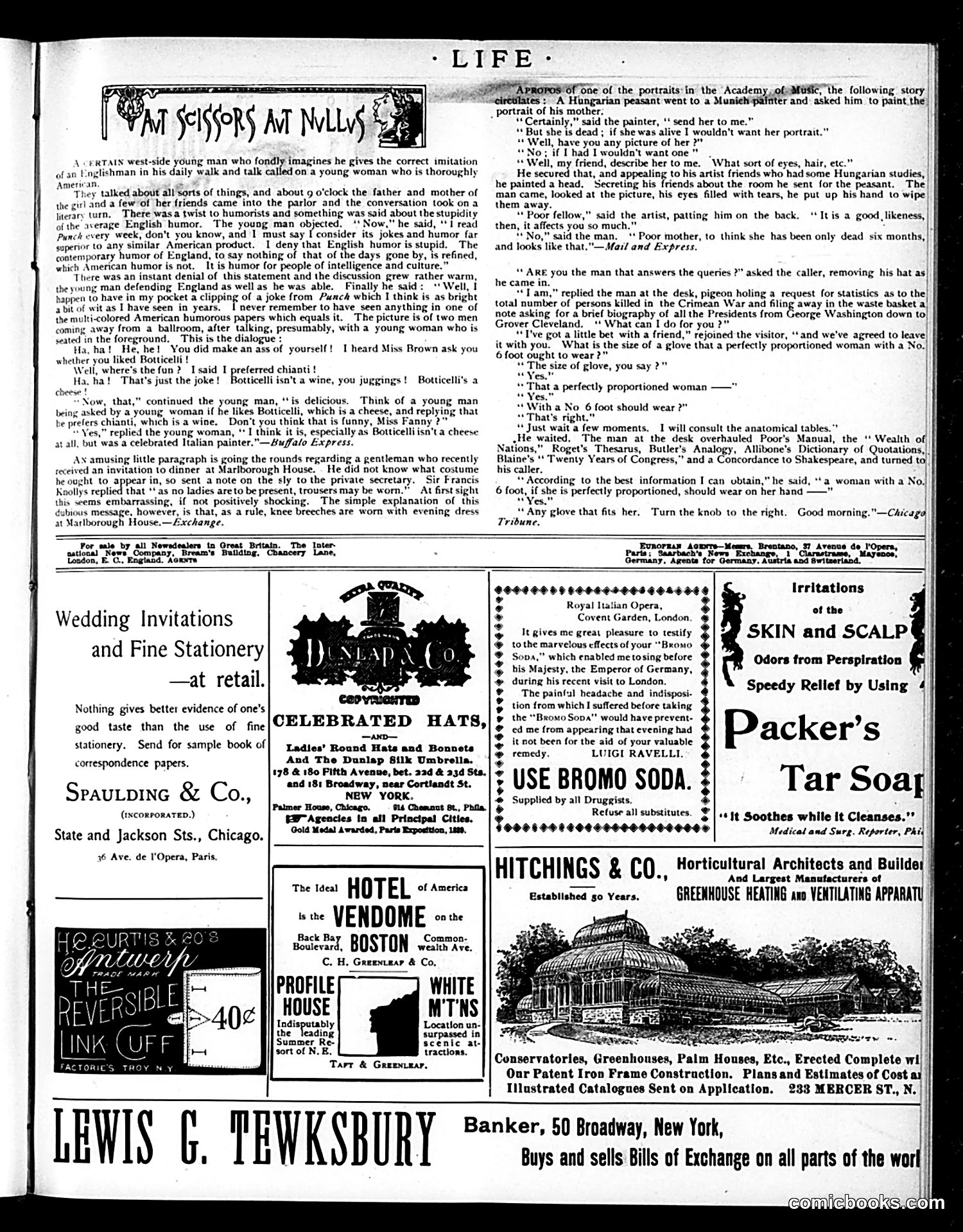
This page features two humor pieces satirizing affected sophistication: **Main Cartoon**: A young American man attempts to impress by claiming English humor is superior to American humor. He cites a "brilliant" joke: two men leaving a ballroom discuss whether one likes "Botticelli"—which the man thinks is a cheese. The punchline relies on confusing Botticelli (actually a celebrated Italian Renaissance painter) with wine and cheese. **The Satire**: The joke's "cleverness" depends entirely on the listener's ignorance. The young man's pretentious defense of English wit is undermined by his own ignorance—he doesn't realize Botticelli is a painter, not food. The woman listening immediately corrects him, exposing his fake erudition. **Context**: This mocks 1910s American Anglophilia—the fashion among some Americans to affect English mannerisms and claim European cultural superiority while demonstrating actual ignorance. The humor targets both the pretentious young man and anyone fooled by superficial cosmopolitanism. The page is otherwise advertisements.
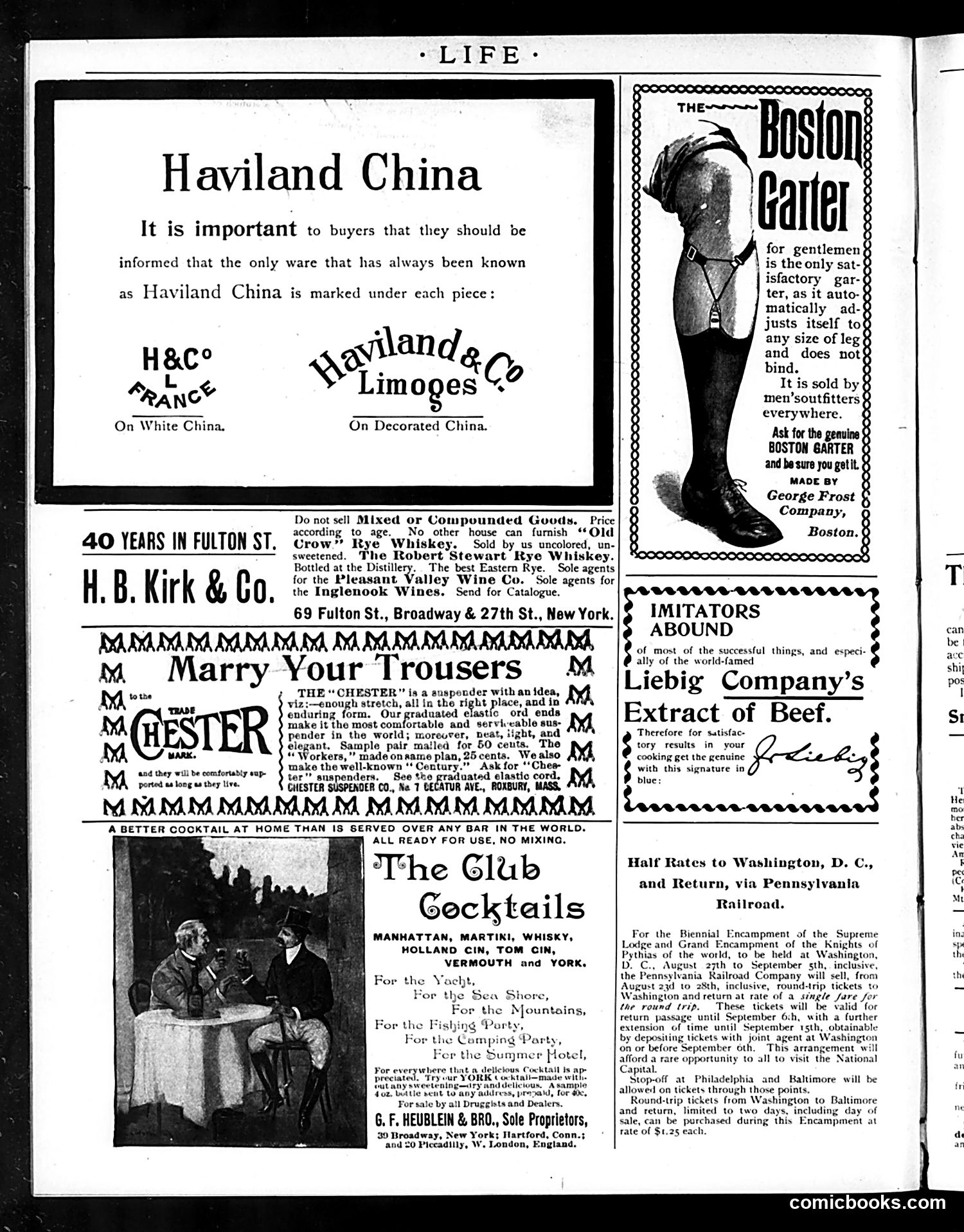
This page is primarily **advertising**, with no political cartoons or satirical content to analyze. The advertisements reflect late 19th/early 20th-century consumer products and services: fine china (Haviland), whiskey, suspenders ("Marry Your Trousers"), pre-mixed cocktails, garters, beef extract, and railroad travel. The tone is typical commercial persuasion of the era—emphasizing quality, authenticity (warning against imitations), and convenience. The only potentially noteworthy item is the "Chester Suspender" ad's playful headline "Marry Your Trousers," using matrimonial language for a practical garment. However, this is mild wordplay rather than satire. The page demonstrates how Life magazine balanced editorial content with substantial advertising revenue. Without seeing other pages, we cannot determine if this issue contained satirical commentary elsewhere.
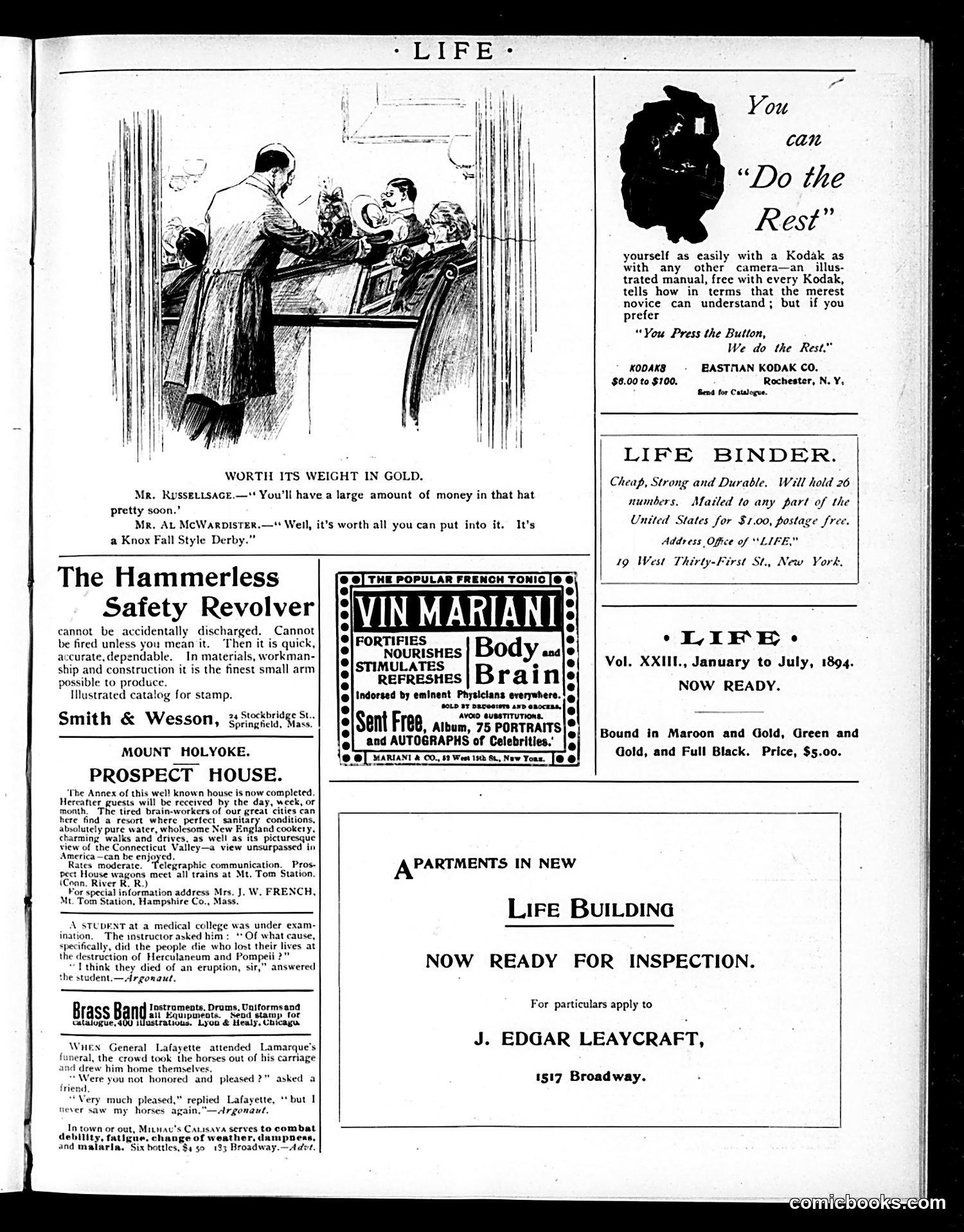
The cartoon at top left depicts two men discussing a hat—likely a Knox Fall Style Derby. One predicts the other will soon have "a large amount of money" in it, and the second responds that it's "worth all you can put into it." This is a joke about the hat's quality and durability—suggesting its value will reward investment. The humor turns on the ambiguous phrasing: the hat is literally "worth" money placed inside it (implying good resale value), playing on the name-dropping of a fashionable Derby style as a premium product worth its price. The remainder of the page consists almost entirely of period advertisements—for firearms, resort hotels, medical tonics, cameras, and real estate—typical of Life magazine's revenue model. There are no other political cartoons or satirical content visible.
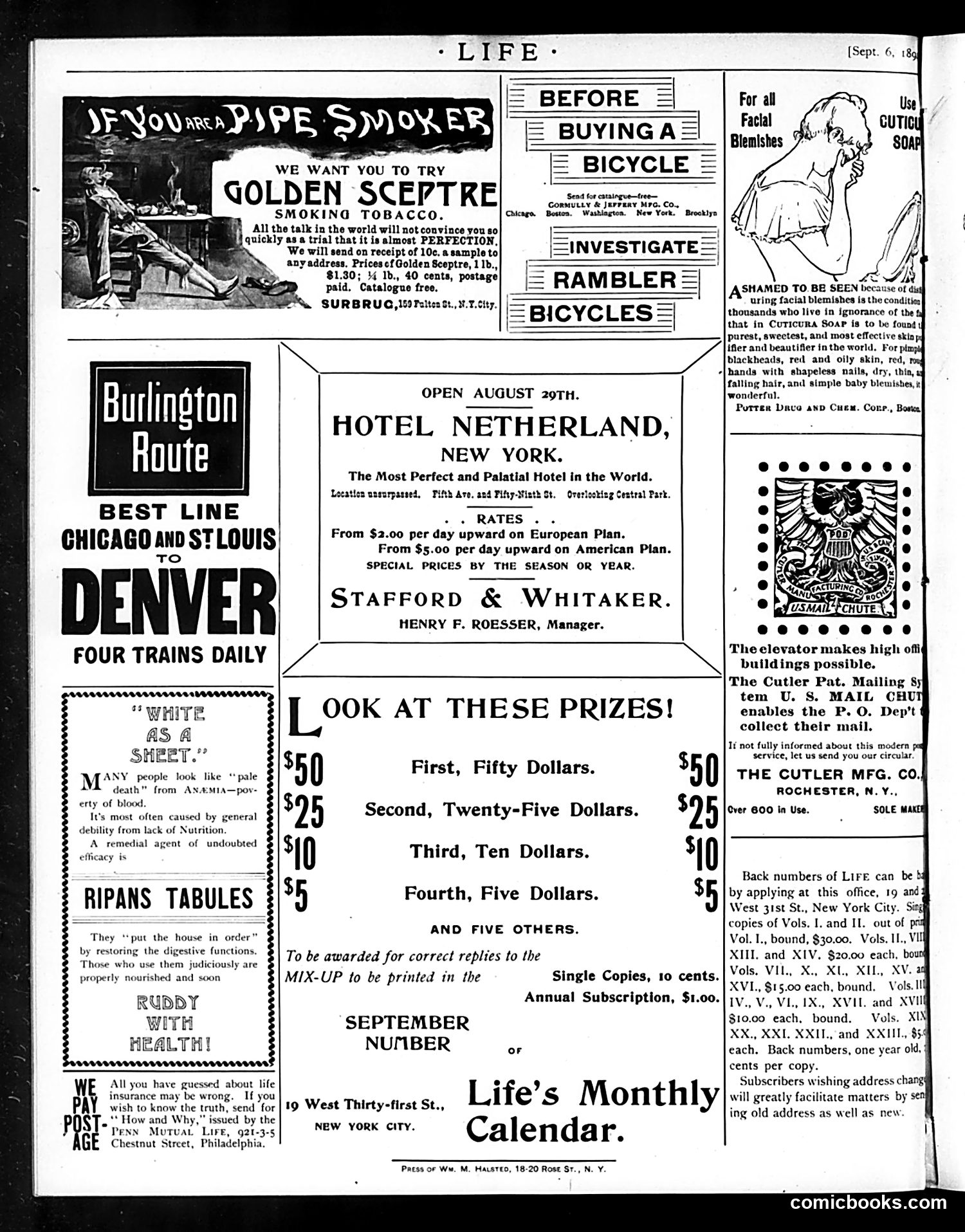
This page is predominantly **advertisements and magazine housekeeping content**, not satirical cartoons. Key elements include: **Advertisements:** - Golden Sceptre smoking tobacco (top left) - Burlington Route railroad (four daily trains Chicago-St. Louis-Denver) - Ripans Tabules (patent medicine for digestive health, with a "before/after" trope of pale vs. ruddy complexion) - Hotel Netherland opening in New York - A contest offering cash prizes ($50, $25, $10, $5) for solving a "mix-up" puzzle - Cuticula Soap for facial blemishes - The Cutler Manufacturing Co.'s mail system for office buildings **Notable Context:** The Ripans Tabules ad reflects late-19th-century medical pseudoscience and the prevalent anxieties about poor nutrition and "anemia." The contest and hotel opening indicate *Life's* commercial ambitions beyond satire. The overall page reflects the magazine's dual function as both satirical publication and advertising vehicle. No political cartoons or satirical commentary is visible on this page.