
Life, 1894-09-06 · page 6 of 16
Life — September 6, 1894 — page 6: what you’re looking at
What you’re looking at
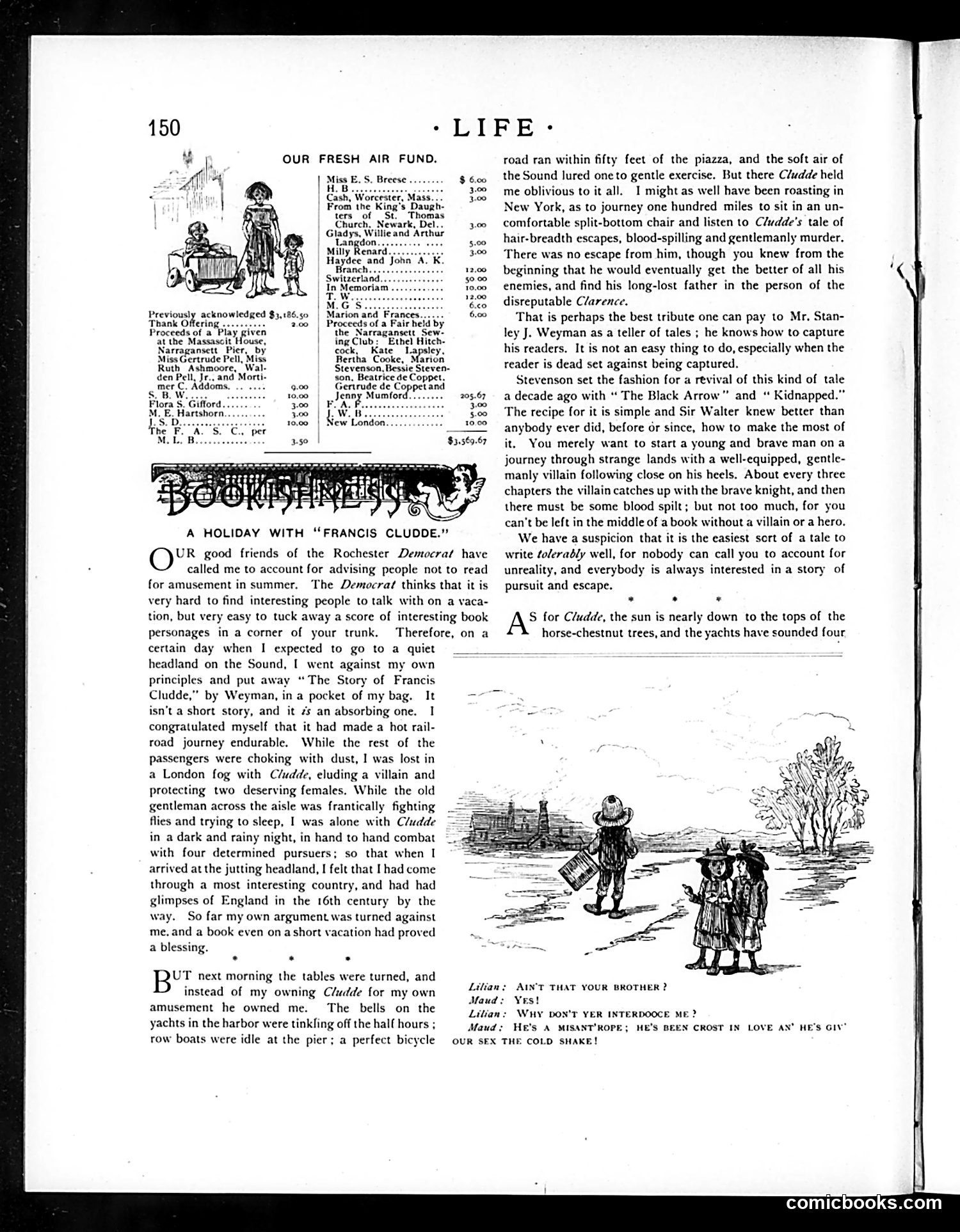
This page combines a charitable fundraising list ("Our Fresh Air Fund") with a book review of "The Story of Francis Cludde" by Stanley J. Weyman. The review discusses how Weyman revived the adventure tale genre, noting readers appreciate stories featuring villains, pursuits, and escapes. The critic praises Cludde as an engaging read, comparing it favorably to historical adventure fiction. The small illustration at page bottom depicts two figures—likely Lias and Maud from the story—in conversation by water, with a steamship visible. The dialogue references introducing a brother and romantic tension, suggesting typical plot elements of Victorian-era adventure romance. The "Fresh Air Fund" listing shows donations for sending urban children to the countryside—a genuine Progressive Era charitable cause addressing child welfare in industrial cities.
📄 Transcribed text from this page (OCR, searchable)
Machine-transcribed from the original scan — historical spelling and the odd misread are preserved.
‘LIFE: OUR FRESH AIR FUND. | Miss E. S. Breese | HB Cash, Worceste From the King ters of St. Church, Newark, Del... Gladys, Willieand Arthur Langdon. Milly Renard. 4 Haydee and John A. K. Branch Marion and’ Frances Proceeds of a Fair held by the Narragansett Sew- ing Club: "Ethel Hitch- cock, Kate Lapsley, Bertha Cooke, Marion Stevenson, Bessie Steven- son, Beatrice de Coppet. Gertrude de Coppetand Jenny Mumfor PLA. .W.B. New Lon Previously acknowledged $3,186.50 Thank Offering « 2.00 Proceeds of a Piay given at the Massascit House, Narragansett Pier, by Miss Gertrude Pell, Miss Ruth Ashmoore, "Wal- den Pell, Jr., and Mort mer C. Addoms. .. S. BW. - Flora S. Gifford. E, Hartshorn D. A HOLIDAY WITH ‘FRANCIS CLUDDE.” Ove good friends of the Rochester Democrat have called me to account for advising people not to read for amusement in summer. The Democrat thinks that it is very hard to find interesting people to talk with on a vaca- tion, but very easy to tuck away a score of interesting book personages in a corner of your trunk. Therefore, on a certain day when I expected to go to a quiet headland on the Sound, I went against my own principles and put away “The Story of Francis Cludde,” by Weyman, in a pocket of my bag. It isn’t a short story, and it #s an absorbing one. I congratulated myself that it had made a hot rail- road journey endurable. While the rest of the passengers were choking with dust, I was lost in a London fog with C/udde, eluding a villain and protecting two deserving females. While the old gentleman across the aisle was frantically fighting flies and trying to sleep, I was alone with C/udde in a dark and rainy night, in hand to hand combat with four determined pursuers; so that when I arrived at the jutting headland, I felt that [had come through a most interesting country, and had had glimpses of England in the 16th century by the way. So far my own argument was turned against me. and a book even ona short vacation had proved a blessing. . . . UT next morning the tables were turned, and instead of my owning Cludde for my own amusement he owned me. The bells on the yachts in the harbor were tinkling off the half hours ; row boats were idle at the pier; a perfect bicycle Lilian: Maud: Lilian: Maud : road ran within fifty feet of the piazza, and the soft air of the Sound lured one to gentle exercise. But there C/udde held me oblivious to it all. 1 might as well have been roasting in New York, as to journey one hundred miles to sit in an un- comfortable split-bottom chair and listen to C/udde’s tale of hair-breadth escapes, blood-spilling and gentlemanly murder. ‘There was no escape from him, though you knew from the beginning that he would eventually get the better of all his enemies, and find his long-lost father in the person of the disreputable Clarence. That is perhaps the best tribute one can pay to Mr, Stan- ley J. Weyman as a teller of tales ; he knows how to capture his readers. It is not an easy thing to do, especially when the reader is dead set against being captured. Stevenson set the fashion for a revival of this kind of tale a decade ago with “ The Black Arrow” and “ Kidnapped.” The recipe for it is simple and Sir Walter knew better than anybody ever did, before or since, how to make the most of it. You merely want to start a young and brave man ona journey through strange lands with a well-equipped, gentle- manly villain following close on his heels. About every three chapters the villain catches up with the brave knight, and then there must be some blood spilt; but not too much, for you can’t be left in the middle of a book without a villain or a hero. We have a suspicion that it is the easiest sort of a tale to write foleraély well, for nobody can call you to account for unreality, and everybody is always interested ina story of pursuit and escape. S for Cludde, the sun is nearly down to the tops of the horse-chestnut trees, and the yachts have sounded four AIN'T THAT YOUR BROTHER ? Yes! WHY DON'T YER INTERDOOCE ME? He's A MISANT'ROPE; HE'S BEEN CROST IN LOVE AN’ HE'S GIV" OUR SEX THE COLD SHAKE! comicbooks.com