
Life, 1894-09-06 · page 4 of 16
Life — September 6, 1894 — page 4: what you’re looking at
What you’re looking at
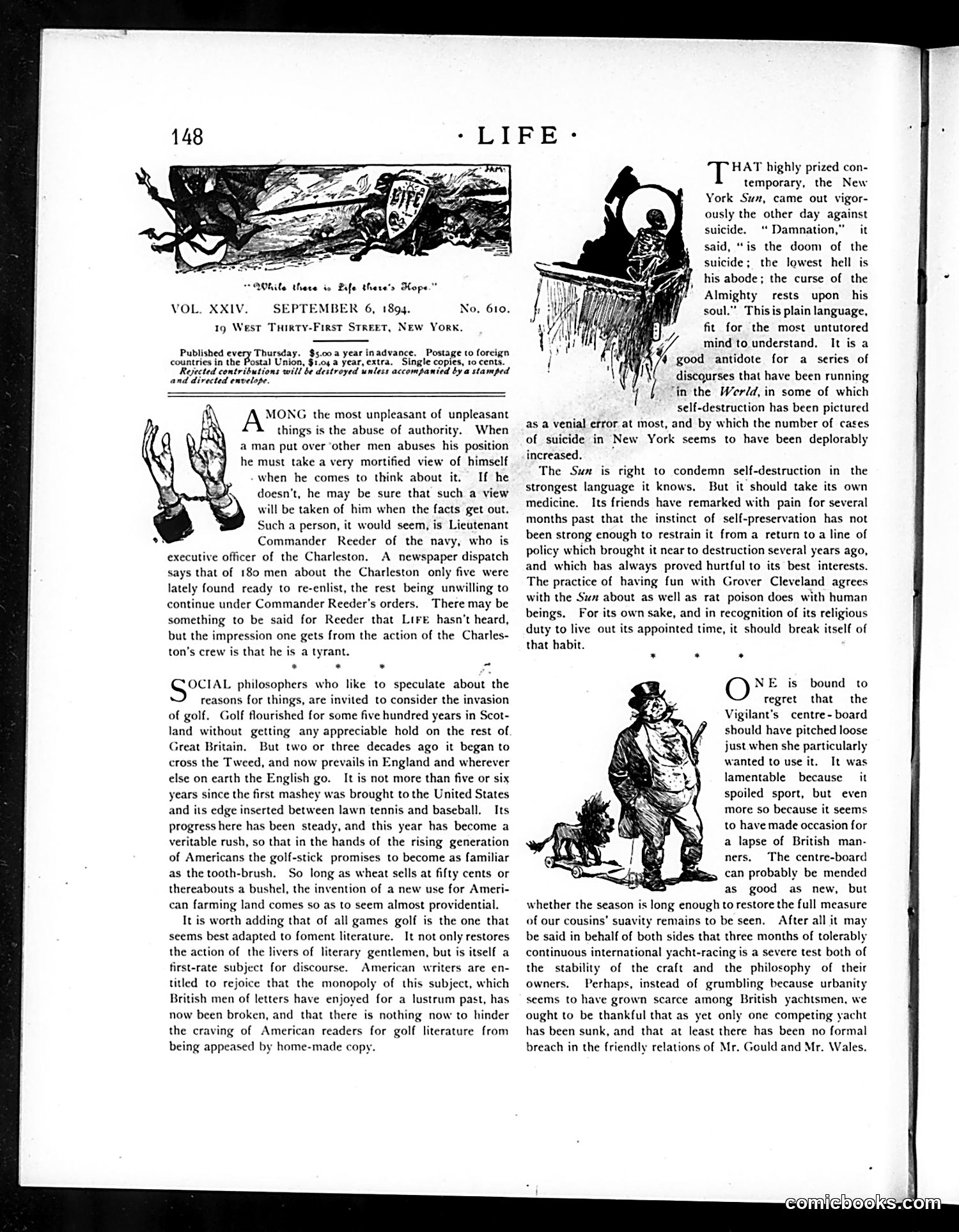
This page contains editorial commentary rather than political cartoons. The text criticizes Lieutenant Commander Reeder of the Charleston, a naval officer accused of abusing his authority and acting as a tyrant toward his crew. The piece defends Life's earlier reporting on this matter. The page also discusses the "invasion" of golf in Britain and America, satirizing how rapidly the sport has spread and become fashionable among the rising generation. The author notes golf's quick adoption in the U.S. since arriving from Scotland, comparing its meteoric rise to other cultural trends. A third section addresses yacht-racing etiquette and complaints about unsportsmanlike behavior among British yachtsmen, suggesting that competitive tensions have damaged previously friendly relations between participants like Mr. Gould and Mr. Wales. The illustrations appear to be generic decorative elements rather than caricatures of specific individuals.
📄 Transcribed text from this page (OCR, searchable)
Machine-transcribed from the original scan — historical spelling and the odd misread are preserved.
“OWNile there io Rife there’s Hope.” VOL. XXIV. SEPTEMBER 6, 1894. No, 610, 19 West Tiirty-First STREET, New Yor. Published every Thursday. $5.00 a year inadvance. Postage to foreign countries in the Postal Union, $1.04 a year, extra. Single copies, ro cents. Rejected contributions will be destroyed unless accompanied by a stamped and directed envelope. MONG the most unpleasant of unpleasant things is the abuse of authority. When a man put over ‘other men abuses his position he must take a very mortified view of himself when he comes to think about it. If he doesn't, he may be sure that such a view will be taken of him when the facts get out. Such a person, it would seem, is Lieutenant Commander Reeder of the navy, who is executive officer of the Charleston. A newspaper dispatch says that of 180 men about the Charleston only five were lately found ready to re-enlist, the rest being unwilling to continue under Commander Reeder’s orders. There may be something to be said for Reeder that LiFe hasn't heard, but the impression one gets from the action of the Charles- ton’s crew is that he is a tyrant. . . * - OCIAL philosophers who like to speculate about the reasons for things, are invited to consider the invasion of golf. Golf flourished for some five hundred years in Scot- land without getting any appreciable hold on the rest of Great Britain, But two or three decades ago it began to cross the Tweed, and now prevails in England and wherever else on earth the English go. It is not more than five or six years since the first mashey was brought to the United States and its edge inserted between lawn tennis and baseball. Its progress here has been steady, and this year has become a veritable rush, so that in the hands of the rising generation of Americans the golf-stick promises to become as familiar as the tooth-brush. So long as wheat sells at fifty cents or thereabouts a bushel, the invention of a new use for Ameri- can farming land comes so as to seem almost providential. It is worth adding that of all games golf is the one that seems best adapted to foment literature. It not only restores the action of the livers of literary gentlemen, but is itself a first-rate subject for discourse. American writers are en- titled to rejoice that the monopoly of this subject, which British men of letters have enjoyed for a lustrum past, has now been broken, and that there is nothing now to hinder the craving of American readers for golf literature from being appeased by home-made copy. HAT highly prized con- temporary, the New York Sun, came out vigor- ously the other day against suicide,‘ Damnation,” it said, “is the doom of the suicide; the lowest hell is his abode; the curse of the Almighty rests upon his soul.” Thisis plain language, fit for the most untutored mind to understand. It is a 4 good antidote for a series of discourses that have been running ‘in the Werld, in some of which self-destruction has been pictured as a venial error at most, and by which the number of cases of suicide in New York seems to have been deplorably increased. ‘ The Sux is right to condemn self-destruction in the strongest language it knows, But it should take its own medicine. Its friends have remarked with pain for several months past that the instinct of self-preservation has not been strong enough to restrain it from a return to a line of policy which brought it near to destruction several years ago, and which has always proved hurtful to its best interests. The practice of having fun with Grover Cleveland agrees with the Sua about as well as rat poison does with human beings. For its own sake, and in recognition of its religious duty to live out its appointed time, it should break itself of that habit. . NE is bound to regret that the lant’s centre- board should have pitched loose just when she particularly wanted to use it. It was lamentable because it spoiled sport, but even more so because it seems to have made occasion for a lapse of British man- ners, The centre-board can probably be mended as good as new, but whether the season is long enough to restore the full measure of our cousins’ suavity remains to be seen. After all it may be said in behalf of both sides that three months of tolerably continuous international yacht-racing is a severe test both of the stability of the craft and the philosophy of their owners, Perhaps, instead of grumbling because urbanity seems to have grown scarce among British yachtsmen, we ought to be thankful that as yet only one competing yacht has been sunk, and that at least there has been no formal breach in the friendly relations of Mr. Gould and Mr. Wales.