
A complete issue · 14 pages · 1894
Life — August 9, 1894
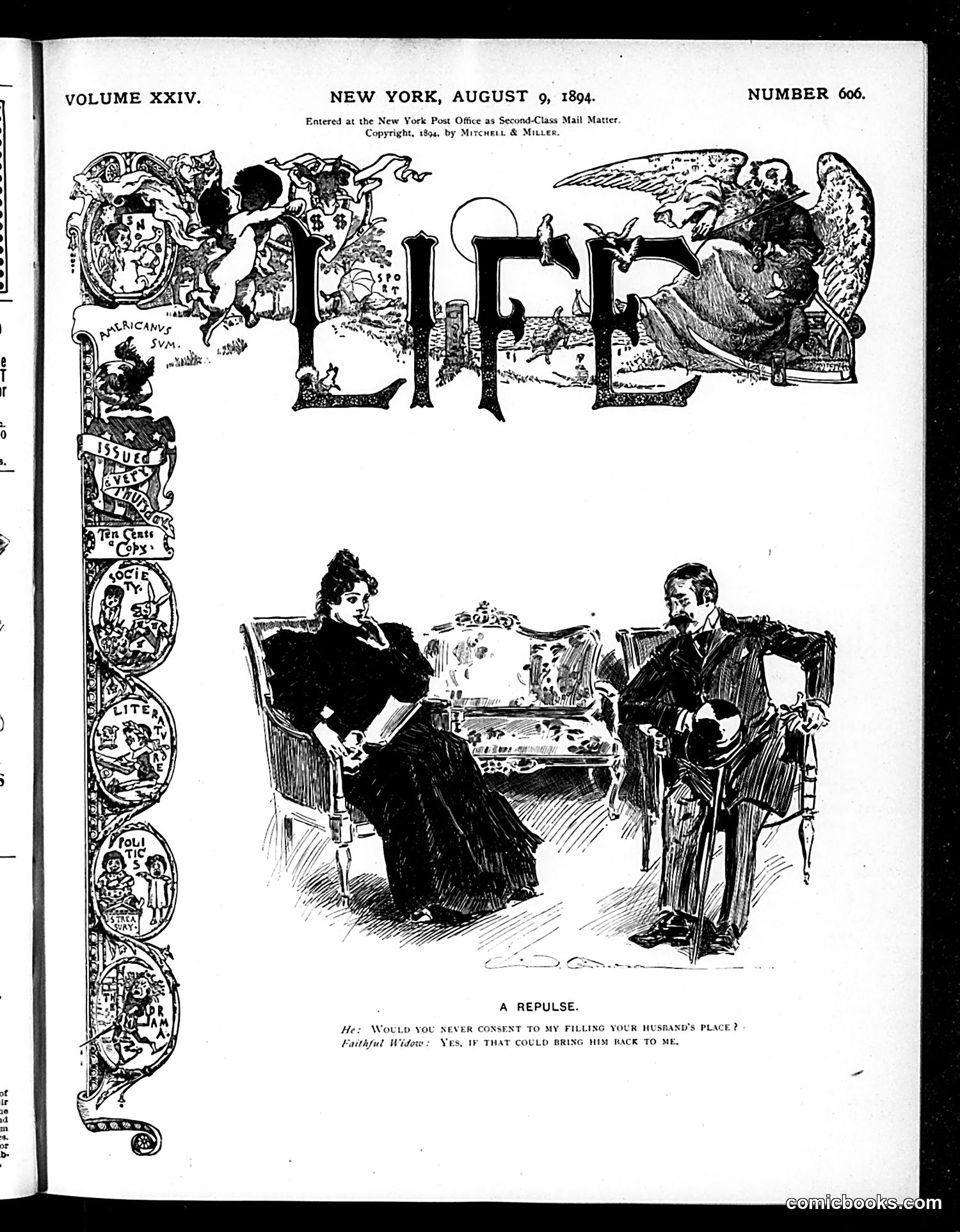
This cartoon depicts a domestic scene titled "A Repulse." A woman sits reading while a man in formal attire sits across from her. The dialogue reads: **Him:** "Would you never consent to my filling your husband's place?" **Faithful Widow:** "Yes, if that could bring him back to me." The satire mocks a man's romantic proposition to a widow by having her respond with a witty, cutting remark—she'll only accept him if he can literally resurrect her deceased husband. The joke relies on the absurdity of his presumption: he's essentially asking to replace her lost spouse, and she deflates his ego by implying her husband's memory is irreplaceable and her loyalty unshakeable. It's a commentary on courtship, widow remarriage, and male audacity in 1890s society.
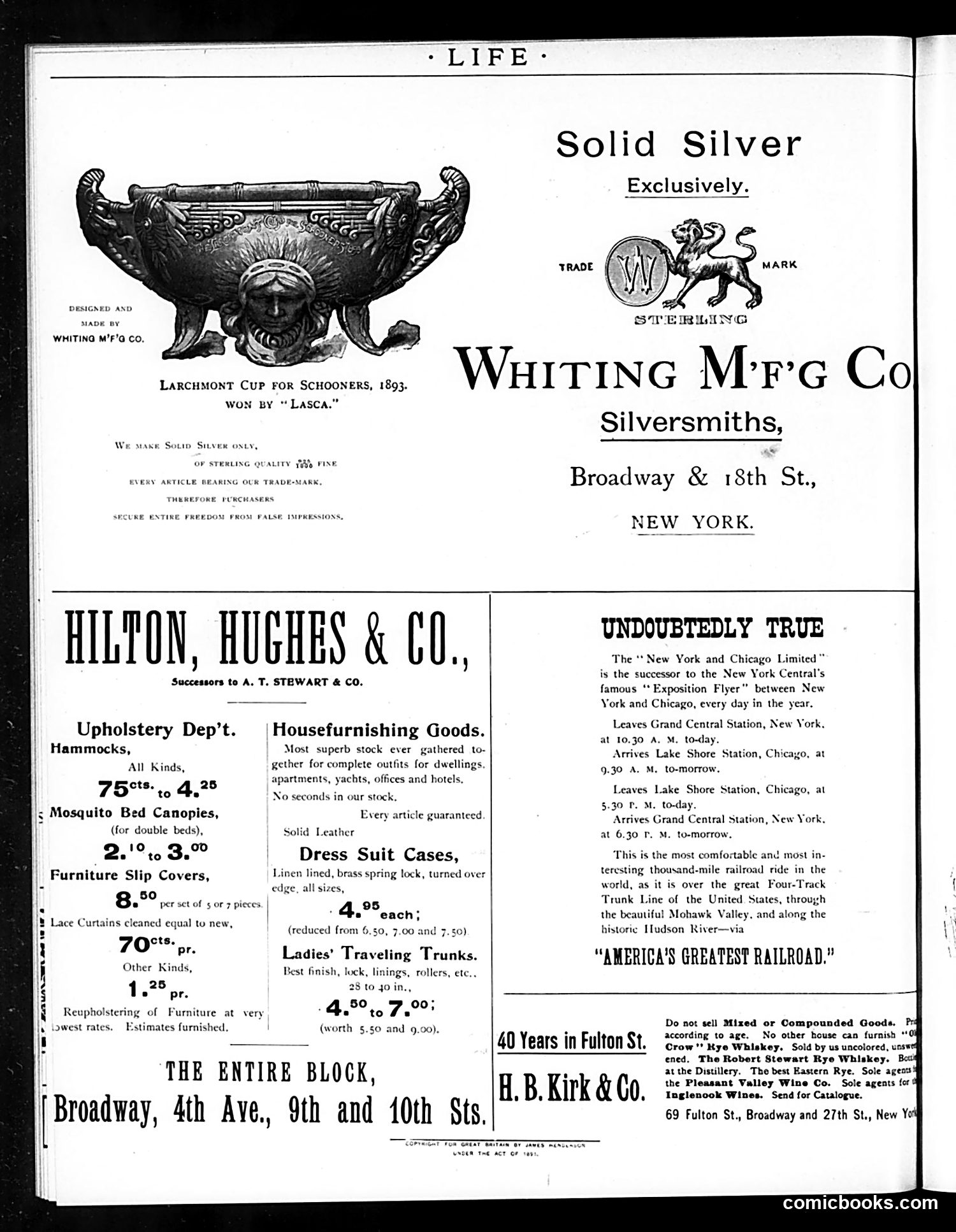
This page is **predominantly advertising** from a late 19th-century issue of Life magazine, not political satire or comics. The main visual element is a decorative silver cup—the "Larchmont Cup for Schooners, 1893, won by 'Lasca'"—advertising Whiting Manufacturing Company's sterling silver goods. This appears to be a luxury product advertisement celebrating a sailing trophy. The remaining content consists of commercial ads for upholstery services (Hilton, Hughes & Co.), housefurnishing goods, luggage, and railroad service ("America's Greatest Railroad"). There is no evident political cartoon or satirical commentary on this page. It represents typical Life magazine advertising space from the 1890s, showcasing middle and upper-class consumer goods and services.
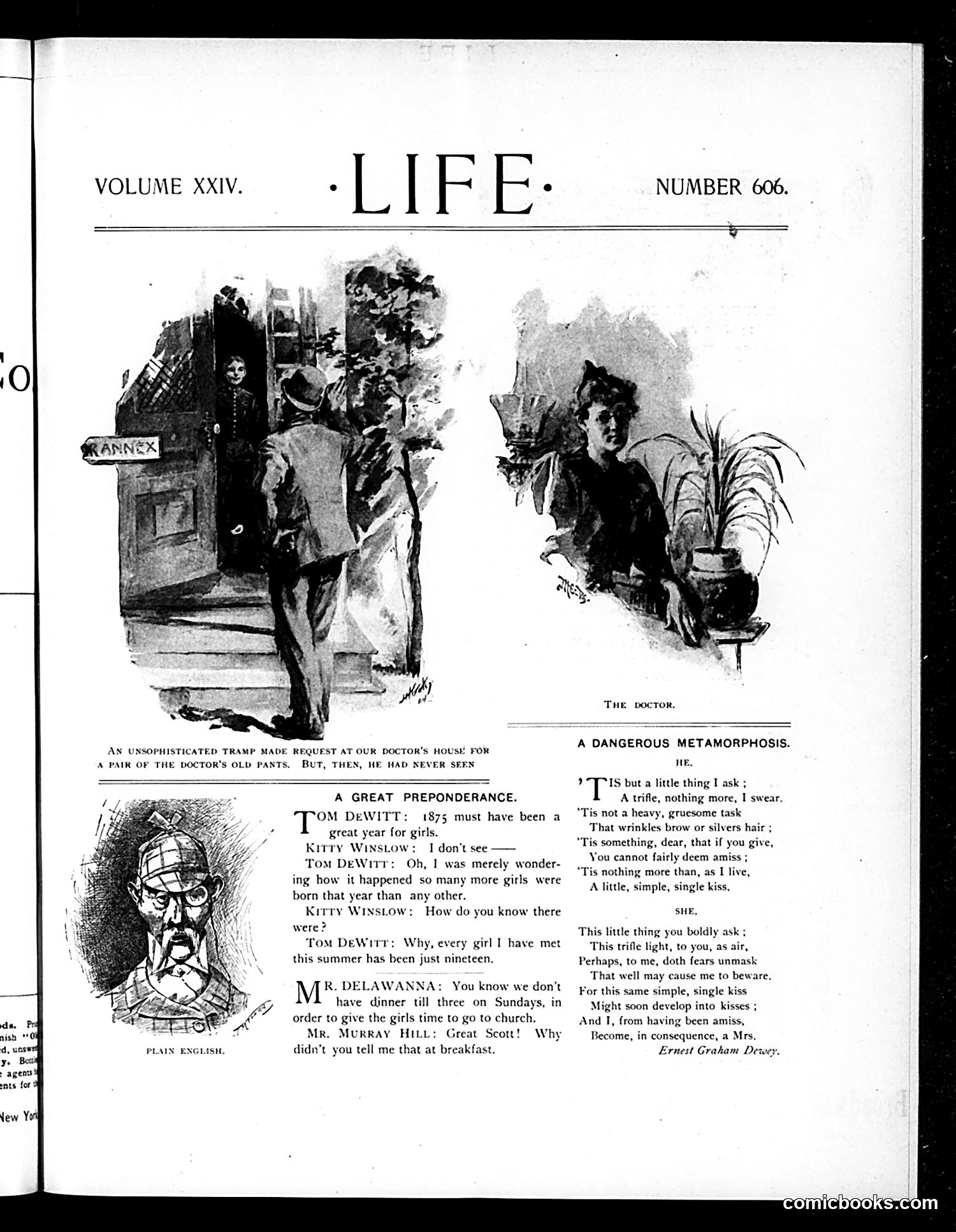
This page contains three separate humorous pieces: 1. **"A Great Preponderance"** (left): A dialogue between Tom DeWitt, Kitty Winslow, and others debating why so many girls were born in 1875. The joke relies on contemporary awareness of actual birth statistics, though the specific reason for the demographic anomaly is unclear from this excerpt. 2. **"An Unsophisticated Tramp"** (top left): A cartoon depicting a vagrant requesting old pants from a doctor's house—a straightforward joke about poverty and social class. 3. **"A Dangerous Metamorphosis"** (right): A poem by Ernest Graham Devey about a woman receiving a simple kiss that potentially transforms her into "a Mrs."—satirizing anxieties about marriage and female propriety in the Victorian/Edwardian era.
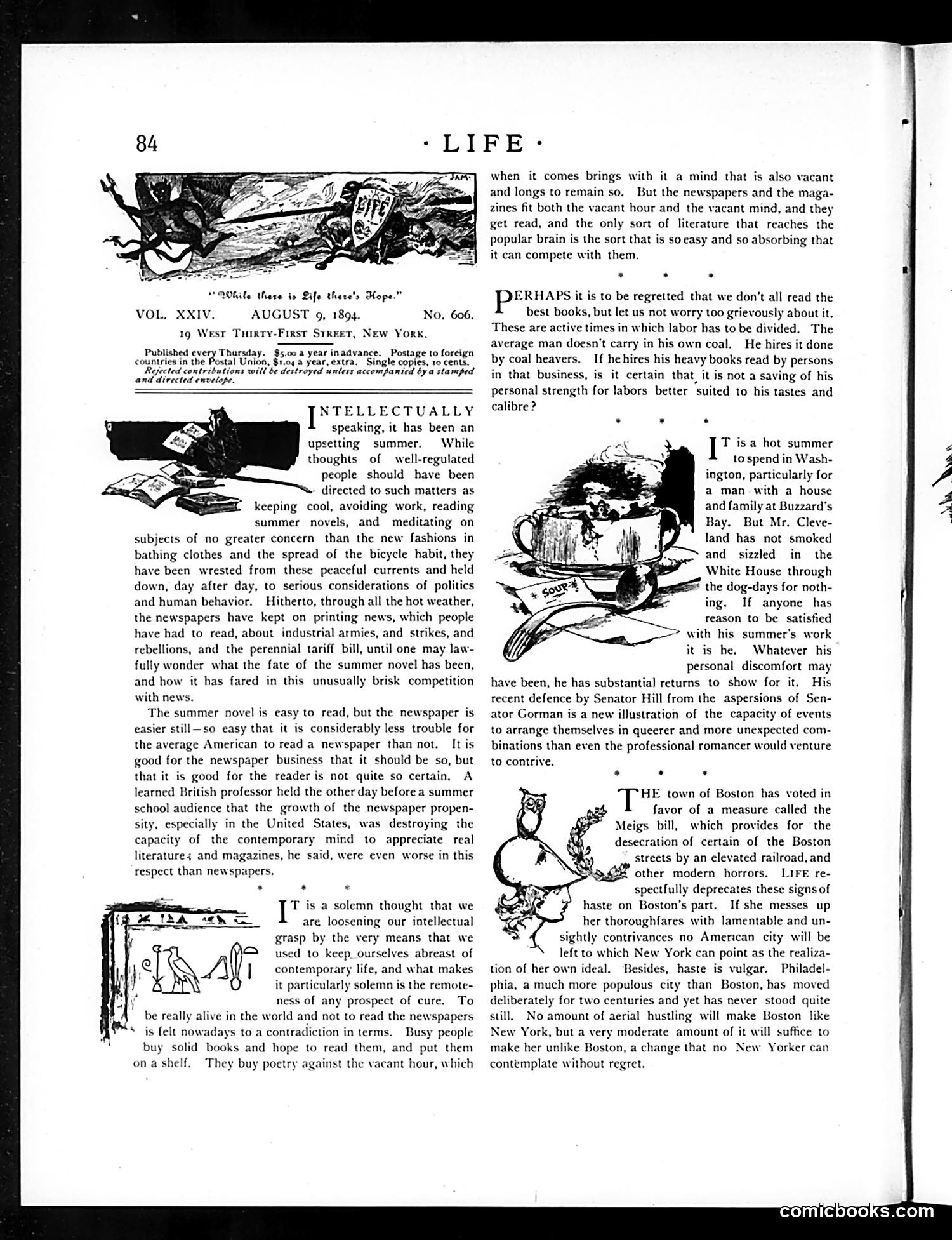
The page contains three distinct editorial cartoons/illustrations addressing intellectual and cultural concerns of 1890s America. The **top cartoon** satirizes summer reading habits, contrasting newspapers (depicted as frivolous) with serious literature. The text warns that newspapers are replacing substantive books, weakening readers' intellectual capacity. The **middle illustration** shows a figure seemingly overwhelmed by summer heat and leisure, mocking those who avoid serious work and reflection during vacation. The **bottom cartoon** references Boston's "Meigs bill," which proposed desecrating certain Boston streets via elevated railroad construction. *Life* criticizes Boston's hesitation while noting New York has modernized more aggressively without regret—a jab at Boston's conservative approach to urban progress. Together, these pieces critique both individual intellectual laziness and municipal timidity in the face of modern development.
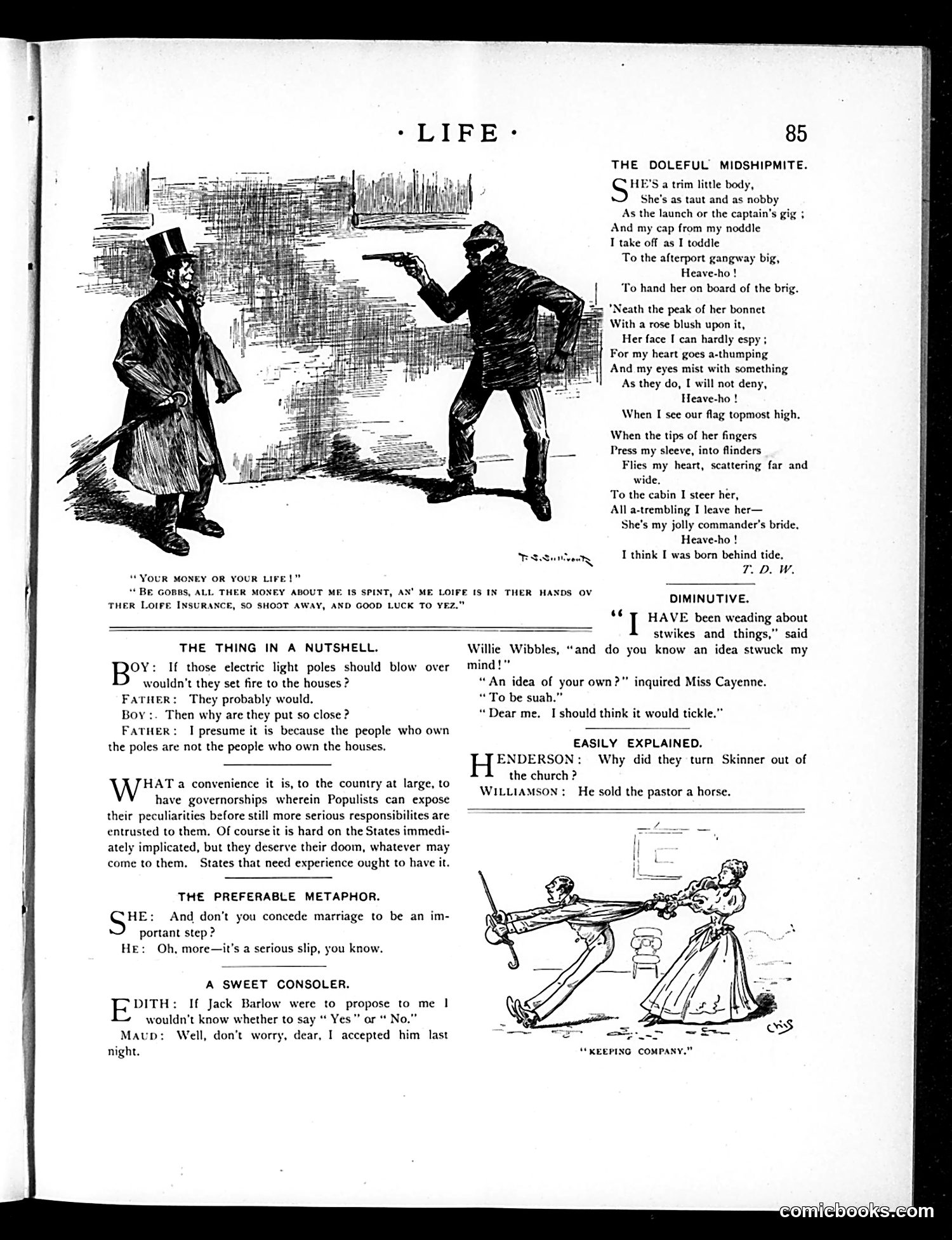
The main illustration depicts two men in Victorian-era dress—one in a top hat confronting another who appears to be drawing a pistol, with a cityscape behind them. The caption reads "Your money or your life!" with dialogue about money being "spent" and "loife" (life) being "in their hands" through life insurance. **The satire:** This is commentary on life insurance as a form of highway robbery. The joke equates purchasing life insurance with surrendering money to a criminal threat—suggesting insurance companies extract payment under duress, offering only the promise of protection (your "life") in return. Below are several short humorous anecdotes mocking various social situations and logical absurdities—typical of Life's satirical format during this era (appears to be late 1800s based on styling).
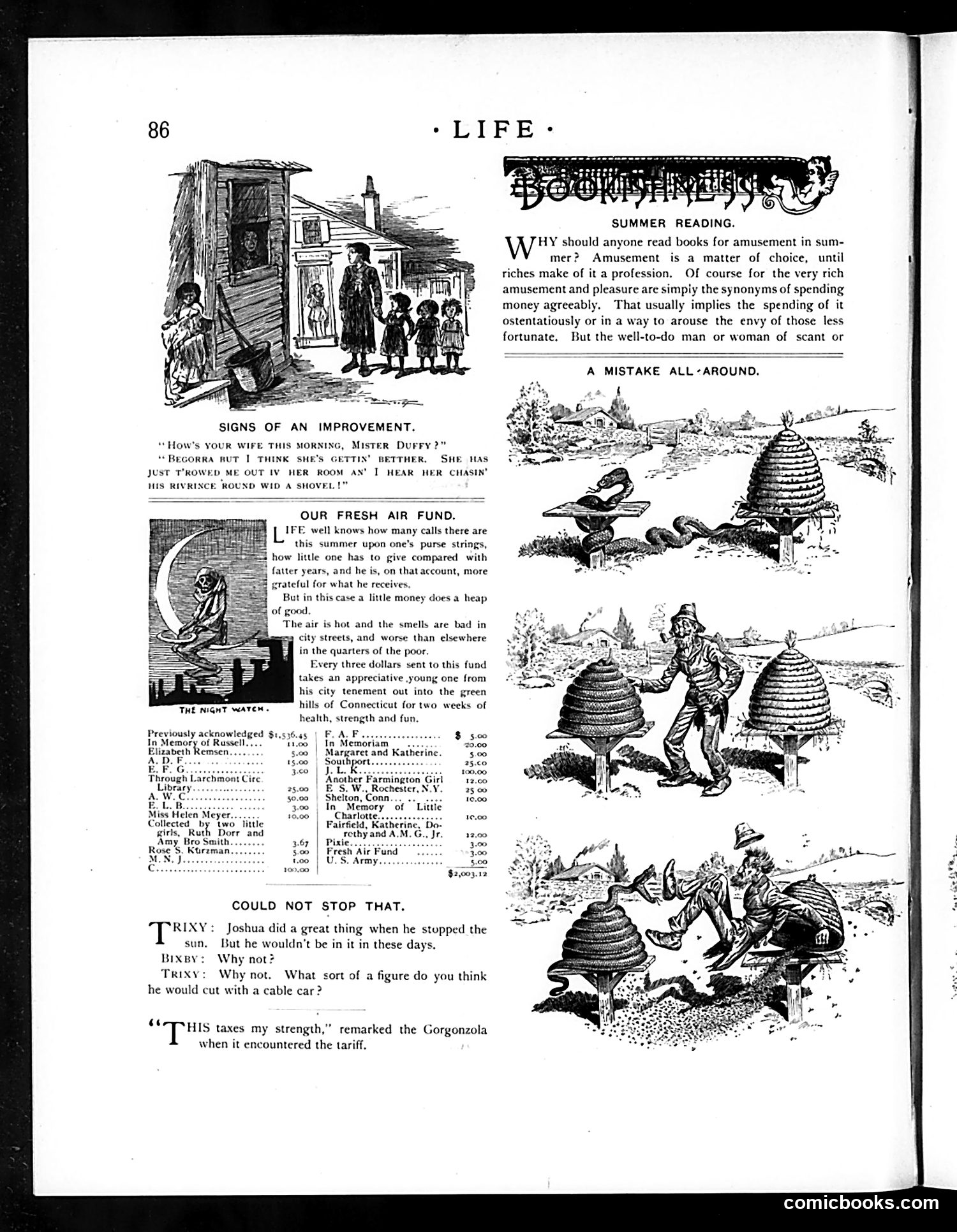
This page contains several unrelated humorous pieces rather than a unified political cartoon: **"Signs of an Improvement"** shows a woman hearing her rivulet "getting better" because she's now hitting him with a shovel instead of just her fists—dark domestic violence humor typical of the era. **"A Mistake All-Around"** depicts a series of illustrations about beekeeping gone wrong, with someone repeatedly encountering an aggressive beehive, escalating from peaceful to chaotic scenes. **"Our Fresh Air Fund"** discusses charitable donations for poor city children to spend time in Connecticut countryside—a genuine social welfare initiative, not satire. The remaining items are brief jokes and a charitable contributions list. The page reflects turn-of-century American humor combining social commentary with slapstick and domestic comedy.
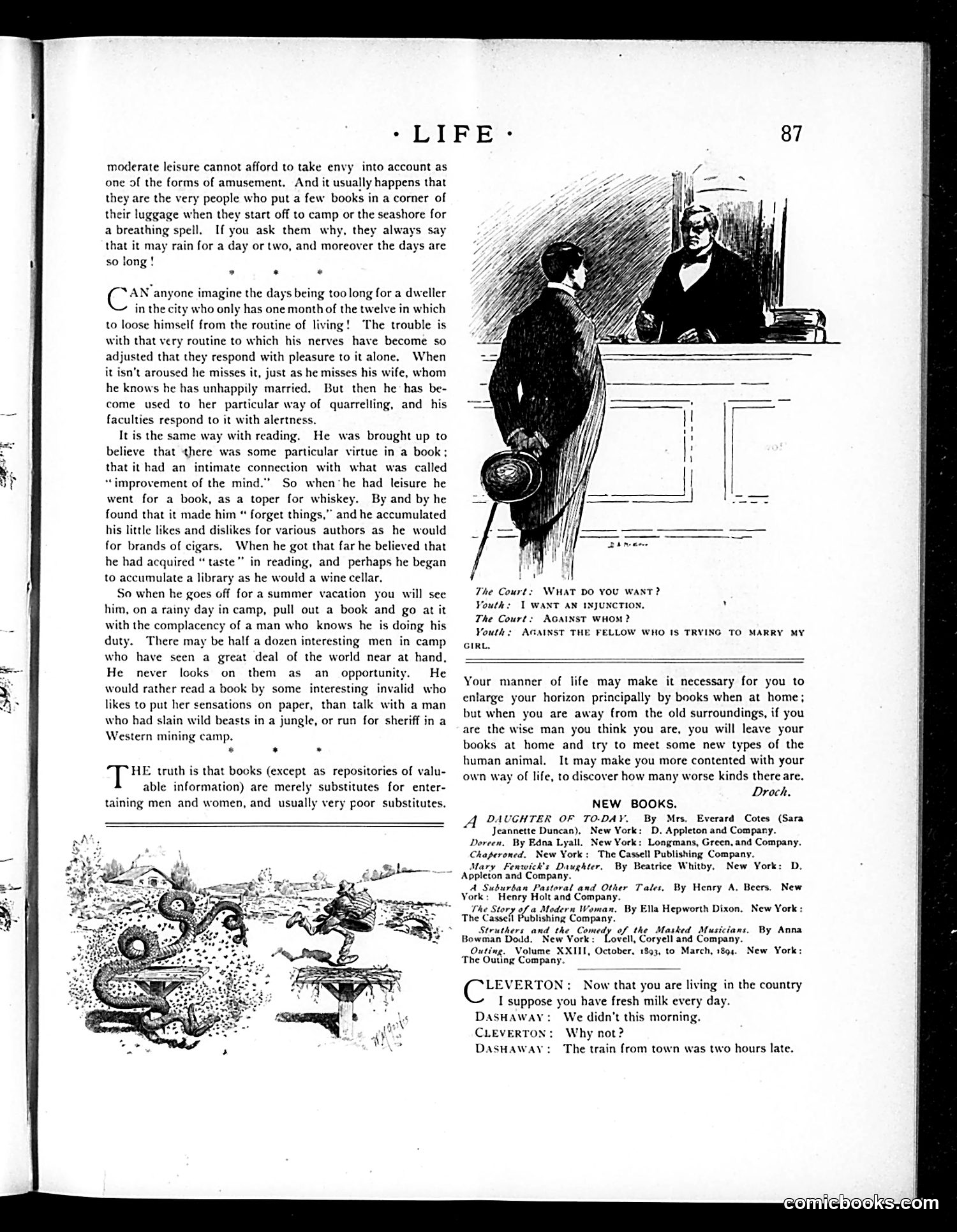
The main cartoon shows a young man at a desk speaking with an older gentleman, illustrating a dialogue about courtship. The youth says "I was an induction," and the older man responds "Against whom?" and "Against the fellow who is trying to marry my girl." This satirizes early 20th-century social conventions around marriage proposals and parental approval. The humor lies in the youth's awkward phrasing—he means he's opposing the rival suitor, but his language creates comedic confusion. The accompanying text discusses books as entertainment substitutes and how educated men use reading as leisure. The page reflects contemporary concerns about modern life, leisure time, and courtship customs among the middle and upper classes.
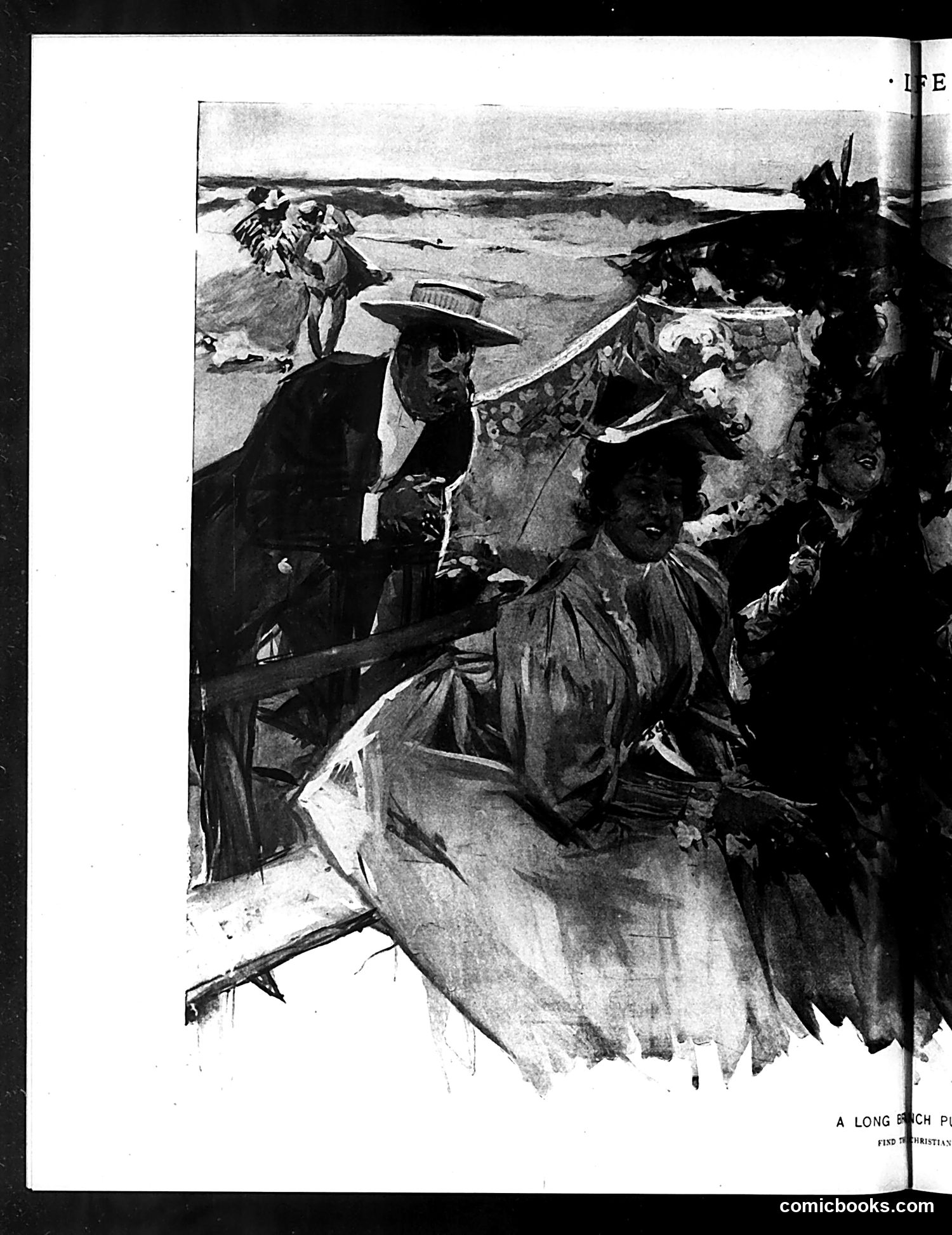
This appears to be a satirical illustration from *Life* magazine depicting a beach or seaside scene with social commentary. The image shows figures in period dress (appearing to be late 19th or early 20th century based on clothing styles) gathered near the shore. The partial caption visible reads "A LONG BEACH PU[...]" (likely "A Long Beach Public" or similar), suggesting this commentary relates to public beach access or behavior. The cartoon likely satirizes social class divisions or public conduct at beaches—a common *Life* magazine theme. The figures' positioning and dress suggest commentary on either overcrowding, class mixing, or social propriety violations at public recreation spaces. Without the complete caption, the specific satirical target remains unclear, though the beach setting and formal dress suggest commentary on contemporary social norms or public behavior.
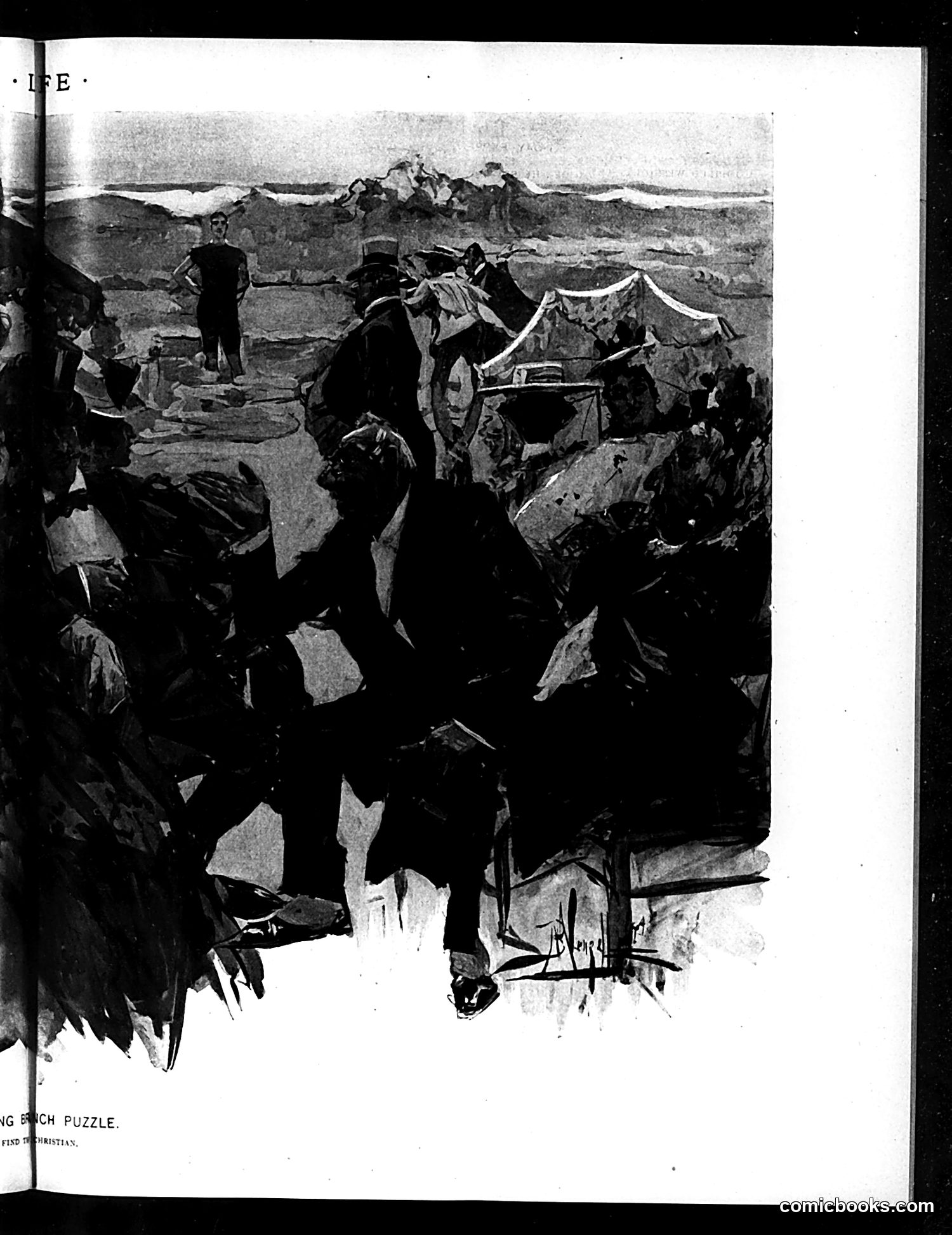
The caption reads "ING BEACH PUZZLE" (possibly "CONEY BEACH PUZZLE" or similar—OCR is unclear). This appears to be a satirical illustration depicting a crowded beach scene with numerous figures in period dress (likely early 20th century). The cartoon seems to satirize the chaos and congestion of a popular public beach during summer season. The densely packed crowd of silhouetted beachgoers, some swimming, some lounging, creates visual confusion—hence the "puzzle" reference. The title likely references a specific famous beach destination, suggesting this mocks the overwhelming crowds and loss of individuality at such tourist spots. Without clearer text or additional context, the precise political commentary remains unclear, though the overall tone criticizes mass leisure culture and urban overcrowding of the era.
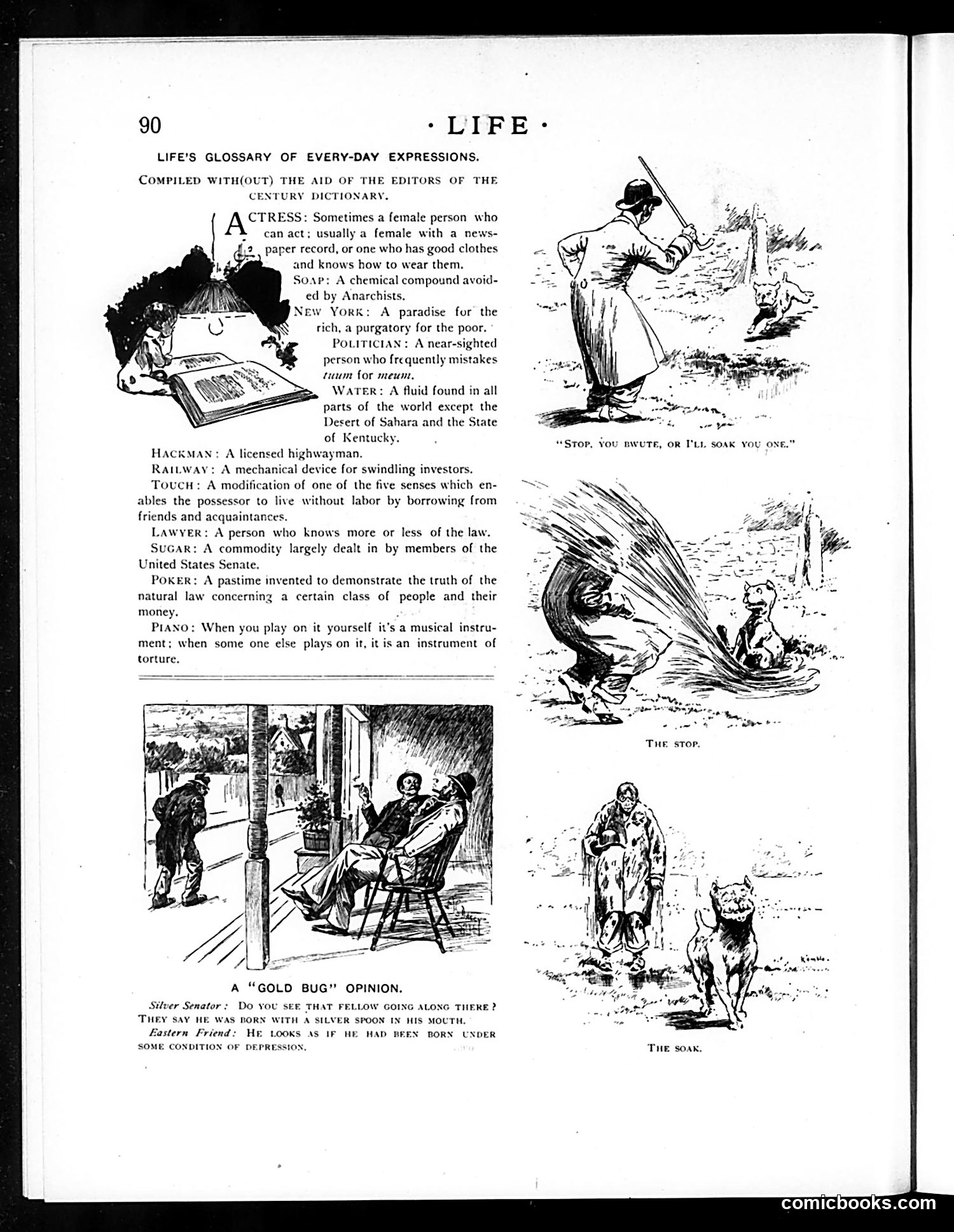
This page from *Life* magazine presents "Life's Glossary of Every-Day Expressions"—satirical definitions mocking contemporary institutions and social types. Key targets include: - **Actress**: A woman with newspaper clout and fashionable clothes - **New York**: Described as a "paradise for the rich, a purgatory for the poor"—critiquing wealth inequality - **Lawyer**: Someone who "knows more or less of the law"—mocking legal incompetence - **Sugar**: A commodity dealt in by U.S. senators—suggesting political corruption - **Poker**: A game demonstrating "natural law concerning a certain class of people and their money" The accompanying cartoon "A Gold Bug Opinion" appears to satirize wealthy elites ("gold bugs," likely referring to gold-standard advocates). The social commentary targets corruption, hypocrisy, and class inequality in Gilded Age America.
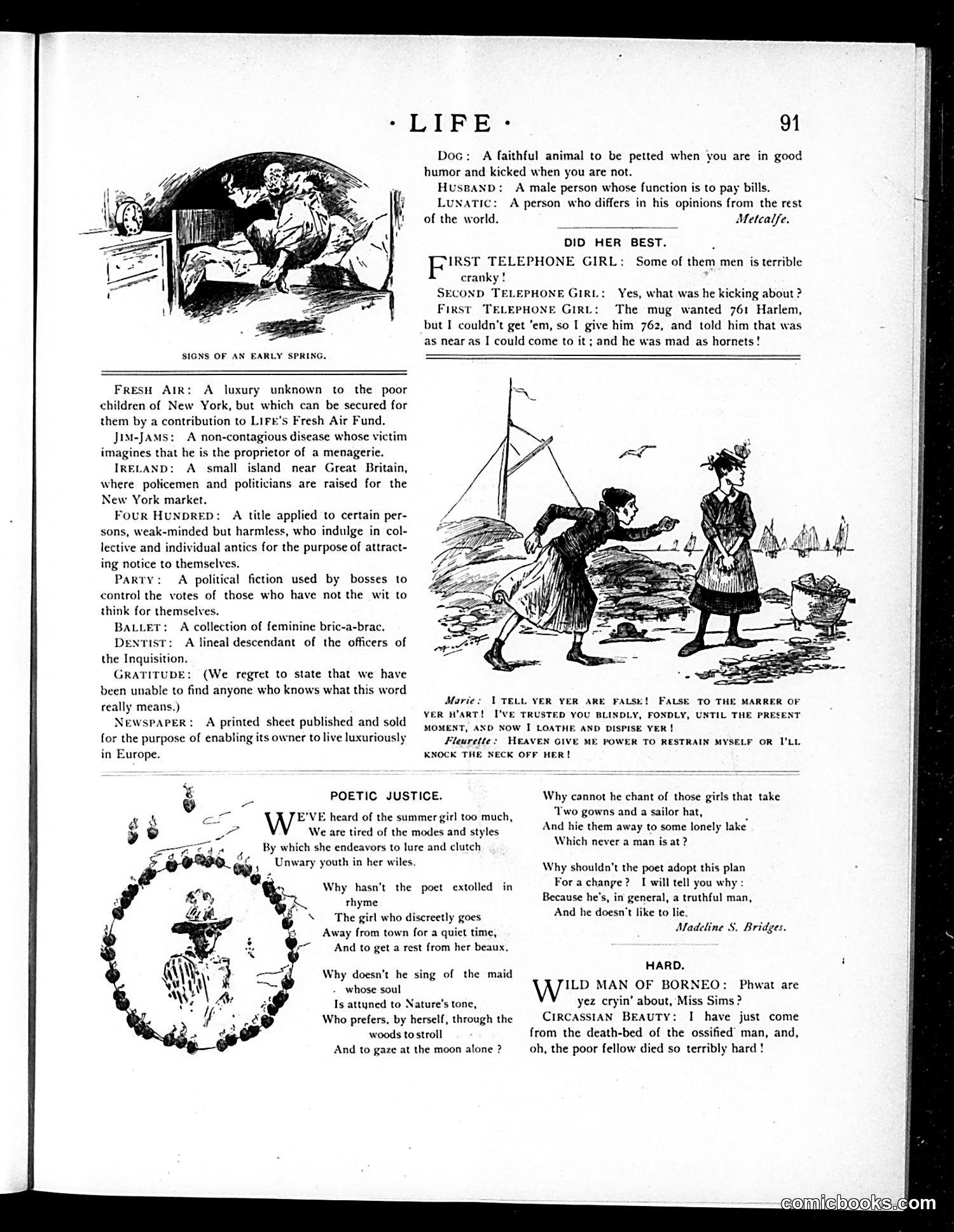
This page contains satirical dictionary definitions and humorous dialogue rather than political cartoons. The "DID HER BEST" section mocks a telephone operator's mistake—she gave a customer the wrong Harlem address (762 instead of 761), causing him anger. The humor lies in her earnest but ineffective apology. The definitions above parody contemporary concepts: "Fresh Air" references a real charity fund for poor New York children; "Jim-Jams" mocks hypochondria; "Ireland" is a joke about British governance; "Party" critiques political manipulation of voters. The "Poetic Justice" section sardonically questions why poets don't celebrate "summer girls" who seduce young men, and why such girls aren't publicly shamed. The satire targets double standards in romantic morality and literary subject matter of the era.
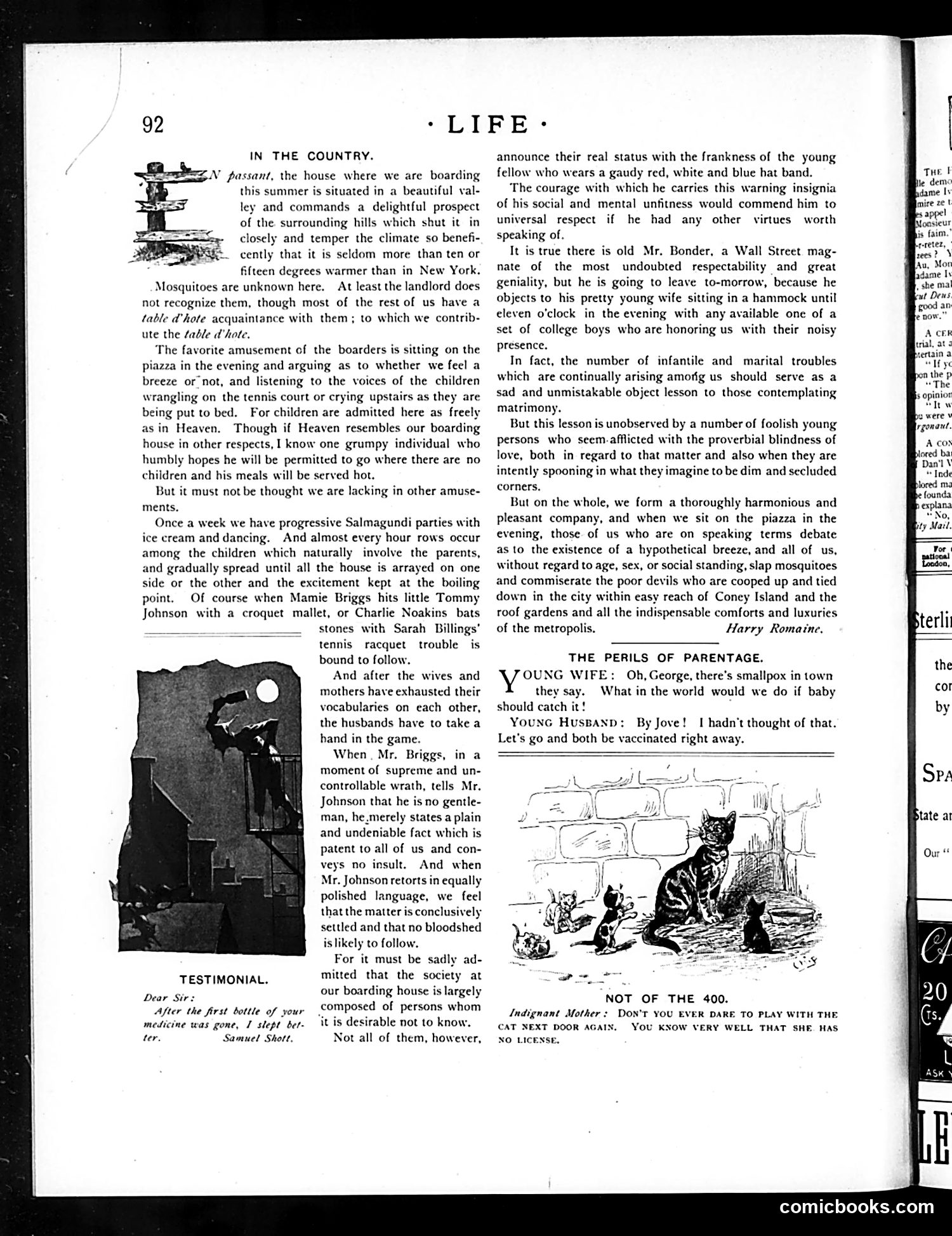
This page satirizes American boarding house culture and social pretension. The main text mocks the genteel pretenses of middle-class summer boarders who, despite claiming respectability, are largely composed of "persons whom it is desirable not to know." The author catalogues petty disputes—children fighting, wives quarreling, husbands trading insults—that escalate through the entire household. The humor lies in the contradiction between their affected civility (polite insults about being "no gentleman") and their actual behavior. The bottom cartoon, "Not of the 400," references the social elite ("the 400" being New York's upper class). An "Indignant Mother" warns her children away from the cat next door, joking it "has no license"—a witty jab at the disreputable, unlicensed status of the boarding house residents themselves, comparing them to an unregistered animal.
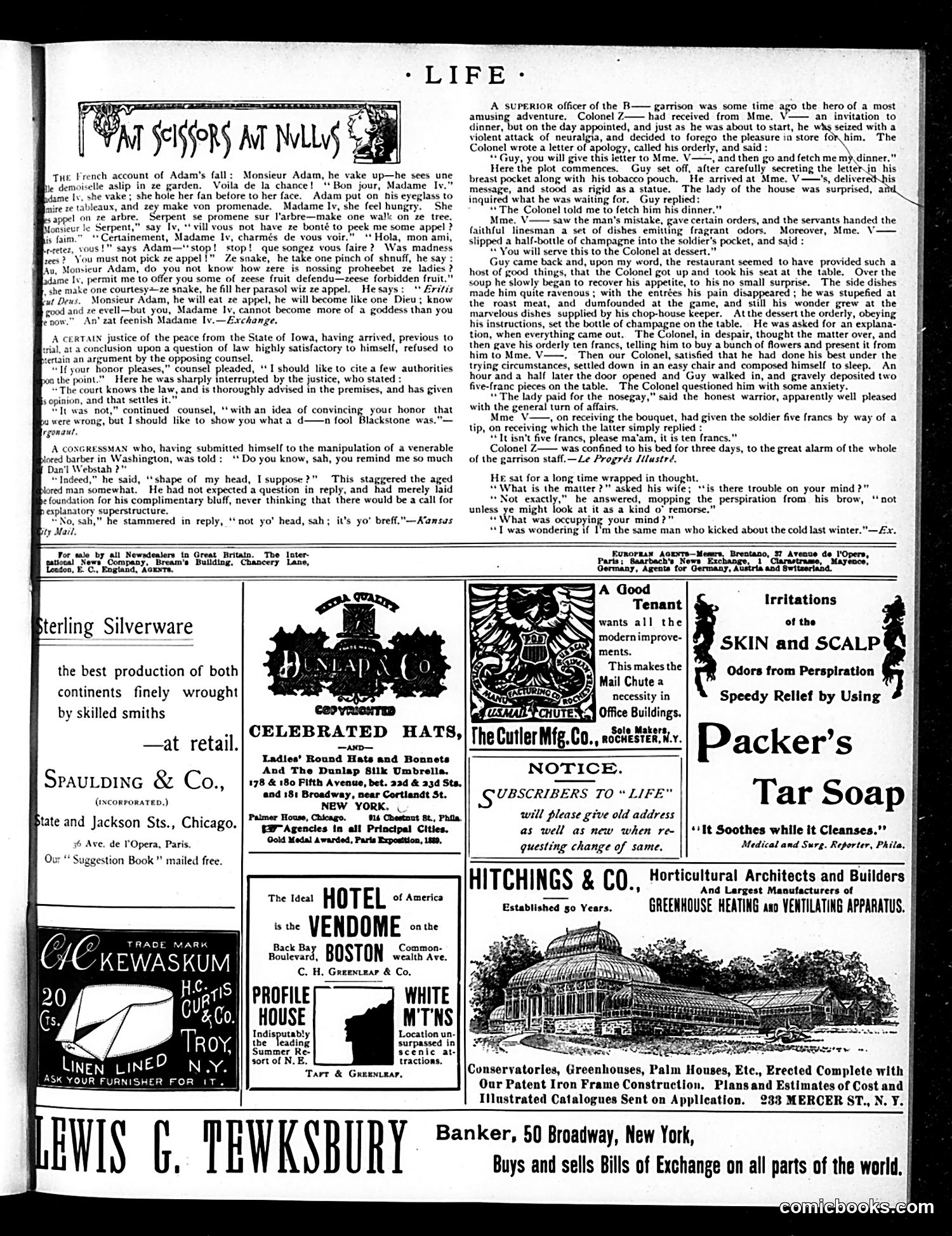
This page contains three humorous anecdotes in the satirical tradition: 1. **"At Scissors at Nullus"** (top): A French-accented retelling of Adam and Eve's fall, played for comedic effect through exaggerated dialect humor common to 19th-century American satire. 2. **The Iowa Justice of the Peace**: A judge refuses to hear legal arguments, claiming he's already decided the case. When a lawyer attempts to cite authorities, the judge interrupts—leading to a punchline about the judge being a fool, delivered by sarcastically claiming to cite "Blackstone" (the famous legal authority). 3. **The Congressman and Barber**: A congressman mistakes a barber's compliment about his resemblance to Daniel Webster (a famous statesman). The twist: the barber meant his *breath*, not his head shape—insulting humor. 4. **Colonel Z— and Guy**: A sick officer sends his orderly to retrieve dinner; the orderly sits down and eats with the Colonel instead, who recovers his appetite. Gentle comedy about military hierarchy disrupted. The page is primarily **satirical humor and advertising**, typical of *Life* magazine's format during this period.
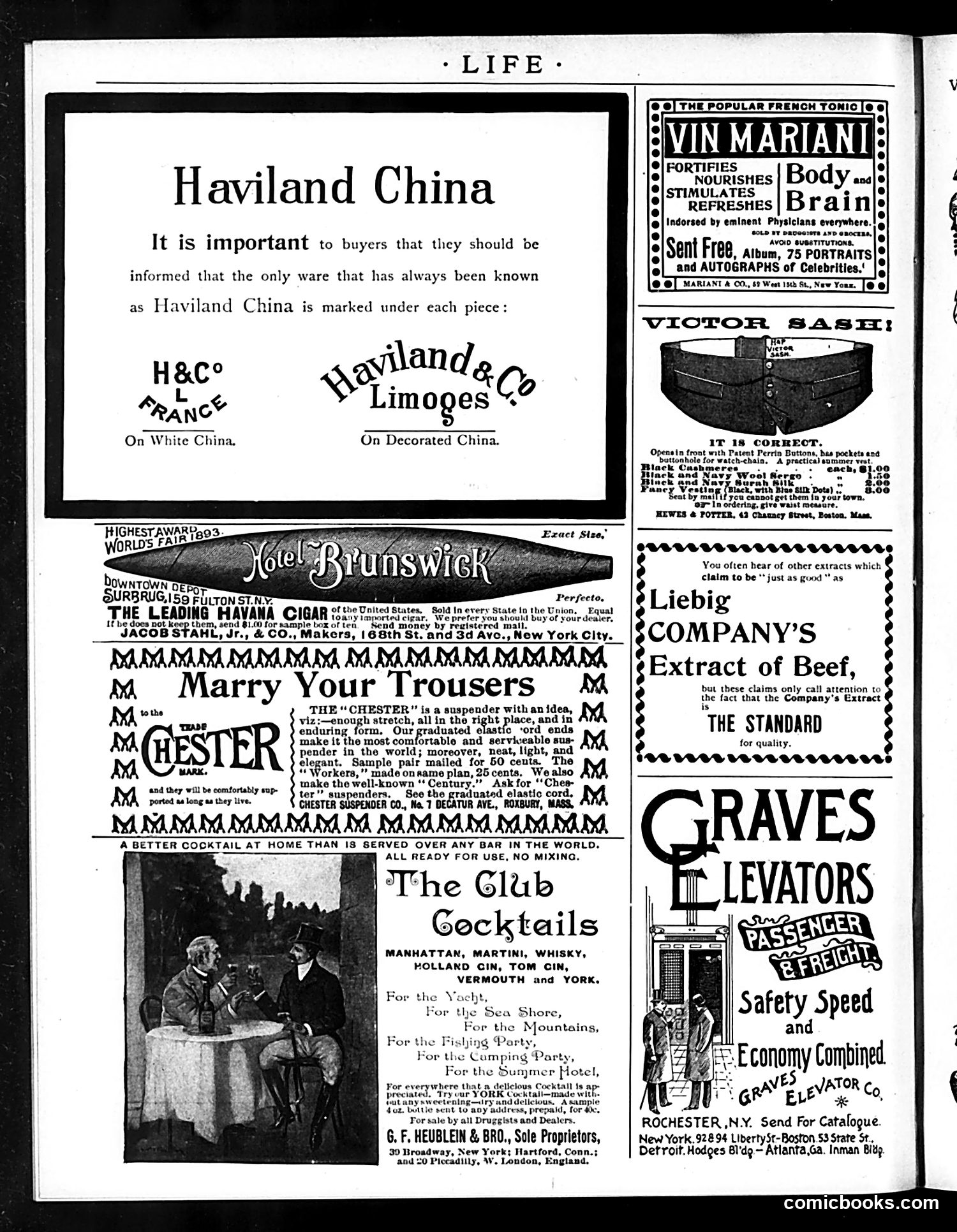
This is primarily an **advertising page** from an early 1900s issue of Life magazine, not a political cartoon. The page contains product advertisements for upscale consumer goods typical of the era. The main featured ad is for **Haviland China**, emphasizing that authentic pieces bear the H&C mark from Limoges, France. Other advertisements promote luxury items: cigars, suspenders ("marry your trousers" is the sales pitch), ready-made cocktails, china accessories, and extract of beef. One notable ad depicts two gentlemen enjoying cocktails at home, promoting the idea that quality mixed drinks could be prepared domestically—a selling point for a pre-Prohibition affluent audience. The **Victor Sash** and **Graves Elevators** ads target commercial/industrial buyers. Overall, this reflects Gilded Age consumer culture targeting wealthy Americans: fine imported goods, convenience products, and leisure pursuits. There is no discernible political satire or cartoon content on this page.