
Life, 1894-08-09 · page 4 of 14
Life — August 9, 1894 — page 4: what you’re looking at
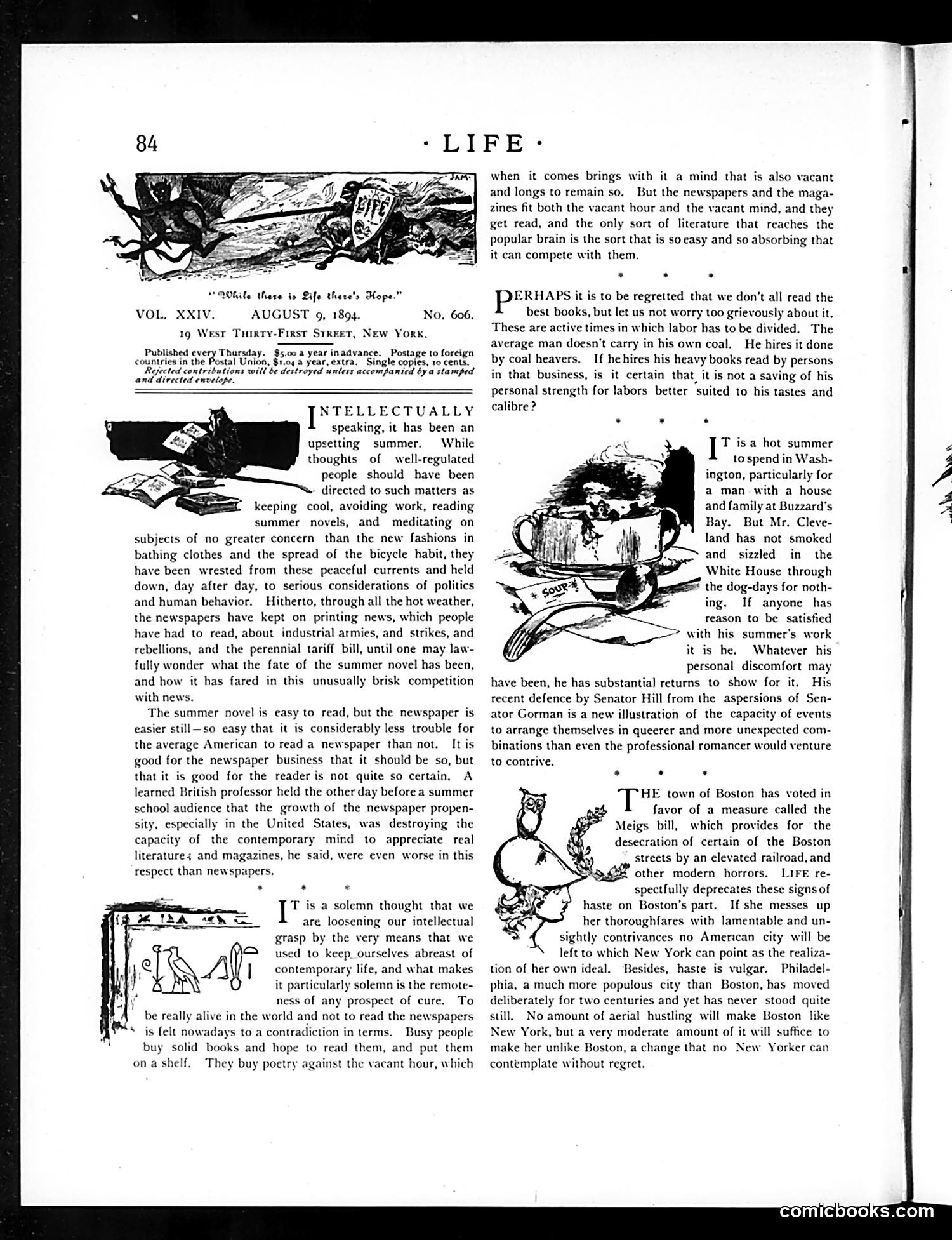
What you’re looking at
The page contains three distinct editorial cartoons/illustrations addressing intellectual and cultural concerns of 1890s America. The **top cartoon** satirizes summer reading habits, contrasting newspapers (depicted as frivolous) with serious literature. The text warns that newspapers are replacing substantive books, weakening readers' intellectual capacity. The **middle illustration** shows a figure seemingly overwhelmed by summer heat and leisure, mocking those who avoid serious work and reflection during vacation. The **bottom cartoon** references Boston's "Meigs bill," which proposed desecrating certain Boston streets via elevated railroad construction. *Life* criticizes Boston's hesitation while noting New York has modernized more aggressively without regret—a jab at Boston's conservative approach to urban progress. Together, these pieces critique both individual intellectual laziness and municipal timidity in the face of modern development.
📄 Transcribed text from this page (OCR, searchable)
Machine-transcribed from the original scan — historical spelling and the odd misread are preserved.
-LIFE- “While there io Life there's Hope.” VOL, XXIV. AUGUST 9, 1894. No, 606. 1g West Tiirty-First Street, New York, Published every Thursday. $5.coa year inadvance. Postage to foreign countries in the Postal Union, $1.04 a year,extra, Single copies, 10 cents, Rejected contributions will be destroyed unless accompanied by a stamped and directed envelope. NTELLECTUALLY speaking, it has been an upsetting summer. While thoughts of well-regulated people should have been ~- directed to such matters as keeping cool, avoiding work, reading summer novels, and meditating on subjects of no greater concern than the new fashions in bathing clothes and the spread of the bicycle habit, they have been wrested from these peaceful currents and held down, day after day, to serious considerations of politics and human behavior. Hitherto, through all the hot weather, the newspapers have kept on printing news, which people have had to read, about industrial armies, and strikes, and rebellions, and the perennial tariff bill, until one may law- fully wonder what the fate of the summer novel has been, and how it has fared in this unusually brisk competition with news. The summer novel is easy to read, but the newspaper is easier still—so easy that it is considerably less trouble for the average American to read a newspaper than not. It is good for the newspaper business that it should be so, but that it is good for the reader is not quite so certain, A learned British professor held the other day before a summer school audience that the growth of the newspaper propen- sity, especially in the United States, was destroying the capacity of the contemporary mind to appreciate real literature; and magazines, he said, were even worse in this respect than newspaper: . * © T is a solemn thought that we are loosening our intellectual grasp by the very means that we used to keep ourselves abreast of contemporary life, and what makes it particularly solemn is the remote- ness of any prospect of cure. To be really alive in the world and not to read the newspapers is felt nowadays to a contradiction in terms. Busy people buy solid books and hope to read them, and put them ona shelf. They buy poetry against the vacant hour, which when it comes brings with it a mind that is also vacant and longs to remain so, But the newspapers and the maga- zines fit both the vacant hour and the vacant mind, and they get read, and the only sort of literature that reaches the popular brain is the sort that is soeasy and so absorbing that it can compete with them. * . . PERHAEs it is to be regretted that we don’t all read the best books, but let us not worry too grievously about it, These are active times in which labor has to be divided. The average man doesn’t carry in his own coal. He hires it done by coal heavers, If he hires his heavy books read by persons in that business, is it certain that, it is not a saving of his personal strength for labors better suited to his tastes and calibre ? T isa hot summer to spend in Wash- ington, particularly for a man with a house and family at Buzzard’s Bay. But Mr. Cleve- land has not smoked and sizzled in the White House through the dog-days for noth- ing. If anyone has reason to be satisfied = with his summer's work it is he. Whatever his personal discomfort may have been, he has substantial returns to show for it. His recent defence by Senator Hill from the aspersions of Se: ator Gorman is a new illustration of the capacity of events to arrange themselves in queerer and more unexpected com- binations than even the professional romancer would venture to contrive. . . . HE town of Boston has voted in favor of a measure called the Meigs bill, which provides for the desecration of certain of the Boston streets by an elevated railroad, and other modern horrors. LIFE re- spectfully deprecates these signs of haste on Boston's part. If she messes up her thoroughfares with lamentable and un- sightly contrivances no American city will be left to which New York can point as the realiza- tion of her own ideal. Besides, haste is vulgar. Philadel- phia, a much more populous city than Boston, has moved deliberately for two centuries and yet has never stood quite still, No amount of aerial hustling will make Boston like New York, but a very moderate amount of it will suffice to make her unlike Boston, a change that no New Yorker can contemplate without regret. icbooks.com