
Life, 1894-08-09 · page 7 of 14
Life — August 9, 1894 — page 7: what you’re looking at
What you’re looking at
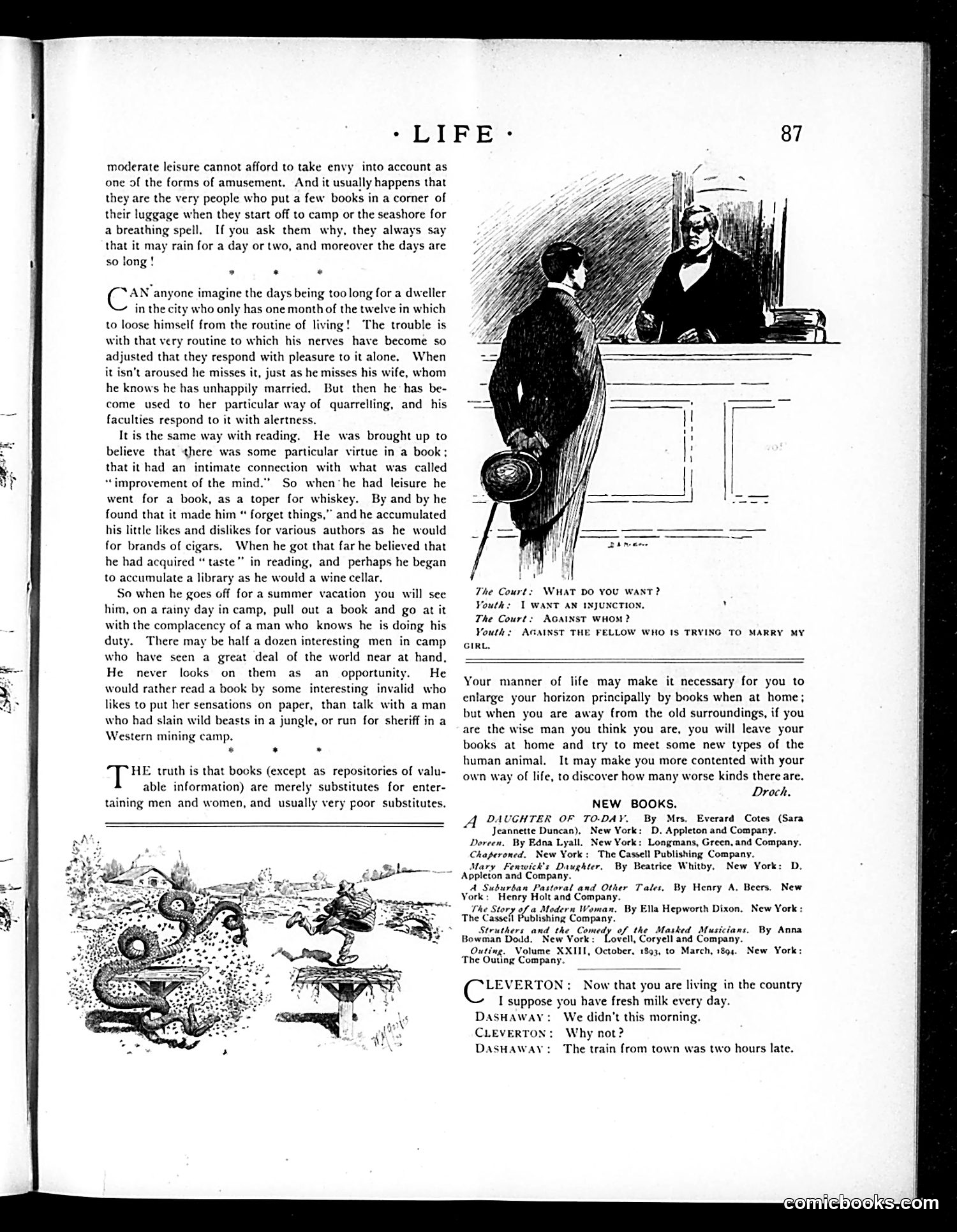
The main cartoon shows a young man at a desk speaking with an older gentleman, illustrating a dialogue about courtship. The youth says "I was an induction," and the older man responds "Against whom?" and "Against the fellow who is trying to marry my girl." This satirizes early 20th-century social conventions around marriage proposals and parental approval. The humor lies in the youth's awkward phrasing—he means he's opposing the rival suitor, but his language creates comedic confusion. The accompanying text discusses books as entertainment substitutes and how educated men use reading as leisure. The page reflects contemporary concerns about modern life, leisure time, and courtship customs among the middle and upper classes.
📄 Transcribed text from this page (OCR, searchable)
Machine-transcribed from the original scan — historical spelling and the odd misread are preserved.
> LIFE: moderate leisure cannot afford to take envy into account as one of the forms of amusement. And it usually happens that are the very people who put a few books in a corner of their luggage when they start off to camp or the seashore for a breathing spell. If you ask them why, they alwi say that it may rain for a day or two, and moreover the days are so long! . . « (CAN anyone imagine the days being too long for a dweller in the city who only has one month of the twelve in which to loose himself from the routine of living! The trouble is with that very routine to which his nerves have become so adjusted that they respond with pleasure to it alone, When it isn't aroused he misses it, just as he misses his wife, whom he knows he has unhappily married. But then he has be- come used to her particular way of quarrelling, and his faculties respond to it with alertness. It is the same way with reading. He was brought up to believe that there was some particular virtue in a book; that it had an intimate connection with what was called “improvement of the mind.” So when‘he had leisure he went for a book, as a toper for whiskey. By and by he found that it made him “ forget things,” and he accumulated his little likes and dislikes for various authors as he would for brands of cigars. When he got that far he believed that he had acquired “ taste" in reading, and perhaps he began to accumulate a library as he would a wine cellar, So when he goes off for a summer vacation you will see him, on a rainy day in camp, pull out a book and go at it with the complacency of a man who knows he is doing his duty. There may be half a dozen interesting men in camp who have seen a great deal of the world near at hand, He never looks on them as an opportunit; He would rather read a book by some interesting invalid who likes to put her sensations on paper, than talk with a man who had slain wild beasts in a jungle, or run for sheriff in a Western mining camp. * . . HE truth is that books (except as repositories of valu- able information) are merely substitutes for enter- taining men and women, and usually very poor substitutes. The Court: WWat po You wast? Youth: I WANT AN INJUNCTION. The Court: AGAINST WHOM? Youth: AGAINST THE FELLOW WHO 1S TRYING TO MARRY MY ort. Your manner of life may make it necessary for you to enlarge your horizon principally by books when at home; but when you are away from the old surroundings, if you are the wise man you think you are, you will leave your books at home and try to meet some new types of the human animal. It may make you more contented with your own way of life, to discover how many worse kinds there are. Droch, NEW BOOKS. A DAUGHTER OF TO-DAY. By Mrs, Everard Cotes (Sara Jeannette Duncan), New York: D. Appleton and Company. Doreen. By Edna Lyall. New York: Longmans, Green, and Company. Chaperoned, New York: The Cassell Publishing Company. Mary Fenwick's Daughter, By Beatrice Whitby. New York: D. Appleton and Company. A Suburban Pastoral and Other Tales, York: Henry Holt and Company. The Story of a Modern Woman, By Ella Hepworth Dixon. New York : The Casseil Publishing Company. Struthers and the Comedy of the Masked Musicians. Bowman Dold. "New Vork |. Lovell, Coryell and Company. Outing. Volume XXIII, October. 1893, to March, 1894. The Outing Company. By Henry A. Beers. New By Anna New York: LEVERTON: Now that you are living in the country I suppose you have fresh milk every day. DaASHAWAY: We didn’t this morning. CLEVERTON: Why not? DasHAWAY: The train from town was two hours late.