
A complete issue · 16 pages · 1894
Life — August 2, 1894
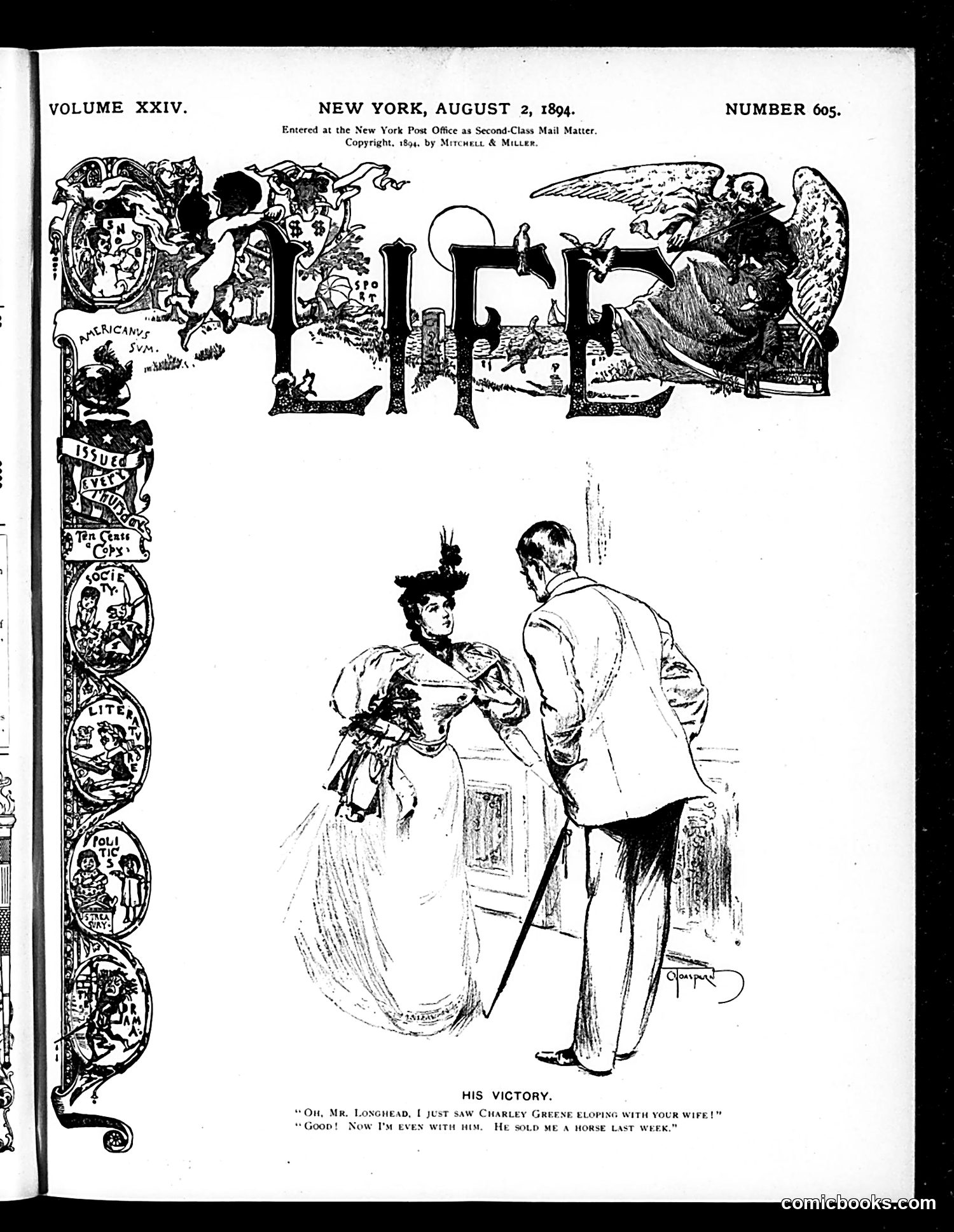
This cartoon satirizes a domestic dispute by depicting a man boasting to another about his marital "victory." The dialogue reveals the joke's irony: Mr. Longhead claims he "just saw Charley Greene eloping with your wife!" The second man responds that this is actually good news—he's now "even with him" because Greene previously sold him a horse. The satire mocks male pride and the casual way these men treat both infidelity and financial disputes as equivalent transactions. The title "His Victory" is ironic; what appears to be a man's triumph (his wife eloping) is reframed as mere economic retaliation for a bad horse deal. The cartoon comments on late-Victorian attitudes toward marriage, masculine honor, and questionable business dealings among men of leisure.
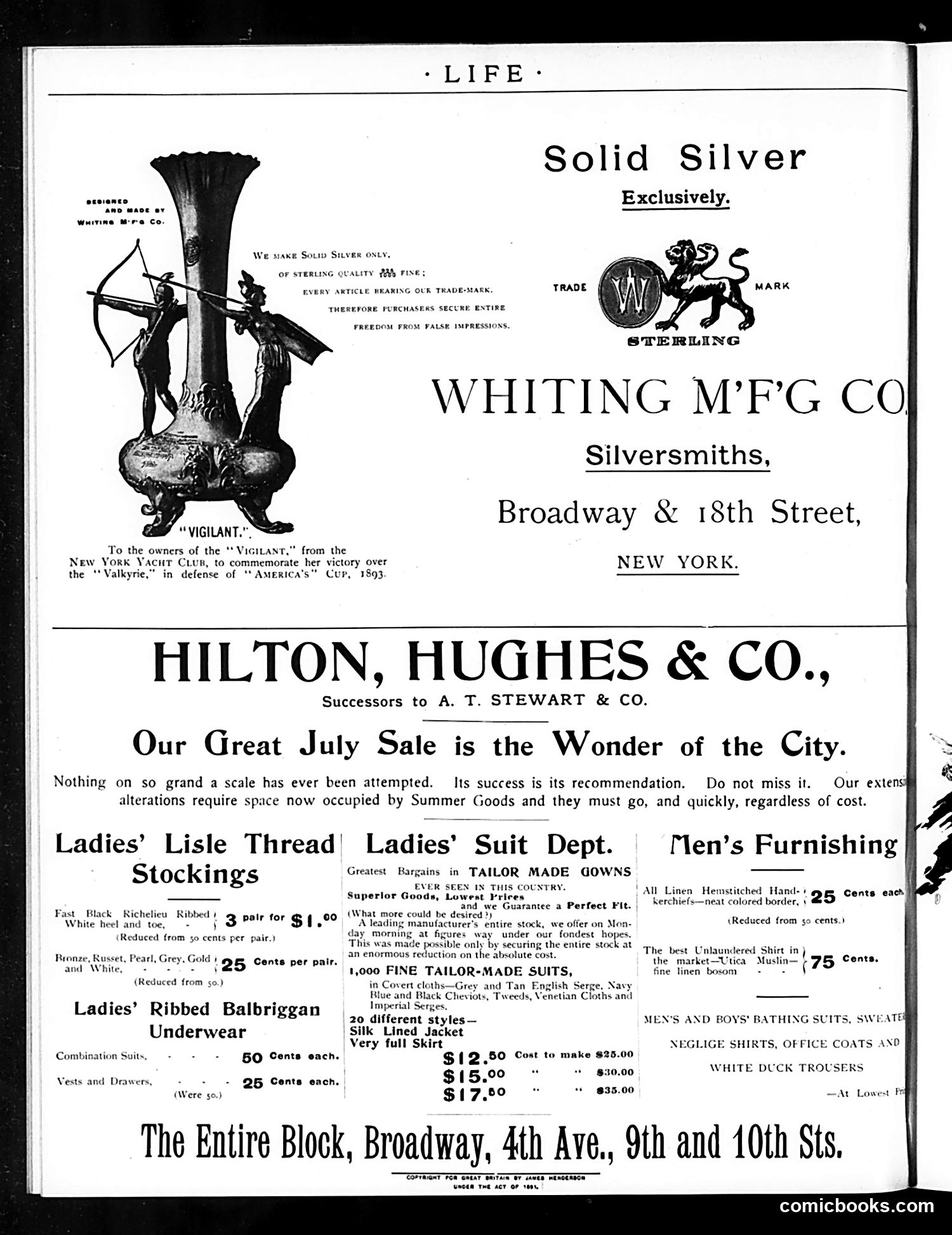
This page is predominantly **advertising**, not editorial content. The main image shows a decorative silver vessel called the "Vigilant," commissioned by the New York Yacht Club to commemorate a yacht race victory over the "Valkyrie" in defense of "America's Cup" in 1893. The vessel features allegorical figures with weapons, celebrating American nautical supremacy. Below are advertisements for Whiting Manufacturing Company (sterling silver goods) and Hilton, Hughes & Co. (department store sale), typical of Life magazine's revenue model. **There is no political cartoon or satire on this page**—it's a commercial publication space mixing luxury goods advertising with a celebratory maritime image that reflects fin-de-siècle American wealth and nationalism around yacht racing.
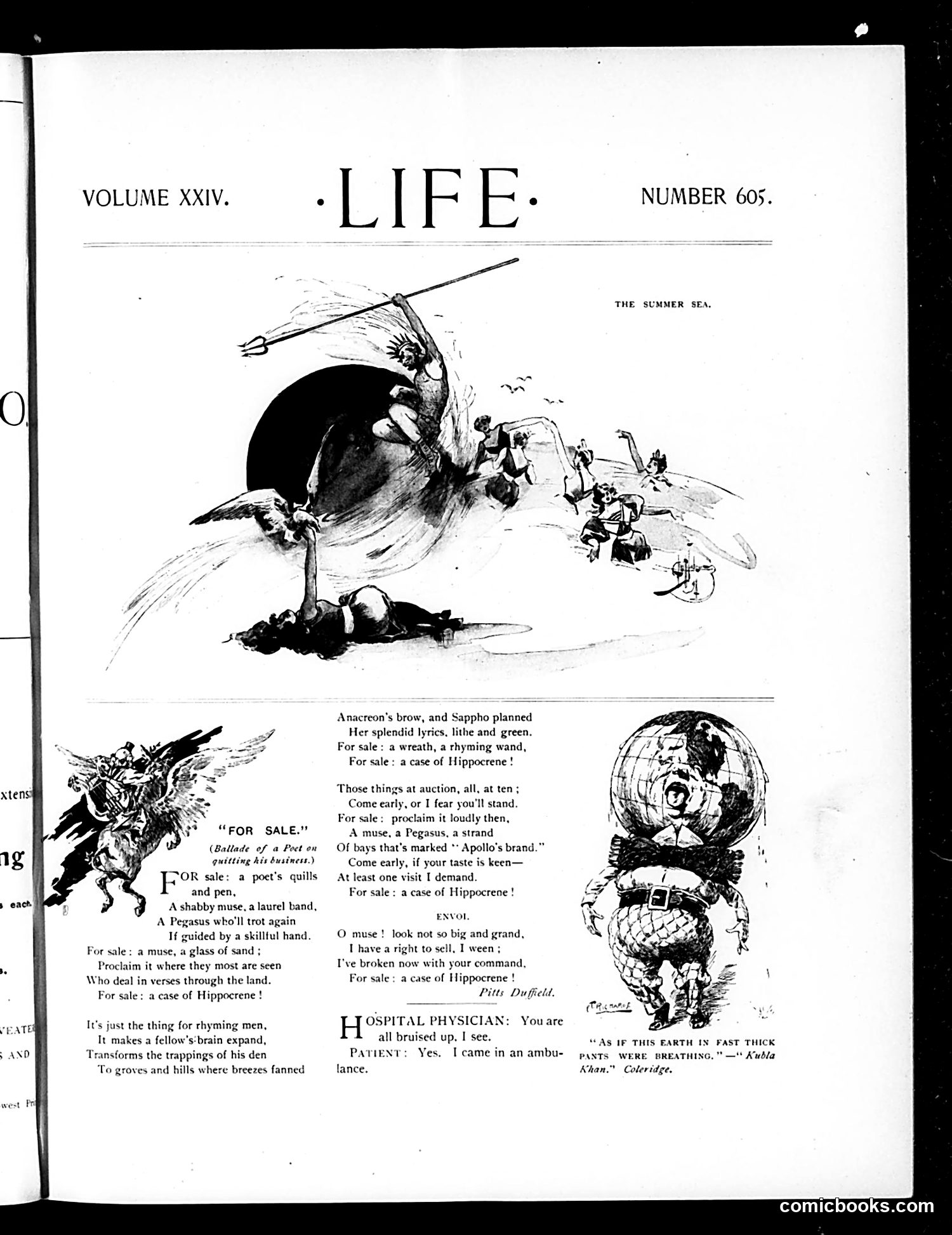
This satirical page features "For Sale," a poem about auctioning off a poet's possessions. The central cartoon depicts a grotesque figure (likely representing a failed or struggling poet) with exaggerated features, offering various items for sale including "a muse, a laurel band, / A Pegasus" and "a case of Hippocrene" (the mythical fountain of poetic inspiration). The satire mocks impoverished poets forced to liquidate their metaphorical and literal assets. The accompanying dialogue between a "Hospital Physician" and "Patient" provides comedic relief about someone bruised from hardship. The imagery—particularly the classical references and the pathetic presentation of once-noble poetic symbols now being auctioned—suggests commentary on the struggling artistic class, treating high literary aspirations with irreverent humor typical of Life's satirical approach.
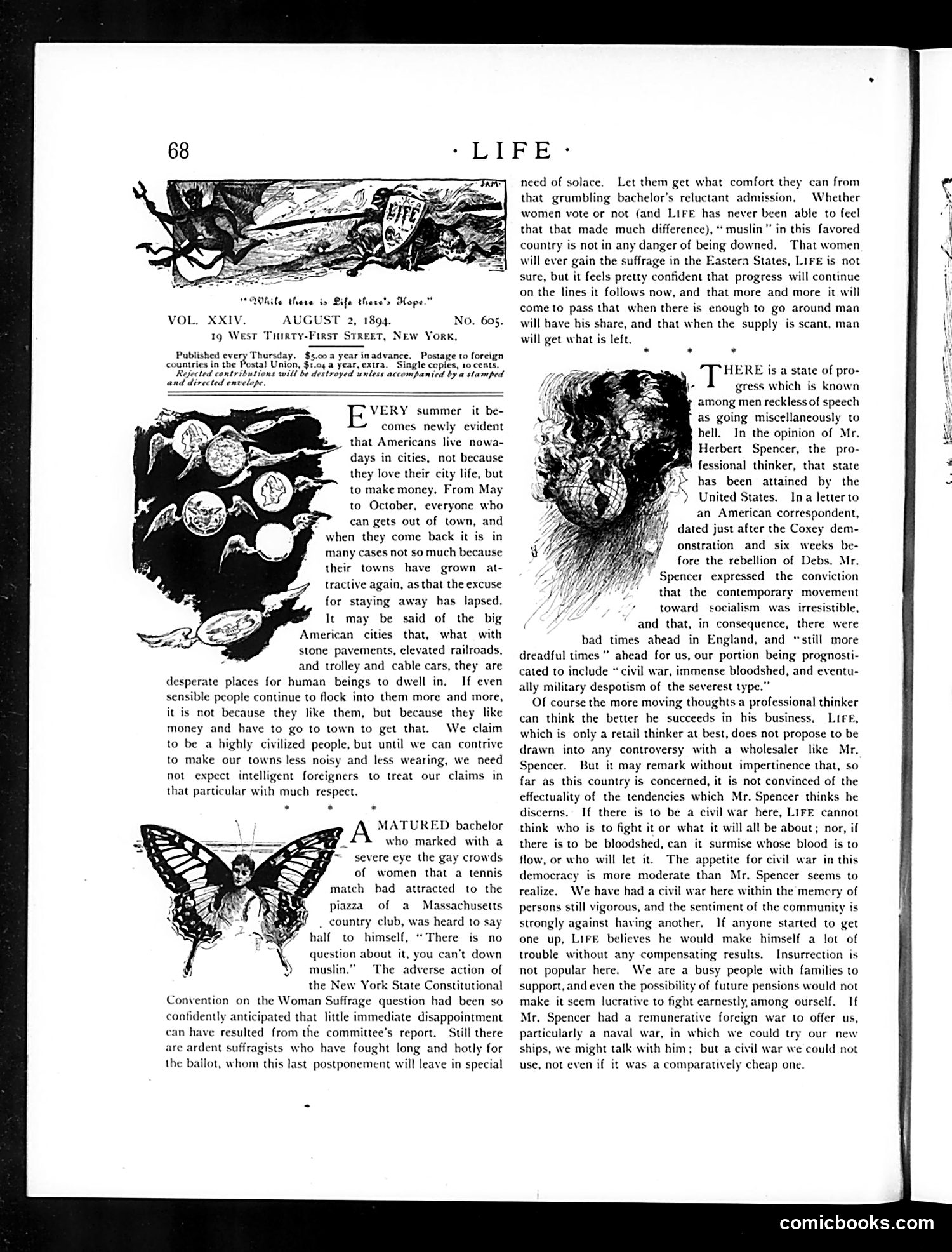
The page contains three satirical illustrations accompanying an article about American city life and contemporary social debates. The **top cartoon** depicts urban decay—overstuffed garbage and refuse—captioned "Strife there is Life there's Hope," mocking the contradiction between American claims of progress and actual urban conditions. The **middle illustration** shows a butterfly, likely symbolizing frivolity or false beauty masking underlying social problems. The **bottom cartoon** features a "matured bachelor" observing tennis-playing women, satirizing debates about women's roles and activities during the 1890s. The accompanying text discusses Mr. Herbert Spencer's pessimistic predictions about American socialism and civil war, contrasting them with Life's skepticism about such dire forecasts. The piece reveals anxieties about labor unrest, women's suffrage, and rapid urbanization during the Gilded Age.
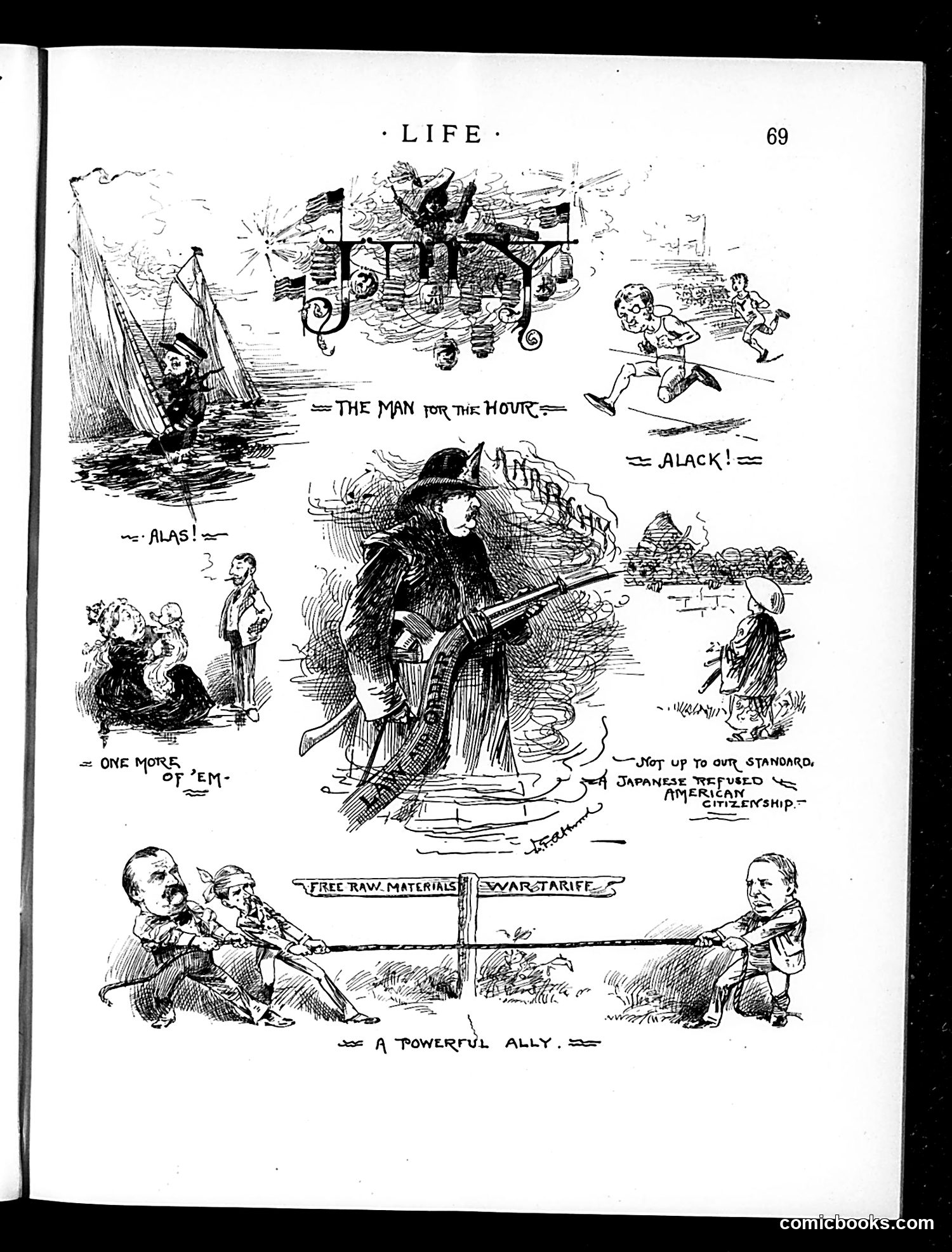
This page presents several interconnected satirical sketches about early 20th-century American foreign policy and immigration concerns: **"The Man for the Hour"** (top) features a chaotic, multi-faced figure representing conflicting political demands—suggesting no single leader can satisfy competing interests. **"Alack!"** and **"Alas!"** scenes depict distressed figures, likely commenting on diplomatic crises or policy failures. The **central figure with a rifle** appears to reference military intervention, labeled regarding "our standard, Japanese-American citizenship," suggesting tensions around Japanese immigration and naturalization rights—a significant political issue of this era. **"A Powerful Ally"** (bottom) shows two figures in a tug-of-war over "Free Raw Materials" versus "War Tariff," satirizing economic protectionism versus free trade debates in American politics. The overall theme critiques America's inability to maintain consistent, unified policies across military, immigration, and economic domains.
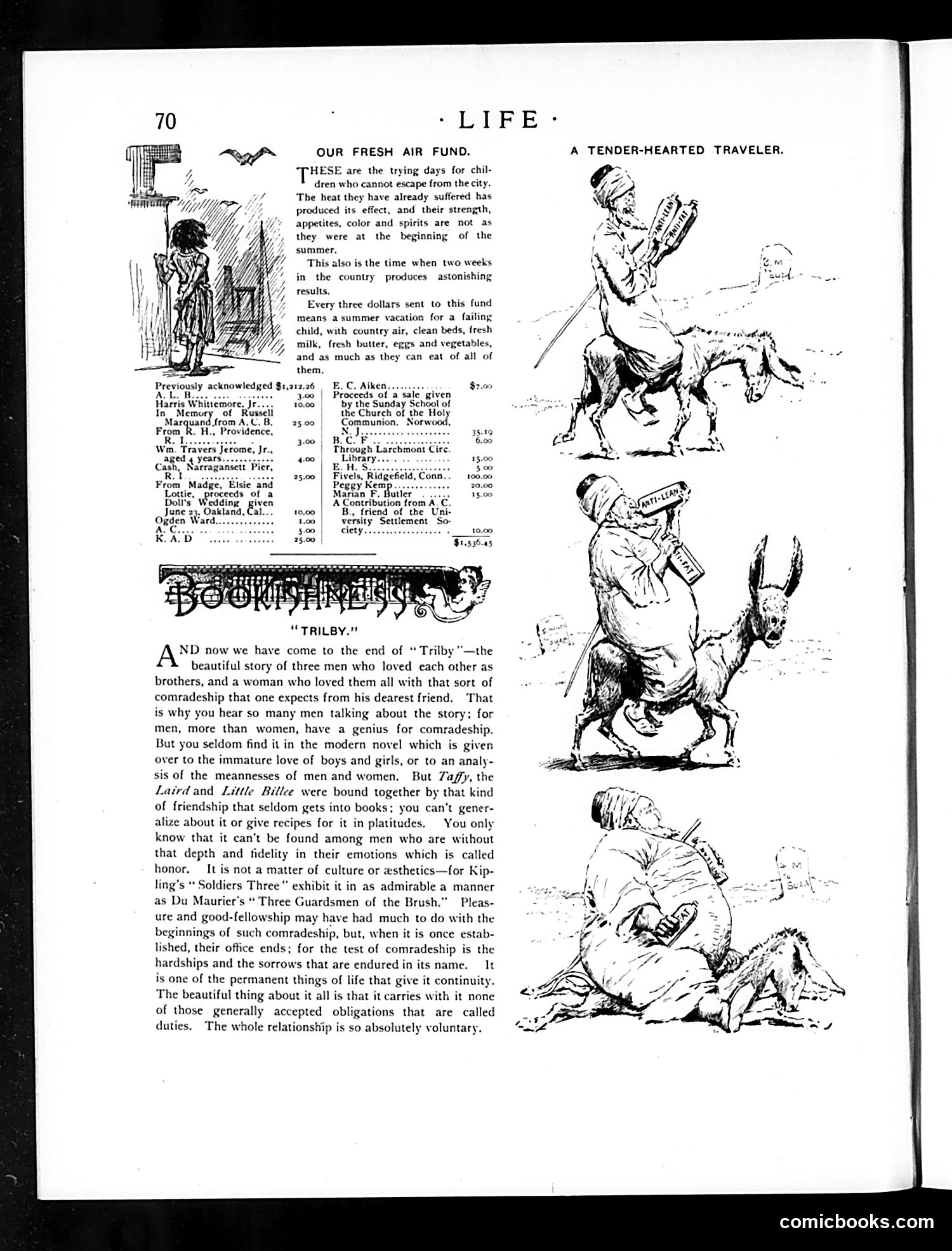
This page contains two sections: **Left side**: "Our Fresh Air Fund" - a charitable fundraising appeal for urban children needing summer respite. The accompanying sketch shows a thin city child, emphasizing the social concern being addressed. **Right side**: "A Tender-Hearted Traveler" - a humorous illustrated feature showing a man traveling with a donkey. The cartoon depicts comedic scenes of the traveler and animal in various mishaps (the man falling, the donkey bucking), playing on the incompetence or misfortune of someone attempting rustic travel. **Bottom**: A lengthy book review of "Trilby" discussing themes of male friendship and comradeship, contrasting it with contemporary literature about romantic love. The page reflects early-1900s Life magazine's mix of social commentary, light humor, and literary criticism.
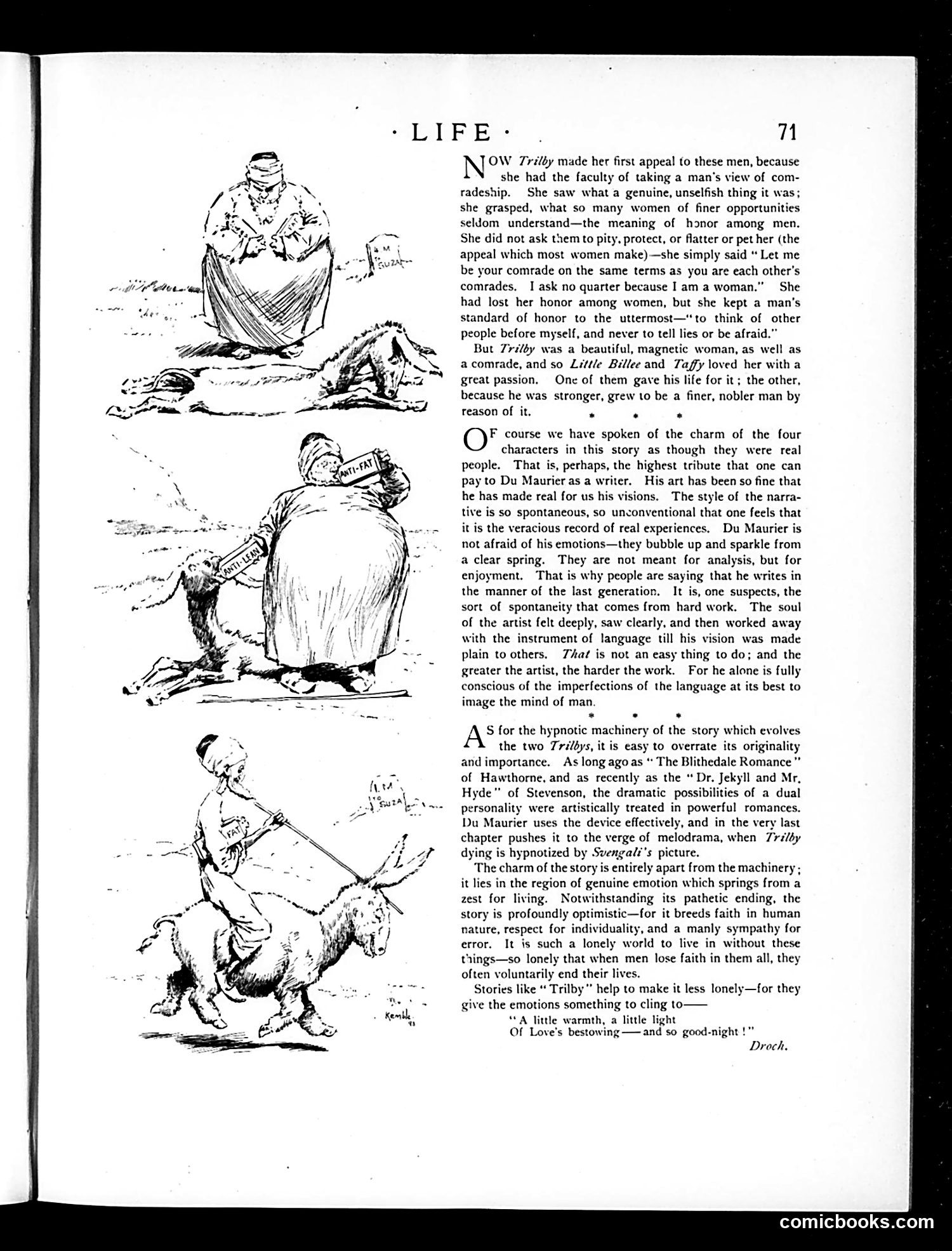
This page discusses Du Maurier's story "Trilby," featuring sketches of characters. The text praises how "Trilby" made her appeal to men through understanding masculine comradeship—she asked to be their "comrade" rather than seeking pity or protection, an unusual stance "most women make." The illustrations depict figures in what appears to be bohemian or artistic settings, consistent with the story's Parisian artist community backdrop. The text emphasizes Du Maurier's skill in creating spontaneous, emotionally authentic characters rather than analytical ones, and notes the story's use of "hypnotic machinery" (the dual personality theme) to create dramatic tension. The final paragraph suggests such stories provide emotional comfort to readers in lonely circumstances.
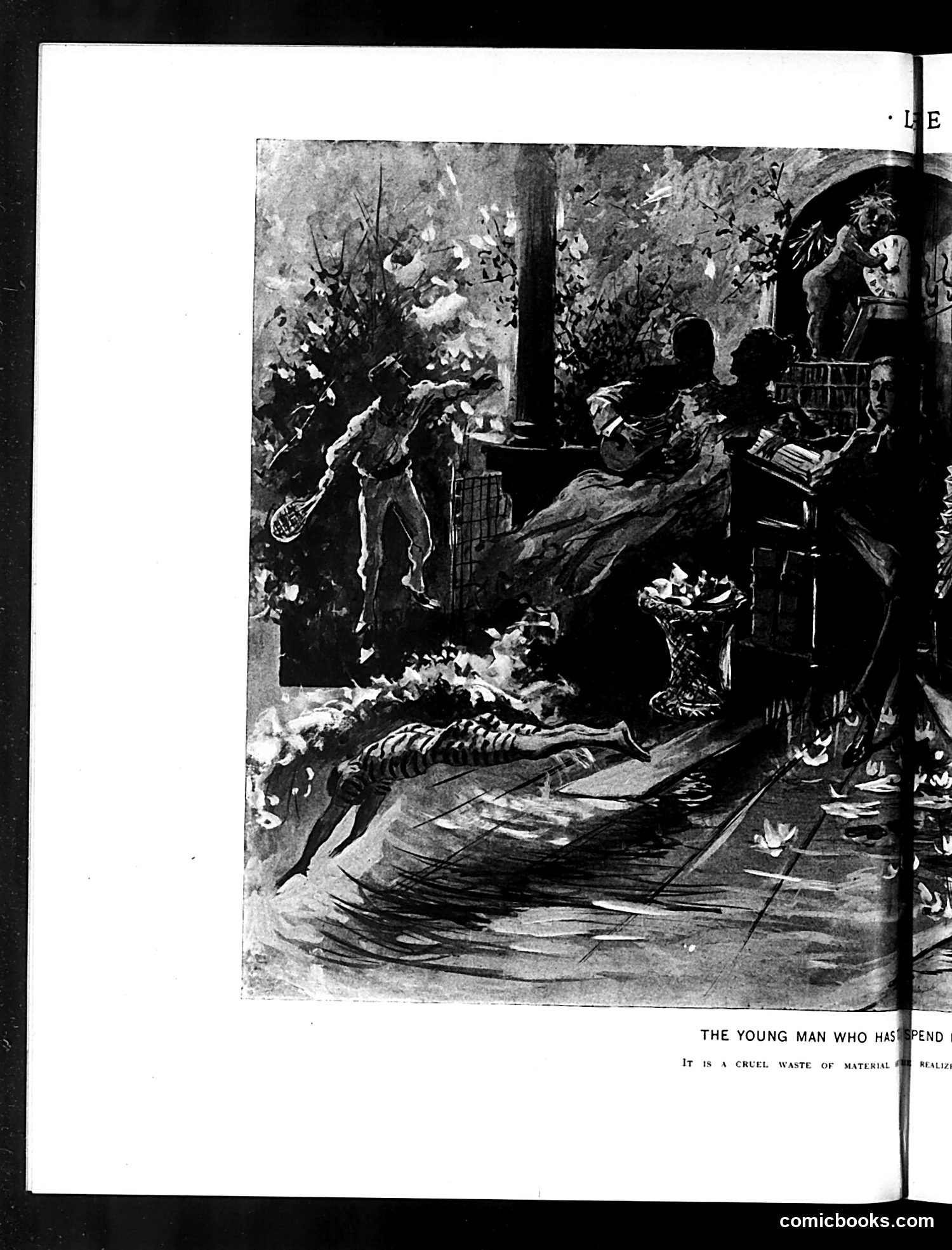
This appears to be a satirical illustration from Life magazine showing a scene of moral critique. The visible caption reads: "THE YOUNG MAN WHO HAS SPEND[T]... IT IS A CRUEL WASTE OF MATERIAL FOR REALIZ[ATION]" The image depicts what seems to be a cautionary scene: a young man lies prostrate or deceased on the ground in the foreground, while other figures (appearing to be in classical or theatrical dress) observe from above in an ornate interior setting with flowering plants. The incomplete text suggests this is moralizing satire about wasteful youth—likely criticizing a young man who squandered his potential or resources. Without the full caption, the exact target remains unclear, but the composition suggests commentary on wasted talent, dissolution, or moral failure among the young. The theatrical staging implies this may reference classical literature or a contemporary morality play.
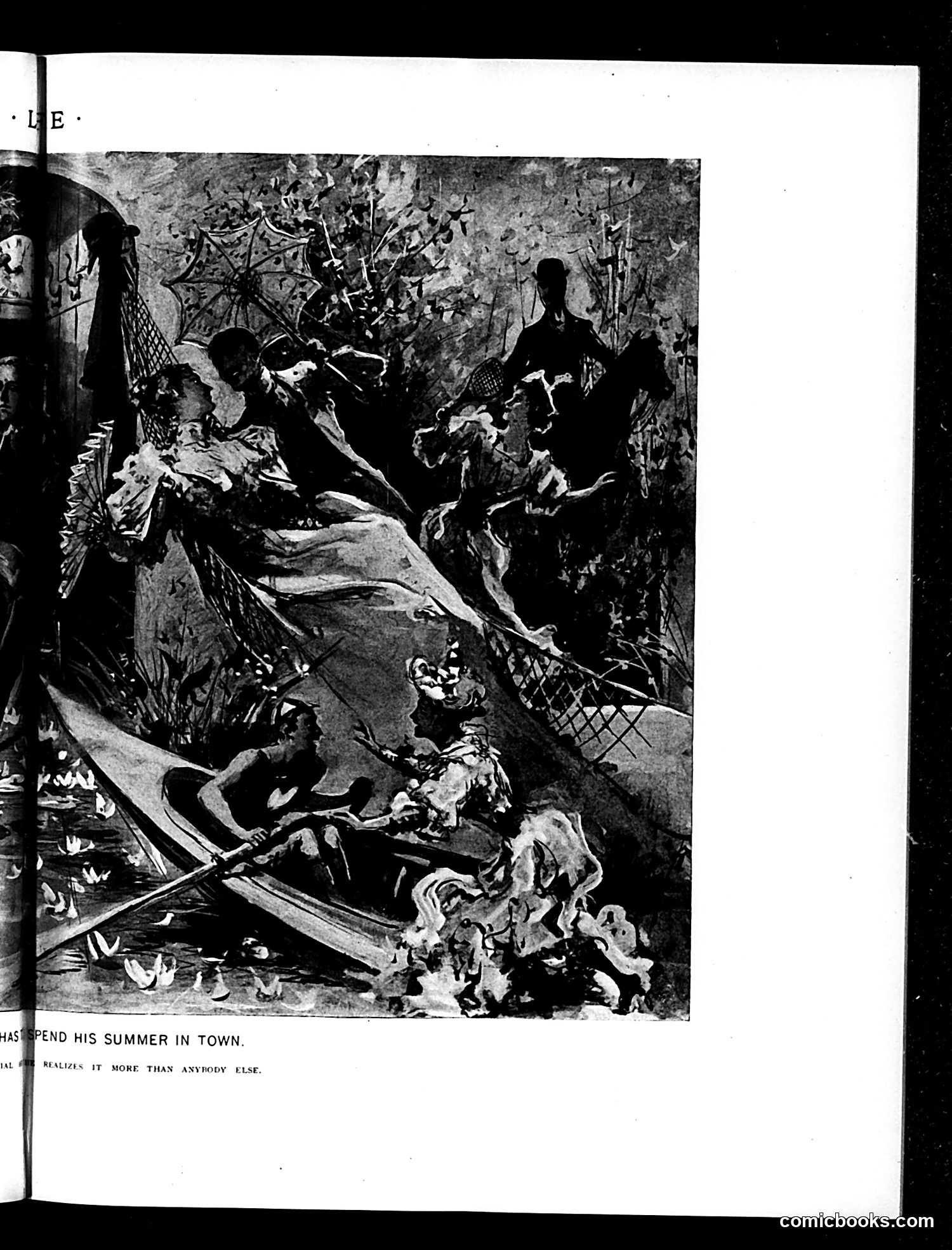
This page shows a classical or mythological scene rendered as a detailed engraving or illustration. The text fragment mentions someone spending "his summer in town" and that "it realizes it more than anybody else." The image depicts what appears to be a Bacchanalian or festive scene with multiple figures in classical dress, cherubs, decorative urns, and ornamental vegetation. The composition is crowded and baroque in style. Without clearer text or caption identifying the specific subject, I cannot definitively explain the satirical point. The satire likely concerns either: a wealthy person remaining in the city during summer (when society typically vacated to country estates), or commentary on excessive revelry and indulgence. The classical artistic style may parody pretentious aesthetic affectations. More complete text context would be needed for accurate interpretation.
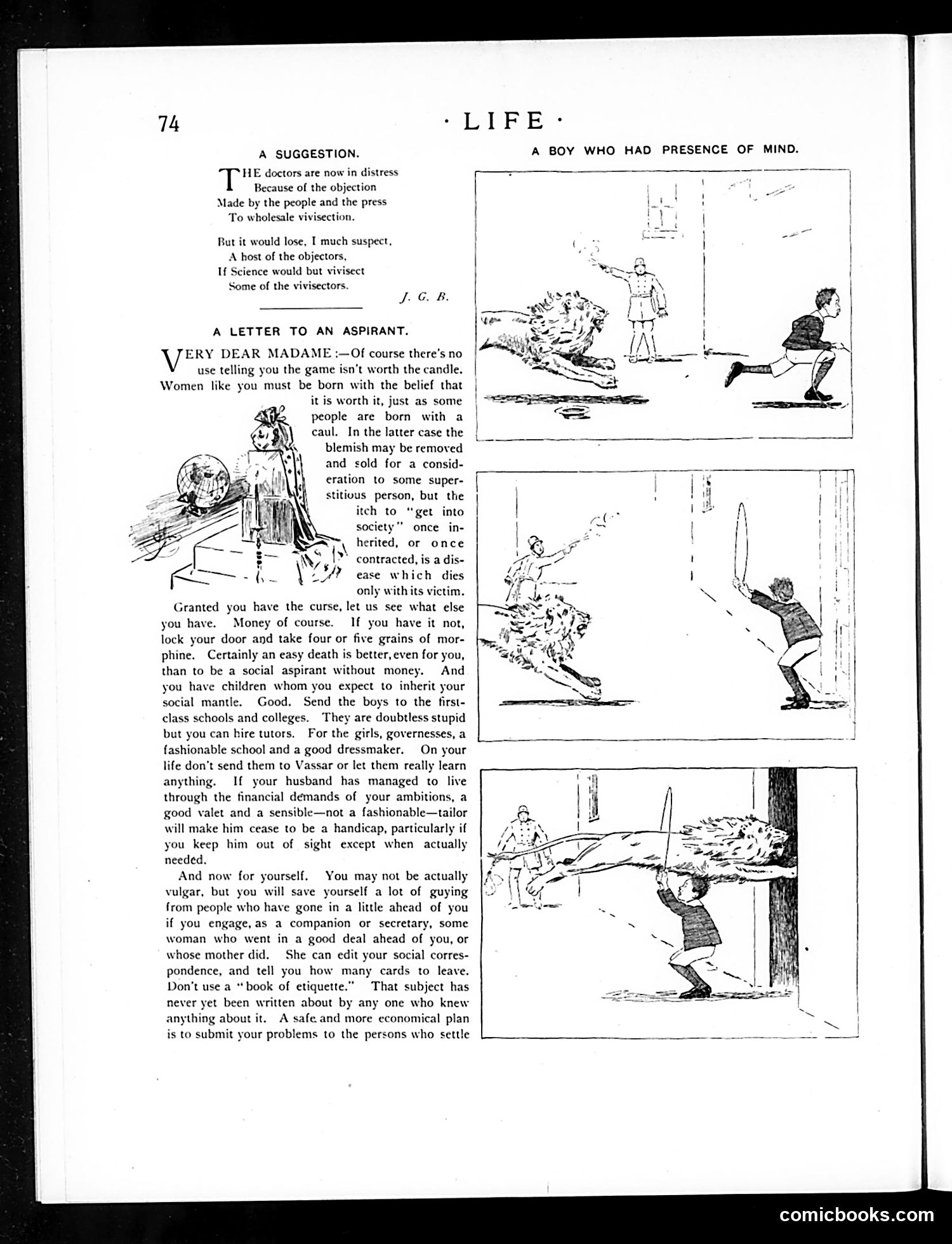
This comic strip illustrates a boy's quick thinking during what appears to be a crisis situation. The sequential panels show the boy responding actively to danger—likely a fall or accident involving another person. The title "A Boy Who Had Presence of Mind" suggests the humor derives from the boy demonstrating composure and resourcefulness under pressure, contrasting with expected panic. The accompanying text articles—"A Suggestion" and "A Letter to an Aspirant"—offer satirical social commentary. "A Suggestion" critiques doctors and vivivisection debates. "A Letter to an Aspirant" mocks social climbing and offers sardonic advice to women seeking upper-class status, emphasizing money and pragmatism over genuine merit or education. Together, the page presents satirical commentary on social pretension and earnest virtue.
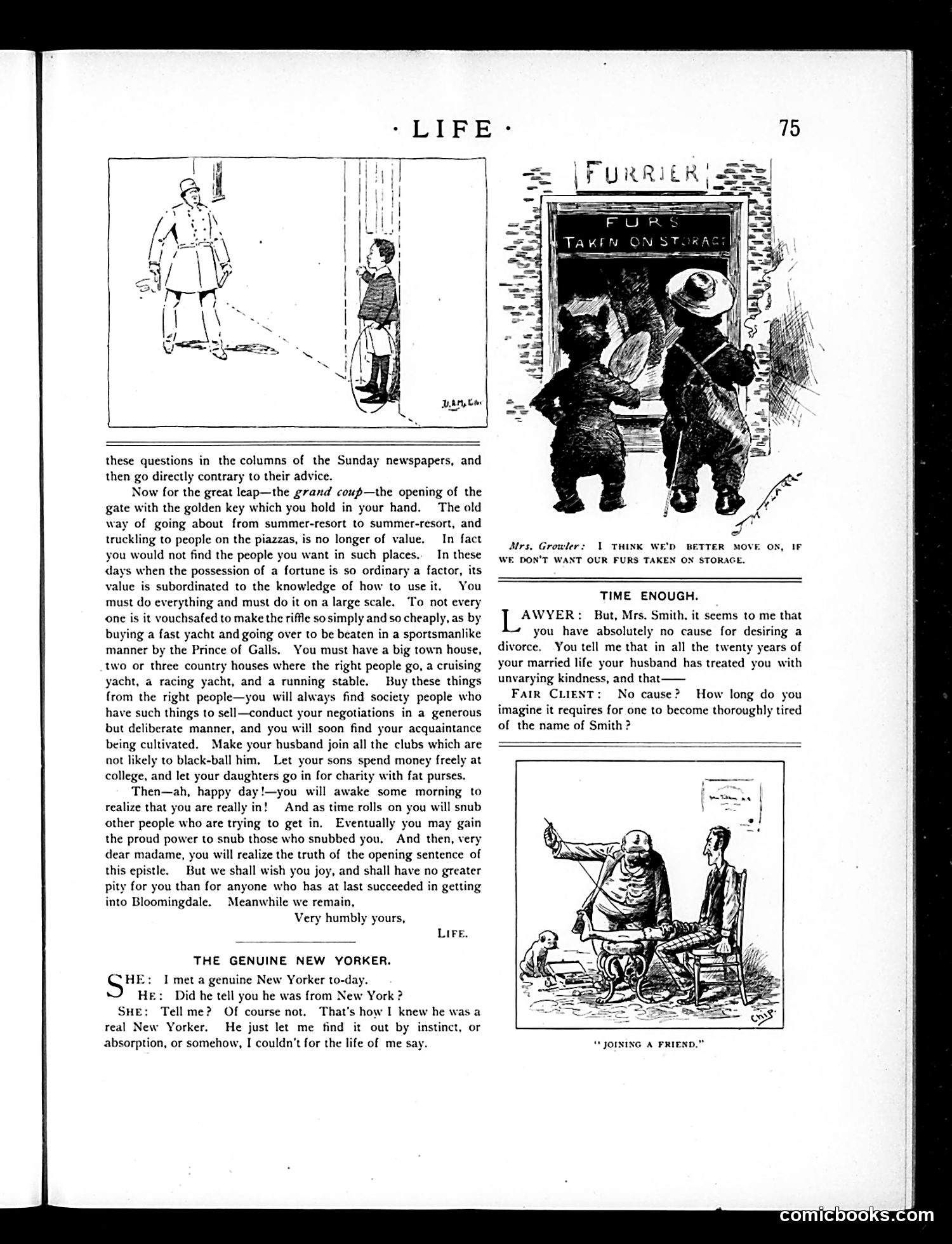
This page contains two distinct satirical pieces: **Top cartoon:** Shows a military officer pointing at a small child by a doorway, illustrating advice about social climbing through ostentatious displays of wealth—owning yachts, racing horses, and large estates to impress "society people." **"Time Enough" dialogue:** A lawyer counsels a client (Mrs. Smith) seeking divorce, noting she's endured an "unvarying" husband for twenty years. The joke hinges on her complaint that she's tired of the *name* Smith—suggesting her real grievance is social embarrassment rather than actual marital cruelty. **"Joining a Friend" cartoon:** Shows adults and children at leisure, depicting comfortable middle-class recreation. **"The Genuine New Yorker" dialogue:** Satirizes New York affectation—a woman identifies someone as a "genuine New Yorker" not by what he says, but by his unconscious mannerisms and absorbed local qualities. The page satirizes social pretension and class consciousness in early 20th-century America.
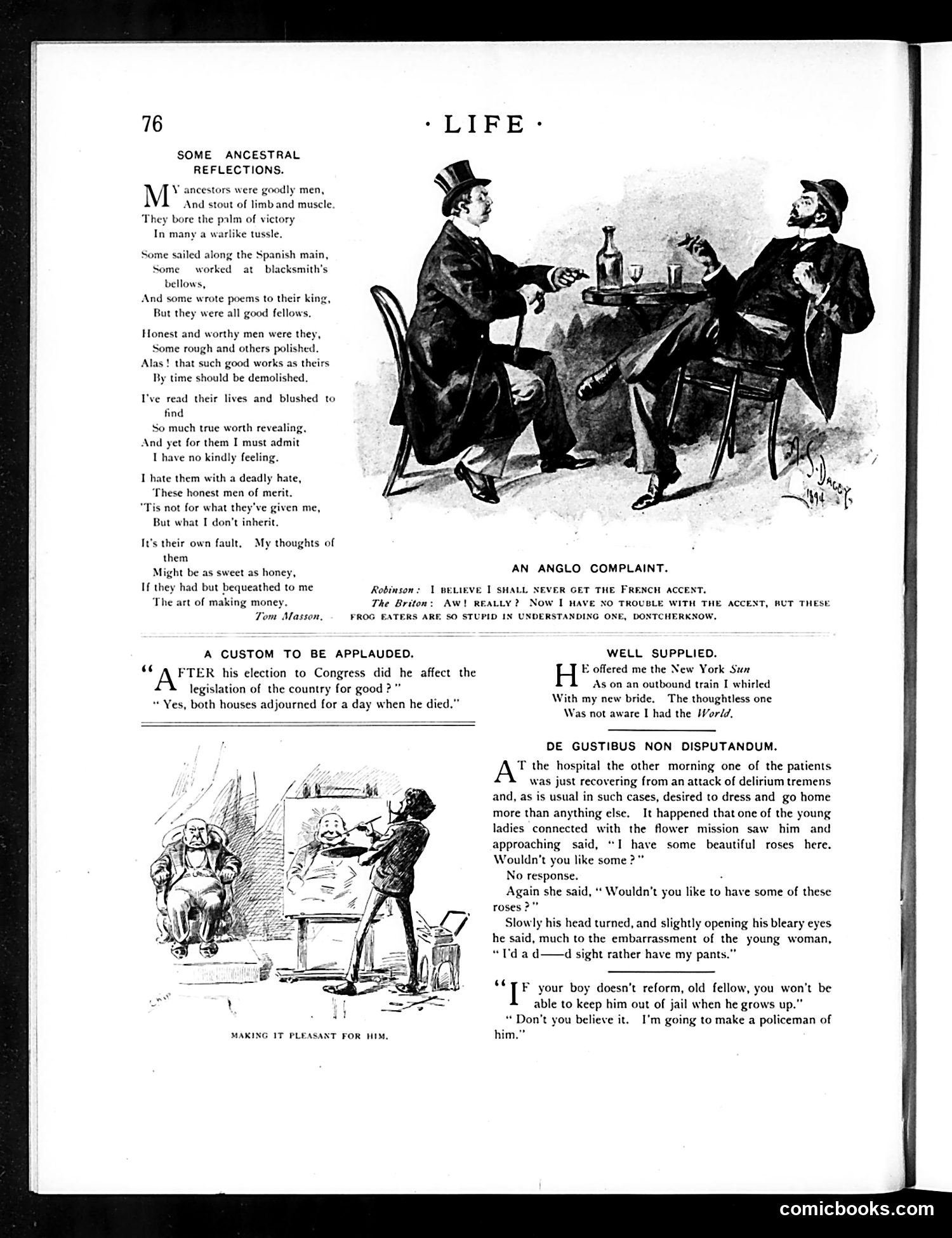
This page contains several humorous pieces targeting class anxieties and national stereotypes of the era. **"Some Ancestral Reflections"** mocks wealthy Americans who resent their ancestors for failing to leave them fortunes. The speaker admits hating his "honest men of merit" forebears solely because they didn't bequeath "the art of making making money"—satirizing inherited-wealth obsession among the nouveau riche. **"An Anglo Complaint"** depicts a British character boasting he has "no trouble with the French accent" while condescendingly dismissing French people as "stupid." This mocks British snobbery and linguistic pretension toward continental rivals. The remaining pieces are brief jokes: one about a congressman whose death warranted adjournment, another about a delirious patient refusing flowers in favor of his pants, and a final quip about making a troublemaker into a policeman. Each satirizes American social types—politicians, sentimentality, and parental delusion.
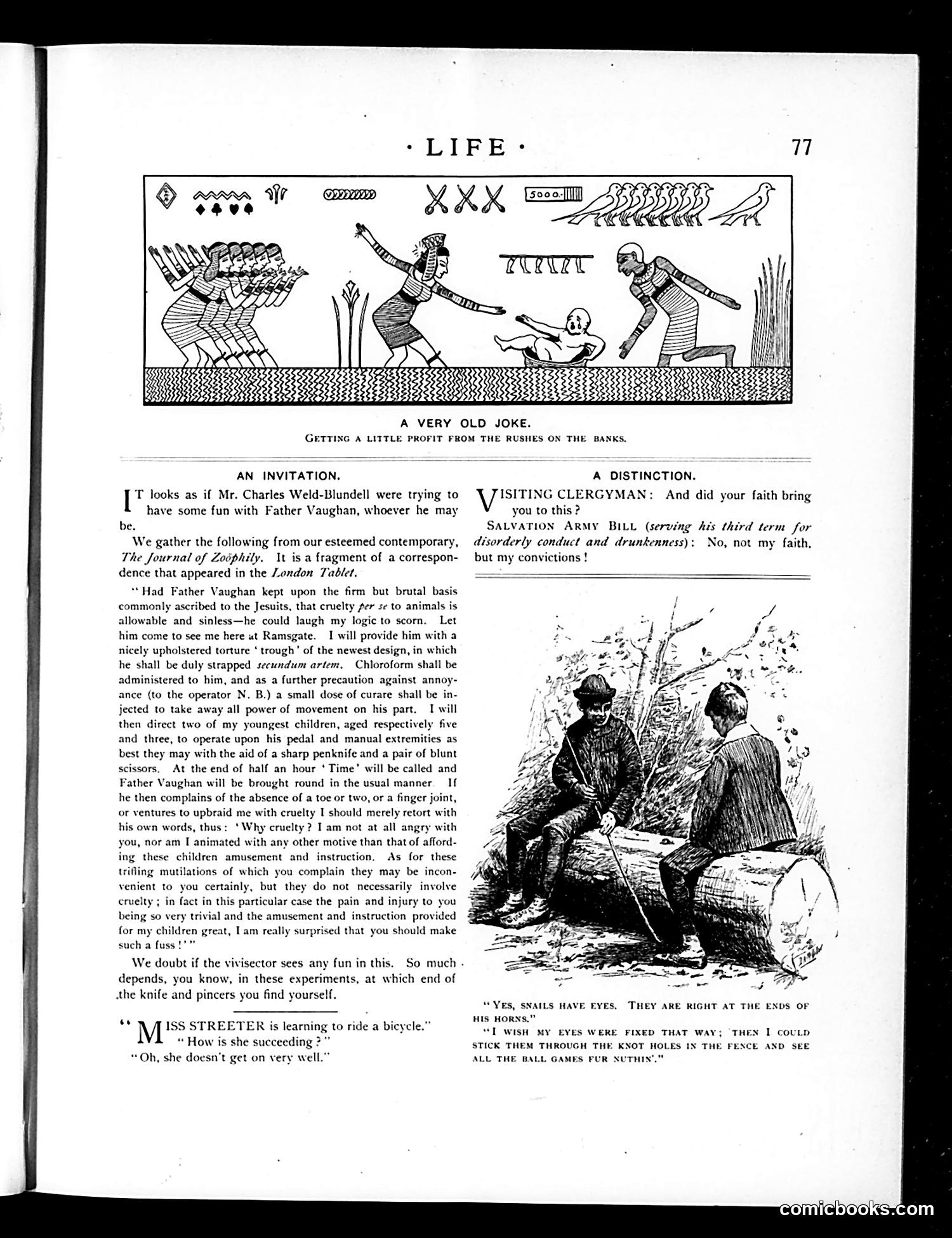
This page contains three satirical pieces: **"A Very Old Joke"** (top): An Egyptian hieroglyphic-style cartoon showing ancient figures harvesting rushes from riverbanks—a visual pun on "getting profit from the rushes." **"An Invitation"** (main text): A pointed satirical letter attacking Father Vaughan, a Jesuit priest, over the ethics of animal cruelty. Charles Weld-Blundell sarcastically "invites" Vaughan to experience torture, turning the priest's own arguments about animal suffering back on him. This appears to be part of a real debate published in *The Journal of Zoophily* and the *London Tablet* regarding Jesuit positions on vivisection and animal cruelty. **"A Distinction"** (bottom): A cartoon joke contrasting a visiting clergyman's assumption that a Salvation Army man's faith brought him there, with the man's reply that it was his criminal convictions instead—playing on the double meaning of "convictions." **"Miss Streeter"** and **snail eyes joke**: Brief humor pieces with no clear satirical target.
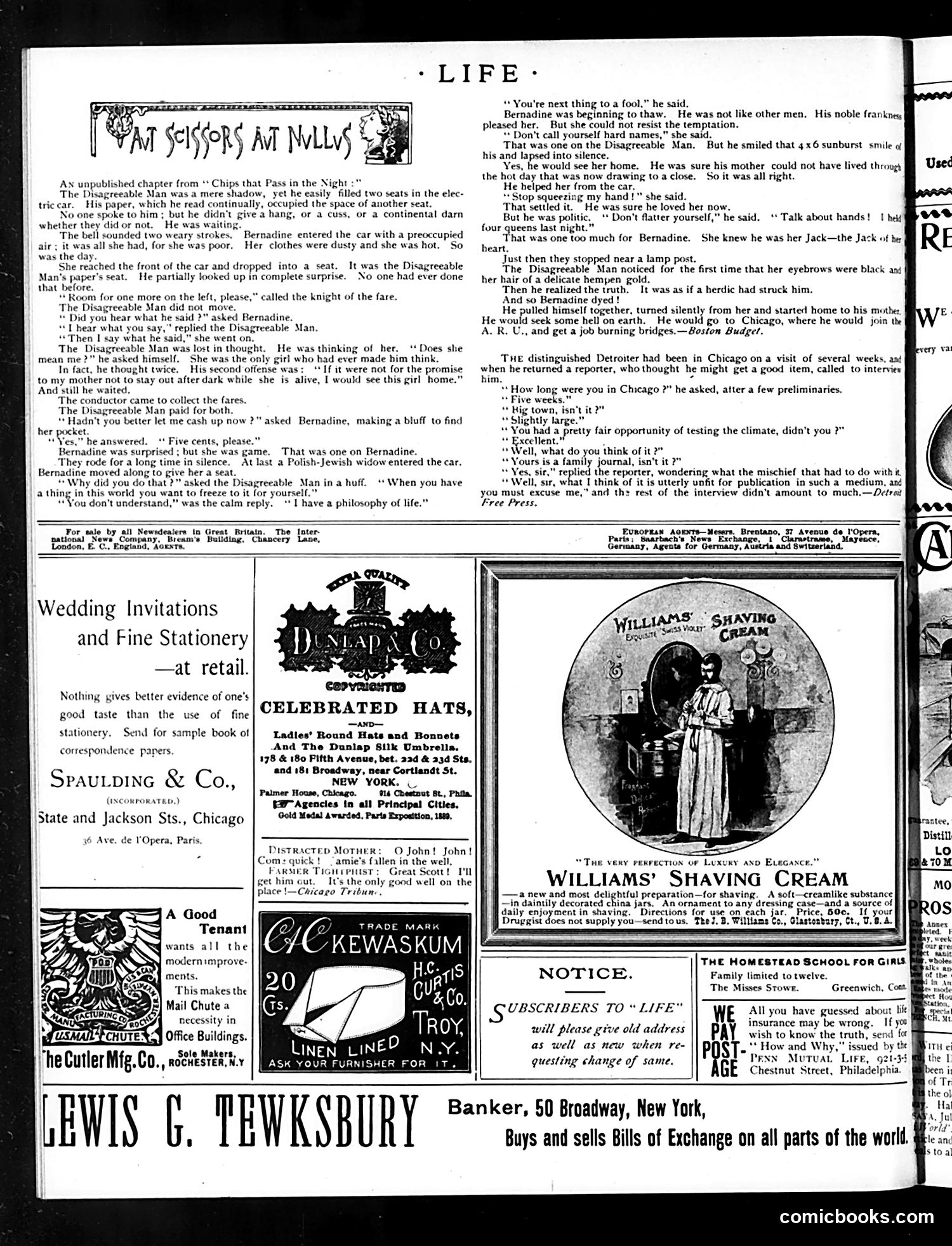
This page contains two satirical stories from *Life* magazine, a publication known for social humor. **"Chips that Pass in the Night"** mocks the "Disagreeable Man"—a curmudgeonly character who monopolizes streetcar seats with his newspaper and refuses basic courtesy. When a poor woman named Bernadine boards, he's unexpectedly moved by her dignity and eventually falls for her. However, the joke's twist: he discovers her eyebrows are artificially dyed, which horrifies him so completely he abandons her to join radical labor groups in Chicago (likely referencing the American Railway Union and labor violence of the era). The satire targets male hypocrisy—men who claim nobility while judging women harshly for minor beautification—and mocks both the "disagreeable" misogynist and romantic melodrama itself. **The second piece** (partially visible) appears to feature a reporter interviewing a Detroit businessman about Chicago, likely setting up a comparative city joke. The advertisements surrounding these stories reflect the era's consumer culture and gender norms.
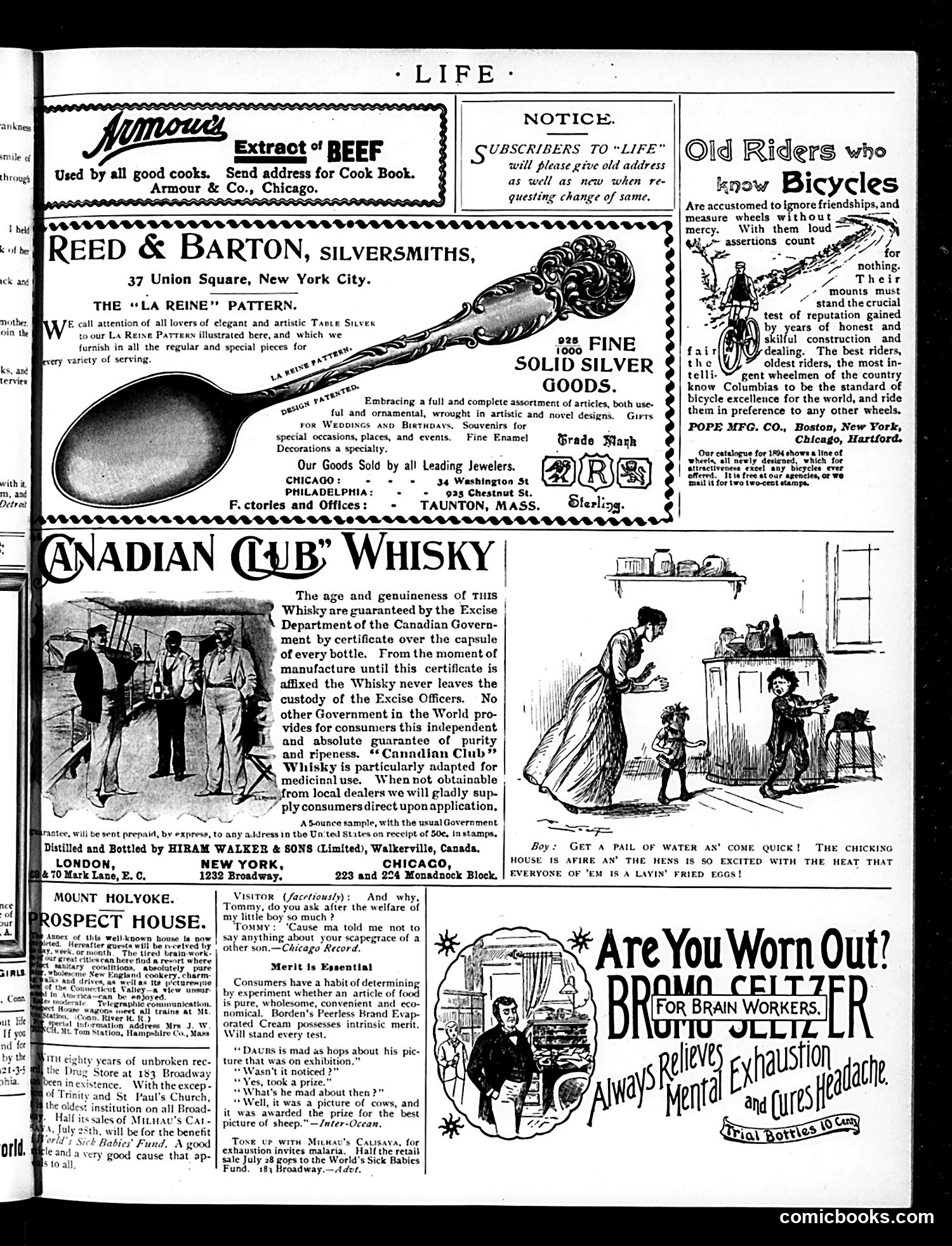
This page is primarily **advertising**, featuring luxury goods and patent medicines typical of early 1900s America. Notable elements: **Major Advertisements:** - Reed & Barton silverware ("La Reine" pattern) for wealthy households - Canadian Club whisky, marketed with government purity guarantees - Pope Manufacturing bicycles, positioned as superior to competitors - Borden's evaporated cream and other consumer products **Humor Content:** A small domestic cartoon depicts a mother and child during a house fire, with the boy excitedly reporting that the excitement has caused the hens to lay fried eggs—a pun on the literal heat situation. **Social Context:** The advertising reflects Gilded Age consumer culture targeting affluent readers. The bicycle ad's emphasis on "Old Riders" and reputation appeals to status-conscious consumers. The whisky's government certification reflects American concerns about product authenticity and purity—significant given the era's lack of food/drug regulations. The page contains no political satire or caricature, but rather represents typical Life magazine content: commercial advertisements supporting the publication.
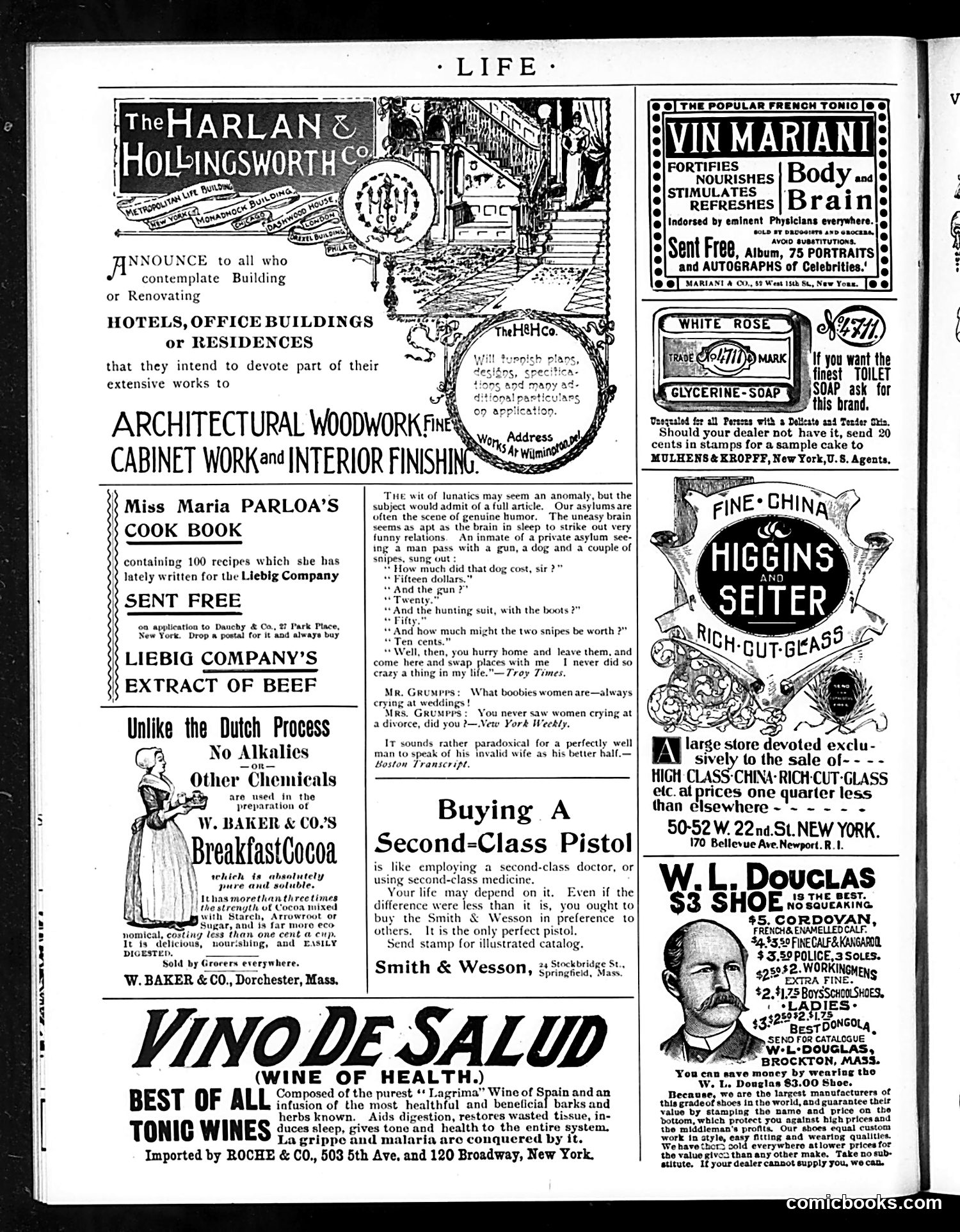
This is primarily a **commercial advertising page**, not political satire. The content consists of period product advertisements typical of early 20th-century American magazines. Notable ads include: - **Harlan & Hollingsworth Co.**: architectural/carpentry services - **Vin Mariani**: a tonic wine endorsed by physicians (a common patent medicine of the era) - **W.L. Douglas shoes**: emphasizing affordability and quality - **Vino de Salud**: another medicinal wine product - **Smith & Wesson pistols**: marketed as superior to "second-class" alternatives - **Liebig Company**: beef extract and Miss Parloa's cookbook The page includes **brief humorous anecdotes** (asylum wit, marital jokes) unrelated to the advertisements—filler content common in Life magazine. The ads reveal era-specific concerns: tonic wines as cure-alls, shoe manufacturing quality, and firearm marketing. There is **no discernible political cartoon or satire** on this page—it represents straightforward commercial publishing from Life's advertising-heavy format.