
Life, 1894-08-02 · page 4 of 16
Life — August 2, 1894 — page 4: what you’re looking at
What you’re looking at
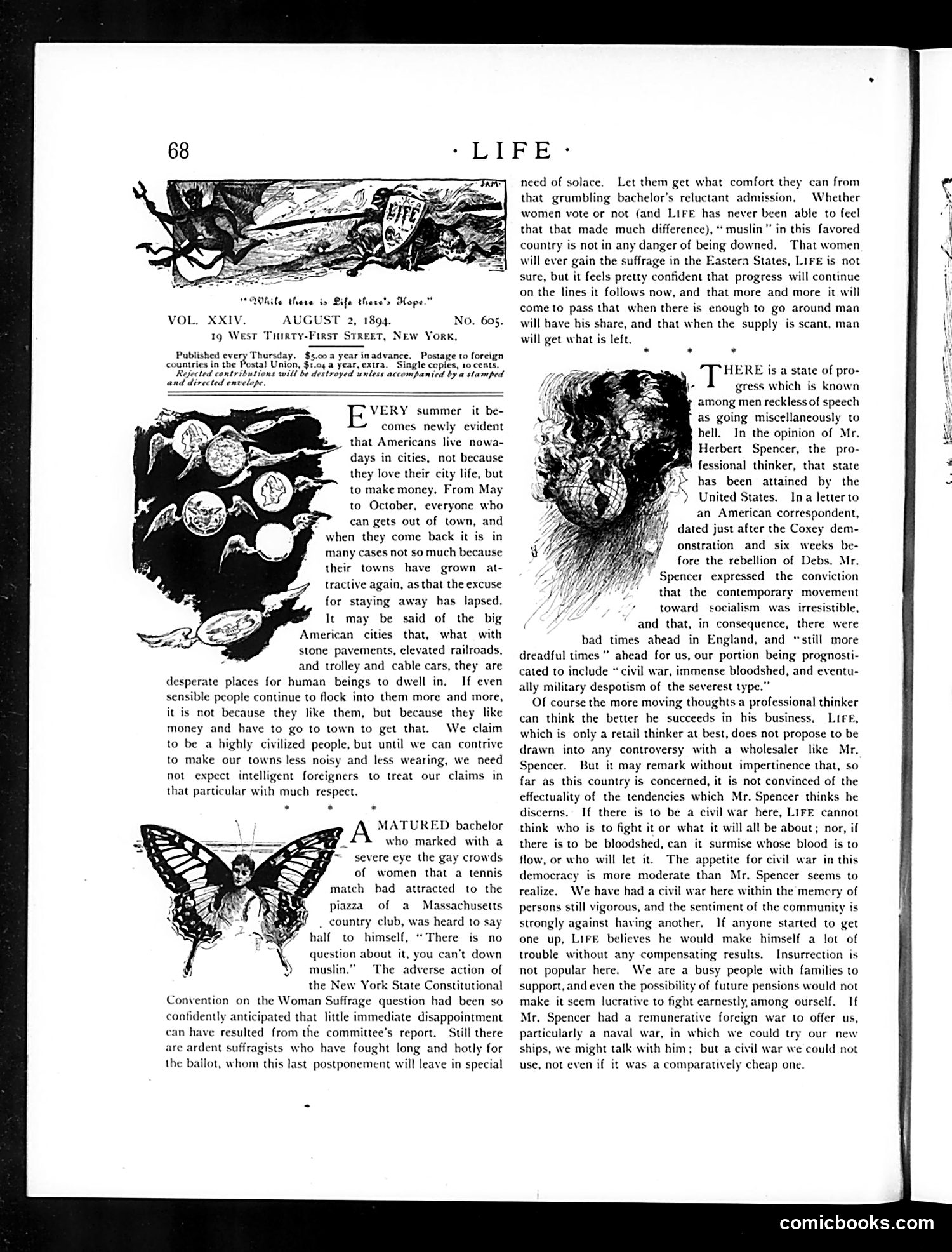
The page contains three satirical illustrations accompanying an article about American city life and contemporary social debates. The **top cartoon** depicts urban decay—overstuffed garbage and refuse—captioned "Strife there is Life there's Hope," mocking the contradiction between American claims of progress and actual urban conditions. The **middle illustration** shows a butterfly, likely symbolizing frivolity or false beauty masking underlying social problems. The **bottom cartoon** features a "matured bachelor" observing tennis-playing women, satirizing debates about women's roles and activities during the 1890s. The accompanying text discusses Mr. Herbert Spencer's pessimistic predictions about American socialism and civil war, contrasting them with Life's skepticism about such dire forecasts. The piece reveals anxieties about labor unrest, women's suffrage, and rapid urbanization during the Gilded Age.
📄 Transcribed text from this page (OCR, searchable)
Machine-transcribed from the original scan — historical spelling and the odd misread are preserved.
- LIFE: *WOKile there is Life there's Hope.” OL. XXIV. AUGUST 2, 1894. No. 605. 1g West Tuirty-First Street, New York, Published every Thursday. $5.00 Postage to foreign countries in the Postal Union, $1.04 a year, extra. Single copies, 10 cents, Rejected contributions will be destroyed unless accompanied by a stamped and directed envelope. VERY summer it be- comes newly evident that Americans live nowa- days in cities, not because they love their city life, but to make money. From May to October, everyone who can gets out of town, and when they come back it is in many cases not so much because their towns have grown at- tractive again, as that the excuse for staying away has lapsed. It may be said of the big American cities that, what with stone pavements, elevated railroads, and trolley and cable cars, they are desperate places for human beings to dwell in. If even sensible people continue to flock into them more and more, it is not because they like them, but because they like money and have to go to town to get that. We claim to be a highly civilized people, but until we can contrive to make our towns less noisy and less wearing, we need not expect intelligent foreigners to treat our claims in that particular with much respect. MATURED bachelor who marked with a severe eye the gay crowds of women that a tennis match had attracted to the piazza of a Massachusetts . country club, was heard to say half to himself, “There is no question about it, you can’t down muslin.” The adve tion of the New York State Constitutional Convention on the Woman Suffrage question had been so contidently anticipated that little immediate disappointment can have resulted from the committee's report. Still there are ardent suffragists who have fought long and hotly for allot, whom this last postponement will leave in special need of solace. Let them get what comfort they can from that grumbling bachelor’s reluctant admission. Whether women vote or not (and LIFE has never been able to feel that that made much difference), “ muslin” in this favored country is not in any danger of being downed. That women will ever gain the suffrage in the Eastera States, LiFe is not sure, but it feels pretty confident that progress will continue on the lines it follows now, and that more and more it will come to pass that when there is enough to go around man will have his share, and that when the supply is scant, man will get what is left. *. . HERE is a state of pro- gress which is known among men reckless of speech as going miscellaneously to hell. In the opinion of Mr. Herbert Spencer, the pro- fessional thinker, that state has been attained by the United States. Ina letter to an American correspondent, dated just after the Coxey dem- onstration and six weeks be- fore the rebellion of Debs. Mr. Spencer expressed the conviction that the contemporary movement toward socialism was irresistible, and that, in consequence, there were bad times ahead in England, and “still more dreadful times ” ahead for us, our portion being prognosti- cated to include “ civil war, immense bloodshed, and eventu- ally military despotism of the severest type.” Of course the more moving thoughts a professional thinker can think the better he succeeds in his business. Lire, which is only a retail thinker at best, does not propose to be drawn into any controversy with a wholesaler like Mr. Spencer. But it may remark without impertinence that, so far as this country is concerned, it is not convinced of the effectuality of the tendencies which Mr. Spencer thinks he discerns. If there is to be a civil war here, LIFE cannot think who is to fight it or what it will all be about; nor, if there is to be bloodshed, can it surmise whose blood is to flow, or who will let it. The appetite for civil war in this democracy is more moderate than Mr, Spencer seems to realize. We have had a civil war here within the memery of persons still vigorous, and the sentiment of the communi strongly against having another. If anyone started to get one up, LIFE believes he would make himself a lot of trouble without any compensating results, Insurrection is not popular here. We are a busy people with families to support, and even the possibility of future pensions would not make it seem lucrative to fight earnestly, among ourself. If Mr. Spencer had a remunerative foreign war to offer us, particularly a naval war, in which we could try our new ships, we might talk with him; but a civil war we could not use, not even if it was a comparatively cheap one. comicbooks.com