
Life, 1894-08-02 · page 7 of 16
Life — August 2, 1894 — page 7: what you’re looking at
What you’re looking at
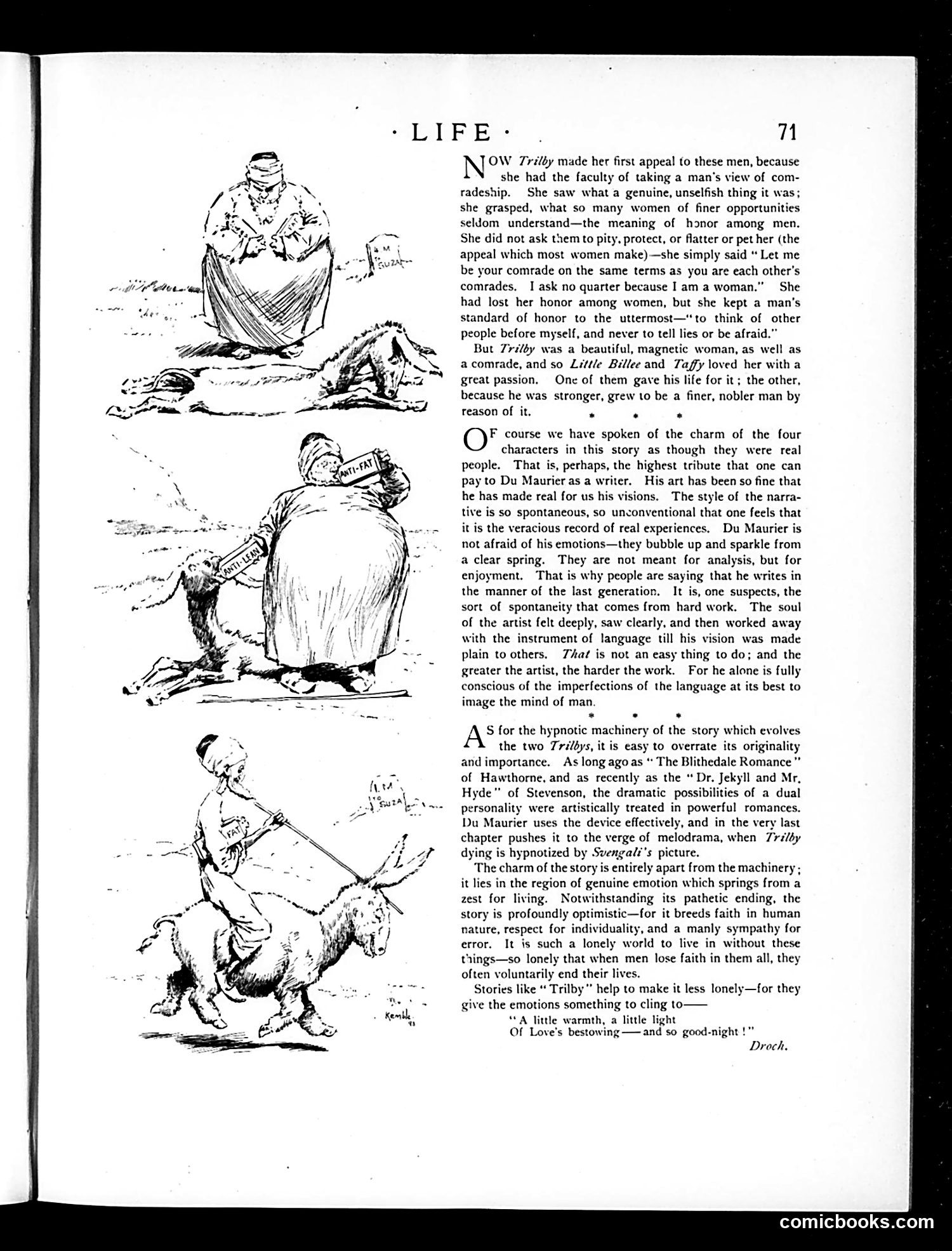
This page discusses Du Maurier's story "Trilby," featuring sketches of characters. The text praises how "Trilby" made her appeal to men through understanding masculine comradeship—she asked to be their "comrade" rather than seeking pity or protection, an unusual stance "most women make." The illustrations depict figures in what appears to be bohemian or artistic settings, consistent with the story's Parisian artist community backdrop. The text emphasizes Du Maurier's skill in creating spontaneous, emotionally authentic characters rather than analytical ones, and notes the story's use of "hypnotic machinery" (the dual personality theme) to create dramatic tension. The final paragraph suggests such stories provide emotional comfort to readers in lonely circumstances.
📄 Transcribed text from this page (OCR, searchable)
Machine-transcribed from the original scan — historical spelling and the odd misread are preserved.
oa) (2) (9 =i) co 71 N OW Trilty made her first appeal to these men, because she had the faculty of taking a man’s view of com- radeship. She saw what a genuine, unselfish thing it was; she grasped, what so many women of finer opportunities seldom understand—the meaning of honor among men. She did not ask them to pity, protect, or flatter or pet her (the appeal which most women make)—she simply said “ Let me be your comrade on the same terms as you are each other's comrades, I ask no quarter because 1 am a woman.” She had lost her honor among women, but she kept a man’s standard of honor to the uttermost—‘to think of other people before myself, and never to tell lies or be afraid.” But 7relby was a beautiful, magnetic woman, as well as a comrade, and so Little Billee and Taffy loved her with a great passion. One of them gave his life for it; the other, because he was stronger, grew to be a finer, nobler man by reason of it. * ri ‘ F course we have spoken of the charm of the four characters in this story as though they were real people. That is, perhaps, the highest tribute that one can pay to Du Maurier as a writer. His art has been so fine that he has made real for us his visions. The style of the narra- tive is so spontaneous, so unconventional that one feels that it is the veracious record of real experiences. Du Maurier is not afraid of his emotions—they bubble up and sparkle from a clear spring. They are not meant for analysis, but for enjoyment. That is why people are saying that he writes in the manner of the last generation. It is, one suspects, the sort of spontaneity that comes from hard work. The soul of the artist felt deeply, saw clearly, and then worked away with the instrument of language till his vision was made plain to others. Za? is not an easy thing to do; and the greater the artist, the harder the work. For he alone is fully conscious of the imperfections of the language at its best to image the mind of man. . . . S for the hypnotic machinery of the story which evolves the two Triibys, it is easy to overrate its originality and importance. As long ago as “ The Blithedale Romance" of Hawthorne, and as recently as the “Dr. Jekyll and Mr, Hyde" of Stevenson, the dramatic possibilities of a dual personality were artistically treated in powerful romances. Du Maurier uses the device effectively, and in the very last chapter pushes it to the verge of melodrama, when 7r¢/by dying is hypnotized by Svengaés''s picture. The charm of the story is entirely apart from the machinery ; it lies in the region of genuine emotion which springs from a zest for living. Notwithstanding its pathetic ending, the story is profoundly optimistic—for it breeds faith in human nature, respect for individuality, and a manly sympathy for error. It is such a lonely world to live in without these things—so lonely that when men lose faith in them all, they often voluntarily end their lives. Stories like “ Trilby” help to make it less lonely—for they give the emotions something to cling to— “*A littke warmth, a little light Of Love's bestowing —and so good-night !” Droch, comicbooks.com