
A complete issue · 14 pages · 1894
Life — June 14, 1894
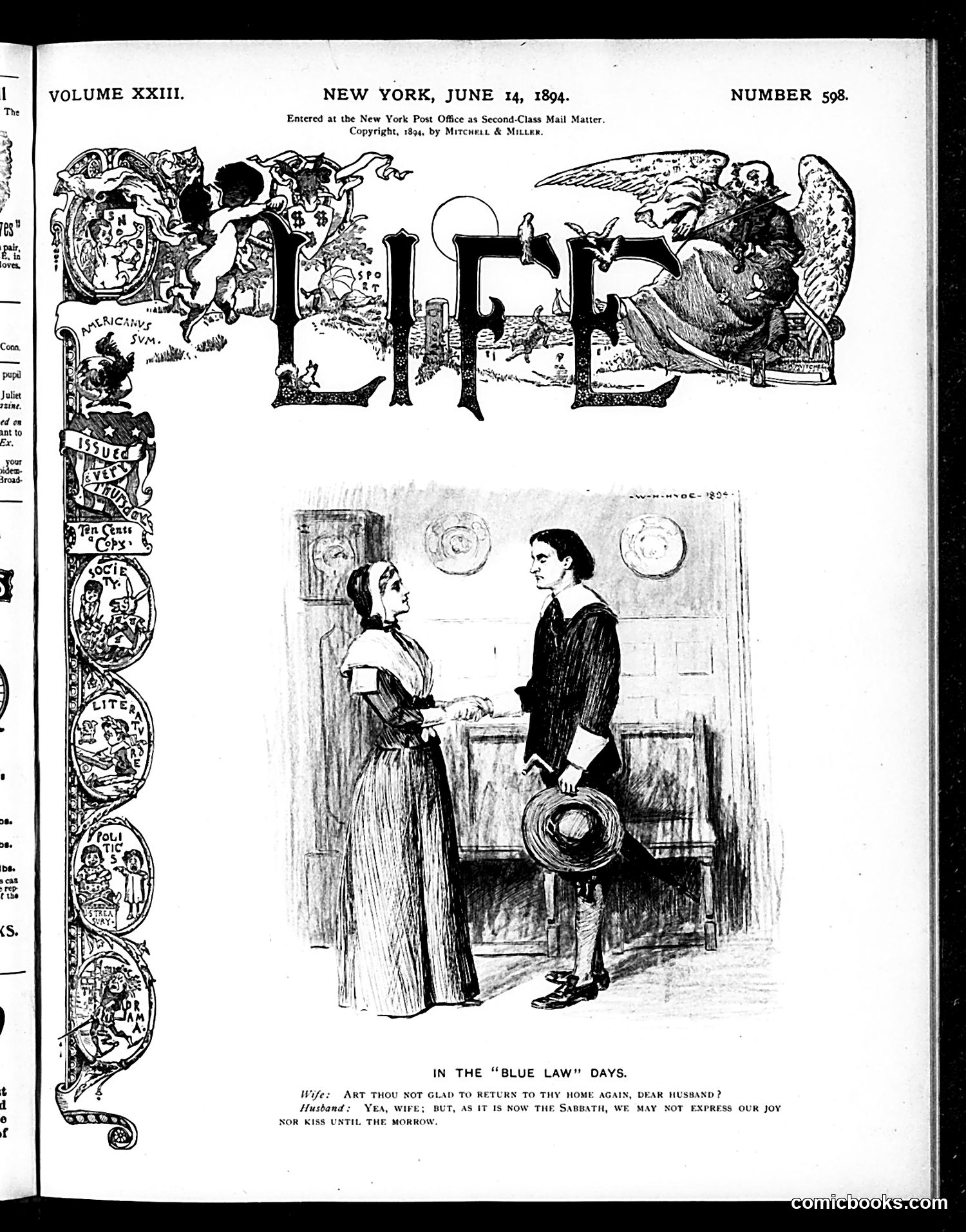
This cartoon satirizes Victorian-era "blue laws"—strict religious regulations that prohibited secular activities on Sundays, particularly socializing between unmarried people. The scene depicts a husband and wife being denied physical affection on the Sabbath. The wife asks if he's glad to return home; the husband responds that yes, he is—but because it's now the Sabbath, they cannot express joy through kissing until tomorrow. The satire mocks the absurd rigidity of these laws, which enforced moral purity by literally preventing couples from showing affection on Sundays. The couple's resigned acceptance of this restriction—unable even to kiss their spouse—highlights the intrusive and joyless nature of such religious legislation that Life's urbane audience would have found oppressively puritanical.
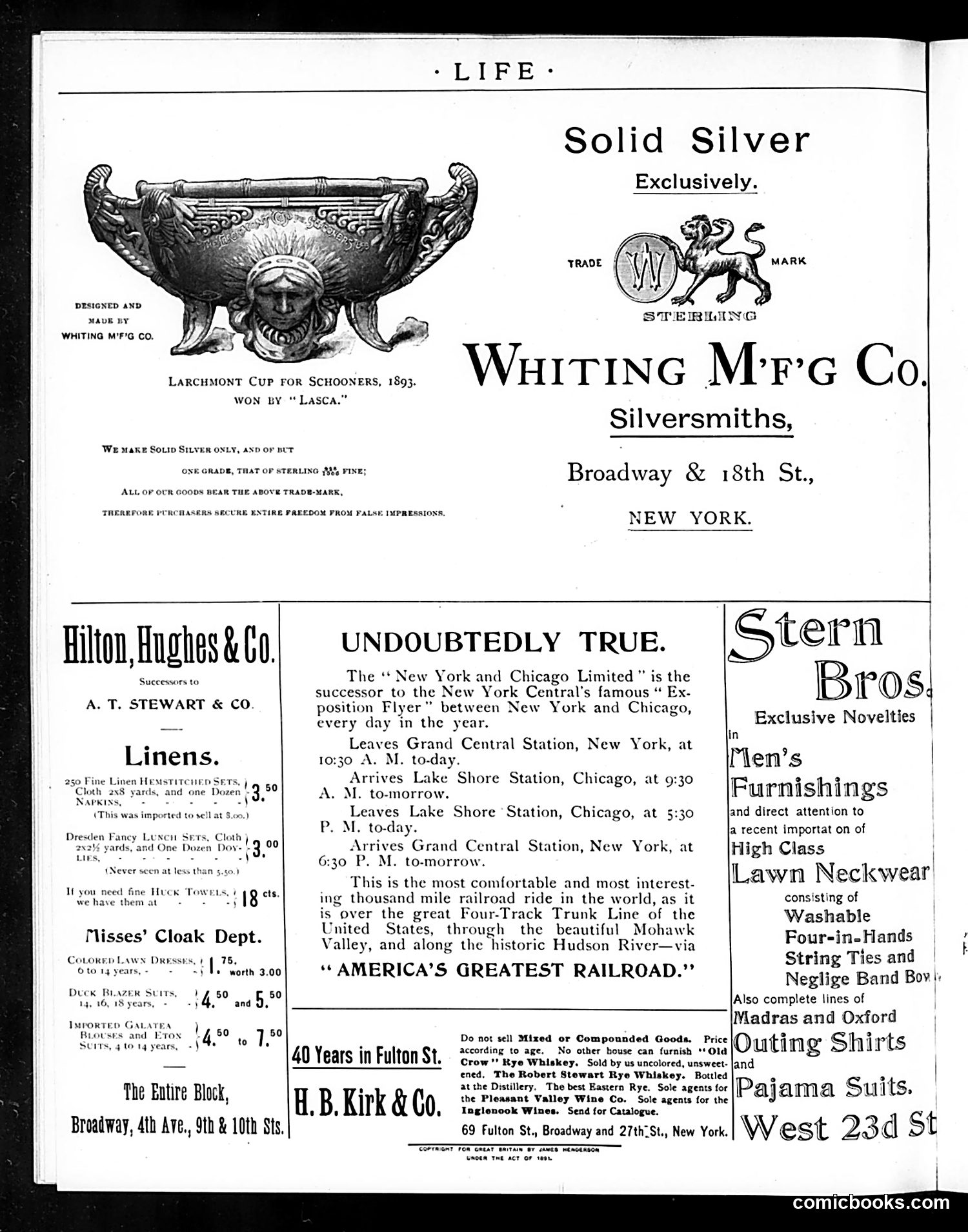
This page is primarily **advertising**, not satirical content. It features multiple commercial advertisements from late 19th-century New York businesses, including: - **Whiting Mfg Co.**: A silversmith advertising solid silver goods, prominently displaying the "Larchmont Cup for Schooners, 1893" (a sailing trophy won by a vessel named "Lasca") - **Hilton, Hughes & Co.**: Selling linens and women's clothing - **Stern Bros.**: High-class men's furnishings and neckwear - **H.B. Kirk & Co.**: A 40-year-old Fulton Street establishment selling spirits and wines The page reflects **Gilded Age consumer culture**, targeting affluent New York readers with luxury goods and prestigious brand names. No political satire or social commentary is evident.
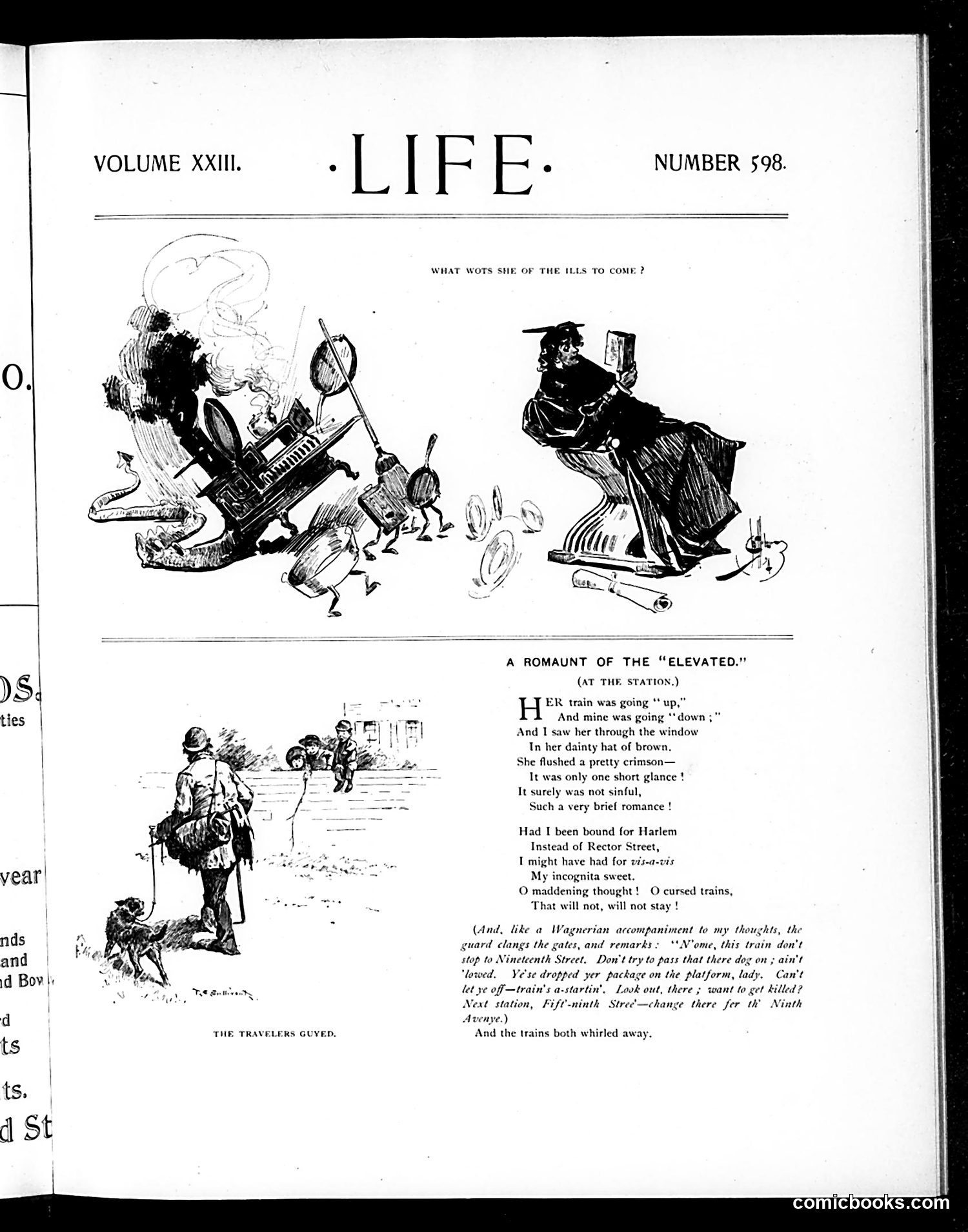
This page from *Life* magazine presents two satirical pieces about romantic encounters in New York City: **Top cartoon** ("What Wots She of the Ills to Come?"): Shows a couple on the elevated train platform—he's a well-dressed man flirting with a woman. The satire mocks brief, superficial city romances. **Bottom poem and illustration** ("A Romaunt of the 'Elevated'"): Depicts a young man spotting an attractive woman on a passing elevated train. The accompanying verse humorously laments their missed connection—had his train gone a different direction, he might have pursued her. The poem parodies romantic Victorian poetry while mocking the transient nature of urban life and chance encounters. Both pieces joke about how modern city infrastructure (the elevated trains) creates fleeting romantic possibilities that come to nothing.
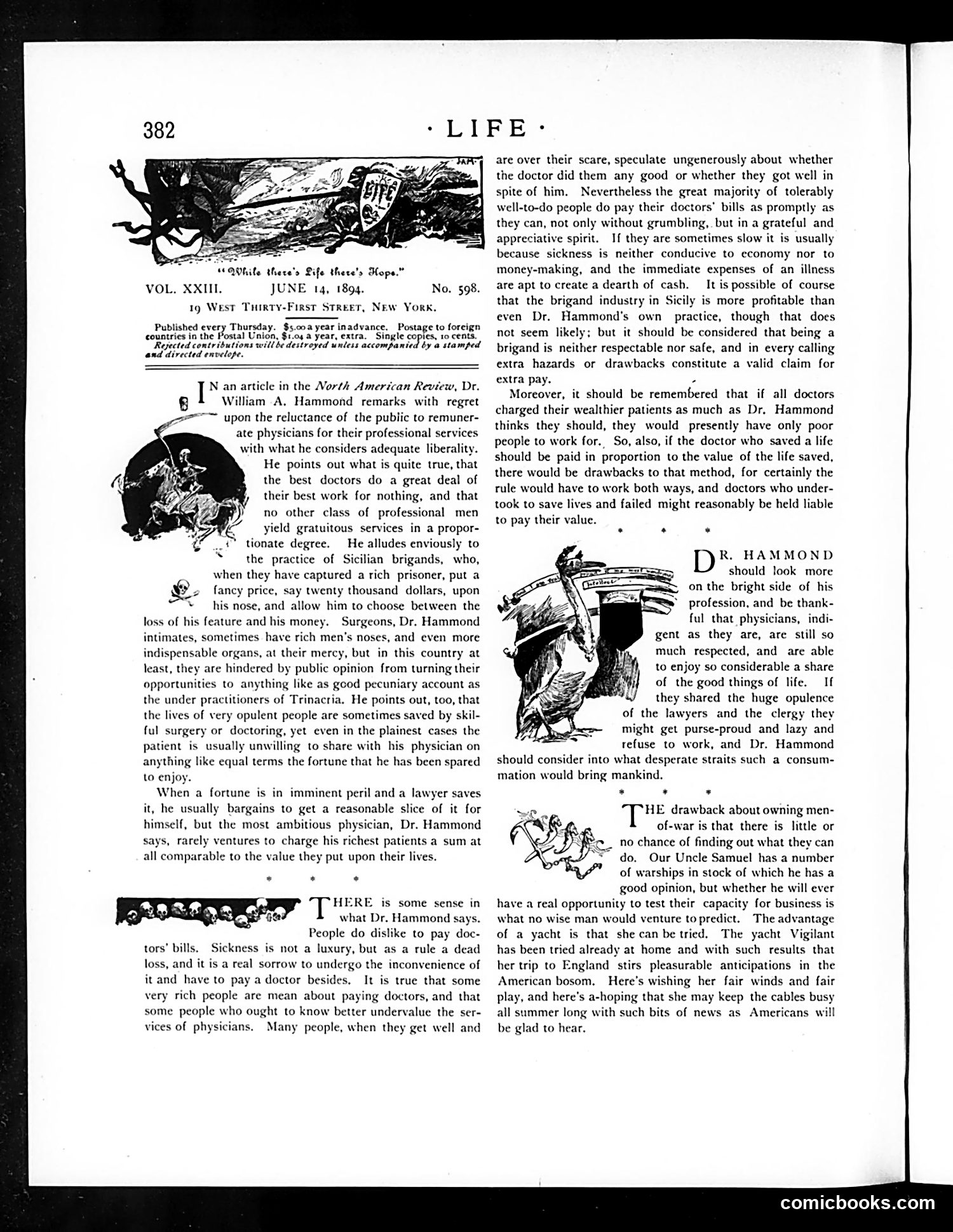
This page discusses Dr. William A. Hammond's article in the *North American Review* defending doctors' fees and professional compensation. The accompanying cartoons satirize Hammond's position. The top illustration appears to show a figure in distress, likely representing a patient bankrupted by medical bills—the visual counterpoint to Hammond's defense of high physician charges. The lower cartoon depicts a skeletal or death-like figure, likely symbolizing how expensive medical care affects the poor or desperate. The text critiques Hammond's argument that doctors deserve substantial payment comparable to lawyers saving fortunes. The satirist suggests Hammond overlooks doctors' moral obligation to treat patients affordably and questions whether physicians should profit equally from life-and-death situations versus legal matters.
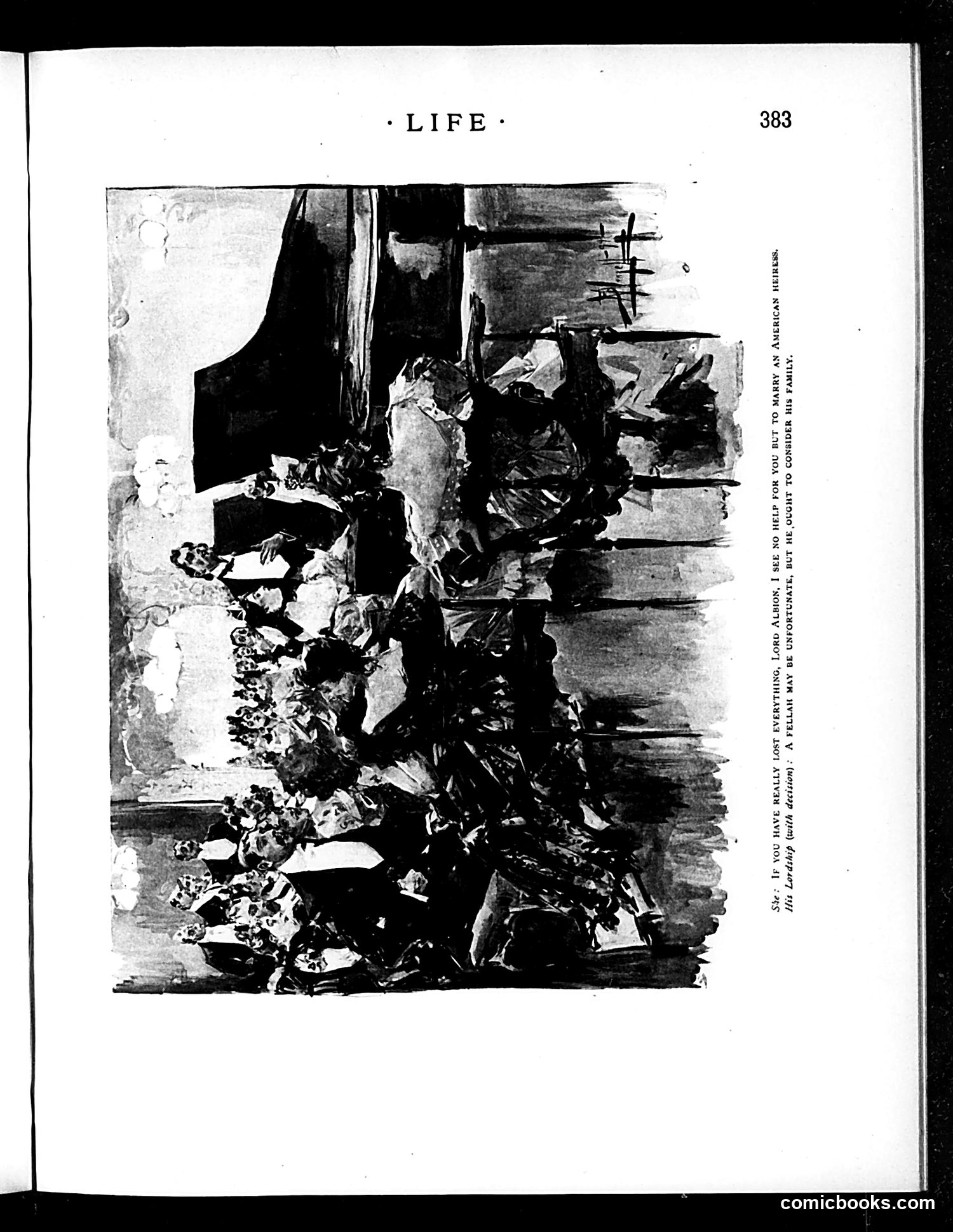
I can see this is page 383 from Life magazine, but the image quality and rotation make it difficult to read the specific caption and identify the exact figures or satire being depicted. The photograph appears to show a dramatic indoor scene with multiple figures in what looks like period clothing, possibly depicting a historical or theatrical moment. There are ornate furnishings and detailed staging visible. Without being able to clearly read the caption text or confidently identify the specific figures and their caricatured characteristics, I cannot reliably explain what political or social commentary this illustration was making for contemporary readers. To provide accurate historical context, I would need a clearer, properly oriented image or legible caption text.
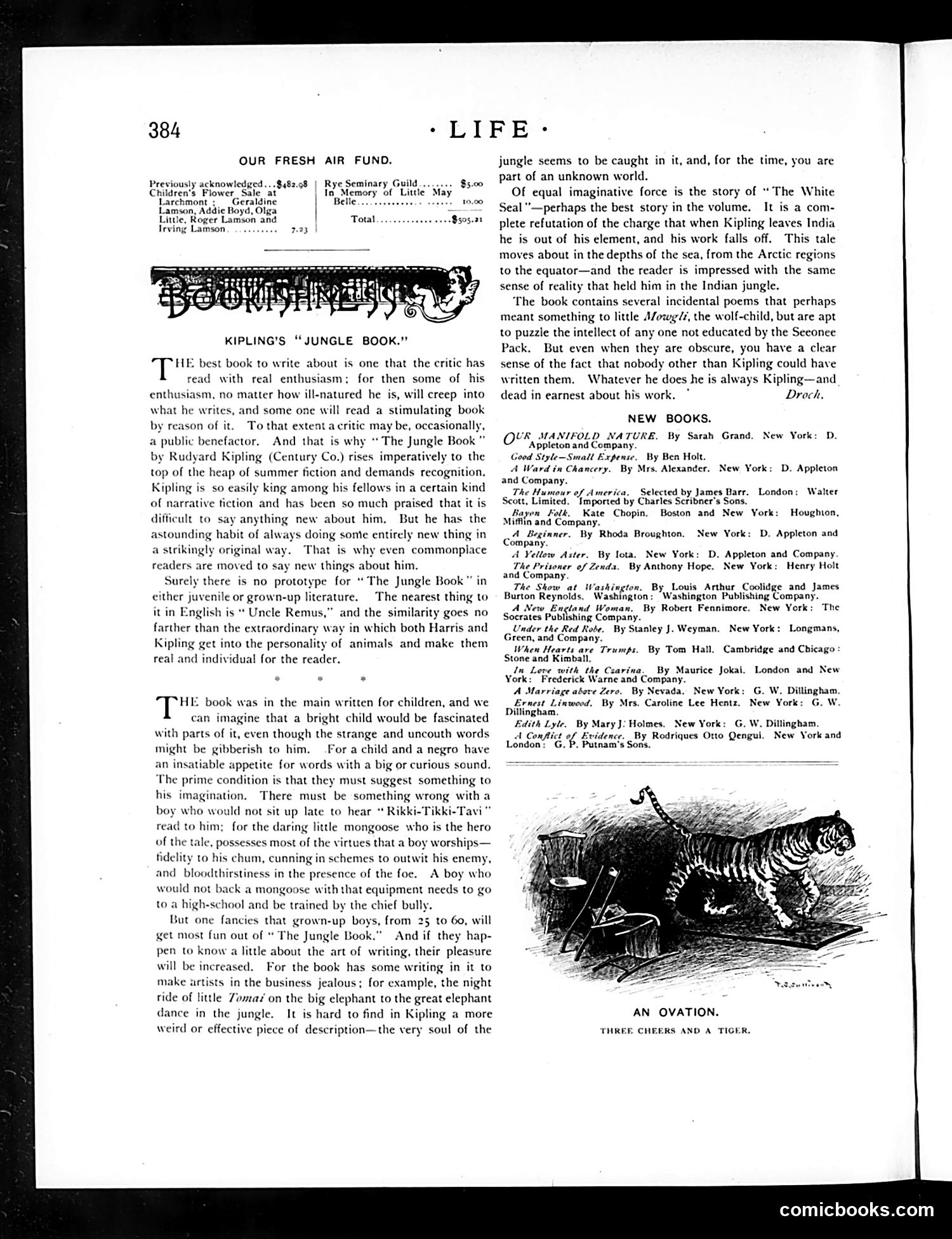
This page is primarily a **literary review and book advertisement**, not political satire. The main content discusses Rudyard Kipling's *Jungle Book*, praising its literary merit and imaginative appeal to both children and adults. The reviewer emphasizes Kipling's unique ability to capture animal personalities authentically. The page includes an illustration titled **"An Ovation: Three Cheers and a Tiger,"** showing a tiger confronting what appears to be human figures—likely a humorous visual reference to the *Jungle Book's* themes of interaction between civilization and the wild animal world. The bottom section lists "New Books," advertising recently published titles from various publishers. This is standard literary journalism rather than political commentary.
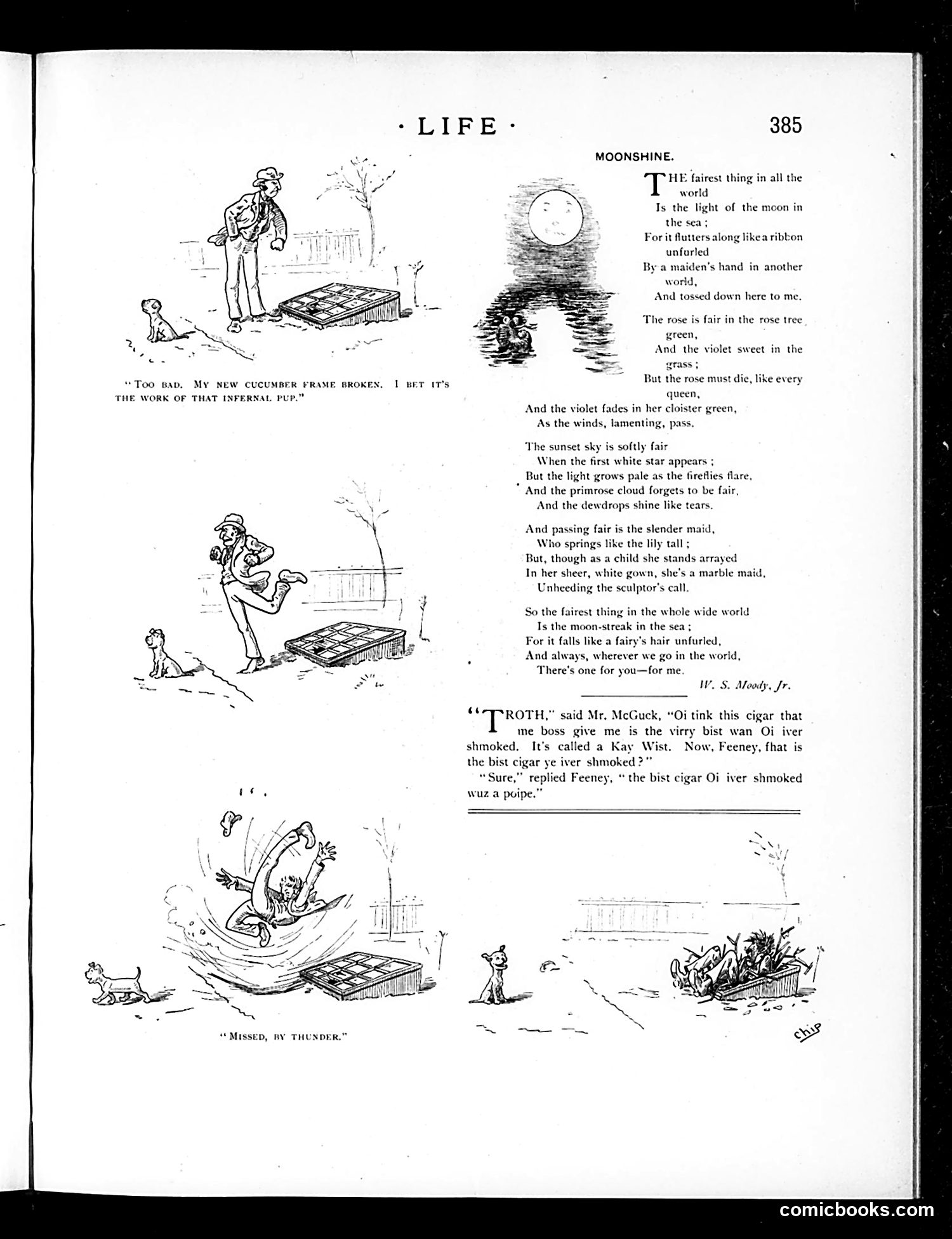
This page contains humorous cartoons and a poem titled "Moonshine" by W.S. Moody, Jr. The cartoons depict a man repeatedly mishaps with a cucumber frame (a gardening device), with captions "Too bad, my new cucumber frame brokes, I bet it's the work of that infernal pup" and "Missed, by thunder." The visual gag shows the man's failed attempts, likely blaming his small dog for the destruction. The "Moonshine" poem is romantic verse celebrating the beauty of moonlight on water and nature's fairness, contrasting with life's transience. Below appears dialogue about cigars between characters McCuck and Feeney, discussing a "Kay Wist" cigar and the term "poipe" (pipe)—seemingly Irish immigrant dialect humor, common in early 20th-century American satire. The page mixes domestic comedy, sentimental poetry, and ethnic humor typical of the era.
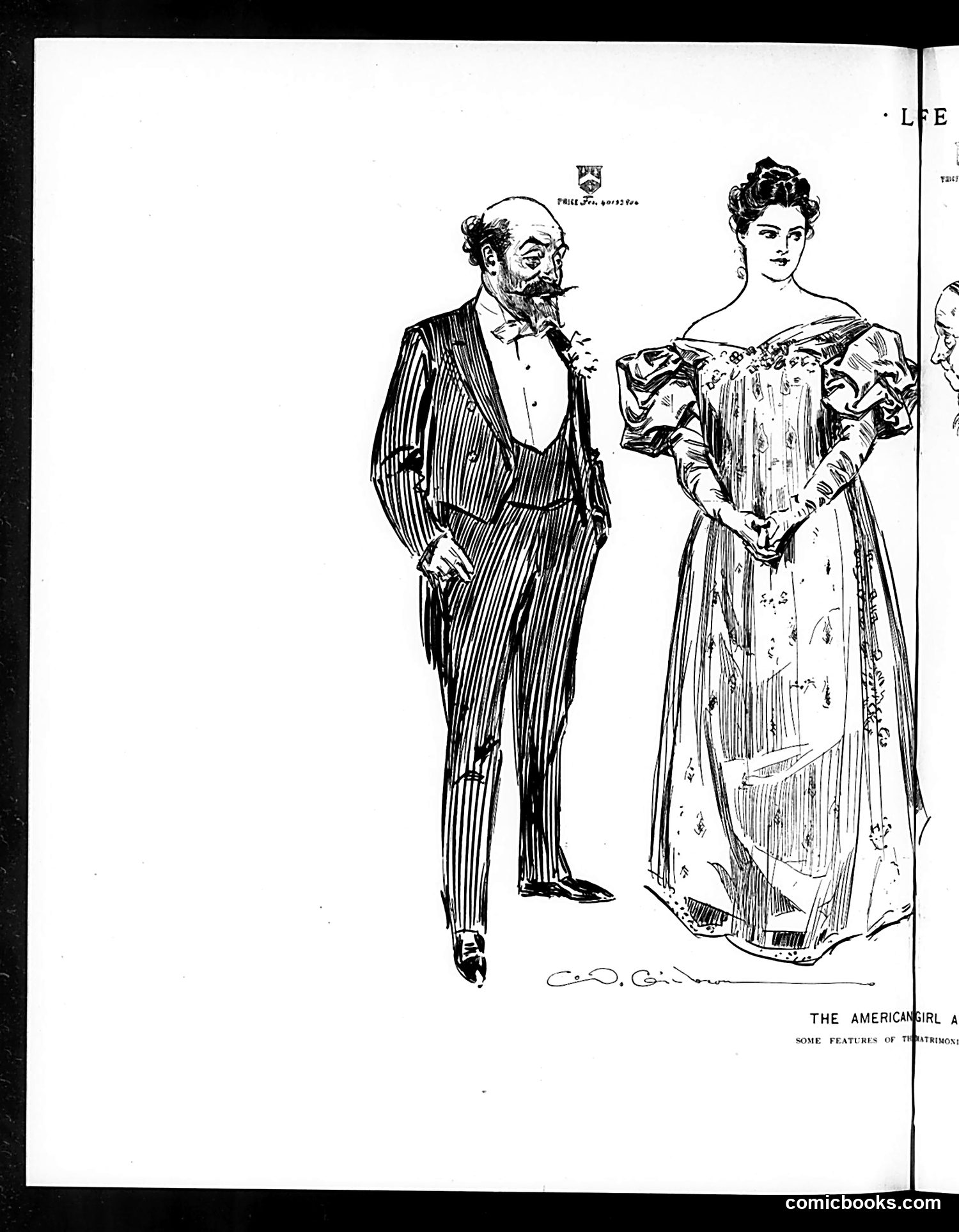
This illustration appears to be from Life magazine and depicts "The American Girl" with features of patrimonial significance. The image shows a well-dressed couple: a portly, older gentleman in a pinstriped suit and the young woman in an elegant gown with puffed sleeves, characteristic of 1890s-1900s fashion. The caption reads "THE AMERICAN GIRL A" with partial text "SOME FEATURES OF T[HE PATRIMON]" visible, suggesting this critiques American marriage customs or wealth dynamics of the Gilded Age—likely satirizing marriages between wealthy American heiresses and foreign (possibly European) aristocrats seeking money, or perhaps marriages based on financial rather than romantic considerations. The gentleman's caricatured features and the formal distance between the couple suggest satirical commentary on matrimonial practices of the era.
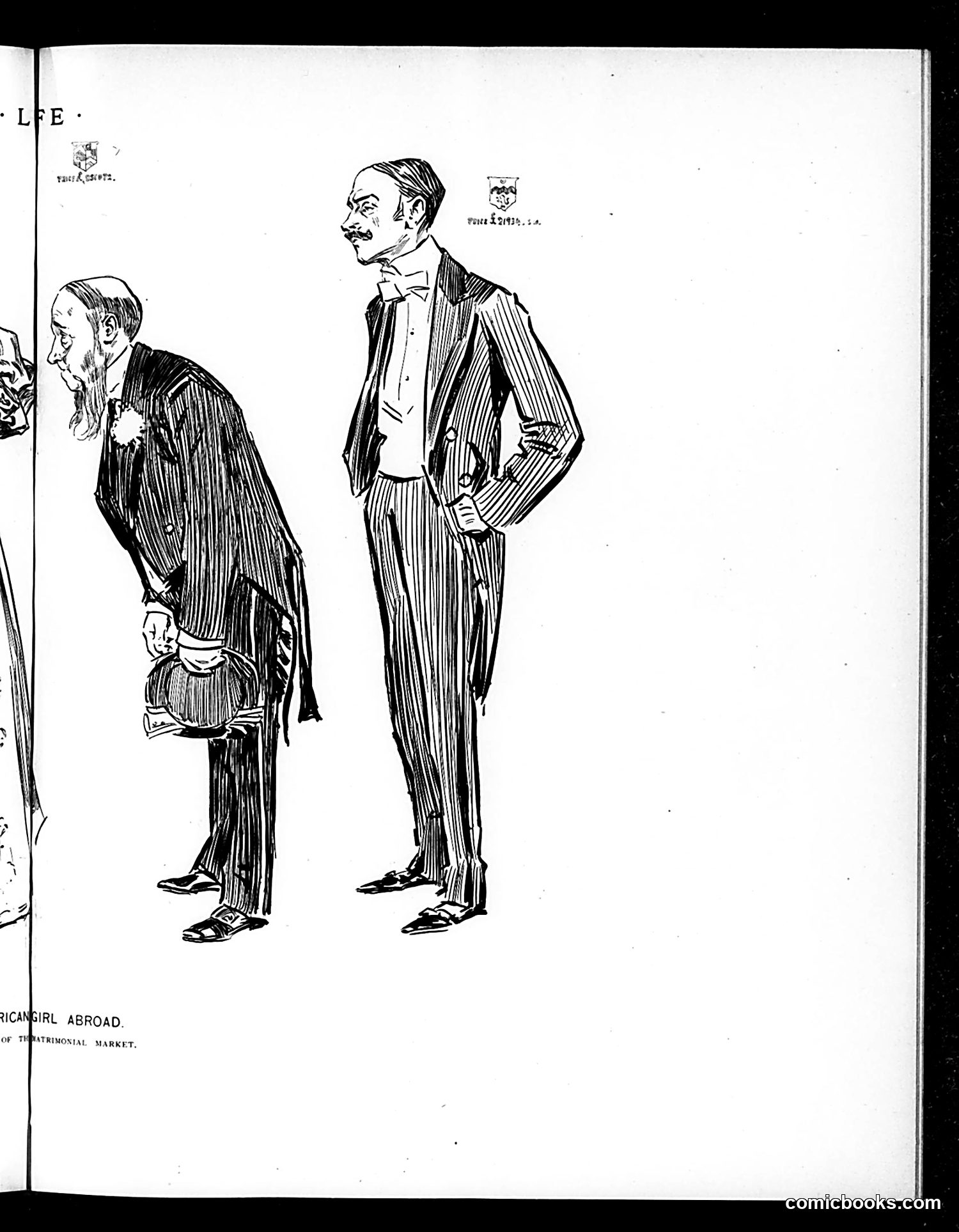
This page from Life magazine depicts two men in formal evening wear (tuxedos). The caption references "American Girl Abroad" and "Matrimonial Market," indicating this is satirical commentary on wealthy American women seeking European husbands. The left figure appears to be a European aristocrat or nobleman—suggested by his exaggerated facial features (thin face, prominent nose) typical of period caricature depicting European types. The right figure, taller and more conventionally handsome, likely represents the American suitor or husband. The satire concerns the "matrimonial market"—the phenomenon of wealthy American heiresses traveling abroad to marry titled Europeans for social prestige, while Europeans sought American wealth. This was a genuine social trend in the Gilded Age, frequently mocked by American satirists as reflecting both American materialism and European decadence.
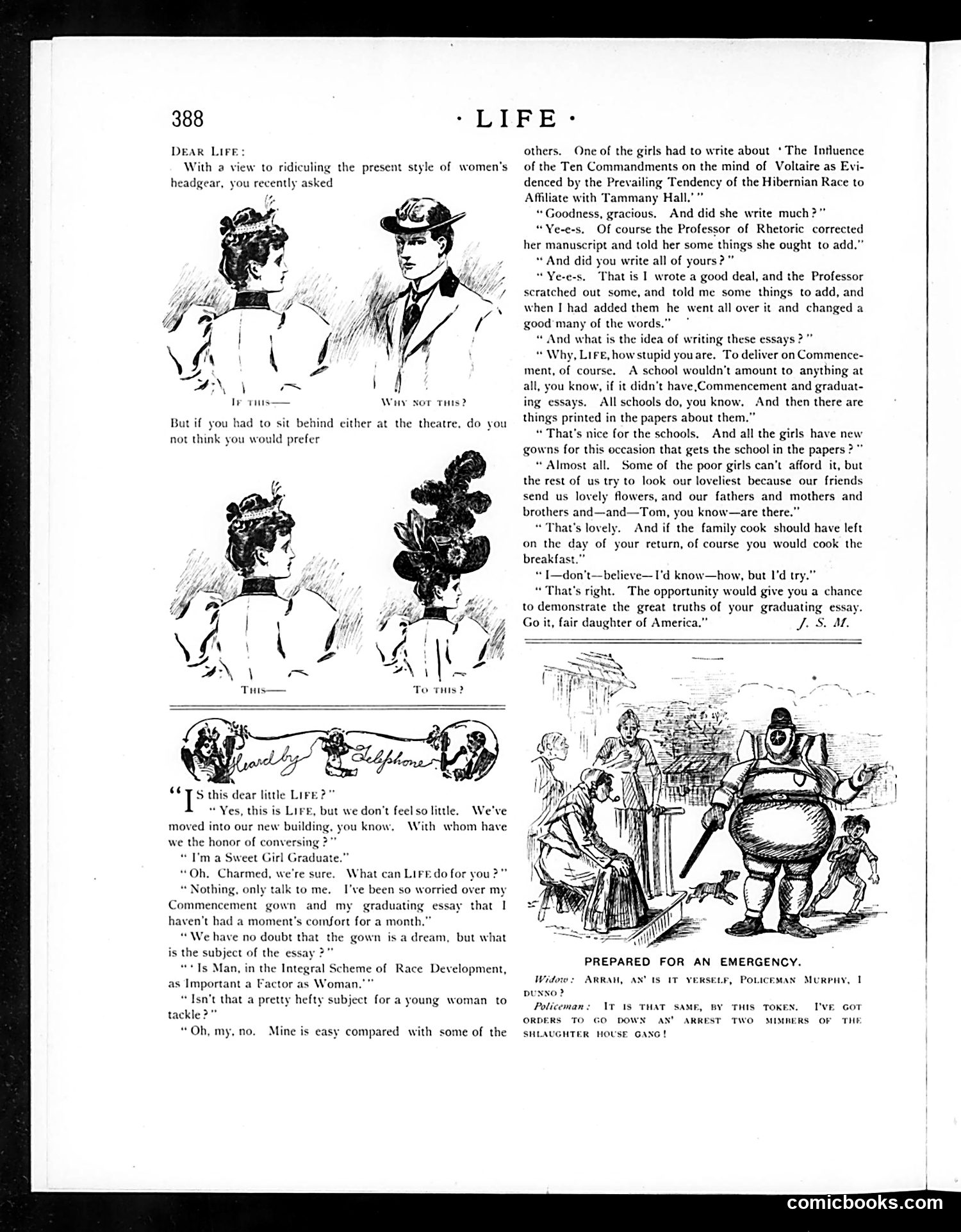
This page contains two distinct satirical pieces: **Top section:** "Dear Life" advice column mocking women's elaborate Edwardian hairstyles through exaggerated illustrations. The drawings show increasingly absurd hat and hair combinations—labeled "If this—," "Why not this?" and "To this?"—satirizing the escalating ridiculousness of contemporary women's fashion. **Bottom section:** A dialogue titled "Locally Telephone" between characters discussing a young woman's graduation gown and commencement essay. The satire targets the pretension of educational ceremonies and gendered expectations—a male character dismisses women's intellectual pursuits, while the woman defends her work. The accompanying illustration shows a rotund policeman character, likely for comedic relief. Both segments mock upper-class social conventions and gender dynamics of the early 1900s.
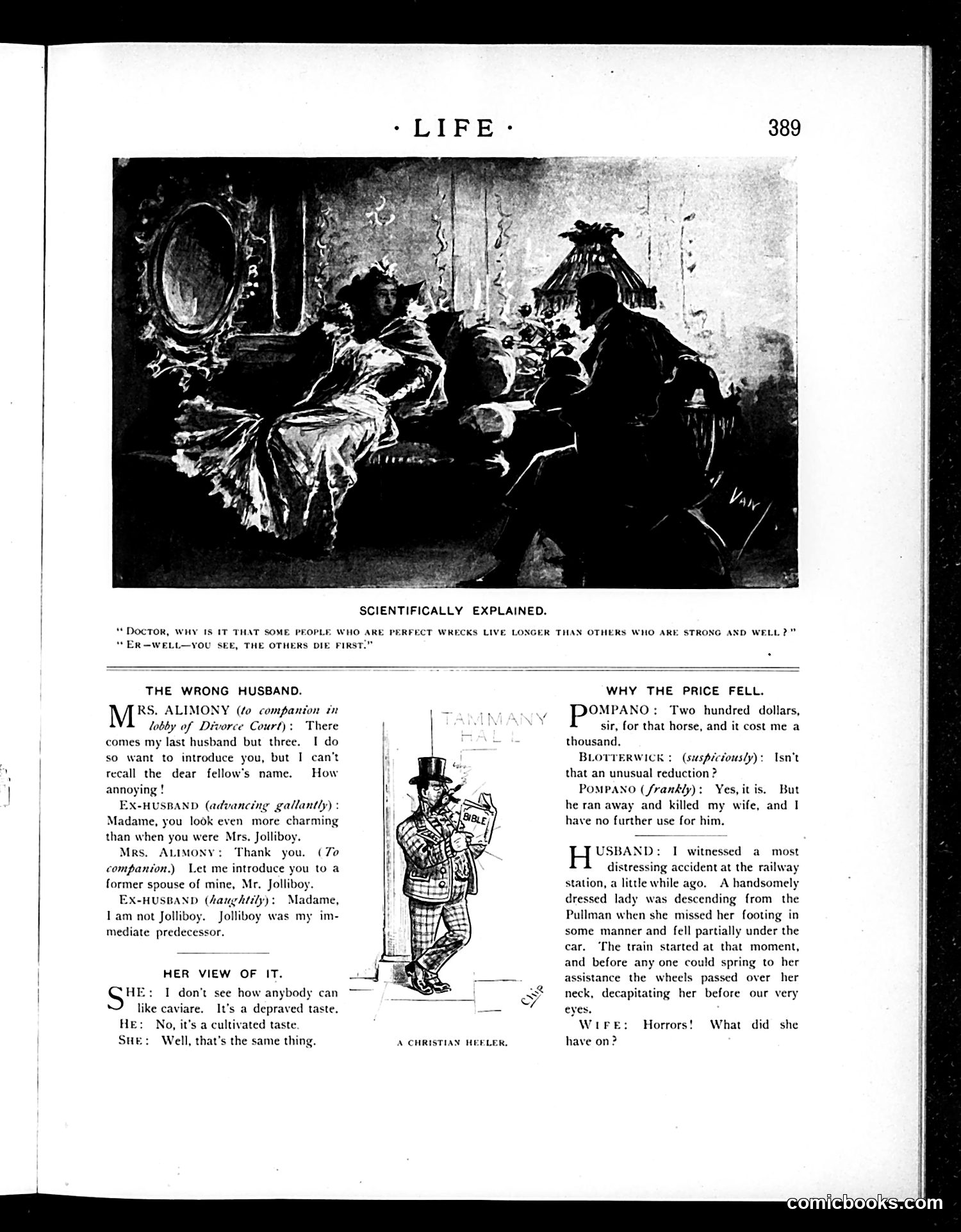
This page contains three unrelated comedic sketches typical of Life's satirical humor: 1. **"Scientifically Explained"** (top): A visual joke about why people in poor health outlive the robust—"the others die first," spoken by a doctor to a well-dressed woman in an ornate interior. 2. **"The Wrong Husband"** (bottom left): Mrs. Almony seeks to introduce her last husband, but her ex-husband interrupts, claiming he was merely her "intermediate predecessor"—a joke about divorce and remarriage. 3. **"Why the Price Fell"** (bottom right): A businessman explains his horse's low sale price: it killed his wife in a railway accident. The dark humor contrasts his financial loss against the tragedy itself. Each sketch employs exaggeration and unexpected punchlines typical of early 20th-century American magazine humor.
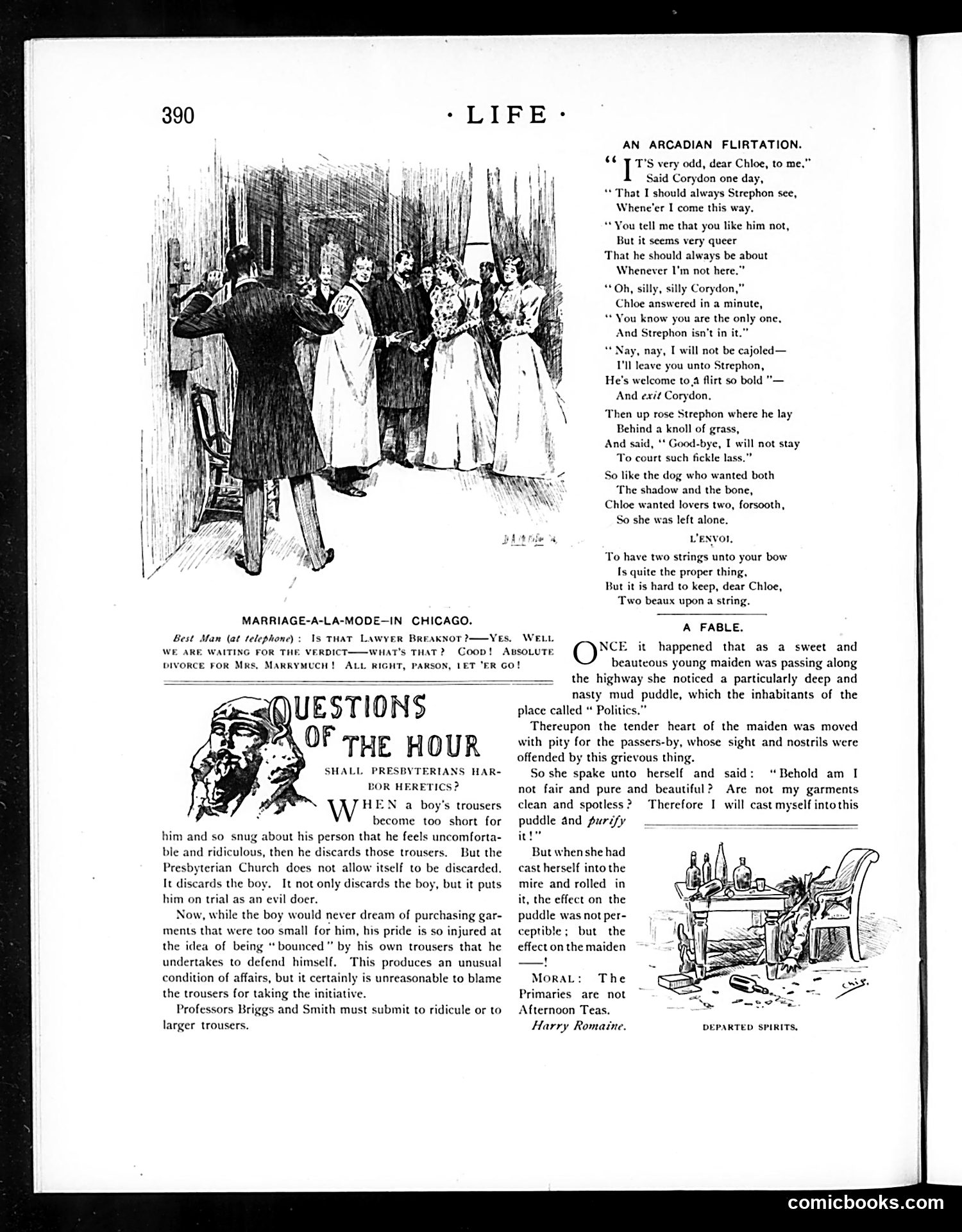
**Top cartoon "Marriage-à-la-Mode in Chicago":** A Best Man calls a lawyer by telephone, asking if the divorce verdict is ready so the wedding can proceed. The joke satirizes how routine divorce has become in Chicago—the ceremony literally cannot start until the previous marriage is legally dissolved. This reflects early 20th-century concerns about rising divorce rates and the speed of American legal proceedings. **"An Arcadian Flirtation":** A verse narrative mocking romantic fickleness. A woman (Chloe) strings along two suitors (Corydon and Strephon), claiming each is her only love. When discovered, both abandon her. The moral: attempting to keep "two beaux upon a string" leaves you with none. **"Questions of the Hour":** A brief essay arguing the Presbyterian Church should accommodate modern sensibilities rather than rigidly expelling members (like professors Briggs and Smith), just as one outgrows childhood trousers. **"A Fable":** A maiden tries to purify the "mud puddle" of Politics through personal sacrifice, but accomplishes nothing except soiling herself. The moral: individual virtue cannot reform corrupt institutions.
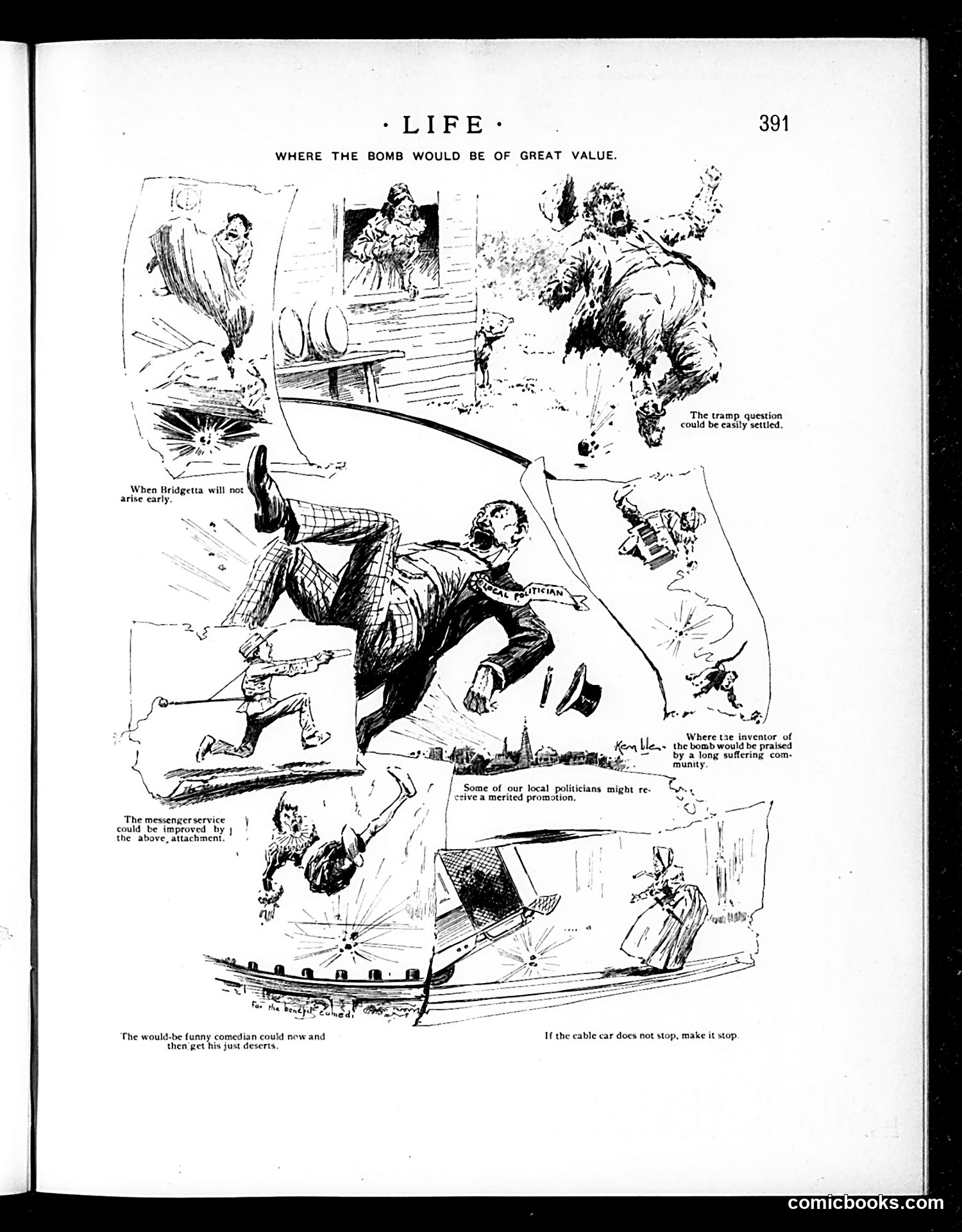
This satirical Life magazine page presents multiple comic scenarios imagining uses for a bomb as social solutions. The cartoons mock various contemporary urban nuisances through exaggerated, darkly humorous vignettes: - A sleeping woman ("Bridgetta") who won't wake early - Poor messenger service - Struggling comedians - Vagrant ("tramp") problems - Unresponsive politicians needing "merited promotion" - Cable cars that won't stop - Uncooperative landlords The overarching joke satirizes public frustration with everyday inconveniences and social problems by suggesting violent, explosive "fixes." This reflects turn-of-the-century anxieties about anarchism and bomb rhetoric, while simultaneously mocking how exasperating mundane urban life had become. The humor relies on the absurdity of proposing bombs for trivial grievances—a dark commentary on social irritants rather than genuine calls for violence.
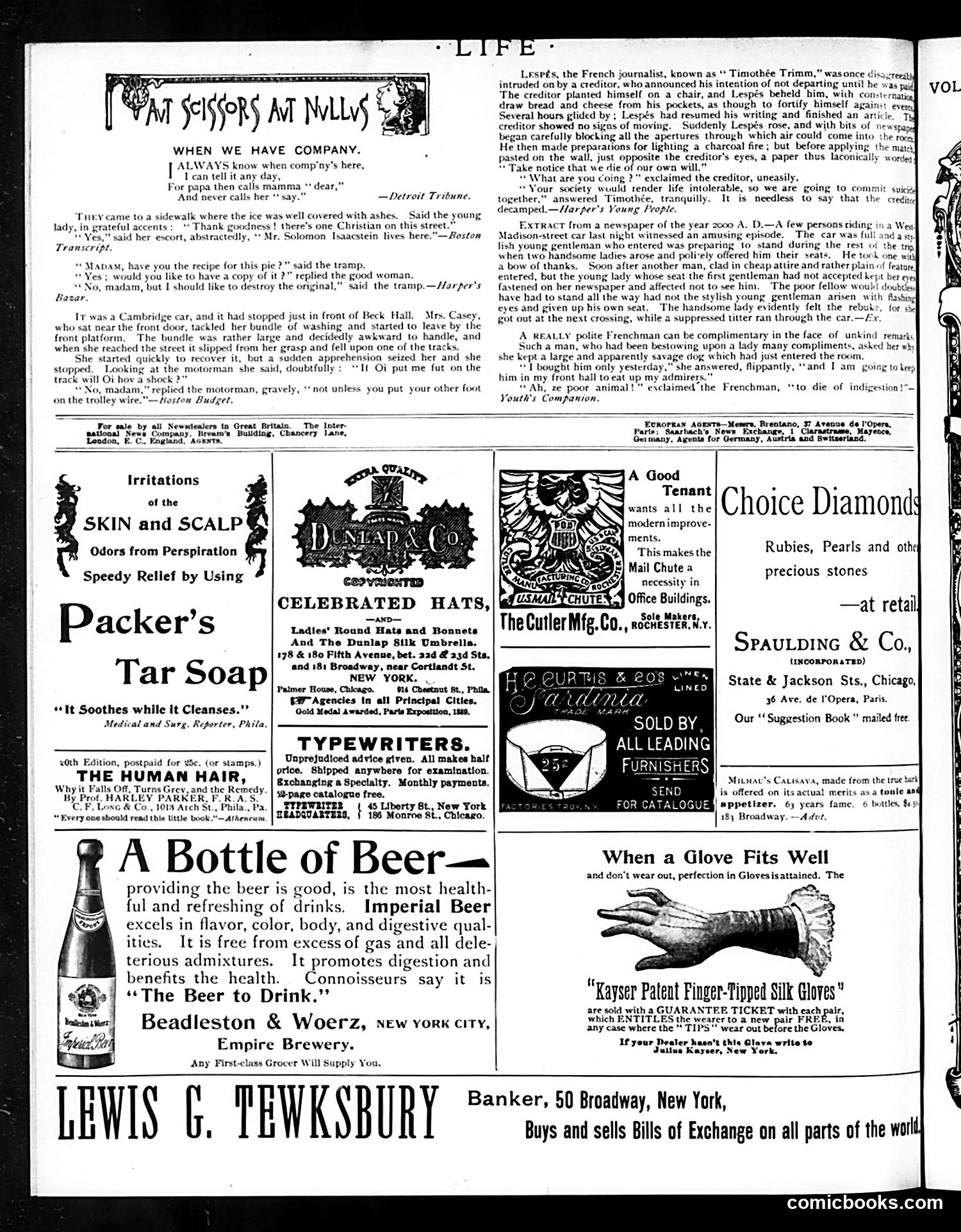
This page collects brief humorous anecdotes typical of early Life magazine. The main cartoon is titled "When We Have Company," illustrating the social pretense of the era: a father formally addresses his mother as "dear" rather than her usual nickname when guests visit—satirizing how people performed artificial propriety for social appearances. The surrounding jokes mock various social situations: a tramp's resourcefulness, a woman's confusion about electric streetcars, and a French journalist's darkly comic threat of suicide-by-charcoal-fire to evict a persistent creditor. A longer story predicts year 2000 behavior, where a stylish gentleman's politeness contrasts with a woman's cold rudeness, suggesting moral decline despite material progress. The humor relies on class observations, gender dynamics, and gentle mockery of human pretension—characteristic of early 20th-century American magazine humor.