
Life, 1894-06-14 · page 4 of 14
Life — June 14, 1894 — page 4: what you’re looking at
What you’re looking at
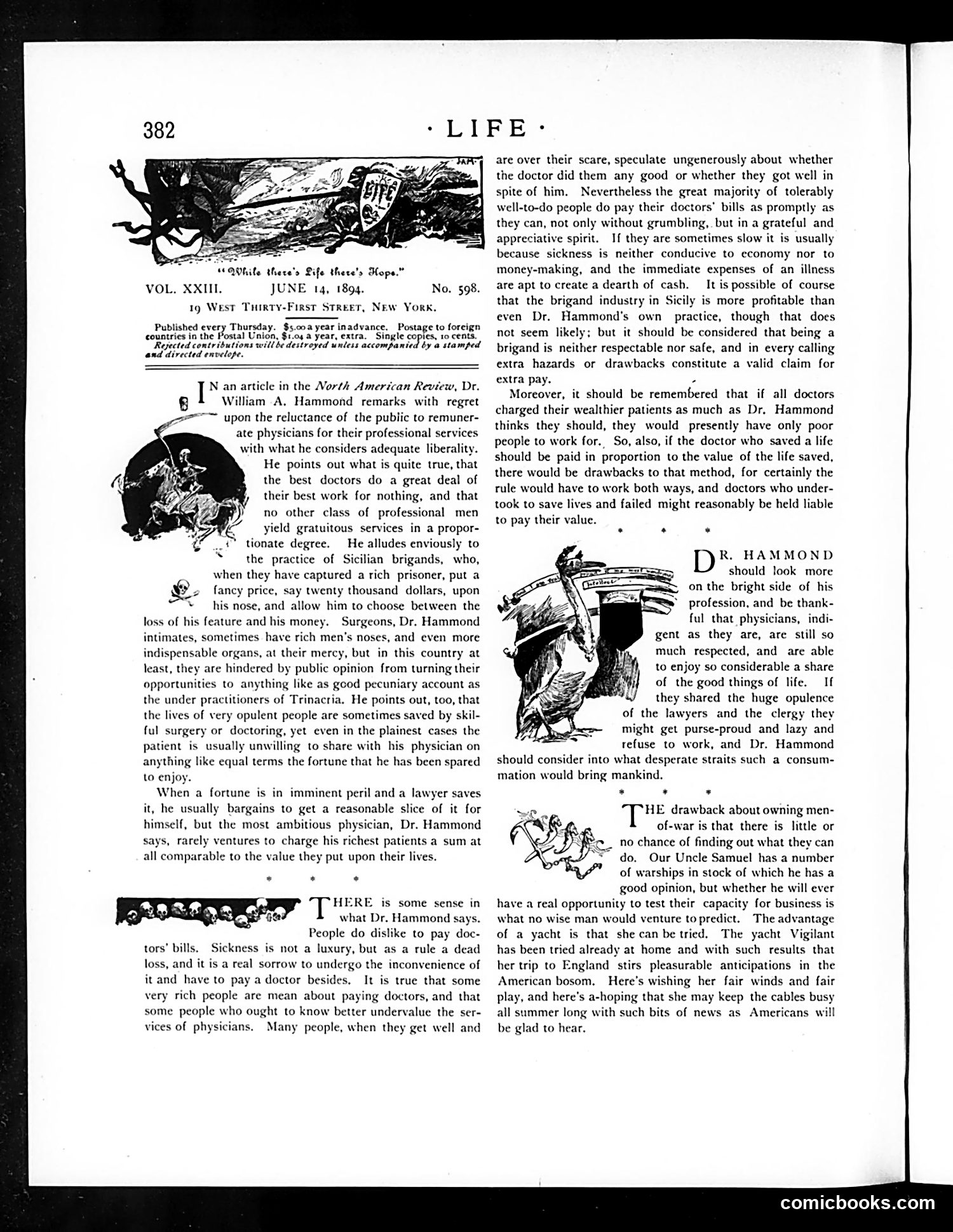
This page discusses Dr. William A. Hammond's article in the *North American Review* defending doctors' fees and professional compensation. The accompanying cartoons satirize Hammond's position. The top illustration appears to show a figure in distress, likely representing a patient bankrupted by medical bills—the visual counterpoint to Hammond's defense of high physician charges. The lower cartoon depicts a skeletal or death-like figure, likely symbolizing how expensive medical care affects the poor or desperate. The text critiques Hammond's argument that doctors deserve substantial payment comparable to lawyers saving fortunes. The satirist suggests Hammond overlooks doctors' moral obligation to treat patients affordably and questions whether physicians should profit equally from life-and-death situations versus legal matters.
📄 Transcribed text from this page (OCR, searchable)
Machine-transcribed from the original scan — historical spelling and the odd misread are preserved.
‘LIFE: White there's Life there's Hope.” VOL. XXIII. JUNE 14, 1894. 1g West Tur No. 598. iRST STREET, NEW York. Published every Thursday. $5.00 year inadvance. Postage to foreign countries in the Postal Union, $1.04 a year, extra. Single copies, 10 cents. Reyected contributions willbe destroyed untess accompanied by a stamped and directed envelope. N an article in the Morth American Review, Dr. William A, Hammond remarks with regret upon the reluctance of the public to remuner- ate physicians for their professional services with what he considers adequate liberality. He points out what is quite true, that the best doctors do a great deal of their best work for nothing, and that no other class of professional men < yield gratuitous services in a propor- +” tionate degree. He alludes enviously to the practice of ian brigands, who, when they have captured a rich prisoner, put a 9. fancy price, say twenty thousand dollars, upon * his nose, and allow him to choose between the loss of his feature and his money. Surgeons, Dr. Hammond intimates, sometimes have rich men’s noses, and even more indispensable organs, at their mercy, but in this country at least, they are hindered by public opinion from turning their opportunities to anything like as good pecuniary account as the under practitioners of Trinacria, He points out, too, that the lives of very opulent people are sometimes saved by skil- ful surgery or doctoring, yet even in the plainest cases the patient is usually unwilling to share with his physician on anything like equal terms the fortune that he has been spared to enjoy. When a fortune is in imminent peril and a lawyer saves , he usually bargains to get a reasonable slice of it for himself, but the most ambitious physician, Dr. Hammond says, rarely ventures to charge his richest patients a sum at all comparable to the value they put upon their lives. e! . * . HERE is some sense in what Dr. Hammond says. People do dislike to pay doc- tors’ bills. Sickness is not a luxury, but as a rule a dead loss, and it is a real sorrow to undergo the inconvenience of it and have to pay a doctor besides. It is true that some very rich people are mean about paying doctors, and that some people who ought to know better undervalue the ser- yices of physicians. Many people, when they get well and ‘Gee are over their scare, speculate ungenerously about whether the doctor did them any good or whether they got well in spite of him. Nevertheless the great majority of tolerably well-to-do people do pay their doctors’ bills as promptly as they can, not only without grumbling, but in a grateful and appreciative spirit. If they are sometimes slow it is usually because sickness is neither conducive to economy nor to money-making, and the immediate expenses of an illness are apt to create a dearth of cash. It is possible of course that the brigand industry in Sicily is more profitable than even Dr. Hammond's own practice, though that does not seem likely; but it should be considered that being a brigand is neither respectable nor safe, and in every calling extra hazards or drawbacks constitute a valid claim for extra pay. a Moreover, it should be remembered that if all doctors charged their wealthier patients as much as Dr, Hammond thinks they should, they would presently have only poor people to work for. So, also, if the doctor who saved a life should be paid in proportion to the value of the life saved, there would be drawbacks to that method, for certainly the rule would have to work both ways, and doctors who under- took to save lives and failed might reasonably be held liable to pay their value. ‘ ; D®: HAMMOND =—— should look more on the bright side of his profession, and be thank- ful that physicians, indi- gent as they are, are still so much respected, and are able to enjoy so considerable a share of the good things of life. If they shared the huge opulence of the lawyers and the clergy they might get purse-proud and lazy and refuse to work, and Dr. Hammond should consider into what desperate straits such a consum- mation would bring mankind. HE drawback about owning men- of-war is that there is little or no chance of finding out what they can do. Our Uncle Samuel has a number of warships in stock of which he has a good opinion, but whether he will ever have a real opportunity to test their capacity for business is what no wise man would venture to predict. The advantage of a yacht is that she can be tried. The yacht Vigilant has been tried already at home and with such results that her trip to England stirs pleasurable anticipations in the American bosom. Here's wishing her fair winds and fair play, and here's a-hoping that she may keep the cables busy all summer long with such bits of news as Americans will be glad to hear, C. comicbooks.com