
Life, 1894-06-14 · page 6 of 14
Life — June 14, 1894 — page 6: what you’re looking at
What you’re looking at
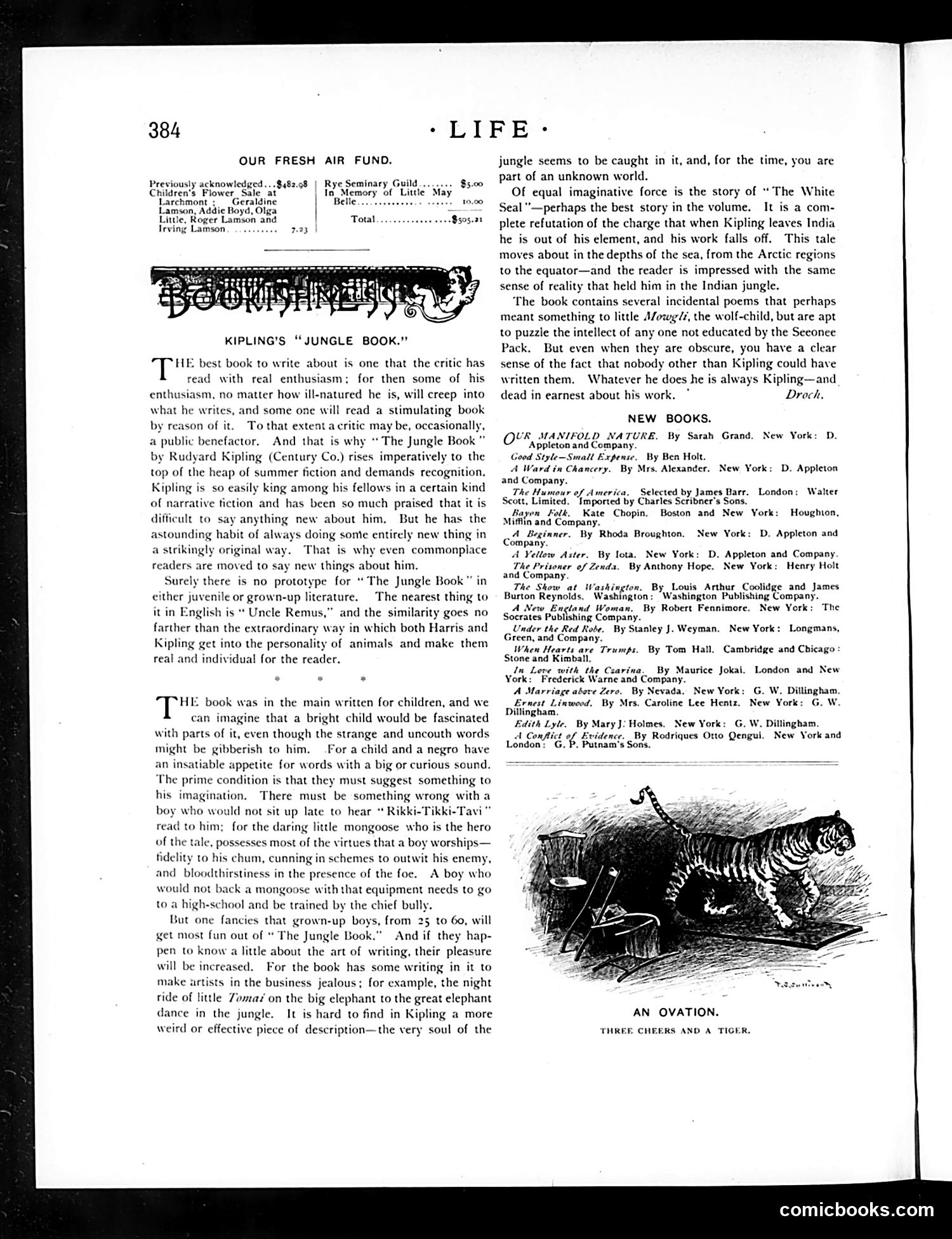
This page is primarily a **literary review and book advertisement**, not political satire. The main content discusses Rudyard Kipling's *Jungle Book*, praising its literary merit and imaginative appeal to both children and adults. The reviewer emphasizes Kipling's unique ability to capture animal personalities authentically. The page includes an illustration titled **"An Ovation: Three Cheers and a Tiger,"** showing a tiger confronting what appears to be human figures—likely a humorous visual reference to the *Jungle Book's* themes of interaction between civilization and the wild animal world. The bottom section lists "New Books," advertising recently published titles from various publishers. This is standard literary journalism rather than political commentary.
📄 Transcribed text from this page (OCR, searchable)
Machine-transcribed from the original scan — historical spelling and the odd misread are preserved.
384 OUR FRESH AIR FUND. Previously acknowledged... .8 482.08 Children’s Flower Sale ‘at Larchmont ; | Geraldine | Lamson, Addie Boyd, Olga Little, Roger Lamson and Irving Lamson. oes... Rye Seminary Guild In Memory of Little M. Belle... see Total KIPLING’S “JUNGLE BOOK.” HE best book to write about is one that the critic has read with real enthusiasm; for then some of his enthusiasm, no matter how ill-natured he is, will creep into what he writes, and some one will read a stimulating book To that extent acritic may be, occasionally a public benefactor. And that is why “The Jungle Book by Rudyard Kipling (Century Co.) rises imperatively to the top of the heap of summer fiction and demands recognition, Kipling is so easily king among his fellows in a certain kind of narrative fiction and has been so much praised that it is difficult to say anything new about him, But he has the astounding habit of always doing some entirely new thing in a strikir rhat is why even commonplace re moved to say new things about him. by reason of it. y original w readers Surely there is no prototype for “The Jungle Book” in cither juvenile or grown-up li erature. The nearest thing to it in English is “ Uncle Remus,” and the similarity goes no ther than the extraordinary way in which both Harris Kipling get into the personality of animals and make them real and individual for the reader. HE book was in the main written for children, and we can imagine that a bright child would be fascinated with parts of it, even though the strange and uncouth words might be gibberish to him. For a child and a negro have an insatiable appetite for words with a big or curious sound. The prime condition is that they must suggest: something to his imagination. There must be something wrong with a boy who would not sit up late to hear “ Rikki-Tikki-Tavi” read to him; for the daring little mongoose who is the hero of the tale, possesses most of the virtues that a boy worships— fidelity to his chum, cunning in schemes to outwit his enemy, and bloodthirstiness in the presence of the foe. A boy who would not back a mongoose with that equipment needs to go to a high-school and be trained by the chief bully. But one fancies that grown-up boys, from 25 to 60, will get most fun out of * The Jungle Book.” And if they hap- pen to know a little about the art of writing, their pleasure will be increased. For the book has some writing in it to make artists in the business jealous; for example, the night ride of little Zomaz on the big elephant to the great elephant dance in the jungle. It is hard to find in Kipling a more weird or effective piece of description—the very soul of the > LIFE: jungle seems to be caught in it, and, for the time, you are part of an unknown world. Of equal imaginative force is the story of “The White Seal ’—perhaps the best story in the volume. It is a com- plete refutation of the charge that when Kipling leaves India he is out of his element, and his work falls off. This tale moves about in the depths of the sea, from the Arctic regions to the equator—and the reader is impressed with the same sense of reality that held him in the Indian jungle. ‘The book contains several incidental poems that perhaps meant something to little A/owg/s, the wolf-child, but are apt to puzzle the intellect of any one not educated by the Seconee Pack. But even when they are obscure, you have a clear sense of the fact that nobody other than Kipling could have written them, Whatever he does he is always Kipling—and dead in earnest about his work. * Droch, NEW BOOKS. UR MANIFOLD NATURE. By Sarah Grand Appieton and Company. Good Styte—Small Expense. By Ben Holt. A Ward in Chancery. By Mrs. Alexander. and Company. The Humour of America, Scott, Limited, Imported by Charles Scribner's Sons. Bayon Folk, Kate Chopin, Boston and New York: Mitfiin and Company. A Beginner. By Rhoda Broughton. Company. a Yellow Aster. By Lota, New York: The Prisoner of Zenda. and Company. The Show at Washington, Burton Reynolds, Washington A New England Woman. Socrates Publishing Company. Under the Red Robe. By Stanley J. Weyman, Green, and Company. When Hearts are Trumps Stone and Kimball, In Love with the Czarina. By Maurice Jokai. York: Frederick Warne and Company. A Marriage above Zero. By Nevada, New York: Ernest Linwood. By Mrs. Caroline Lee Hentz. Dillingham. Edith Lyle, By Mary J: Holmes. New York: A Conflict of E London New York: D. New York: D. Appleton Selected by James Barr. London: Walter Houghton, New York: D. Appleton and D. Appleton and Company. By Anthony Hope. New York: Henry Holt By Louis Arthur Coolidge and James ‘Washington Publishing Company. By Robert Fennimore. New York: The New York: Longmans, By Tom Hall. Cambridge and Chicago : London and New G. W. Dillingham. New York: G. W. G. W. Dillingham. idence. By Rodriques Otto Qengui. New York and . Putnam's Sons. AN OVATION. THREE CHEERS AND A TIGER. comicbooks.com