
A complete issue · 16 pages · 1894
Life — May 24, 1894
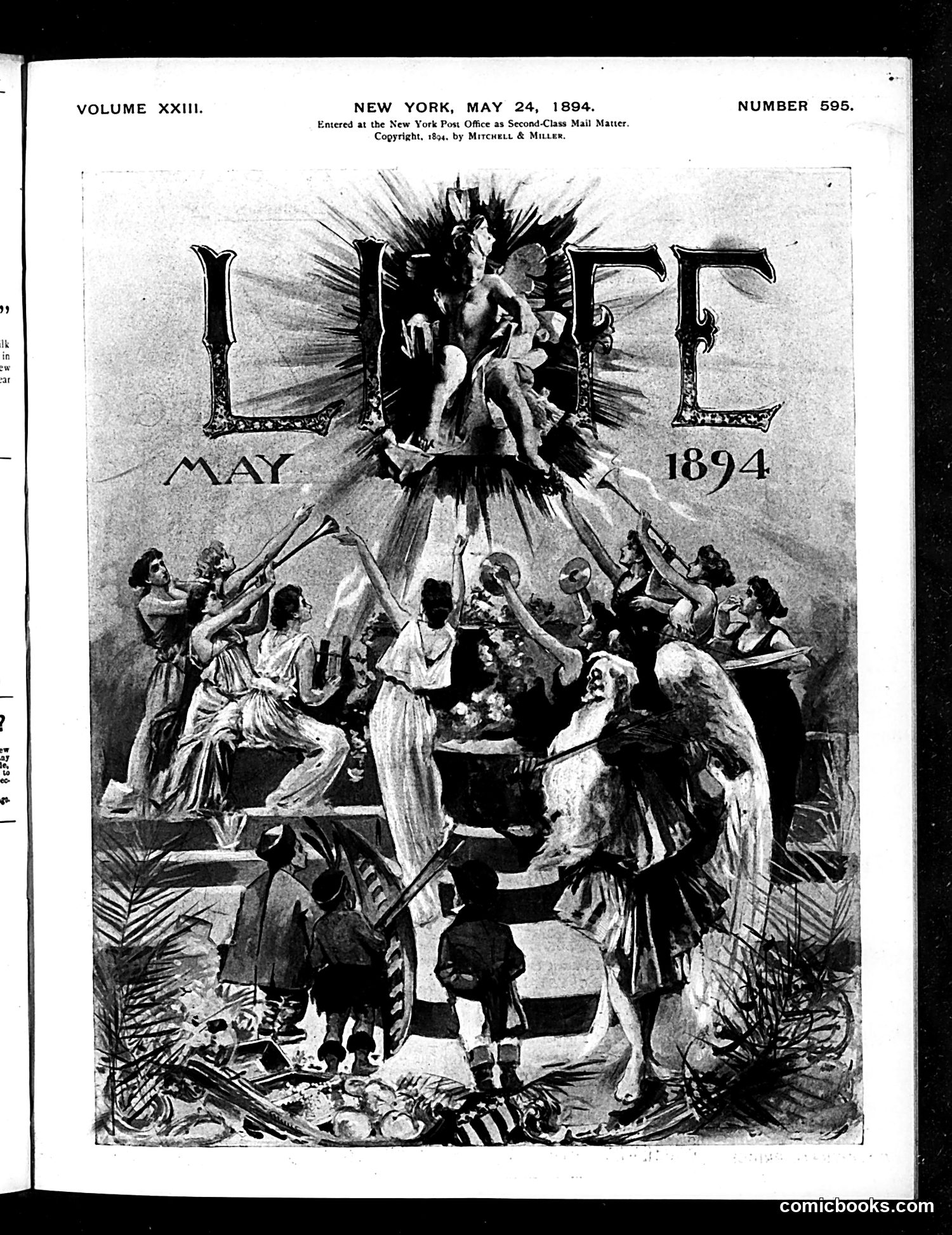
This allegorical illustration depicts **May 1894** as a classical celebration. Winged cherubs and figures in Greco-Roman dress gather around a central female figure representing the month of May, who holds a cornucopia or harvest vessel. Attendants play musical instruments (appearing to be pan pipes and lyres) in a festive, pastoral scene. The imagery celebrates spring's arrival and renewal using classical mythology conventions popular in 1890s decorative art. The elaborate ornamentation and allegorical figures are typical of Life magazine's cover designs during this period—mixing high art with periodical branding. Without accompanying article text, the specific satirical message remains unclear, though the cover likely references seasonal themes or contemporary May Day celebrations and their cultural significance in 1894 America.
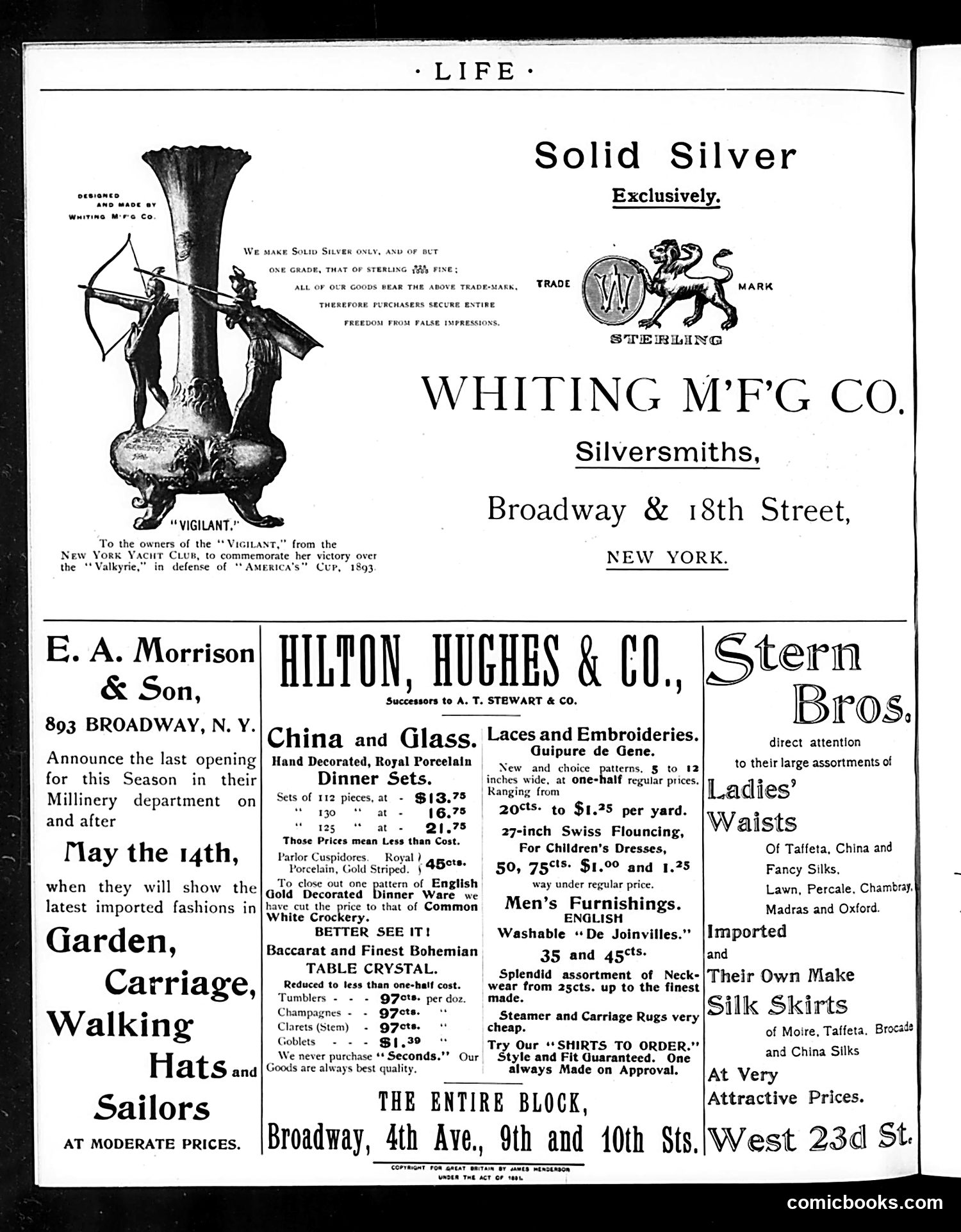
This page is primarily **advertising**, not satire or political commentary. The main content features ads for: - **Whiting M'fg Co.**, a silversmith advertising "Solid Silver Exclusively" on Broadway & 18th Street, New York - Various retailers selling millinery, china, glassware, and ladies' clothing The only illustration with potential historical interest is the ornamental vase labeled **"VIGILANT,"** described as a commemorative piece for the owners of the yacht *Vigilant*, celebrating her victory over the *Valkyrie* in defense of "America's Cup, 1893." This references the famous yacht race competition, a significant sporting event of that era. The rest of the page consists entirely of commercial advertisements typical of 1890s Life magazine, with no political satire or social commentary apparent.
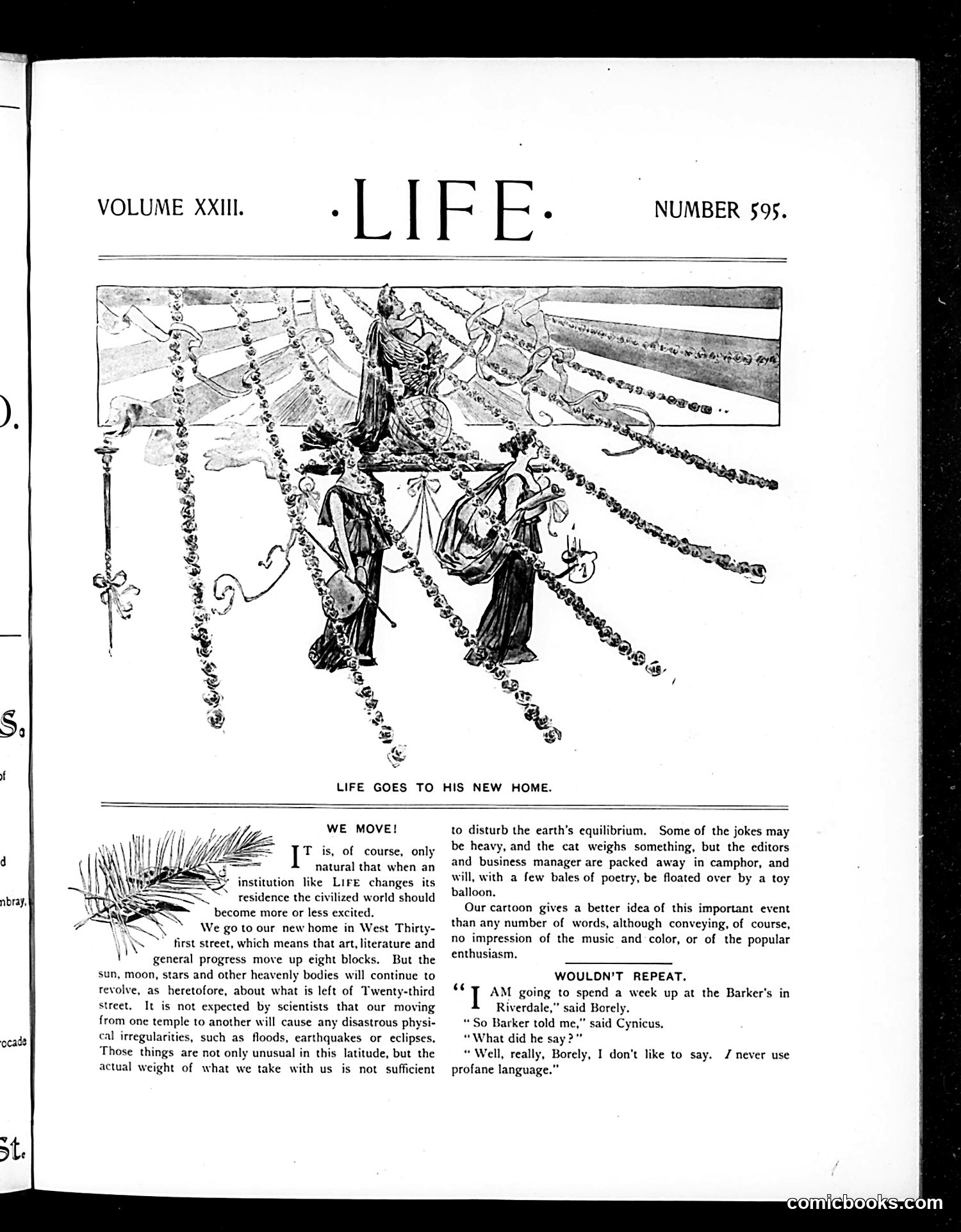
The main cartoon, titled "Life Goes to His New Home," depicts the magazine's mascot (a cherubic figure) being transported by two robed allegorical figures holding garlands, with additional figures in the background. The accompanying text explains that *Life* magazine is relocating its offices from Twenty-third Street to West Thirty-first Street in New York City. The satire humorously treats this mundane office move as an epochal event worthy of grand ceremonial treatment. The joke mocks both the magazine's self-importance and the melodramatic way major institutions announce routine administrative changes. The brief dialogue snippet below further employs humor about profane language to entertain readers.
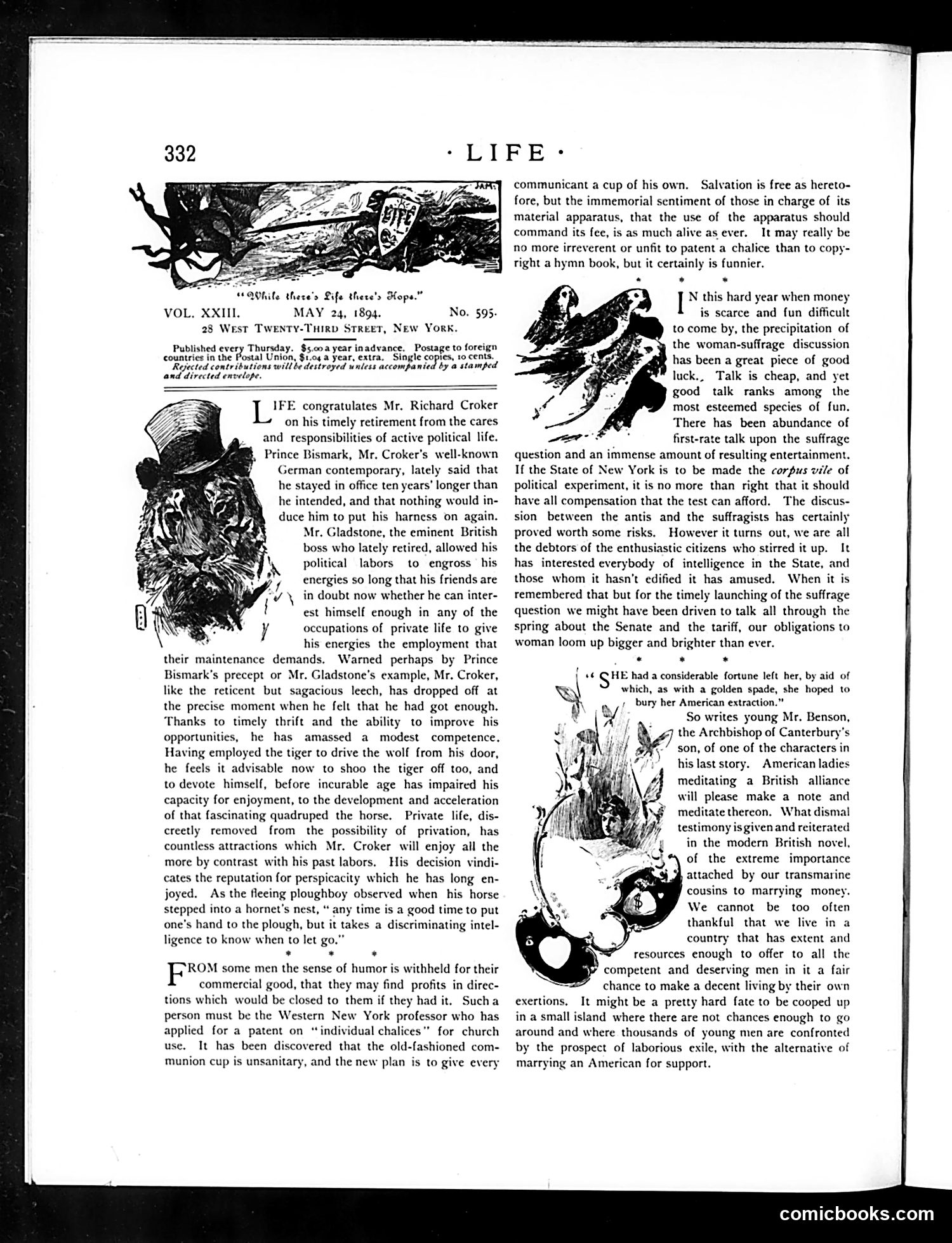
The main illustration depicts **Richard Croker**, a prominent Tammany Hall political boss, retiring from active politics. The accompanying text congratulates him on leaving public life, comparing him favorably to Prince Bismarck and British politician Gladstone—suggesting he's wise to exit while maintaining his reputation. The satire criticizes Croker's past political machinations while praising his decision to pursue private life instead. The text implies he accumulated sufficient wealth through political office to retire comfortably, allowing him to focus on leisure activities like horseback riding. The secondary commentary addresses women's suffrage debates and Anglo-American relations, touching on contemporary political discussions of 1894. The overall tone mixes praise for his exit with subtle criticism of machine politics and wealth accumulation through public service.
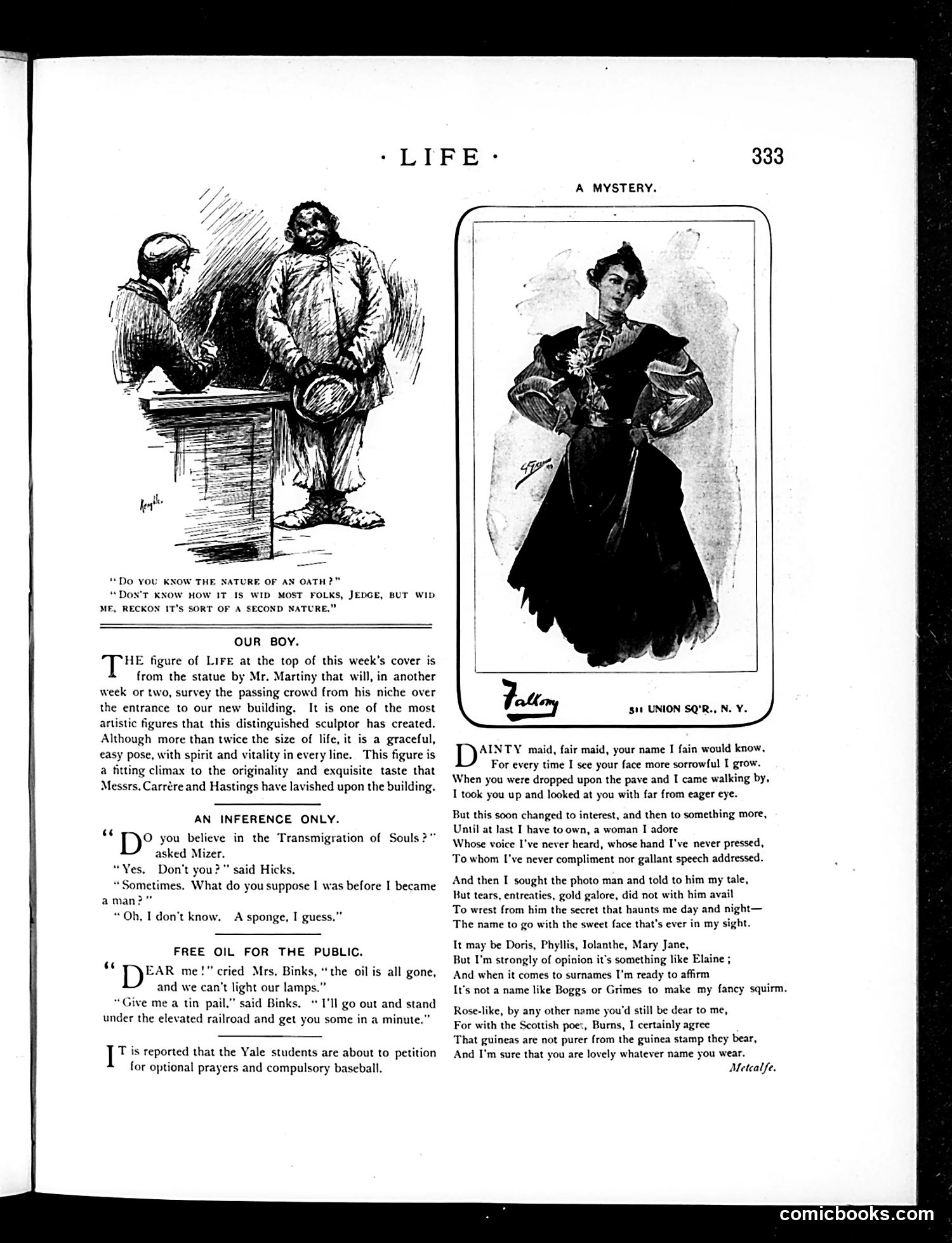
**Left cartoon ("Our Boy"):** A judge and another man discuss oaths. The caption quotes the second figure claiming he doesn't know how oaths work but assures the judge it will be "sort of a second nature"—satirizing casual, careless swearing-in of witnesses, suggesting incompetence or indifference to legal procedures. **Right image ("A Mystery"):** A fashionably dressed woman in an elegant dark gown with puffy sleeves, labeled "211 Union Sq., N.Y." The accompanying poem is titled "Dainty maid" and expresses romantic bewilderment about her identity, suggesting she's an unidentified woman the author admires but cannot identify—playing on the trope of mysterious feminine beauty. Both pieces use humor to comment on social confusion and uncertainty.
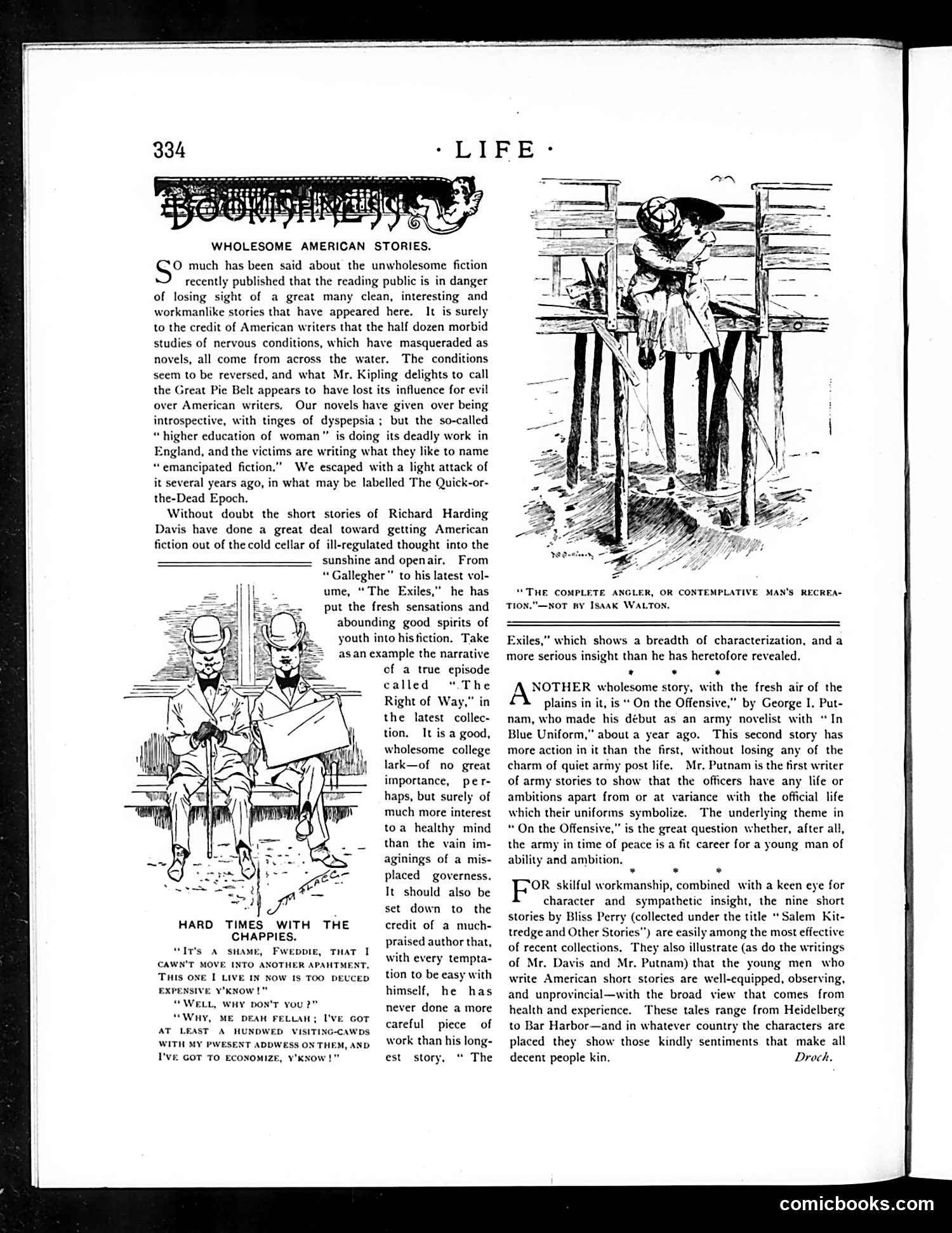
This page discusses "wholesome American stories" in fiction, praising short story writers like Richard Harding Davis and George I. Putnam for moving away from what the text calls morbid "nervous condition" narratives. The left cartoon captioned "Hard Times with the Craphies" shows two men in conversation, illustrating financial difficulties. The dialogue references a "hundred visiting-cards" and economic constraints, satirizing pretentious social affectation during economic hardship—the humor lies in maintaining appearances despite poverty. The right illustration shows a man fishing, accompanying praise for Isaac Walton's *The Complete Angler*, representing the "contemplative man's recreation." The overall message: quality American literature should reflect healthy, optimistic values rather than psychological dysfunction, celebrating outdoorsy and morally uplifting themes.
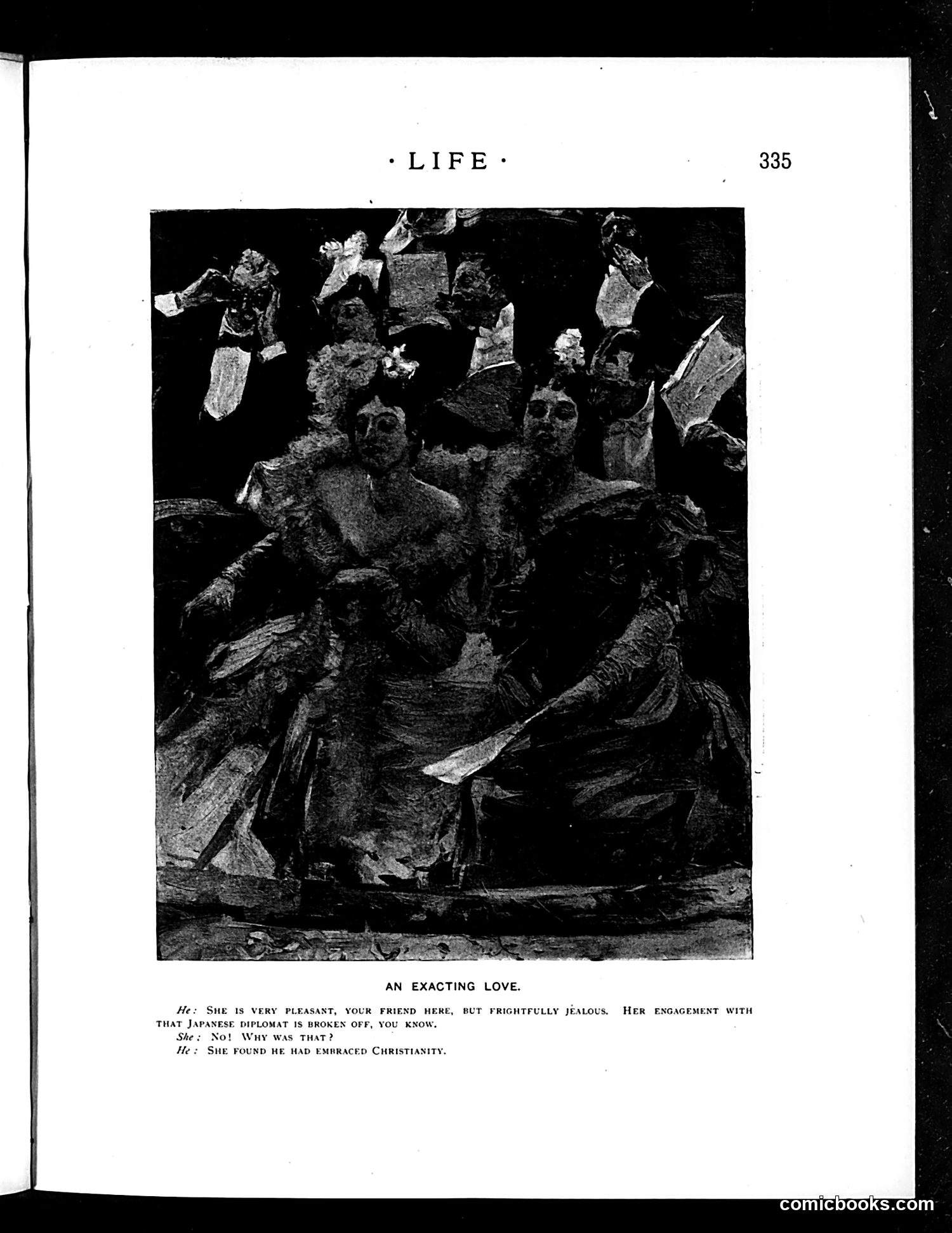
This satirical cartoon depicts what appears to be a dramatic domestic scene. The caption describes a jealous confrontation: a man warns his friend that a woman ("very pleasant") is "frightfully jealous" because her engagement to a Japanese diplomat has been broken off. When the friend asks why the engagement ended, the man replies she discovered the diplomat "had embraced Christianity." The satire targets anti-Christian prejudice in early 20th-century international relations and attitudes toward Japan. It mocks the notion that a woman would end an engagement specifically because her partner converted to Christianity—suggesting this reasoning is absurd and reflects broader stereotypes about Japanese religious practices and Western-Japanese cultural tensions of the era.
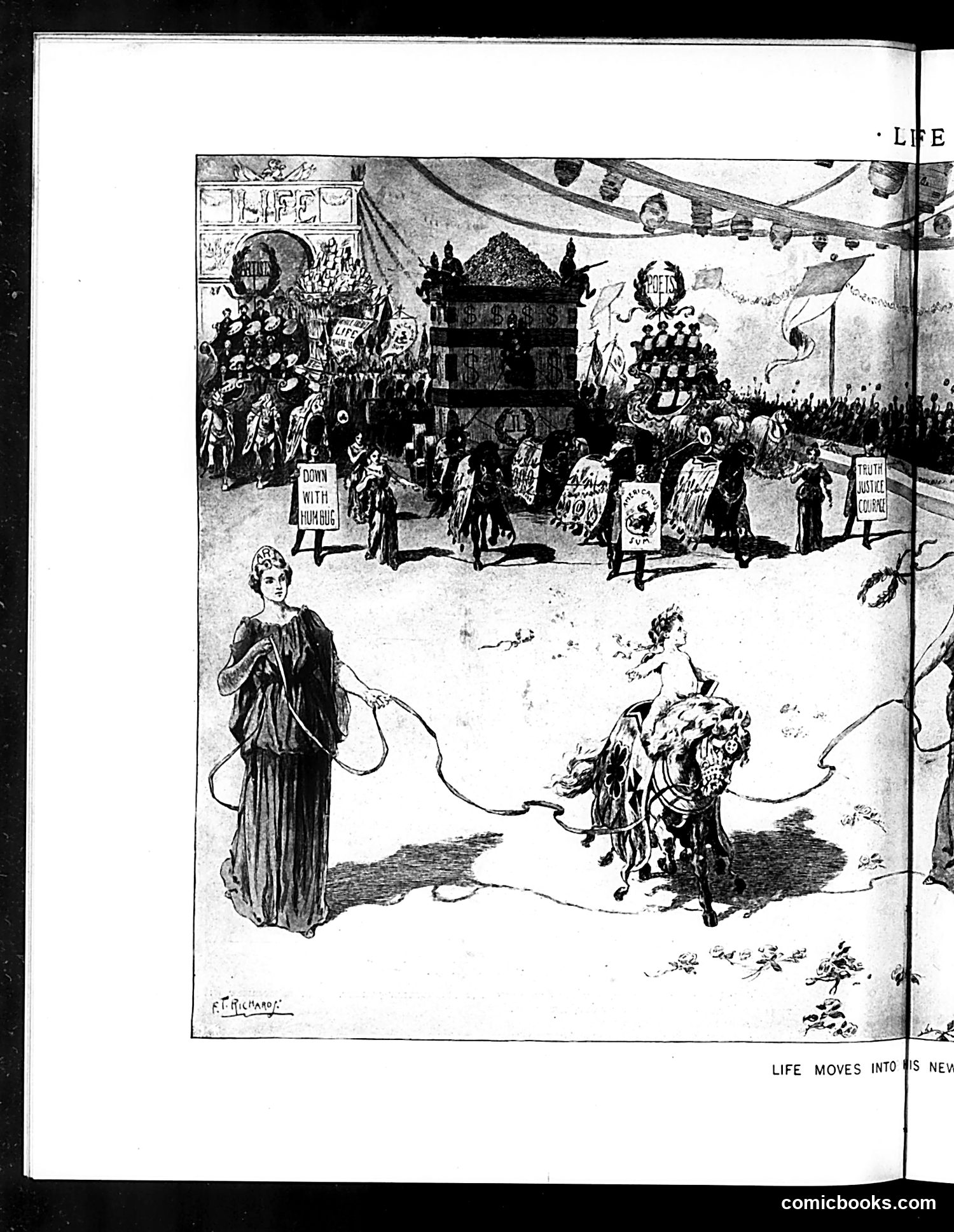
This satirical illustration depicts a classical allegorical scene. A female figure (likely representing Justice or Lady Liberty) on the left holds a whip, confronting a mounted rider on the right carrying a child. The background shows an elaborate procession or pageant with banners, crowds, and ornate structures. The visible banner text includes "DOWN WITH HUMBUG" and references to "JUSTICE" and "FORCE," suggesting this critiques hypocrisy or injustice in contemporary society. The contrast between the foreground's stark confrontation and the background's elaborate spectacle implies the cartoon satirizes how grand public displays or institutions mask underlying corruption or wrongdoing. Without a clear date or additional context, the specific historical event remains unclear, though the artistic style suggests early 20th-century American satirical commentary.
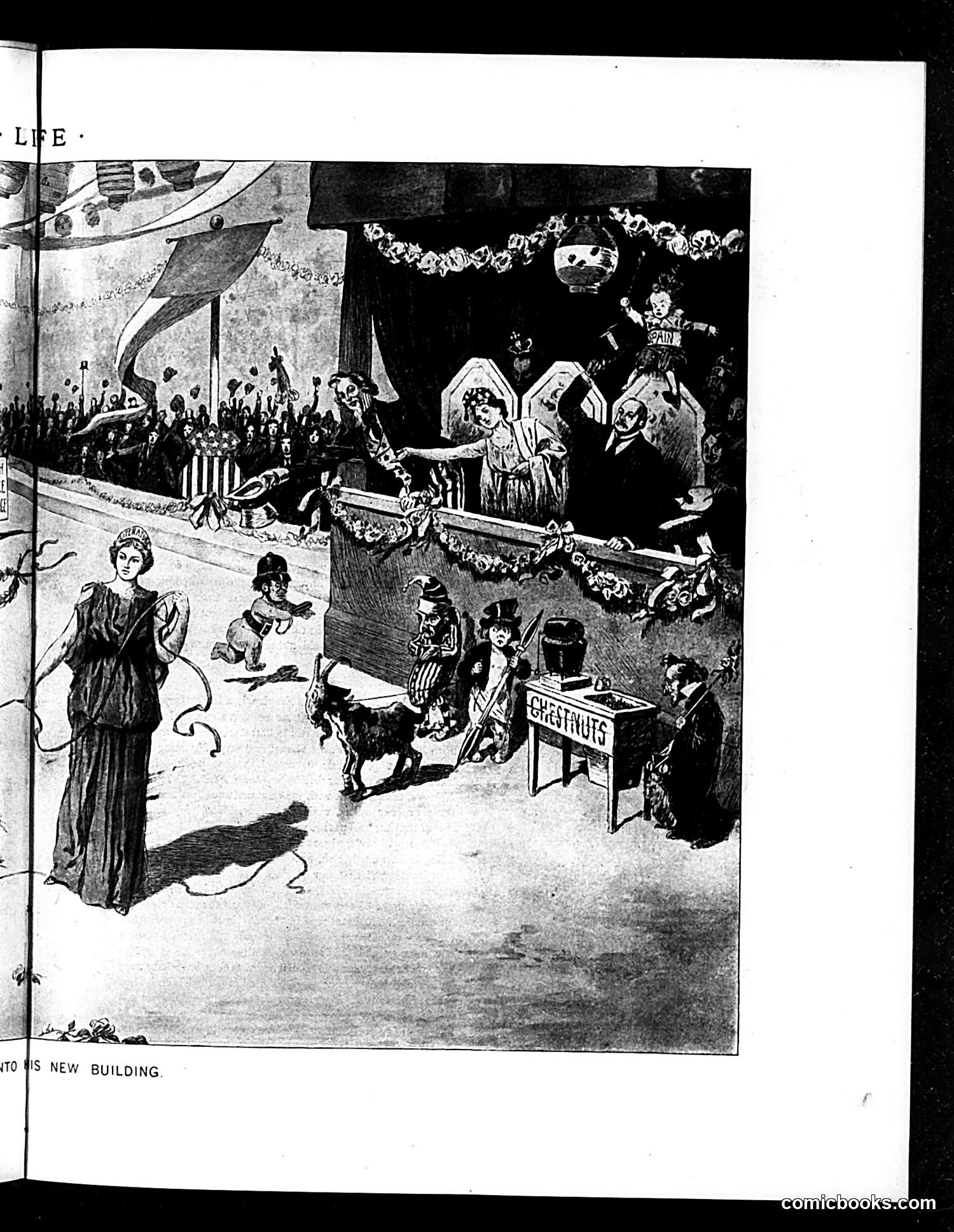
This appears to be a satirical illustration from *Life* magazine depicting a Christmas scene with social commentary. The image shows a festive holiday gathering with decorated venues, gift vendors (note the "CHESTNUTS" stand), and well-dressed figures in period costume. On the left stands a woman in dark clothing with a prominent shadow—likely representing a social critique. The upper portion shows what appears to be wealthy or aristocratic figures in an elegant setting with garland decorations and a nativity-style scene. The satire likely contrasts wealthy holiday celebrations with social inequality or poverty (suggested by the lone figure and shadow on the left). Without the full OCR text or publication date visible, the specific political target remains unclear, but the composition suggests commentary on class divisions during the Christmas season.
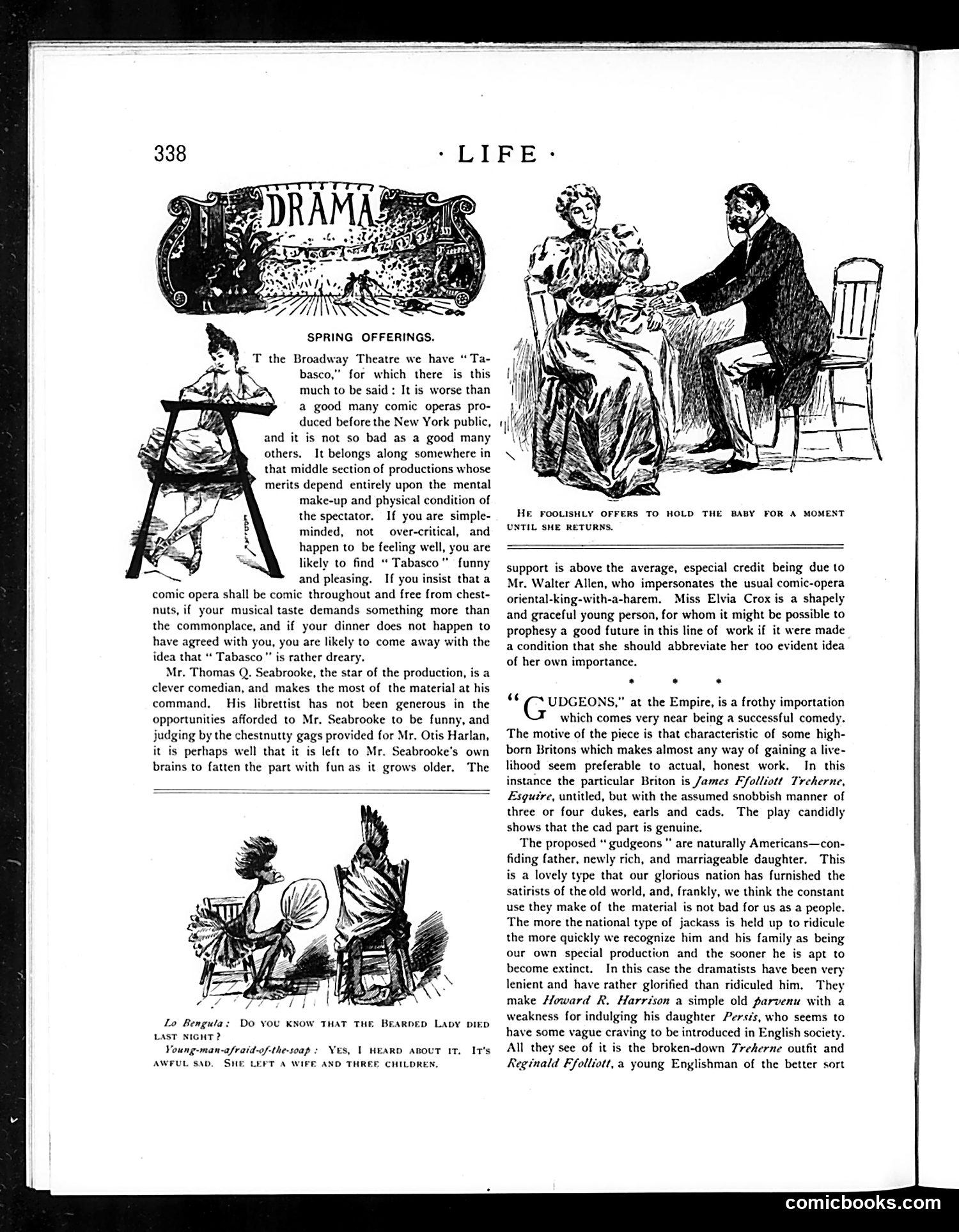
This page reviews Broadway productions, focusing on two shows: **"Tabasco"** — a comic opera the reviewer dismisses as mediocre. It's pitched at simple audiences and relies on physical comedy rather than wit. The reviewer suggests it's pleasant enough if you're not demanding intellectually. **"Gudgeons"** at the Empire Theatre — described as a "frothy importation" (likely British). The play mocks high-born Britons (dukes, earls, cads) as types American audiences find ridiculous. The reviewer criticizes it for glorifying a distinctly British "jackass" character rather than ridiculing him, finding this approach lenient compared to American satire. The cartoons illustrate typical theatre-goers and their conversations, capturing period social commentary about American versus British dramatic tastes.
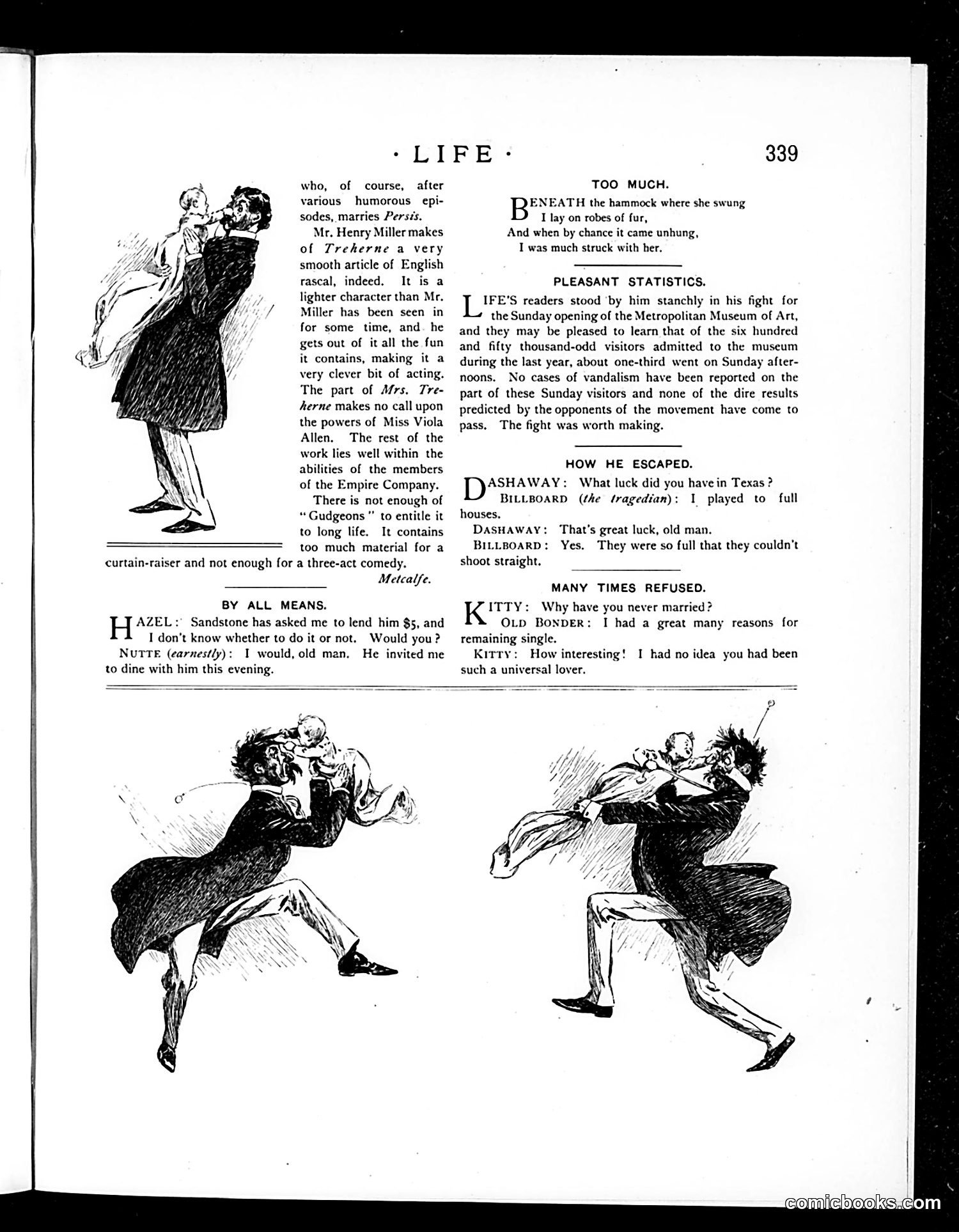
This page contains theatrical reviews and humorous sketches rather than political cartoons. The text discusses a play called *Trèberne* (likely *Tréherne*), praising Henry Miller's performance as a "smooth article of English rascal" and noting that the work contains sufficient material for a three-act comedy but falls short as presented by the Empire Company. The two illustrated sketches at the bottom appear to be comedic vignettes showing figures in exaggerated poses—possibly depicting slapstick or physical comedy moments. The surrounding text includes brief comedic dialogues about lending money, refusing marriage proposals, and escaping from Texas. This is primarily entertainment journalism and theater criticism rather than political satire.
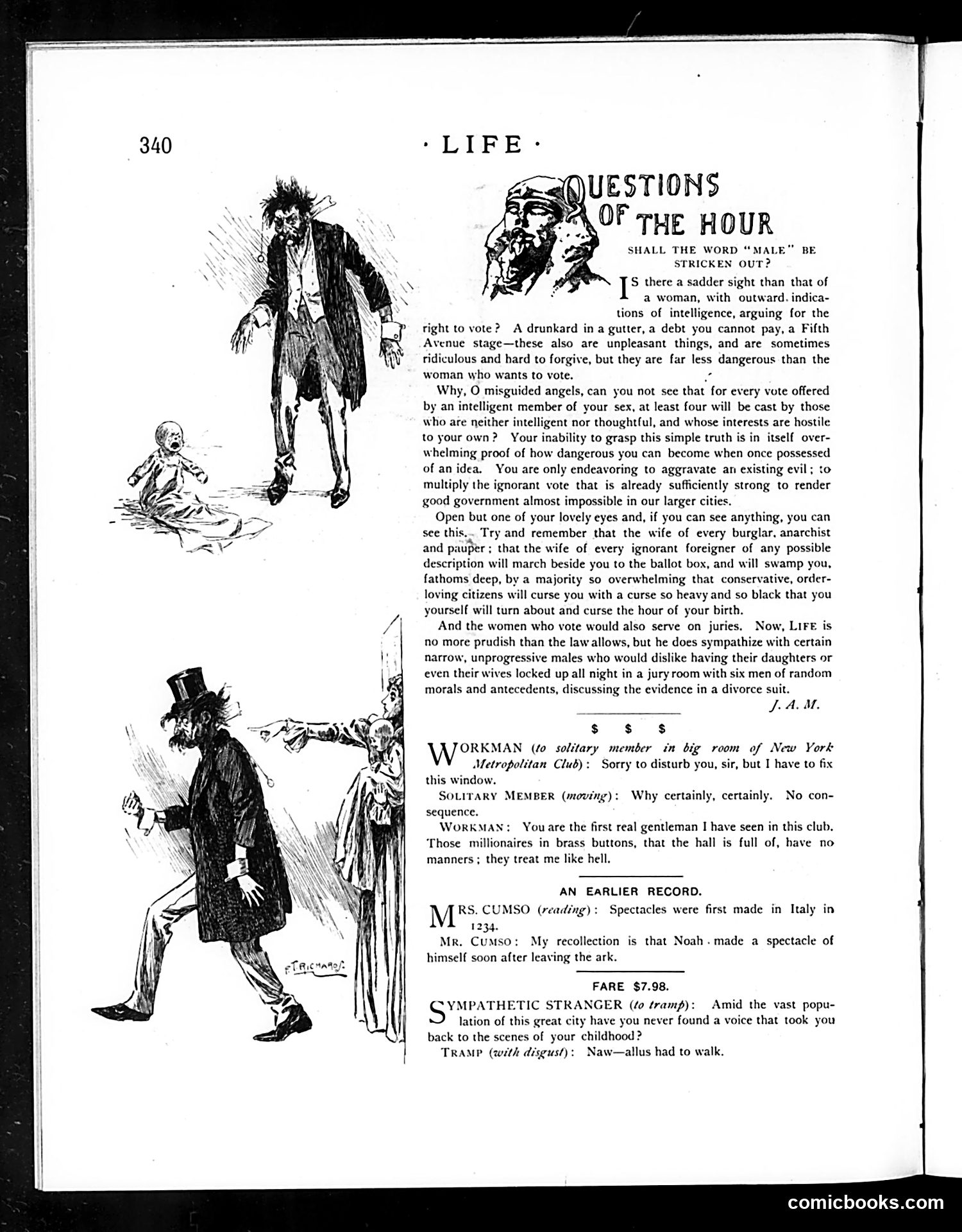
This *Life* page satirizes anti-suffrage arguments circa the 1910s women's voting rights movement. The main essay mocks female suffrage by claiming intelligent women voters would be outnumbered by wives of criminals and "ignorant foreigners," thus worsening urban governance. It also objects to women serving on juries, suggesting they'd be corrupted by exposure to men of "random morals." The accompanying cartoons are lighter sketches unrelated to suffrage—one contrasts working-class courtesy with wealthy club members' rudeness; another plays on the word "spectacle"; the final depicts a tramp's dismissive response about nostalgia. The satire's target is ambiguous: it may mock suffrage opponents' hysteria, or endorse their views. *Life's* actual editorial position on women's voting remains unclear from this page alone.
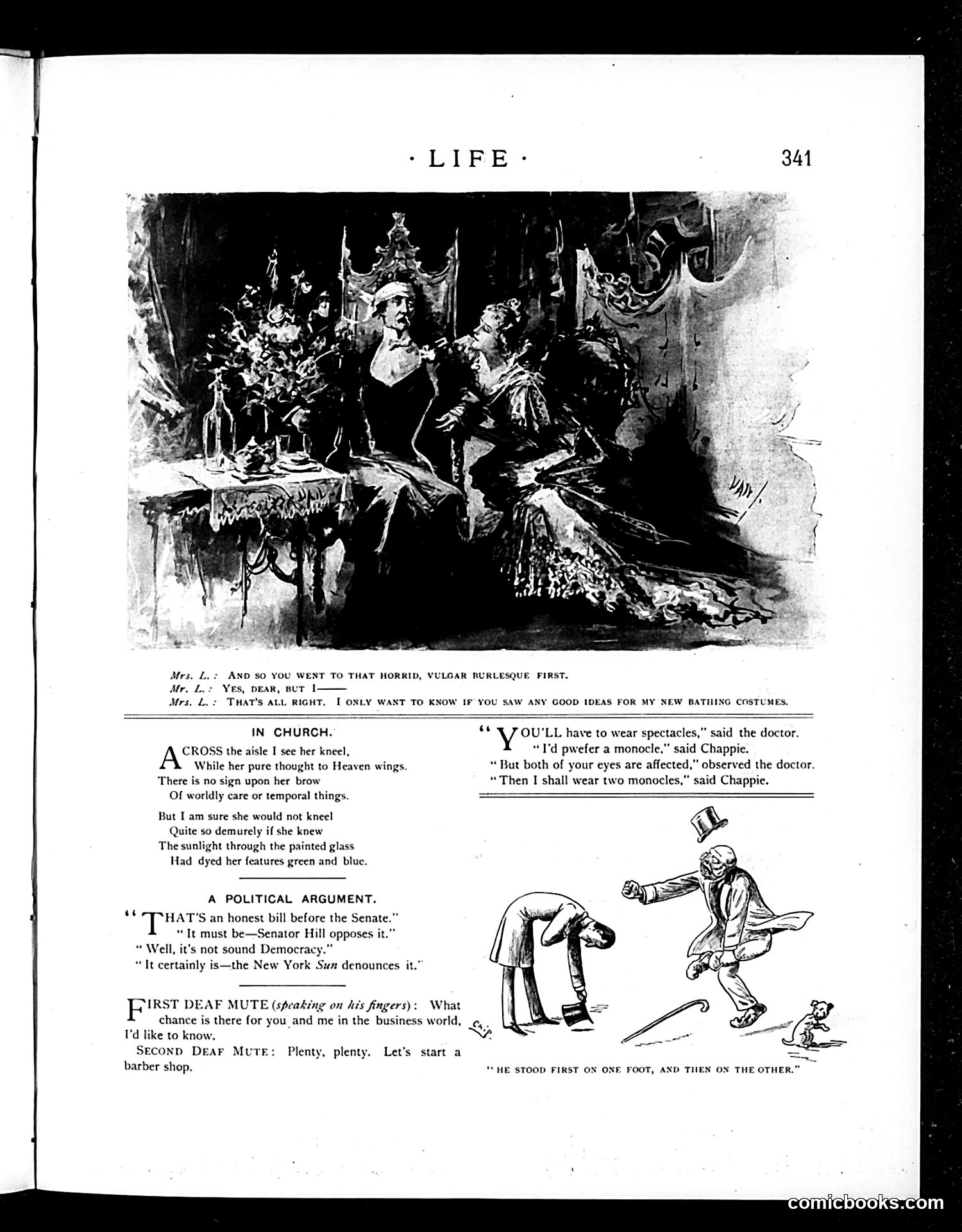
This page contains several unrelated comic sketches typical of Life's format: **Top cartoon**: A woman asks her husband about attending a burlesque show, not caring about the performance itself—only whether he spotted good bathing costume designs. The satire mocks both the husband's dubious entertainment and the wife's materialistic priorities. **"In Church"**: Verses mock a woman's display of piety in church, revealing her sanctimonious posture is undermined by unflattering green-and-blue lighting from stained glass—a gentle jab at false religiosity. **"A Political Argument"**: Quick joke about Senate politics: a bill must be honest because Senator Hill (appears to reference a real senator) opposes it; it can't be sound democracy because the *New York Sun* denounces it. Satirizes partisan contradiction. **Deaf Mutes cartoon**: Two deaf men discuss business prospects. One suggests opening a barber shop—the joke being unclear from this excerpt alone, likely playing on period stereotypes about deaf workers' employment options.
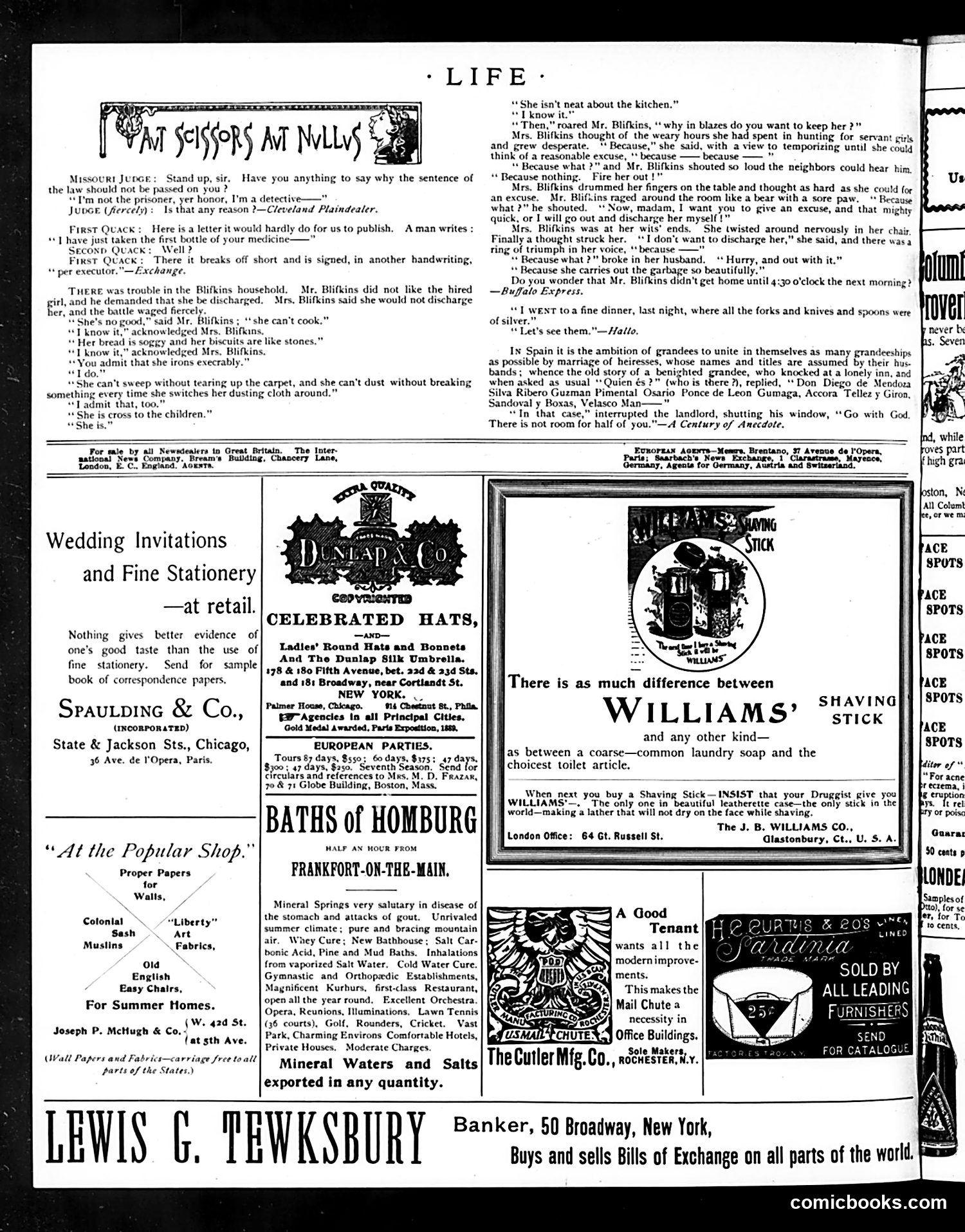
This page contains three separate humorous pieces typical of *Life* magazine's satirical content. **"At Nullys"** (top) is a courtroom sketch mocking incompetent legal proceedings. A judge questions a prisoner who claims to be a detective, creating absurdist confusion about who is actually on trial—satirizing the often-muddled nature of court proceedings. **"The Blifkins Household"** (middle) depicts a marital dispute where Mr. Blifkins demands his wife fire their incompetent servant. When pressed for a reason to keep her, Mrs. Blifkins desperately improvises that the servant "carries out the garbage so beautifully"—a ridiculous excuse so transparently false that it enrages him so thoroughly he doesn't come home until 4:30 AM. The satire mocks both marital dynamics and the servant-employment struggles of the era. **"Spanish Grandees"** (bottom) is a brief anecdote about a Spanish nobleman with so many inherited titles he literally cannot fit through an inn doorway to state his full name, satirizing aristocratic pretension and genealogical absurdity. All three rely on exaggeration and absurdist logic typical of early 20th-century American humor magazines.
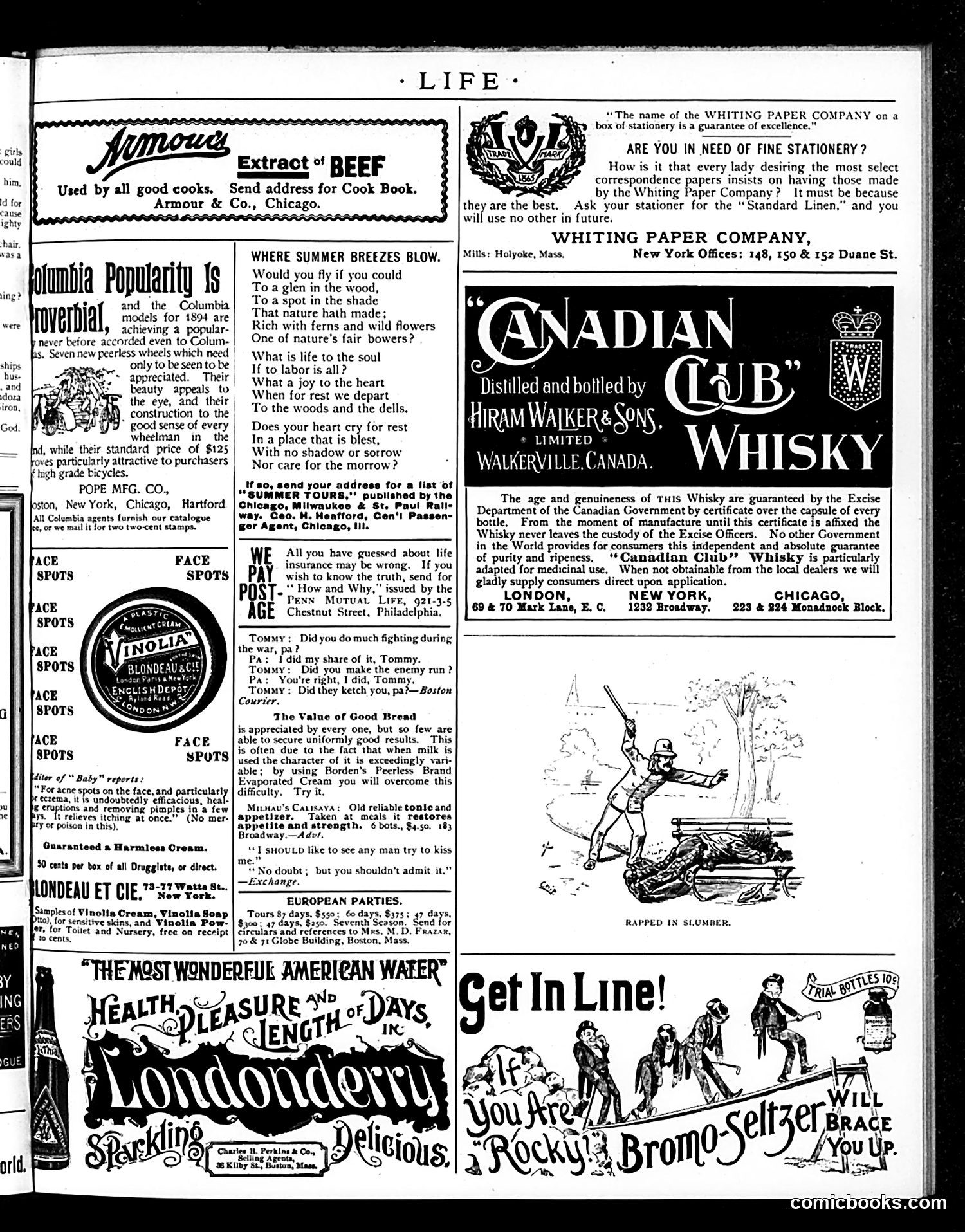
This page is primarily **advertising**, typical of 1890s American magazines. Notable content includes: **Main Advertisement**: A large Canadian Club Whisky ad emphasizing government certification of authenticity—important given widespread product counterfeiting in that era. **Small Humor/Satire**: A brief dialogue between "Tommy" and "Pa" about the war. Pa claims he "made the enemy run," but Tommy asks "Did they ketch you, pa?"—the joke being that Pa actually *fled* from combat, not fought bravely. This gently mocks wartime boasting and false heroism, likely referencing recent Spanish-American War experiences. **Other Ads**: Bicycle manufacturers (Columbia), patent medicines (Vinolia cream for acne, Bordeaux milk), stationery, and travel tours—reflecting 1890s consumer products and middle-class leisure interests. The "Rapped in Slumber" cartoon illustration appears to depict someone sleeping outdoors, accompanying summer travel advertisements.
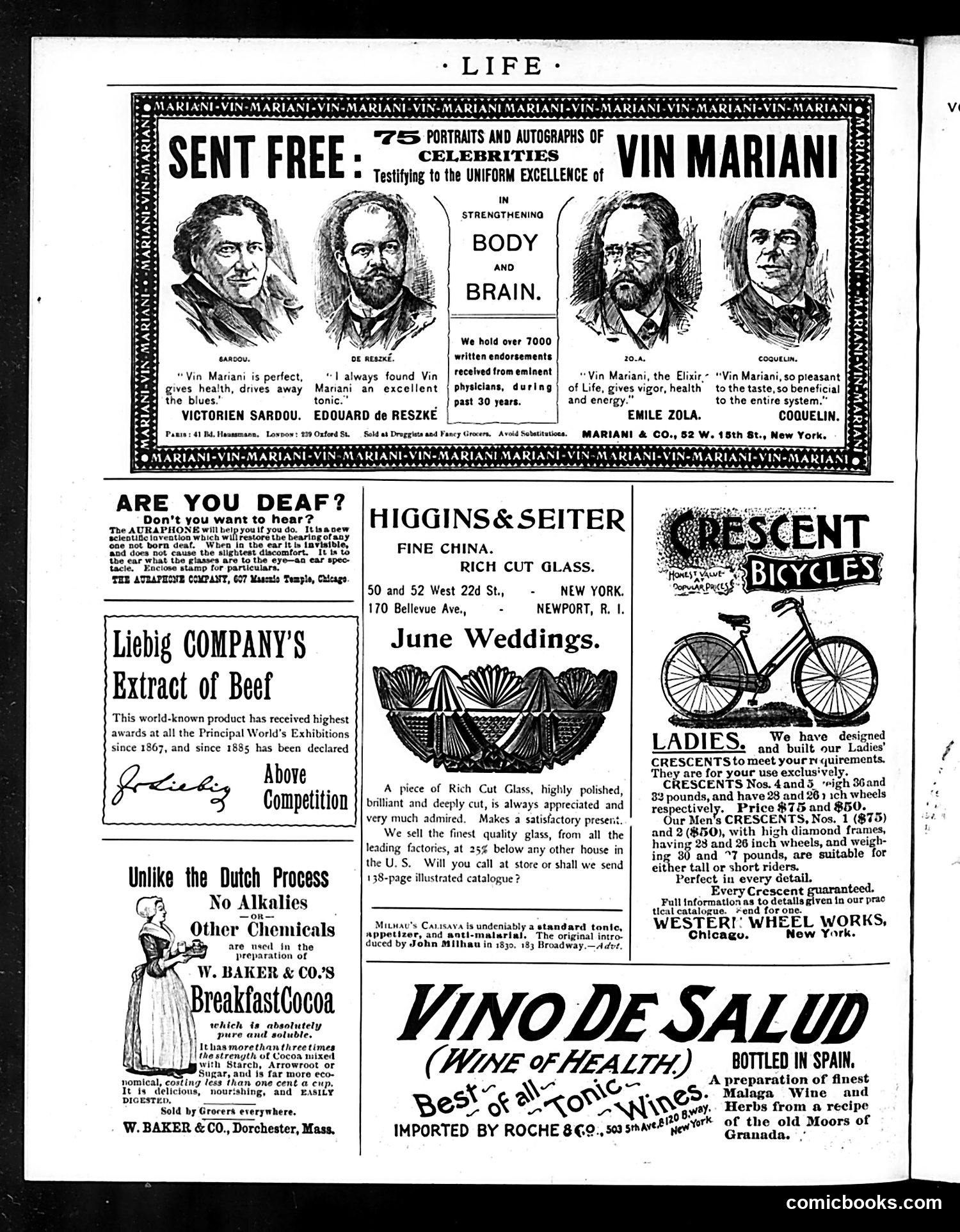
This page is primarily **advertising** with no political satire. It showcases patent medicines and consumer goods typical of the late 19th/early 20th century. The dominant ad promotes **Vin Mariani**, a wine-based tonic claiming to strengthen "body and brain." It lists celebrity endorsements from figures like French playwright Victorien Sardou and operatic tenor Édouard de Reszke—their famous names lending credibility to an unregulated product. The claim of "over 7000 written endorsements from eminent physicians" reflects the era's unpoliced medical advertising. Other ads reveal period concerns: the **Auraphone** addresses deafness, **Liebig's Extract of Beef** and **Baker's Cocoa** promise nutritional benefit, and **Crescent Bicycles** markets to women—noting the novelty of female riders. **Vino de Salud** (Spanish wine tonic) similarly trades on exotic origins and health claims. The page demonstrates how early-20th-century advertising exploited medical anxiety and celebrity authority before FDA regulation, presenting dubious tonics and untested devices as scientific solutions.