
Life, 1894-05-24 · page 6 of 16
Life — May 24, 1894 — page 6: what you’re looking at
What you’re looking at
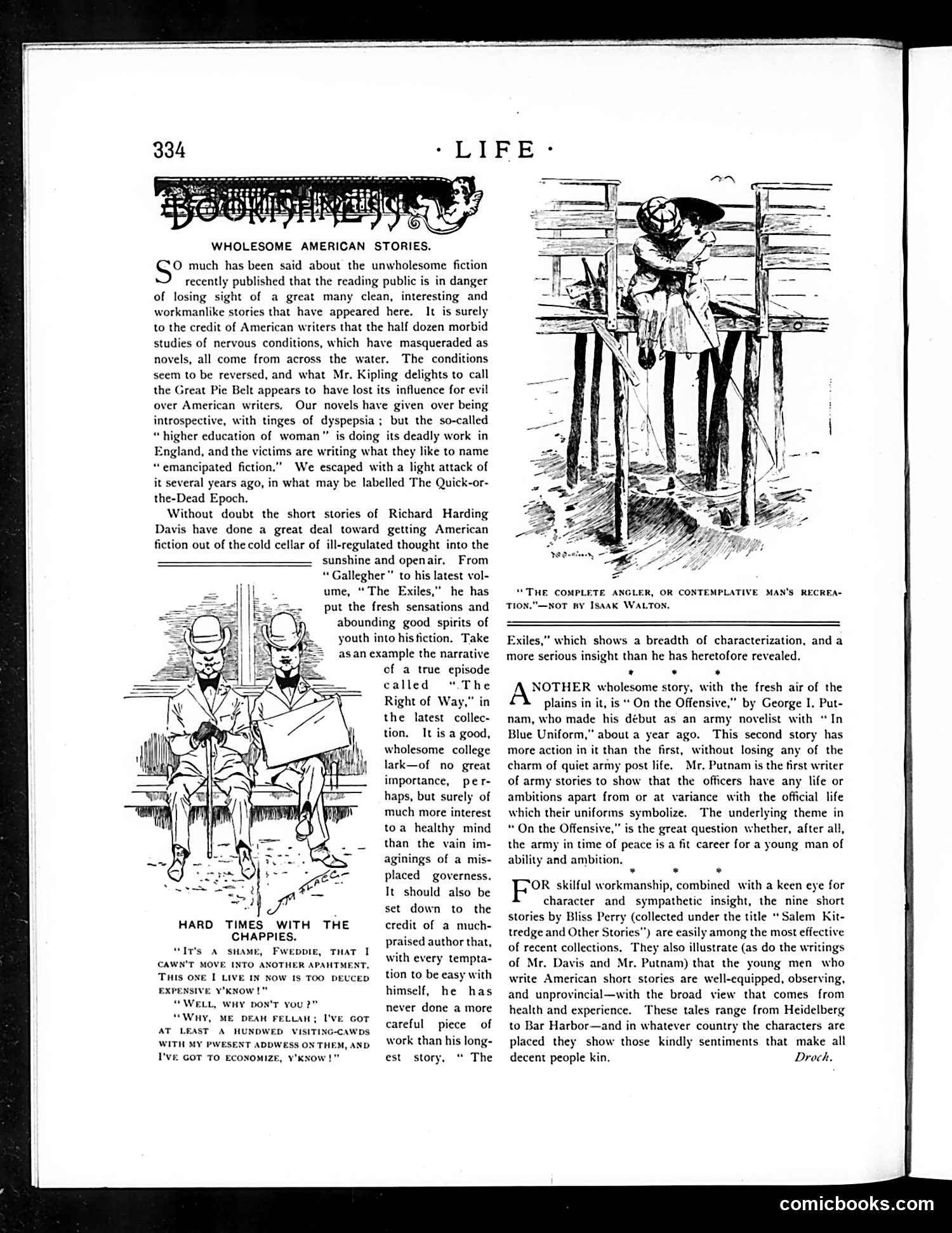
This page discusses "wholesome American stories" in fiction, praising short story writers like Richard Harding Davis and George I. Putnam for moving away from what the text calls morbid "nervous condition" narratives. The left cartoon captioned "Hard Times with the Craphies" shows two men in conversation, illustrating financial difficulties. The dialogue references a "hundred visiting-cards" and economic constraints, satirizing pretentious social affectation during economic hardship—the humor lies in maintaining appearances despite poverty. The right illustration shows a man fishing, accompanying praise for Isaac Walton's *The Complete Angler*, representing the "contemplative man's recreation." The overall message: quality American literature should reflect healthy, optimistic values rather than psychological dysfunction, celebrating outdoorsy and morally uplifting themes.
📄 Transcribed text from this page (OCR, searchable)
Machine-transcribed from the original scan — historical spelling and the odd misread are preserved.
WHOLESOME AMERICAN STORIES. O much has been said about the unwholesome fiction recently published that the reading public is in danger of losing sight of a great many clean, interesting and workmanlike stories that have appeared here, It is surely to the credit of American writers that the half dozen morbid studies of nervous conditions, which have masqueraded as novels, all come from across the water. The conditions seem to be reversed, and what Mr. Kipling delights to call the Great Pie Belt appears to have lost its influence for evil over American writers, Our novels have given over being introspective, with tinges of dyspepsia ; but the so-called “higher education of woman” is doing its deadly work in England, and the victims are writing what they like to name “emancipated fiction.” We escaped with a light attack of it several years ago, in what may be labelled The Quick-or- the-Dead Epoch. Without doubt the short stories of Richard Harding Davis have done a great deal toward getting American fiction out of the cold cellar of ill-regulated thought into the ——___________ sunshine and openair. From “Gallegher” to his latest vol- ume, “The Exiles,” he has put the fresh sensations and abounding good spirits of youth into histiction. Take as an example the narrative of a true episode called “The Right of Way,” in the latest collec- tion. It is a good, wholesome college lark—of no great importance, pe r- haps, but surely of much more interest toa healthy mind than the vain im- aginings of a mis- placed governess. It should also be set down to the credit of a much- praised author that, with every tempta- tion to be easy with himself, he has never done a more careful piece of work than his long- story, “ The WITH THE CHAPPIES. “It's A SHAME, Fweppte, THaTt I CAWN'T MOVE INTO ANOTHER APAHTMENT. Tus one I LIVE IN NOW IS TOO DEUCED EXPENSIVE Y'KNOW |" OW, WHY DON'T you ?” “WHY, ME DEAH FELLA; I've GoT AT LEAST A HUNDWED VISITING-CAWDS WITH MY PX T ADDWESS ON THEM, AND. I've Got To EcoNoMIzE, Y'KNOW!" est “THE COMPLETE ANGLER, OR CONTEMPLATIVE MAN'S RECREA- TION."—NOT BY ISAAK WALTON. Exiles,” which shows a breadth of characterization, and a more serious insight than he has heretofore revealed. . . * NOTHER wholesome story, with the fresh air of the plains in it, is * On the Offensive,” by George I. Put- nam, who made his début as an army novelist with “In Blue Uniform,” about a year ago, This second story has more action in it than the first, without losing any of the charm of quiet army post life. Mr. Putnam is the first writer of army stories to show that the officers have any life or ambitions apart from or at variance with the official life which their uniforms symbolize. The underlying theme in “ On the Offensive,” is the great question whether, after all, the army in time of peace is a fit career for a young man of ability and ambition, . * * Fee skilful workmanship, combined with a keen eye for character and sympathetic insight, the nine short stories by Bliss Perry (collected under the title “Salem Kit- tredge and Other Stories”) are easily among the most effective of recent collections, They also illustrate (as do the writings of Mr. Davis and Mr. Putnam) that the young men who write American short stories are well-equipped, observing, and unprovincial—with the broad view that comes from health and experience. These tales range from Heidelberg to Bar Harbor—and in whatever country the characters are placed they show those kindly sentiments that make all decent people kin. Droch. comicbooks.com