
Life, 1894-05-24 · page 4 of 16
Life — May 24, 1894 — page 4: what you’re looking at
What you’re looking at
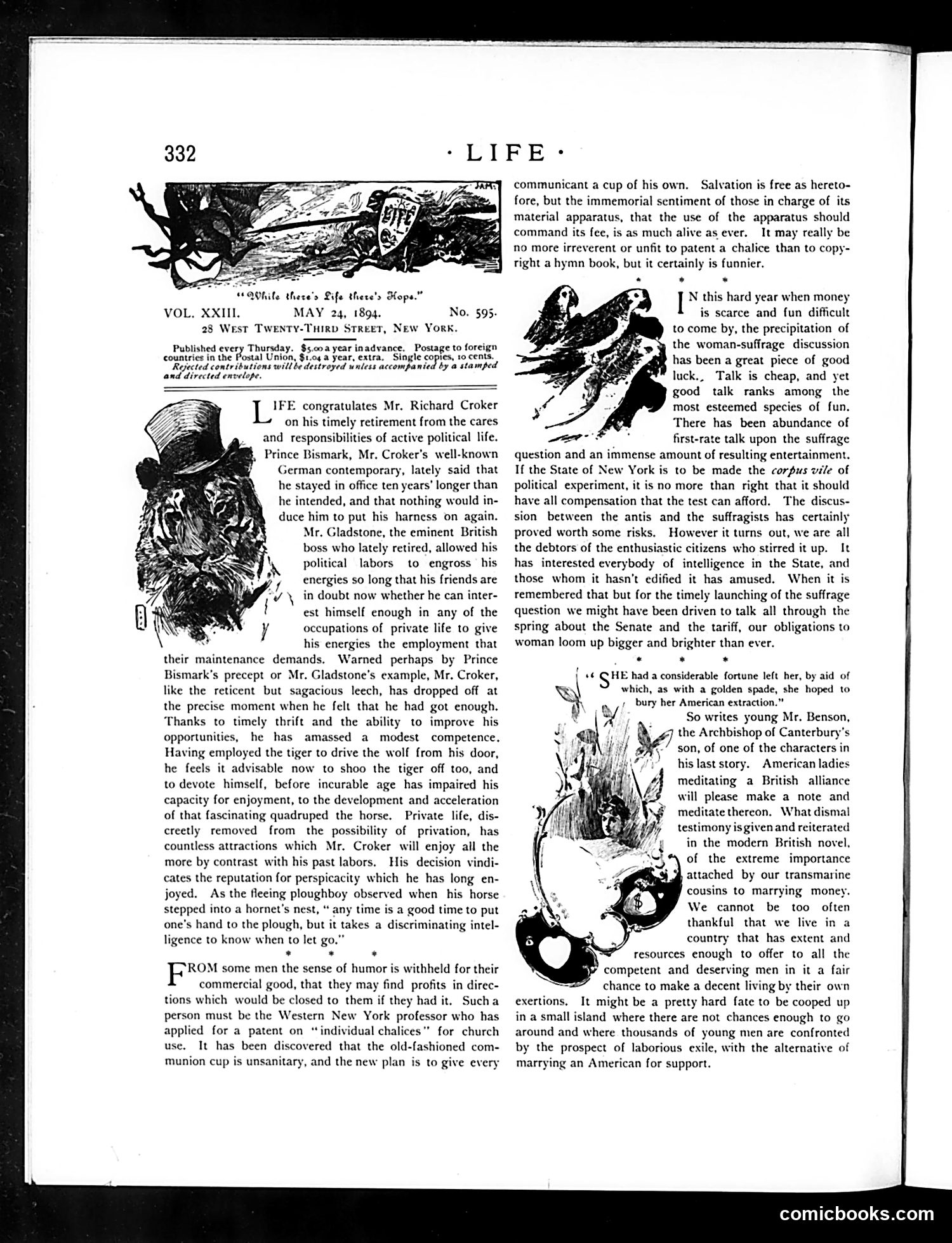
The main illustration depicts **Richard Croker**, a prominent Tammany Hall political boss, retiring from active politics. The accompanying text congratulates him on leaving public life, comparing him favorably to Prince Bismarck and British politician Gladstone—suggesting he's wise to exit while maintaining his reputation. The satire criticizes Croker's past political machinations while praising his decision to pursue private life instead. The text implies he accumulated sufficient wealth through political office to retire comfortably, allowing him to focus on leisure activities like horseback riding. The secondary commentary addresses women's suffrage debates and Anglo-American relations, touching on contemporary political discussions of 1894. The overall tone mixes praise for his exit with subtle criticism of machine politics and wealth accumulation through public service.
📄 Transcribed text from this page (OCR, searchable)
Machine-transcribed from the original scan — historical spelling and the odd misread are preserved.
-LIFE: hile there's Life there's Hope.” VOL. XXIII. MAY 24, 1894. No. 595- 28 West Twenty-THIRD STREET, New York. Published every Thursday. $5.00a year inadvance. Postage to foreign countries in the Postal Union, $1.04 a year, extra. Single copies, to cents. Rejected contributions willbe destroyed untess accompanied by a stamped and directed envelope. IFE congratulates Mr. Richard Croker on his timely retirement from the cares and responsibilities of active political life. Prince Bismark, Mr. Croker's well-known German contemporary, lately said that he stayed in office ten years’ longer than he intended, and that nothing would in- duce him to put his harness on again. Mr. Gladstone, the eminent British boss who lately retired, allowed his political labors to engross his energies so long that his friends are in doubt now whether he can inter- est himself enough in any of the occupations of private life to give his energies the employment that their maintenance demands. Warned perhaps by Prince Bismark’s precept or Mr. Gladstone's example, Mr. Croker, like the reticent but sagacious leech, has dropped off at the precise moment when he felt that he had got enough. Thanks to timely thrift and the ability to improve his opportunities, he has amassed a modest competence, Having employed the tiger to drive the wolf from his door, he feels it advisable now to shoo the tiger off too, and to devote himself, before incurable age has impaired his capacity for enjoyment, to the development and acceleration of that fascinating quadruped the horse. Private life, dis- creetly removed from the possibility of privation, has countless attractions which Mr. Croker will enjoy all the more by contrast with his past labors. His decision vindi- cates the reputation for perspicacity which he has long en- joyed. As the fleeing ploughboy observed when his horse stepped into a hornet’s nest, “ any time is a good time to put one's hand to the plough, but it takes a discriminating intel- ligence to know when to let go,” . * . ROM some men the sense of humor is withheld for their commercial good, that they may find profits in direc- tions which would be closed to them if they had it. Sucha person must be the Western New York professor who has applied for a patent on “individual chalices” for church use. It has been discovered that the old-fashioned com- munion cup is unsanitary, and the new plan is to give every communicant a cup of his own. Salvation is free as hereto- fore, but the immemorial sentiment of those in charge of its material apparatus, that the use of the apparatus should command its fee, is as much alive as ever. It may really be no more irreverent or unfit to patent a chalice than to copy- right a hymn book, but it certainly is funnier. . . I N this hard year when money is scarce and fun difficult to come by, the precipitation of the woman-suffrage discussion has been a great piece of good luck., Talk is cheap, and yet good talk ranks among the most esteemed species of fun, There has been abundance of first-rate talk upon the suffrage question and an immense amount of resulting entertainment. If the State of New York is to be made the corpus vile of political experiment, it is no more than right that it should have all compensation that the test can afford. The discus- sion between the antis and the suffragists has certainly proved worth some risks. However it turns out, we are all the debtors of the enthusiastic citizens who stirred it up. It has interested everybody of intelligence in the State, and those whom it hasn't edified it has amused. When it is remembered that but for the timely launching of the suffrage question we might have been driven to talk all through the spring about the Senate and the tariff, our obligations to woman loom up bigger and brighter than ever. « * * {s SHE had a considerable fortune left her, by aid of which, as with a golden spade, she hoped to ; bury her American extractio1 ) % So writes young Mr. Benson, J aN A] the Archbishop of Canterbury's gs’ son, of one of the characters in his last story. American ladies meditating a British alliance will please make a note and meditate thereon, What dismal testimony isgiven and reiterated in the modern British novel, of the extreme importance attached by our transmarine cousins to marrying money. We cannot be too often thankful that we live in a country that has extent and resources enough to offer to all the competent and deserving men in it a fair chance to make a decent living by their own It might be a pretty hard fate to be cooped up in a small island where there are not chances enough to go around and where thousands of young men are confronted by the prospect of laborious exile, with the alternative of marrying an American for support. exertions, comicbooks.com