
A complete issue · 14 pages · 1894
Life — April 5, 1894
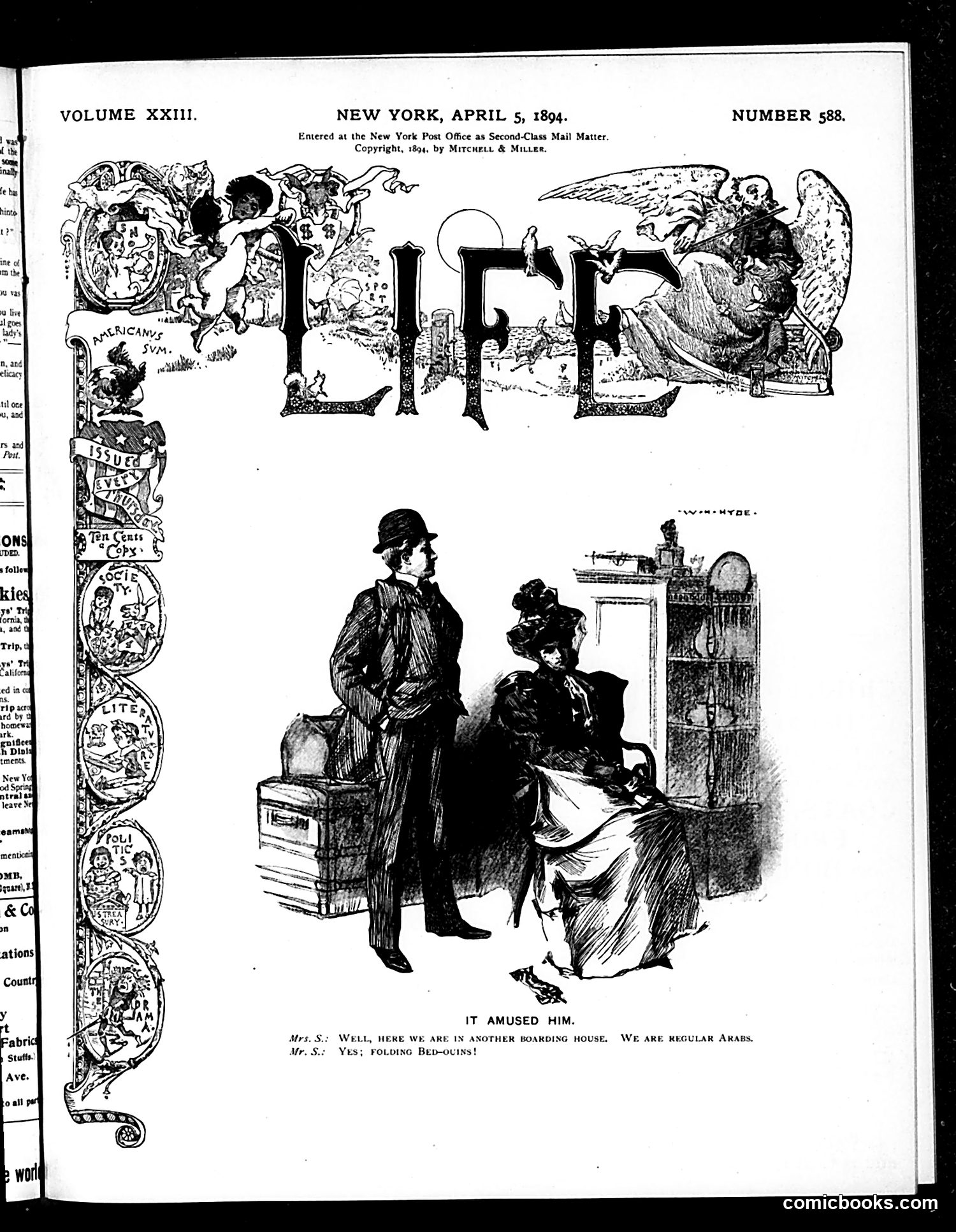
This page features a single cartoon titled "It Amused Him," depicting a domestic scene in a boarding house. A well-dressed man stands while a woman sits, with the caption reading: "Mrs. S.: Well, here we are in another boarding house. We are regular Arabs. / Mr. S.: Yes; folding bed-ouins!" The joke is a pun on "Bedouins" (nomadic Arab desert dwellers), playing on the phrase "folding bed" — referring to the portable furniture common in boarding houses of the era. The cartoon satirizes the transient lifestyle of boarding-house residents, comparing their constant relocations to the wandering existence of nomadic peoples. The humor relies on wordplay rather than political commentary.
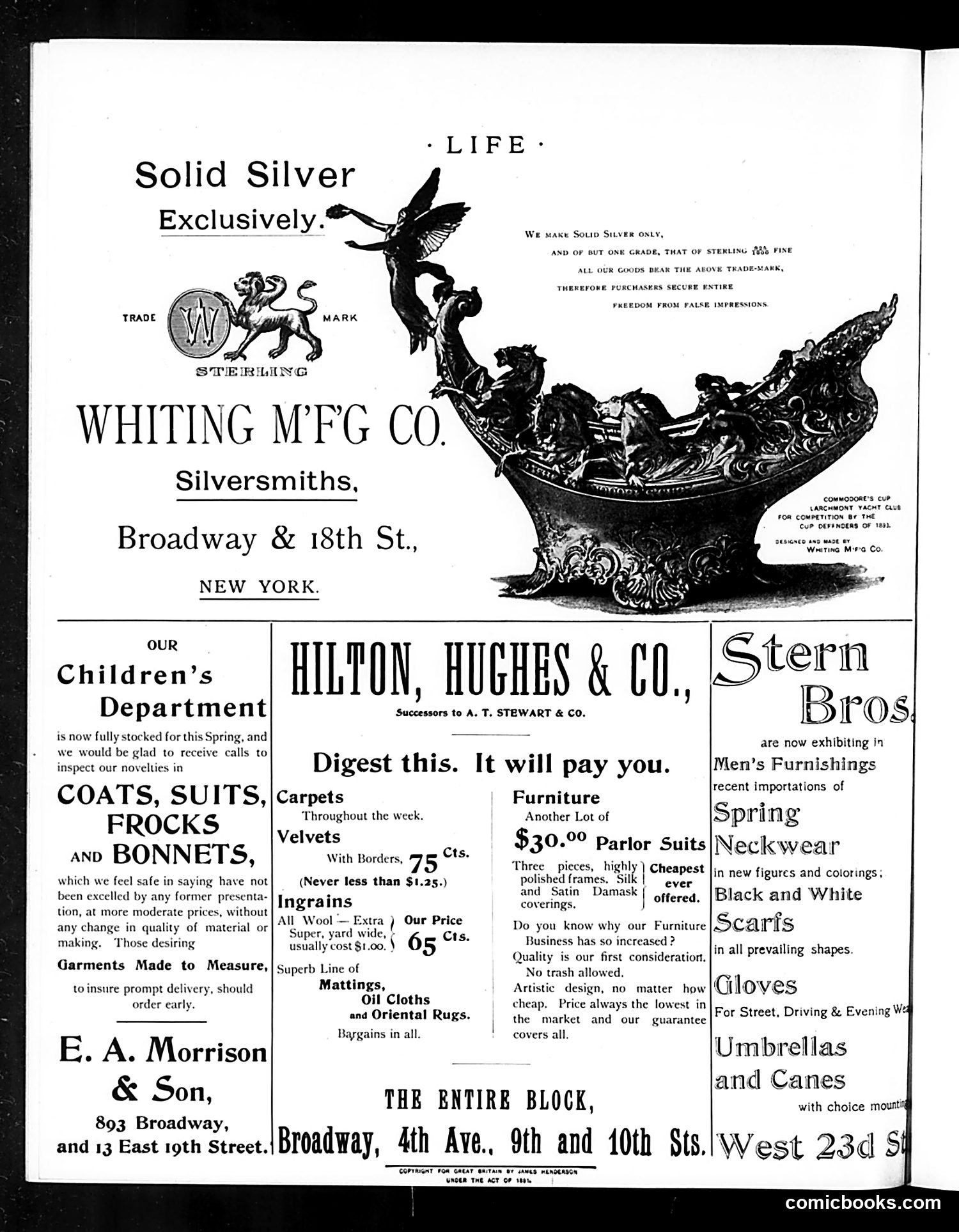
This page is primarily **advertising**, not satire or political commentary. It contains multiple commercial advertisements from late 19th-century New York retailers: - **Whiting Mfg Co.** advertises sterling silver goods, emphasizing quality with a decorative boat/vessel illustration - **Hilton, Hughes & Co.** promotes carpets, furniture, velvets, and other home goods - **E.A. Morrison & Son** advertises children's clothing and made-to-measure garments - **Stern Bros** showcases men's furnishings, neckwear, and accessories The only illustrative element—an ornate silver vessel with mythological figures—is a product advertisement, not political commentary. This is a commercial page from *Life* magazine's advertising section, with no discernible satire or social critique present.
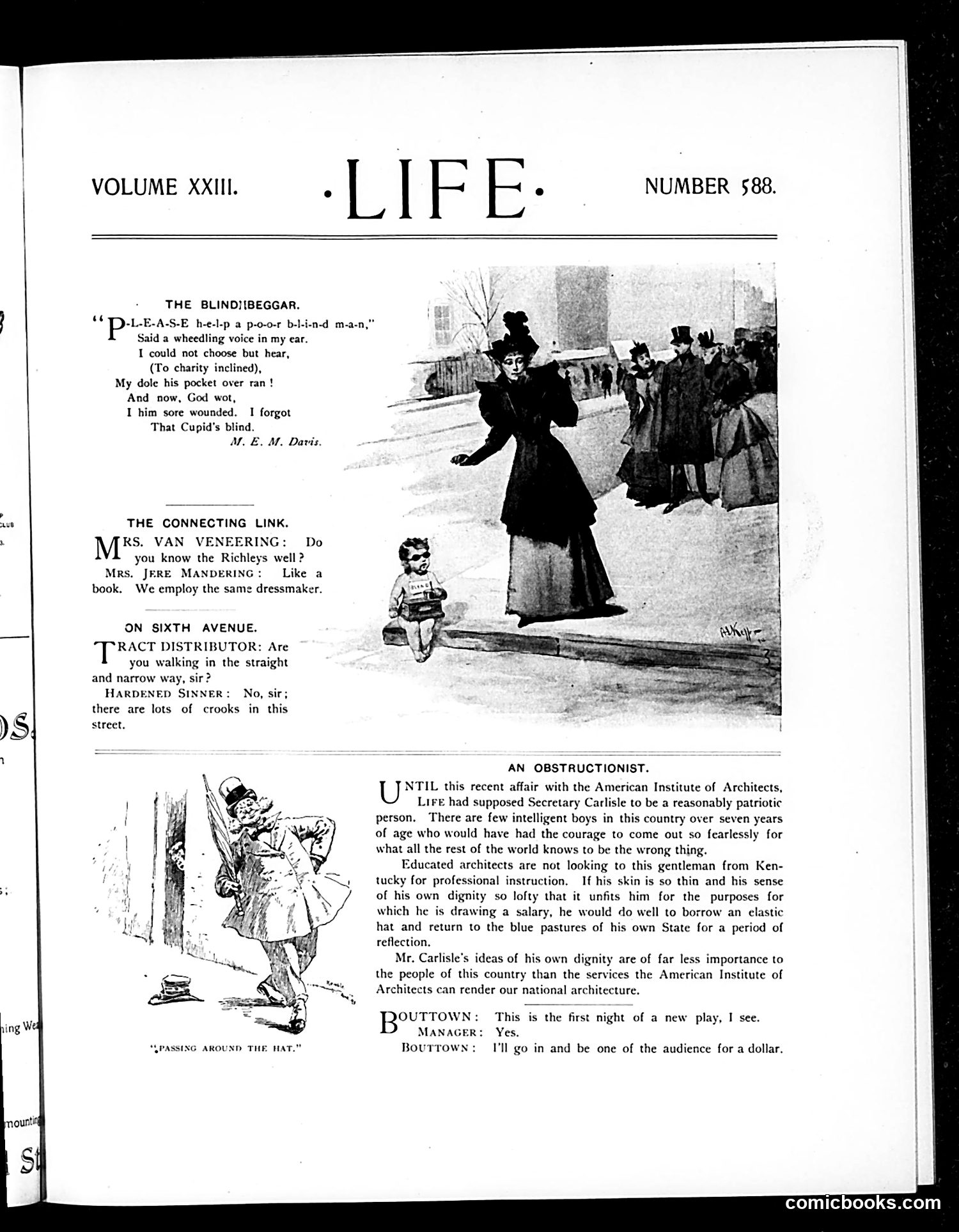
This page contains several short satirical pieces and illustrations typical of early 20th-century humor magazines. **"The Blind Beggar"** is a sentimental poem about charity toward a disabled person, with the ironic twist that the speaker forgot the beggar was blind. **"The Connecting Link"** jokes about two wealthy women (Mrs. Van Veneering and Mrs. Jerk Mandering) knowing each other through sharing a dressmaker—a gentle jab at upper-class social connections. **"On Sixth Avenue"** satirizes urban corruption, with a "Tract Distributor" asking if someone walks "the straight and narrow way," only to be told there are "lots of crooks in this street." **"An Obstructionist"** criticizes Secretary of State Carlisle for refusing to endorse the American Institute of Architects' position, suggesting his personal dignity matters more than national architectural advancement. The cartoons use humor to critique social pretension, urban vice, and political stubbornness.
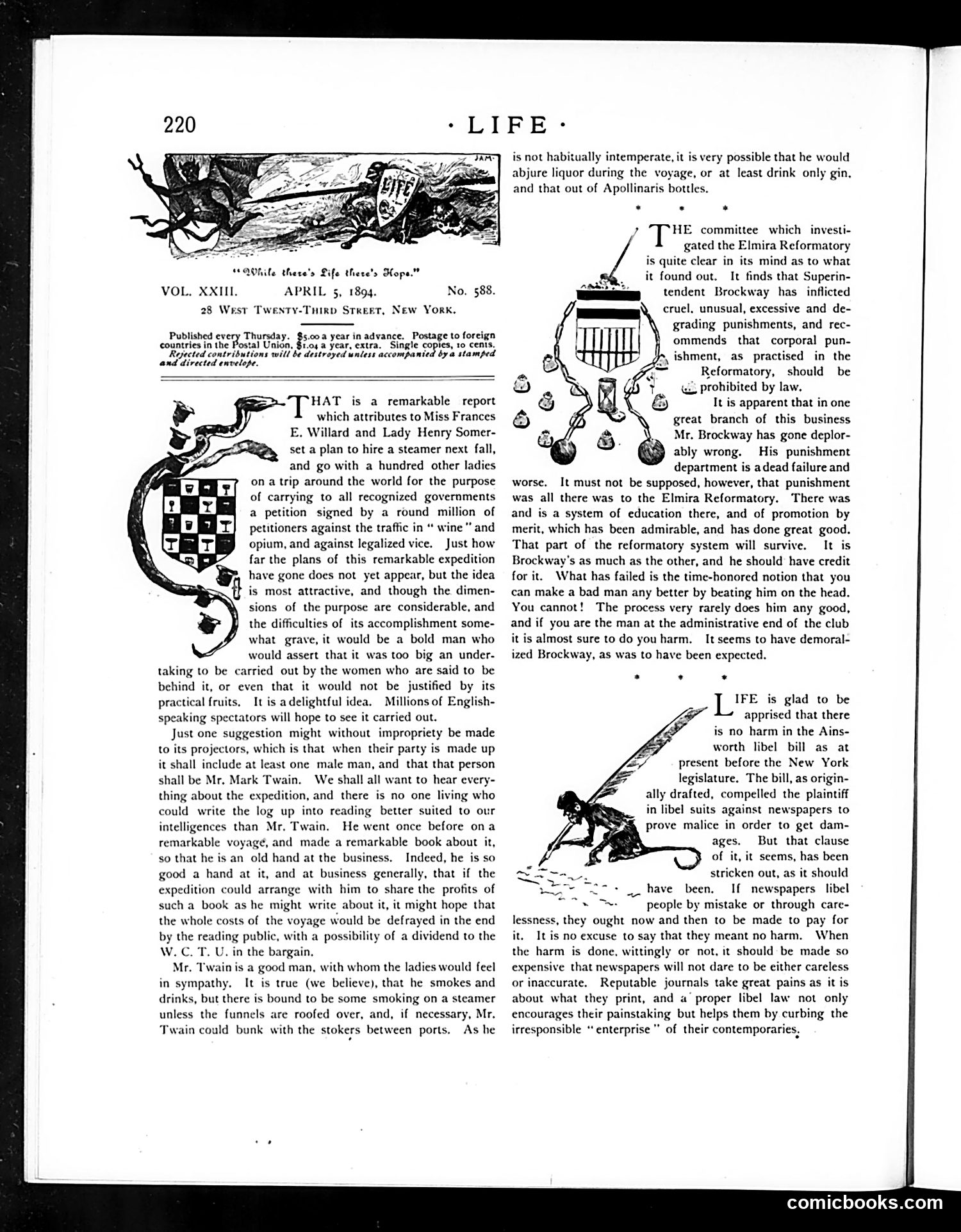
The page discusses a "remarkable report" about a proposed around-the-world voyage by Miss Frances E. Willard and Lady Henry Somerset to promote temperance (eliminating alcohol traffic). The text humorously suggests including Mark Twain as a male chronicler. The left cartoon depicts a coat of arms with a checkered shield—likely representing the temperance movement's respectability claims. The right cartoon shows a gallows with hanging nooses and spheres, a dark visual metaphor criticizing the Elmira Reformatory's harsh punishments under Superintendent Brockway. The text argues that while the reformatory's education system had merit, its brutal discipline (literally "beating him on the head") was counterproductive and should be legally prohibited. This page satirizes both temperance activism and prison reform debates of the 1890s.
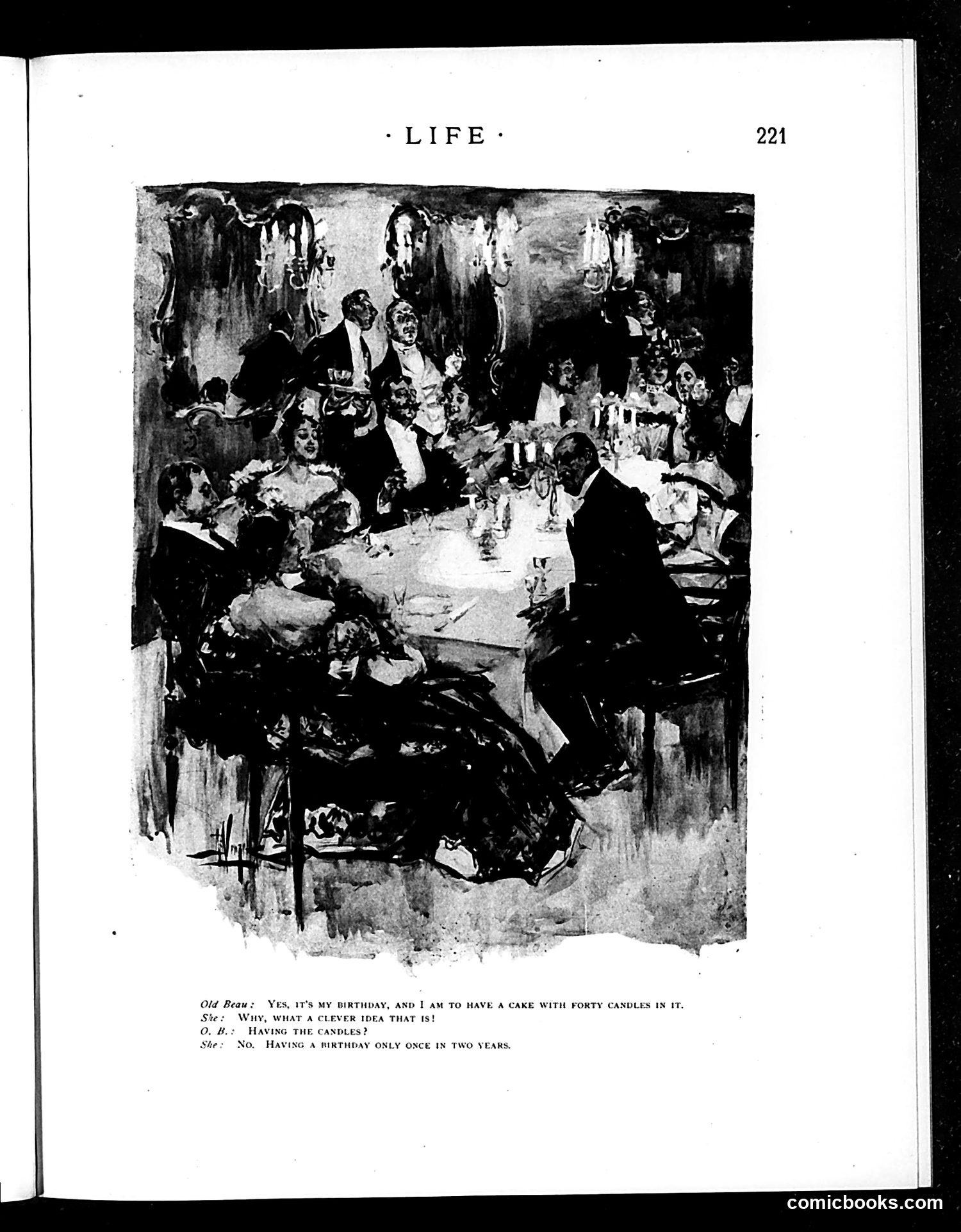
This is a single-panel cartoon depicting an elegant dinner party scene. The joke plays on the concept of aging and leap years. The caption shows an exchange where an "Old Bean" announces he's having a birthday cake with forty candles. When asked why so many candles, his female companion responds with surprise at the idea. The Old Bean clarifies: he's only having a birthday once every two years—a reference to leap years occurring every four years, with the implication he's advancing his age only half as frequently to appear younger. The satire targets vanity about aging among wealthy society figures, mocking the absurd logic people employ to minimize the passage of time. The formal dinner setting emphasizes this is about the upper classes' preoccupation with youthfulness and appearance.
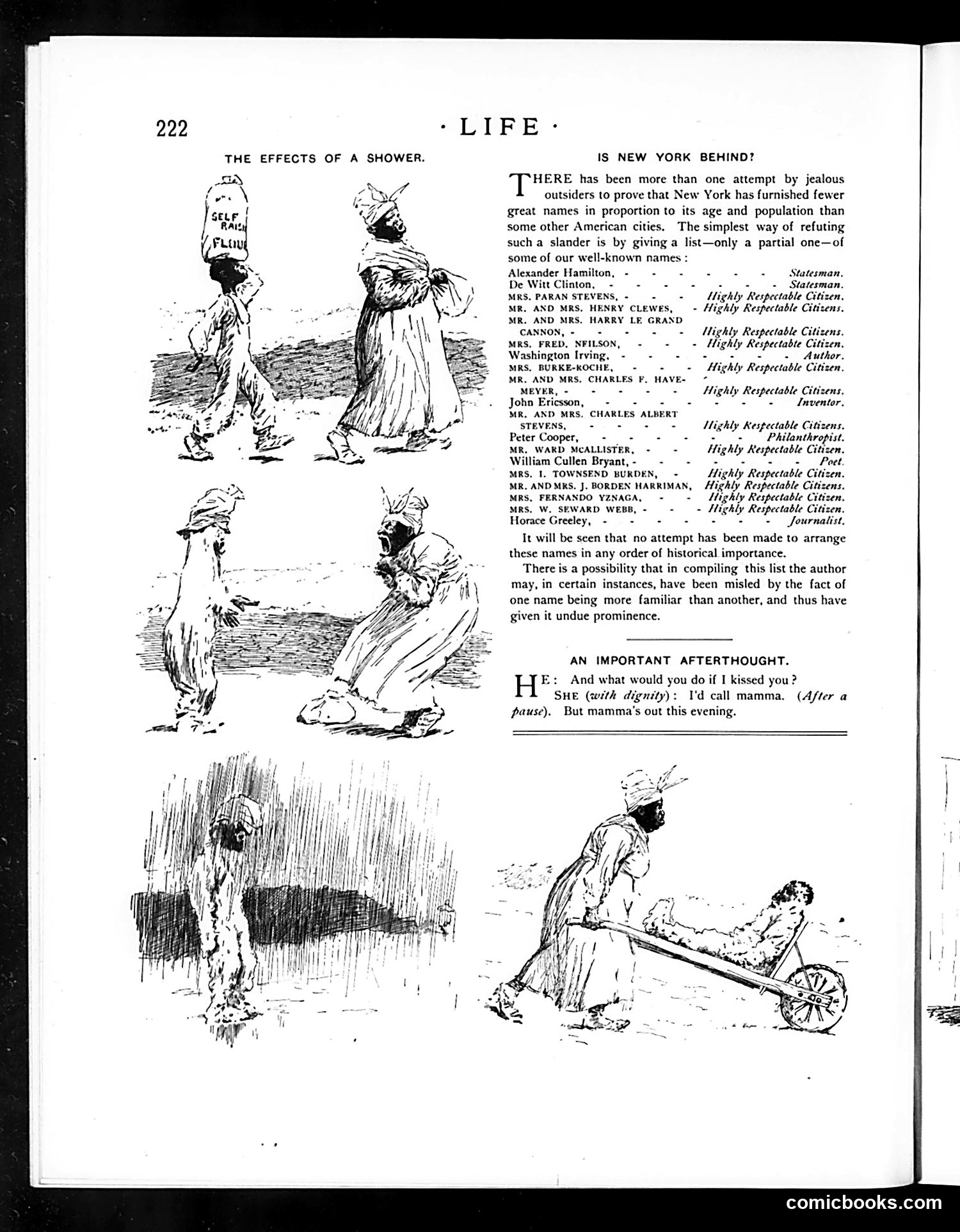
**"The Effects of a Shower"** (top left): Four comic panels show a person progressively transformed by rain—becoming increasingly bedraggled and disheveled, illustrating the humorous indignity of getting caught in a downpour. **"Is New York Behind?"** (right): This section defensively lists prominent names (Alexander Hamilton, Washington Irving, etc.) claiming New York produced many notable Americans, refuting "jealous outsiders" who allegedly argued other cities contributed more famous figures proportionally. The tone is satirical, mocking civic boosterism and competitive city pride. **"An Important Afterthought"** (bottom right): A brief humorous domestic exchange where a man asks what his wife would do if he kissed her; she threatens to tell his mother—a gentle joke about marital dynamics and maternal authority. The page exemplifies Life's mix of visual gags and social commentary.
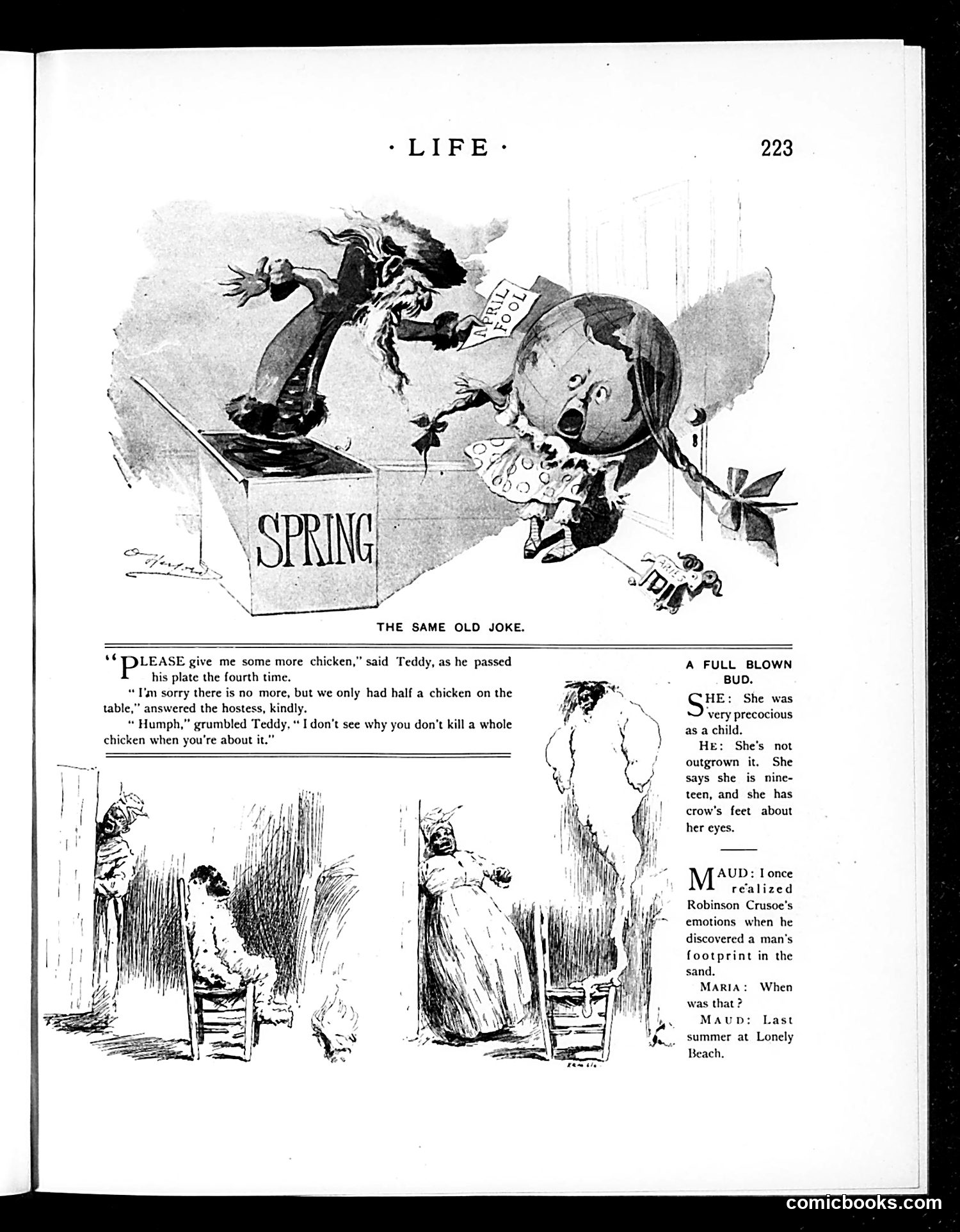
**Top Cartoon ("The Same Old Joke"):** Shows a jack-in-the-box labeled "SPRING" with a grotesque clown figure emerging. A child recoils in shock. This satirizes the repetitive nature of spring's arrival—treating the season's return as predictable and worn-out comedy. **Middle Section:** Features a dinner conversation where "Teddy" repeatedly asks for more chicken, claiming only half was served. The hostess responds he's received a whole chicken, sarcastically suggesting he kill an entire bird if dissatisfied. This appears to reference Theodore Roosevelt's known voracious appetite, using it as gentle social satire about excess. **Right Column ("A Full Blown Bud"):** Brief character sketches discussing a precocious girl with premature aging ("crow's feet"), and references to Robinson Crusoe's emotional discovery and "Lonely Beach"—context unclear from this excerpt alone.
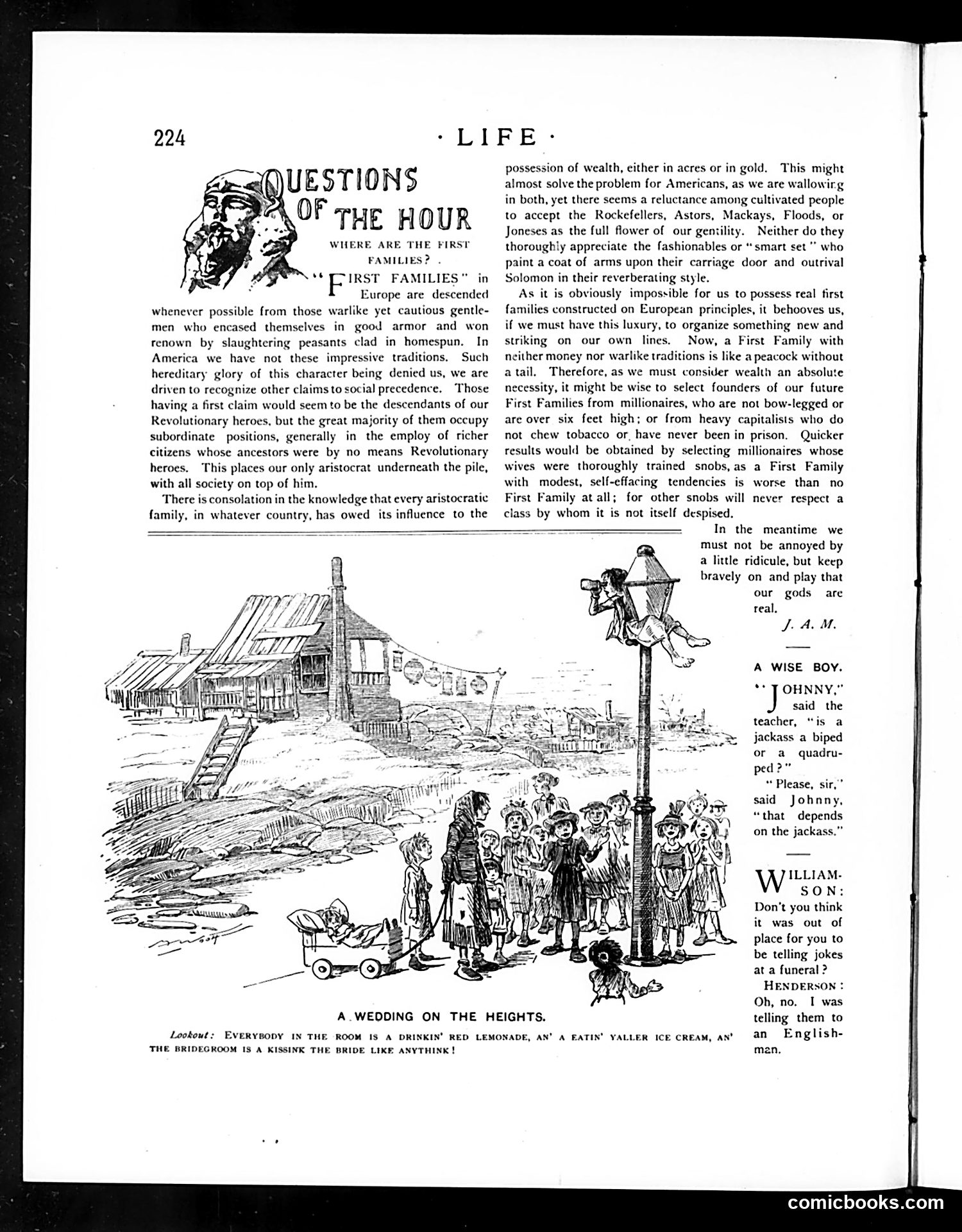
This satirical piece critiques American social pretension. The text argues against selecting future "First Families" based merely on wealth, advocating instead for those with established aristocratic pedigree and refined manners. The author mocks wealthy industrialists (appearing to reference the Rockefellers, Astors, and Vanderbilts) who lack the cultural sophistication of European nobility, despite their financial power. The lower illustration, "A Wedding on the Heights," depicts a working-class ceremony with crude humor about refreshments. The caption's "Englishman" joke suggests Americans' awkward attempts to imitate European sophistication. The overall satire targets the gap between American wealth and genuine social standing—money alone cannot buy class or respectability.
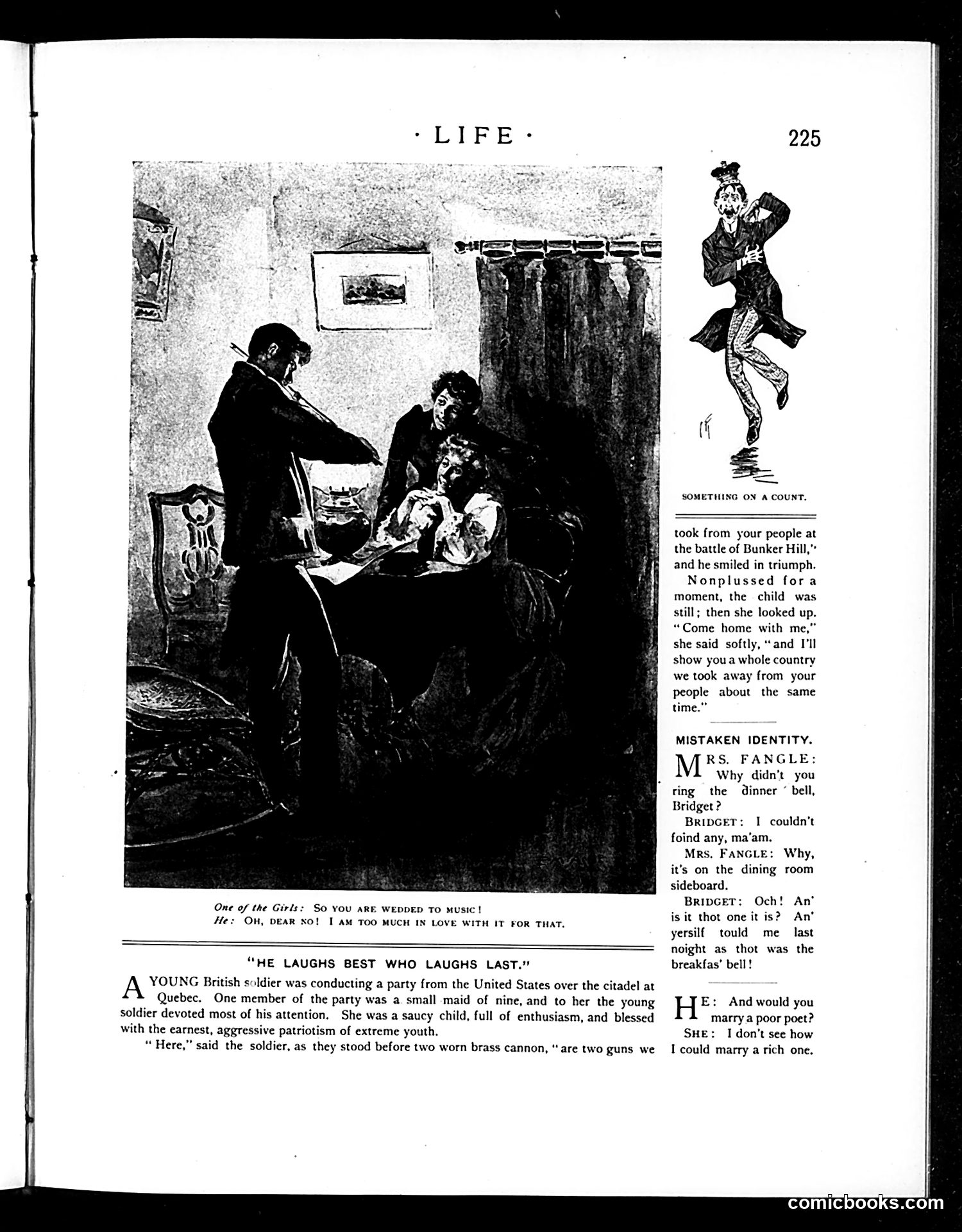
This page contains two distinct pieces of satirical content: **Main Illustration ("He Laughs Best Who Laughs Last"):** Depicts a British soldier during the Quebec campaign showing a maid a painting or sketch, with the caption suggesting she's "wedded to music." The soldier claims patriotic credit for territory taken from Americans, making a romantic advance. The satire appears to mock British military aggrandizement and seduction tactics during colonial conflicts. **Right Column Sections:** - "Something on a Count" shows a figure in theatrical dress (possibly mocking aristocratic pretension) - "Mistaken Identity" presents a domestic dialogue between Mrs. Fangle and Bridget about a missing dinner bell, satirizing household confusion The overall tone reflects early-to-mid 20th century American satirical humor targeting British imperialism, class pretension, and domestic absurdity.
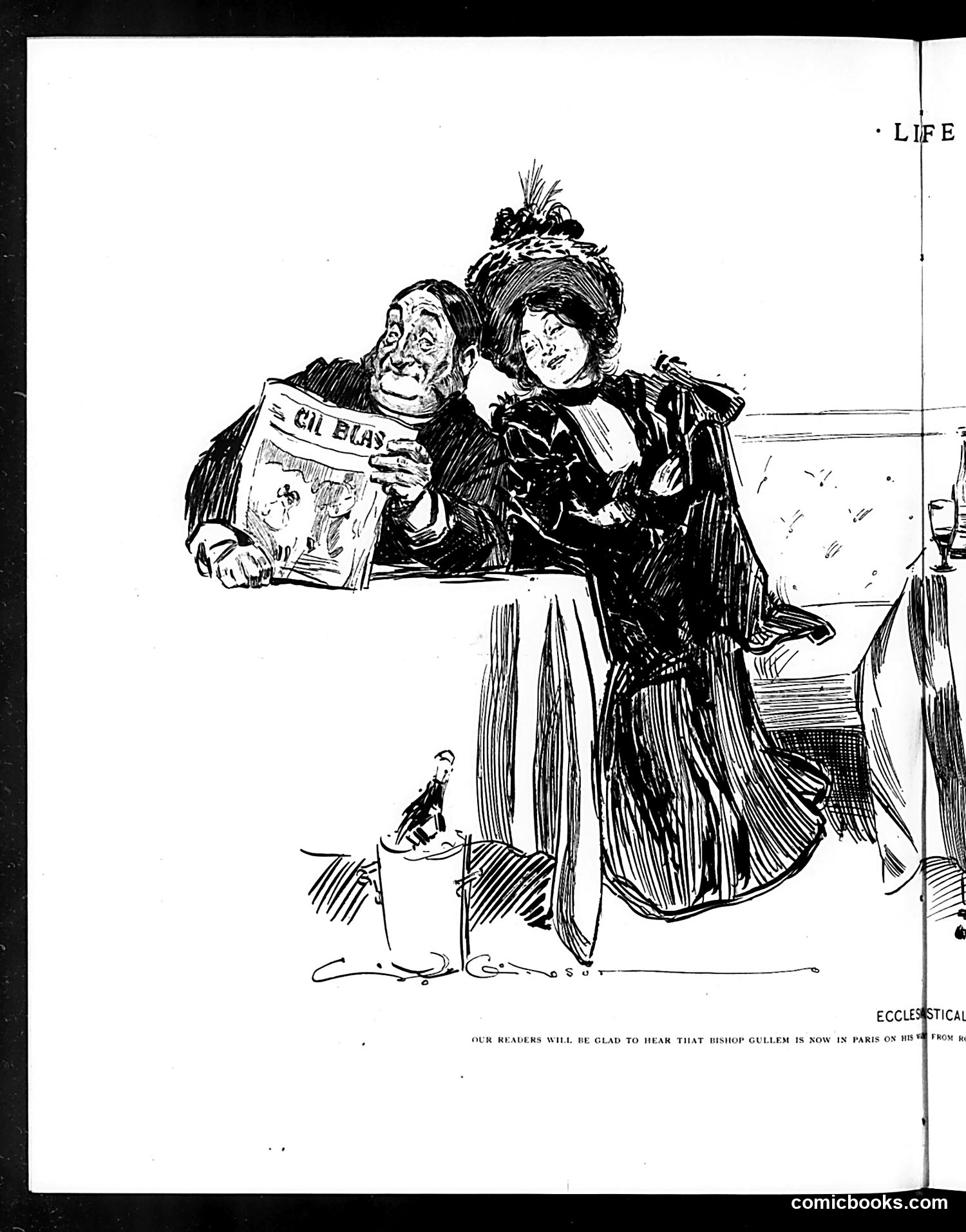
This Life magazine cartoon satirizes clerical hypocrisy regarding Bishop Guillem's presence in Paris. The illustration shows two figures—a poorly-dressed man reading a newspaper labeled "GIL BLAS" (a French publication) and an elaborately dressed woman with an ornate hat. A small figure emerges from a champagne bottle at their feet. The caption states readers will be "glad to hear that Bishop Guillem is now in Paris on his way from [text cut off]." The satire appears to mock the contradiction between ecclesiastical respectability and indulgent Paris society. The champagne bottle and luxurious woman's attire suggest worldly pleasures inconsistent with clerical virtue, while the ragged man's presence implies social commentary on inequality or hypocrisy within religious institutions.
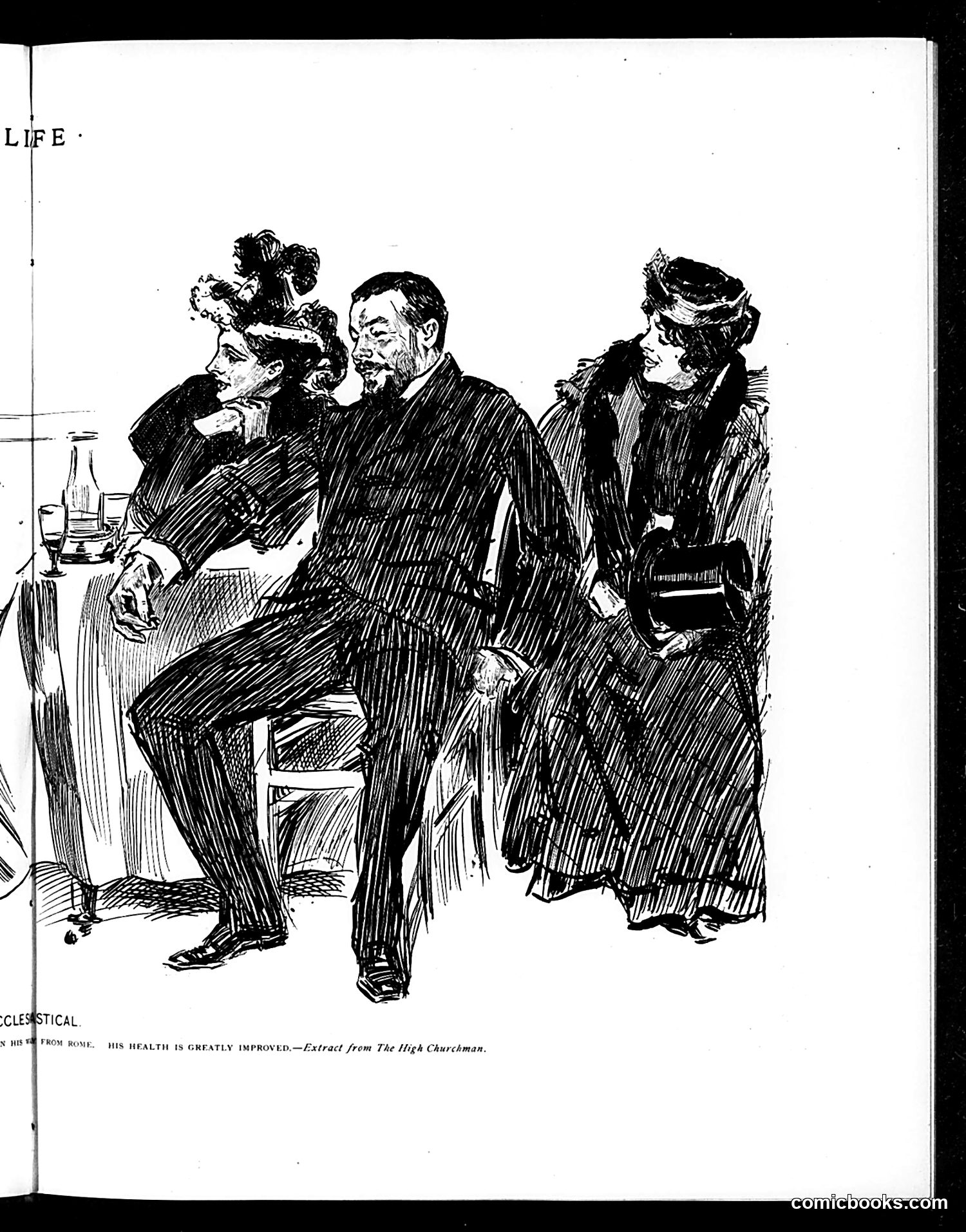
This is a satirical cartoon from *Life* magazine showing three figures in Victorian-era formal dress at what appears to be a social gathering, with drinks visible on a table. The caption references "Extract from The High Churchman" and mentions someone returning "from Rome" with greatly improved health. The satire appears to target **ecclesiastical hypocrisy**—specifically clergy or church figures whose trips abroad (particularly to Rome, the seat of Catholicism) are supposedly for health reasons but are implied to have other purposes. The cartoon mocks **religious duplicity**: the formal dress and social setting suggest respectability, while the caption's ironic tone suggests the actual motivations or activities are questionable. The "health improvement" claim appears to be a pretext for behavior the satirist considers unbecoming of churchmen. Without seeing the full publication context, the specific figures remain unclear, though they appear to represent clergy or high church officials.
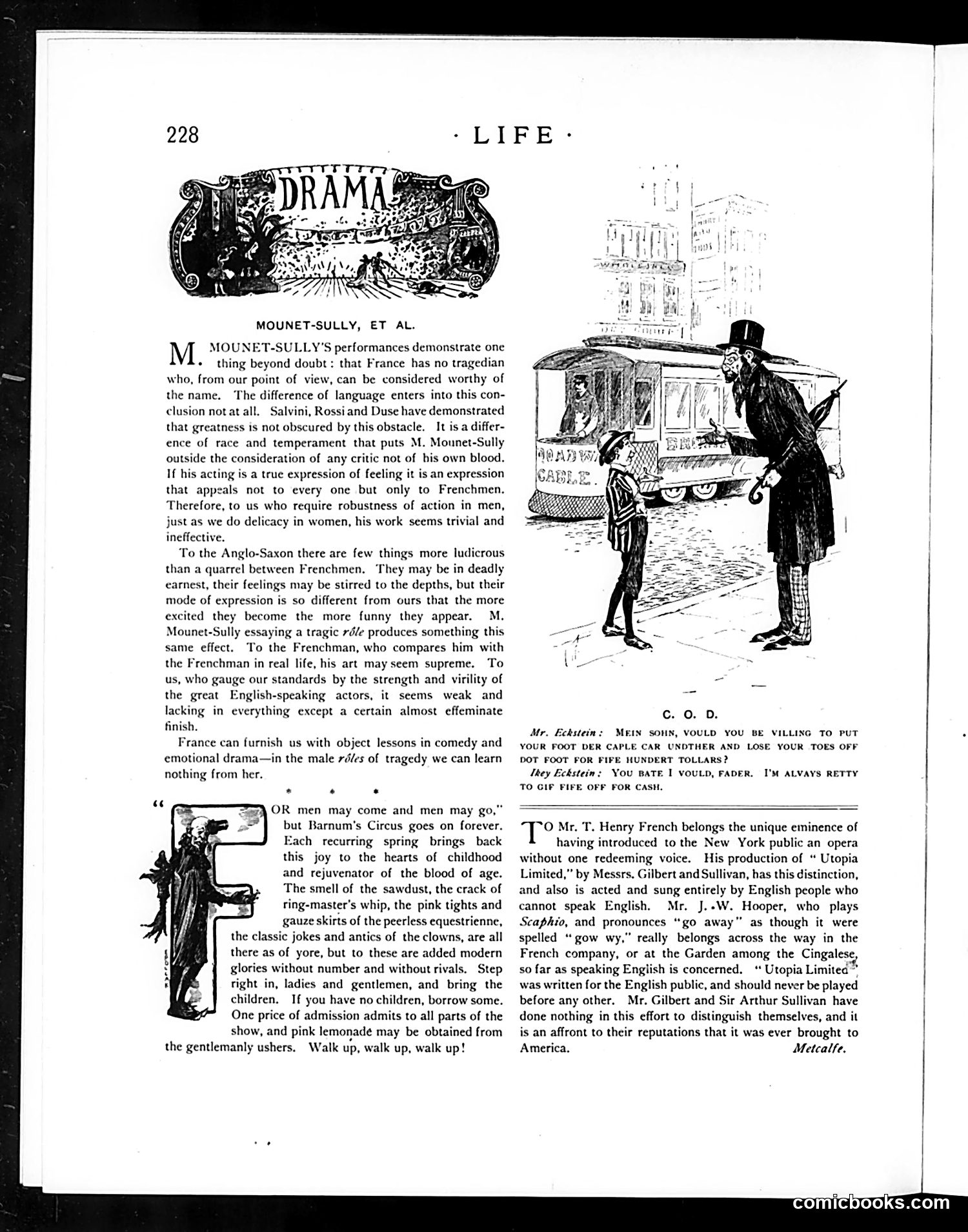
This page from *Life* magazine contains theatrical criticism and satire from the late 19th century. **Main Content:** The lead article critiques French actor Mounet-Sully, arguing that French tragedy lacks the "robustness" and "virility" of English-speaking actors. The critic dismisses French emotional expression as effeminate and claims Anglo-Saxons find French quarrels laughable. This reflects contemporary Anglo-American cultural superiority attitudes. **The Cartoon (C.O.D.):** Shows a German immigrant (indicated by the dialect spelling "MEIN SOMN," "VOULD," "FADER") negotiating with another man about inserting his foot under a cable car for $500. This satirizes immigrant desperation and willingness to risk bodily harm for money—a common *Life* theme mocking both immigrant poverty and dangerous urban conditions. **Lower Section:** Attacks T. Henry French's production of Gilbert & Sullivan's *Utopia Limited*, claiming English-speaking actors who cannot actually speak English properly are unfit to perform English comic opera—a meta-joke about casting incompetence.
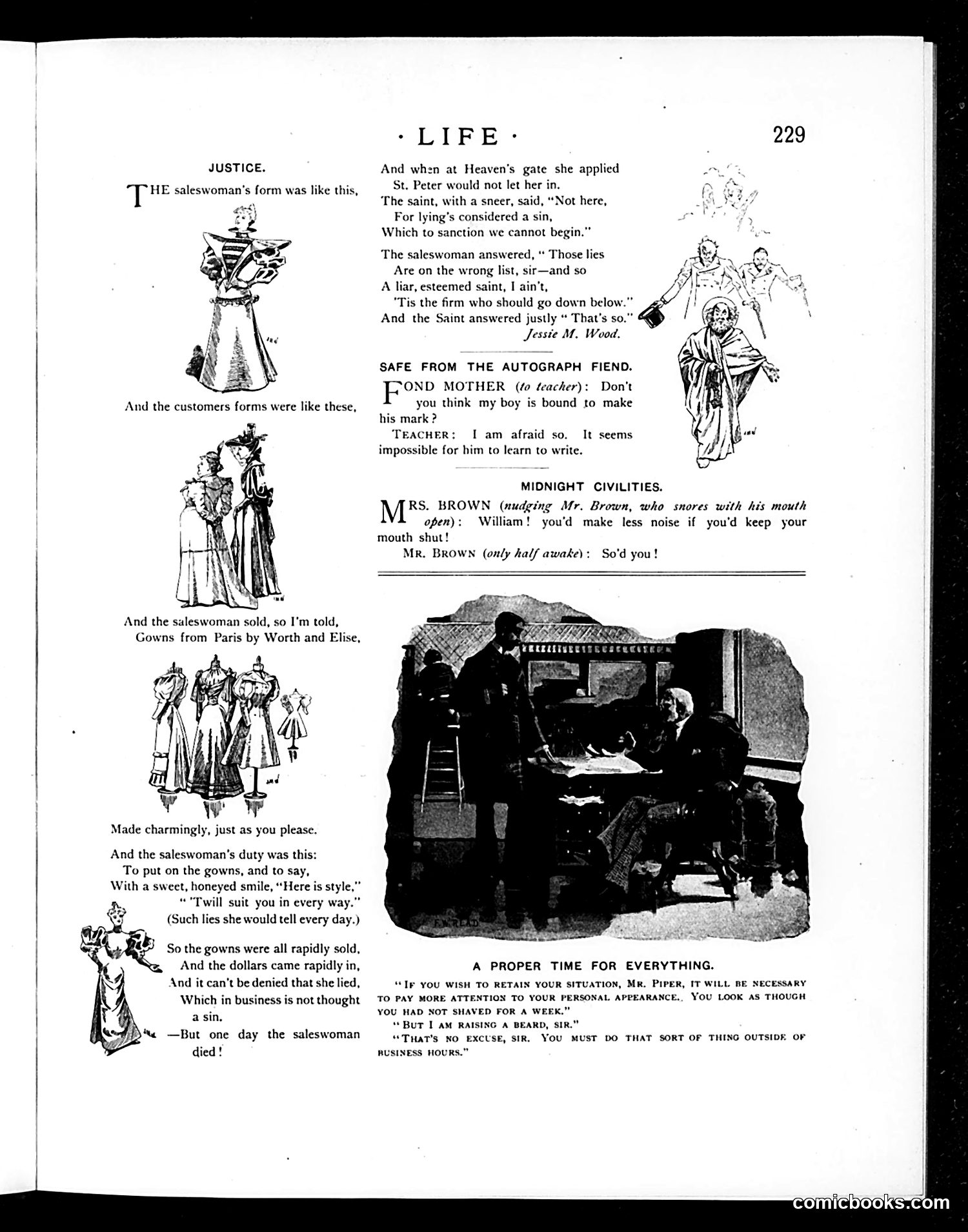
This page contains several humorous sketches lampooning workplace and domestic hypocrisy: **"Justice"** (by Jessie M. Wood) satirizes business dishonesty. A saleswoman who lies constantly about gowns from Paris dies and faces St. Peter, who initially rejects her for lying. She argues her lies are "on the wrong list"—implying the *firm's* deception is the real sin, not her sales pitch. The joke suggests lying is so normalized in commerce that individual salespeople aren't even culpable. **"Safe from the Autograph Fiend"** mocks a teacher's low expectations—the mother hopes her boy will "make his mark," but the teacher fears he can't even learn to write. **"Midnight Civilities"** presents a married couple's petty argument: Mrs. Brown complains about Mr. Brown snoring with his mouth open; his groggy response—"So'd you!"—implies she also snores. **"A Proper Time for Everything"** shows an employer scolding an employee about his unkempt appearance, insisting grooming occur "outside business hours"—absurdly rigid workplace authority.
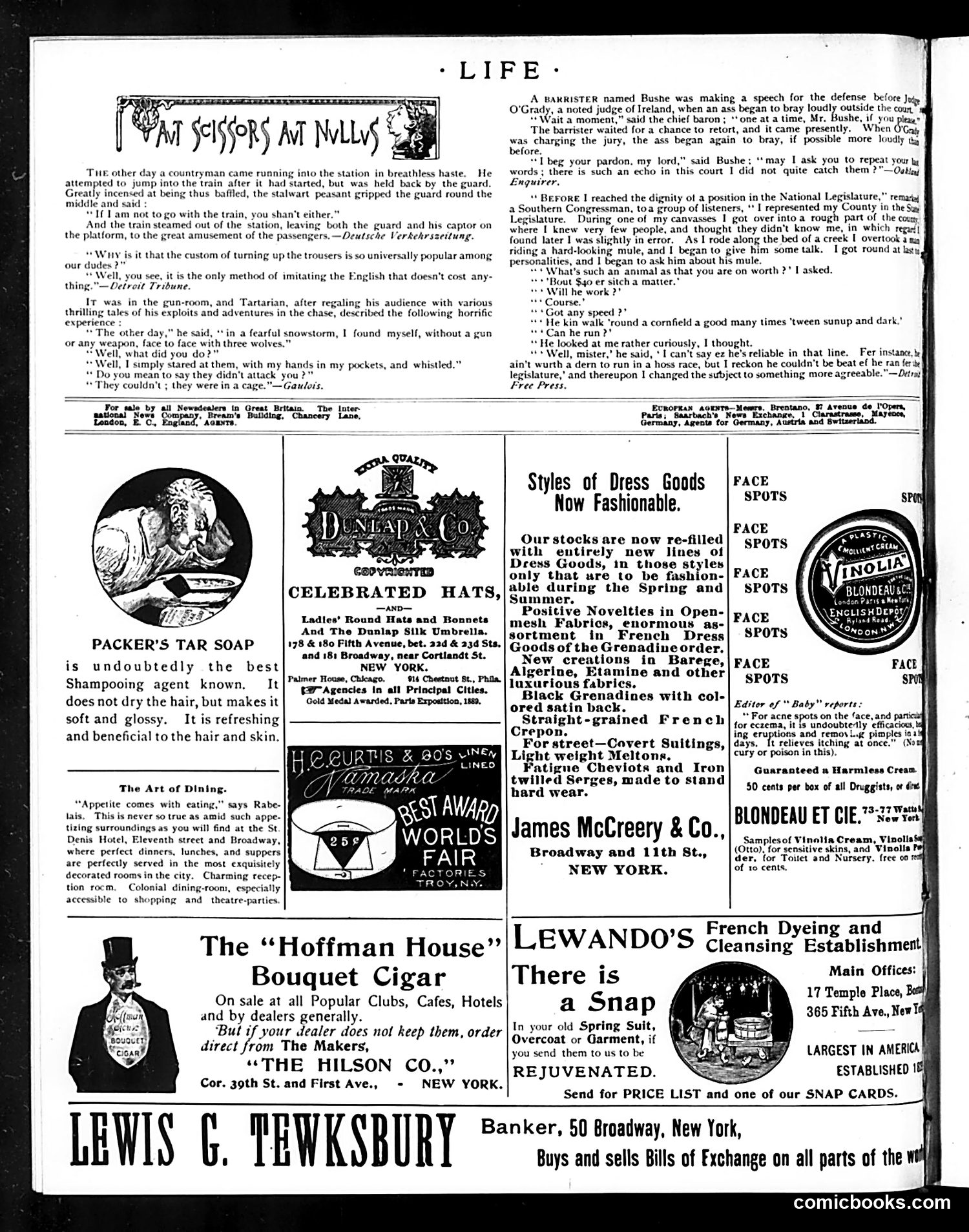
This is primarily an **advertising page** from Life magazine featuring several brief humorous anecdotes in the upper portion, followed by commercial advertisements. The jokes rely on **courtroom wit and rural/dialectical humor** typical of the era. One anecdote mocks Irish legal proceedings through a pun about an ass braying during court. Another depicts a peasant's literal-minded stubbornness. A third features a politician's embarrassment when a backwoods farmer unknowingly insults him by comparing him to a worthless mule—the humor lies in the farmer's innocent bluntness revealing truth the politician wanted hidden. These rely on **class-based comedy**: educated speakers encounter common folk whose straightforward speech exposes pretension or creates unintentional insults. The advertisements below sell grooming products (soap), cigars, hats, and services—typical turn-of-century American commerce targeting middle-class consumers. The page reflects **pre-modern humor sensibilities** emphasizing wordplay, social hierarchy, and rustic vernacular that modern audiences would find quaint or dated.