
Life, 1894-04-05 · page 12 of 14
Life — April 5, 1894 — page 12: what you’re looking at
What you’re looking at
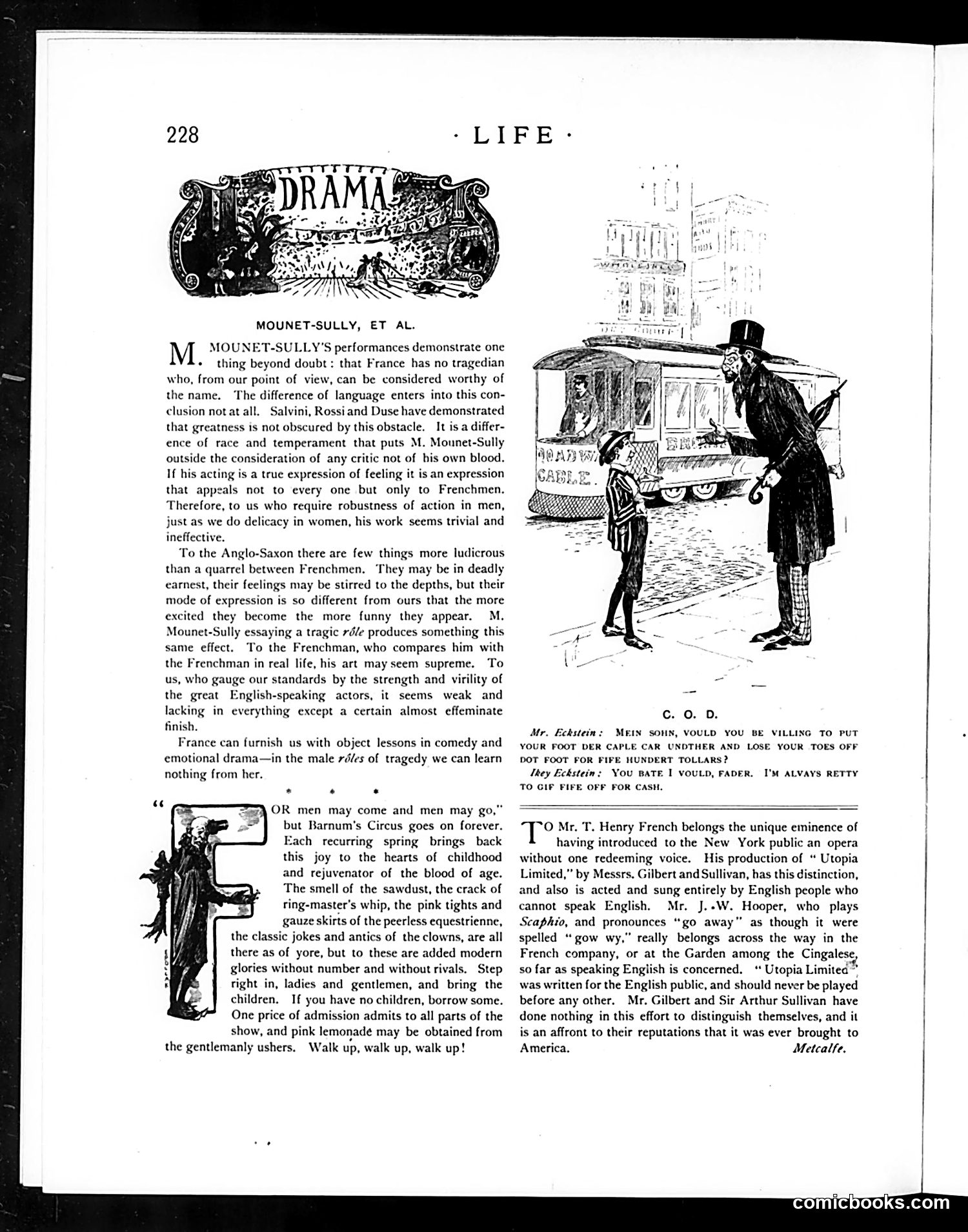
This page from *Life* magazine contains theatrical criticism and satire from the late 19th century. **Main Content:** The lead article critiques French actor Mounet-Sully, arguing that French tragedy lacks the "robustness" and "virility" of English-speaking actors. The critic dismisses French emotional expression as effeminate and claims Anglo-Saxons find French quarrels laughable. This reflects contemporary Anglo-American cultural superiority attitudes. **The Cartoon (C.O.D.):** Shows a German immigrant (indicated by the dialect spelling "MEIN SOMN," "VOULD," "FADER") negotiating with another man about inserting his foot under a cable car for $500. This satirizes immigrant desperation and willingness to risk bodily harm for money—a common *Life* theme mocking both immigrant poverty and dangerous urban conditions. **Lower Section:** Attacks T. Henry French's production of Gilbert & Sullivan's *Utopia Limited*, claiming English-speaking actors who cannot actually speak English properly are unfit to perform English comic opera—a meta-joke about casting incompetence.
📄 Transcribed text from this page (OCR, searchable)
Machine-transcribed from the original scan — historical spelling and the odd misread are preserved.
MOUNET-SULLY, ET AL. M MOUNET-SULLY'S performances demonstrate one + thing beyond doubt: that France has no tragedian who, from our point of view, can be considered worthy of the name. ‘The difference of language enters into this con- clusion notat all, Salvini, Rossiand Duse have demonstrated that greatness is not obscured by this obstacle. It is a differ- ence of race and temperament that puts M. Mounet-Sully outside the consideration of any critic not of his own blood. If his acting is a true expression of feeling it is an expression that appeals not to every one but only to Frenchmen. Therefore, to us who require robustness of action in men, just as we do delicacy in women, his work seems trivial and ineffective. To the Anglo-Saxon there are few things more ludicrous than a quarrel between Frenchmen. ‘They may be in deadly earnest, their feelings may be stirred to the depths, but their mode of expression is so different from ours that the more excited they become the more funny they appear. M. Mounet-Sully essaying a tragic ré/e produces something this same effect. To the Frenchman, who compares him with the Frenchman in real life, his art may seem supreme. To us, who gauge our standards by the strength and virility of the great English-speaking actors, it seems weak and lacking in everything except a certain almost effeminate finish. France can furnish us with object lessons in comedy and emotional drama—in the male ré/es of tragedy we can learn nothing from her. * . . OR men may come and men may go,” but Barnum’s Circus goes on forever. Each recurring spring brings back this joy to the hearts of childhood and rejuvenator of the blood of age. The smell of the sawdust, the crack of ring-master’s whip, the pink tights and gauze skirts of the peerless equestrienne, the classic jokes and antics of the clowns, are all there as of yore, but to these are added modern glories without number and without rivals. Step right in, ladies and gentlemen, and bring the children, If you have no children, borrow some. One price of admission admits to all parts of the show, and pink lemonade may be obtained from the gentlemanly ushers. Walk up, walk up, walk up! c. 0. D. Mr, Eckstein: MEIN SOMN, VOULD YOU BE VILLING TO PUT YOUR FOOT DER CAPLE CAR UNDTHER AND LOSE YOUR TOES OFF DOT FOOT FOR FIFE HUNDERT TOLLARS? Shey Eckstein: You Bate 1 VOULD, FADER. I'M ALVAYS RETTY TO GIF FIFE OFF FOR CASH. T° Mr. T. Henry French belongs the unique eminence of having introduced to the New York public an opera without one redeeming voice. His production of “ Utopia Limited,” by Messrs. Gilbert and Sullivan, has this distinction, and also is acted and sung entirely by English people who cannot speak English. Mr. J.-W. Hooper, who plays Scaphio, and pronounces “go away” as though it were spelled “gow wy,” really belongs across the way in the French company, or at the Garden among the Cingalese, so far as speaking English is concerned. “ Utopia Limitea” was written for the English public, and should never be played before any other. Mr. Gilbert and Sir Arthur Sullivan have done nothing in this effort to distinguish themselves, and it is an affront to their reputations that it was ever brought to America. Metcalfe. comicbooks.com