
Life, 1894-04-05 · page 4 of 14
Life — April 5, 1894 — page 4: what you’re looking at
What you’re looking at
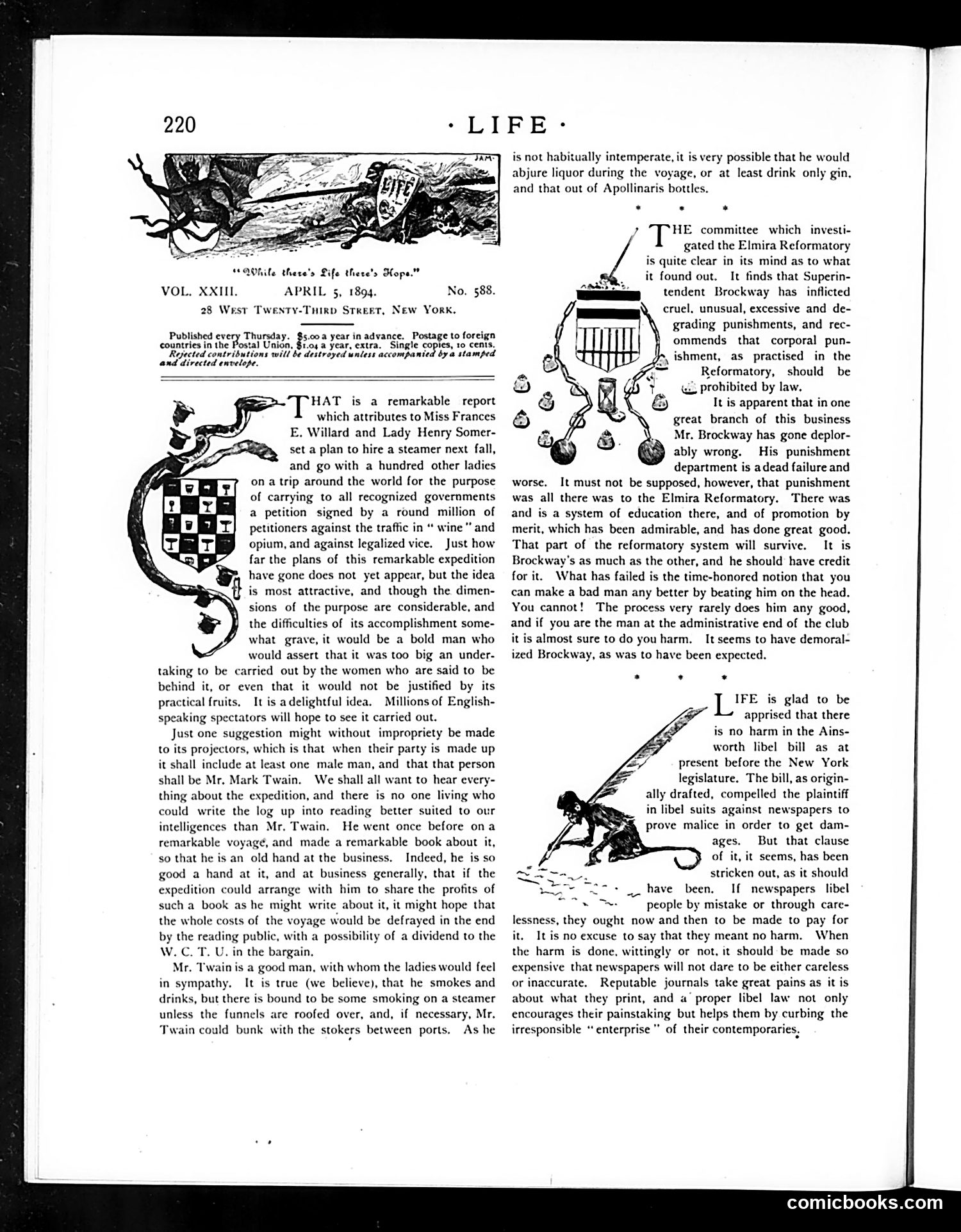
The page discusses a "remarkable report" about a proposed around-the-world voyage by Miss Frances E. Willard and Lady Henry Somerset to promote temperance (eliminating alcohol traffic). The text humorously suggests including Mark Twain as a male chronicler. The left cartoon depicts a coat of arms with a checkered shield—likely representing the temperance movement's respectability claims. The right cartoon shows a gallows with hanging nooses and spheres, a dark visual metaphor criticizing the Elmira Reformatory's harsh punishments under Superintendent Brockway. The text argues that while the reformatory's education system had merit, its brutal discipline (literally "beating him on the head") was counterproductive and should be legally prohibited. This page satirizes both temperance activism and prison reform debates of the 1890s.
📄 Transcribed text from this page (OCR, searchable)
Machine-transcribed from the original scan — historical spelling and the odd misread are preserved.
‘LIFE: QWhile there's Life there's Hope.” VOL. XXIII. APRIL 5, 1894. No. 588. 28 West Twenty-Tuirp Street, New York, Published every Thursday. fea year in advance. Postage to foreign countries in the Postal Union, $1.04 a year, extra. Single copies, to cents. Rejected contributions will be destroyed unless accompanied bya stamped and directed envelope. = HAT is a remarkable report which attributes to Miss Frances E. Willard and Lady Henry Somer- set a plan to hire a steamer next fall, and go with a hundred other ladies on a trip around the world for the purpose of carrying to all recognized governments a petition signed by a round million of petitioners against the traffic in “ wine" and opium, and against legalized vice. Just how far the plans of this remarkable expedition have gone does not yet appear, but the idea most attractive, and though the dimen- sions of the purpose are considerable, and the difficulties of its accomplishment some- what grave, it would be a bold man who would assert that it was too big an under- taking to be carried out by the women who are said to be behind it, or even that it would not be justified by its practical fruits, It is adelightful idea. Millions of English- speaking spectators will hope to see it carried out. Just one suggestion might without impropriety be made to its projectors, which is that when their party is made up it shall include at least one male man, and that that person shall be Mr. Mark Twain. We shall all want to hear every- thing about the expedition, and there is no one living who could write the log up into reading better suited to our intelligences than Mr. Twai He went once before ona remarkable voyagé, and made a remarkable book about it, so that he is an old hand at the business. Indeed, he is so good a hand at it, and at business generally, that if the expedition could arrange with him to share the profits of such a book as he might write about it, it might hope that the whole costs of the voyage would be defrayed in the end by the reading public, with a possibility of a dividend to the U. in the bargain, in is a good man, with whom the ladies would feel It is true (we believe), that he smokes and Mr. Tw. in sympathy, inks, but there is bound to be some smoking on a steamer the funnels are roofed over, and, if necessary, Mr. Twain could bunk with the stokers between ports. As he is not habitually intemperate, it is very possible that he would abjure liquor during the voyage, or at least drink only gin, and that out of Apollinaris bottles. , HE committee which investi- gated the Elmira Reformatory is quite clear in its mind as to what it found out. It finds that Superin- tendent Brockway has inflicted cruel, unusual, excessive and de- grading punishments, and rec- ommends that corporal pun- yr, ishment, as practised in the Reformatory, should be ts prohibited by law. It is apparent that in one great branch of this business Mr. Brockway has gone deplor- ably wrong. His punishment department is adead failure and worse. It must not be supposed, however, that punishment was all there was to the Elmira Reformatory. There was and is a system of education there, and of promotion by merit, which has been admirable, and has done great good. That part of the reformatory system will survive. It is Brockway’s as much as the other, and he should have credit for it. What has failed is the time-honored notion that you can make a bad man any better by beating him on the head. You cannot! The process very rarely does him any good, and if you are the man at the administrative end of the club it is almost sure to do you harm, It seems to have demoral- ized Brockway, as was to have been expected. . . . IFE is glad to be apprised that there is no harm in the Ains- worth libel bill as at present before the New York legislature. The bill, as origin- ally drafted, compelled the plaintiff in libel suits against newspapers to prove malice in order to get dam- ages. But that clause of it, it seems, has been stricken out, as it should + have been, If newspapers libel people by mistake or through care- lessness, they ought now and then to be made to pay for it. It is no excuse to say that they meant no harm. When the harm is done, wittingly or not, it should be made so expen that newspapers will not dare to be either careless or inaccurate. Reputable journals take great pains as it is about what they print, and a proper libel law not only encourages their painstaking but helps them by curbing the irresponsible “ enterprise ” of their contemporaries, comicbooks.com