
A complete issue · 16 pages · 1894
Life — March 1, 1894
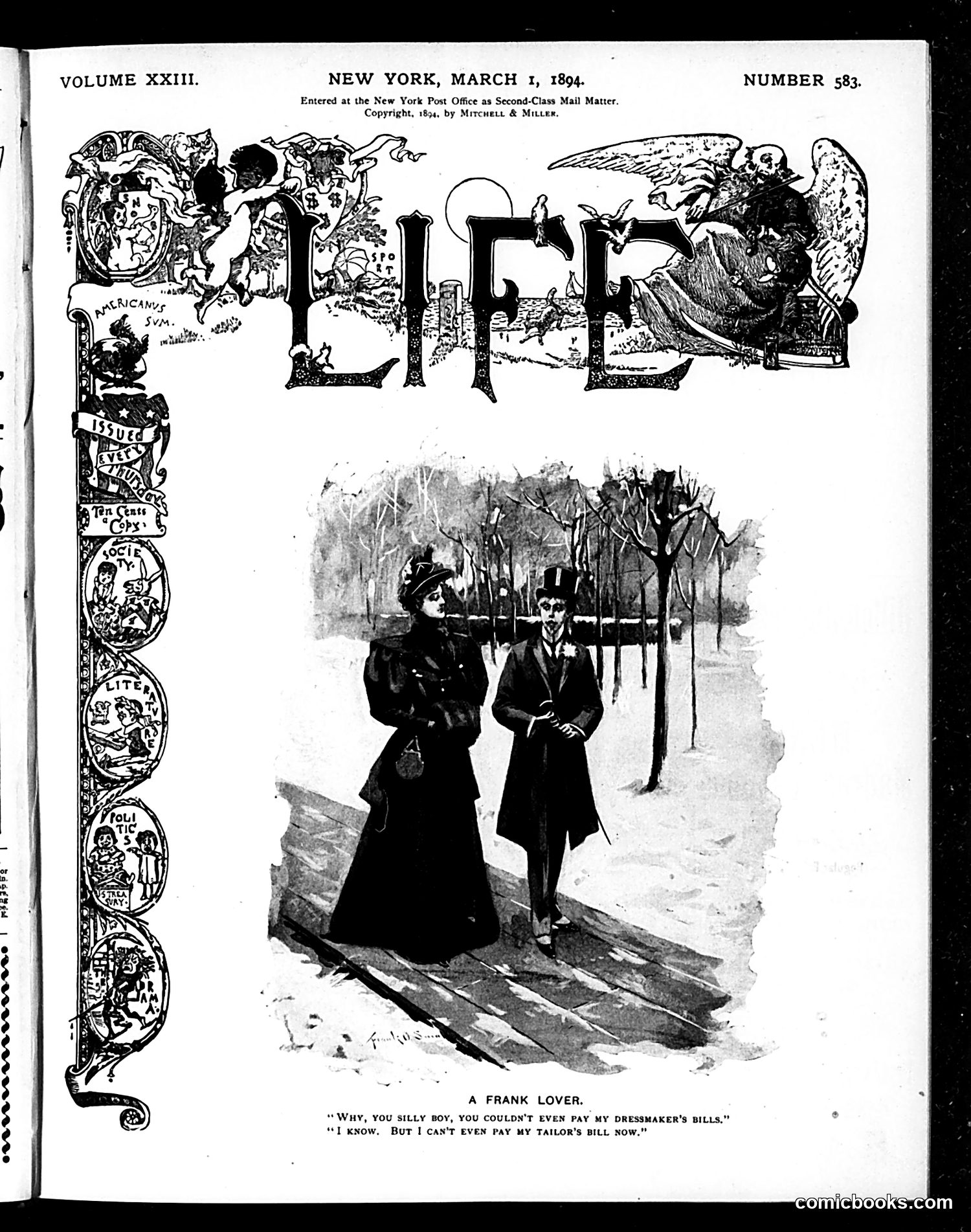
This cartoon satirizes a young man's romantic financial irresponsibility. Two figures stand in a snowy winter landscape—a woman in elegant winter dress and a young man in a suit. The caption reads: "Why, you silly boy, you couldn't even pay my dressmaker's bills. I know. But I can't ever pay my tailor's bill now." The joke targets the common social practice where wealthy young women expected suitors to finance their expensive wardrobes as tokens of romantic devotion. The man's response—admitting he's already financially ruined by his own tailor—suggests he's so smitten that he's bankrupted himself trying to impress her, yet still foolishly pursues the relationship despite economic impossibility. It's satire of turn-of-the-century courtship excess and male financial recklessness driven by romance.
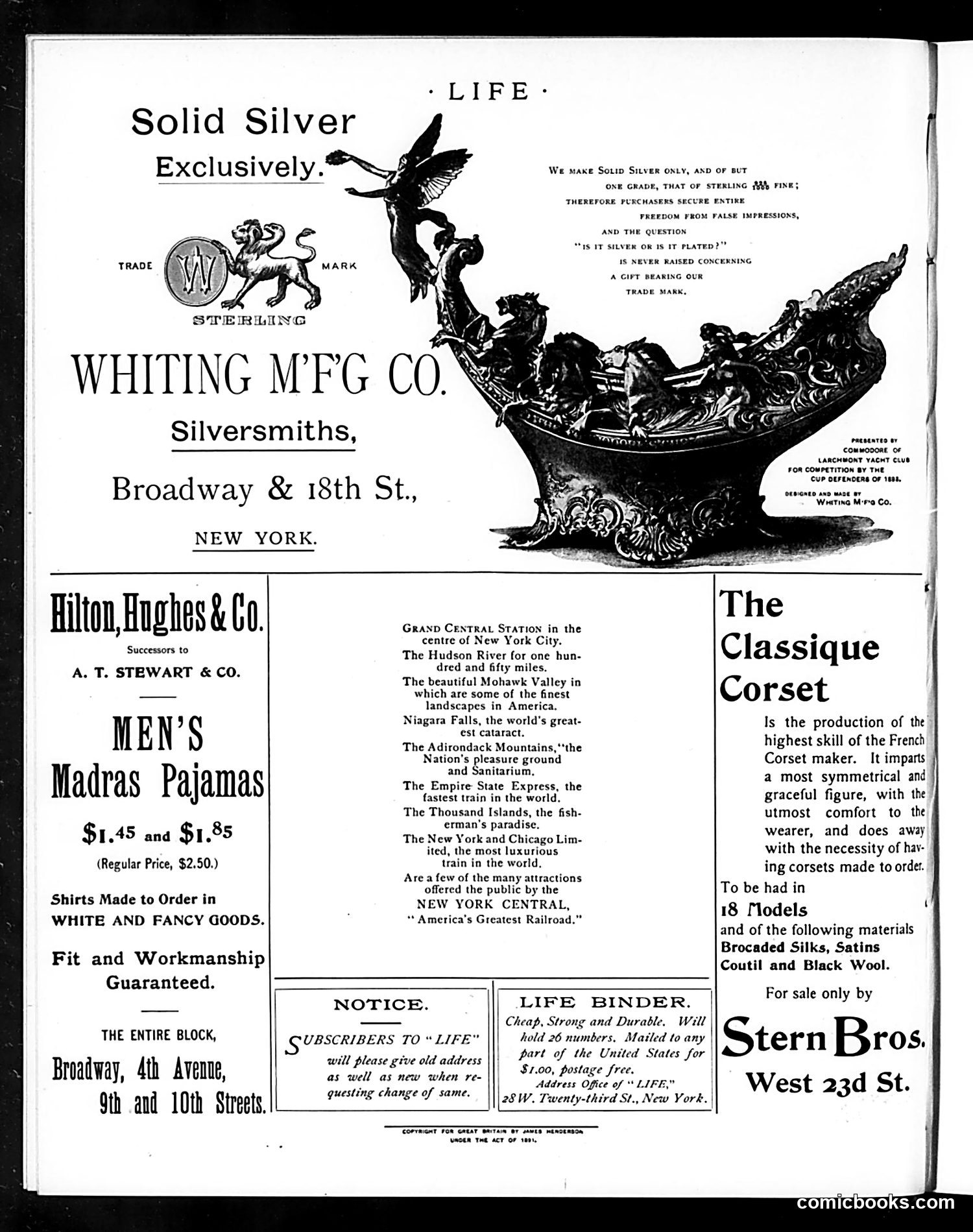
This page is **primarily advertising** with no political cartoon or satirical content. The dominant advertisement is for **Whiting Manufacturing Company**, a New York silversmith at Broadway & 18th Street. They emphasize "Solid Silver Exclusively" and display an ornate silver punch bowl or serving vessel as their product showcase. The elaborate mythological imagery (cherubs, winged figures) reflects late 19th/early 20th-century luxury goods marketing. Additional ads include men's pajamas, corsets, and a Life magazine subscription offer—typical period merchandise. The small text block describes New York attractions (Niagara Falls, the Adirondacks, Grand Central Station), suggesting this may accompany travel-related editorial content. There is **no discernible satire or political messaging** on this particular page.
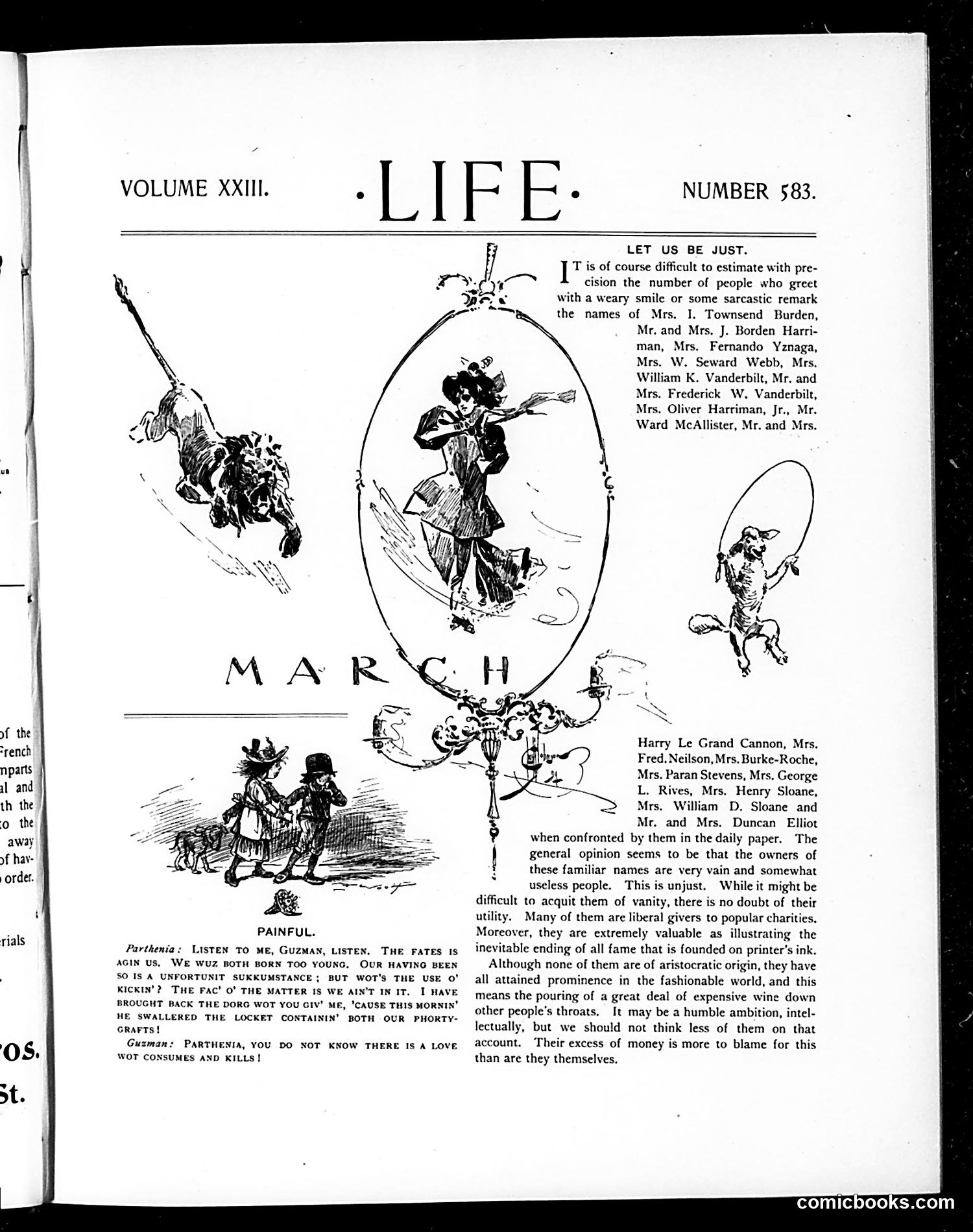
This page satirizes wealthy philanthropists and socialites who donate to charities while living extravagantly. The central illustration depicts a fashionable woman, likely representing the type of donor criticized in the accompanying text. The article "Let Us Be Just" mocks named individuals (including various Vanderbilts and other prominent families) who make charitable donations yet maintain expensive lifestyles. The satirical point: their charity is undermined by excessive personal spending on luxuries like wine. The text argues these donors receive undeserved praise in newspapers despite their moral contradictions. The smaller sketches labeled "Painful" and referencing a "Guzman" dialogue appear to support this theme of hypocrisy among the wealthy classes. The satire targets both the donors' vanity and society's uncritical celebration of their charitable acts.
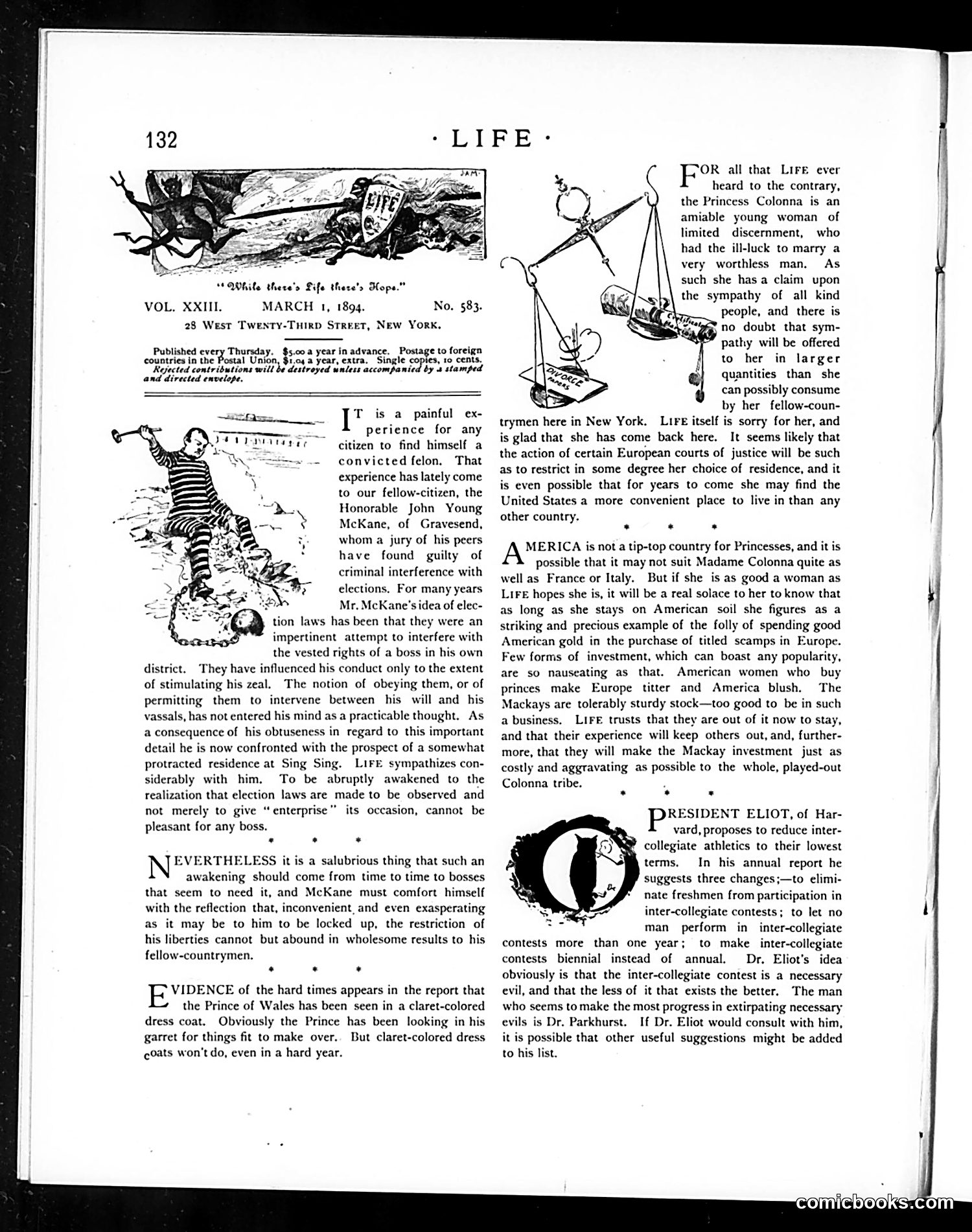
The main cartoon depicts a man labeled with election imagery being trampled and restrained by various figures representing political interference. The text discusses **John Young McKane of Gravesend**, who was convicted of "criminal interference with elections" after "many years" of allegedly wearing "an experiment armor" to shield himself from consequences while controlling political outcomes in his district. The satire critiques McKane's abuse of power—using his position as a boss to interfere with elections and workers' rights. The visual metaphor of him being physically constrained suggests the consequences of his "obliviousness" finally catching up with him. The page also includes commentary on **Princess Colonna** and remarks about **President Eliot's** proposals for collegiate athletics reform.
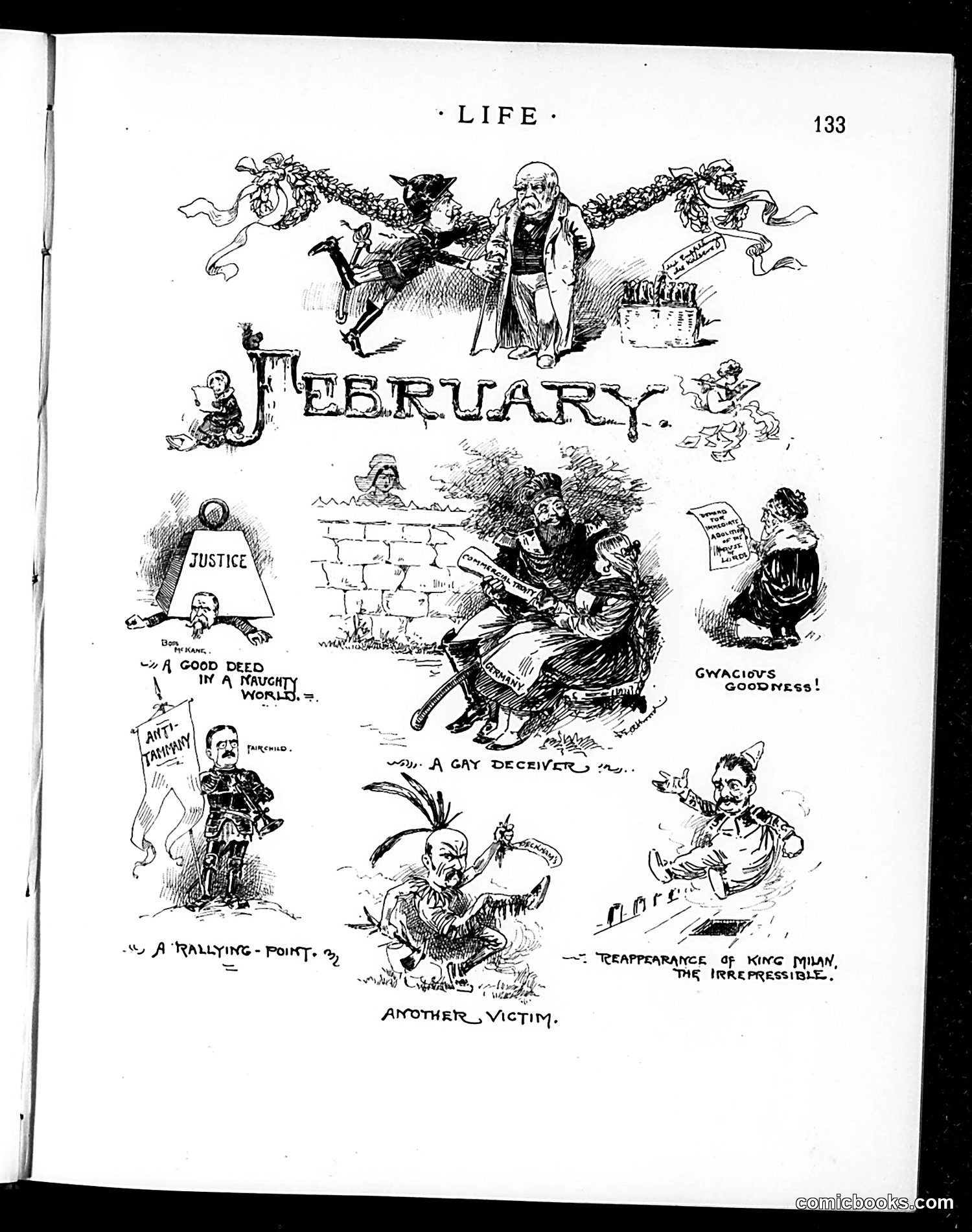
This satirical page from Life magazine presents February as a month of moral and political failings. The central cartoon shows a figure labeled "A Gay Deceiver" engaged in deception. Other scenes include: - "A Good Deed in a Naughty World" - suggesting moral hypocrisy - "Ait! Taimery" (possibly "Art! Trickery") - commenting on fraudulent behavior - "A Rallying-Point" - unclear reference - "Another Victim" - depicting someone suffering consequences - "Reappearance of King Milan, the Irrepressible" - likely referencing a Balkan political figure - "Gwacious Goodness!" - appears to mock affected speech or false virtue The overall theme critiques dishonesty, deception, and hypocrisy prevalent in February's social and political events. Without knowing the specific 1890s context, the exact targets remain partially unclear, though the satire addresses corruption and false morality.
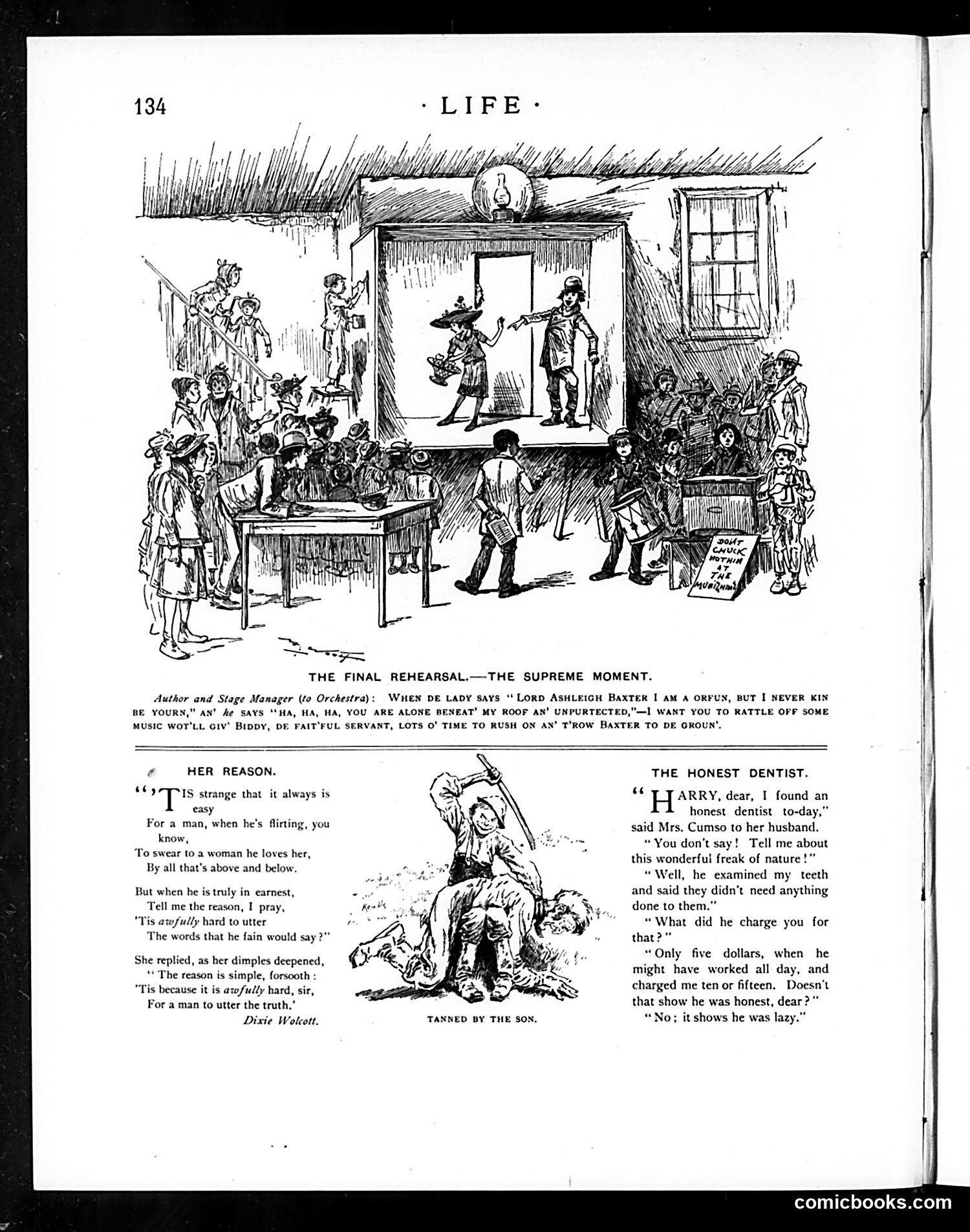
This page from *Life* magazine contains three distinct humor pieces: 1. **"The Final Rehearsal"** (top): A theatrical scene satirizing backstage chaos during a play's final rehearsal, with the author and stage manager arguing over whether actors need more practice time. 2. **"Her Reason"** (bottom left): A poem by Dane Wetski exploring why women find it difficult to tell men the truth in romantic contexts—suggesting honesty is "awfully hard" between lovers. 3. **"The Honest Dentist"** (bottom right): A humorous dialogue where Mrs. Cumso praises a dentist for his honesty, but her husband interprets the low charge ($5 vs. $15) as evidence of laziness rather than integrity. All three pieces use gentle satire about human nature, performance, relationships, and professional conduct typical of early 20th-century *Life* magazine humor.
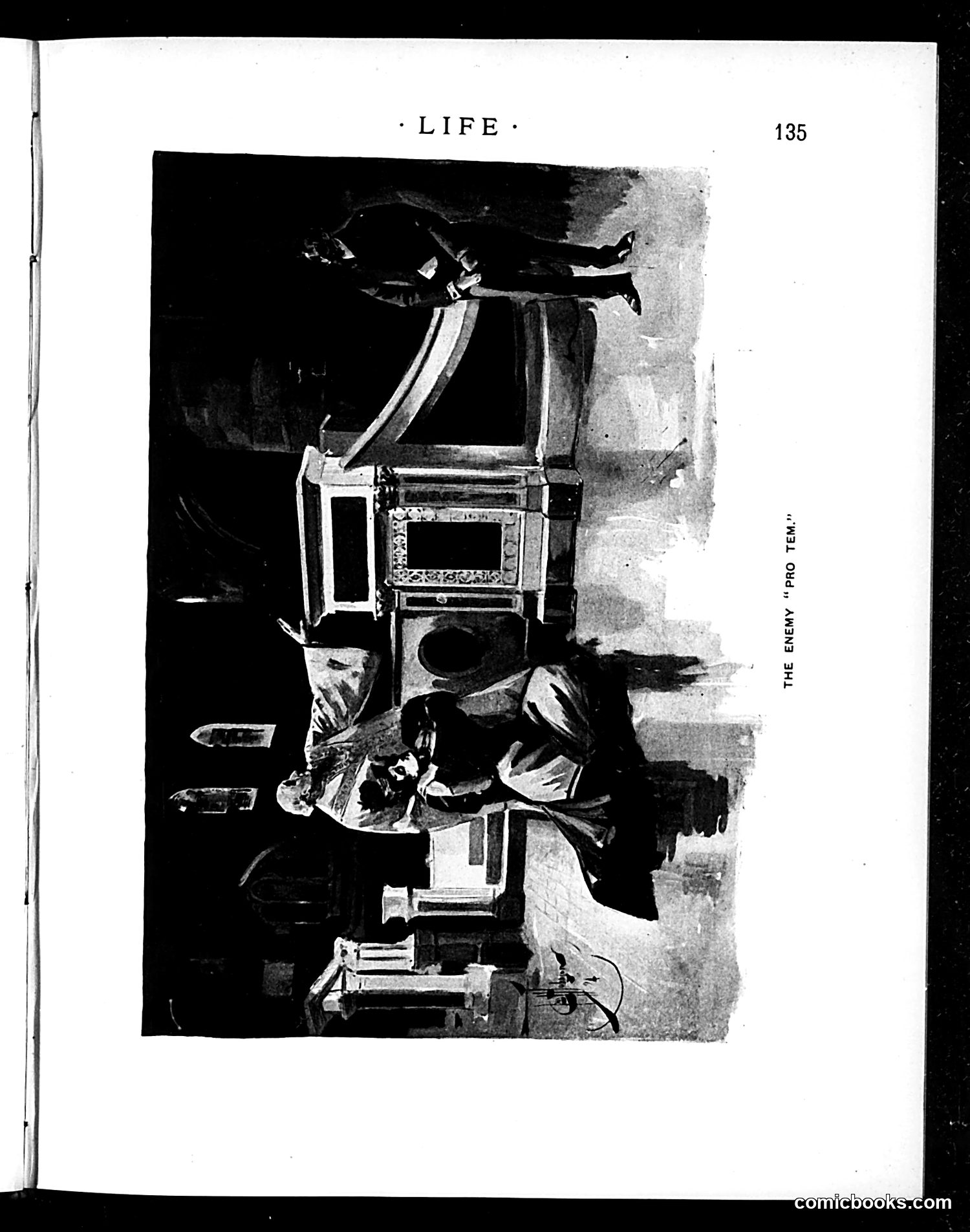
This page from *Life* magazine (page 135) shows a political cartoon titled "The Enemy 'Pro Tem'" (temporary enemy). The image depicts a figure at what appears to be a podium or speaking platform, with another figure visible above in a dramatic pose. The phrase "Pro Tem" suggests this satirizes a temporary or shifting political relationship. Without clearer visibility of specific identifying features or the publication date, I cannot definitively name the figures involved. However, the composition suggests commentary on political adversaries or allies whose status changes opportunistically. The theatrical staging and dramatic positioning indicate *Life*'s typical approach to mocking political hypocrisy or the convenient realignment of enemies and allies for political advantage.
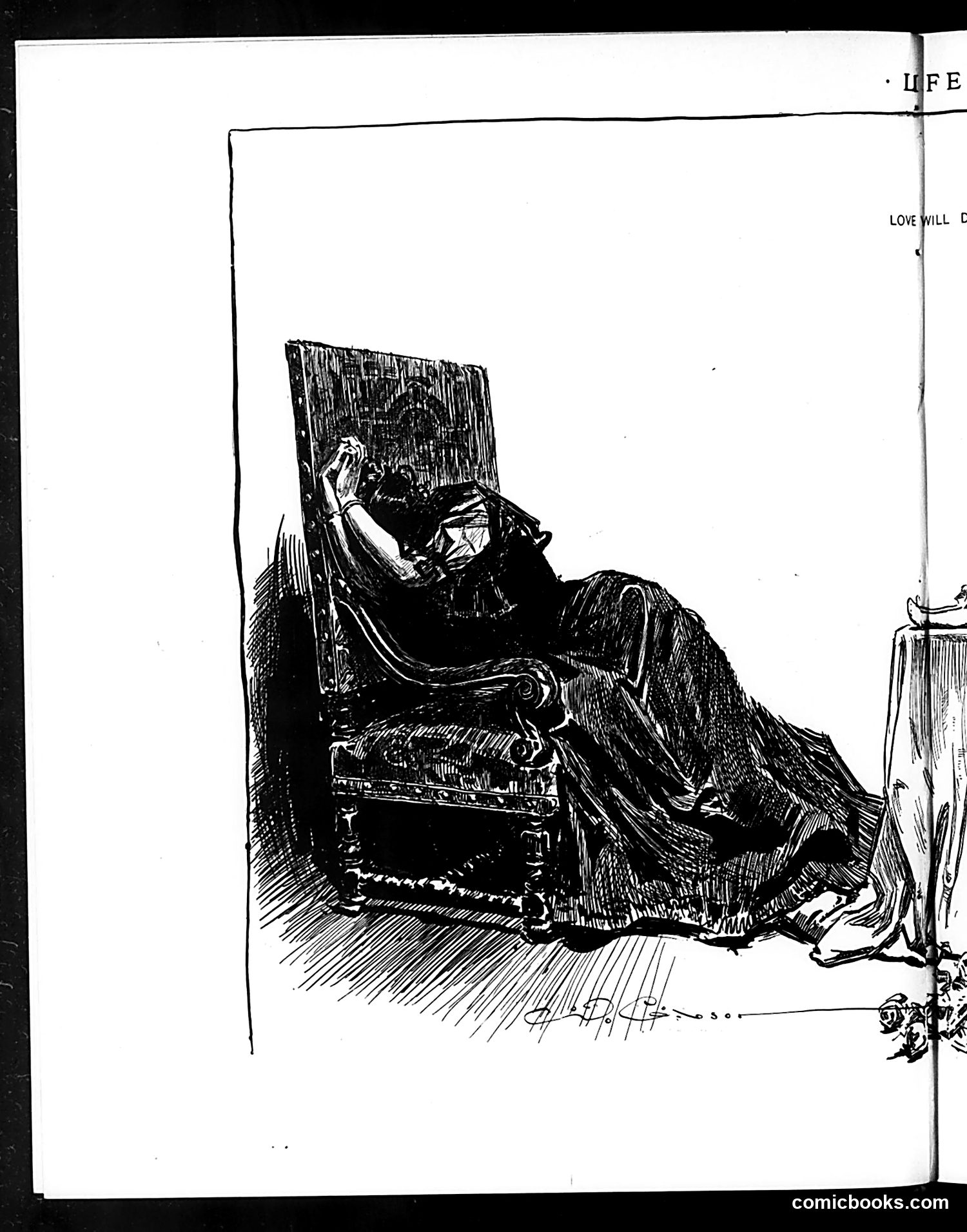
This appears to be a single satirical ink illustration from *Life* magazine showing a figure slumped in a chair against a wall, head tilted back in an attitude of exhaustion or despair. The figure wears heavy, draped clothing and appears male. The visible text fragments read "LIFE" (top) and "LOVE WILL C[...]" (right edge, partially cut off). **What we can determine:** The cartoon likely comments on romantic disappointment or disillusionment, given the "love will" fragment and the figure's posture of resignation. However, without the complete text or clearer identifying details, I cannot specify which particular social or political situation this references. The dramatic pose suggests emotional rather than physical hardship, but the specific satirical target remains unclear from the image alone.
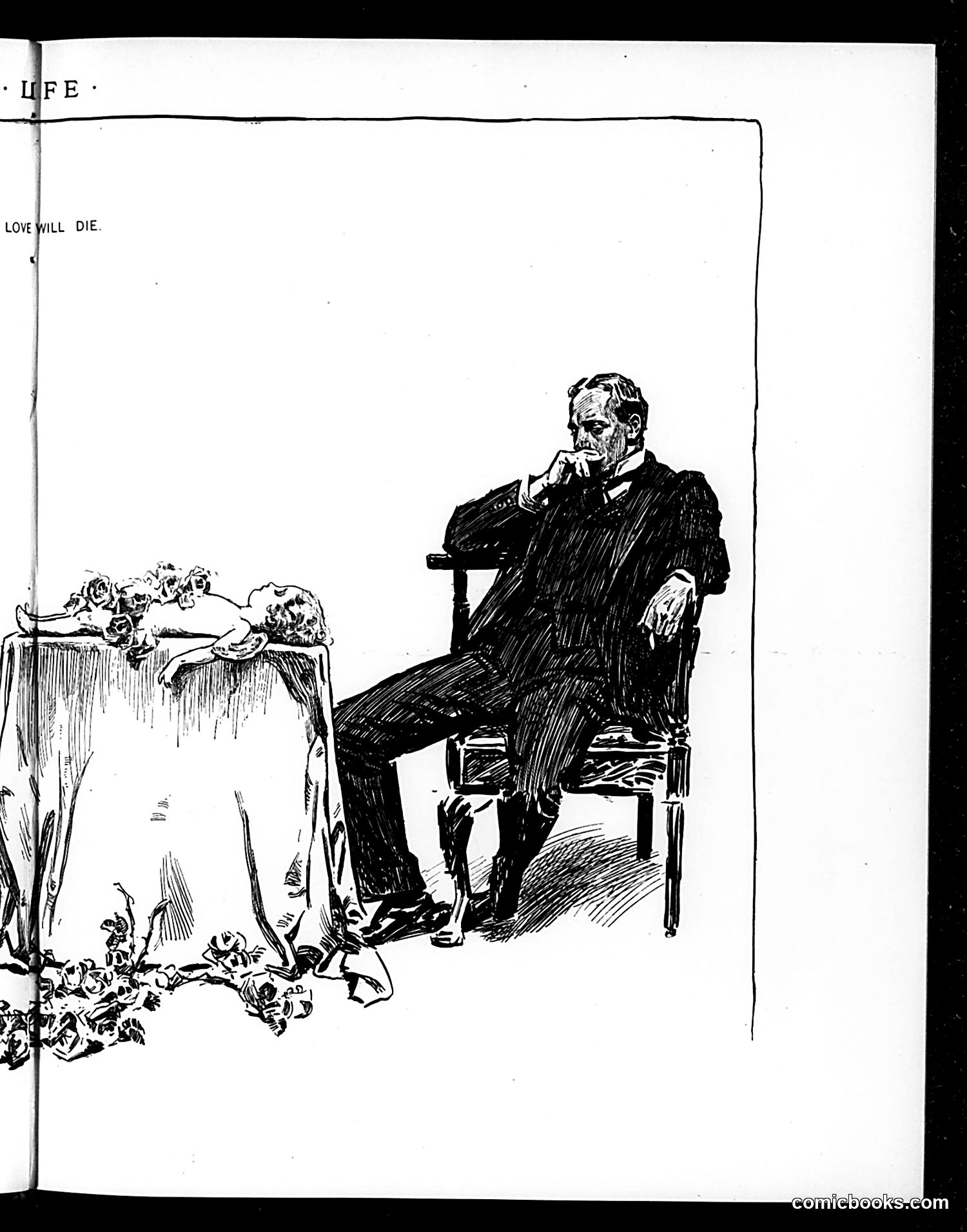
This page from *Life* magazine shows a melancholic illustration accompanying the text "LOVE WILL DIE" at the top. The image depicts a solitary, well-dressed man in formal attire sitting pensively with his hand to his face in a contemplative or sorrowful pose. Beside him sits a small table with wilted flowers, reinforcing the theme of decay and loss. The satire appears to be social commentary on romantic disillusionment or the death of romance in modern life. The juxtaposition of the gentleman's formal dress with his dejected posture, combined with the dying flowers, suggests the article or cartoon critiques how contemporary society (or perhaps a specific social trend) has killed romantic sentiment. Without additional context from the magazine issue, the specific target of this satire remains unclear.
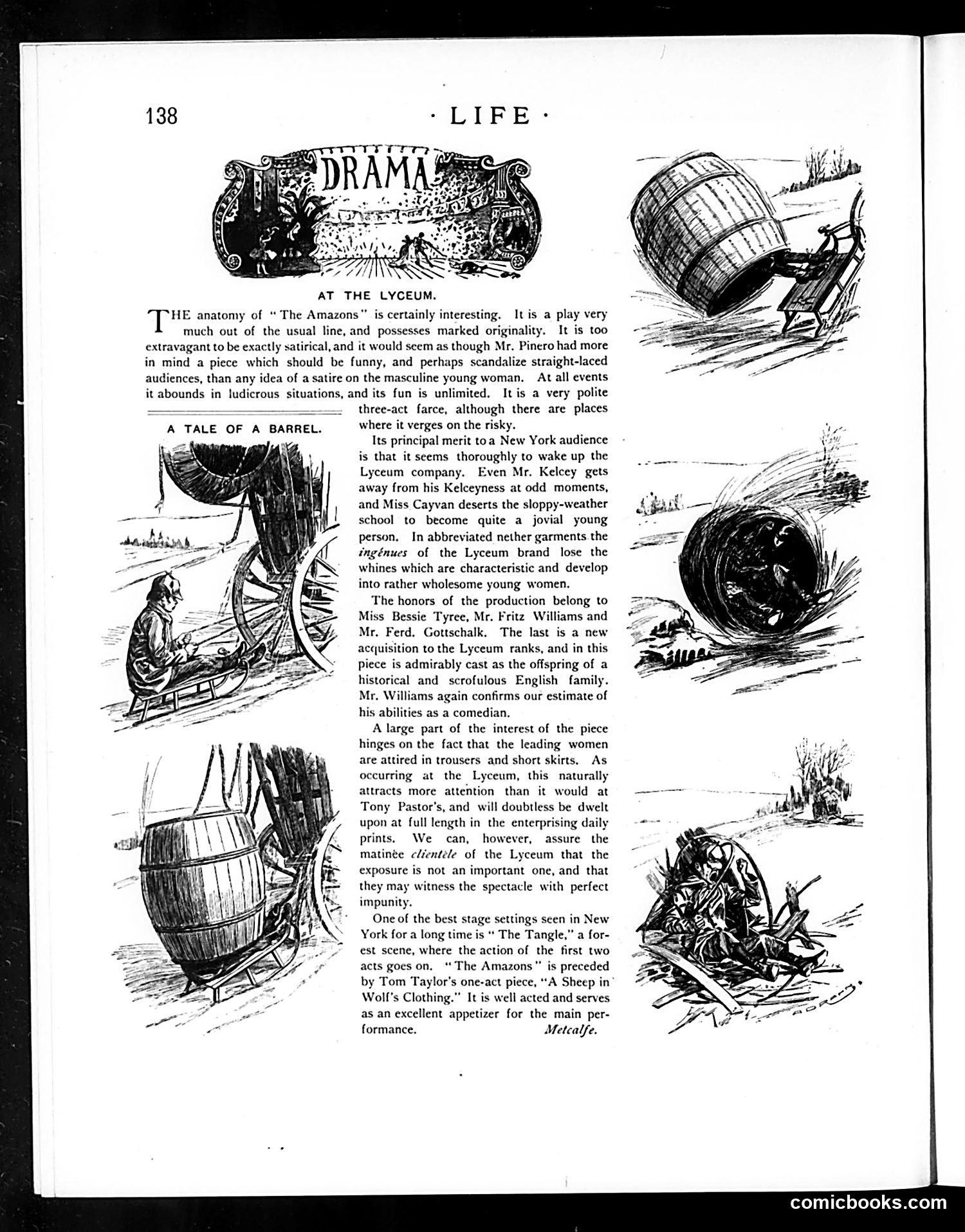
This page reviews a theatrical production at the Lyceum theater. The text discusses Mr. Pinero's play "The Amazons," praising it as original and funny, though "extravagant" and verging on scandalous for showing women in masculine clothing (trousers and short skirts). The illustrations are decorative barrels—a visual pun on the review's subtitle "A Tale of a Barrel." These barrel drawings serve as ornamental elements rather than satirical commentary. The review notes the production's appeal lies partly in actresses wearing unconventional attire, calling this "a large part of the interest." It mentions performers like Miss Bessie Tyree and Mr. Fritz Williams, confirming this as genuine theater criticism rather than political satire. The piece exemplifies *Life* magazine's coverage of contemporary entertainment.
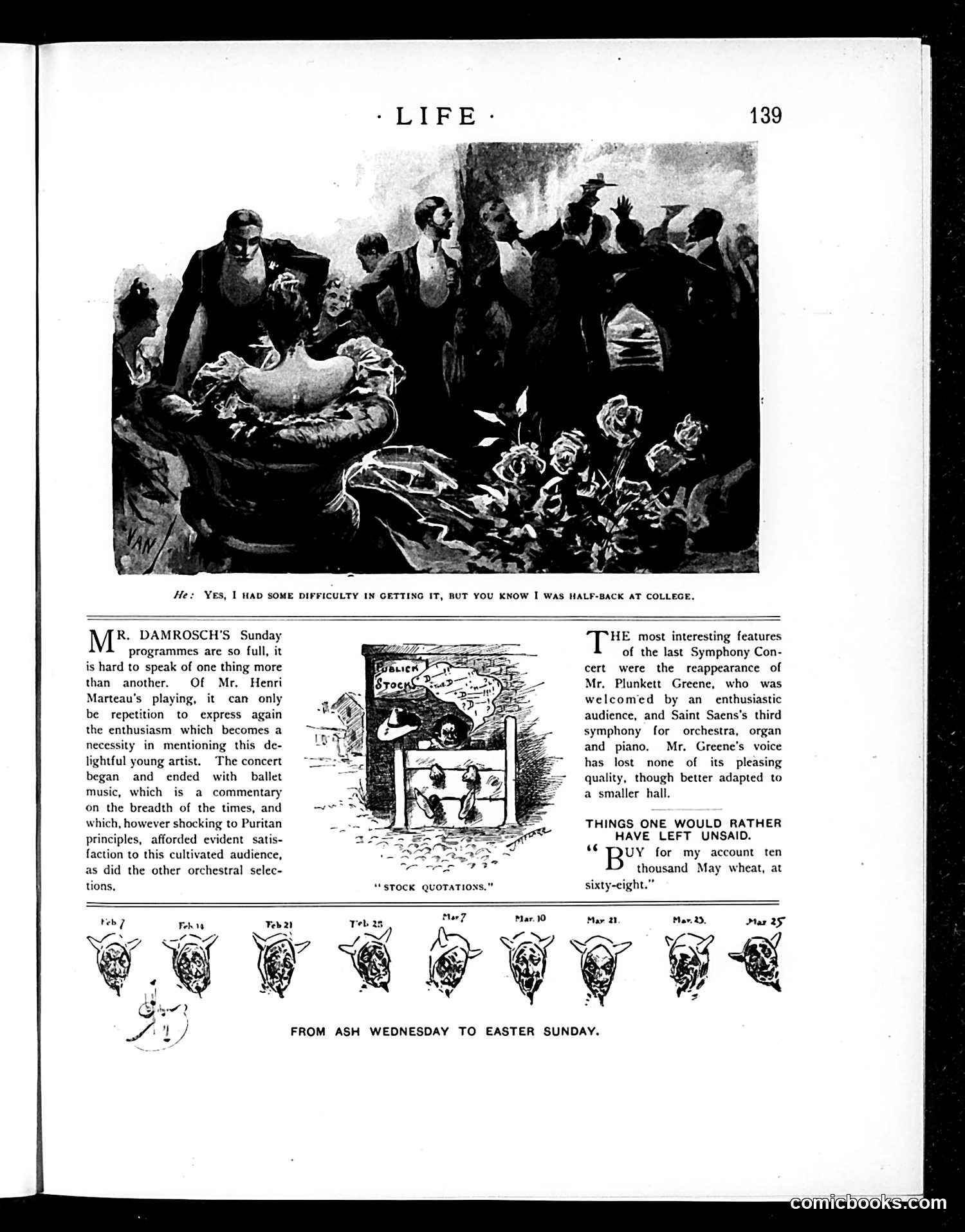
**Main Cartoon (top):** A well-dressed man explains to others at what appears to be a market or produce stand: "Yes, I had some difficulty in getting it, but you know I was half-back at college." The joke satirizes men who constantly reference their college athletic achievements—suggesting he's using his past football experience as an excuse or explanation for obtaining scarce goods, likely during wartime rationing. **Lower Content:** Includes a "Stock Quotations" illustration and a series of small demon/devil head drawings labeled "From Ash Wednesday to Easter Sunday," apparently depicting the progression of Lenten observance through religious iconography. The page combines sports nostalgia humor with religious seasonal references typical of early 20th-century American satire.
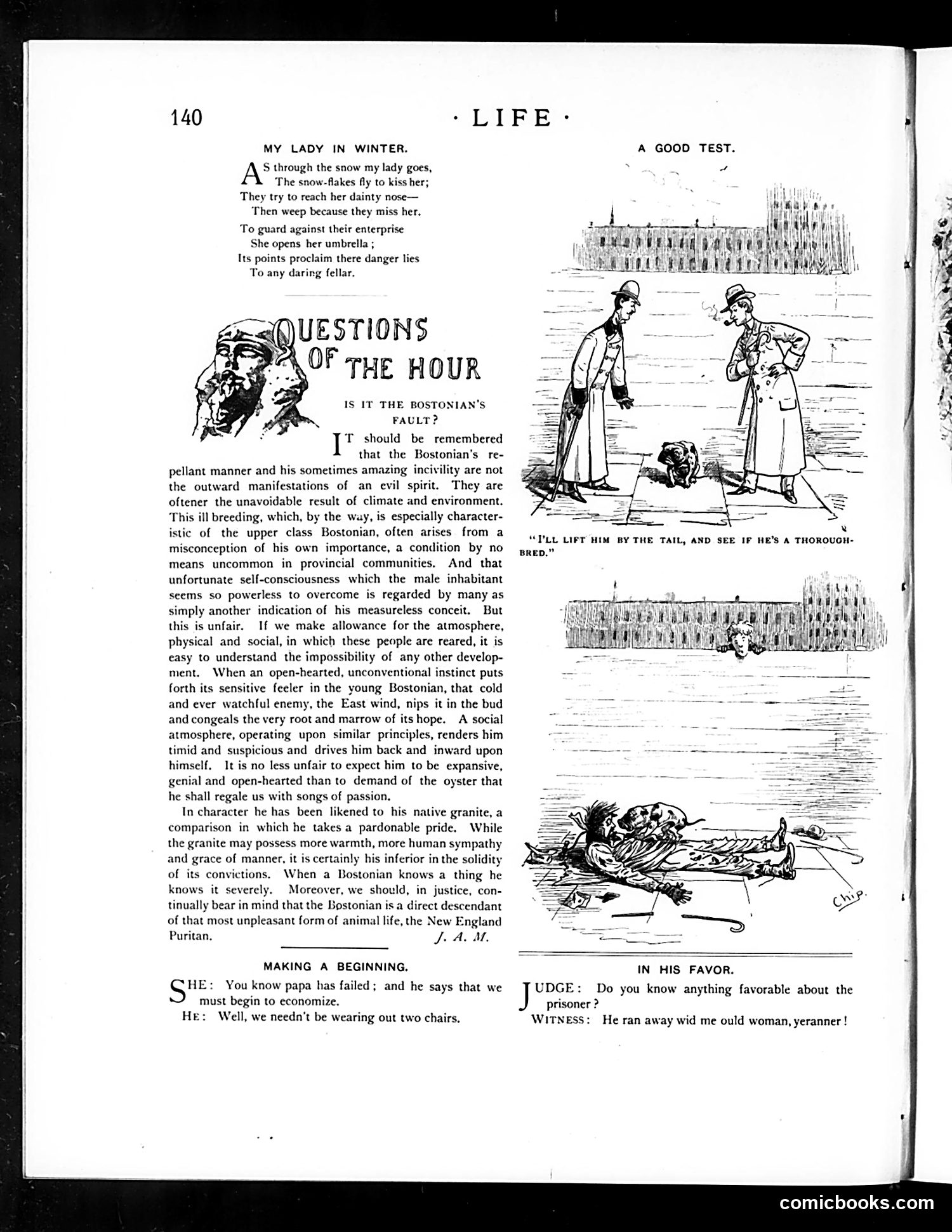
This page contains three distinct satirical pieces typical of early 20th-century American humor: **"Questions of the Hour: Is It the Bostonian's Fault?"** — A lengthy essay-cartoon defending upper-class Bostonians' notorious coldness and rudeness as environmental rather than moral failing. It attributes their icy reserve to harsh New England climate and their Puritan ancestry, comparing them to granite: solid and unfeeling but dependable. The satire lies in the mock-sympathetic excuse-making for genuinely unpleasant behavior. **"A Good Test"** — Three cartoons depicting ice-fishing or winter scenes with working-class characters testing a horse or dog's breeding by lifting it by the tail. The humor is physical comedy about determining animal quality through crude means. **"In His Favor"** — A courtroom joke where a witness testifies favorably about a prisoner by noting he "ran away wid me ould woman"—implying the defendant's only redeeming quality is eloping with someone else's spouse. The ethnic dialect ("yeranner," "ould") suggests Irish-American characters, common in period satire.
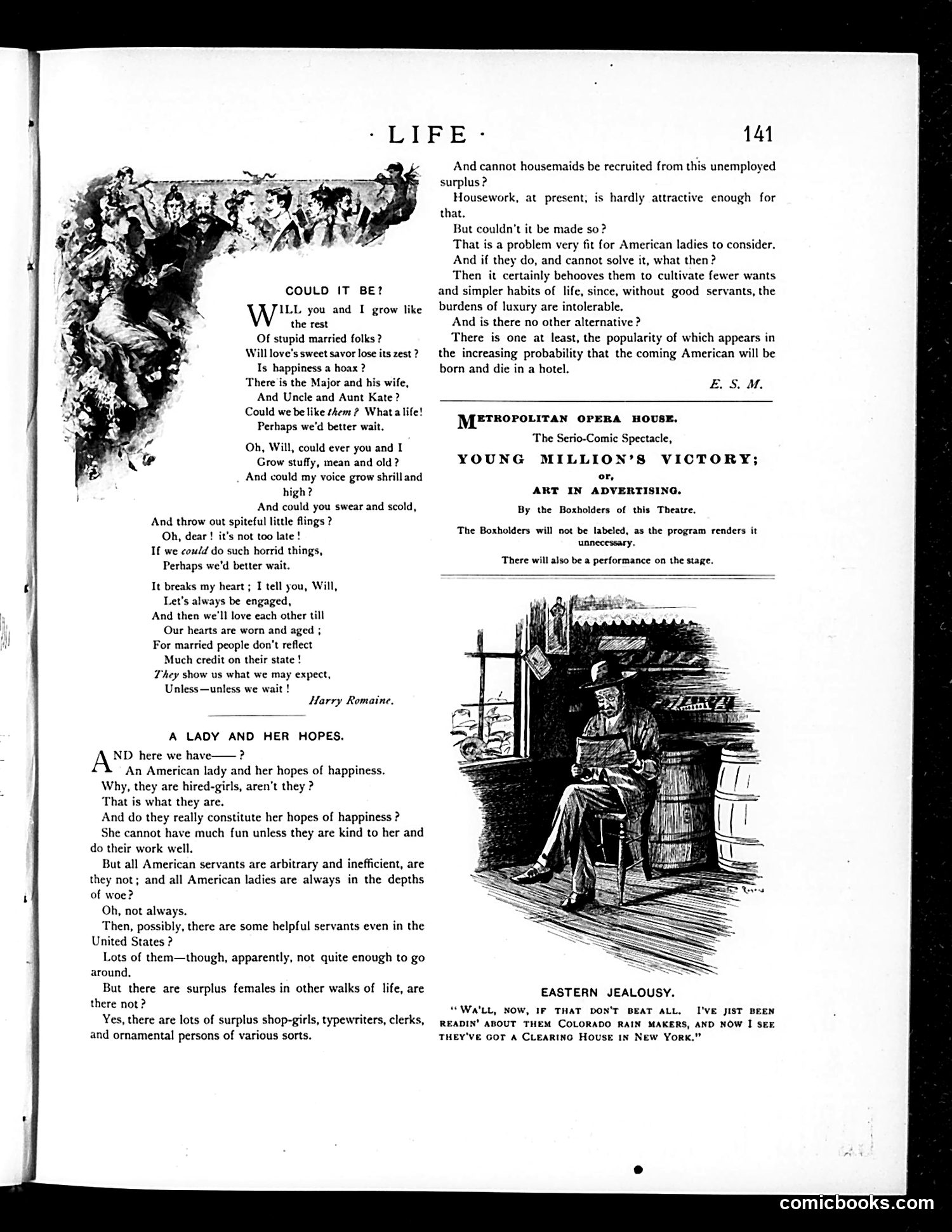
This page contains social satire targeting American domestic life and class anxieties. **"Could It Be?"** — A poem by Harry Romaine mocking young engaged couples who idealize marriage while observing "stupid married folks" like the Major and Aunt Kate, worrying they'll become equally dull and irritable. The satire suggests romantic naïveté about marriage's reality. **"A Lady and Her Hopes"** — A Socratic dialogue (signed E.S.M.) critiquing American wealthy women's dependence on household servants. It argues that because good domestic help is scarce and housework seems unattractive, American ladies either need to: hire from unemployed surplus women (shop-girls, clerks, typewriters), simplify their luxurious lifestyles, or—satirically—accept that affluent Americans will increasingly be "born and die in a hotel," outsourcing domestic life entirely. **"Eastern Jealousy"** — A dialect cartoon showing Western rural resentment toward Eastern sophistication, joking that Colorado's "rain makers" pale compared to New York's "Clearing House." The page reflects Gilded Age anxieties: servant shortages, women's limited employment options, and regional tensions.
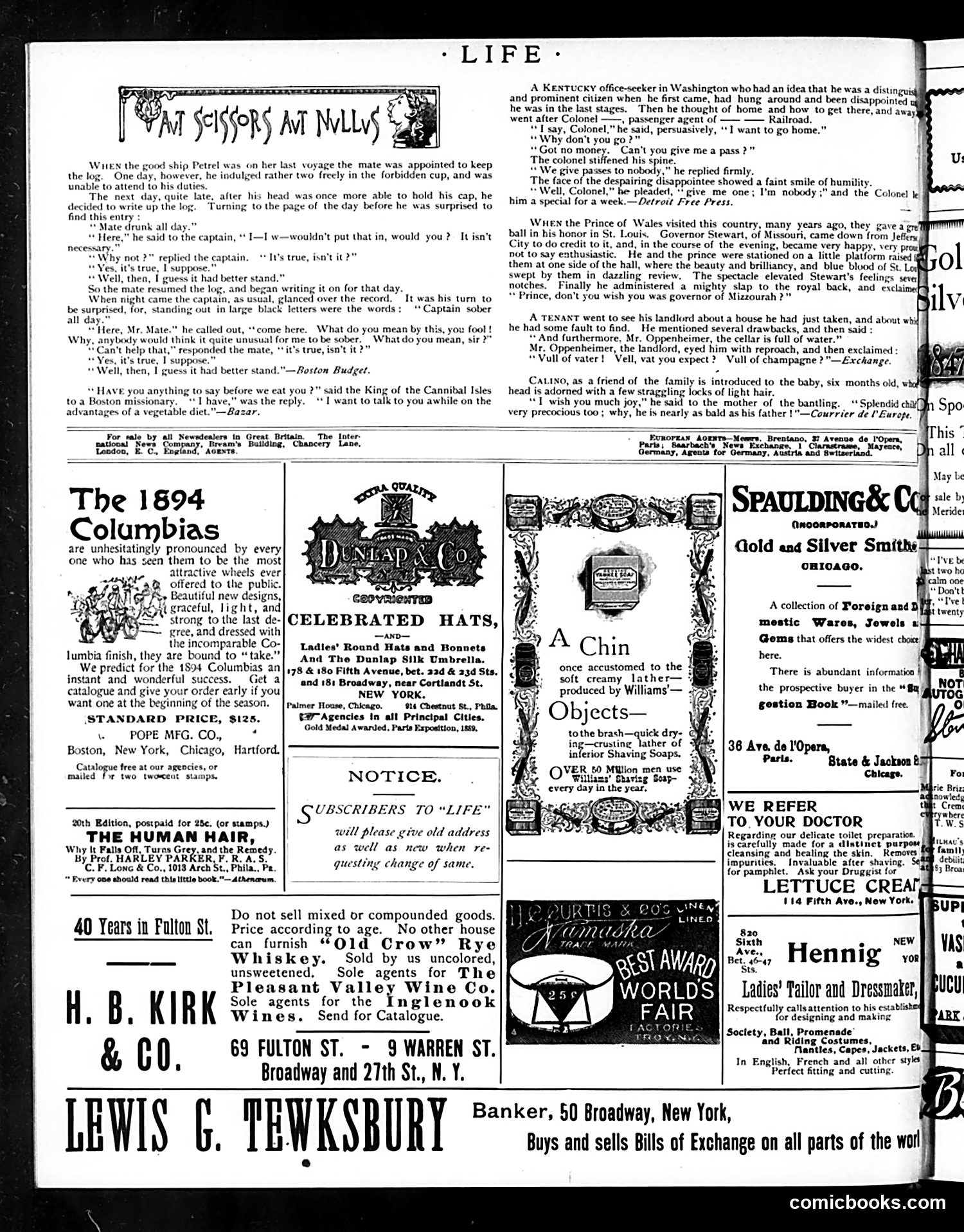
This page contains several brief humorous anecdotes typical of *Life* magazine's satirical style: **"Captain Sober"**: A ship's mate, hungover, writes "Mate drunk all day" in the log. When the captain questions this unflattering entry, the mate defends it as truthful—establishing the joke that honesty can be inconvenient. **Kentucky Office-Seeker**: A disappointed job-hunter asks a railroad colonel for a free pass home, claiming "I'm nobody." The colonel, moved by this self-deprecating admission, grants it. The satire targets both the man's naïveté and the arbitrary power of railroad officials. **Governor Stewart & the Prince**: A Missouri governor, drunk at a St. Louis ball honoring a foreign prince, becomes so emboldened he slaps the dignitary's back and asks if he wishes he were "governor of Mizzourah"—mocking American provincial pride and drunken familiarity. **Landlord Oppenheimer**: A tenant complains the cellar floods; the Yiddish-accented landlord sarcastically replies it should be full of champagne instead—ethnic humor typical of the era. The page is primarily **advertising** below these short jokes.
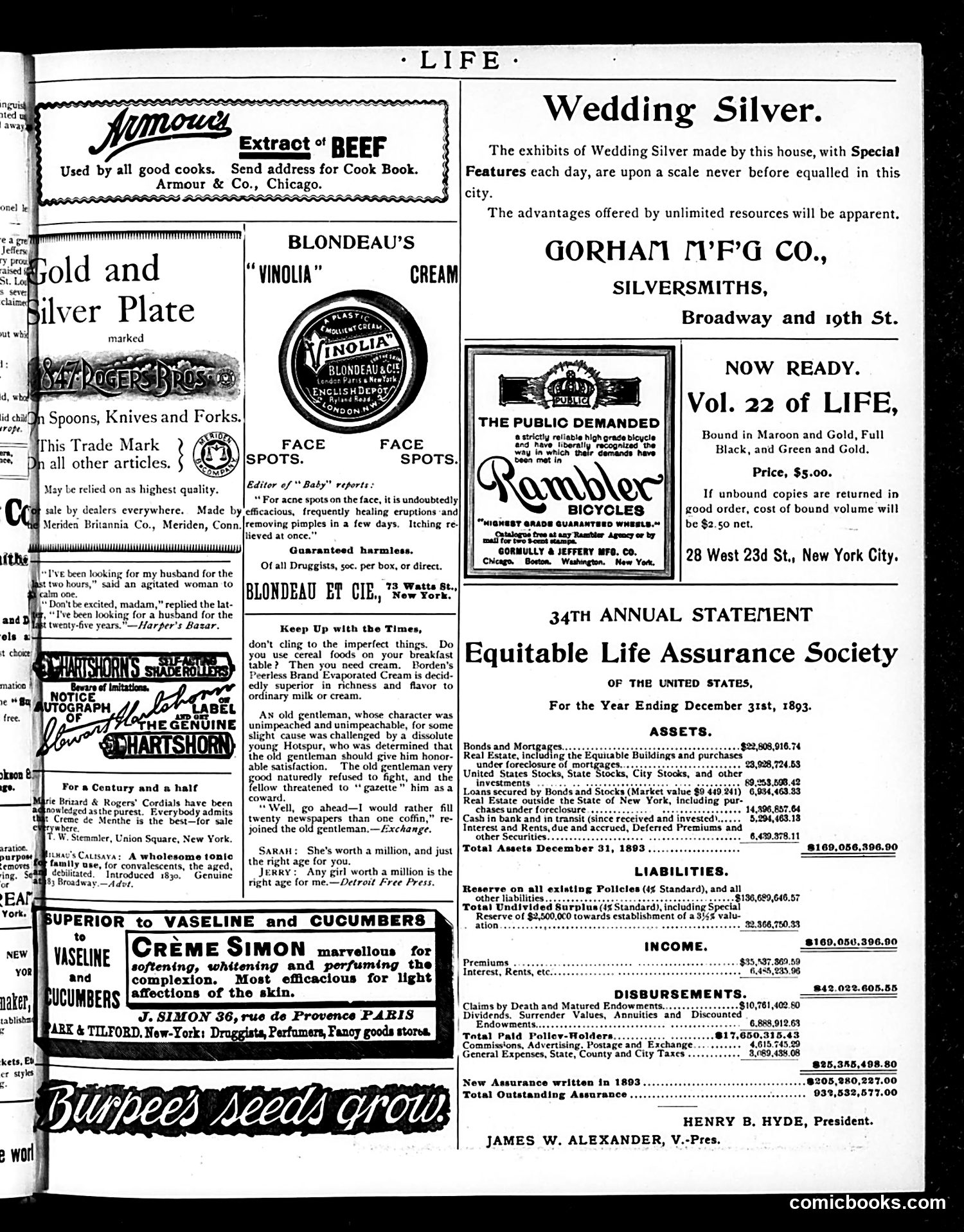
This page consists primarily of **advertisements and an insurance company statement**, not political satire or editorial cartoons. The visible content includes ads for beef extract, silverware, bicycles, cosmetics, and cream products. There is one brief **humor piece** (credited to "Editor of 'Baby'") presenting two short jokes: one about a woman seeking her husband and another about an old gentleman refusing a duel, threatening to make his challenger look like a coward in the newspaper rather than meet him in combat. These are conventional wit pieces, not political cartoons. The dominant feature is the **34th Annual Statement of the Equitable Life Assurance Society** (1893), displaying financial assets, liabilities, and income in tabular form. This page functions as a business and advertising supplement rather than editorial or satirical content.
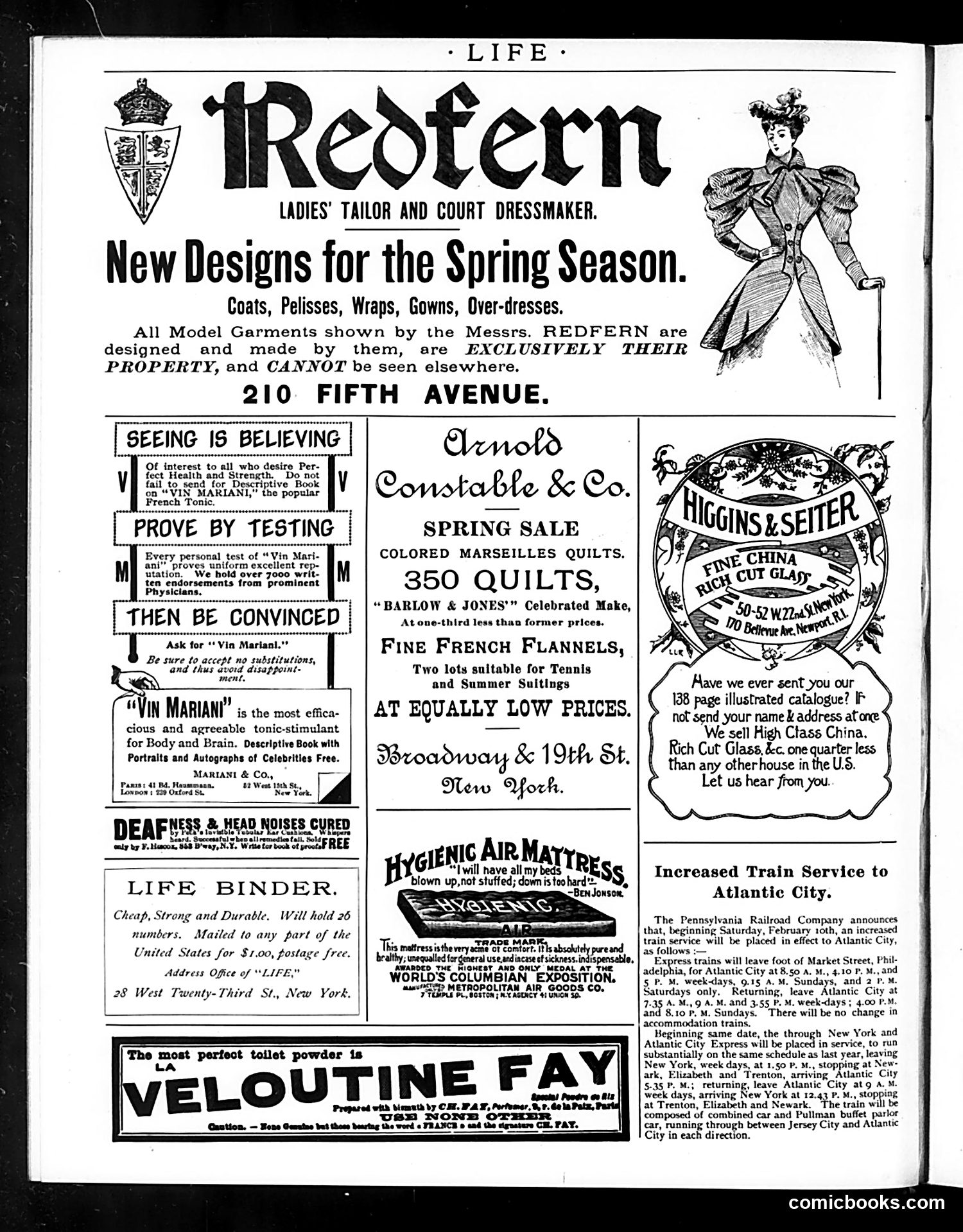
This page is **primarily advertising**, not satirical content. It's a typical early 20th-century magazine layout mixing various commercial announcements. Key advertisements include: - **Redfern** (top): A high-end ladies' tailor/dressmaker advertising exclusive spring fashions - **Vin Mariani** (left): A patent medicine claiming to boost health and strength, endorsed by physicians - **Veloutine Fay** (bottom): A talcum powder advertised as "the most perfect toilet powder" - **Arnold Constable & Co.**: Selling quilts and French flannels - **Higgins & Seltzer**: Promoting fine china and cut glass - **Pennsylvania Railroad**: Announcing increased train service to Atlantic City The page reflects **turn-of-the-century consumer culture**—luxury fashion, unregulated medicinal tonics, and leisure travel. The "Vin Mariani" endorsements by unnamed physicians exemplify how patent medicines made dubious health claims before FDA regulation. The railroad advertisement reflects growing American leisure travel to resort destinations like Atlantic City.