
Life, 1894-03-01 · page 12 of 16
Life — March 1, 1894 — page 12: what you’re looking at
What you’re looking at
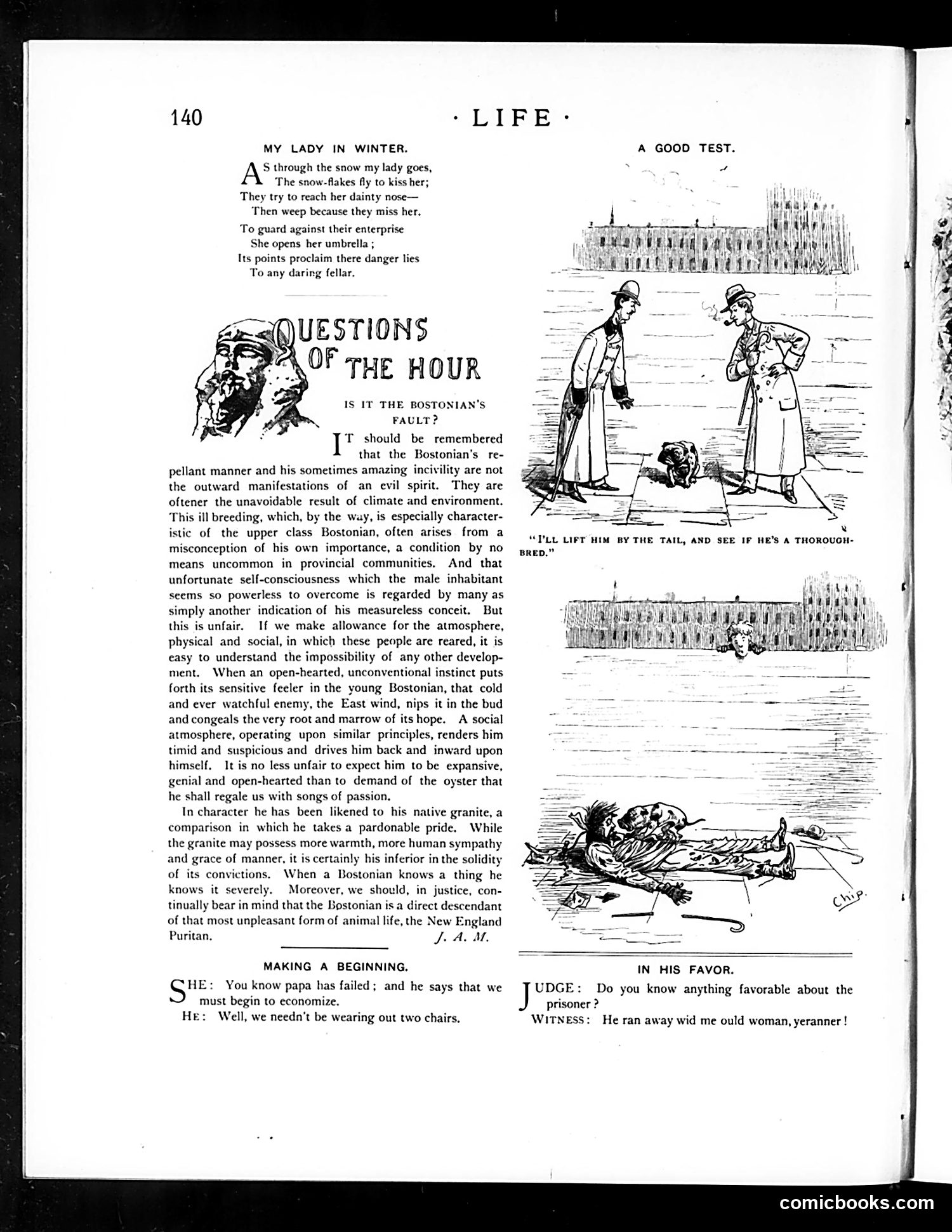
This page contains three distinct satirical pieces typical of early 20th-century American humor: **"Questions of the Hour: Is It the Bostonian's Fault?"** — A lengthy essay-cartoon defending upper-class Bostonians' notorious coldness and rudeness as environmental rather than moral failing. It attributes their icy reserve to harsh New England climate and their Puritan ancestry, comparing them to granite: solid and unfeeling but dependable. The satire lies in the mock-sympathetic excuse-making for genuinely unpleasant behavior. **"A Good Test"** — Three cartoons depicting ice-fishing or winter scenes with working-class characters testing a horse or dog's breeding by lifting it by the tail. The humor is physical comedy about determining animal quality through crude means. **"In His Favor"** — A courtroom joke where a witness testifies favorably about a prisoner by noting he "ran away wid me ould woman"—implying the defendant's only redeeming quality is eloping with someone else's spouse. The ethnic dialect ("yeranner," "ould") suggests Irish-American characters, common in period satire.
📄 Transcribed text from this page (OCR, searchable)
Machine-transcribed from the original scan — historical spelling and the odd misread are preserved.
MY LADY IN WINTER. S through the snow my lady goes, The snow-flakes fly to kiss her; They try to reach her dainty nose— Then weep because they miss her. To guard against their enterprise She opens her umbrella ; Its points proclaim there danger lies To any daring fellar. —— UESTIONS IS IT THE BOSTONIAN’S FAULT? I should be remembered that the Bostonian’s re- pellant manner and his sometimes amazing incivility are not the outward manifestations of an evil spirit. They are oftener the unavoidable result of climate and environment. This ill breeding, which, by the way, is especially character- istic of the upper class Bostonian, often arises from a misconception of his own importance, a condition by no means uncommon in provincial communities. And that unfortunate self-consciousness which the male inhabitant seems so powerless to overcome is regarded by many as simply another indication of his measureless conceit. But this is unfair. If we make allowance for the atmosphere, physical and social, in which these people are reared, it is easy to understand the impossibility of any other develop- ment, When an open-hearted, unconventional instinct puts forth its sensitive feeler in the young Bostonian, that cold and ever watchful enemy, the East wind, nips it in the bud and congeals the very root and marrow of its hope. A social atmosphere, operating upon similar principles, renders him timid and suspicious and drives him back and inward upon himself. It is no less unfair to expect him to be expansive, genial and open-hearted than to demand of the oyster that he shall regale us with songs of passion. In character he has been likened to his native granite, a comparison in which he takes a pardonable pride. While the granite may possess more warmth, more human sympathy and grace of manner, it is certainly his inferior in the solidity of its convictions. When a Bostonian knows a thing he knows it severely. Moreover, we should, in justice, con- tinually bear in mind that the Bostonian is a direct descendant of that most unpleasant form of animal life, the New England Puritan, J. A.M. MAKING A BEGINNING, HE: You know papa has failed; and he says that we must begin to economize. HE: Well, we needn’t be wearing out two chairs, A GOOD TEST. a ee er “TLL LIFT HIM BY THE TAIL, AND SEE IF HE'S A THOROUGH- BRED.” ‘ (ya Aet IN HIS FAVOR. UDGE: Do you know anything favorable about the prisoner ? WITNESS : He ran away wid me ould woman, yeranner ! we wie ae comicbooks.com