
Life, 1894-03-01 · page 4 of 16
Life — March 1, 1894 — page 4: what you’re looking at
What you’re looking at
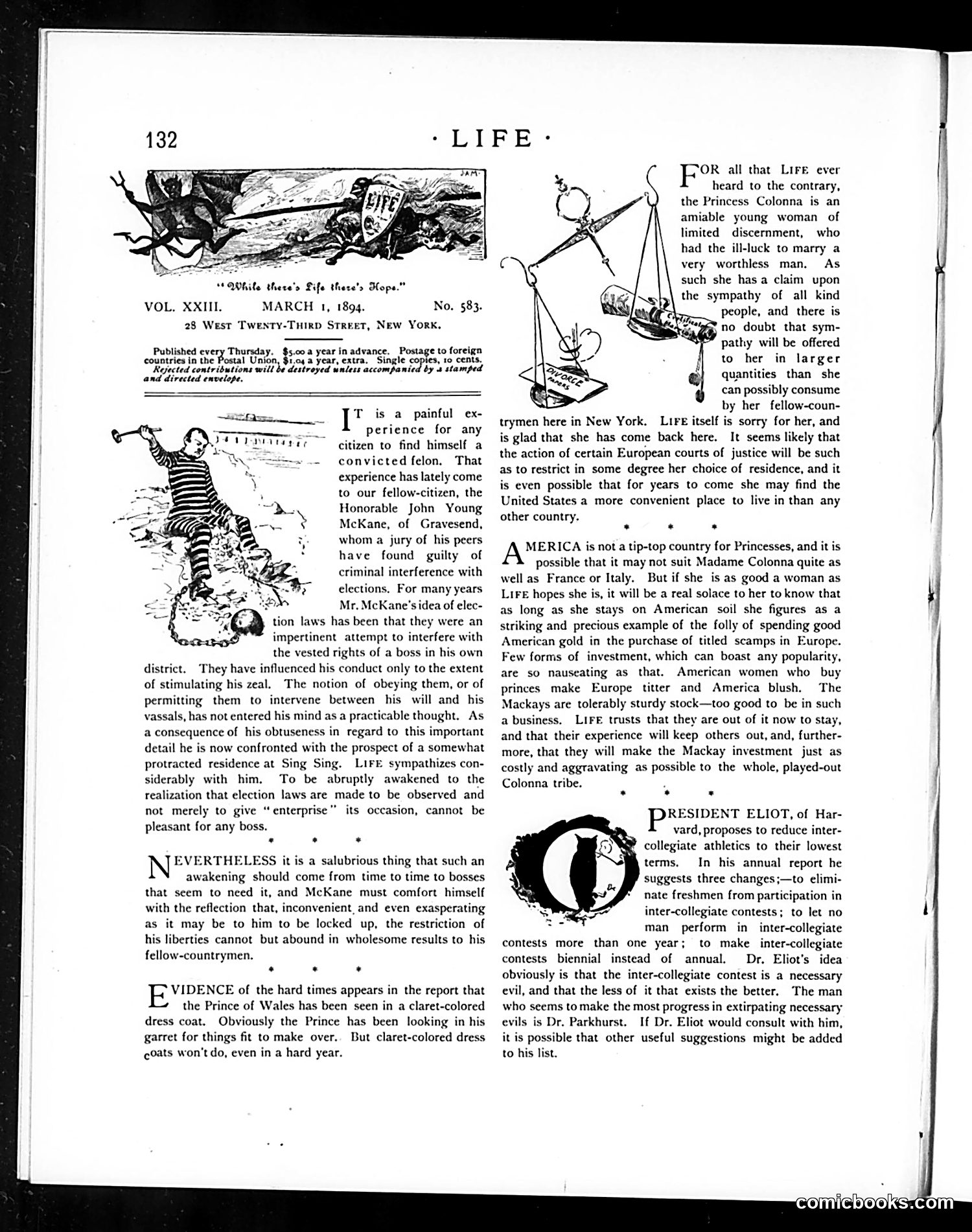
The main cartoon depicts a man labeled with election imagery being trampled and restrained by various figures representing political interference. The text discusses **John Young McKane of Gravesend**, who was convicted of "criminal interference with elections" after "many years" of allegedly wearing "an experiment armor" to shield himself from consequences while controlling political outcomes in his district. The satire critiques McKane's abuse of power—using his position as a boss to interfere with elections and workers' rights. The visual metaphor of him being physically constrained suggests the consequences of his "obliviousness" finally catching up with him. The page also includes commentary on **Princess Colonna** and remarks about **President Eliot's** proposals for collegiate athletics reform.
📄 Transcribed text from this page (OCR, searchable)
Machine-transcribed from the original scan — historical spelling and the odd misread are preserved.
+ OWhile there's Life there's Hope.” VOL. XXIII. MARCH 1, 1894. No. 583. 28 West Twenty-THirD S T, New York, Published every Thursday. $3.00 year in advance, Postage to foreign countries in the Postal Union, $104 a year, extra. Single copies, 10 cents, ‘Rejected contributions will be destroyed unless accompanied by 4 stamped and directed envelope. Ae [i is a painful ex- perience for any citizen to find himself a - convicted felon, That experience has lately come to our fellow-citizen, the Honorable John Young McKane, of Gravesend, whom a jury of his peers have found guilty of criminal interference with elections. For many years Mr. McKane's idea of elec- tion laws has been that they were an impertinent attempt to interfere with the vested rights of a boss in his own district. They have influenced his conduct only to the extent of stimulating his zeal, The notion of obeying them, or of permitting them to intervene between his will and his vassals, has not entered his mind as a practicable thought. As a consequence of his obtuseness in regard to this important detail he is now confronted with the prospect of a somewhat protracted residence at Sing Sing. LiFE sympathizes con- siderably with him. To be abruptly awakened to the realization that election laws are made to be observed and not merely to give “enterprise” its occasion, cannot be pleasant for any boss. . . . EVERTHELESS it is a salubrious thing that such an awakening should come from time to time to bosses that seem to need it, and McKane must comfort himself with the reflection that, inconvenient, and even exasperating as it may be to him to be locked up, the restriction of his liberties cannot but abound in wholesome results to his fellow-countrymen, . . . VIDENCE of the hard times appears in the report that the Prince of Wales has been seen in a claret-colored dress coat. Obviously the Prince has been looking in his garret for things fit to make over. But claret-colored dress coats won't do, even in a hard year. ‘OR all that LIFE ever heard to the contrary, the Princess Colonna is an amiable young woman of limited discernment, who had the ill-luck to marry a very worthless man. As such she has a claim upon the sympathy of all kind people, and there is no doubt that sym- * pathy will be offered to her in larger quantities than she can possibly consume by her fellow-coun- trymen here in New York. LIFE itself is sorry for her, and is glad that she has come back here. It seems likely that the action of certain European courts of justice will be such as to restrict in some degree her choice of residence, and it is even possible that for years to come she may find the United States a more convenient place to live in than any other country. . * * AMERICA is not a tip-top country for Princesses, and it is possible that it may not suit Madame Colonna quite as well as France or Italy. But if she is as good a woman as LiFe hopes she is, it will be a real solace to her to know that as long as she stays on American soil she figures as a striking and precious example of the folly of spending good American gold in the purchase of titled scamps in Europe. Few forms of investment, which can boast any popularity, are so nauseating as that. American women who buy princes make Europe titter and America blush, The Mackays are tolerably sturdy stock—too good to be in such a business. LIFE trusts that they are out of it now to stay, and that their experience will keep others out, and, further- more, that they will make the Mackay investment just as costly and aggravating as possible to the whole, played-out Colonna tribe. . . * . RESIDENT ELIOT, of Har- vard, proposes to reduce inter- collegiate athletics to their lowest terms. In his annual report he suggests three changes;—to elimi- nate freshmen from participation in inter-collegiate contests; to let no man perform in_ inter-collegiate contests more than one year; to make inter-collegiate contests biennial instead of annual. Dr. Eliot's idea obviously is that the inter-collegiate contest is a necessary evil, and that the less of it that exists the better. The man who seems to make the most progress in extirpating necessary evils is Dr. Parkhurst. If Dr. Eliot would consult with him, it is possible that other useful suggestions might be added to his list.