
A complete issue · 14 pages · 1894
Life — February 15, 1894
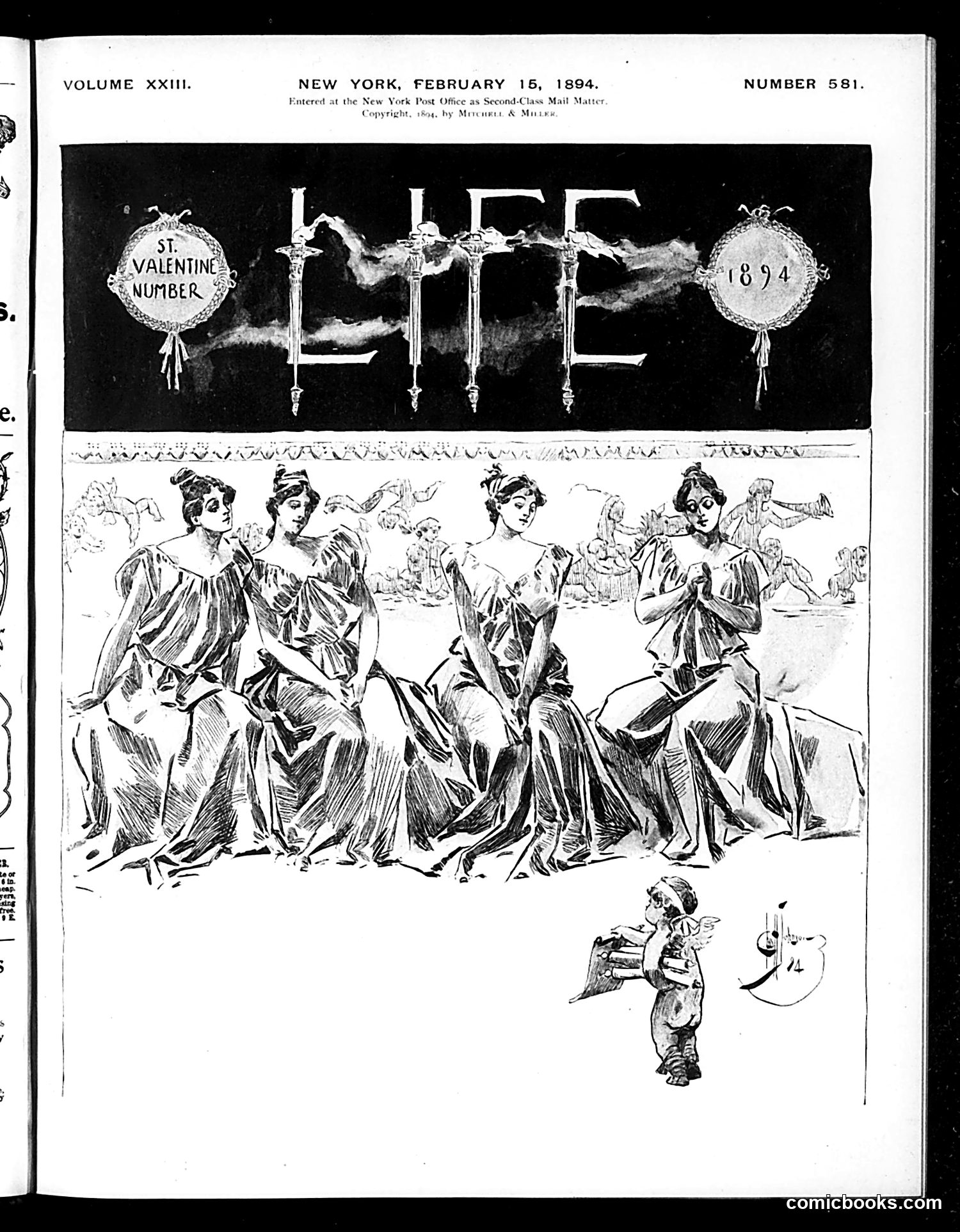
This is the cover of Life's Valentine's Day special issue. The main illustration depicts four elegantly dressed women seated together in classical or allegorical poses, likely representing idealized feminine virtue or beauty—a common theme for Valentine's content. The small Cupid figure at bottom appears to be a decorative element typical of Valentine's imagery from this era. The exact satirical point is unclear without additional context or accompanying text. Given that this is a Valentine's number from Life (known for social satire), it likely mocks contemporary attitudes toward romance, courtship, or women's roles, though the specific target isn't evident from the image alone. The allegorical style suggests commentary on romanticized ideals of womanhood.
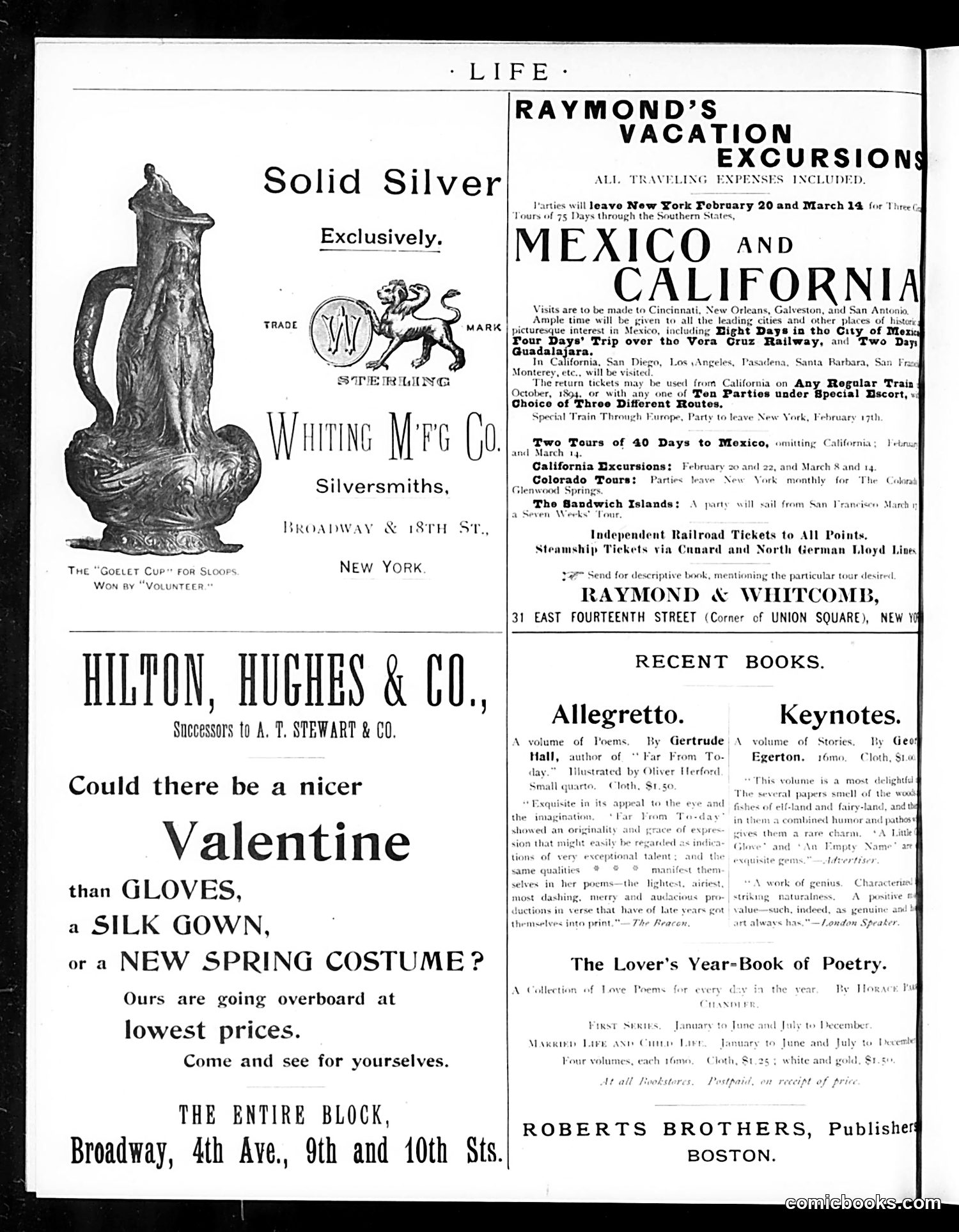
This page is **primarily advertising** with no political cartoons or satirical commentary. The left side features ads for luxury goods (Whiting Mfg Co. silverware, Hilton Hughes & Co. clothing) appropriate to the magazine's affluent readership. The Valentine's Day advertisement for gloves, silk gowns, and spring costumes reflects early 20th-century seasonal retail marketing. The right side contains travel advertisements (Raymond's vacation excursions to Mexico and California) and book advertisements (poetry collections and story volumes from Roberts Brothers Publishers). The only illustration with potential symbolic meaning is the decorative "Gollet Cup" won by "Volunteer"—likely referring to a sporting trophy, though without additional context, the specific event remains unclear.
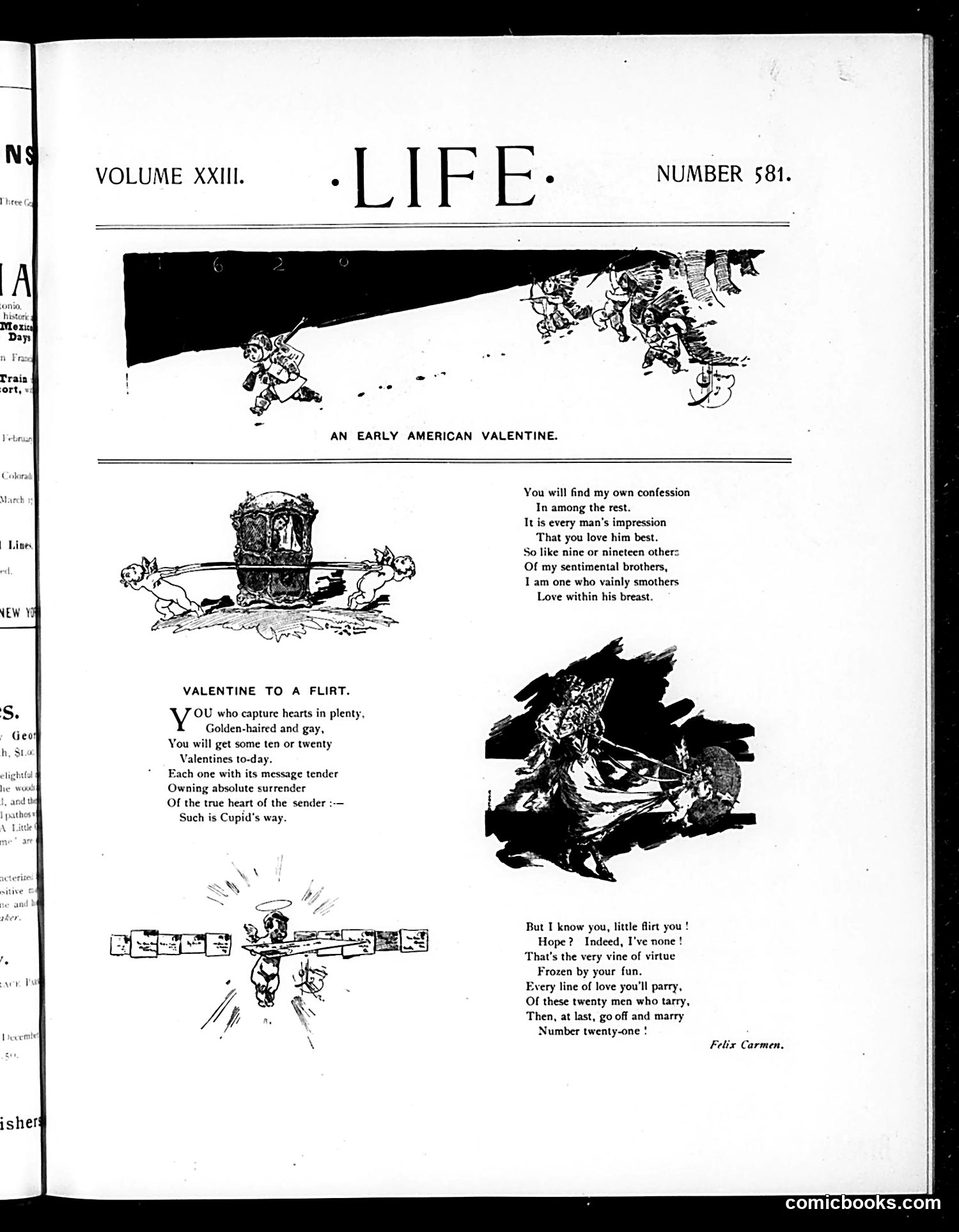
This page presents Valentine's Day-themed content from early 20th-century Life magazine. The top illustration, "An Early American Valentine," depicts a rifle barrel as a love token—a humorous visual pun playing on "shooting" someone with romantic feelings. Below, "Valentine to a Flirt" uses verse to mock a woman who collects romantic attention from many suitors. The poem suggests she'll eventually marry one of "twenty men" pursuing her, satirizing the social dynamics of courtship and female coquettishness. The decorative illustrations—featuring Cupid figures and romantic imagery—support the Valentine's theme throughout. The content reflects early 1900s attitudes toward courtship, gender relations, and the magazine's satirical humor aimed at contemporary social customs and romantic behavior.
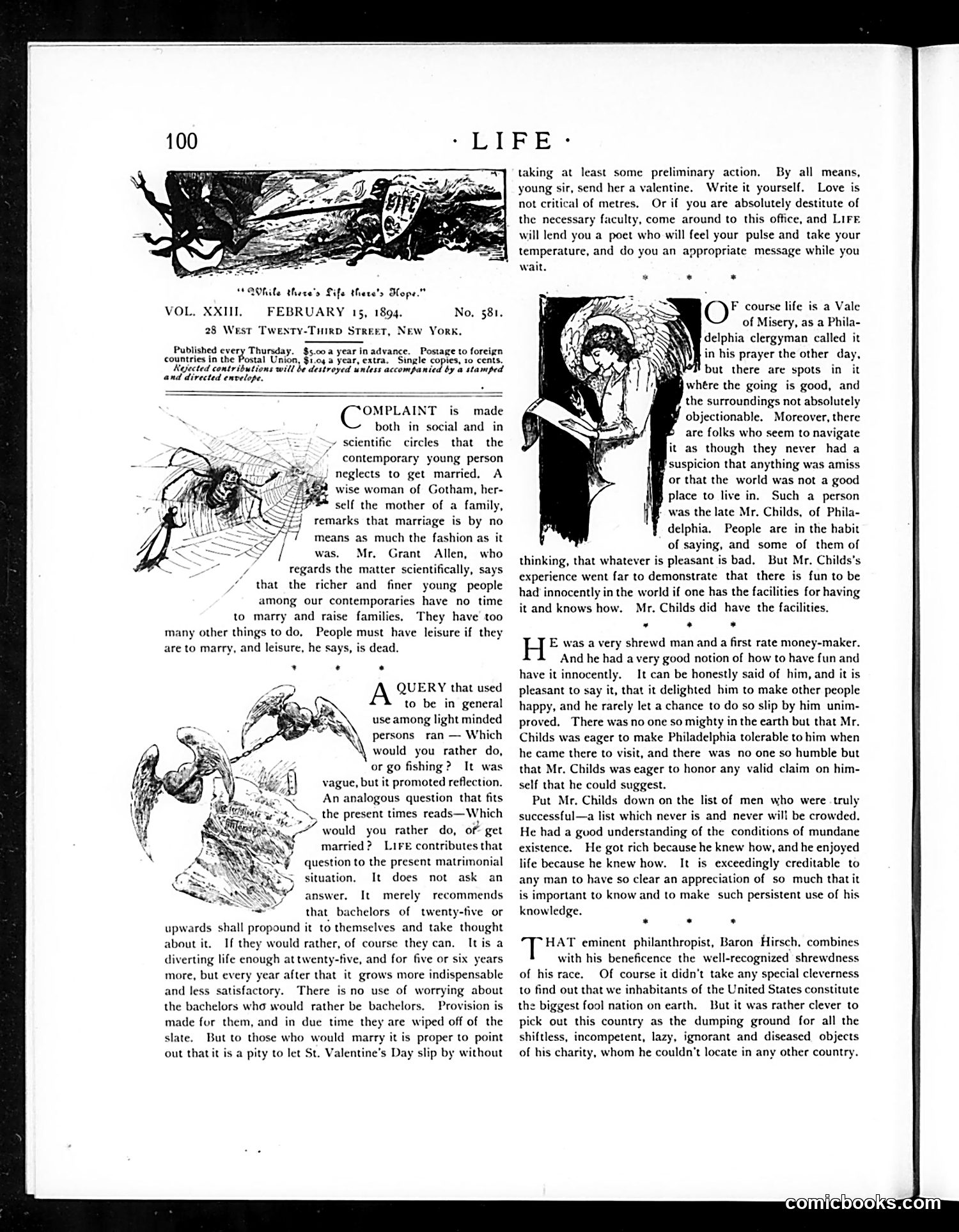
This page contains three separate editorial cartoons addressing marriage and social customs: 1. **Top left**: A skeletal or death figure labeled "While there's Life there's Hope"—satirizing the grim prospects of marriage. 2. **Center**: Allegorical figures (appearing to represent cupids or cherubs) accompanying text questioning whether young unmarried men should marry. The cartoon supports remaining single, arguing bachelors enjoy superior leisure and freedom compared to married men burdened by family obligations. 3. **Right column**: Discusses Mr. Childs of Philadelphia, apparently a wealthy philanthropist. The text praises his shrewd money-making abilities and charitable work, though it also critiques him for choosing America as a dumping ground for "shiftless, incompetent, lazy, ignorant and diseased objects"—likely referencing immigration debates of the 1890s. The overall theme critiques both marriage as a trap and selective philanthropy.
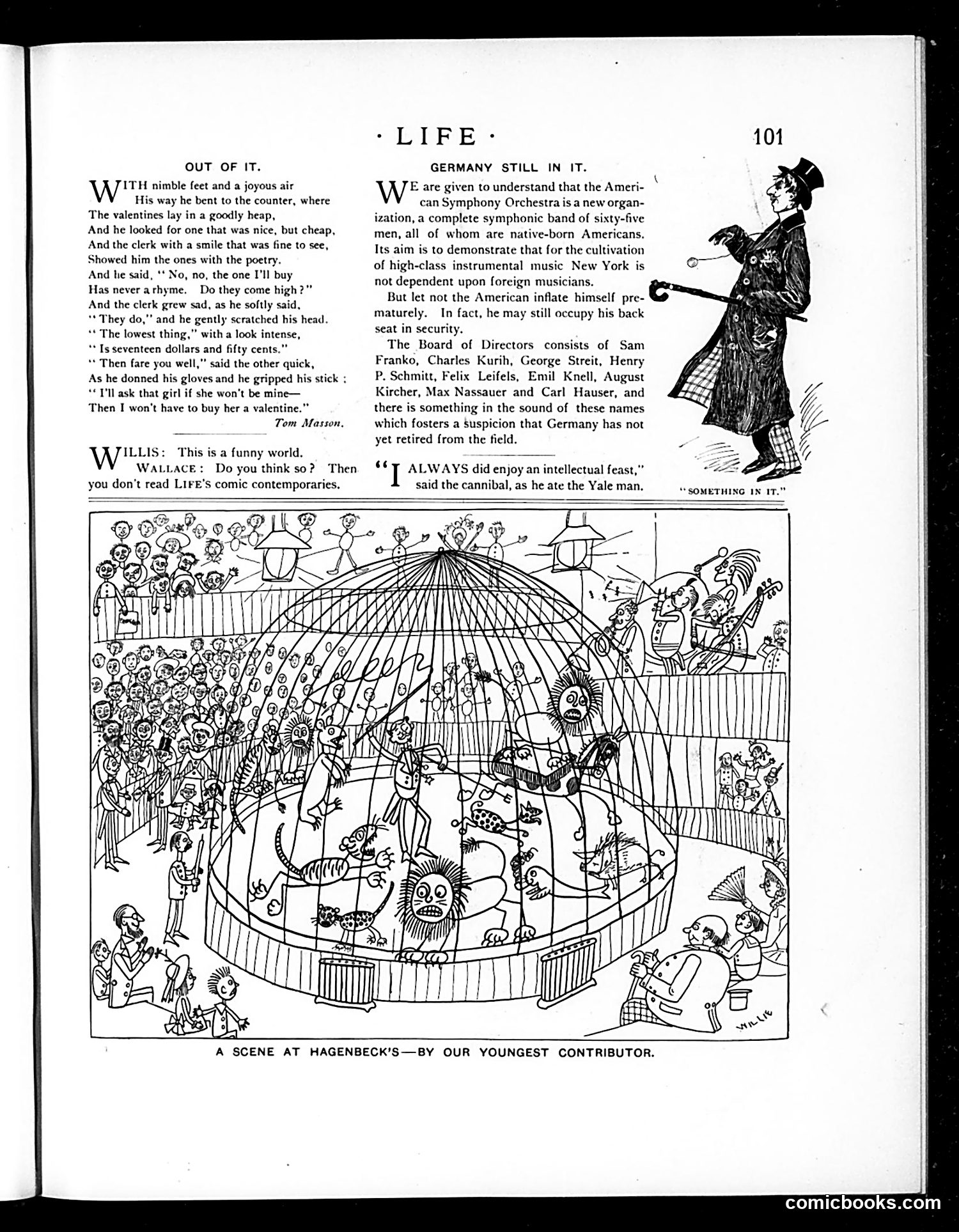
This page contains two satirical items: **"Out of It"** (top left): A poem mocking someone's attempt at sophistication—likely a nouveau riche figure trying to impress with cheap imitations of culture. The joke is that he shows off "owes" (owls) in poetry, revealing his ignorance. **"Germany Still in It"** (top right): Anti-German satire from WWI era. It mocks the American Symphony Orchestra's claim to independence from foreign musicians, noting the Board of Directors consists entirely of German names (Franko, Knuth, Nassauer, Hauser, etc.). The caricature depicts a German conductor, suggesting Germany maintains cultural influence in America despite the war. **Bottom cartoon**: "A Scene at Hagenbeck's" depicts a circus tent with exaggerated, grotesque figures—likely caricaturing foreign performers or "exotic" circus acts as objects of mockery.
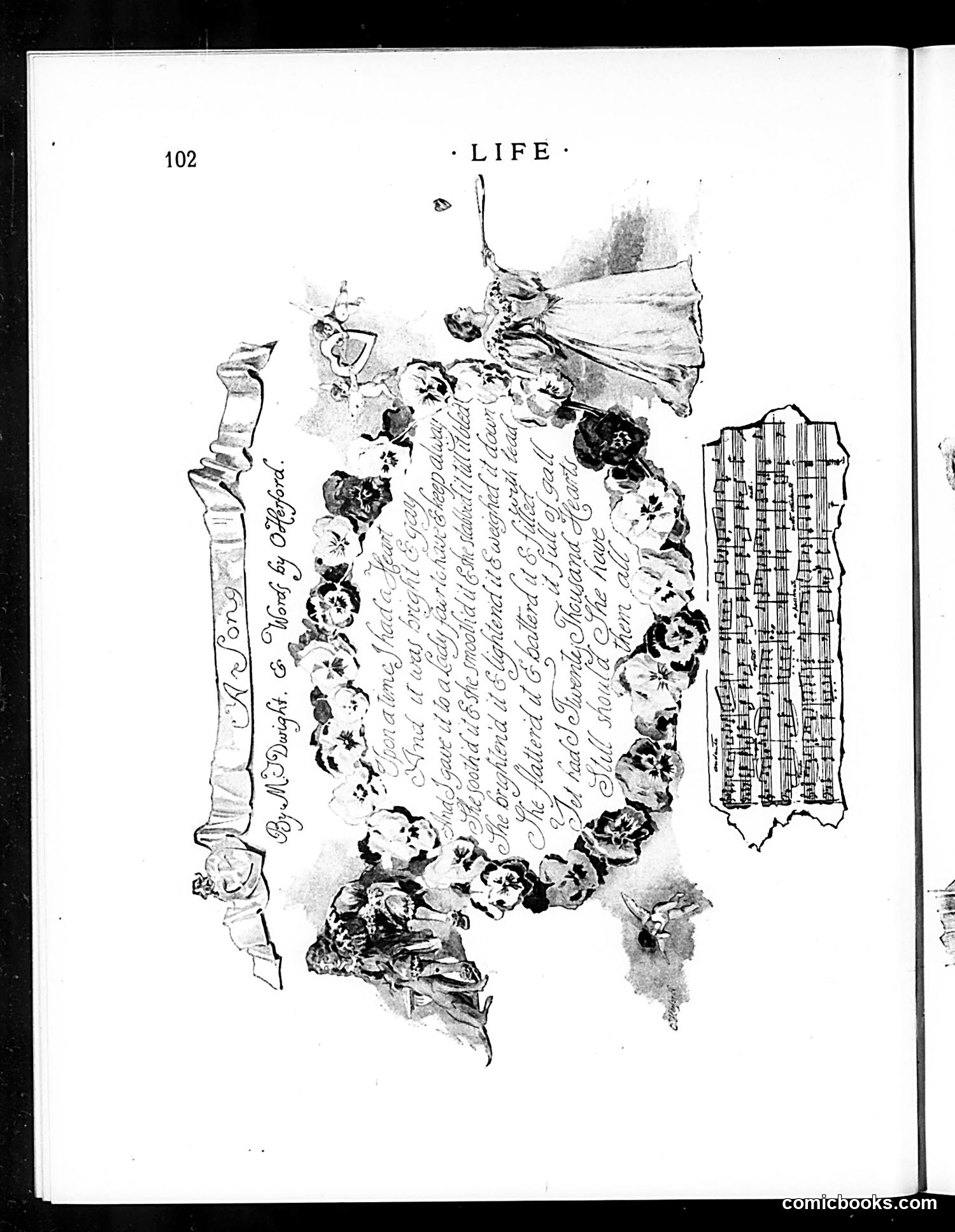
This appears to be a decorative page design from Life magazine featuring ornamental elements rather than political satire. The central element is a framed text block (content illegible in this reproduction) surrounded by floral garland decorations featuring dark blooms and leaves. On the left side runs a vertical banner labeled "By Joseph G. Sperlt" (or similar—OCR uncertain). The right side displays what appears to be an architectural or structural diagram with a grid pattern. At the top center floats a cherub or cupid figure with trailing fabric. The overall aesthetic suggests this may be a section divider, advertisement, or decorative content page rather than political commentary. Without legible text, specific satire or references cannot be determined.
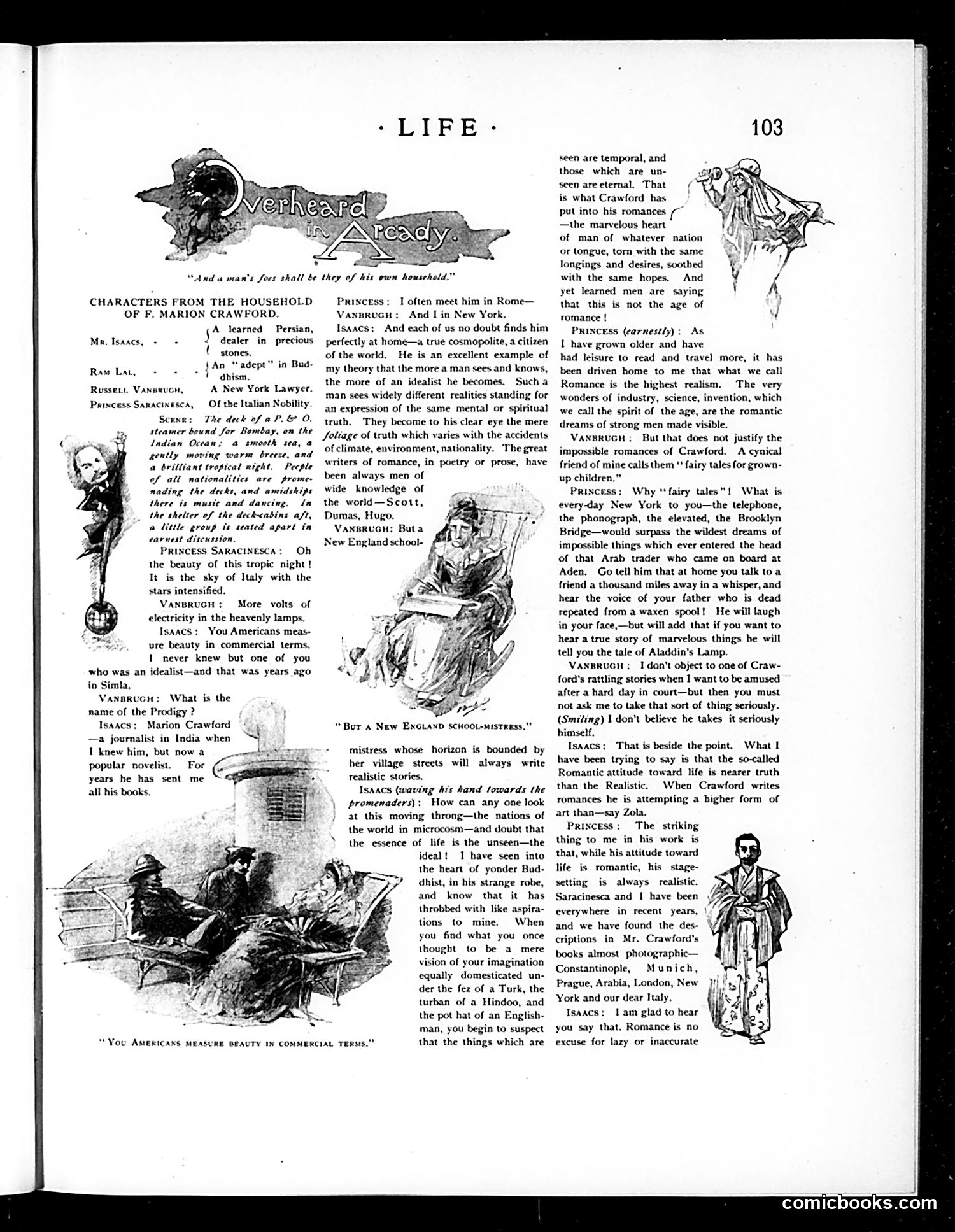
This page presents a literary discussion framed as dialogue between characters from F. Marion Crawford's work. The "Characters from the Household of F. Marion Crawford" are listed left side, including a Persian dealer, Ram Lal, Russell Vanbrugh, and a Princess. The satirical illustrations mock romantic idealism versus commercial realism. One caption reads "You Americans measure beauty in commercial terms," critiquing American materialism. The dialogue debates whether Crawford's romanticized stories (featuring exotic settings like Arabia, India, and Italy) represent genuine artistic merit or merely escapist fantasy detached from reality. The cartoons visually reinforce this tension: a figure surrounded by commercial imagery contrasts with the romantic Eastern settings described. The satire targets both Crawford's sentimental romanticism and American readers' appetite for such fantasies as commodities.
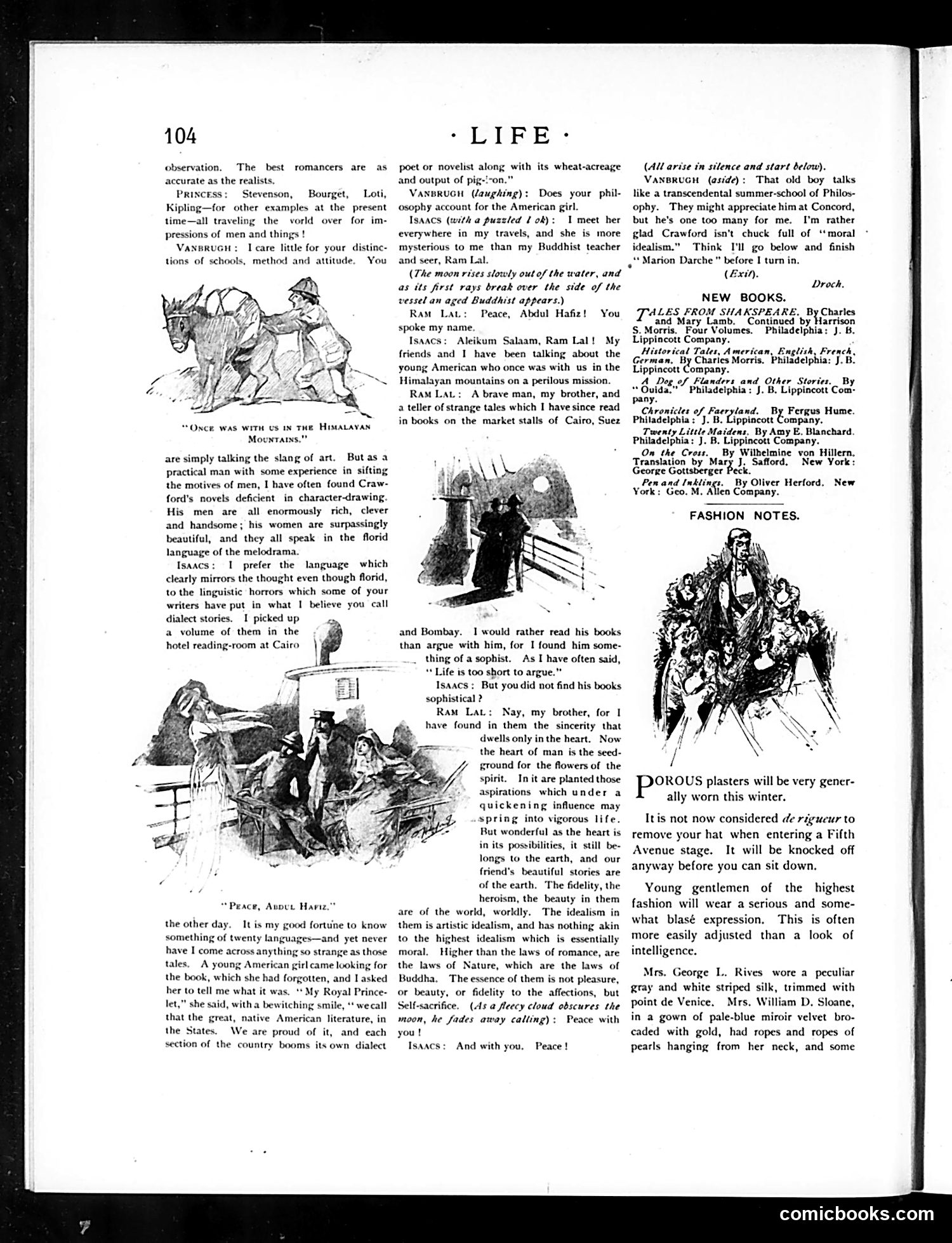
This page contains a satirical dialogue between characters named Isaacs and Ram Lal, discussing literature and American culture. The text celebrates American writers and their authenticity, contrasting them favorably with European literary traditions. The three accompanying illustrations appear to depict colonial or imperial-era scenes—including what's labeled "Once was with us in the Himalayan Mountains" and "Peace, Abdul Hafiz"—suggesting the dialogue references travel narratives and cross-cultural encounters. The "New Books" and "Fashion Notes" sections are standard magazine content. The satire seems directed at pretentious literary criticism and European cultural snobbery, arguing American literature captures genuine human experience better than sophisticated but emotionally hollow European works. The exotic illustrations reinforce themes of authenticity versus artifice in storytelling.
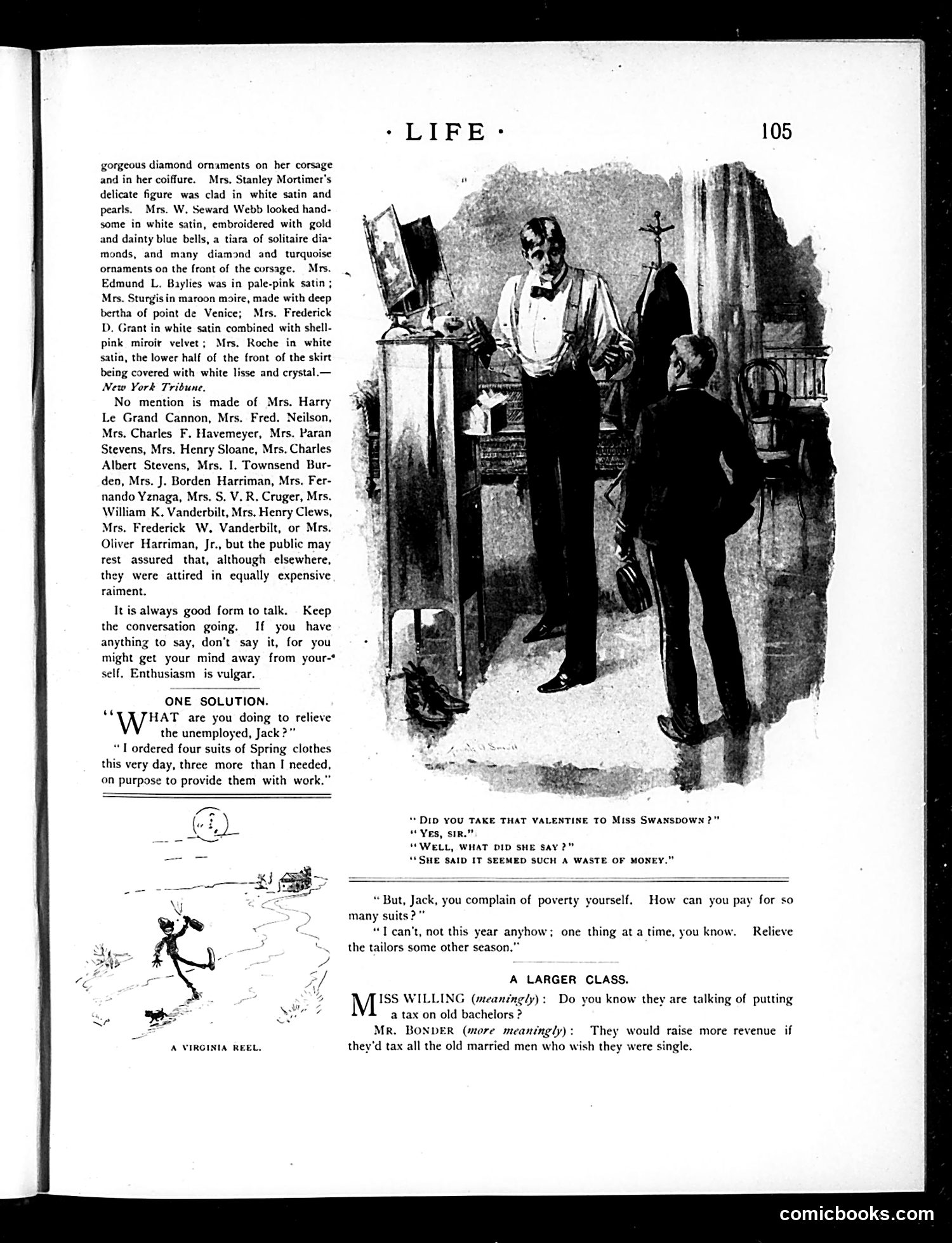
This page from *Life* magazine contains social satire about wealth and class distinctions. The upper section describes lavish formal attire worn by wealthy attendees at an event, listing expensive fabrics and jewelry in mock-admiring detail—likely satirizing conspicuous consumption among the wealthy. The main cartoon shows two men in formal dress discussing unemployment relief. One claims he ordered extra Spring clothes "on purpose to provide them with work"—a satirical jab at the wealthy's self-serving justifications for their spending habits as economic stimulus. Below, "A Virginia Reel" depicts a dancing figure, while the final dialogue between Miss Willing and Mr. Bonder jokes about taxing bachelors versus married men—satirizing tax policy debates and suggesting the wealthy use marriage strategically for financial advantage. The overall theme critiques how the rich rationalize excessive spending during economic hardship.
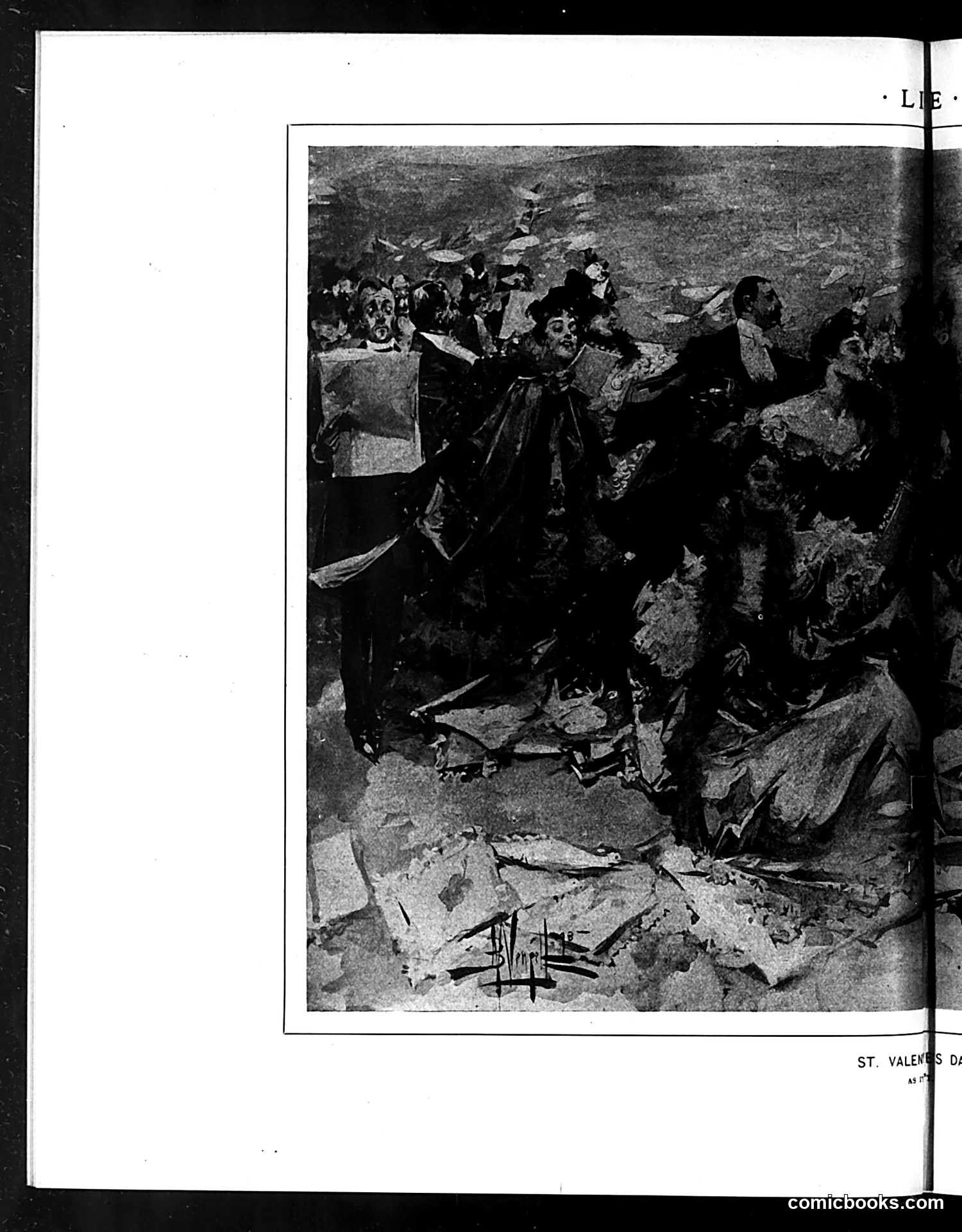
This appears to be a satirical illustration related to St. Valentine's Day. The image shows a group of figures in period dress gathered around what seems to be debris or wreckage on the ground. The composition suggests a chaotic or violent scene, with multiple figures in dark clothing positioned dramatically. The visible caption reads "ST. VALENS DA[Y]" (likely "ST. VALENTINE'S DAY"), indicating the subject matter concerns Valentine's Day celebrations or traditions. However, without additional context or clearer identification of specific figures, the exact satirical point—whether mocking romantic customs, social gatherings, or a particular historical event—remains unclear from the image alone. The dramatic staging suggests social commentary on Valentine's Day practices or expectations.
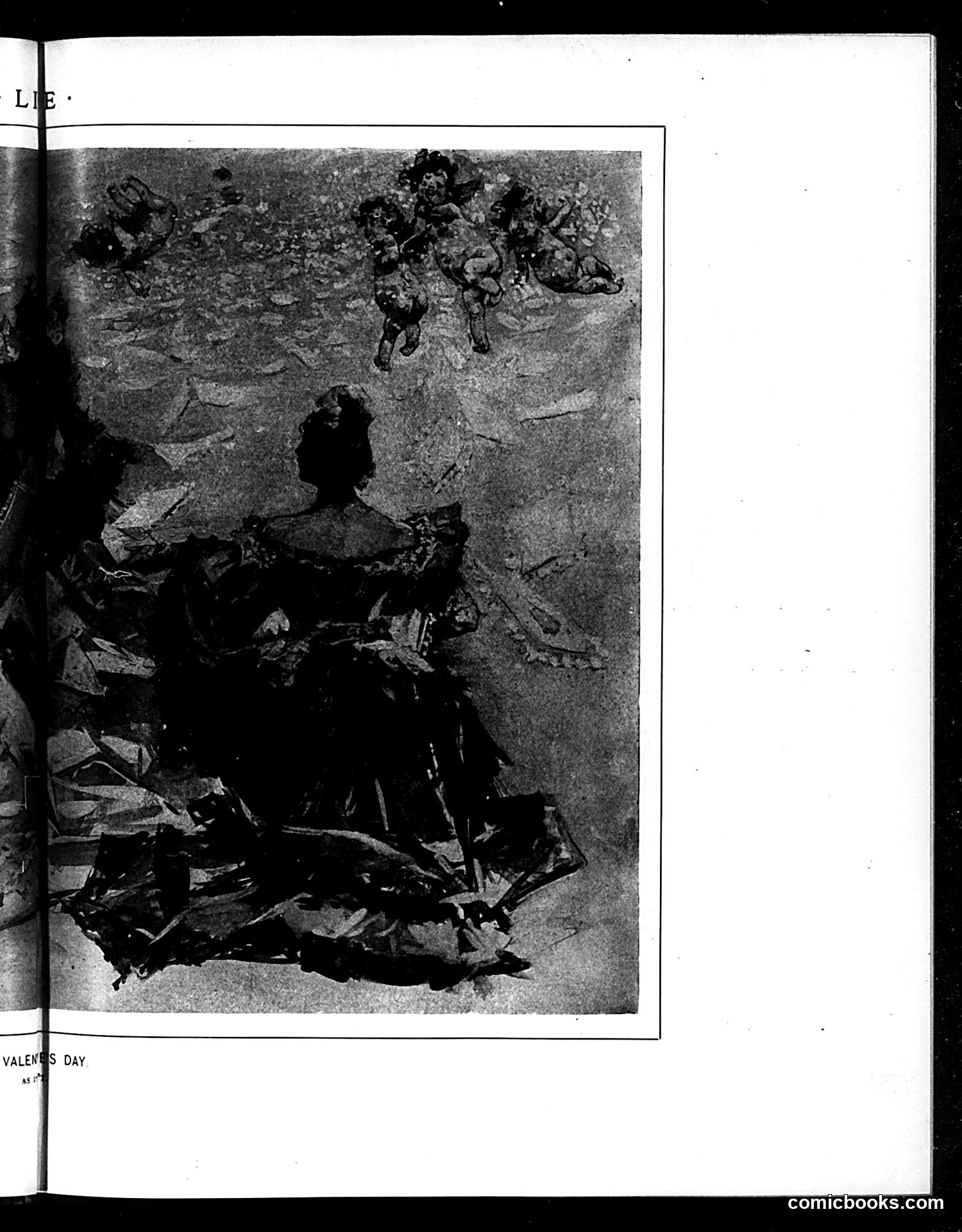
This appears to be a Valentine's Day illustration from Life magazine. The image shows a seated figure in dark clothing gazing upward at cherubs or cupids floating above in the clouds. The romantic, allegorical composition is typical of sentimental Valentine's Day imagery. The caption reads "VALENTINE'S DAY," and the illustration uses classical artistic conventions—the reclining figure, heavenly cherubs, and ethereal clouds—to depict romantic longing or reverie. Without additional context or visible text identifying specific political figures or satirical targets, this appears to be a straightforward romantic illustration rather than political satire. It exemplifies the kind of sentimental, art-based content Life magazine frequently published alongside its humor and social commentary.
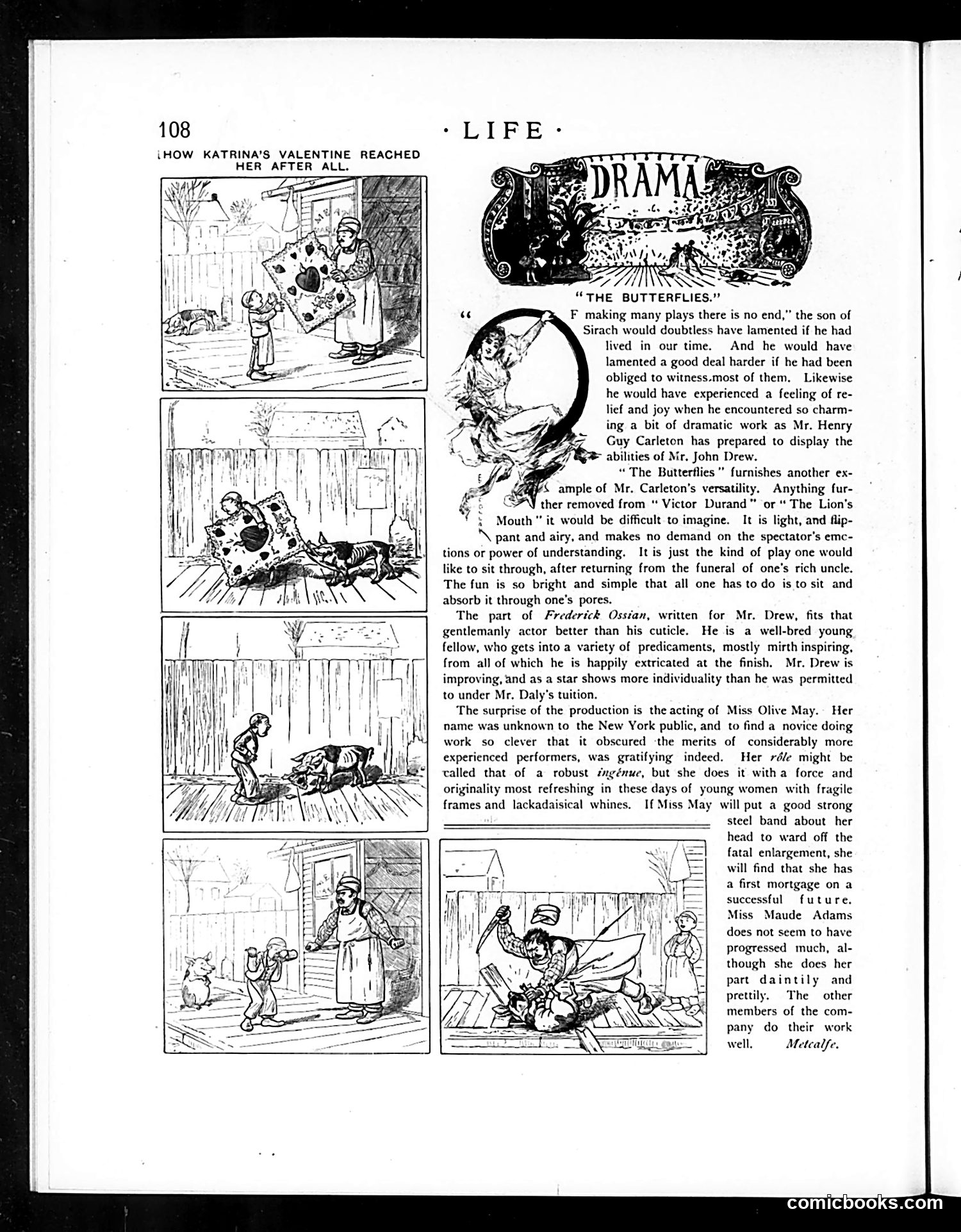
This page reviews a Broadway play titled "The Butterflies," written by Henry Guy Carleton and starring John Drew. The left side shows a comic strip depicting how "Katrina's Valentine reached her after all"—a humorous subplot involving a child chasing butterflies to deliver a valentine message. The review praises the light, escapist nature of the play, calling it perfect entertainment after attending a funeral. Drew performs well as the lead character Frederick Osstan, showing more individuality than under his previous director Daly. The surprise success is novice actress Miss Olive May, praised for her robust, energetic performance—a refreshing contrast to the "fragile frames and lackadaisical whines" of typical young actresses of the era. The reviewer gently warns she should protect herself from "fatal enlargement" (likely meaning weight gain). Miss Maude Adams receives mild criticism for merely adequate work. The piece illustrates early 1900s theater criticism and period attitudes toward women performers.
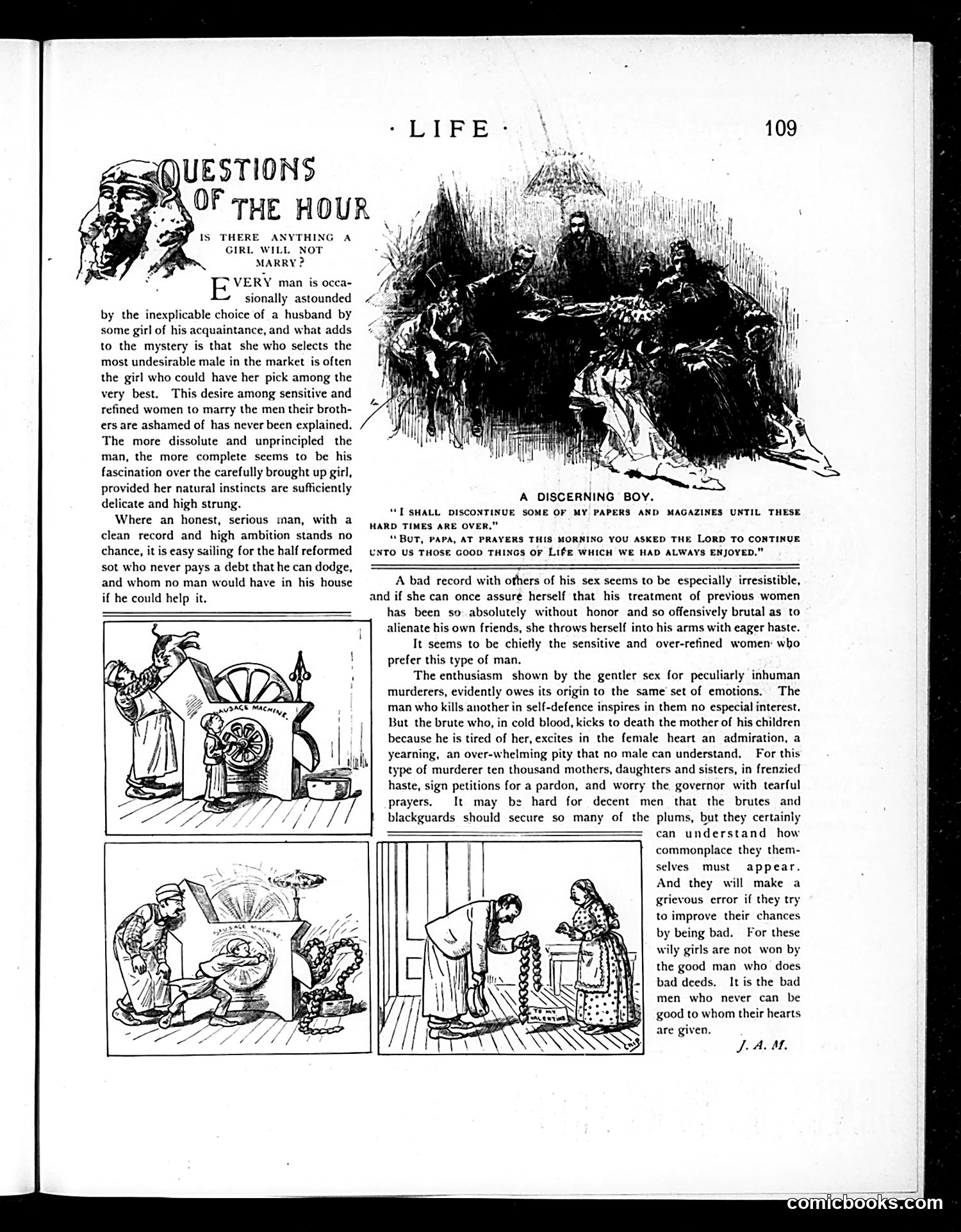
This page contains a satirical essay titled "Questions of the Hour: Is There Anything a Girl Will Not Marry?" alongside a separate humorous cartoon vignette. **The Main Essay** attacks what the author sees as the paradoxical attraction refined, sensitive women feel toward disreputable men—"dissolute and unprincipled" types with bad records—rather than honest, ambitious suitors. The piece sarcastically suggests such women are drawn to brutality and dishonor, even citing their sympathy for brutal murderers. The author's tone is misogynistic, blaming women for inexplicable poor judgment. **"A Discerning Boy"** cartoon depicts a child catching his father in hypocrisy: the father announces cutting subscriptions due to "hard times," yet that morning prayed for God to "continue unto us those good things of life which we had always enjoyed." The satire highlights middle-class economic anxiety during what appears to be a financial crisis, and the contradiction between religious piety and practical self-interest. The three smaller illustrations below show domestic scenes, likely reinforcing themes of family economics and morality.
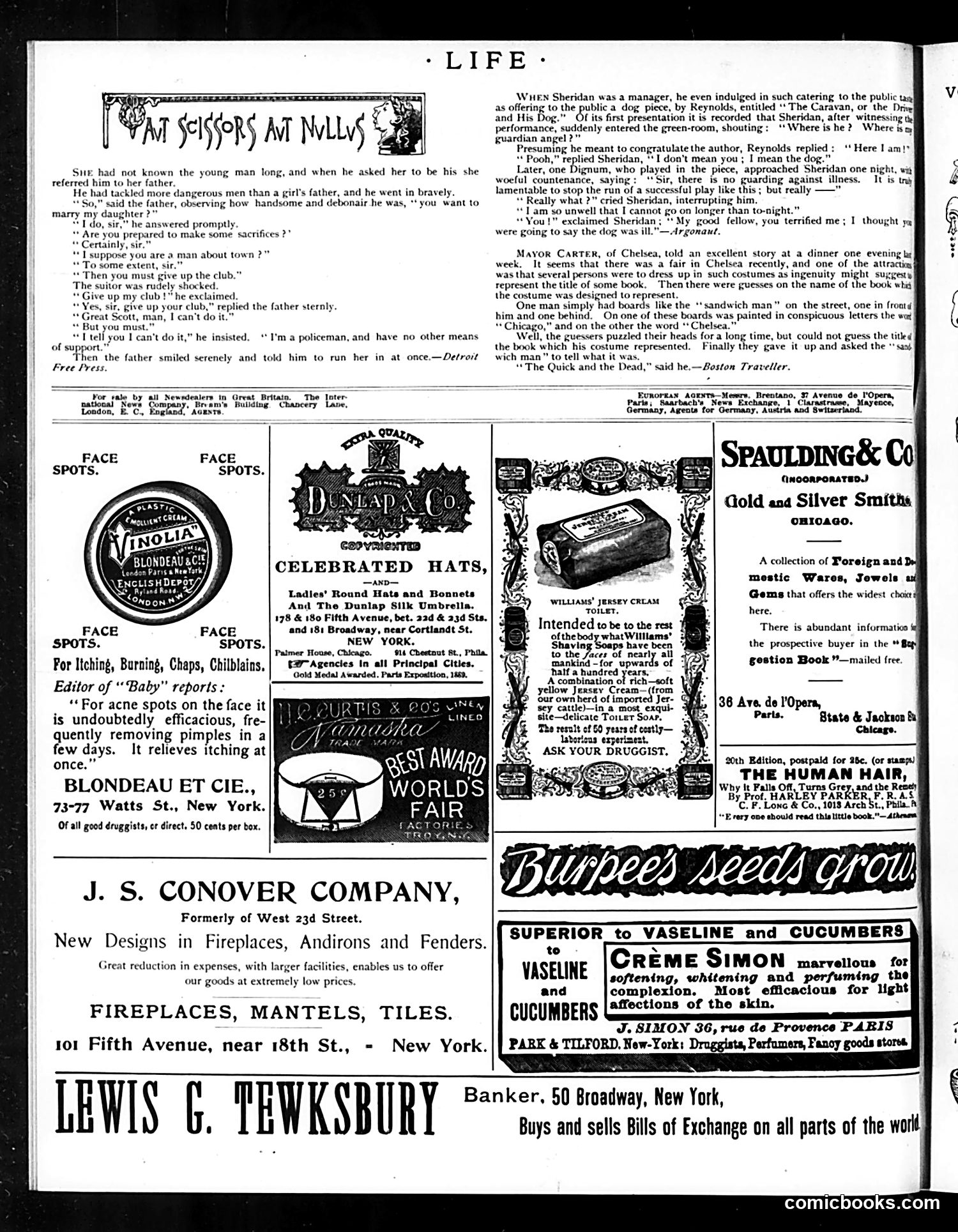
This page contains **three humorous anecdotes** aimed at late-19th-century readers: 1. **"Scissors at Nullys"** (top): A young man seeks a girl's father's permission to marry. The father demands he give up his club—a gentleman's social institution. When the suitor refuses, the father reveals he's a policeman with no income, so he tells him to "run her in" (arrest her). The joke mocks both paternal authority and police corruption. 2. **Sheridan anecdote**: Theater manager Richard Brinsley Sheridan, after watching a play called *The Caravan, or the Driver and His Dog*, ignores the human author to praise the dog—satirizing public taste prioritizing spectacle over dramatic merit. 3. **Chelsea Fair costume puzzle**: A man dressed as a "sandwich board" with "20" and "Chelsea" written on front and back represents *The Quick and the Dead*—a visual/verbal pun playing on a famous phrase. The page is **primarily advertising** for beauty products, hats, and business services, interspersed with these light satirical stories typical of *Life* magazine's humor.