
Life, 1894-02-15 · page 4 of 14
Life — February 15, 1894 — page 4: what you’re looking at
What you’re looking at
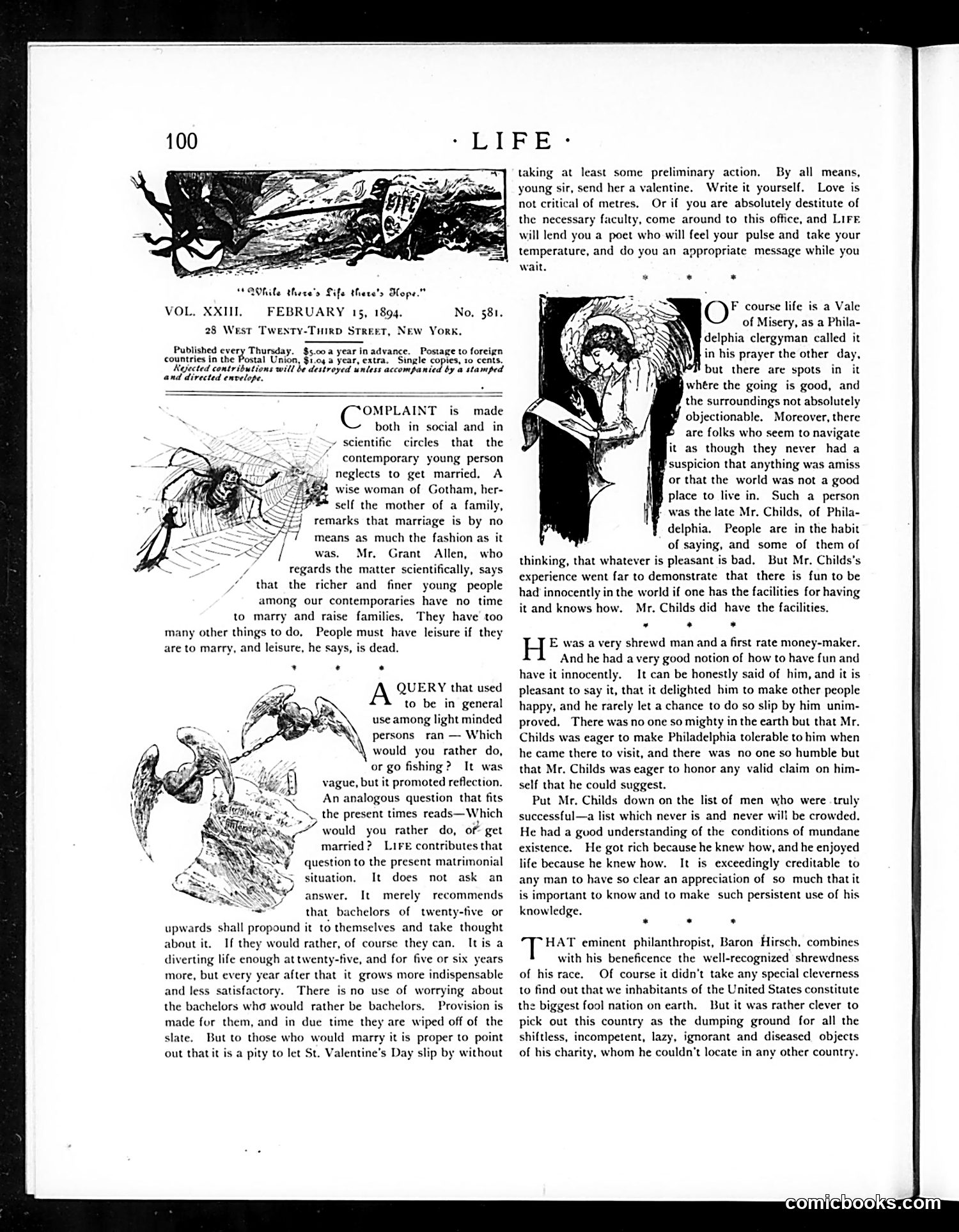
This page contains three separate editorial cartoons addressing marriage and social customs: 1. **Top left**: A skeletal or death figure labeled "While there's Life there's Hope"—satirizing the grim prospects of marriage. 2. **Center**: Allegorical figures (appearing to represent cupids or cherubs) accompanying text questioning whether young unmarried men should marry. The cartoon supports remaining single, arguing bachelors enjoy superior leisure and freedom compared to married men burdened by family obligations. 3. **Right column**: Discusses Mr. Childs of Philadelphia, apparently a wealthy philanthropist. The text praises his shrewd money-making abilities and charitable work, though it also critiques him for choosing America as a dumping ground for "shiftless, incompetent, lazy, ignorant and diseased objects"—likely referencing immigration debates of the 1890s. The overall theme critiques both marriage as a trap and selective philanthropy.
📄 Transcribed text from this page (OCR, searchable)
Machine-transcribed from the original scan — historical spelling and the odd misread are preserved.
“QOMile there's Life there's Hope.” XXIII. FEBRUARY 15, 1894. No, 581. 28 West Twenty-Tiirp Street, New York. VOL. Published every Thursday. $5.00 a year in advance. Postage to foreign countries in the Postal Union, $1.04 a year, extra. Single copies, 10 cents, Kujected contributions will be destroyed unless accompanied by a stamped and directed envelope. OMPLAINT is made both in social and in - scientific circles that the contemporary young person neglects to get married. A wise woman of Gotham, her- self the mother of a family, remarks that marriage is by no SS} ‘7 means as much the fashion as it 2 | was. Mr. Grant Allen, who regards the matter scientifically, says that the richer and finer young people among our contemporaries have no time to marry and raise families, They have too many other things to do, People must have leisure if they are to marry, and leisure, he says, is dead. A QUERY that used to be in general use among light minded persons ran — Which would you rather do, or go fishing? It was vague, but it promoted reflection. An analogous question that fits the present times reads—Which Tee » would you rather do, of get married? LiFe contributes that question to the present matrimonial situation, It does not ask an answer. It merely recommends that bachelors of twenty-five or upwards shall propound it to themselves and take thought about it. If they would rather, of course they can. Itis a diverting life enough at twenty-five, and for five or six years more, but every year after that it grows more indispensable and less satisfactory. There is no use of worrying about the bachelors who would rather be bachelors. Provision is made for them, and in due time they are wiped off of the slate. But to those who would marry it is proper to point out that it is a pity to let St. Valentine's Day slip by without taking at least some preliminary action. By all means, young sir, send her a valentine. Write it yourself. Love is not critical of metres. Or if you are absolutely destitute of the necessary faculty, come around to this office, and LIFE will lend you a poet who will feel your pulse and take your temperature, and do you an appropriate message while you * course life is a Vale of Misery, as a Phila- delphia clergyman called it in his prayer the other day, N but there are spots in it W where the going is good, and the surroundings not absolutely P objectionable. Moreover, there are folks who seem to navigate it as though they never had a suspicion that anything was amiss or that the world was not a good place to live in. Such a person was the late Mr. Childs, of Phila- delphia. People are in the habit of saying, and some of them of thinking, that whatever is pleasant is bad. But Mr. Childs’s experience went far to demonstrate that there is fun to be had innocently in the world if one has the facilities for having it and knows how. Mr. Childs did have the facilities. . . . E was a very shrewd man and a first rate money-maker. And he had a very good notion of how to have fun and have it innocently. It can be honestly said of him, and it is pleasant to say it, that it delighted him to make other people happy, and he rarely let a chance to do so slip by him unim- proved. There was no one so mighty in the earth but that Mr. Childs was eager to make Philadelphia tolerable to him when he came there to visit, and there was no one so humble but that Mr. Childs was eager to honor any valid claim on him- self that he could suggest. Put Mr. Childs down on the list of men who were truly successful—a list which never is and never will be crowded. He had a good understanding of the conditions of mundane existence. He got rich because he knew how, and he enjoyed life because he knew how. It is exceedingly creditable to any man to have so clear an appreciation of so much thatit is important to know and to make such persistent use of his knowledge. . . . pest eminent philanthropist, Baron Hirsch, combines with his beneficence the well-recognized shrewdness of his race. to find out that we inhabitants of the United States constitute Of course it didn't take any special cleverness the biggest fool nation on earth, But it was rather clever to pick out this country as the dumping ground for all the shiftless, incompetent, lazy, ignorant and diseased objects of his charity, whom he couldn’t locate in any other country.