
Life, 1894-02-15 · page 8 of 14
Life — February 15, 1894 — page 8: what you’re looking at
What you’re looking at
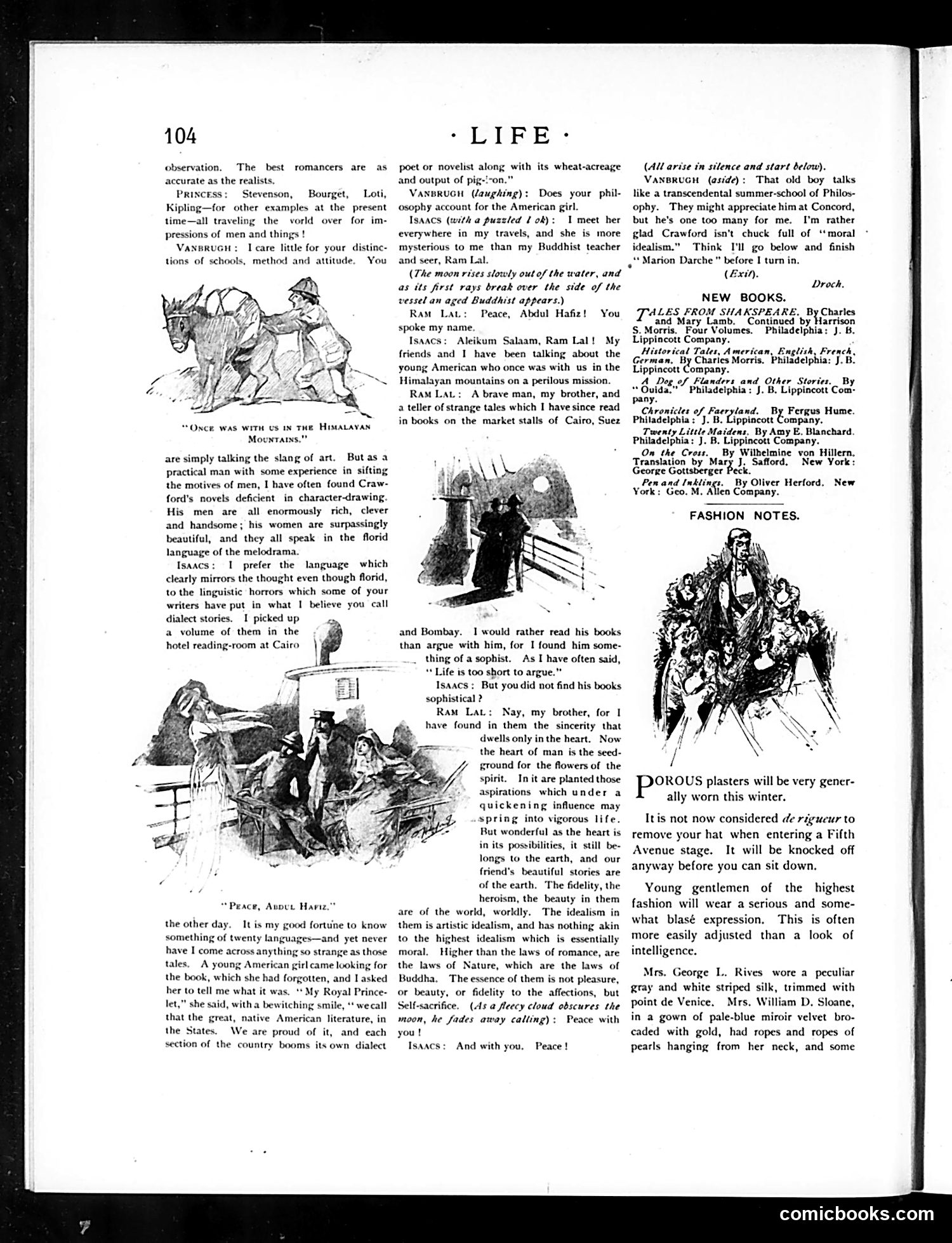
This page contains a satirical dialogue between characters named Isaacs and Ram Lal, discussing literature and American culture. The text celebrates American writers and their authenticity, contrasting them favorably with European literary traditions. The three accompanying illustrations appear to depict colonial or imperial-era scenes—including what's labeled "Once was with us in the Himalayan Mountains" and "Peace, Abdul Hafiz"—suggesting the dialogue references travel narratives and cross-cultural encounters. The "New Books" and "Fashion Notes" sections are standard magazine content. The satire seems directed at pretentious literary criticism and European cultural snobbery, arguing American literature captures genuine human experience better than sophisticated but emotionally hollow European works. The exotic illustrations reinforce themes of authenticity versus artifice in storytelling.
📄 Transcribed text from this page (OCR, searchable)
Machine-transcribed from the original scan — historical spelling and the odd misread are preserved.
104 observation. The best accurate as the realists, PRINCESS: Stevenson, Bourget, Loti, Kipliog—for other examples at the present time—all traveling the for im- pressions of men and things ! Vansrucn: Lcare little for your distine- tions of schools, method and attitude. You romancers are as vorld over “Once WAS WITH US IN THE HIMALAYAN Mowunratns.”” are simply talking the slang of art, But as a practical man with some experience in sifting the motives of men, I have often found Craw- ford's novels deficient. in character-drawing. His men are all enormously rich, clever and handsome; his women are surpassingly beautiful, and they all speak in the florid language of the melodrama. Isaacs: I prefer the language which clearly mirrors the thought even though florid, to the linguistic horrors which some of your writers have put in what I believe you call dialect stories. I picked up a volume of them in the hotel reading-room at Cairo “Peace, Auput Hariz,” the other day. It is my good fortuine to know something of twenty languages—and yet never have I come across anything so strange as those tales. A young American girl came looking for the book, which she had forgotten, and I asked her to tell me what it was. ** My Royal Prince- let,” she said, with a bewitching smile, “ wecall that the great, native American literature, in the States. We are proud of it, and each section of the country booms its own dialect - LIFE: poet or novelist along with its wheat-acreage and output of pig-!-on.” Vanprucn (laughing): Does your phil- osophy account for the American girl. Isaacs (with a puzzled ¢ ok): 1 meet her everywhere in my travels, and she is more mysterious to me than my Buddhist teacher and seer, Ram Lal. (The moon rises slowly out of the water, and as its first rays break over the side of the vessel an aged Buddhist appears.) Ram Lat: Peace, Abdul Hafiz! spoke my name. Isaacs: Aleikum Salaam, Ram Lal! My friends and I have been talking about the young American who once was with us in the Himalayan mountains on a perilous mission. Ram Lat: A brave man, my brother, and a teller of strange tales which I have since read in books on the market stalls of Cairo, Suez You and Bombay. I would rather read his books than argue with him, for I found him some- thing of a sophist. As I have often said, ** Life is too short to argue." Isaacs: But you did not find his books sophistical ? Raw Lat: Nay, my brother, for I have found in them the sincerity that dwells only in the heart. Now the heart of man is the seed- ground for the flowers of the Init are planted those aspirations which under a quickening influence may spring into vigorous life. But wonderful as the heart is in its possibilities, it still be- longs to the earth, and our friend's beautiful stories are of the earth. ‘The fidelity, the heroism, the beauty in them are of the world, worldly. The idealism in them is artistic idealism, and has nothing akin to the highest idealism which is essentially moral. Higher than the laws of romance, are the laws of Nature, which are the laws of Buddha, The essence of them is not pleasure, or beauty, or fidelity to the affections, but Self-sacrifice. (As @ fleecy cloud obscures the moon, he fades away calling): Peace with you! Isaacs : And with you, Peace! (AU arise in silence and start below). VaNBRUGH (aside): That old boy talks like a transcendental summer-school of Philos- ophy. They might appreciate him at Concord, but he's one too many for me. I’m rather glad Crawford isn't chuck full of ‘moral idealism.” Think I'll go below and finish Marion Darche" before I turn in. (Exif. NEW BOOKS. TALES FROM SHAKSPEARE, By Charles and Mary Lamb. Continued ‘by Harrison $. Morris. Four Volumes. Philadelphia: J. 6. Lippincott Company. Historical Tales, American, Englith, French, German. By Charies Morris. Philadelphia: J. B: Lippincott Company. ef Flanders and Other Stories. By *” Philadelphia : J. B. Lippincott Com: Droch. Chronicles of Faeryland. By Fergus Hume. Philadelphia :”J. B. Cippiacott Company. Twenty Little Maidens, By Amy E. Blanchard Philadelphia: J. B. Lippincott Company. On the Cross. By Wilhelmine von Hillern, Translation by Mary J. Safford, New York: George Gottsberger Peck. Pen and Inklings, By Oliver Herford, New York: Geo. M. Allen Company. FASHION NOTES. OROUS plasters will be very gener- ally worn this winter. Itis not now considered de rigueur to remove your hat when entering a Fifth Avenue stage. It will be knocked off anyway before you can sit down. Young gentlemen of the highest fashion will wear a serious and some- what blasé expression. This is often more easily adjusted than a look of intelligence. Mrs. George L. Rives wore a peculiar gray and white striped silk, trimmed with point de Venice, Mrs. William D. Sloane, in a gown of pale-blue miroir velvet _bro- caded with gold, had ropes and ropes of pearls hanging from her neck, and some comicbooks.com