
Life, 1894-02-15 · page 7 of 14
Life — February 15, 1894 — page 7: what you’re looking at
What you’re looking at
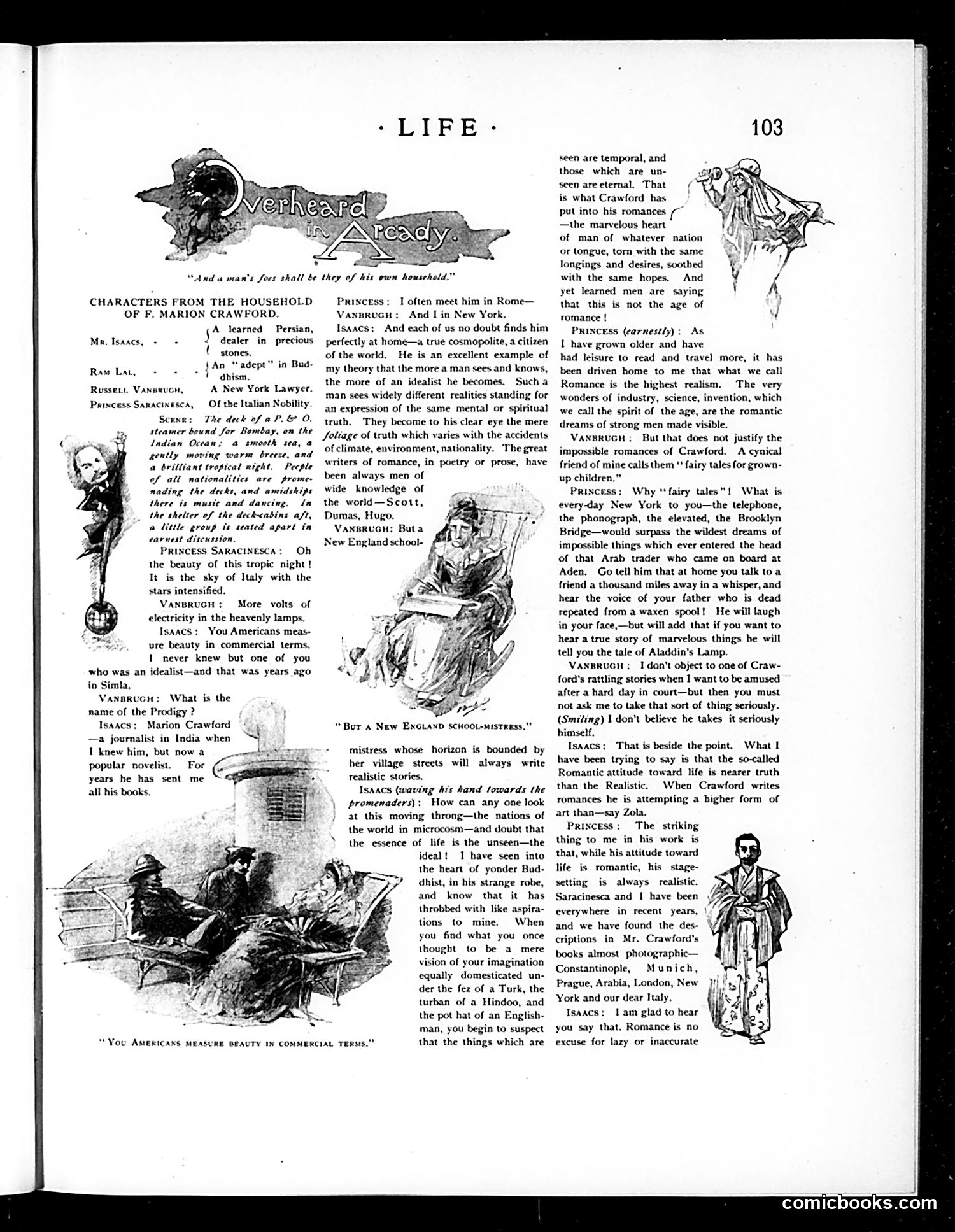
This page presents a literary discussion framed as dialogue between characters from F. Marion Crawford's work. The "Characters from the Household of F. Marion Crawford" are listed left side, including a Persian dealer, Ram Lal, Russell Vanbrugh, and a Princess. The satirical illustrations mock romantic idealism versus commercial realism. One caption reads "You Americans measure beauty in commercial terms," critiquing American materialism. The dialogue debates whether Crawford's romanticized stories (featuring exotic settings like Arabia, India, and Italy) represent genuine artistic merit or merely escapist fantasy detached from reality. The cartoons visually reinforce this tension: a figure surrounded by commercial imagery contrasts with the romantic Eastern settings described. The satire targets both Crawford's sentimental romanticism and American readers' appetite for such fantasies as commodities.
📄 Transcribed text from this page (OCR, searchable)
Machine-transcribed from the original scan — historical spelling and the odd misread are preserved.
“Anda man's foes shall be they of his own household.” CHARACTERS FROM THE HOUSEHOLD OF F. MARION CRAWFORD. i‘ learned Persian, dealer in precious stones. a jane ta A New York Lawyer. Of the Italian Nobility Scune: The deck of aP.& O. steamer bound for Bombay, on the Indian Ocean; @ smooth sea, a gently moving warm breeze, and a brilliant tropical night. Pecple of all nationalities are prome- nading the decks, and amidships there is music and dancing. In _ the shelter of the deckecabins aft, a little group is seated apart in earnest discussion, PRINCESS SARACINESCA: Oh the beauty of this tropic night ! It is the sky of Italy with the stars intensified. VANBRUGH : More volts of electricity in the heavenly lamps, Isaacs: You Americans meas- ure beauty in commercial terms. 1 never knew but one of you who was an idealist—and that was years ago in Simla, VanerucH: What is the name of the Prodigy ? Isaacs: Marion Crawford —a journalist in India when 1 knew him, but now a é Mr. Isaacs, = + Russert. Vanauc PRINCESS SARACINESCA, ay popular novelist. For years he has sent me all his books. “You AMERICANS MEASURE BEAUTY IN COMMERCIAL TERMS," Princess: I often meet him in Rome— VanaruGi: And I in New York. Isaacs: And each of us no doubt finds him perfectly at home—a true cosmopolite, a citizen of the world, He is an excellent example of my theory that the more a man sees and knows, the more of an idealist he becomes. Such a man sees widely different realities standing for an expression of the same mental or spiritual truth. They become to his clear eye the mere Joliage of truth which varies with the accidents of climate, environment, nationality, The great writers of romance, in poetry or prose, have been always men of wide knowledge of the world—Scott, Dumas, Hugo. VaNpRUGH: Buta New England school- “ But a New ExcLanD SCHOOL-misTREss.”” mistress whose horizon is bounded by her village streets will always write realistic stories. ISAACS (waving his hand towards the promenaders): How can any one look at this moving throng—the nations of the world in microcosm—and doubt that the essence of life is the unseen—the ideal! 1 have seen into the heart of yonder Bud- dhist, in his strange robe, and know that it has throbbed with like aspira- tions to mine. When you find what you once thought to be a mere vision of your imagination equally domesticated un- der the fez of a Turk, the turban of a Hindoo, and the pot hat of an English- man, you begin to suspect that the things which are seen are temporal, and those which are un- seen are eternal. That is what Crawford has put into his romances ~ —the marvelous faa! of man of whatever nation or tongue, torn with the same longings and desires, soothed with the same hopes. And yet learned men are saying that this is not the age of romance ! PRINCESS (earnestly): As I have grown older and have had leisure to read and travel more, it has been driven home to me that what we call Romance is the highest realism. The very wonders of industry, science, invention, which we call the spirit of the age, are the romantic dreams of strong men made visible. VaNBRUGH : But that does not justify the impossible romances of Crawford. A cynical friend of mine calls them ** fairy tales for grown- up children.” Prixci Why “fairy tales"! What is every-day New York to you—the telephone, the phonograph, the elevated, the Brooklyn Bridge—would surpass the wildest dreams of impossible things which ever entered the head of that Arab trader who came on board at Aden. Go tell him that at home you talk to a friend a thousand miles away in a whisper, and hear the voice of your father who is dead repeated from a waxen spool! He will laugh in your face,—but will add that if you want to hear a true story of marvelous things he will tell you the tale of Aladdin's Lamp. VANBRUGH ; I don't object to one of Craw- ford's rattling stories when I want to be amused after a hard day in court—but then you must not ask me to take that sort of thing seriously. (Smiting) 1 don't believe he takes it seriously himself, Isaacs: That is beside the point. What I have been trying to say is that the so-called Romantic attitude toward life is nearer truth than the Reali When Crawford writes romances he is attempting a higher form of art than—say Zola. Princess: The striking thing to me in his work is that, while his attitude toward life is romantic, his stage- setting is always realistic. Saracinesca and | have been everywhere in recent years, and we have found the des- criptions in Mr. Crawford's books almost photographic— Constantinople, Munich, Prague, Arabia, London, New York and our dear Italy. Isaacs: 1am glad to hear you say that, Romance is no excuse for lazy or inaccurate comicbooks.com