
A complete issue · 14 pages · 1894
Life — February 1, 1894
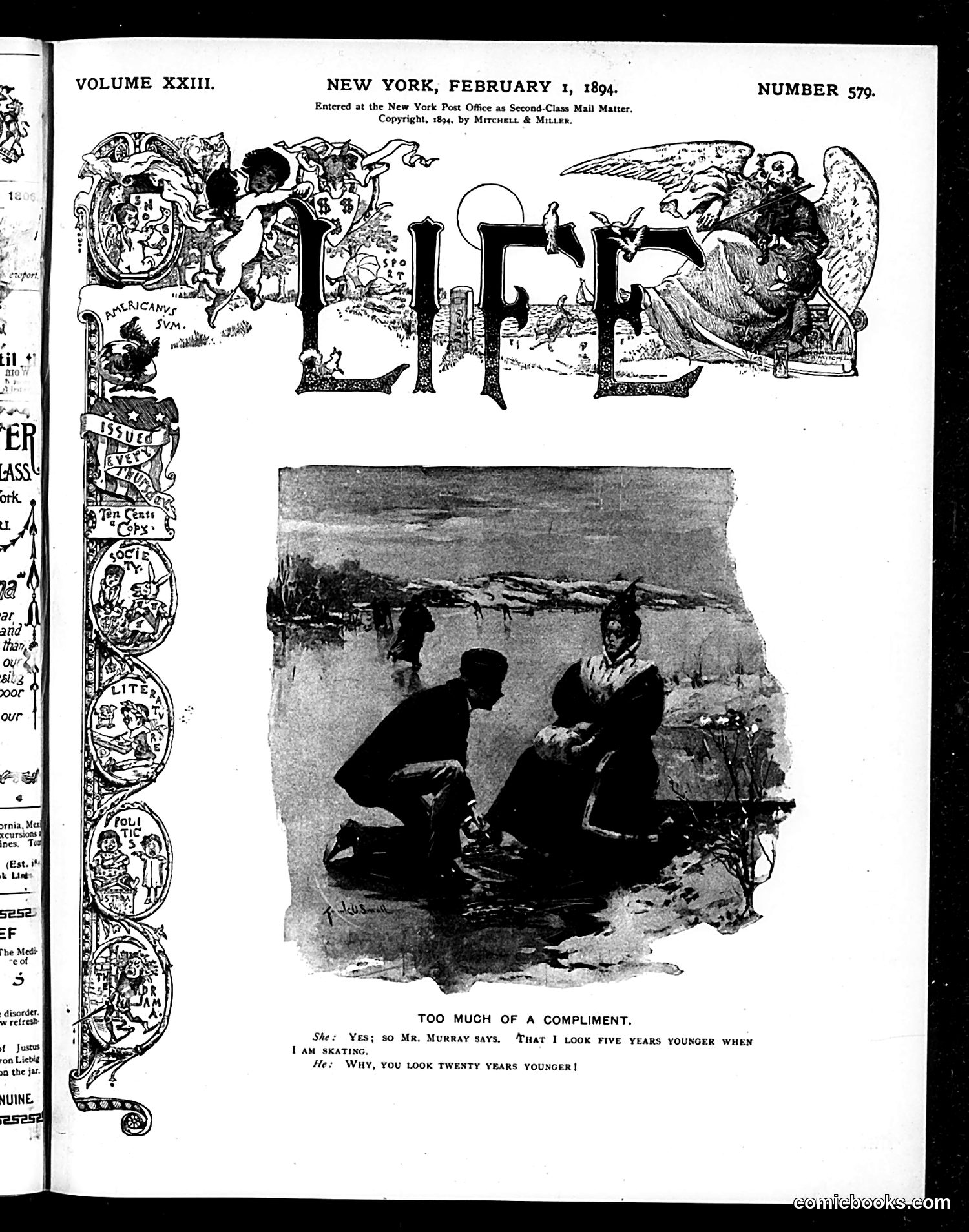
This page features a single cartoon with a domestic humor joke. The image shows a couple ice skating together. The caption reads: the woman says she looks five years younger when skating; the man replies that she looks twenty years younger. The joke is a backhanded compliment—the man's response implies the woman actually looks quite old normally (twenty years older than she does while skating), making his remark seem insulting despite appearing flattering on the surface. This plays on the Victorian-era trope of making ostensibly kind observations that inadvertently reveal unflattering truths about someone's appearance. The ornate left border contains decorative vignettes typical of Life's design aesthetic from this period.
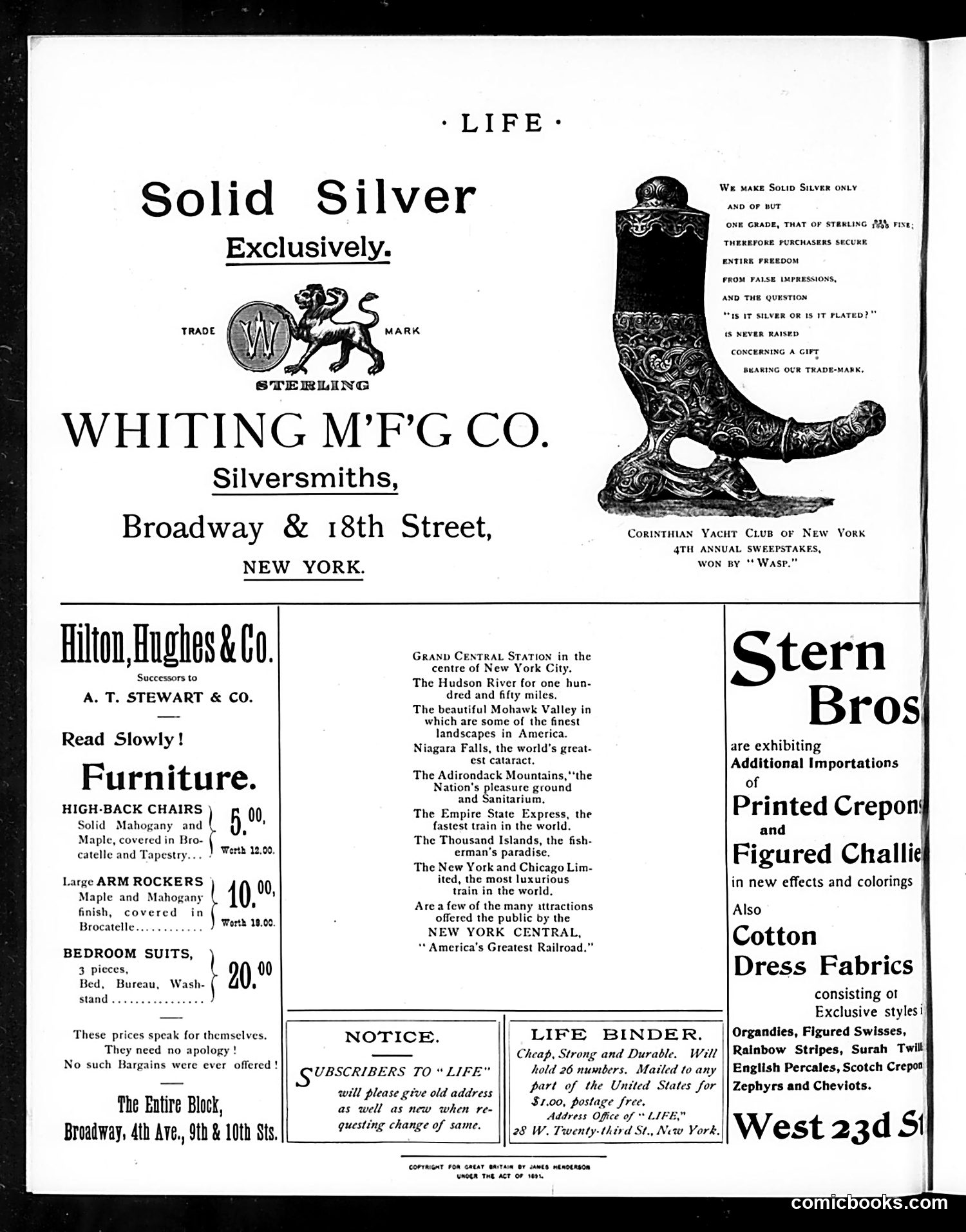
This page is primarily **advertising**, not satire or political commentary. The main content features: 1. **Whiting M'FG Co.** advertisement emphasizing their sterling silver products are solid silver exclusively, addressing consumer concerns about plated ("false") silver. 2. **A decorative trophy image** labeled as won by "Wasp" in the Corinthian Yacht Club's 4th annual sweepstakes—likely promoting the silverware's prestige. 3. **Furniture and fabric advertisements** from various retailers (Hilton Hughes & Co., Stern Bros.). 4. A **notice** for Life magazine subscribers regarding address changes. The "satire" here is subtle: Whiting's advertisement defensively emphasizes authenticity ("Is it silver or is it plated?"), suggesting contemporary consumer skepticism about product quality—a legitimate concern during this era of industrial manufacturing.
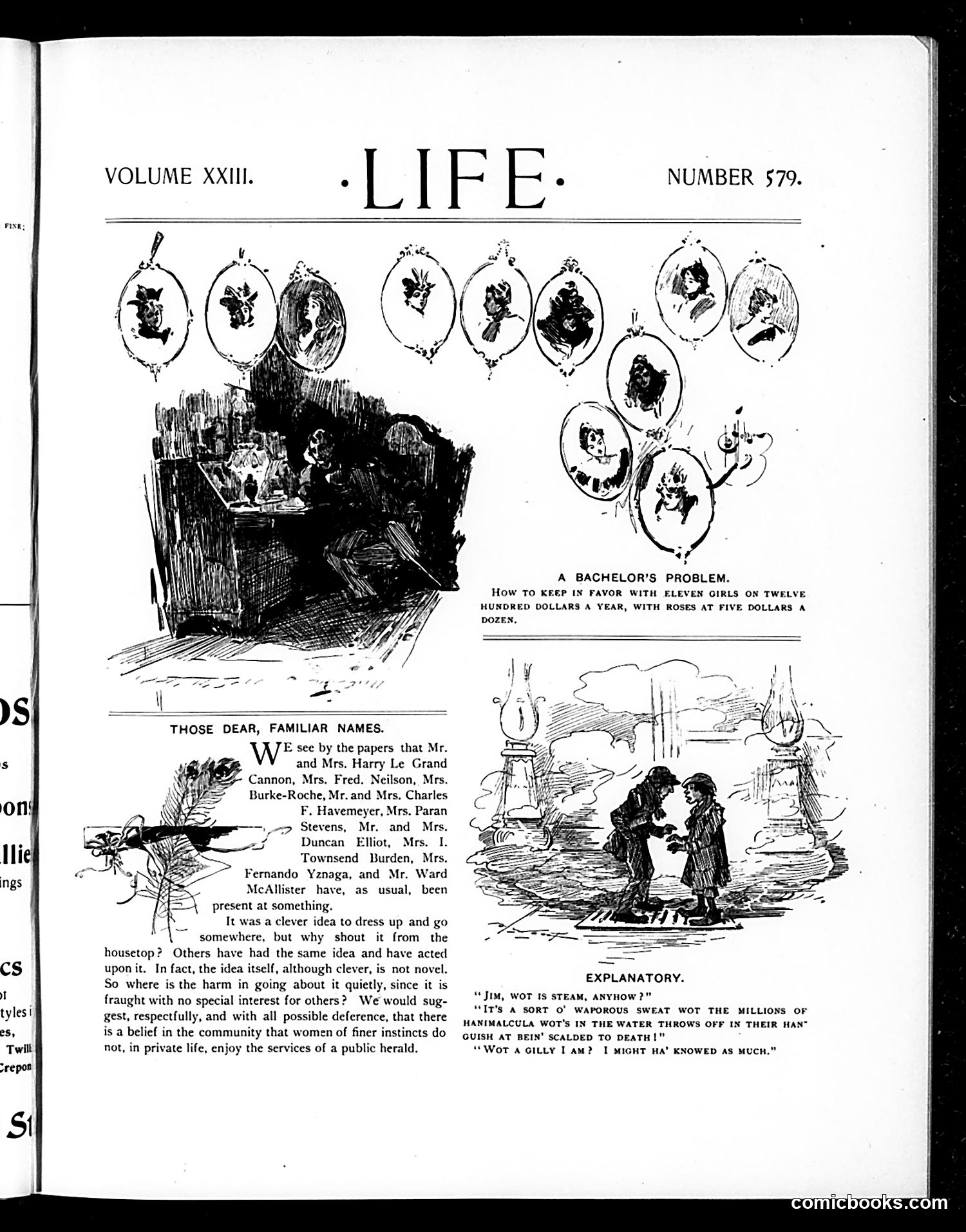
This page from *Life* magazine (Volume XXIII, No. 579) contains two distinct pieces of satire: **"Those Dear, Familiar Names"** (left): A short article mocking the practice of women using public heralds to announce social activities. The author argues this undermines privacy and propriety, suggesting women of "finer instincts" shouldn't need public servants to broadcast their affairs. **"A Bachelor's Problem"** (right): A humorous piece about managing romantic expenses—keeping favor with eleven girlfriends on a $1,200 annual budget, buying a dozen roses at five dollars each. The illustration depicts a man in financial distress, with the caption joking about "steam" and "sweat" related to romantic entanglements. Both pieces satirize contemporary social customs around courtship, publicity, and gender roles in what appears to be the late 19th or early 20th century.
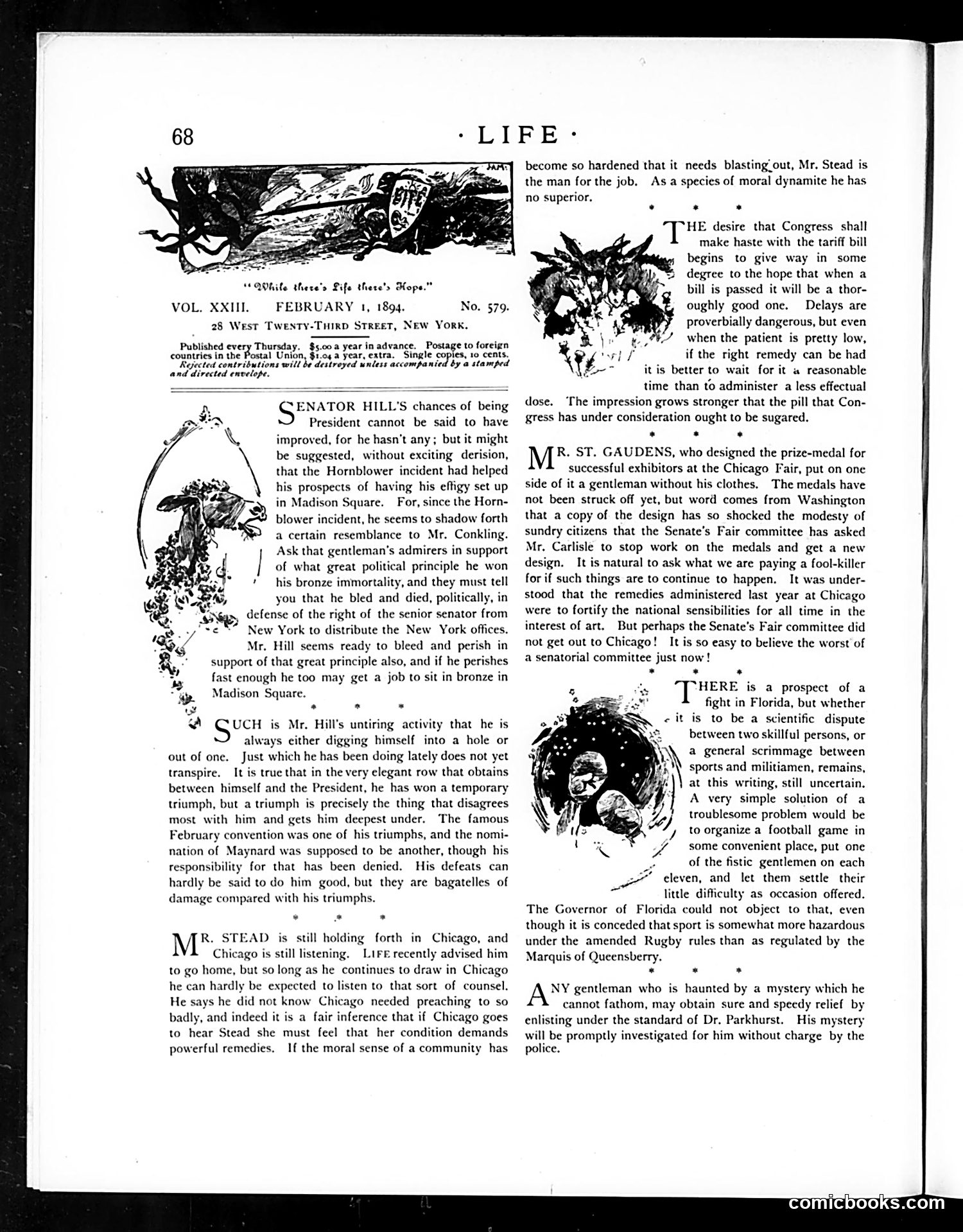
The page contains three separate political commentary sections with illustrations. **Senator Hill cartoon**: Mocks Senator David B. Hill's presidential ambitions, suggesting he's been damaged by the Hornblower incident and now resembles Mr. Conkling (a rival politician). The text implies Hill's efforts to succeed are futile—he should expect to end up as a forgotten bronze statue in Madison Square rather than the presidency. **Mr. Stead section**: References W.T. Stead, a prominent figure in Chicago, being advised by Life magazine to address Chicago's moral condition. The satire suggests Chicago's problems are so severe that even Stead cannot fix them. **Remaining items**: Brief notes on medal design controversies and a Florida sports dispute. The overall tone is characteristic 1890s political ridicule targeting specific public figures and civic issues.
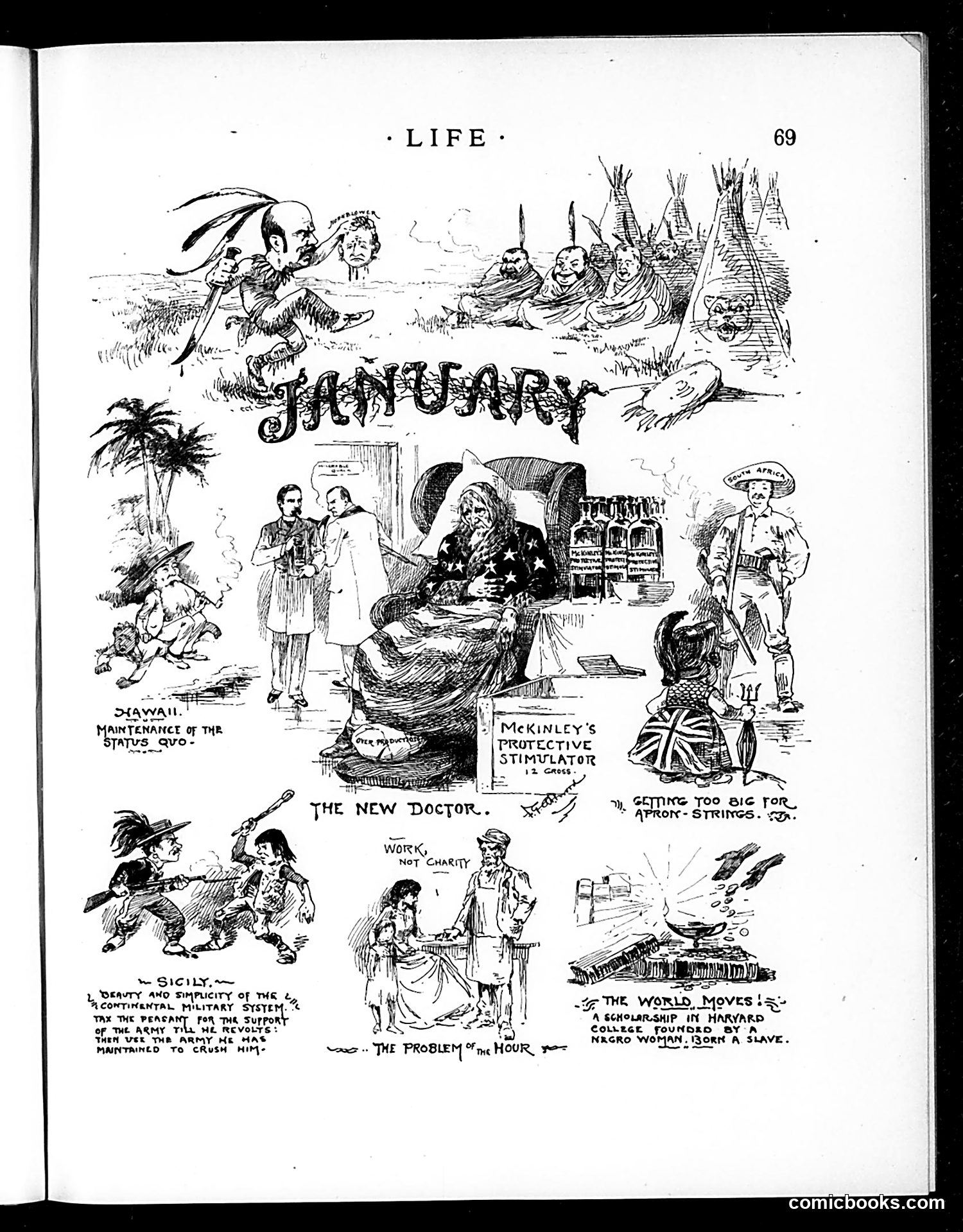
This page contains six political cartoons satirizing President McKinley's policies and contemporary issues: **"January"** (top): Shows McKinley as a reckless figure causing chaos with Native Americans and colonial subjects. **"The New Doctor"**: Depicts an elderly woman (likely representing a nation or institution) receiving treatment labeled "McKinley's Protective Stimulator," suggesting his policies are dubious remedies. **"Hawaii"**: References American colonial expansion and the maintenance of colonial status. **"Sicily"**: Critiques McKinley's military interventionism. **"Getting Too Big for Apron-Strings"**: Shows a figure outgrowing restraint. **"The World Moves"**: Sarcastically comments on a Harvard scholarship founded by a formerly enslaved woman—likely critiquing racial hypocrisy in American institutions. The overall theme attacks McKinley's imperialism, protectionism, and military policies.
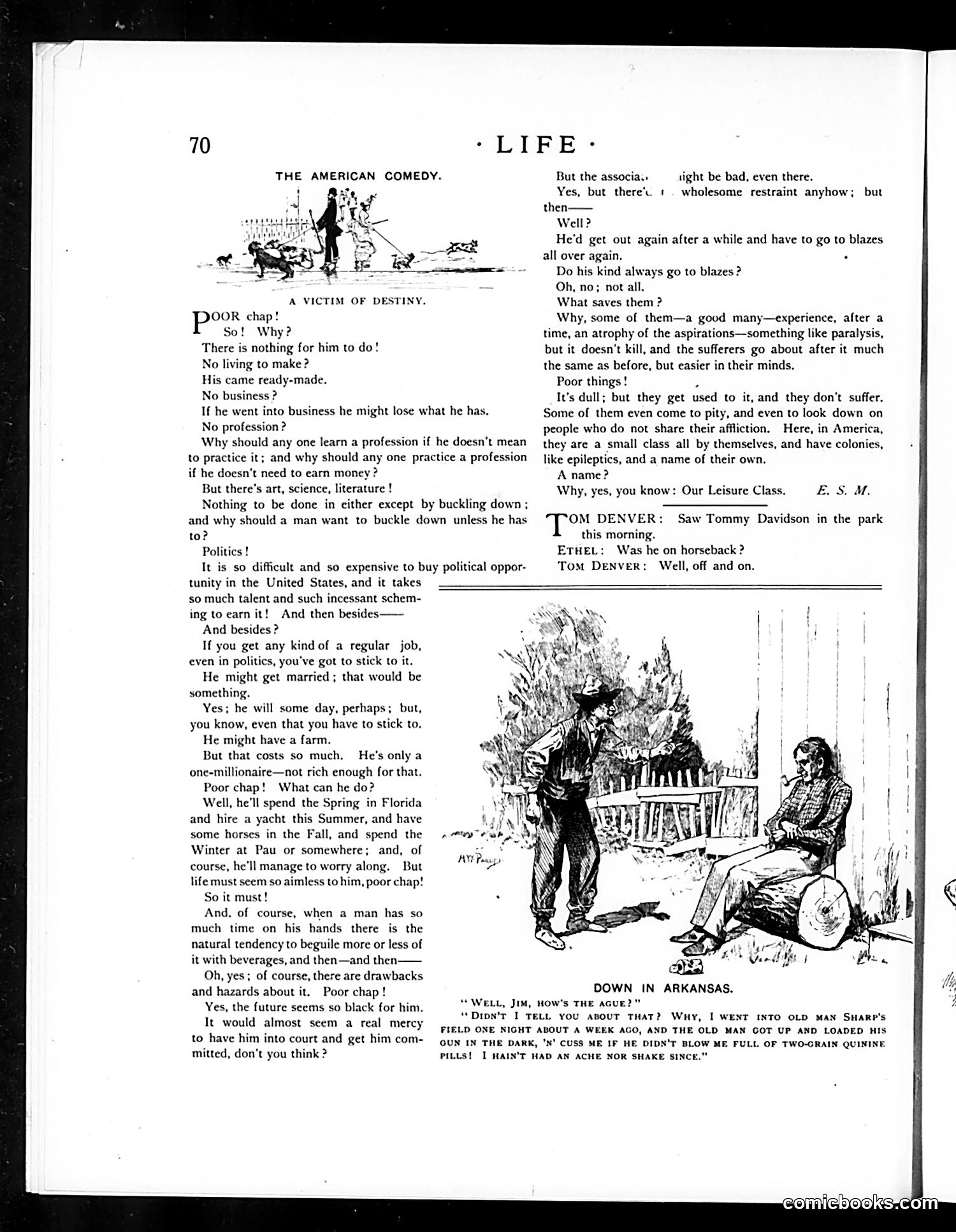
This page contains two distinct pieces: **"A Victim of Destiny"** (left column) is a satirical dialogue mocking American class mobility. It presents the pessimistic view that a poor person has no viable path forward—lacking money for business, profession, or politics. The piece cynically suggests that even obtaining a farm requires excessive capital, leaving poverty as inevitable. The satire targets both the economic system's barriers and the American myth of upward mobility. **"Down in Arkansas"** (bottom illustration) depicts rural working-class characters in a humorous anecdote. The crude dialect and the story about a dangerous encounter with a gun suggest satirical commentary on rural American violence and frontier culture, presented for urban readers' amusement at rural life's rough nature. Both pieces reflect early 20th-century Life magazine's satirical critique of American society and class divisions.
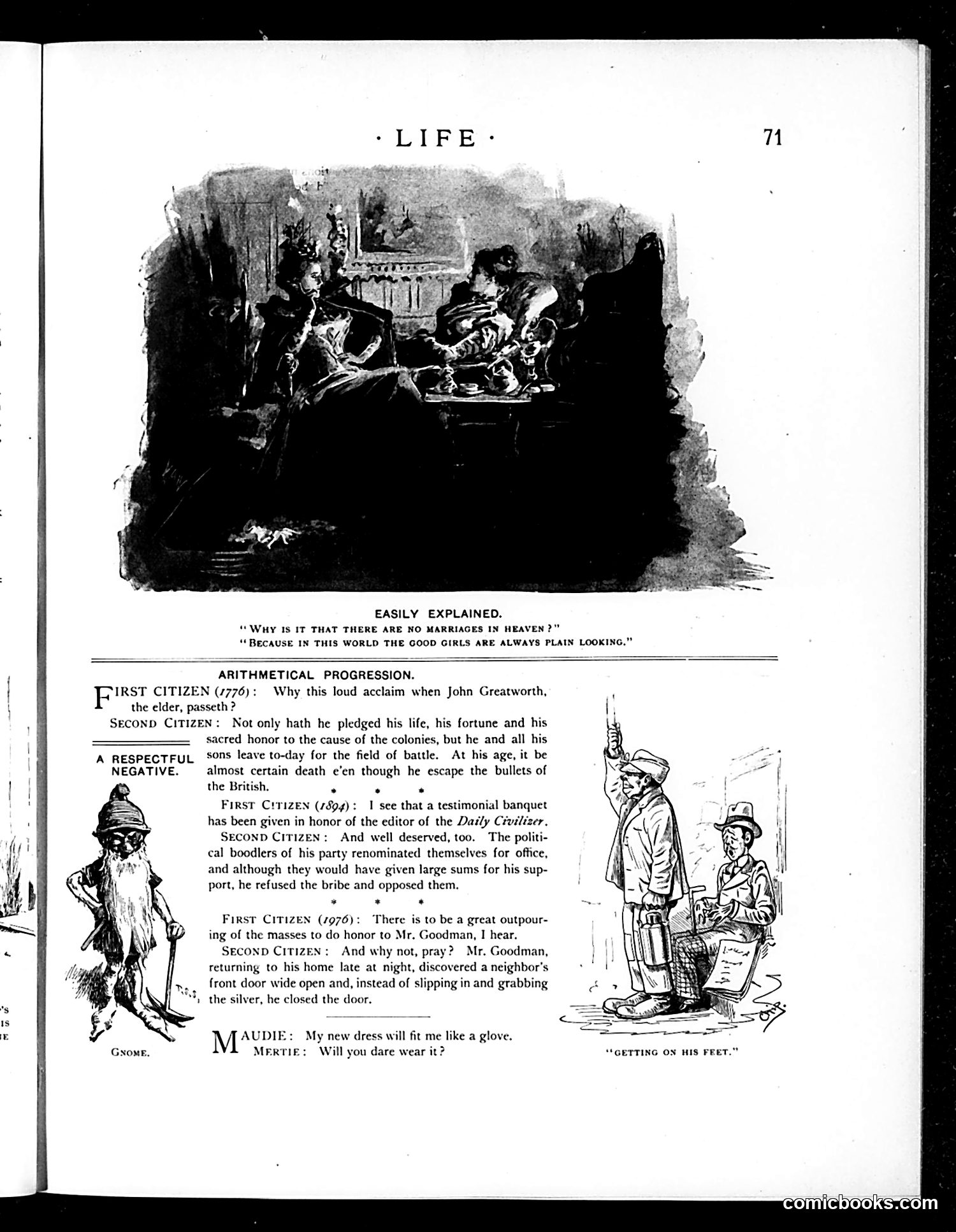
This page contains three separate satirical pieces mocking American society circa the Revolutionary War era and contemporary politics. **"Easily Explained"** (top cartoon): A joke about plain-looking women remaining unmarried, suggesting heaven lacks marriages because "good girls are always plain looking." **"Arithmetical Progression"** (main section): A dialogue between two citizens discussing John Greatworth's patriotic sacrifice for the colonies. The satire critiques hypocrisy: while praising Greatworth's honor publicly, citizens like "Goodman" commit petty theft (closing a neighbor's door to steal silver). It mocks self-righteous patriotism masking everyday dishonesty. **Bottom illustrations**: "A Respectful Negative" (a gnome figure) and "Getting on His Feet" depict social types, likely commentary on class and behavior. The overall message satirizes the gap between stated patriotic values and actual moral conduct.
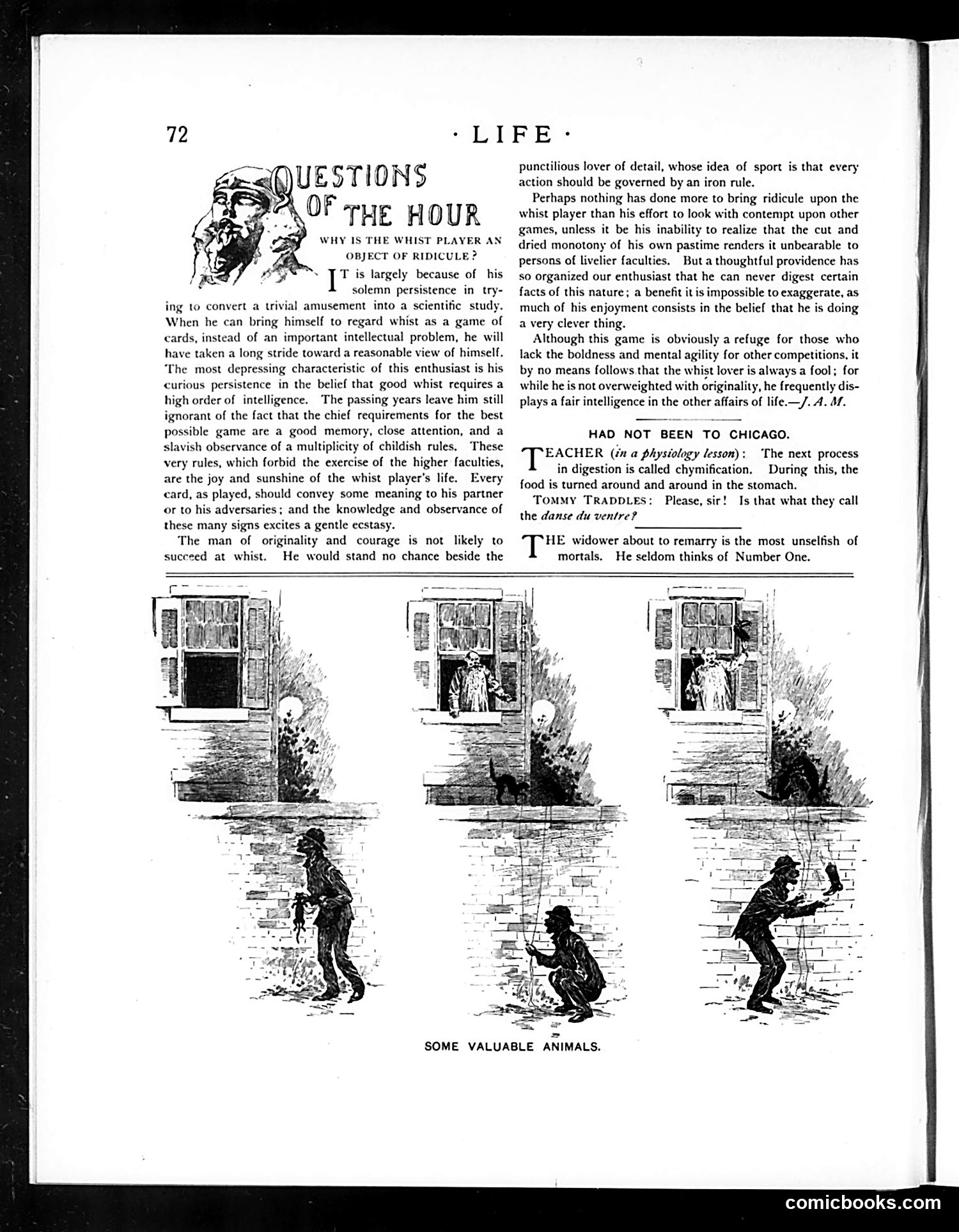
This three-panel cartoon satirizes human behavior by depicting a man attempting to catch what appears to be a duck or waterfowl near a brick wall with a window. The title "Some Valuable Animals" ironically equates the man's clumsy, undignified efforts with animal behavior. The accompanying article "Questions of the Hour" critiques whist players—specifically those who treat card games with excessive seriousness and pseudo-intellectual pretension. The satire mocks enthusiasts who convert trivial pastimes into overly complex "scientific" pursuits, viewing their persistence as ridiculous rather than admirable. The cartoon visually reinforces this theme: just as the fumbling man pursues the bird uselessly, so too do whist devotees chase meaningless intellectual validation through a simple game.
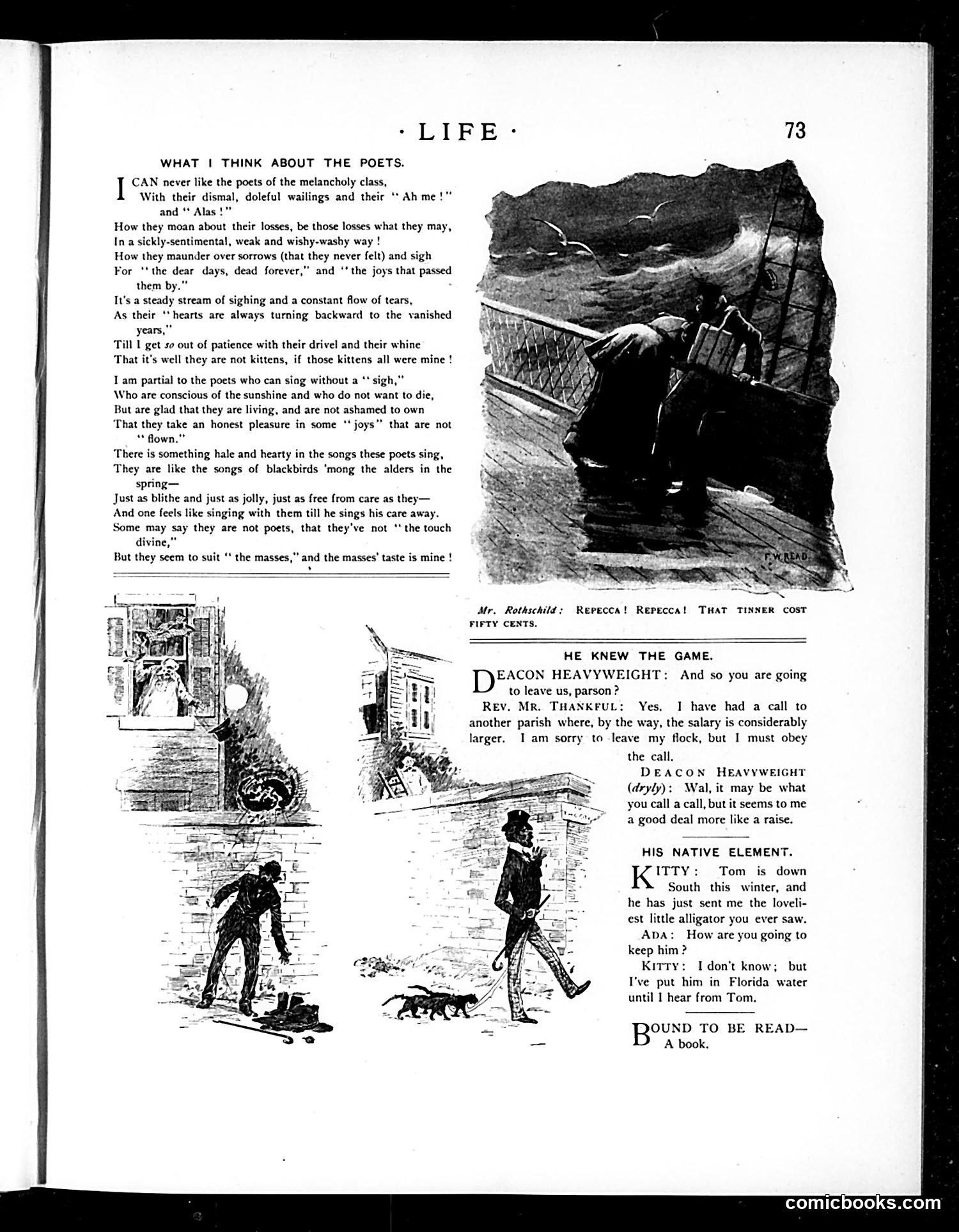
This page contains three distinct sections: **"What I Think About the Poets"** (left column): A prose essay criticizing sentimental, melancholy Romantic poets for excessive mourning and self-pity. The author prefers poets who sing "without a sigh"—those finding joy in simple living, like blackbirds. The piece mocks the emotional excess and backward-looking nostalgia of certain poetic traditions. **Illustrations** (center-left): Victorian-era sketches depicting working-class figures in urban settings, illustrating the essay's contrast between maudlin sentimentality and genuine life experience. **Dialogue sections** (right): "He Knew the Game," "His Native Element," and "Bound to Be Read"—brief comedic exchanges. These appear to be humorous vignettes about everyday situations, likely satirizing social pretense or hypocrisy, though specific references are unclear without additional context. The page overall contrasts artistic sentimentality with practical, unsentimental living.
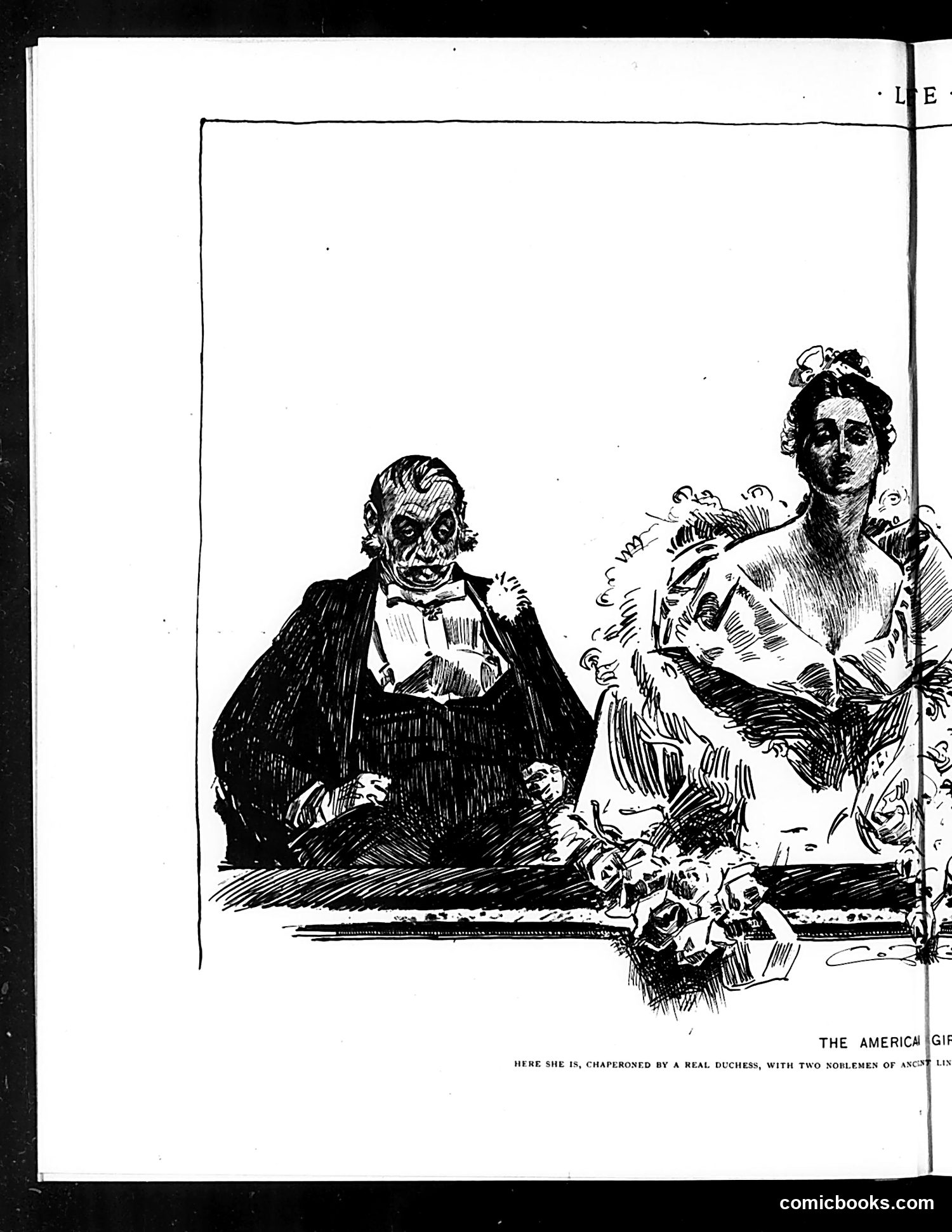
This appears to be a satirical illustration from *Life* magazine showing a social scene. The caption reads: "HERE SHE IS, CHAPERONED BY A REAL DUCHESS, WITH TWO NOBLEMEN OF ANCI[ENT]..." The text is cut off, but the satire targets American wealthy women being "chaperoned" by European nobility. The illustration depicts a woman presented alongside what appears to be aristocratic figures (likely depicted as the "duchess" and "noblemen"). The joke likely mocks the American upper class's fascination with European titles and the social climbing that occurred when wealthy Americans sought validation through association with old-world nobility. This was a common satirical target in the Gilded Age, when American heiresses would marry European nobles. The incomplete caption prevents fuller analysis of the specific reference or satirical target.
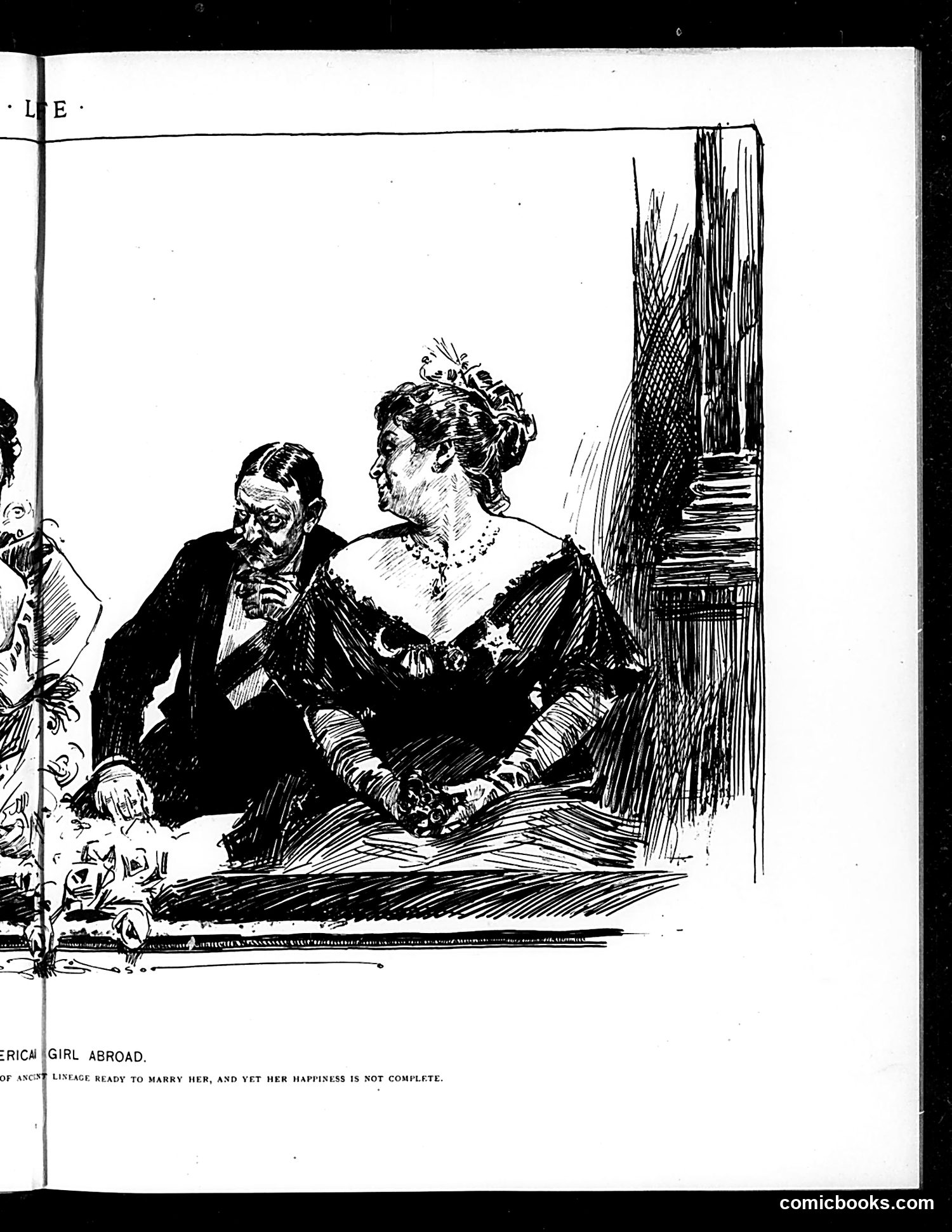
This satirical illustration depicts a wealthy American woman abroad in what appears to be a European interior setting. The caption reads: "OF ASCOT LINEAGE READY TO MARRY HER, AND YET HER HAPPINESS IS NOT COMPLETE." The cartoon mocks the social aspirations of American heiresses of the Gilded Age who sought European titles and marriages to aristocrats. The woman's fashionable dress and jewelry signal her wealth, while the man beside her—likely representing a European nobleman—appears eager to marry her despite their apparent unsuitability. The joke suggests that despite achieving her goal of marrying "old money" and European nobility, the American woman remains unsatisfied, satirizing both her materialistic ambitions and the transatlantic matchmaking trend popular among the American wealthy.
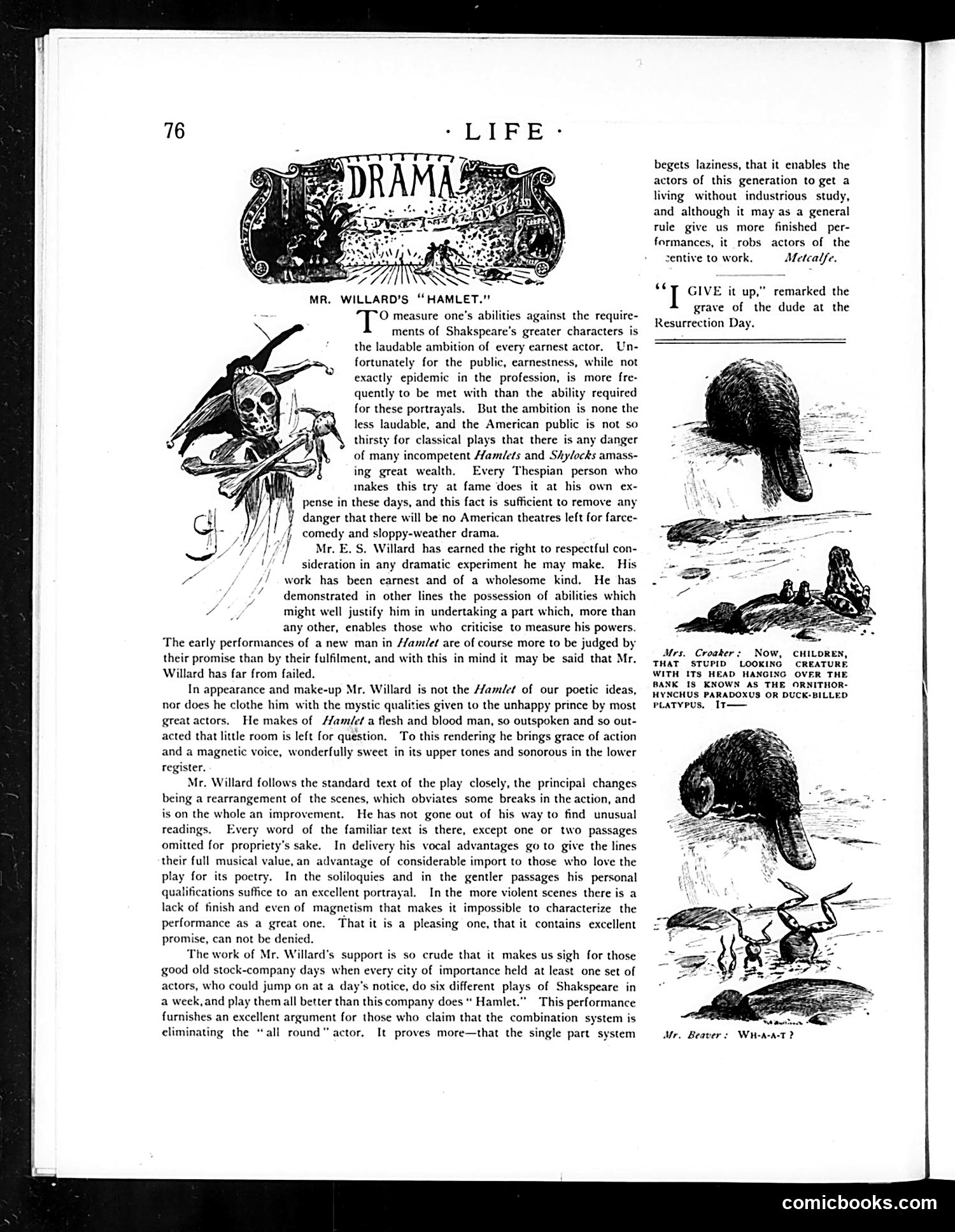
This page reviews actor E. S. Willard's performance as Hamlet. The main text is a theatrical critique praising Willard's earnest effort and vocal abilities while noting he lacks the "mystic qualities" and poetic grandeur audiences expect from the role. The critic acknowledges Willard's "grace of action" but criticizes his support cast as crude. The illustrated cartoons on the right are unrelated animal jokes. The top shows a dude's grave comment at Resurrection Day; below are sketches of a platypus labeled "Mrs. Croaker," with the text explaining it's "that stupid looking creature" known as the ornithorrhynch (platypus). These appear to be separate humorous filler content typical of Life magazine's satirical format. The overall critique is measured—acknowledging Willard's respectability as an actor while suggesting he's naturalistic rather than transcendent in this demanding Shakespearean role.
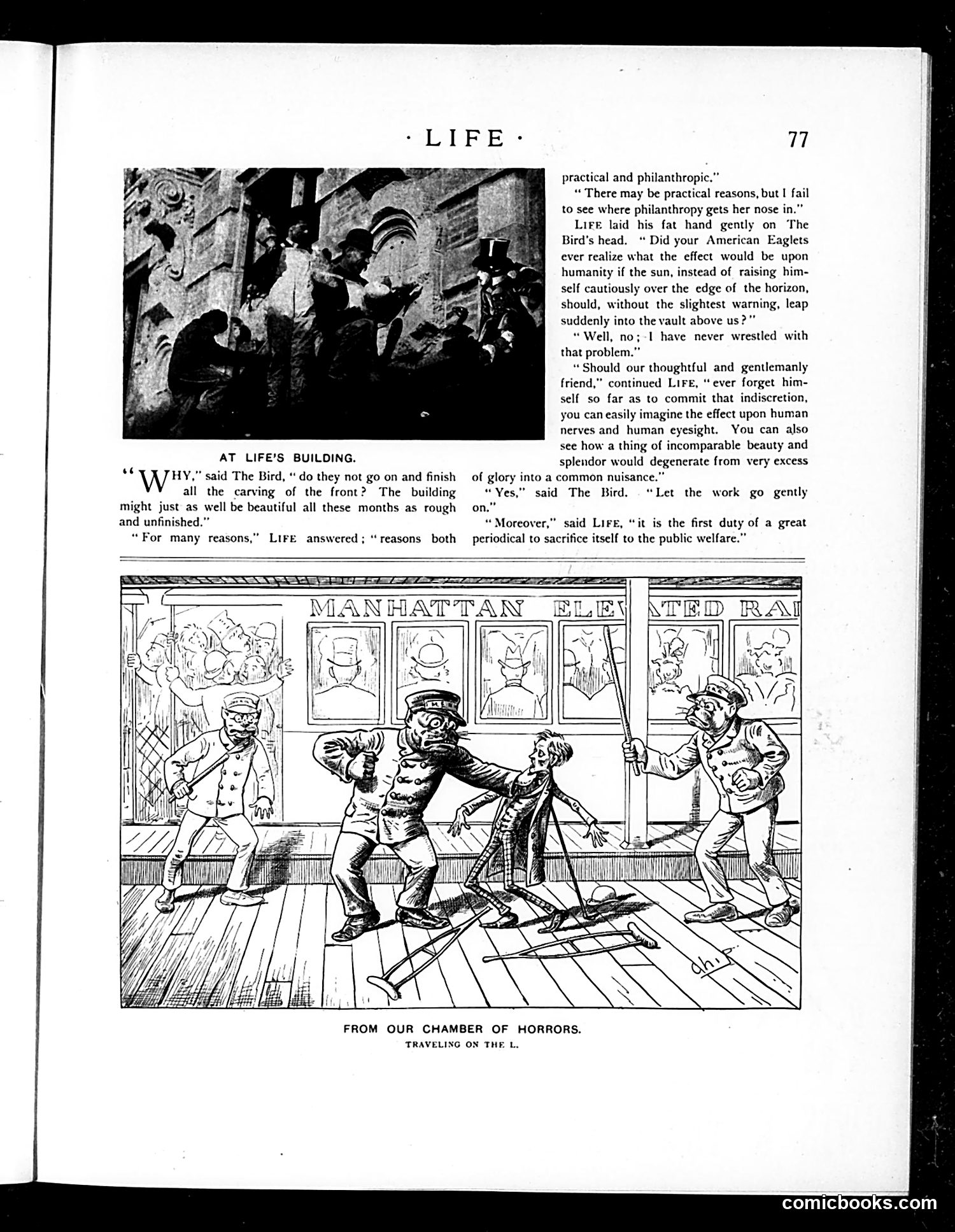
This page from *Life* magazine contains two satirical pieces: **Top section**: A dialogue between "The Bird" (likely representing an American Eagle or patriotic symbol) and "Life" (the magazine's personified voice). They debate whether a building's ornamental front should be completed during construction. Life argues against finishing it, using absurd reasoning—comparing it to the sun suddenly jumping across the sky without warning. The satire mocks overelaborate architectural ornamentation and suggests that periodicals have a duty to sacrifice beauty for "public welfare" (efficiency/practicality). **Bottom cartoon**: Titled "Traveling on the L" (the elevated train), it depicts crowded, chaotic conditions on Chicago's or New York's elevated railway system. Multiple figures struggle and fight in cramped quarters—satirizing the notorious discomfort and danger of urban mass transit during this era. The "Chamber of Horrors" title emphasizes how awful the commuting experience was for ordinary citizens. Both pieces target contemporary urban life and excess.
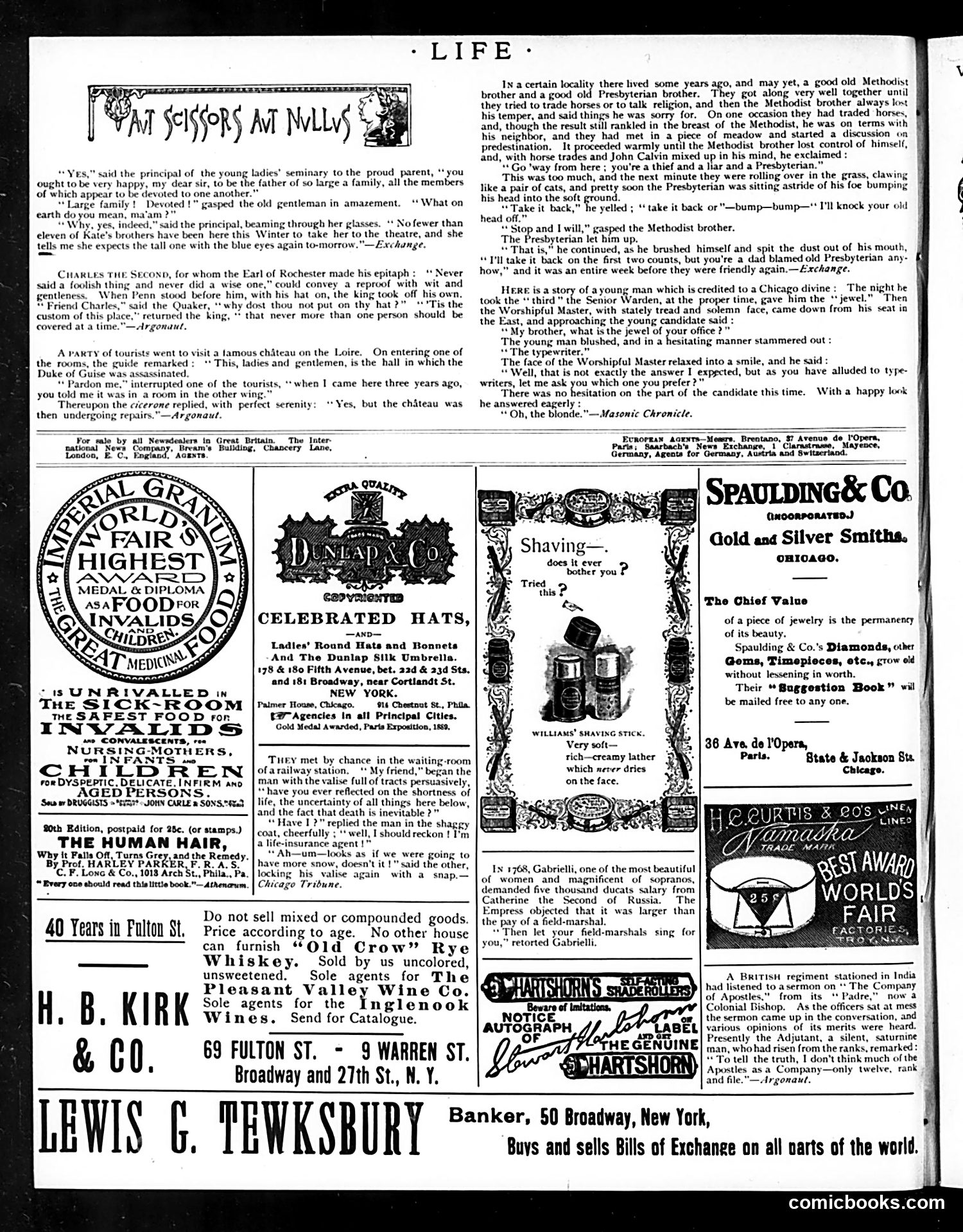
This page contains three separate humorous anecdotes rather than political cartoons: 1. **"Kate's Brothers"**: A joke about a seminary principal mistaking eleven visits from a young woman's suitor (the same man visiting repeatedly) as evidence of a large, devoted family. 2. **"Charles the Second"**: A historical anecdote about King Charles II's wit—illustrating how he used humor to make a point to William Penn about hat-wearing customs. 3. **"Methodist and Presbyterian"**: A sectarian humor piece depicting a fight between two neighbors over theological differences (predestination) mixed with a horse-trading dispute, played for comedic effect through their eventual reconciliation. The page is primarily **advertising** for various products (whiskey, hats, jewelry, shaving supplies) with these jokes interspersed. The humor relies on period-specific religious tensions between Protestant denominations and assumptions about courtship and family life that modern readers would find quaint rather than satirical.