
Life, 1894-02-01 · page 12 of 14
Life — February 1, 1894 — page 12: what you’re looking at
What you’re looking at
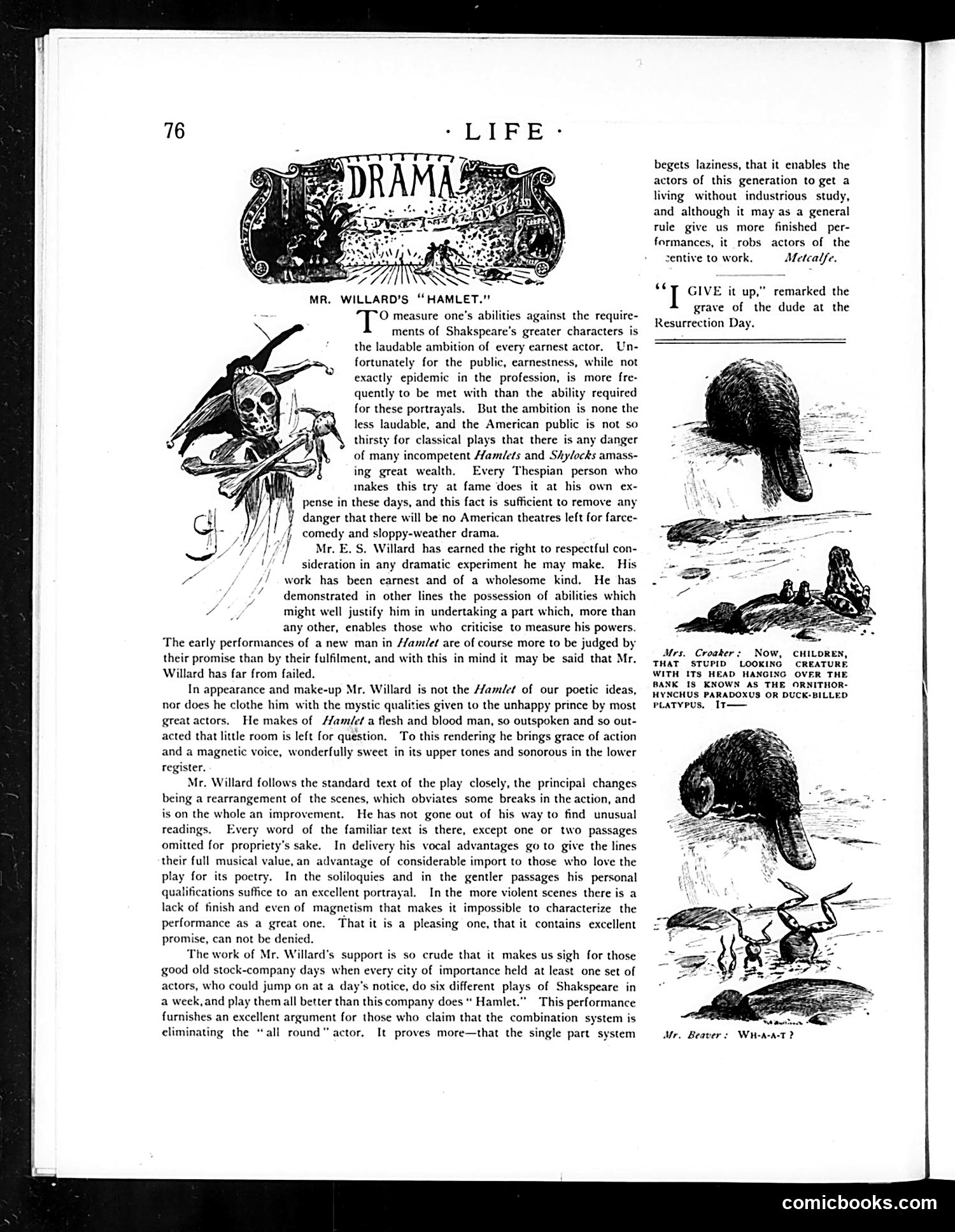
This page reviews actor E. S. Willard's performance as Hamlet. The main text is a theatrical critique praising Willard's earnest effort and vocal abilities while noting he lacks the "mystic qualities" and poetic grandeur audiences expect from the role. The critic acknowledges Willard's "grace of action" but criticizes his support cast as crude. The illustrated cartoons on the right are unrelated animal jokes. The top shows a dude's grave comment at Resurrection Day; below are sketches of a platypus labeled "Mrs. Croaker," with the text explaining it's "that stupid looking creature" known as the ornithorrhynch (platypus). These appear to be separate humorous filler content typical of Life magazine's satirical format. The overall critique is measured—acknowledging Willard's respectability as an actor while suggesting he's naturalistic rather than transcendent in this demanding Shakespearean role.
📄 Transcribed text from this page (OCR, searchable)
Machine-transcribed from the original scan — historical spelling and the odd misread are preserved.
MR. WILLARD’S ‘ HAMLET." 'O measure one’s abilities against the require- ments of Shakspeare’s greater characters is the laudable ambition of every earnest actor. Un- fortunately for the public, earnestness, while not exactly epidemic in the profession, quently to be met with than the ability required for these portrayals. But the ambition is none the less laudable, and the American public is not so thirsty for classical plays that there is any danger of many incompetent Hamlets and Shylocks amass- ing great wealth. Every Thespian person who makes this try at fame does it at his own ex- pense in these days, and this fact is sufficient to remove any danger that there will be no American theatres left for farce- comedy and sloppy-weather drama. Mr. E. S. Willard has earned the right to respectful con- sideration in any dramatic experiment he may make. His work has been earnest and of a wholesome kind. He has demonstrated in other lines the possession of abilities which might well justify him in undertaking a part which, more than any other, enables those who criticise to measure his powers. The early performances of a new man in /fam/et are of course more to be judged by their promise than by their fulfilment, and with this in mind it may be said that Mr. Willard has far from failed. In appearance and make-up Mr. Willard is not the Afam/et of our poetic ideas, nor does he clothe him with the mystic qualities given to the unhappy prince by most great actors. He makes of Hamief a flesh and blood man, so outspoken and so out- acted that little room is left for question. To this rendering he brings grace of action and a magnetic voice, wonderfully sweet in its upper tones and sonorous in the lower register. Mr. Willard follows the standard text of the play closely, the principal changes being a rearrangement of the scenes, which obviates some breaks in the action, and is on the whole an improvement. He has not gone out of his way to find unusual readings. Every word of the familiar text is there, except one or two passages omitted for propriety’s sake. In delivery his vocal advantages go to give the lines their full musical value, an advantage of considerable import to those who love the play for its poetry. In the soliloquies and in the gentler passages his personal qualifications suffice to an excellent portrayal. In the more violent scenes there is a lack of finish and even of magnetism that makes it impossible to characterize the performance as a great one. That it is a pleasing one, that it contains excellent promise, can not be denied. The work of Mr. Willard’s support is so crude that it makes us sigh for those good old stock-company days when every city of importance held at least one set of actors, who could jump on at a day's notice, do six different plays of Shakspeare in a week,and play them all better than this company does “ Hamlet.” This performance furnishes an excellent argument for those who claim that the combination system is eliminating the “all round” actor. It proves more—that the single part system begets laziness, that it enables the actors of this generation to get a living without industrious study, and although it may as a general rule give us more finished per- fermances, it robs actors of the Metcalfe. centive to work. “T IVE it up,” remarked the grave of the dude at the Resurrection Day. Mrs. Croaker; Now, CHILDREN, THAT STUPID LOOKING CREATURE. WITH ITS HEAD HANGING OVER THE BANK 18 KNOWN AS THE ORNITHOR- HYNCHUS PARADOXUS OR DUCK-BILLED PLATYPUS, IT—— comicbooks.com