
Life, 1894-02-01 · page 4 of 14
Life — February 1, 1894 — page 4: what you’re looking at
What you’re looking at
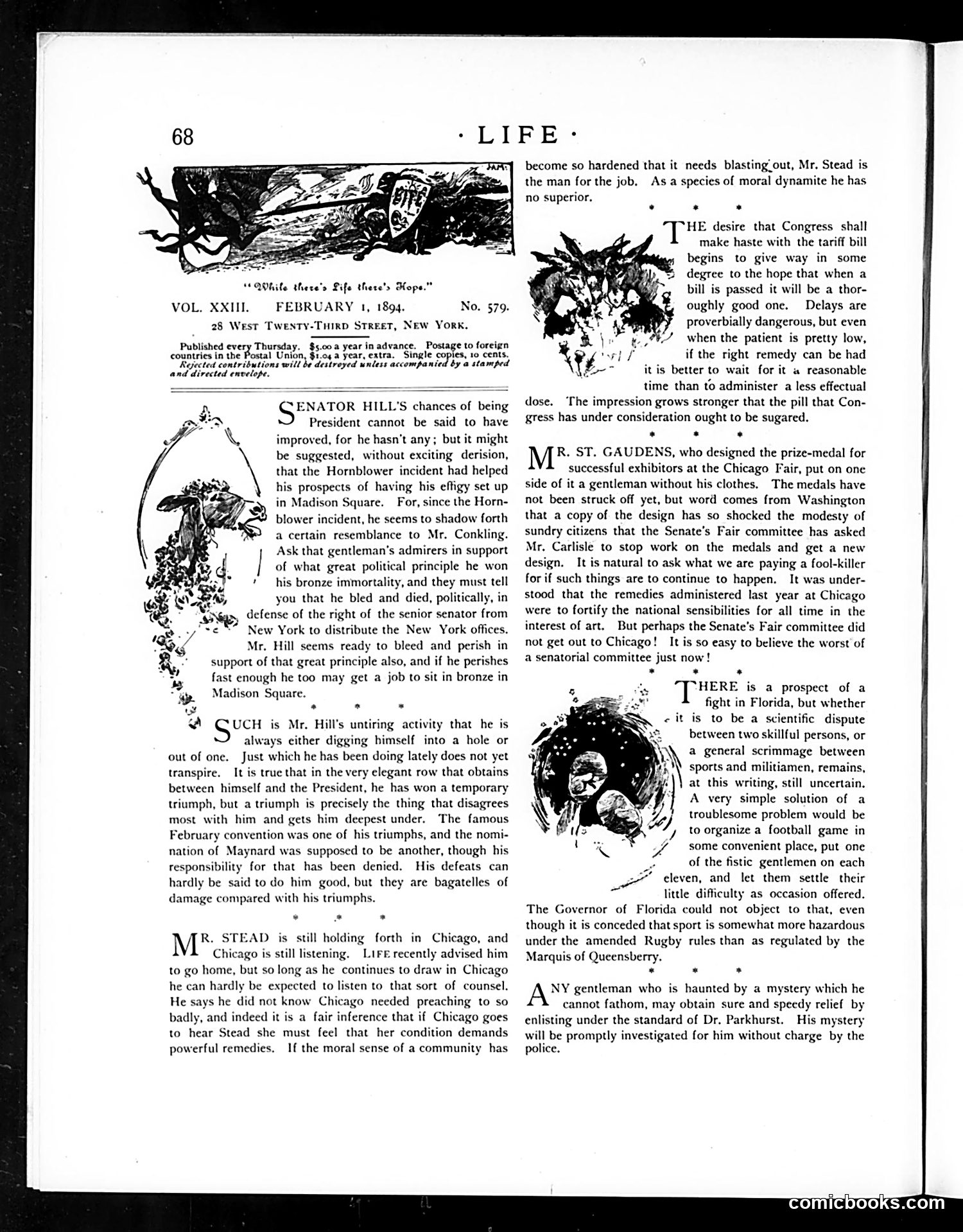
The page contains three separate political commentary sections with illustrations. **Senator Hill cartoon**: Mocks Senator David B. Hill's presidential ambitions, suggesting he's been damaged by the Hornblower incident and now resembles Mr. Conkling (a rival politician). The text implies Hill's efforts to succeed are futile—he should expect to end up as a forgotten bronze statue in Madison Square rather than the presidency. **Mr. Stead section**: References W.T. Stead, a prominent figure in Chicago, being advised by Life magazine to address Chicago's moral condition. The satire suggests Chicago's problems are so severe that even Stead cannot fix them. **Remaining items**: Brief notes on medal design controversies and a Florida sports dispute. The overall tone is characteristic 1890s political ridicule targeting specific public figures and civic issues.
📄 Transcribed text from this page (OCR, searchable)
Machine-transcribed from the original scan — historical spelling and the odd misread are preserved.
‘LIFE: “QWhile there's Life there's Hope.” VOL. XXIII. FEBRUARY 1, 1894. No. 579. 28 West Twenty-THirD STREET, NEW York. Published every Thursday. $5.00 a year in advance. Postage to foreign countries in the Postal Union, $1.04 a year, extra. Single copies, 10 cents, Rejected contributions will be destreyed untess accompanied by a stamped and directed envelope. jaan HILL'S chances of being President cannot be said to have improved, for he hasn't any; but it might be suggested, without exciting derision, that the Hornblower incident had helped his prospects of having his effigy set up in Madison Square. For, since the Horn- blower incident, he seems to shadow forth a certain resemblance to Mr. Conkling. Ask that gentleman's admirers in support of what great political principle he won his bronze immortality, and they must tell you that he bled and died, politically, in SE defense of the right of the senior senator from wee New York to distribute the New York offices. Mr. Hill seems ready to bleed and perish in support of that great principle also, and if he perishes fast enough he too may get a job to sit in bronze in Madison Square. . . . UCH is Mr. Hill's untiring activity that he is always either digging himself into a hole or out of one. Just which he has been doing lately does not yet transpire. It is true that in the very elegant row that obtains between himself and the President, he has won a temporary triumph, but a triumph is precisely the thing that disagrees most with him and gets him deepest under. The famous February convention was one of his triumphs, and the nomi- nation of Maynard was supposed to be another, though his responsibility for that has been denied. His defeats can hardly be said to do him good, but they are bagatelles of damage compared with his triumphs. M R. STEAD is still holding forth in Chicago, and Chicago is still listening. LiFe recently advised him to go home, but so long as he continues to draw in Chicago he can hardly be expected to listen to that sort of counsel. He says he did not know Chicago needed preaching to so badly, and indeed it is a fair inference that if Chicago goes to hear Stead she must feel that her condition demands powerful remedies. If the moral sense of a community has . * . become so hardened that it needs blasting out, Mr. Stead is the man for the job. As a species of moral dynamite he has no superior, . . . HE desire that Congress shall make haste with the tariff bill begins to give way in some degree to the hope that when a bill is passed it will be a thor- oughly good one, Delays are proverbially dangerous, but even when the patient is pretty low, if the right remedy can be had it is better to wait for it a reasonable time than to administer a less effectual dose. ‘The impression grows stronger that the pill that Con- gress has under consideration ought to be sugared. * * . R. ST. GAUDENS, who designed the prize-medal for successful exhibitors at the Chicago Fair, put on one side of it a gentleman without his clothes. The medals have not been struck off yet, but word comes from Washington that a copy of the design has so shocked the modesty of sundry citizens that the Senate’s Fair committee has asked Mr. Carlisle to stop work on the medals and get a new design. It is natural to ask what we are paying a fool-killer for if such things are to continue to happen. It was under- stood that the remedies administered last year at Chicago were to fortify the national sensibilities for all time in the interest of art. But perhaps the Senate's Fair committee did not get out to Chicago! It is so easy to believe the worst of a senatorial committee just now ! . . HERE is a prospect of a fight in Florida, but whether < it is to be a scientific dispute between two skillful persons, or a general scrimmage between sports and militiamen, remains, at this writing, still uncertain, A very simple solution of a troublesome problem would be to organize a football game in some convenient place, put one of of the fistic gentlemen on each ** eleven, and let them settle their little difficulty as occasion offered. The Governor of Florida could not object to that, even though it is conceded that sport is somewhat more hazardous under the amended Rugby rules than as regulated by the Marquis of Queensberry. * * . NY gentleman who is haunted by a mystery which he cannot fathom, may obtain sure and speedy relief by enlisting under the standard of Dr. Parkhurst. His mystery will be promptly investigated for him without charge by the police.