
Life, 1894-02-01 · page 9 of 14
Life — February 1, 1894 — page 9: what you’re looking at
What you’re looking at
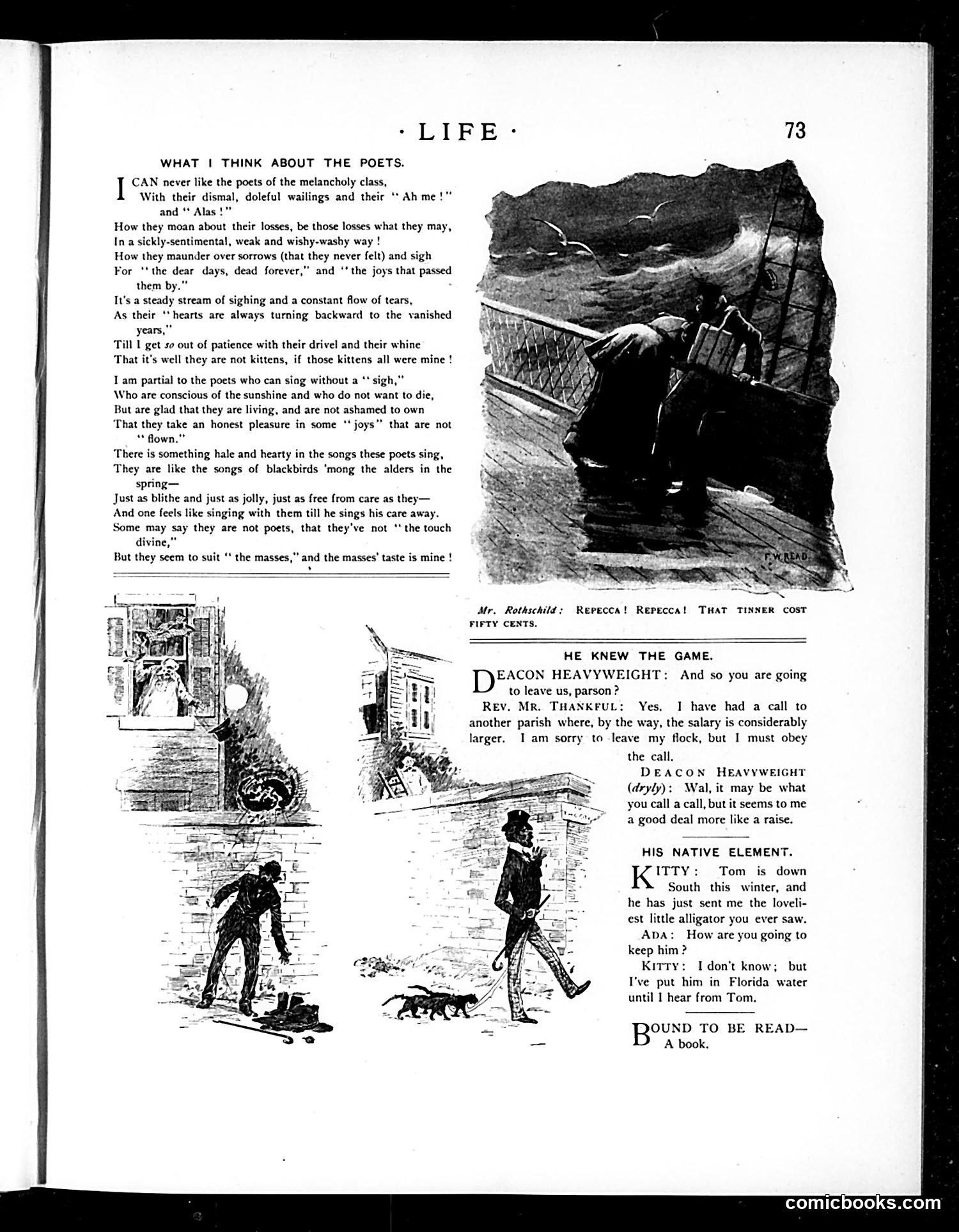
This page contains three distinct sections: **"What I Think About the Poets"** (left column): A prose essay criticizing sentimental, melancholy Romantic poets for excessive mourning and self-pity. The author prefers poets who sing "without a sigh"—those finding joy in simple living, like blackbirds. The piece mocks the emotional excess and backward-looking nostalgia of certain poetic traditions. **Illustrations** (center-left): Victorian-era sketches depicting working-class figures in urban settings, illustrating the essay's contrast between maudlin sentimentality and genuine life experience. **Dialogue sections** (right): "He Knew the Game," "His Native Element," and "Bound to Be Read"—brief comedic exchanges. These appear to be humorous vignettes about everyday situations, likely satirizing social pretense or hypocrisy, though specific references are unclear without additional context. The page overall contrasts artistic sentimentality with practical, unsentimental living.
📄 Transcribed text from this page (OCR, searchable)
Machine-transcribed from the original scan — historical spelling and the odd misread are preserved.
> LIFE: WHAT | THINK ABOUT THE POETS. CAN never like the poets of the melancholy class, With their dismal, doleful wailings and their ‘* Ah me!" and ** Alas!" How they moan about their losses, be those losses what they may, Ina sickly-sentimental, weak and wishy-washy way ! How they maunder over sorrows (that they never felt) and sigh For ‘‘the dear days, dead forever,” and ‘‘ the joys that passed them by.” . It's a steady stream of sighing and a constant flow of tears, As their ‘*hearts are always turning backward to the vanished years,” Till L get so out of patience with their drivel and their whine That it’s well they are not kittens, if those kittens all were mine ! 1 am partial to the poets who can sing without a ** sigh,” Who are conscious of the sunshine and who do not want to die, But are glad that they are living, and are not ashamed to own ‘That they take an honest pleasure in some *‘ joys" that are not “* flown.” ‘There is something hale and hearty in the songs these poets sing, They are like the songs of blackbirds ‘mong the alders in the spring— Just as blithe and just as jolly, just as free from care as they— And one feels like singing with them till he sings his care away. Some may say they are not poets, that they’ve not ** the touch divine,” But they seem to suit ‘‘ the masses,” and the masses’ taste is mine ! Mr. Rothschild; Rerecca! Repecca! THAT TINNER COST FIFTY CENTS. HE KNEW THE GAME. EACON HEAVYWEIGHT: And so you are going to leave us, parson ? Rev. MR. THANKFUL: Yes, 1 have had a call to another parish where, by the way, the salary is considerably larger. I am sorry to leave my flock, but I must obey the call. DEACON HEAVYWEIGHT (dryly): Wal, it may be what you call a call, but it seems to me a good deal more like a raise. HIS NATIVE ELEMENT. ITTY: Tom is down South this winter, and he has just sent me the loveli- est little alligator you ever saw. ADA: How are you going to keep him ? Kitty: Idon’t know; but I've put him in Florida water until | hear from Tom. OUND TO BE READ— A book. comicbooks.com