
A complete issue · 16 pages · 1894
Life — January 25, 1894
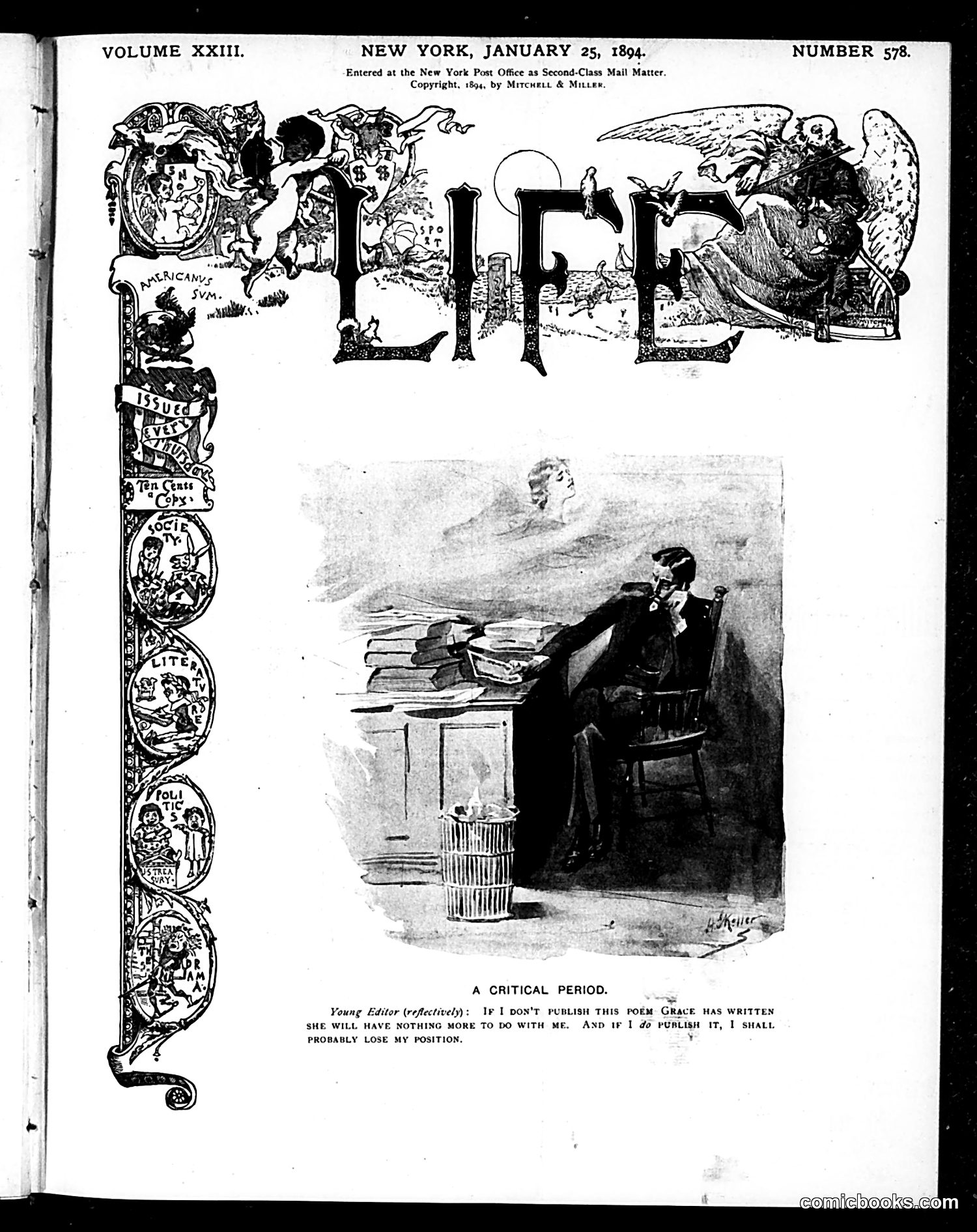
This cartoon depicts a young editor in a dilemma. He sits at his desk, contemplating a poem submitted by someone named Grace. His internal conflict: publishing the poem risks losing his job, but rejecting it means offending the author—likely someone of social importance or influence. The satire targets the precarious position of editors balancing literary merit against social/political pressure. Early 1900s magazines like *Life* often navigated tensions between honest criticism and deference to powerful contributors. The "critical period" refers both to the editor's crisis and to the gatekeeping role of literary criticism itself—suggesting editors sometimes suppress honest judgment to avoid consequences.
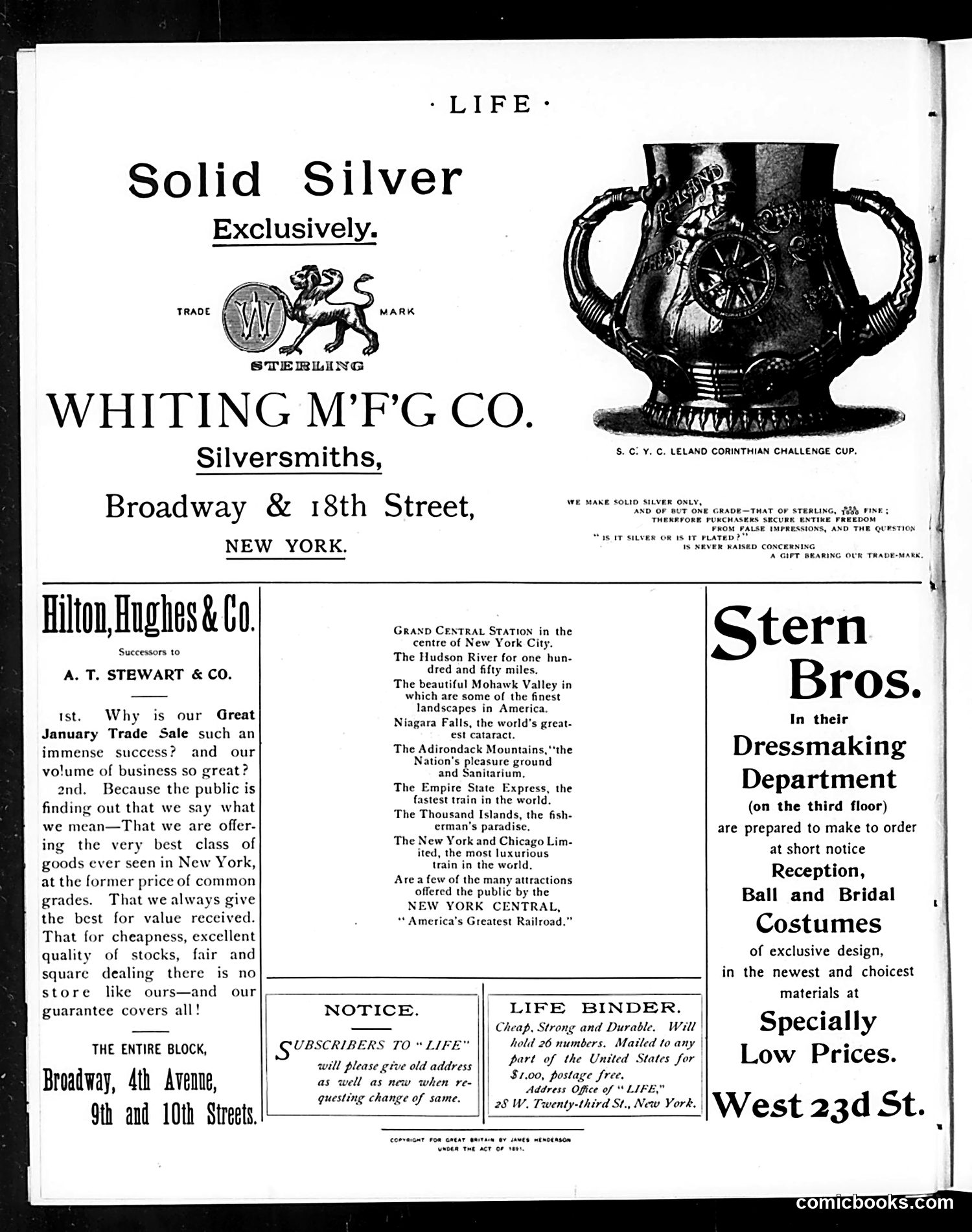
This page is primarily **advertising**, not satire or political commentary. It contains four commercial advertisements from early 20th-century New York businesses: 1. **Whiting M'fg Co.** - Sterling silver manufacturer on Broadway & 18th Street 2. **Hilton, Hughes & Co.** - Department store promoting a January sale 3. **Stern Bros.** - Dressmaking department offering custom costumes 4. **Life Binder** - Magazine binding service The only illustrative content is a decorative image of an ornate silver trophy or urn (labeled "S.C.Y.C. Leland Corinthian Challenge Cup"), which serves as product display for the silversmith. There is no political cartoon or satirical content on this page. It represents typical revenue-generating advertising that sustained Life magazine's publication.
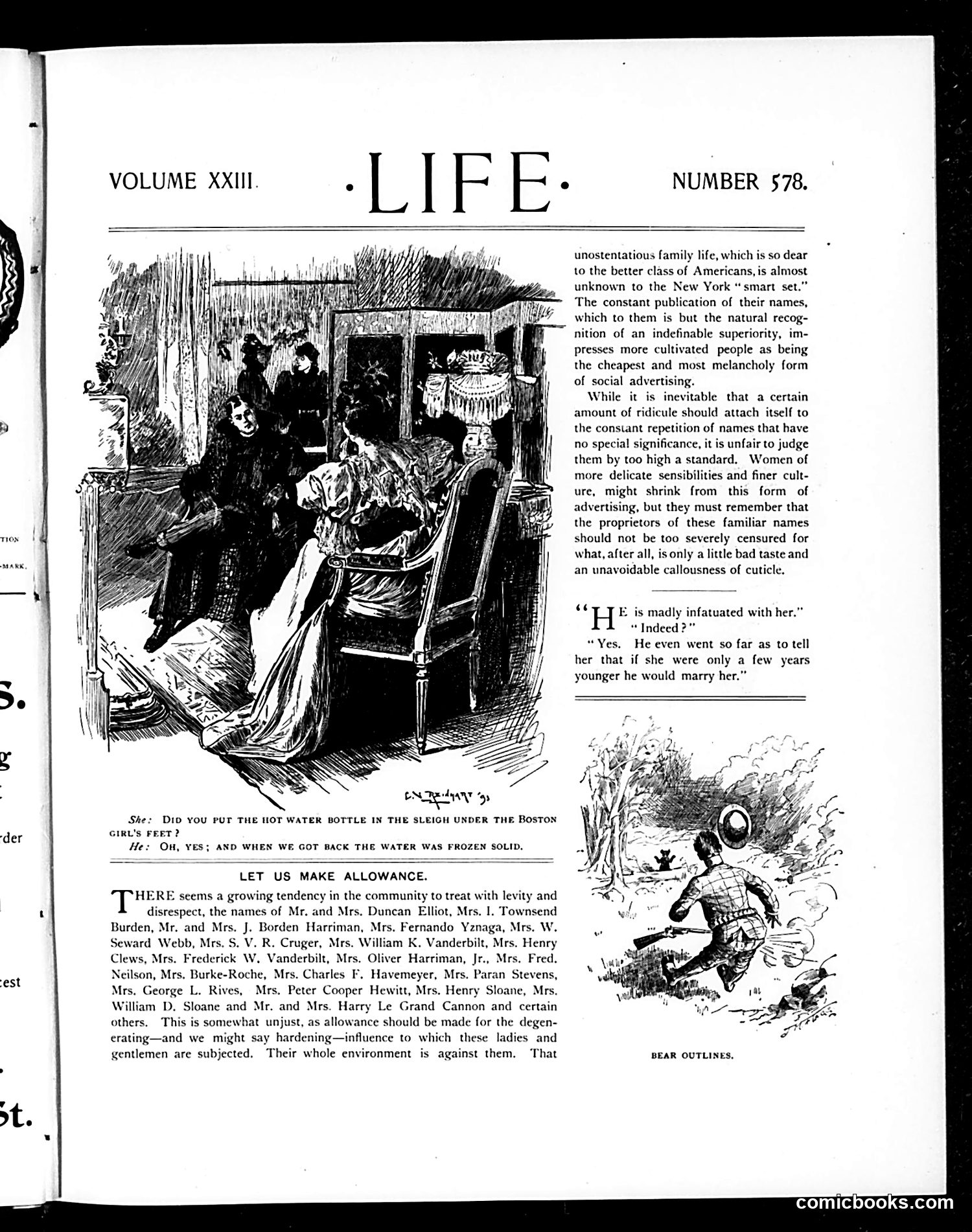
The main cartoon depicts a sleigh scene with passengers, captioned with dialogue about a hot water bottle freezing solid during a Boston sleigh ride—a simple winter joke about extreme cold. The article "Let Us Make Allowance" defends prominent Boston society families (Vanderbilt, Hariman, Townsend, Burden, etc.) against public ridicule. It argues their names appearing repeatedly in society pages shouldn't be judged harshly, attributing this to their social prominence rather than vanity. The piece pleads for tolerance toward the upper class, acknowledging their "unavoidable callousness of cuticle"—a satirical jab suggesting wealthy families inherently lack sensitivity. The lower illustration titled "Bear Outlines" shows a figure in outdoor/hunting attire, likely unrelated to the main content.
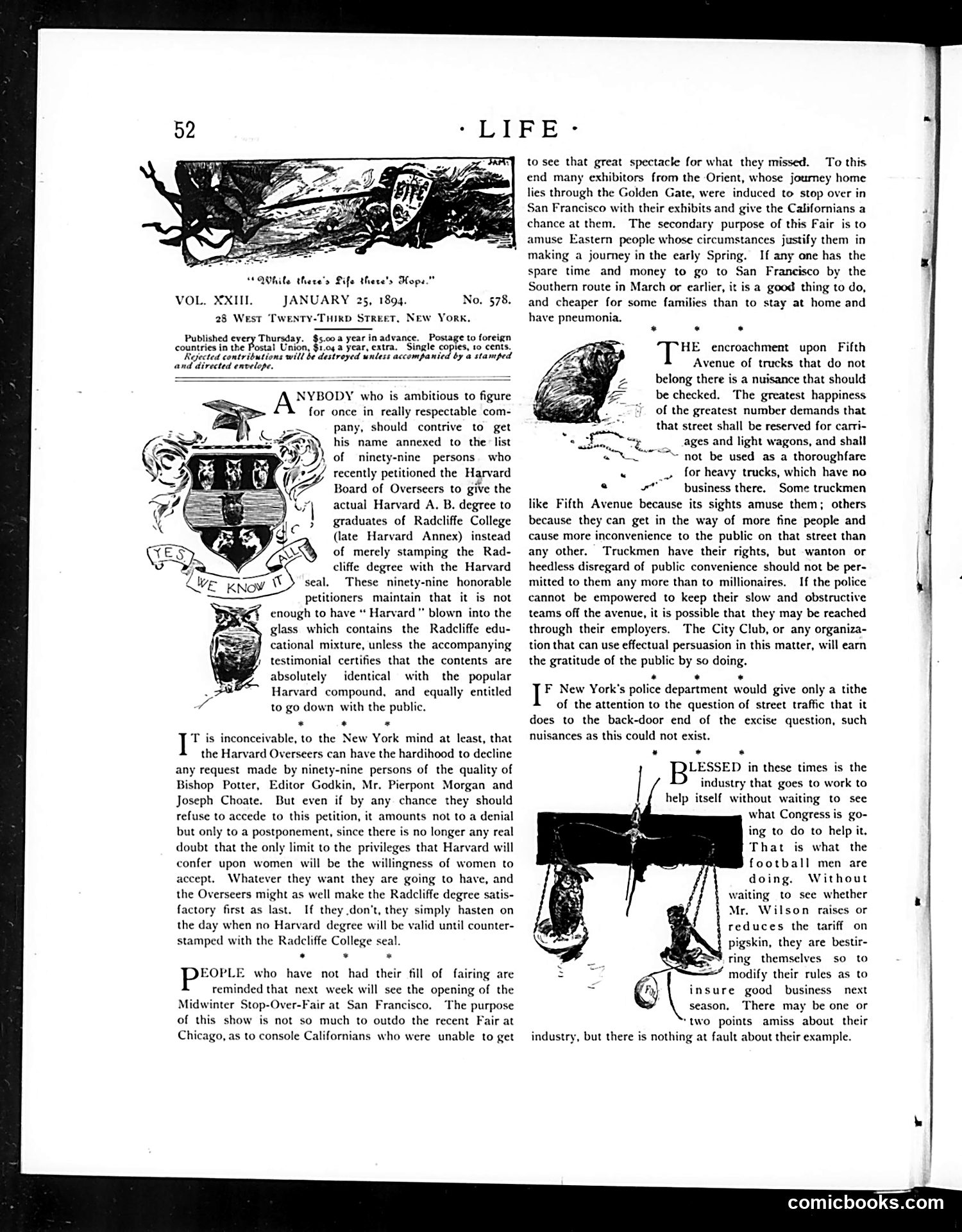
This page contains satirical commentary on academic credentials and urban infrastructure rather than traditional political cartoons. The main article mocks a petition by 99 Harvard graduates requesting that Radcliffe College (Harvard's women's college) award the same A.B. degree as Harvard itself. The author argues this would cheapen Harvard's prestige—a sharp critique of late-19th-century gender discrimination in higher education. A secondary piece criticizes New York City's lack of traffic regulation on Fifth Avenue, where trucks obstruct pedestrians and commerce. The author praises the football industry for self-regulation, suggesting the city should pressure trucking companies similarly rather than relying on police enforcement. The illustrations are decorative rather than satirical, showing the Harvard seal and a hanging figure (likely representing commerce or industry).
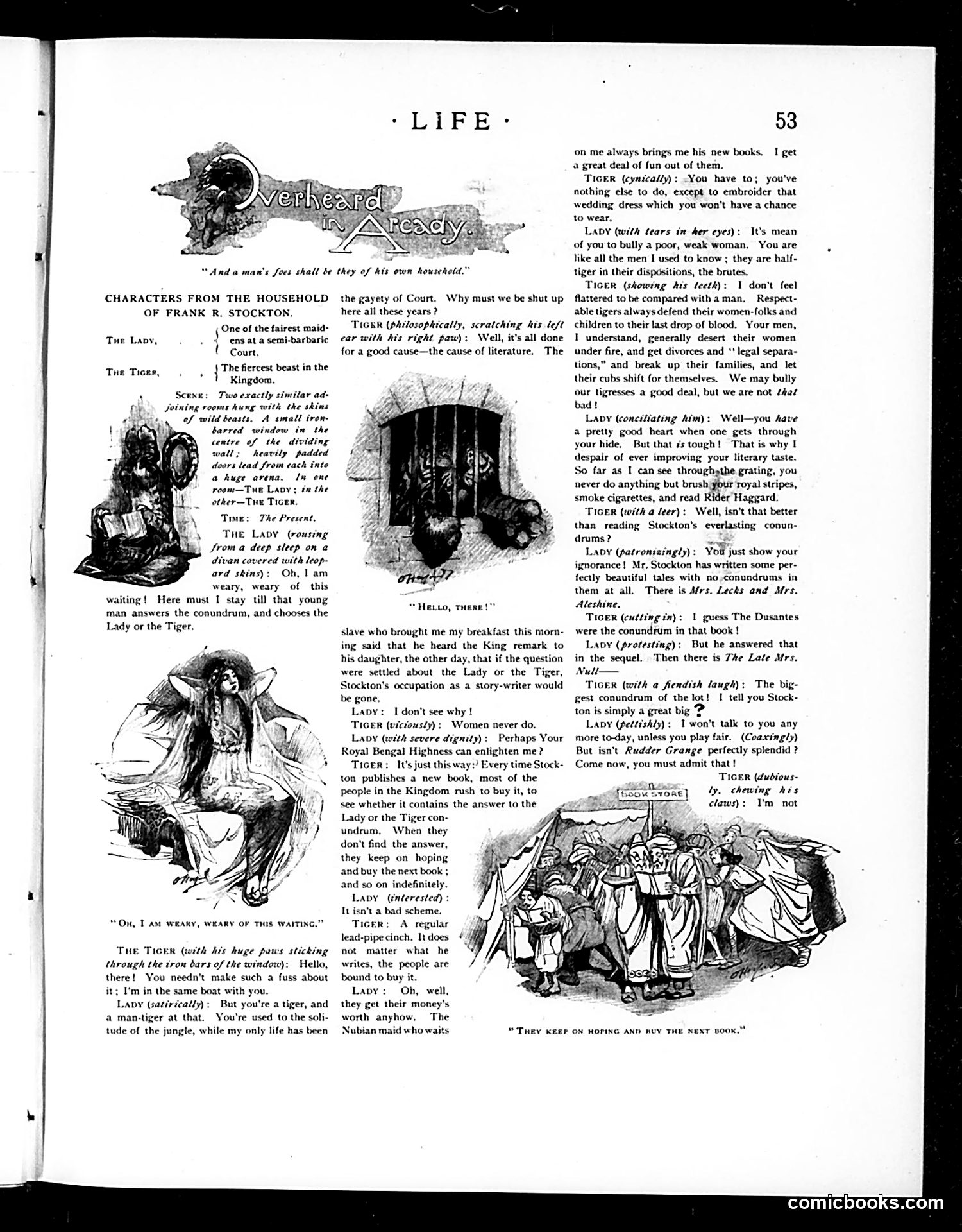
This satirical dialogue between "The Lady" and "The Tiger" mocks literary pretension and reading habits of the era. The Tiger represents a skeptical, practical reader; the Lady embodies affected gentility and literary snobbery. The satire targets: - **Stockton's publishing machine**: Frank R. Stockton's prolific output (mentioned as constantly releasing new books) and readers' compulsive buying regardless of quality - **Literary fashion**: The Lady's insistence on discussing books she hasn't read, conflating reading with social status - **Gender stereotypes**: The Lady's vapid intellectualism versus the Tiger's grounded critique The cartoons show characters discussing whether Stockton's works merit serious attention. The joke: readers buy books mechanically, hoping each will contain profundity, yet remain perpetually disappointed—a timeless critique of consumerism dressed as cultural refinement.
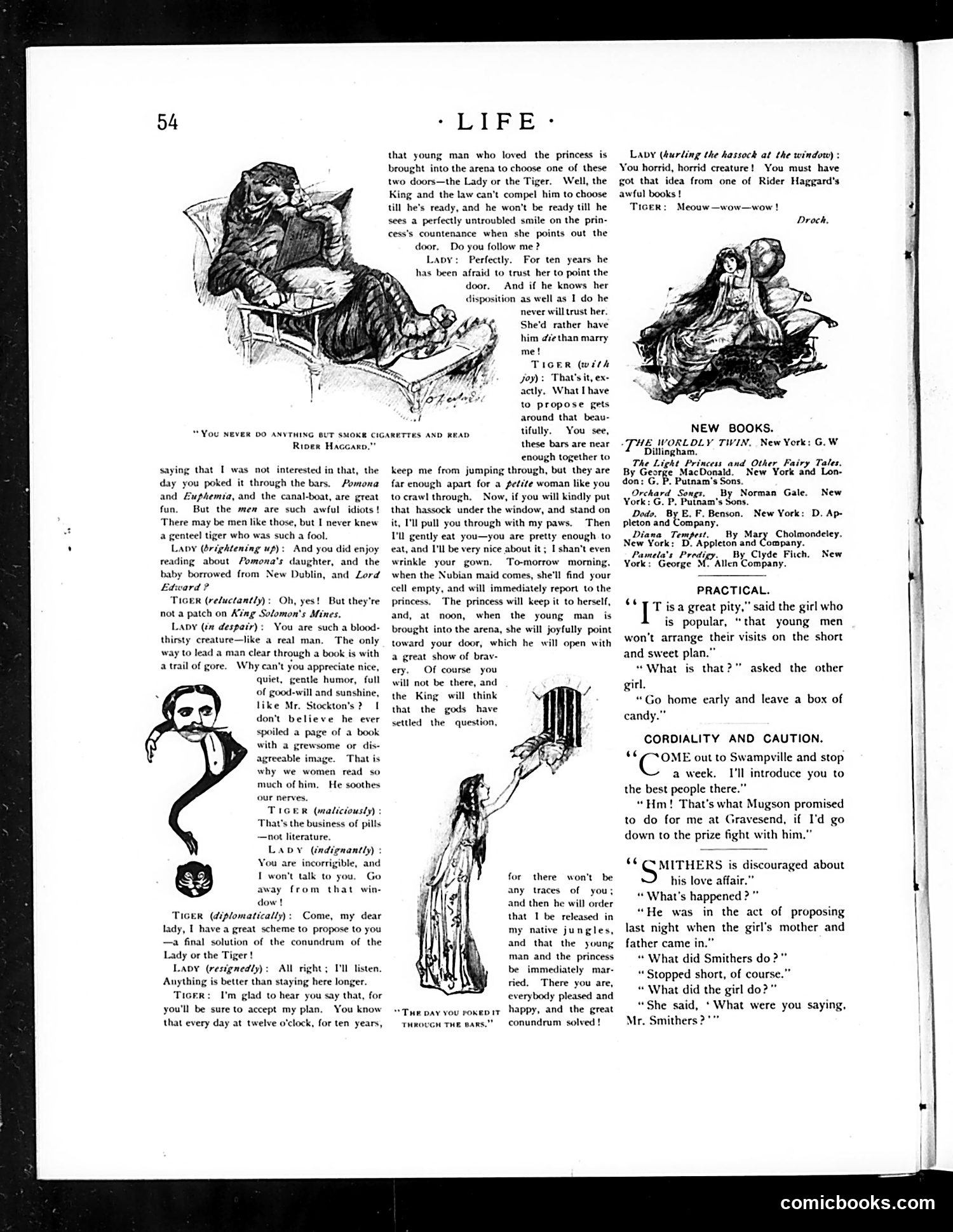
This page contains a satirical dialogue between a Tiger and a Lady, illustrated with period sketches. The Tiger proposes a scheme to the Lady involving a young man who must choose between two doors—one leading to the Lady, the other to the Tiger. The satire appears to mock Victorian courtship conventions and female manipulation. The Lady manipulates the young man through ten years of romantic uncertainty, then uses a scheme involving hidden doors and a Nizam (an Indian ruler) to force his decision toward marriage. The jokes target the Lady's strategic dishonesty in romance and the absurdity of elaborate schemes to secure matrimonial commitment. The Tiger represents a cynical observer of human romantic behavior. The "New Books" section and other content suggest this is a typical Life magazine issue mixing commentary with advertisements.
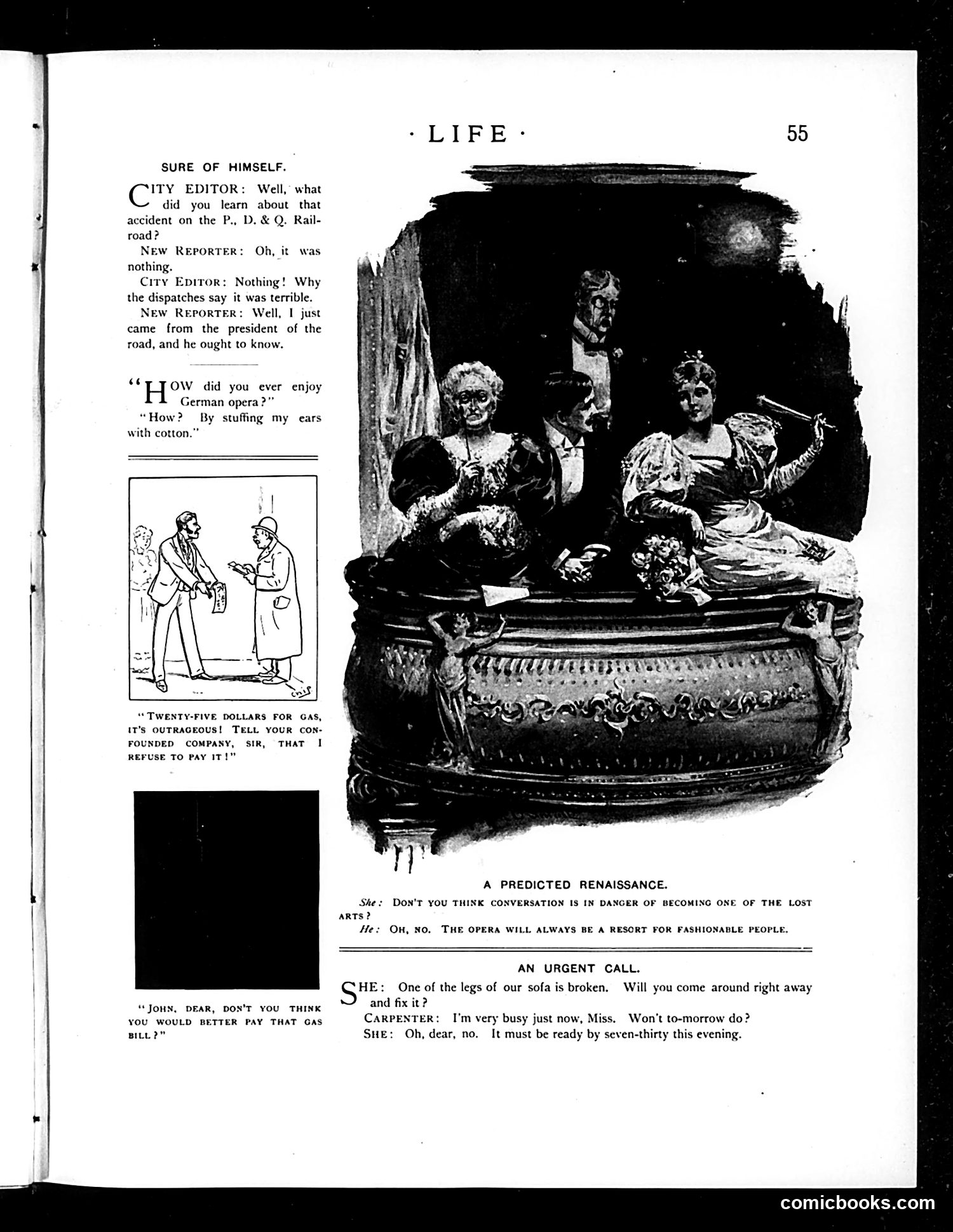
This page contains three separate humorous items typical of early 20th-century satirical magazines: 1. **"Sure of Himself"** (top left): A dialogue joke between a City Editor and New Reporter about a railroad accident. The humor relies on the reporter's naïveté—he contacted the railroad president for information, assuming the executive would naturally know about a disaster on his own line. 2. **"A Predicted Renaissance"** (center): A drawing depicting elegantly dressed people in an ornate theater box discussing whether opera will decline. The satire suggests that conversation itself—not the art form—keeps opera fashionable among wealthy society people. 3. **"An Urgent Call"** (bottom): A domestic humor sketch where a wife urgently needs a carpenter to repair a broken sofa leg by evening, but the carpenter refuses, creating comedic tension over domestic priorities.
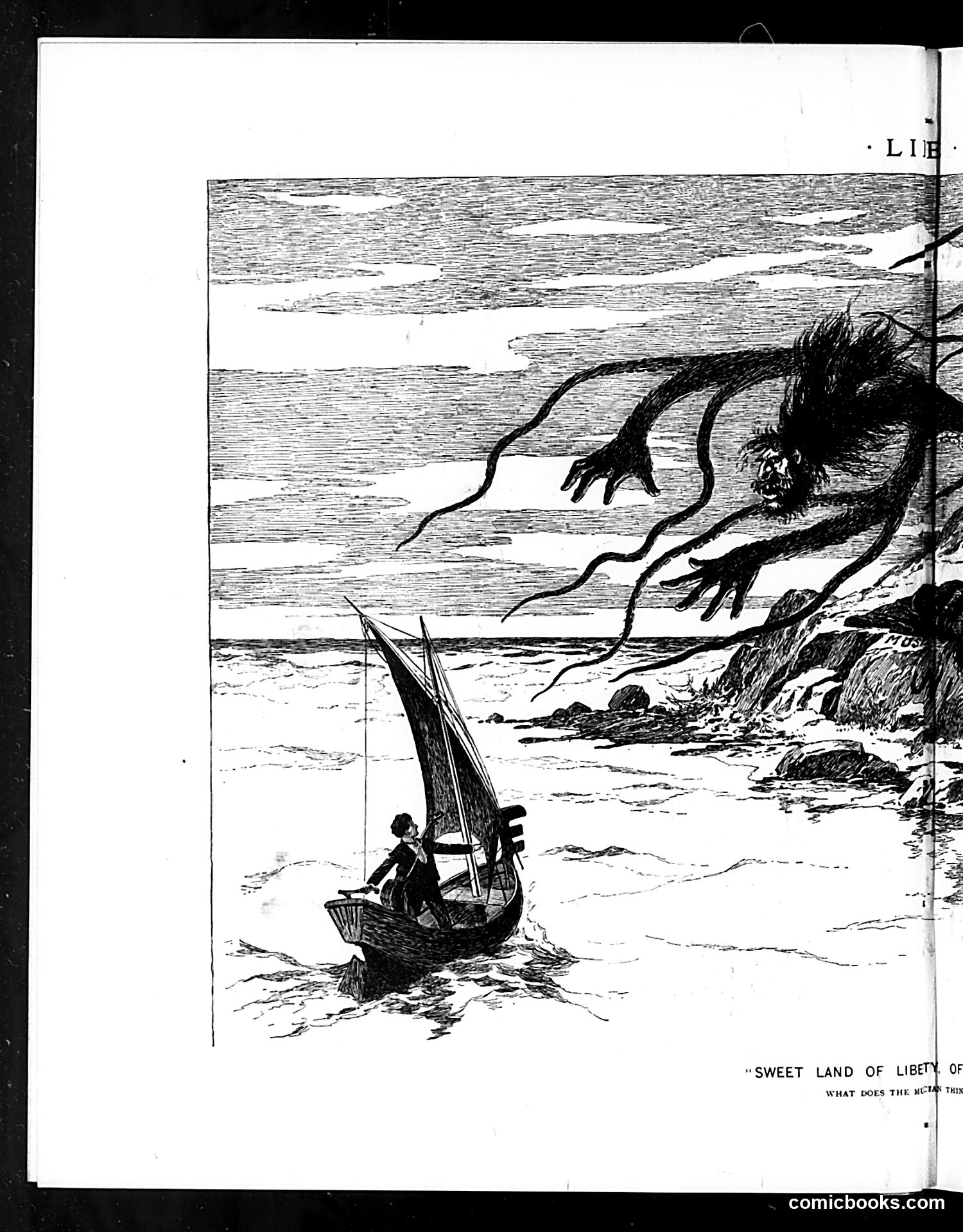
This Life magazine illustration depicts a small sailboat with a single figure approaching a rocky, ominous coastline. Looming above the shore are dark, serpentine creatures with grotesque features—appearing demonic or monstrous. The visible caption reads "Sweet Land of Liberty" with a partial question beginning "What does the..." This appears to be satirical commentary on American ideals versus reality. The boat likely represents an immigrant or hopeful arrival in America, while the threatening creatures on the shore represent obstacles, dangers, or disillusionment awaiting them. The juxtaposition between the patriotic phrase "Sweet Land of Liberty" and the hostile imagery suggests ironic critique—questioning whether America truly lives up to its promised ideals of freedom and welcome. The exact historical moment remains unclear without complete caption text.
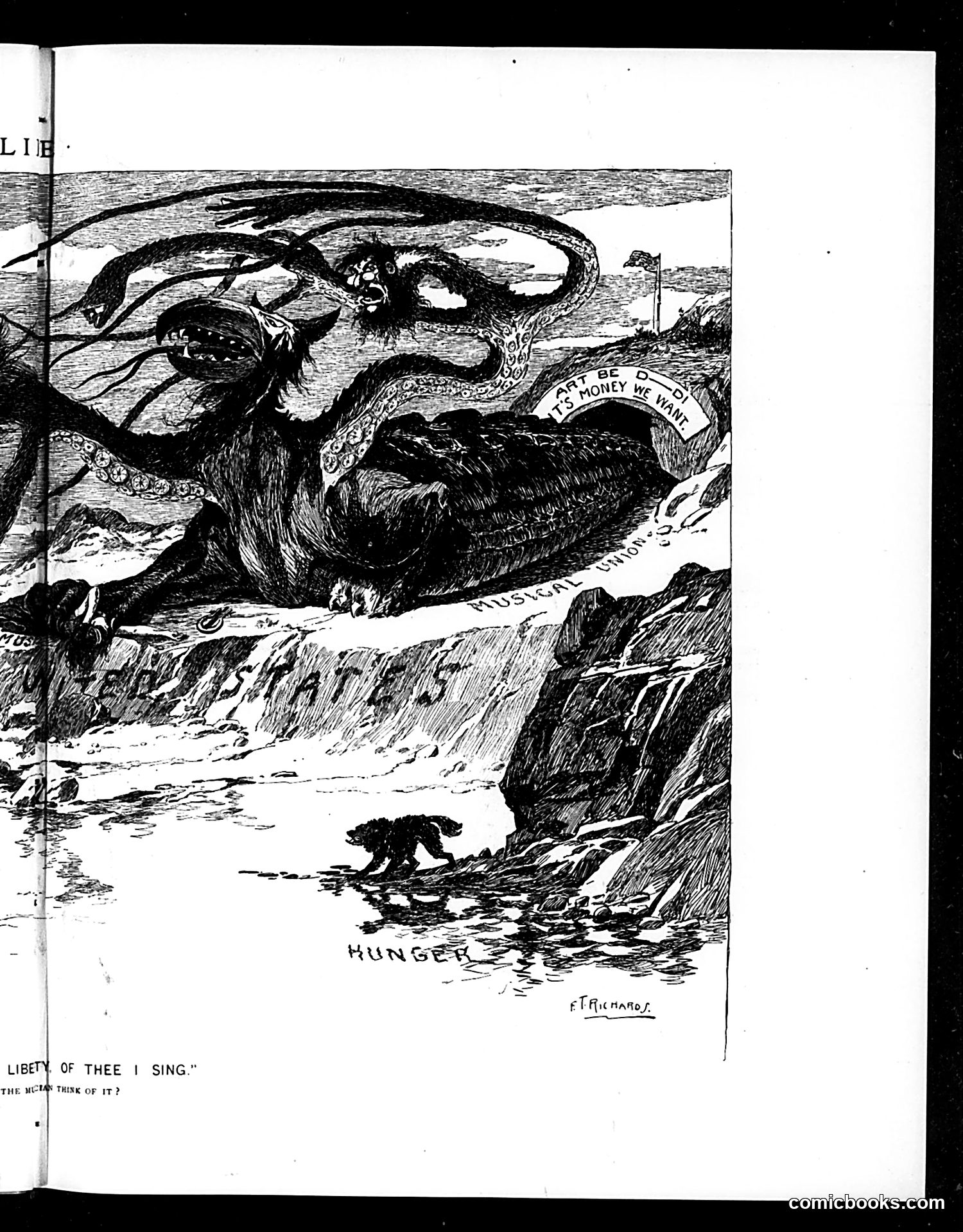
This appears to be a satirical cartoon from *Life* magazine depicting **Hunger** as a central figure—a large, emaciated or beast-like creature dominating a barren landscape. A smaller human figure cowers at the bottom left, labeled "HUNGER." The serpents or tentacles above the figure bear text referencing "MUSIC" and what appears to be "HONEY WE WANT" (partially visible), suggesting commentary on promises or distractions offered to distressed populations during economic hardship. The cartoon critiques how authorities or media distract the hungry poor with entertainment, music, or false promises rather than addressing their material needs. The stark, nightmarish imagery emphasizes the real suffering of hunger versus the hollow consolations offered. The artist signature appears to read "Fitzpatrick."
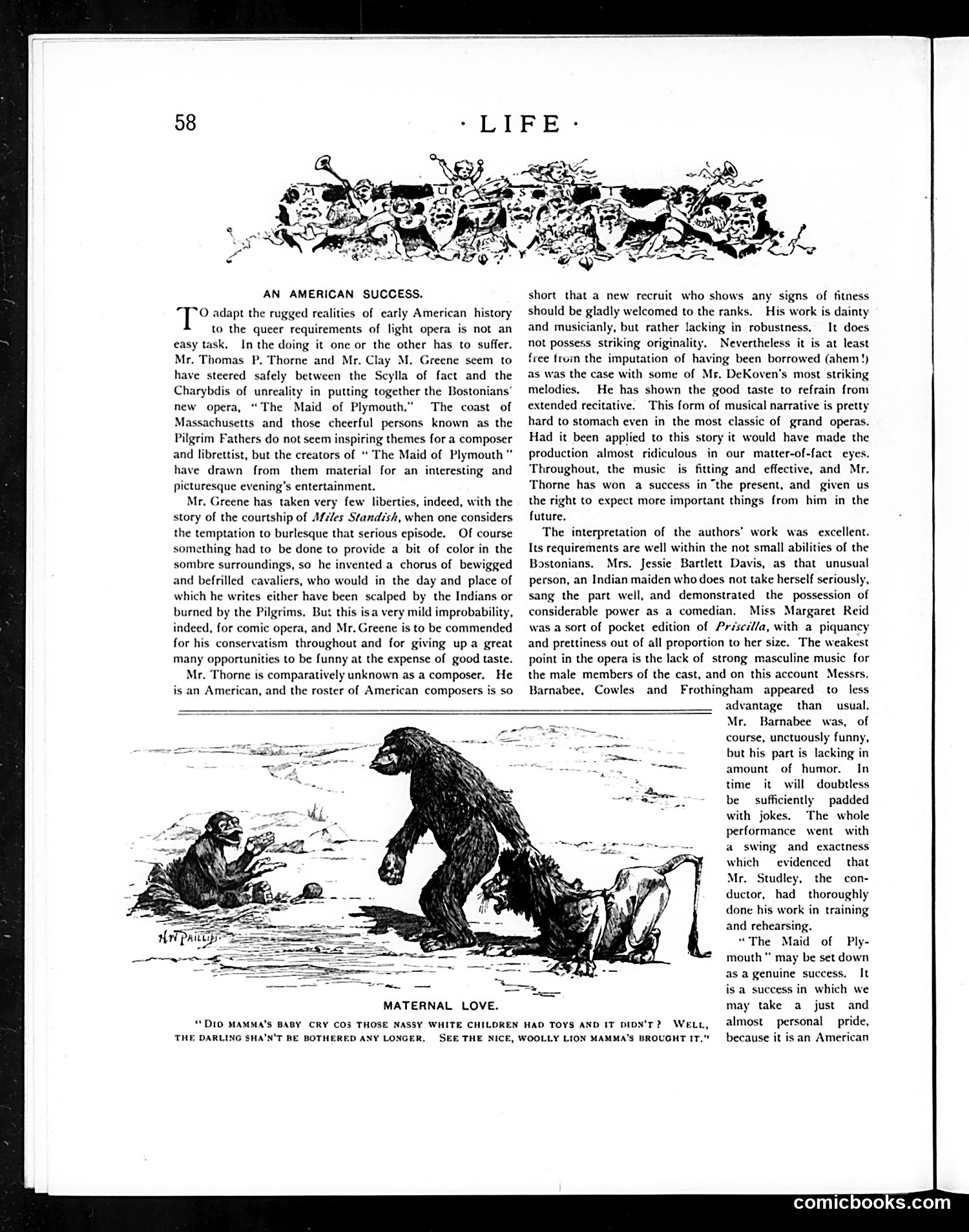
This cartoon illustrates a humorous scene of animal parenting, likely satirizing contemporary attitudes about child-rearing or maternal instinct. The image shows what appears to be a lioness presenting her cubs with a toy—specifically, a small human figure or doll. The caption's joke relies on the absurdity of the scenario: the lioness has given her children a "nice, woolly" toy so they won't bother her with their cries. This inverts normal expectations—a predator mother providing comfort items rather than teaching hunting. The satire likely critiques parents (particularly wealthy ones) who use material goods or toys to pacify children rather than engaging with them directly. The "woolly" toy suggests commercialized childhood entertainment of the era, common targets of Life magazine's social commentary.
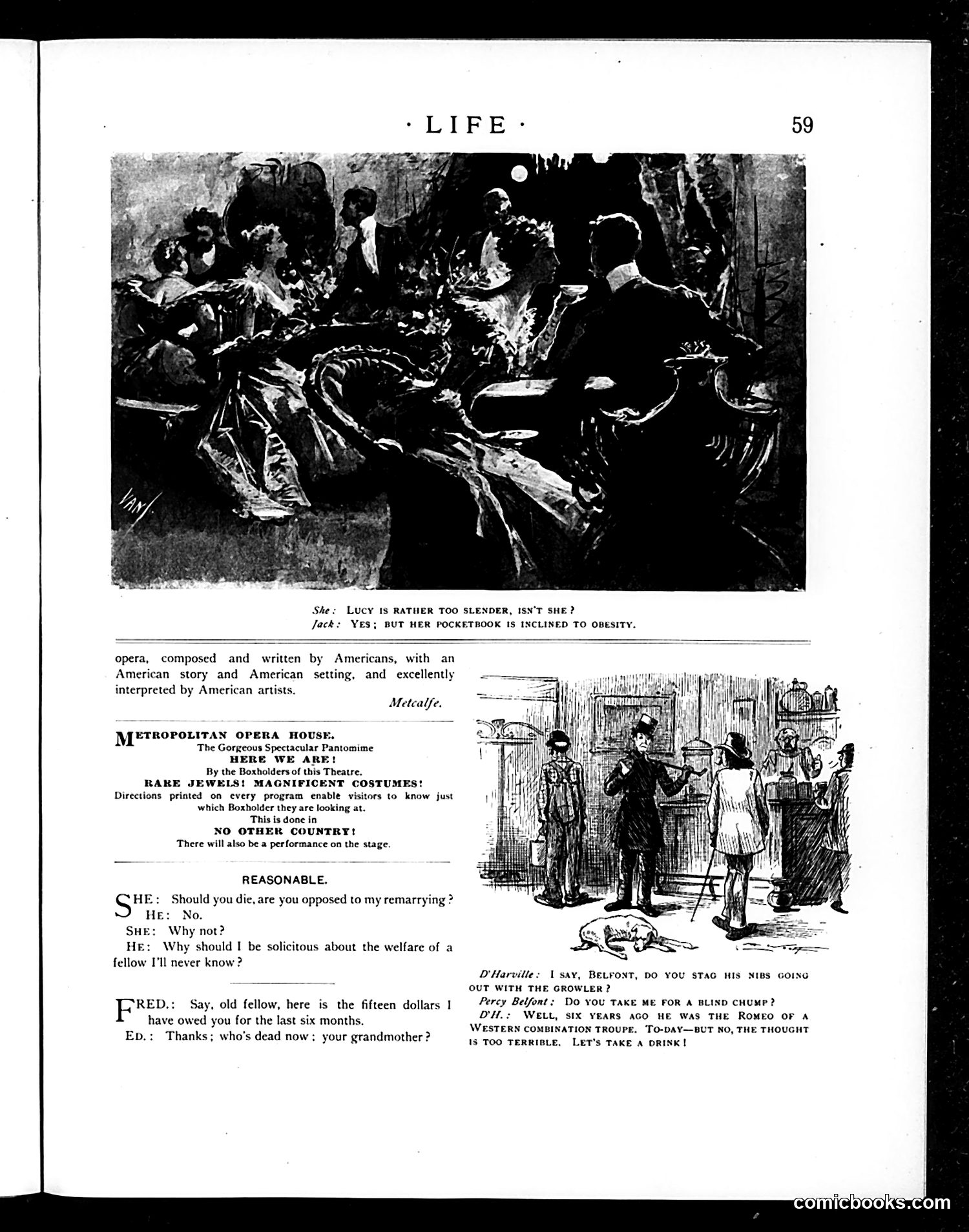
This page contains theatrical humor and social satire rather than political cartoons. **Top Image**: A sketch captioned with dialogue about "Lucy" being "slender" but having a "pocketbook inclined to obesity"—a joke about a woman's purse being overstuffed, playing on the contrast between her thin figure and her bulging accessories. **Metropolitan Opera House Advertisement**: Promotes an American opera with "rare Jewish magnificent costumes," emphasizing patriotic American production values. **Bottom Cartoons**: Two separate humor sketches depicting everyday social interactions—one about remarriage after death, another about theatrical performers reminiscing about their past ("Romeo of a Western combination troupe"). These rely on period-specific theatrical references and social conventions about courtship and propriety that would be familiar to early 20th-century readers but require historical context today. The page reflects leisure-class humor and theatrical culture of the era.
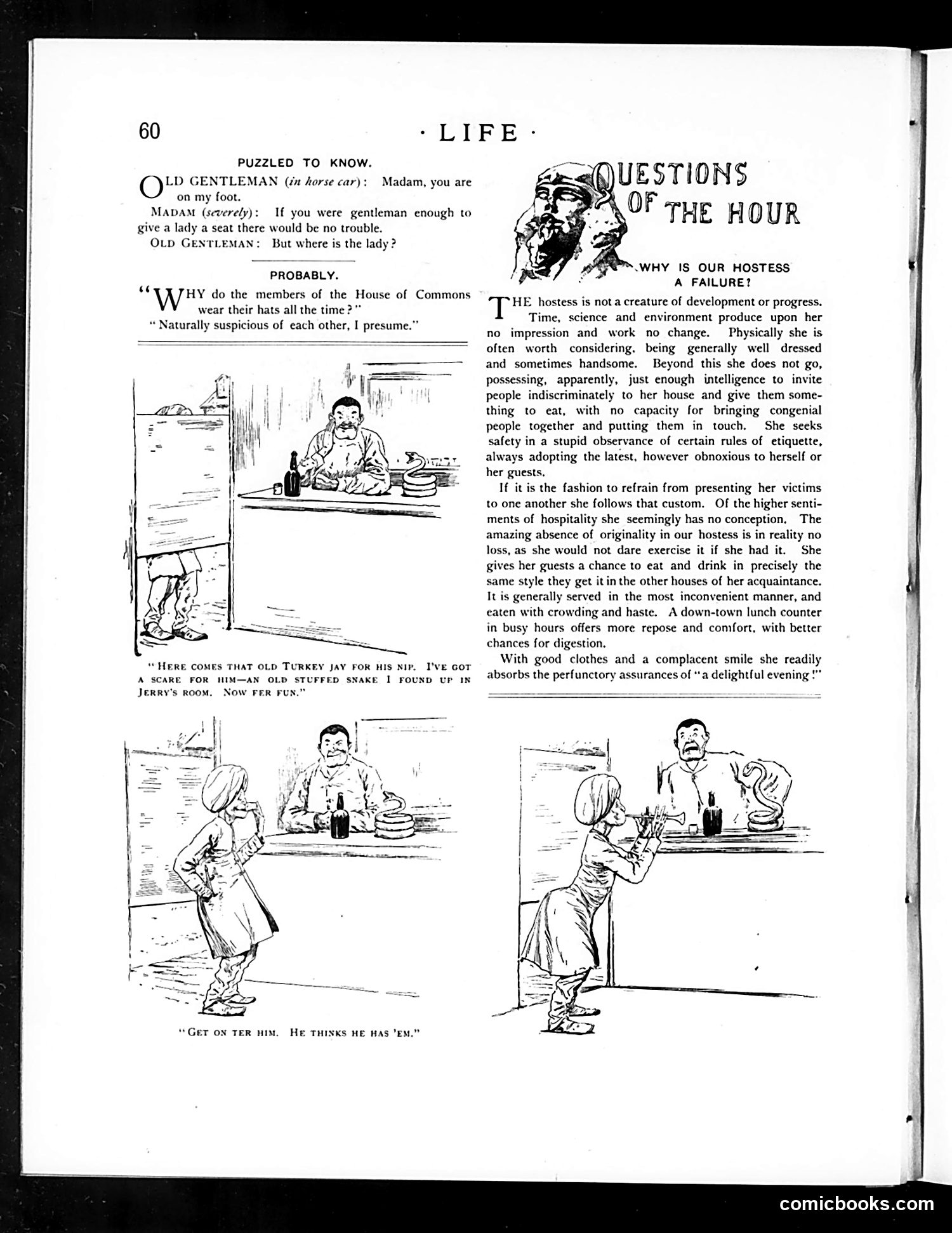
This page contains three separate satirical pieces: **"Puzzled to Know"**: A two-part joke mocking social pretense. First, an old gentleman steps on a woman's foot in a horse car; when she demands he offer his seat as a "gentleman" would, he insults her by questioning whether she qualifies as a lady. Second, a joke about Members of Parliament wearing hats constantly because they're "naturally suspicious of each other"—implying political distrust. **"Here Comes That Old Turkey Jay"**: A domestic prank scene where someone plans to scare "Turkey Jay" (an apparent neighborhood figure) with a stuffed snake, seeking amusement from his frightened reaction. **"Why Is Our Hostess a Failure?"**: An extended essay-cartoon criticizing upper-class hostesses as intellectually stagnant and mechanically hospitable. They rigidly follow etiquette rules without genuine warmth, serve meals inconveniently, and lack originality—making their gatherings inferior even to lunch counters. The satire targets shallow society women who prioritize appearance and fashion over authentic human connection.
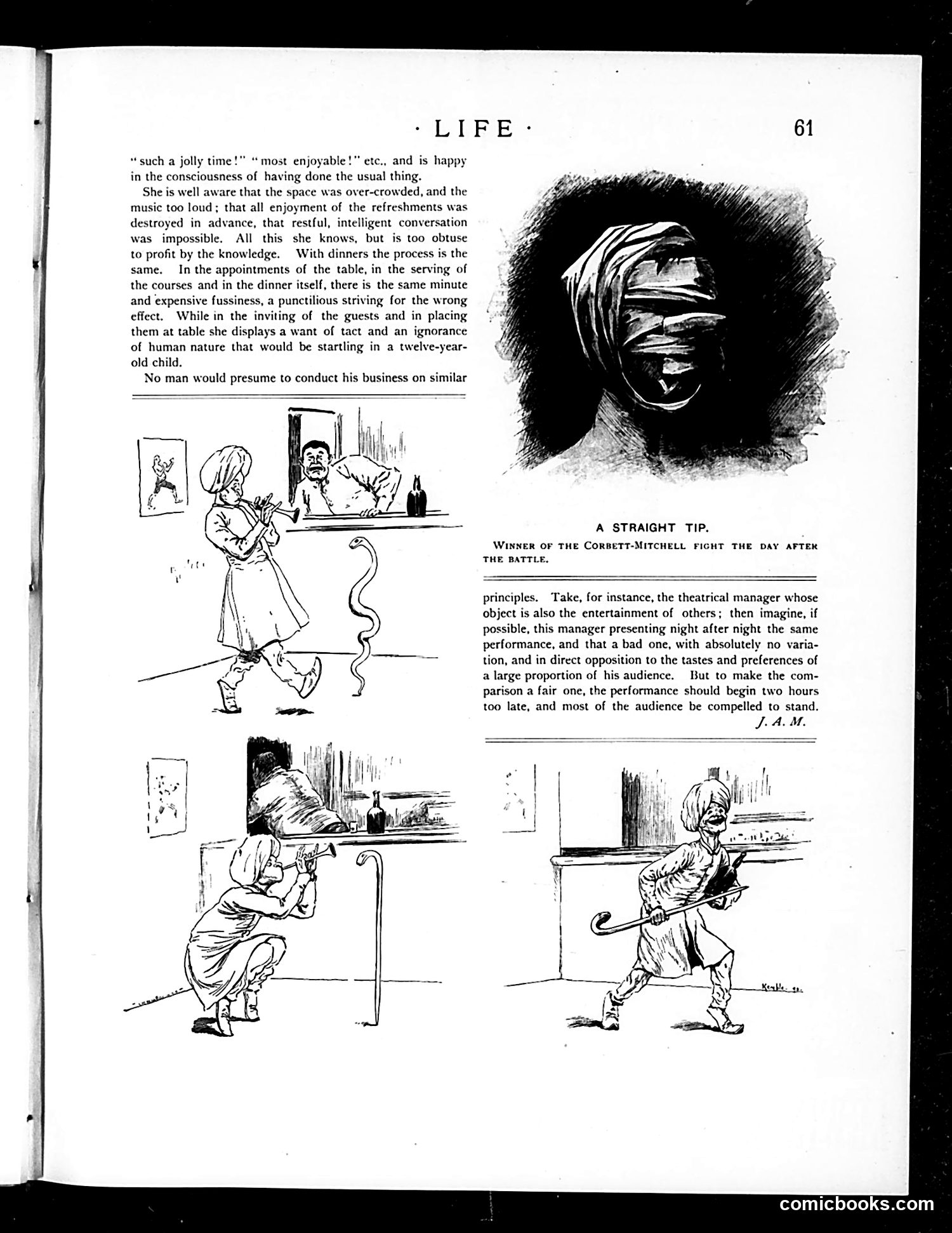
This page from *Life* magazine satirizes poor hostessing through contrasting text and cartoons. The upper text criticizes women who host crowded, loud social gatherings with bad food service, yet congratulate themselves for following convention. The author argues such hostesses lack basic human understanding—they wouldn't tolerate equivalent incompetence in business or theater. The cartoons illustrate this critique through a domestic comedy series showing a woman dealing with chaotic situations (a snake appearing during entertaining, guests awkwardly positioned). The caption "A Straight Tip" references the boxers Corbett and Mitchell, suggesting practical advice: just as a boxer needs good coaching to win, a hostess needs to understand her guests' actual comfort rather than rigidly follow social formulas. The satire targets upper-class women's blind adherence to social convention over genuine hospitality—prioritizing appearances of propriety while creating uncomfortable experiences.
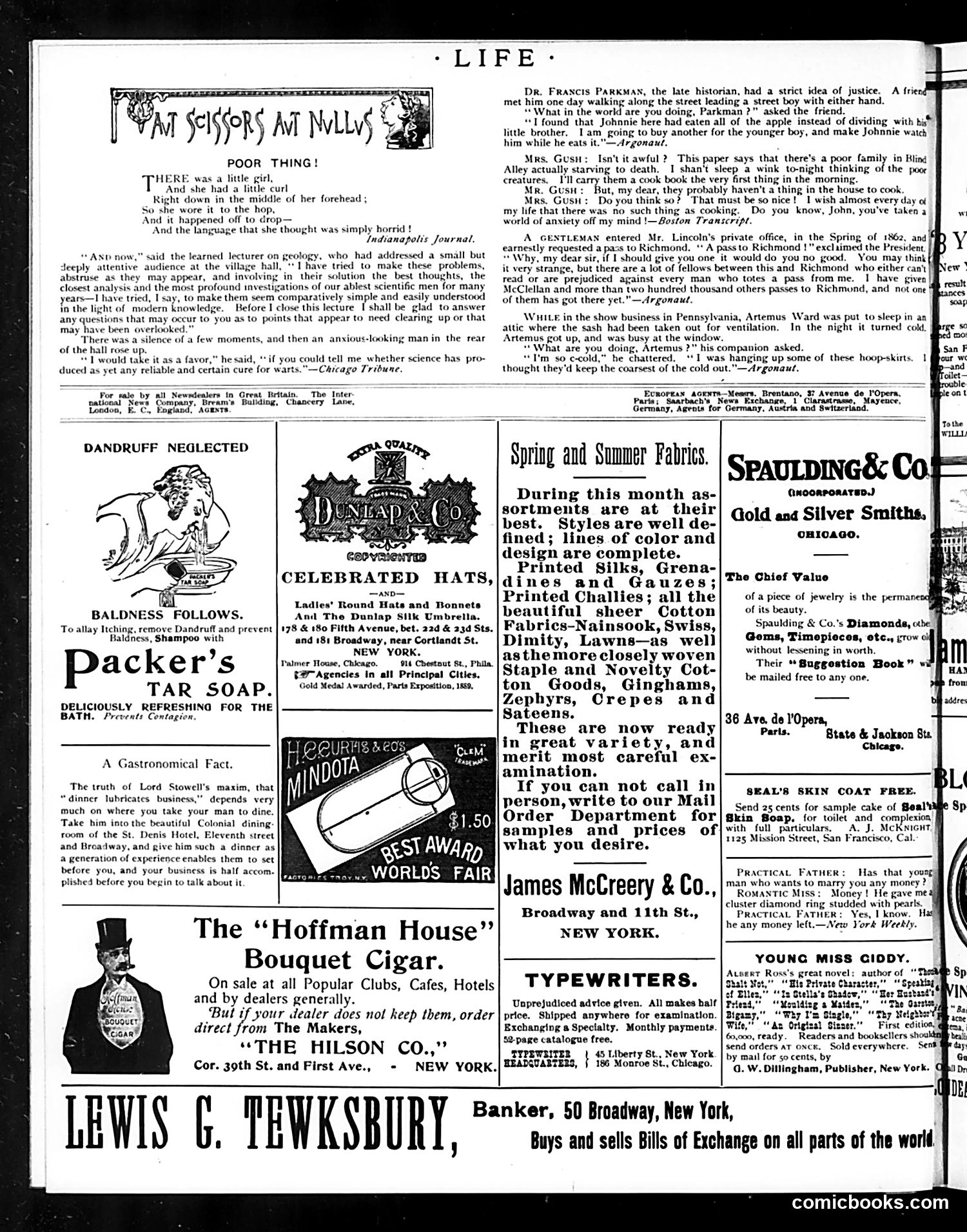
This page contains several short humorous anecdotes rather than political cartoons. The jokes rely on unexpected punchlines that would have amused Victorian-era readers: 1. **"Pat Scissors at Wills"**: A girl loses a curl and thinks "horrid" thoughts—the humor is in the innocent contrast between her appearance and her internal language. 2. **The geology lecture**: An audience member asks about wart cures instead of geology—satirizing how people ask irrelevant questions to authority figures. 3. **Historical anecdotes about Lincoln, Parkman, and Artemus Ward**: These feature famous figures demonstrating wit or moral lessons through clever responses to everyday situations. The page is primarily **advertising**—most space features commercial notices for hats, soap, cigars, typewriters, and financial services typical of 1880s-90s America. The humor throughout is gentle, domestic, and focused on manners and social awkwardness rather than sharp political satire. The page reflects Life magazine's role as genteel entertainment for middle-class readers.
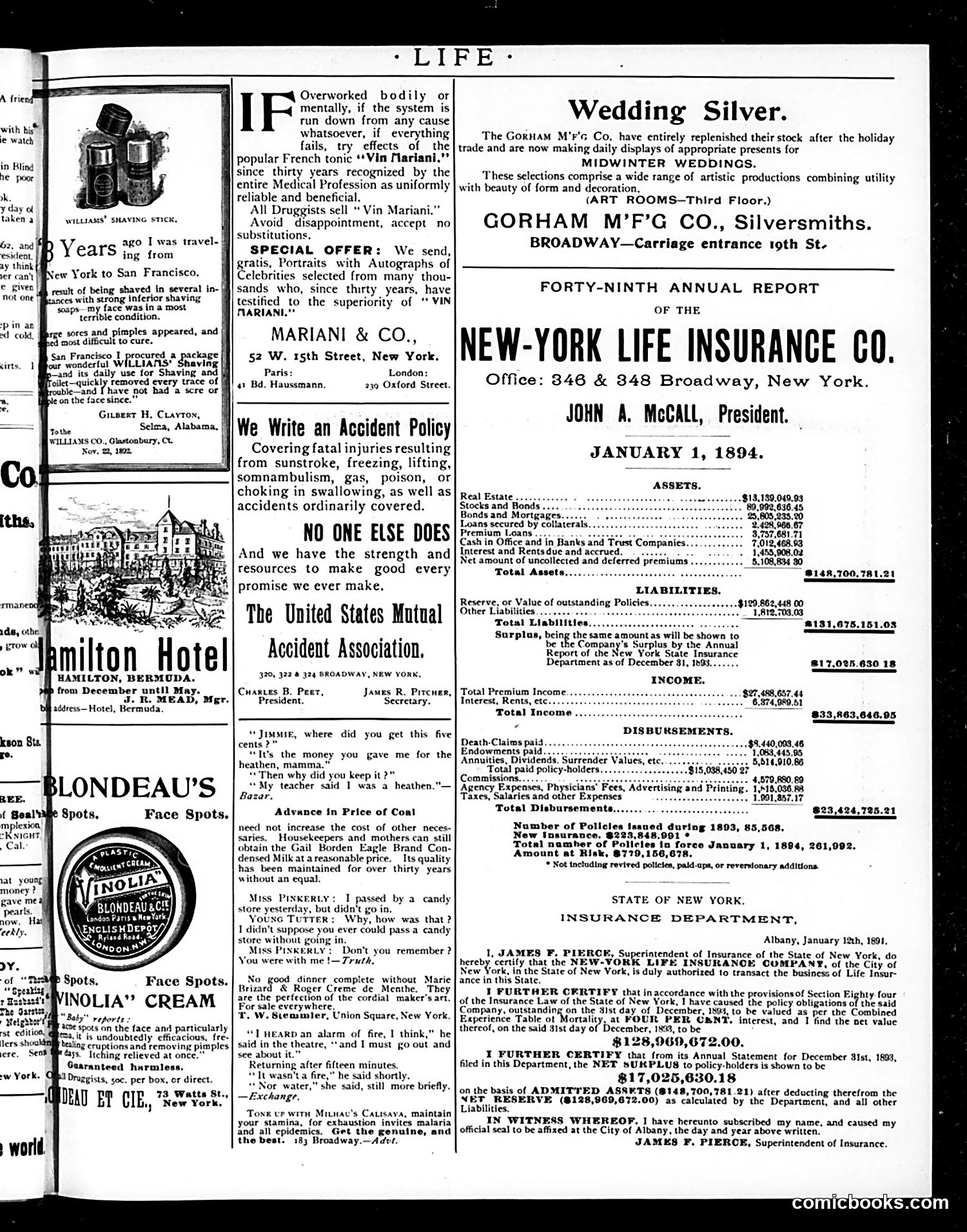
This page is primarily **advertising and financial reporting**, not political satire. The main content includes: 1. **New-York Life Insurance Company's annual report** — the dominant feature, showing assets, liabilities, and premium income for 1893. 2. **Multiple product advertisements** for patent medicines and cosmetics (Vin Mariani tonic, Williams' Shaving Stick, Blondeau's face cream), typical of late-19th-century magazines. 3. **Small humorous anecdotes** (marked "Truth" and "Bazar" — contemporary humor publications), including jokes about a child misusing missionary donations and a woman avoiding a candy store. 4. **Advertisement for Hamilton Hotel in Bermuda** and wedding silver from Gorham Manufacturing. There are no significant political cartoons or satirical commentary visible. The page reflects 1890s consumer culture and the insurance industry's growth during the Gilded Age.
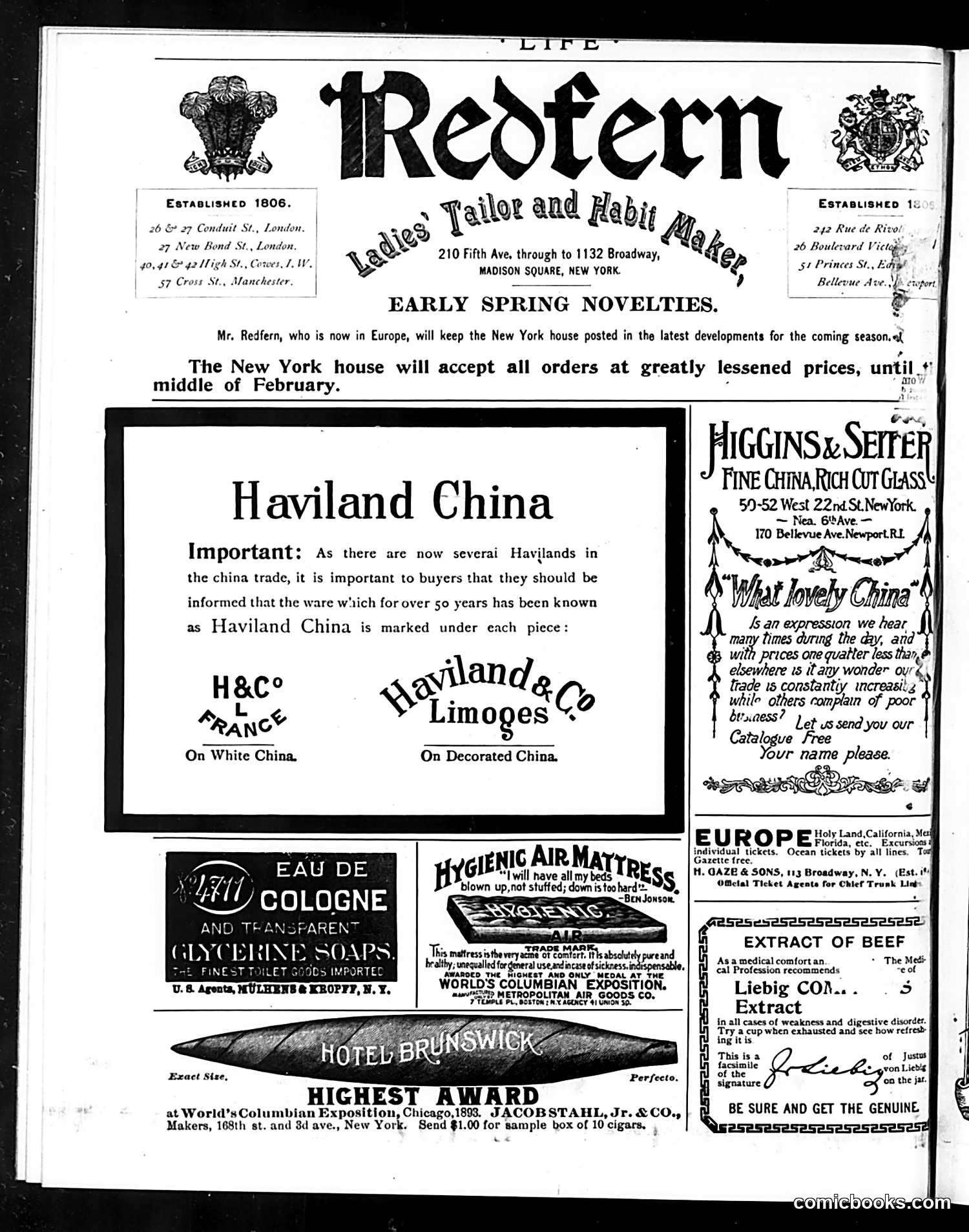
This is primarily an **advertising page** from Life magazine, not a satirical cartoon. It features commercial advertisements for luxury goods and services circa 1890s New York. The main content advertises **Redfern**, an established ladies' tailor and habit maker with locations in London and New York, announcing early spring novelties and reduced prices through mid-February. Other notable ads include: - **Haviland China**, clarifying that genuine Haviland ware (sold for 50+ years) is marked "H&C" to distinguish it from imitators flooding the market - **Higgins & Seifter** fine china and glassware - Various patent medicines and luxury goods (cologne, extract of beef, mattresses) - **Hotel Brunswick** cigars, awarded highest honors at the 1893 World's Columbian Exposition The page reflects Gilded Age consumer culture, targeting wealthy readers with high-end imports and branded goods—a stark contrast to modern advertising's mass-market approach.