
Life, 1894-01-25 · page 4 of 16
Life — January 25, 1894 — page 4: what you’re looking at
What you’re looking at
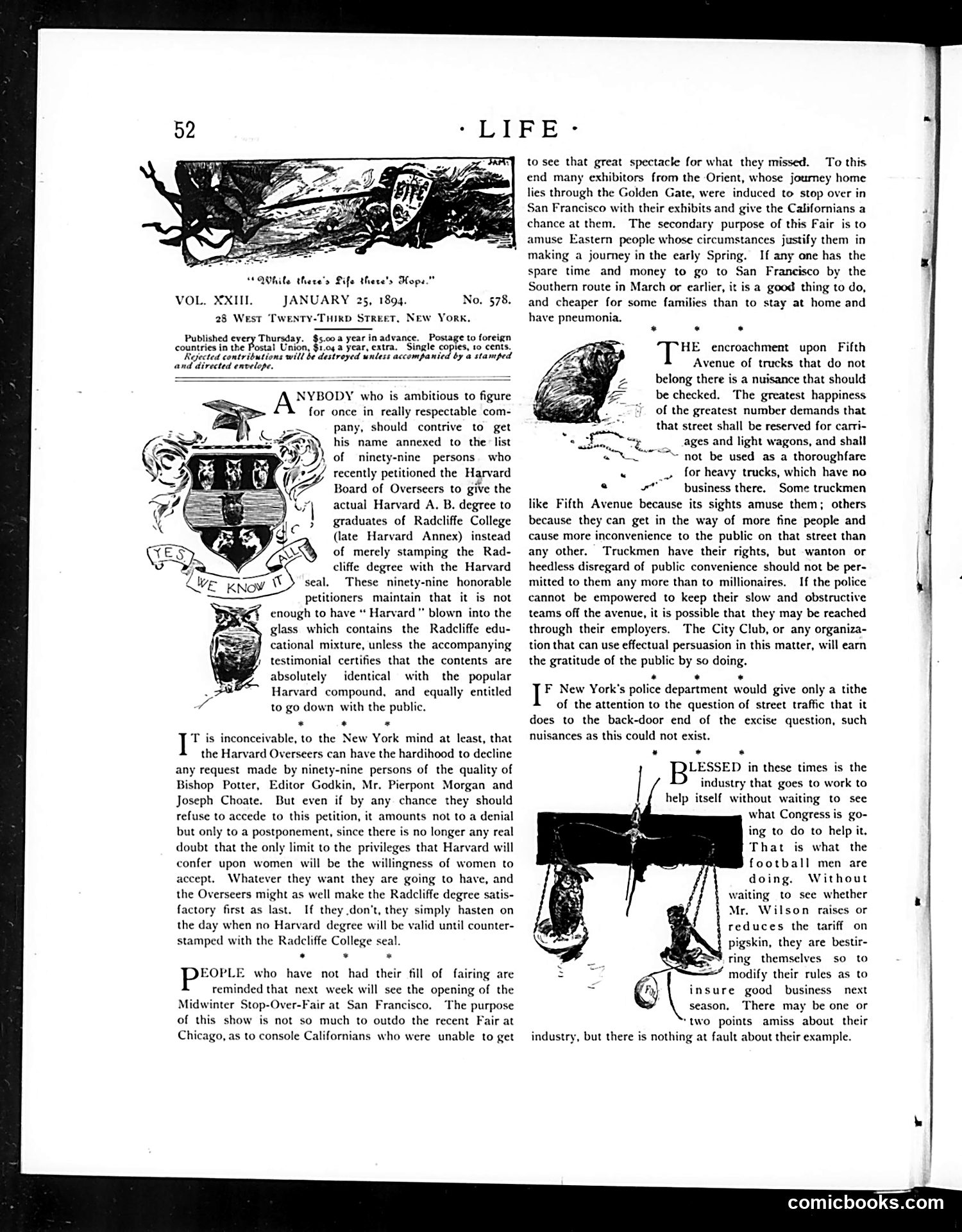
This page contains satirical commentary on academic credentials and urban infrastructure rather than traditional political cartoons. The main article mocks a petition by 99 Harvard graduates requesting that Radcliffe College (Harvard's women's college) award the same A.B. degree as Harvard itself. The author argues this would cheapen Harvard's prestige—a sharp critique of late-19th-century gender discrimination in higher education. A secondary piece criticizes New York City's lack of traffic regulation on Fifth Avenue, where trucks obstruct pedestrians and commerce. The author praises the football industry for self-regulation, suggesting the city should pressure trucking companies similarly rather than relying on police enforcement. The illustrations are decorative rather than satirical, showing the Harvard seal and a hanging figure (likely representing commerce or industry).
📄 Transcribed text from this page (OCR, searchable)
Machine-transcribed from the original scan — historical spelling and the odd misread are preserved.
“QWhile there's Life there's Hope.” VOL. XXIII. JANUARY 25, 1894. No. 578. 28 West Twenty-Tiikp Street, New York. Published every Thursday. $5.00 a year in advance. Postage to foreign countries in the Postal Union, $1.04 a year, extra. Single copies, 10 cents. Rejected contributions will be destroyed unless accompanied by a stamped and directed envelope, NYBODY who is ambitious to figure for once in really respectable com- pany, should contrive to get his name annexed to the list of ninety-nine persons who recently petitioned the Harvard Board of Overseers to give the actual Harvard A. B. degree to graduates of Radcliffe College (late Harvard Annex) instead of merely stamping the Rad- cliffe degree with the Harvard seal, These ninety-nine honorable petitioners maintain that it is not enough to have * Harvard" blown into the glass which contains the Radcliffe edu- cational mixture, unless the accompanying testimonial certifies that the contents are absolutely identical with the popular Harvard compound, and equally entitled to go down with the public. . . . T is inconceivable, to the New York mind at least, that the Harvard Overseers can have the hardihood to decline any request made by ninety-nine persons of the quality of Bishop Potter, Editor Godkin, Mr. Pierpont Morgan and Joseph Choate. But even if by any chance they should refuse to accede to this petition, it amounts not to a denial but only to a postponement, since there is no longer any real doubt that the only limit to the privileges that Harvard will confer upon women will be the willingness of women to accept. Whatever they want they are going to have, and the Overseers might as well make the Radcliffe degree satis- factory first as last. If they don’t, they simply hasten on the day when no Harvard degree will be valid until counter- stamped with the Radcliffe College seal. P EOPLE who have not had their fill of fairing are reminded that next week will see the opening of the Midwinter Stop-Over-Fair at San Francisco. The purpose of this show is not so much to outdo the recent Fair at Chicago, as to console Californians who were unable to get to see that great spectacle for what they missed. To this end many exhibitors from the Orient, whose journey home lies through the Golden Gate, were induced to stop over in San Francisco with their exhibits and give the Californians a chance at them. The secondary purpose of this Fair is to amuse Eastern people whose circumstances justify them in making a journey in the early Spring. If any one has the spare time and money to go to San Francisco by the Southern route in March or earlier, it is a good thing to do, and cheaper for some families than to stay at home and have pneumonia. * . . HE encroachment upon Fifth Avenue of trucks that do not belong there is a nuisance that should be checked. The greatest happiness of the greatest number demands that that street shall be reserved for carri- ages and light wagons, and shall “not be used as a thoroughfare « . for heavy trucks, which have no s a business there. Some truckmen like Fifth Avenue because its sights amuse them; others because they can get in the way of more fine people and cause more inconvenience to the public on that street than any other. Truckmen have their rights, but wanton or heedless disregard of public convenience should not be per- mitted to them any more than to millionaires. If the police cannot be empowered to keep their slow and obstructive teams off the avenue, it is possible that they may be reached through their employers. The City Club, or any organiza- tion that can use effectual persuasion in this matter, will earn the gratitude of the public by so doing. . . . F New York's police department would give only a tithe of the attention to the question of street traffic that it does to the back-door end of the excise question, such nuisances as this could not exist. . . B’ SED in these times is the industry that goes to work to help itself without waiting to see what Congress is go- ing to do to help it. That is what the football men are doing. Without waiting to see whether Mr. Wilson raises or reduces the tariff on pigskin, they are bestir- ring themselves so to modify their rules as to insure good business next season, There may be one or "two points amiss about their industry, but there is nothing at fault about their example. comicbooks.com