
A complete issue · 53 pages · 1893
Life — December 28, 1893
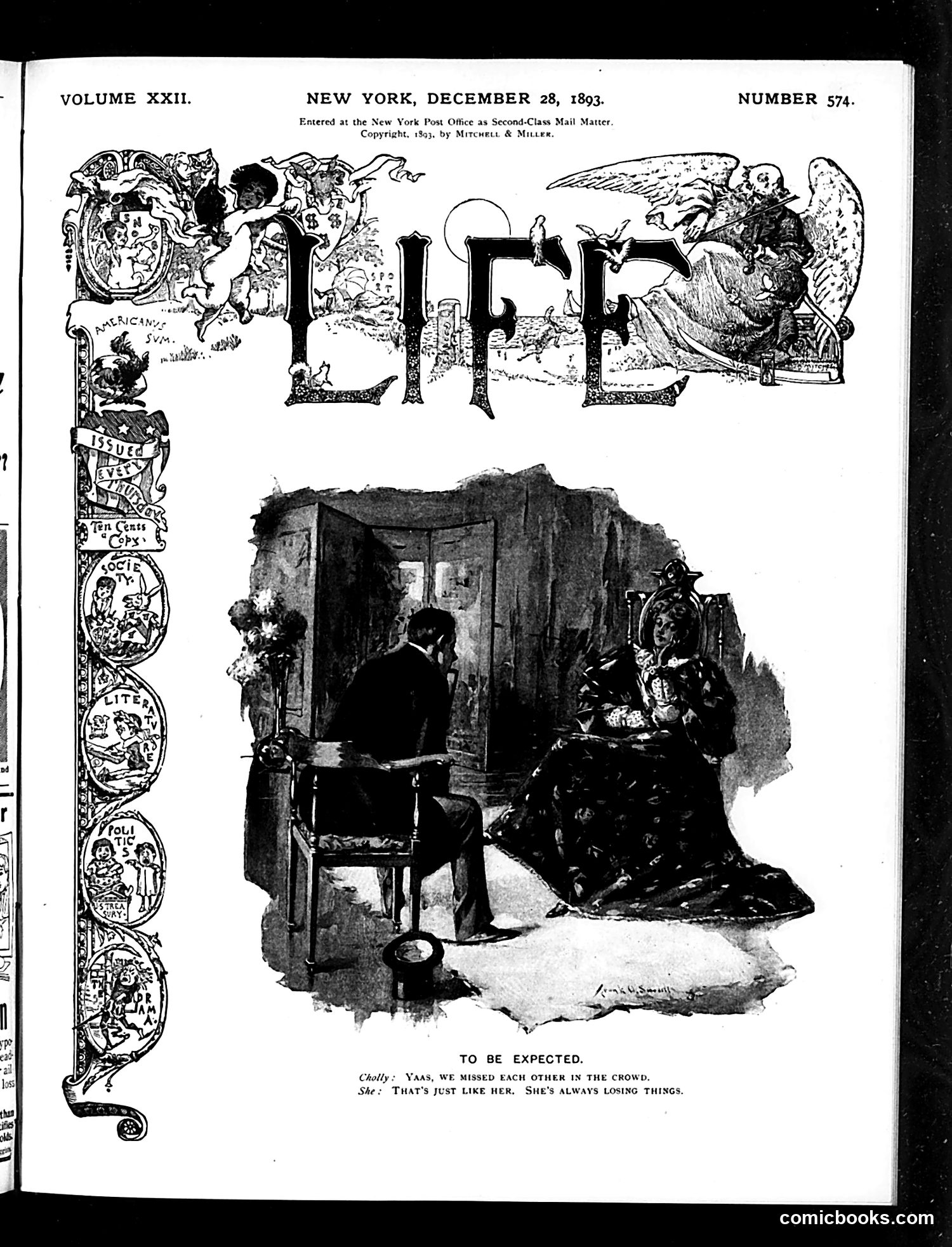
This satirical cartoon illustrates a domestic scene titled "To Be Expected." A man sits at a piano or desk while a woman in elaborate dress reclines nearby. The dialogue reads: "Yass, we missed each other in the crowd. She: That's just like her. She's always losing things." The humor operates on a double meaning: the speakers initially reference missing each other in a crowded public space, but the woman's response suggests the man is actually criticizing "her" (presumably the absent woman) for habitually losing or misplacing things—implying chronic disorganization or carelessness. The ornate decorative border and "Life" masthead indicate this was a prominent satirical magazine feature mocking middle-class domestic life and gender relations of the 1890s.
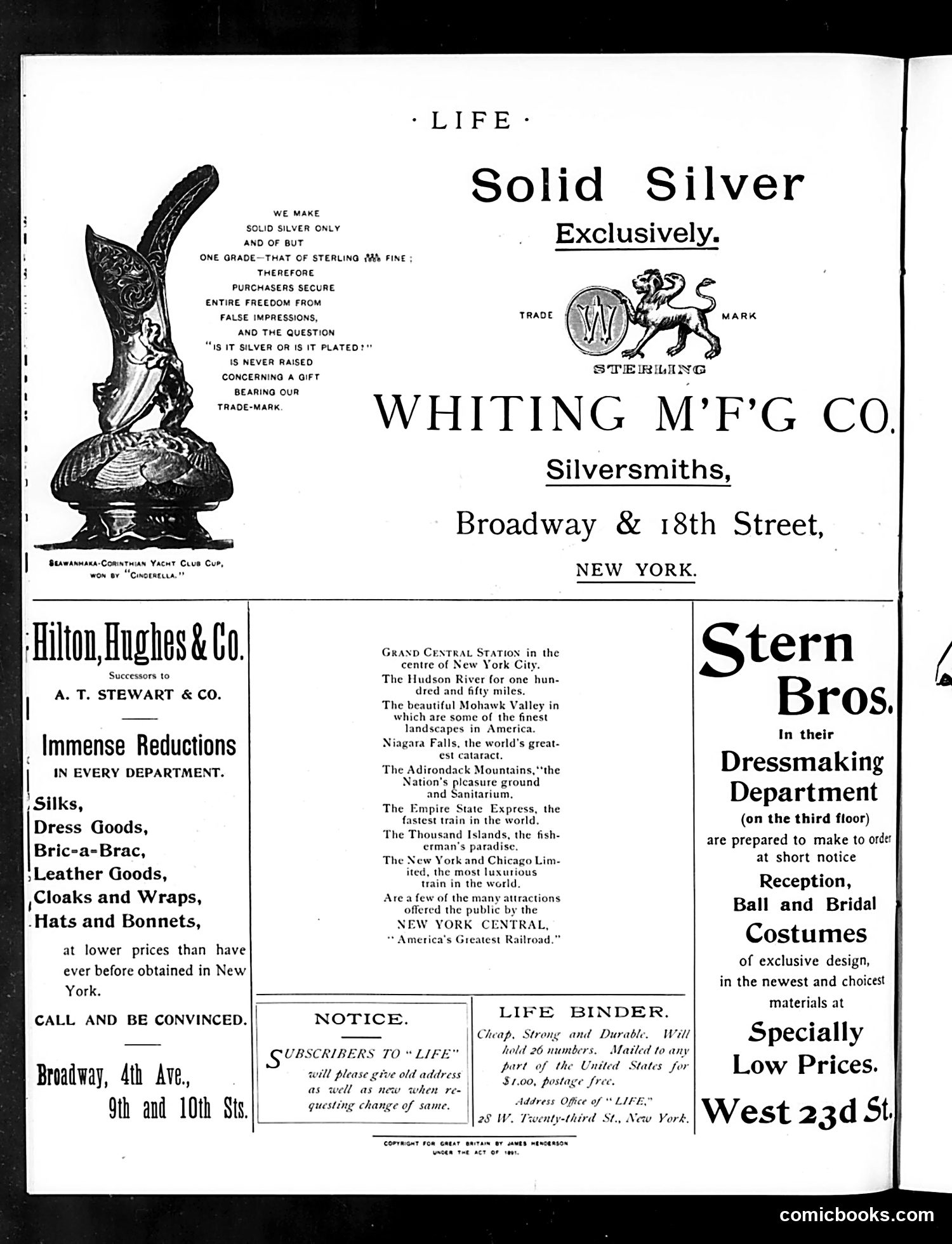
This page is primarily **advertising** rather than satirical content. The dominant feature is an advertisement for Whiting Manufacturing Company, silversmiths located on Broadway and 18th Street in New York, emphasizing their exclusive use of solid sterling silver. The left side shows a decorative silver trophy cup (the "Seawanhaka-Corinthian Yacht Club Cup, won by 'Cinderella'"), serving as a visual example of their craftsmanship. The accompanying text assures purchasers that their sterling silver mark guarantees authenticity, eliminating concerns about plating or false impressions. The remaining advertisements promote other New York merchants—Hilton, Hughes & Co. offering discounted silks and clothing, and Stern Bros. advertising dressmaking services. There is no discernible political satire on this page.
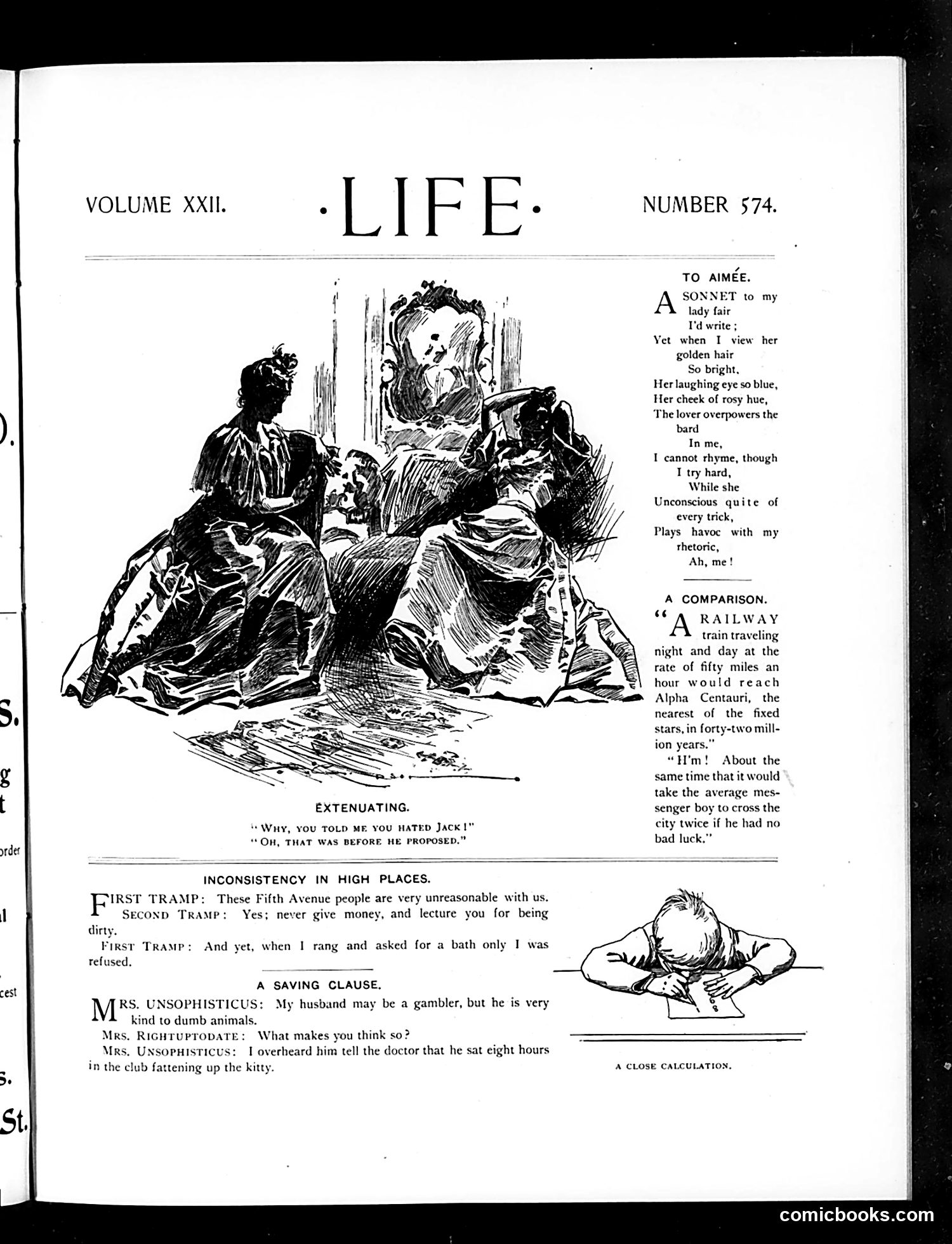
This page from *Life* magazine contains several satirical pieces: **"Extenuating"** shows a couple where the woman defends her husband Jack's proposal by claiming she hated him beforehand—so his proposal was actually an improvement in their relationship. It's a humorous take on low romantic expectations. **"Inconsistency in High Places"** mocks wealthy Fifth Avenue residents for being hypocritical: they refuse to give money or help servants, yet complain when refused basic services themselves. **"A Saving Clause"** jokes about a husband who gambles but is kind to animals—presented as his one redeeming quality. The page also includes a sonnet "To Aimée" and "A Comparison" about railway travel speeds. These pieces represent typical early-20th-century *Life* humor: domestic satire, class commentary, and gentle mockery of social contradictions.
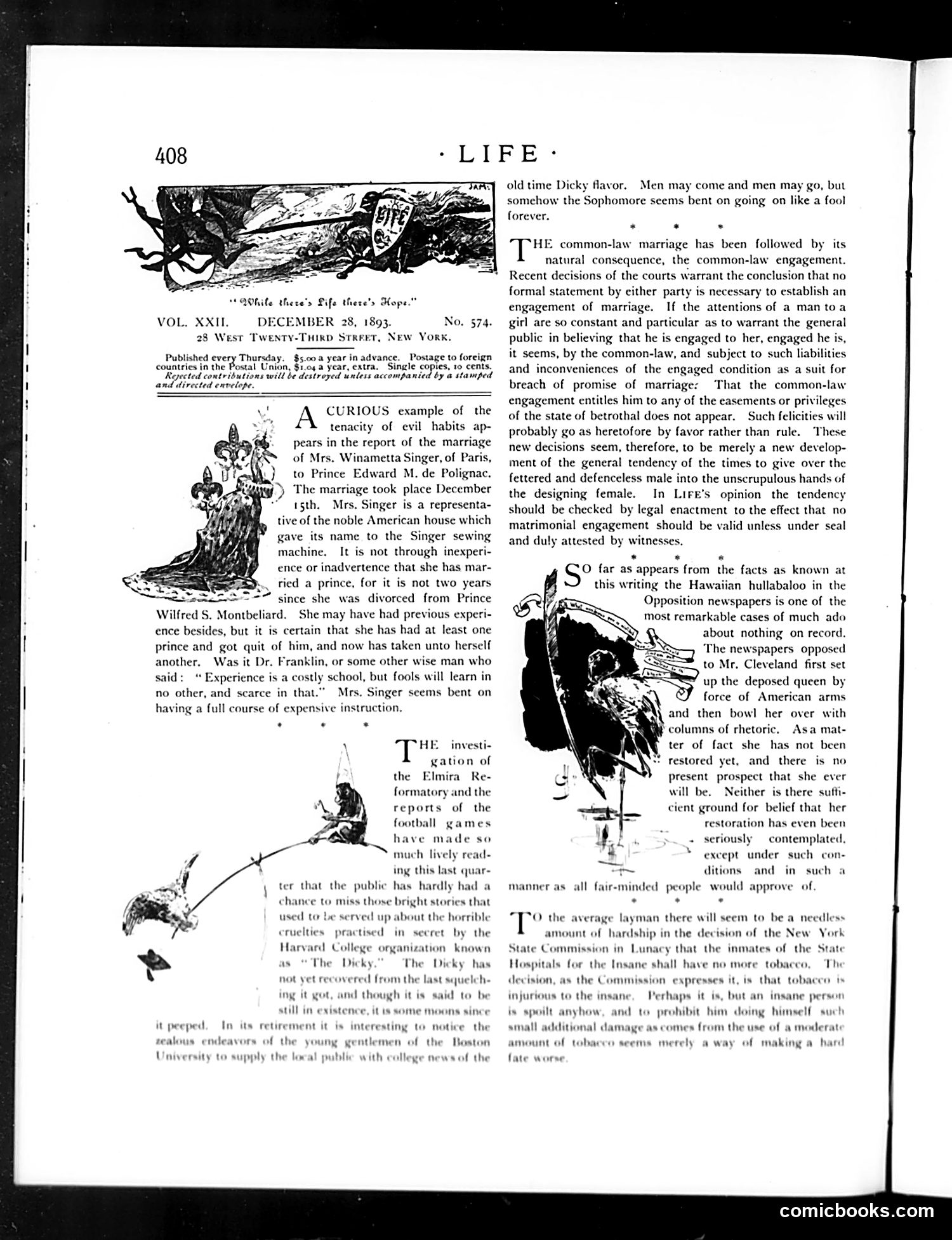
This page contains three separate satirical pieces rather than one unified cartoon: 1. **The Singer/Polignac case**: Text discusses Mrs. Wnametta Singer's marriage to Prince Edward M. de Polignac. The satire criticizes how she married a European prince despite previous divorces, mocking the American tendency to pursue titled husbands. 2. **Harvard "Dicky" hazing**: Illustrations mock Harvard College's secret society practices, specifically "The Dicky" organization's hazing rituals against students. The satire suggests the college covers up these cruel traditions. 3. **Hawaiian politics**: Text discusses newspaper coverage of a deposed Hawaiian queen, criticizing American colonial intervention and the press's role in supporting military occupation. Each section ridicules either aristocratic pretension, institutional abuse, or imperial expansion.
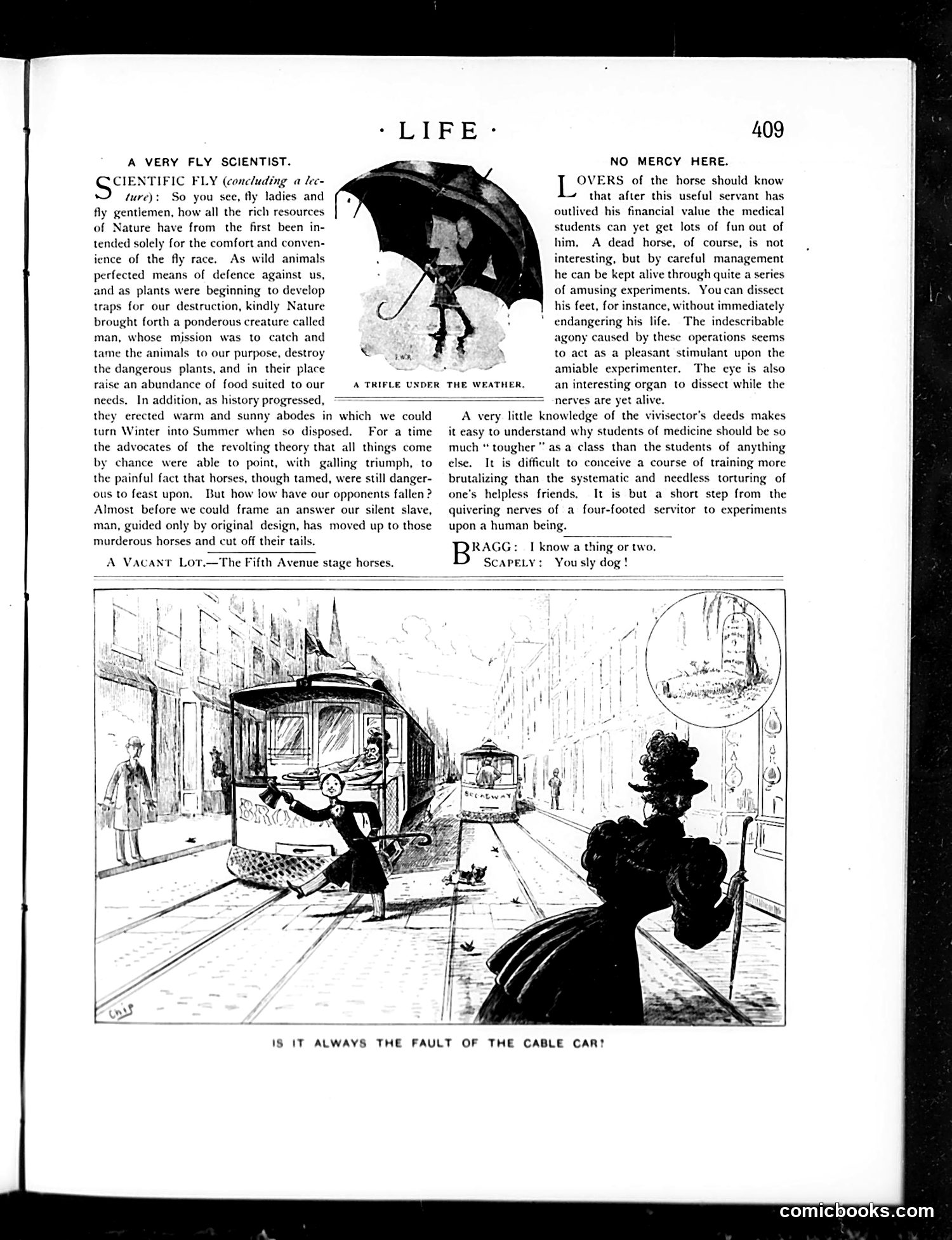
This page contains three distinct pieces of satire: 1. **"A Very Fly Scientist"** (top left): A humorous essay mocking the scientific use of flies in laboratory experiments, presented as if flies are complaining about their exploitation by researchers. 2. **"No Mercy Here"** (top right): Commentary criticizing medical students' brutal dissection practices on dead horses, comparing it unfavorably to vivisection experiments on living animals. The piece argues such practices desensitize students to animal suffering. 3. **"Is It Always the Fault of the Cable Car?"** (bottom): A cartoon satirizing cable car accidents in San Francisco. The illustration shows a cable car collision with pedestrians, suggesting ironic blame-shifting—implying the cable car system receives unfair criticism for accidents that may not be entirely its fault.
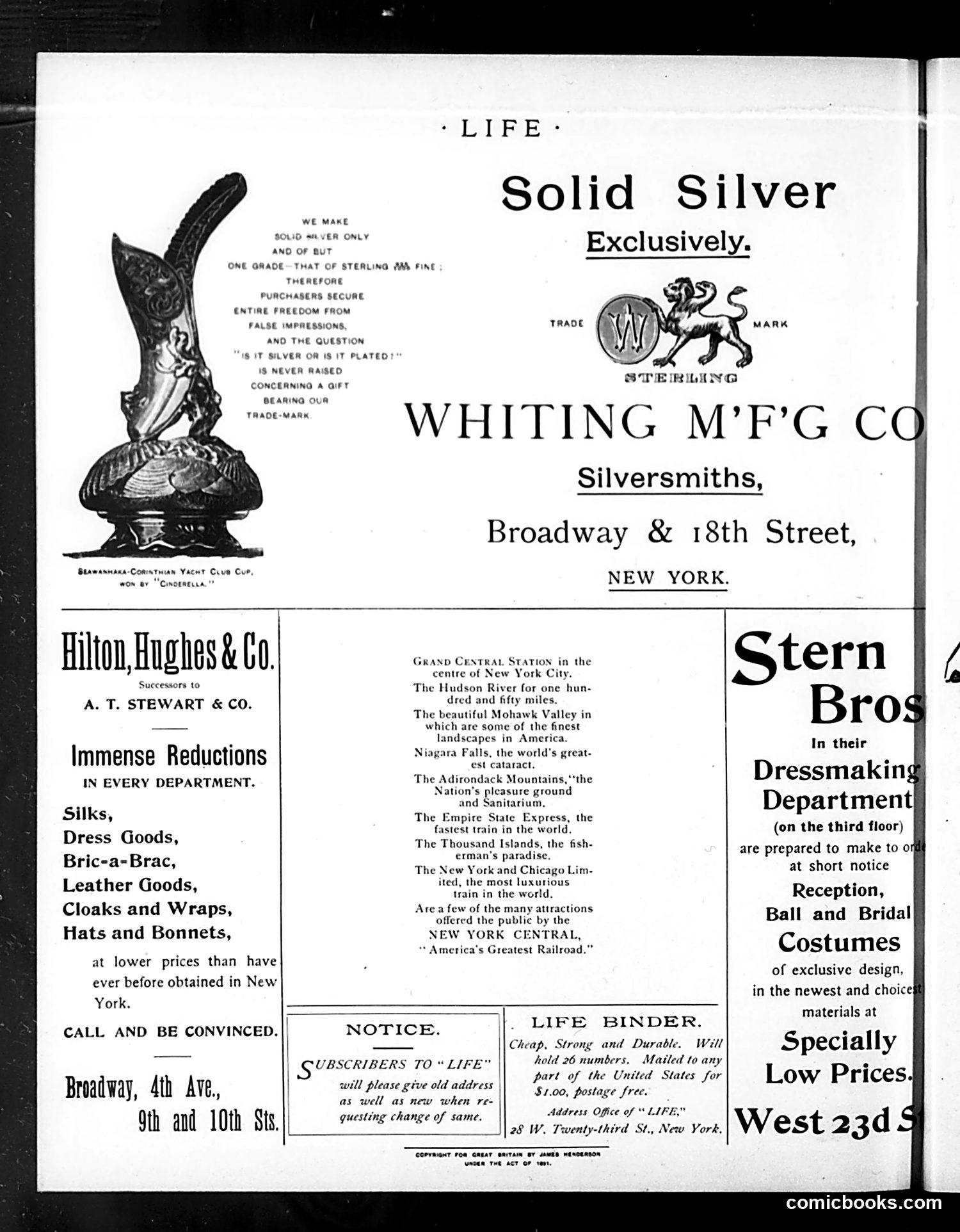
This page is primarily **advertising**, not satirical content. It contains four commercial advertisements from what appears to be a late 19th-century issue of *Life* magazine: 1. **Whiting M'FG Co.** – A silversmith promoting solid sterling silver goods, featuring their trade mark (a lion) 2. **Hilton, Hughes & Co.** – Advertising massive price reductions on textiles and clothing 3. **Stern Bros.** – Promoting custom dressmaking services for "Reception, Ball and Bridal Costumes" 4. **Life Binder** – A subscription service notice for *Life* magazine itself The only illustrative element is a decorative trophy or vessel at top left, labeled as a "Sausumuska Corinthian Yacht Club Cup." The page demonstrates how *Life* magazine monetized space through luxury goods advertising to its affluent readership.
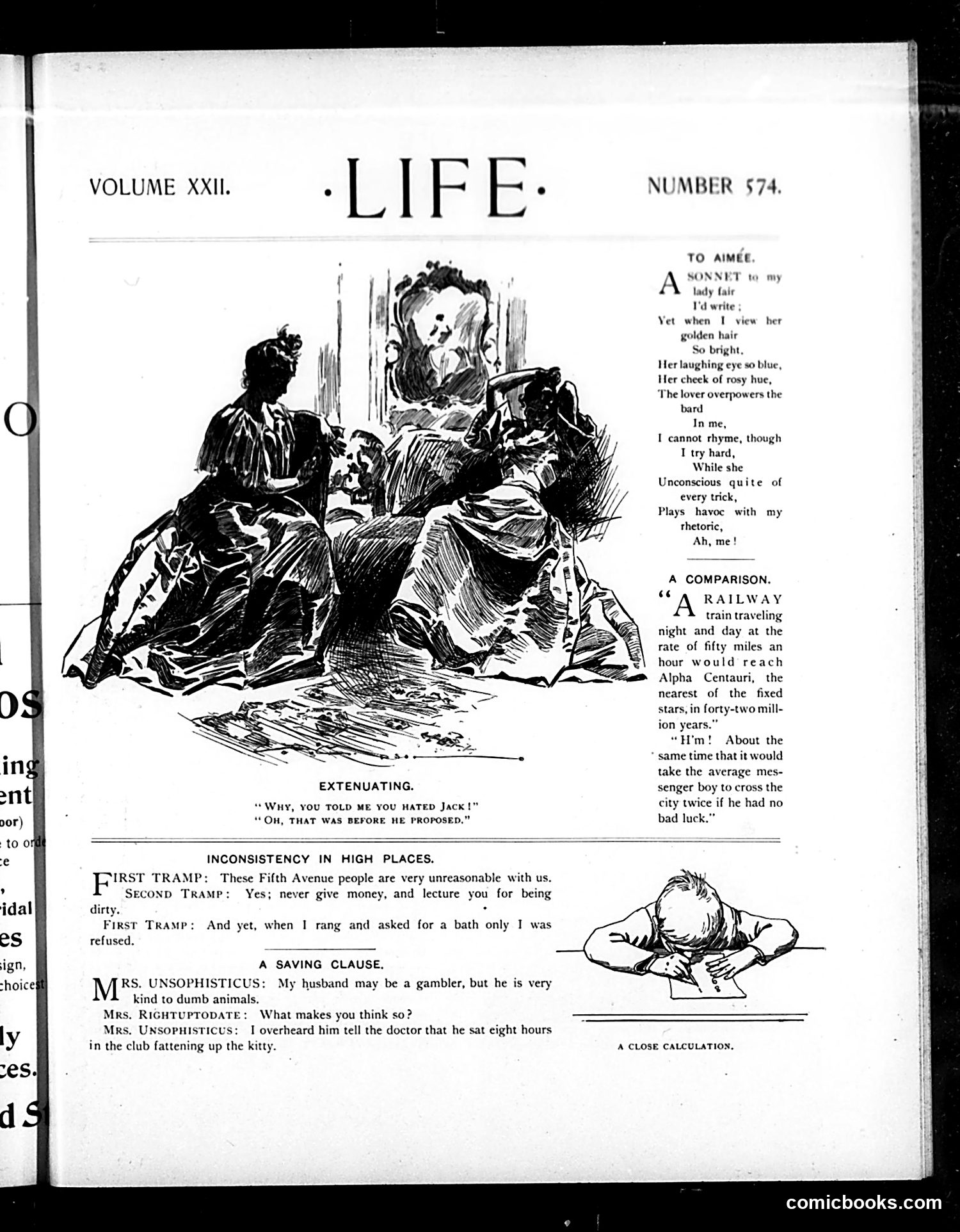
This page contains three separate satirical pieces typical of Life's humor: 1. **"Extenuating"** (top illustration): Shows a woman confronting a man, captioned with dialogue about "hating Jack" before he proposed. The joke plays on romantic reconciliation—she's explaining away her prior negative feelings. 2. **"Inconsistency in High Places"**: A dialogue satirizing wealthy Fifth Avenue residents' hypocrisy. They refuse to give money to servants yet demand free baths and lectures about morality while being unreasonable themselves. 3. **"A Saving Clause"** and **"A Comparison"**: Brief jokes about a husband who gambles but is kind to animals, and a mathematical piece about train speeds and messenger boys. These represent typical early-20th-century American satirical humor targeting class contradictions and social absurdities.
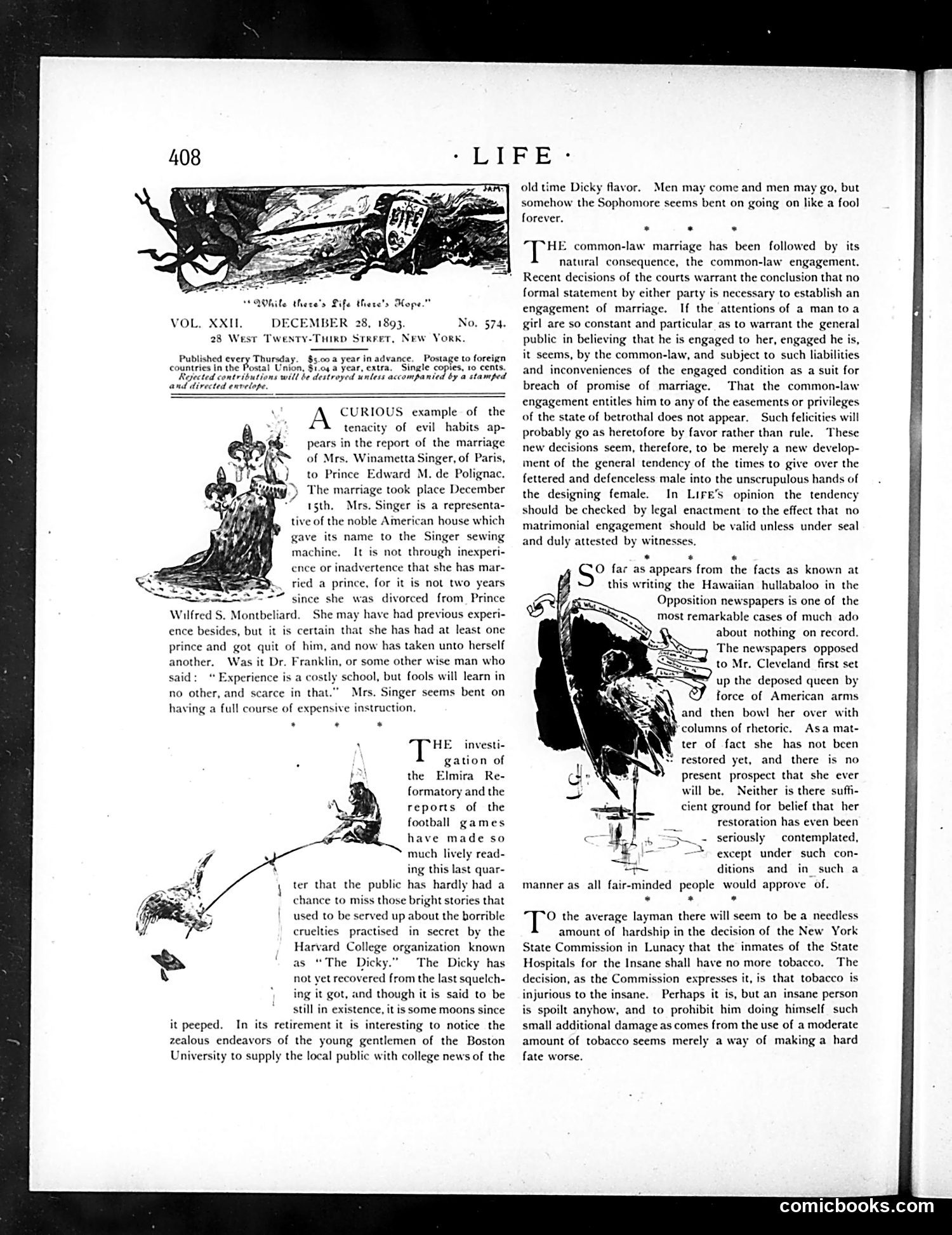
This page contains three distinct articles with accompanying illustrations rather than unified political cartoons. The first discusses Mrs. Winnametta Singer's marriage to Prince Edward M. de Polignac, satirizing her marital history by suggesting repeated divorces have given her expensive "instruction" in relationships. The second addresses Harvard College's "Dicky" newspaper, apparently a problematic student publication known for cruel hazing practices that the university struggled to suppress. The third critiques a New York State Commission decision banning tobacco use by insane asylum patients, arguing the restriction seems excessive—that prohibiting a "moderate" vice is counterproductively harsh. The illustrations are decorative rather than sharply satirical political commentary, using period-appropriate caricature styles typical of 1890s satirical journalism.
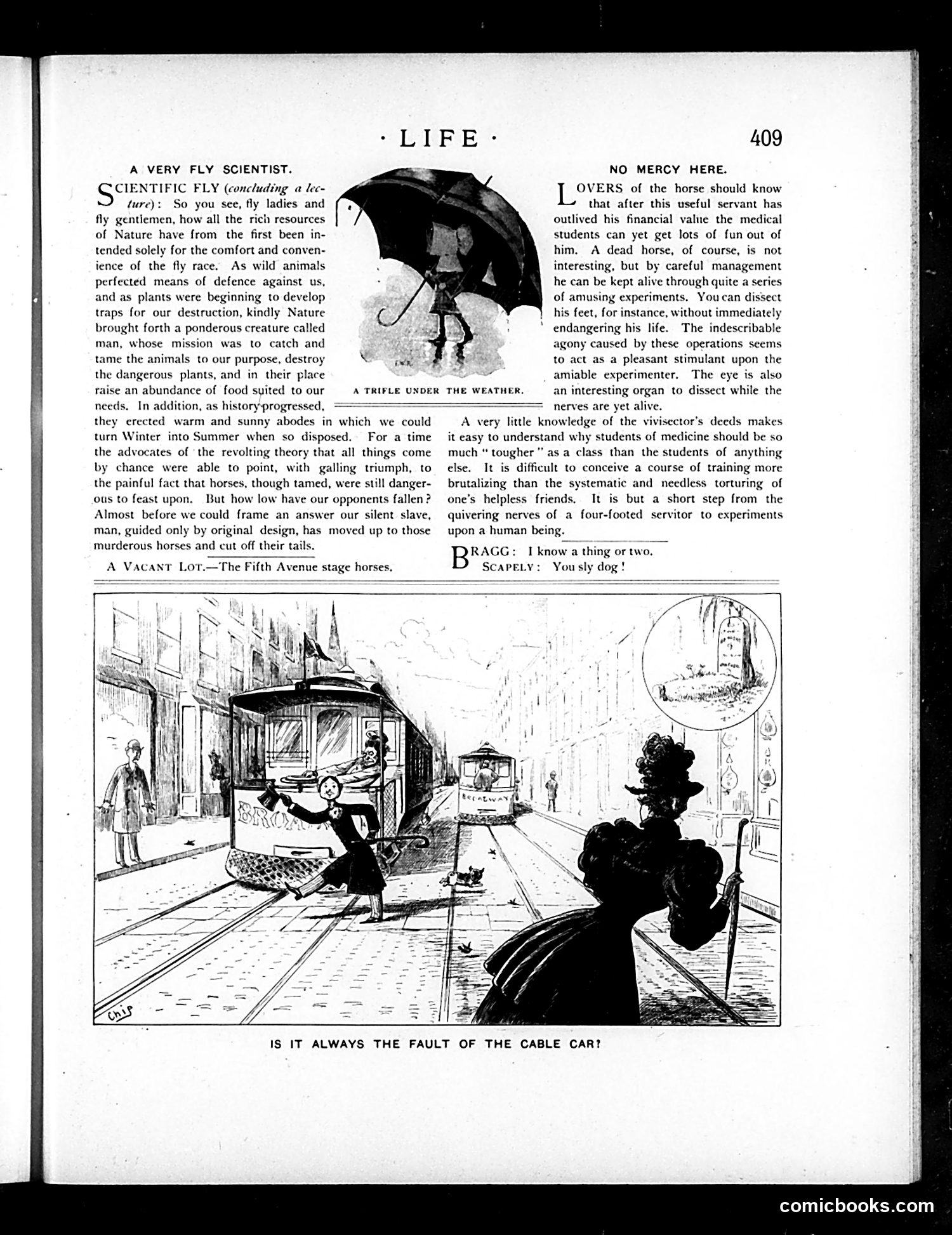
This *Life* magazine page contains two distinct pieces of satire: **Top section ("A Very Fly Scientist")**: A humorous essay mocking vivisectionists—scientists who perform experiments on living animals. The text sarcastically praises Nature for creating the fly as a "useful servant" while criticizing the "brutality" of systematic animal torture in laboratories. A small illustration shows a fly under an umbrella. **Bottom cartoon ("Is It Always the Fault of the Cable Car?")**: A San Francisco scene depicting a cable car accident. A woman lies on the tracks while pedestrians observe; the inset shows her apparently crushed. The caption suggests the cable car is being blamed, sarcastically questioning whether it's always responsible for such incidents—implying perhaps pedestrian carelessness is the actual fault. Both pieces critique contemporary attitudes: scientific cruelty and urban safety negligence.
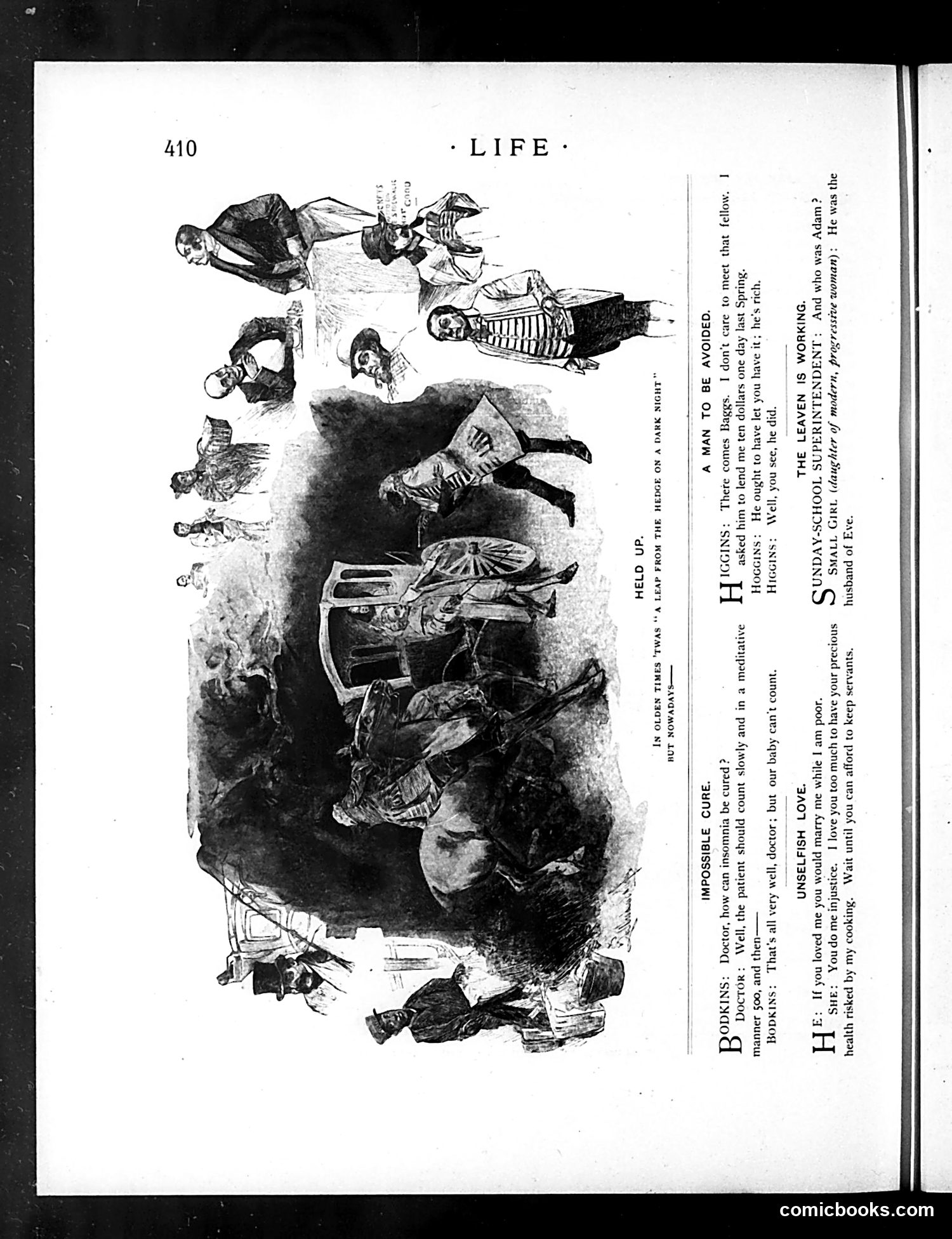
This appears to be a satirical cartoon about impossibly difficult medical or social cures. The central image shows a chaotic scene with multiple figures in various predicaments—a person in a barrel, figures in contorted positions, and general disorder. The text headings reference "IMPOSSIBLE CURE," "HORNS: There come these," and discuss "A MAN TO AVOID." The right-side text, titled "SUNDAY-SCHOOL LESSONS," presents scenarios involving moral improvement and character reform ("Shall I become a good fellow?"). The overall satire mocks the notion that deeply entrenched personal flaws or social problems can be simply "cured" through moral instruction or external intervention. The grotesque, impossible positioning of the figures reinforces the message that such transformations are absurdly unrealistic.
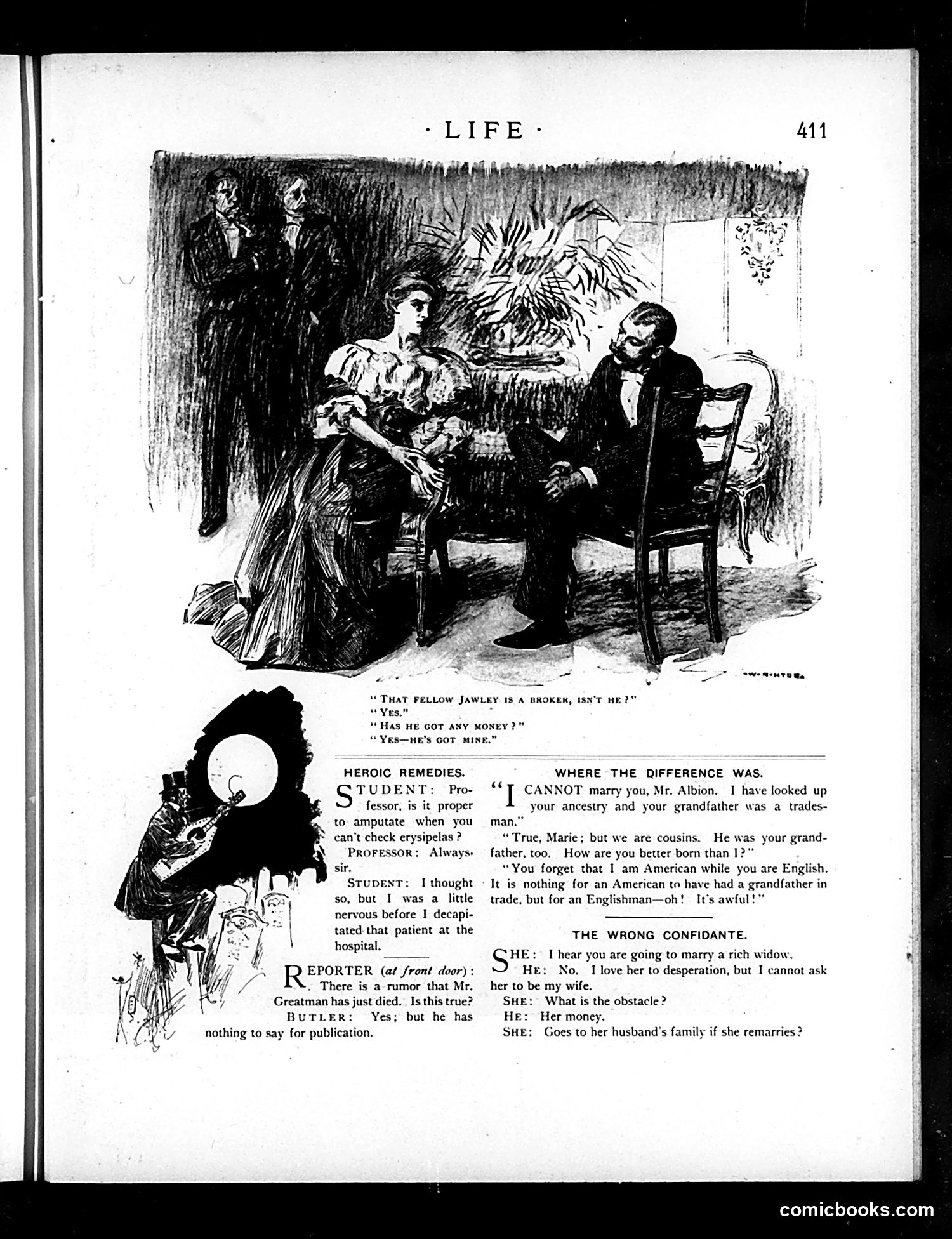
This page contains three separate humor pieces typical of early 20th-century satirical magazines: **Top cartoon**: Depicts a conversation about someone named Jawley who is a "broker" with money. The joke plays on financial status and social assumptions. **"Heroic Remedies"**: A brief exchange mocking medical students who perform unnecessary procedures (amputating eyeglasses) without proper knowledge, satirizing overconfident or incompetent medical trainees. **"Where the Difference Was"**: A romantic rejection scenario where an American woman refuses an English suitor, claiming he's beneath her because his grandfather was a tradesman while hers was too. The satire mocks both social snobbery and American pretension about ancestry. **"The Wrong Confidante"**: A cynical joke about a man pursuing a wealthy widow solely for her money, with the implication that her family's disapproval stems from financial rather than moral concerns. The page satirizes class consciousness, professional pretension, and mercenary motives.
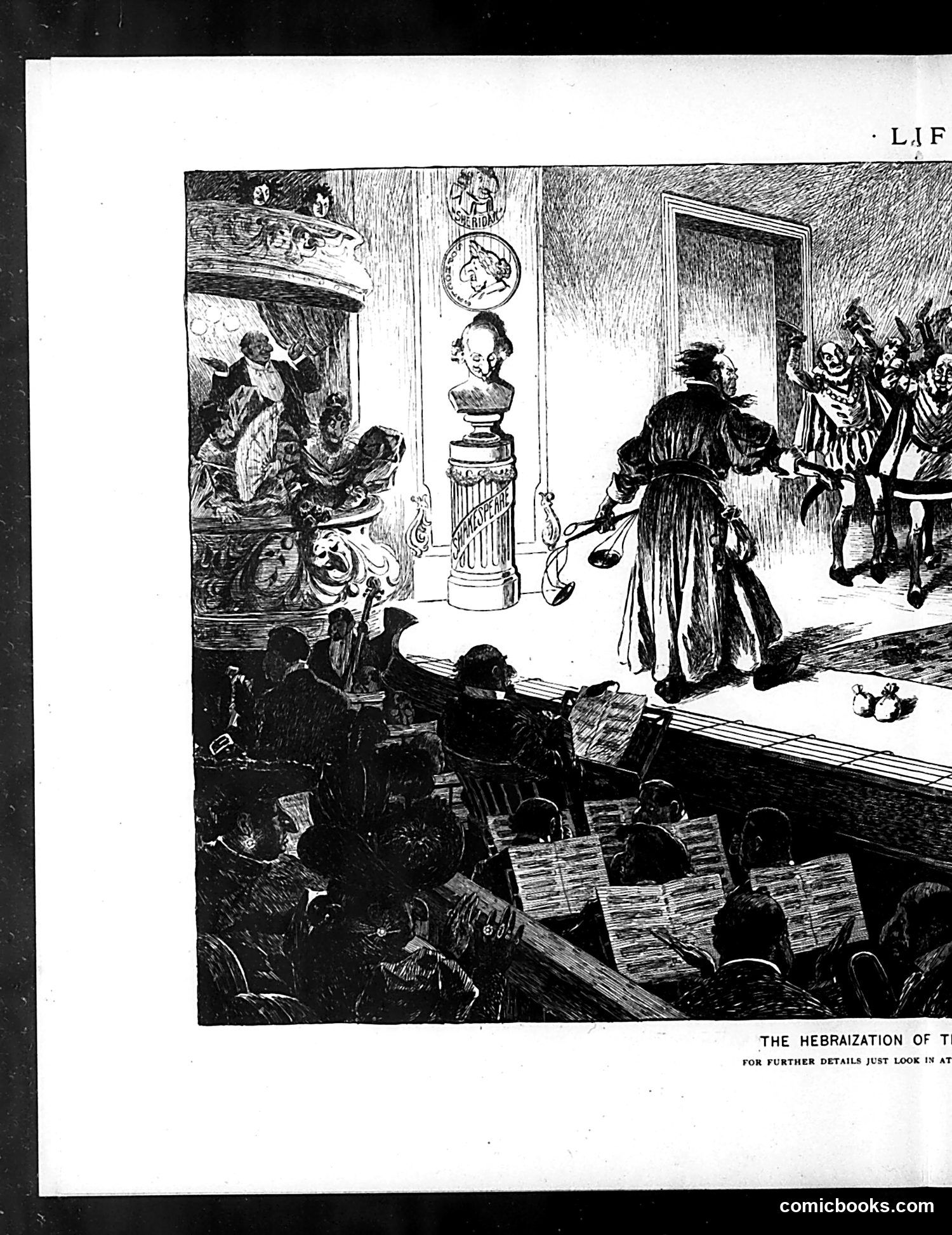
This satirical illustration appears to depict a Jewish religious or cultural ceremony, shown as theatrical and somewhat absurd. The scene features figures in formal dress observing what looks like a formal proceeding in an ornate interior. A bust sits prominently on a pedestal, while a central figure gestures dramatically. The incomplete title "HEBRAIZATION" and the cartoonist's mocking tone suggest this is anti-Semitic satire—likely critiquing Jewish cultural influence or assimilation in American society. The theatrical staging and caricatured presentation were typical of early 20th-century *Life* magazine's sometimes prejudicial humor targeting religious and ethnic minorities. Without the complete text or publication date, the specific political target remains unclear, but the intent to ridicule Jewish culture is evident from the visual treatment and titled framing.
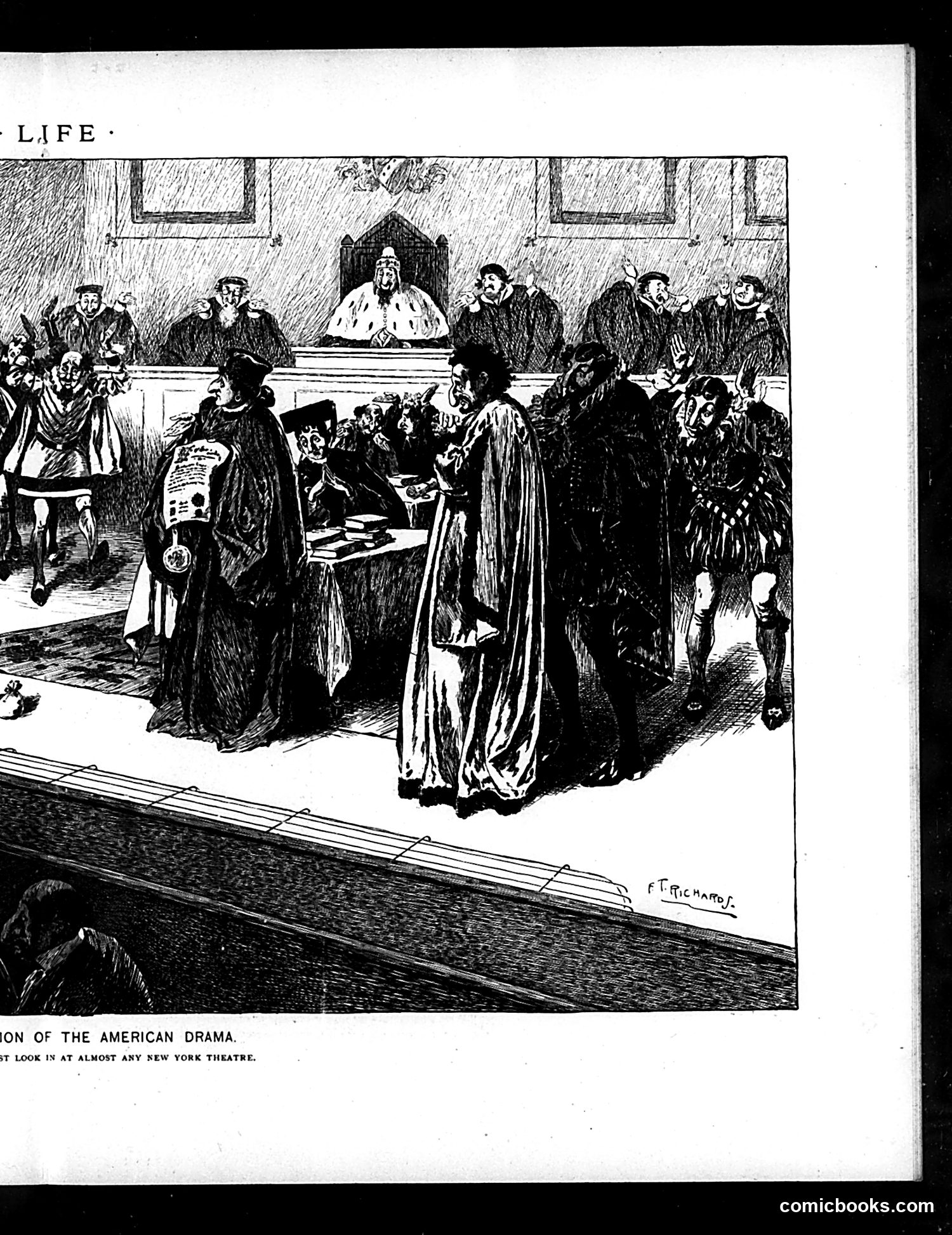
This satirical illustration depicts a courtroom or theatrical scene mocking American drama of the period. A judge presides over what appears to be a formal proceeding, while various figures in elaborate cloaks and period costumes stand before the bench. The caption references "almost any New York theatre," suggesting the cartoon critiques the theatrical productions popular in New York at the time. The satire likely targets either the melodramatic nature of contemporary plays or criticizes specific theatrical trends—possibly the prevalence of overly ornate, artificial performances or foreign-influenced drama dominating American stages. The formal courtroom setting may parody how seriously audiences took these theatrical productions, or it could be commenting on theatrical scandals or controversies. The artist's signature appears to read "Cesare" or similar. Without the full caption and surrounding context, the specific target remains somewhat unclear.
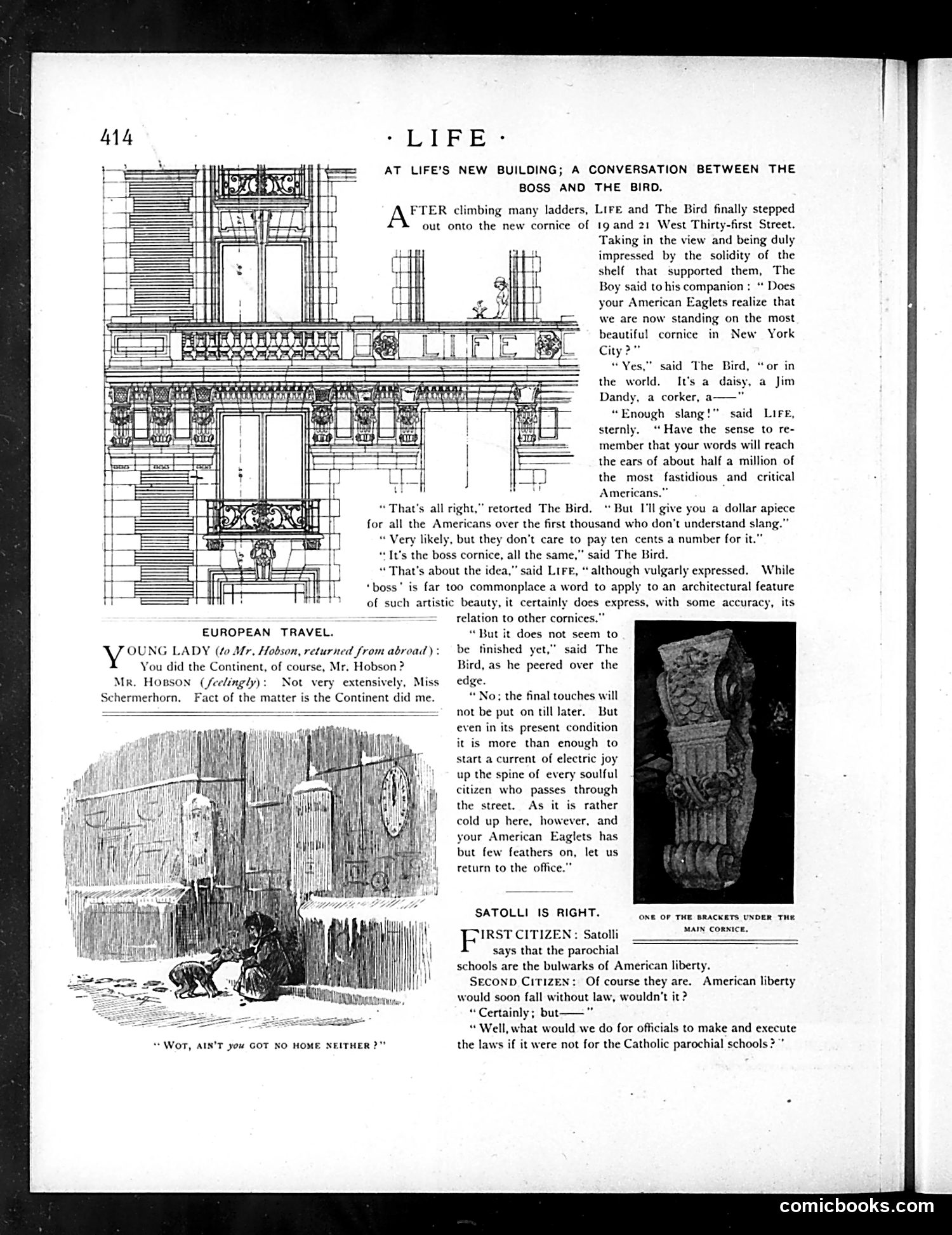
This page contains three satirical pieces from *Life* magazine (likely early 1900s): **Top: "At Life's New Building"** — A dialogue between *Life* (the magazine's personified "Boss") and "The Bird" (its mascot) admiring the new *Life* building's cornice on West 31st Street. The satire mocks The Bird's use of slang ("daisy," "Jim Dandy," "corker"), which Life rebukes as unfit for their "half a million" educated readers. The joke: The Bird cheerfully bets dollars that common Americans won't understand slang—exposing the magazine's pretension about its own audience. **Middle: "European Travel"** — A brief joke about Mr. Hobson's Continental tour, where he admits "the Continent did me" rather than the reverse—implying he was financially ruined abroad. **Bottom: "Satolli Is Right"** — Political commentary on Archbishop Satolli's claim that Catholic parochial schools support American liberty. The satire suggests these schools produce the officials who make and enforce laws, making them indispensable to government—a pointed commentary on Catholic education's civic role.
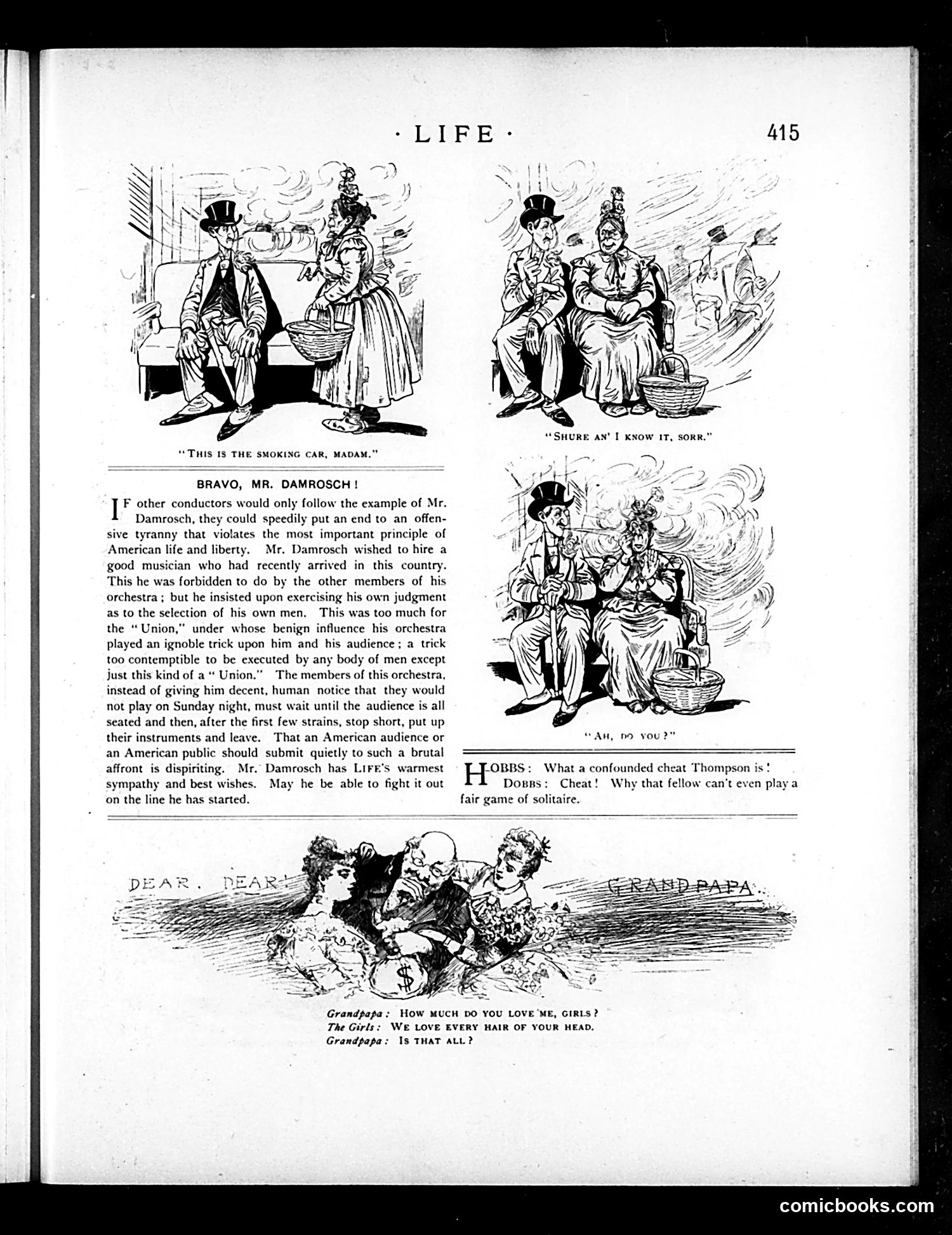
**Main Article: "Bravo, Mr. Damrosch!"** This editorial supports conductor Walter Damrosch against his orchestra's union strike. Damrosch wanted to hire a recently-arrived foreign musician, but union members prevented this. Rather than give notice beforehand, they waited until the audience was seated, played the opening bars, then walked out—described as a "brutal affront" to paying patrons. Life frames this as union tyranny violating American liberty and individual judgment, criticizing the union's underhanded tactics. **Side Cartoons:** The upper vignettes mock smoking cars and clueless passengers ("Sure an' I know it, sorr"). The bottom cartoon shows an elderly man asking granddaughters how much they love him; they flatter him by praising his hair. A separate joke mocks someone named Thompson for cheating at solitaire. The page reflects late-19th/early-20th-century anti-labor sentiment among magazine editors.
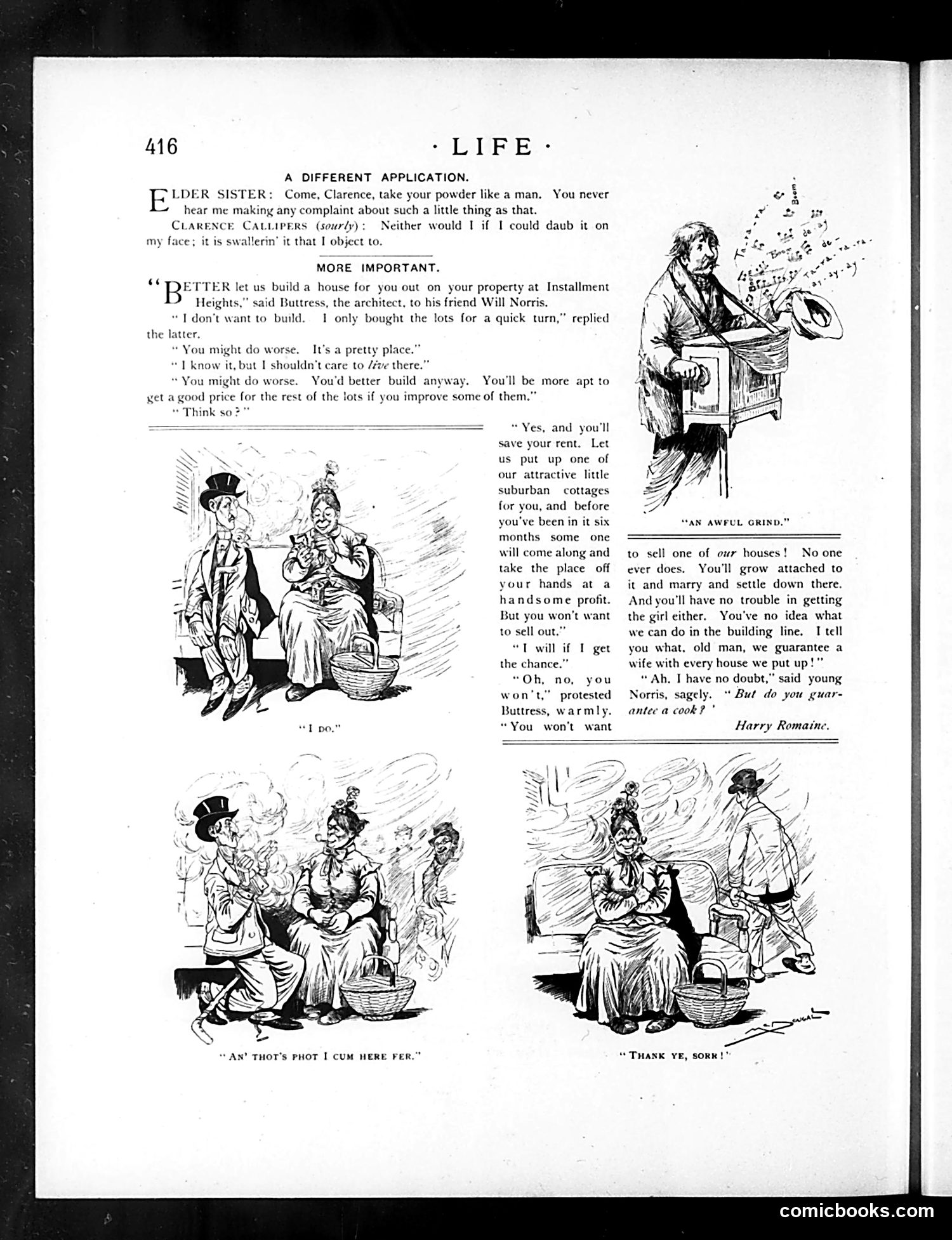
This page contains two satirical sketches about early 1900s American life: **"A Different Application"**: A brief joke about gender and propriety—a young man ("Clarence Callipers") complains about having to swallow medicinal powder, while his elder sister suggests he should accept it without complaint "like a man," implying women routinely endure minor discomforts without complaint. The satire mocks rigid gender expectations. **"More Important"**: A longer narrative satirizing suburban real estate development and marriage. An architect ("Buttress") pressures a reluctant property owner to build a house, arguing it will increase adjacent lot values. The punchline—"we guarantee a wife with every house we put up!"—satirizes how suburban cottage developments were marketed to bachelors as matrimonial traps. The final panel shows working-class characters, possibly suggesting class mobility or domestic labor concerns. The satire targets aggressive real estate marketing and the era's assumptions linking homeownership to marriage.
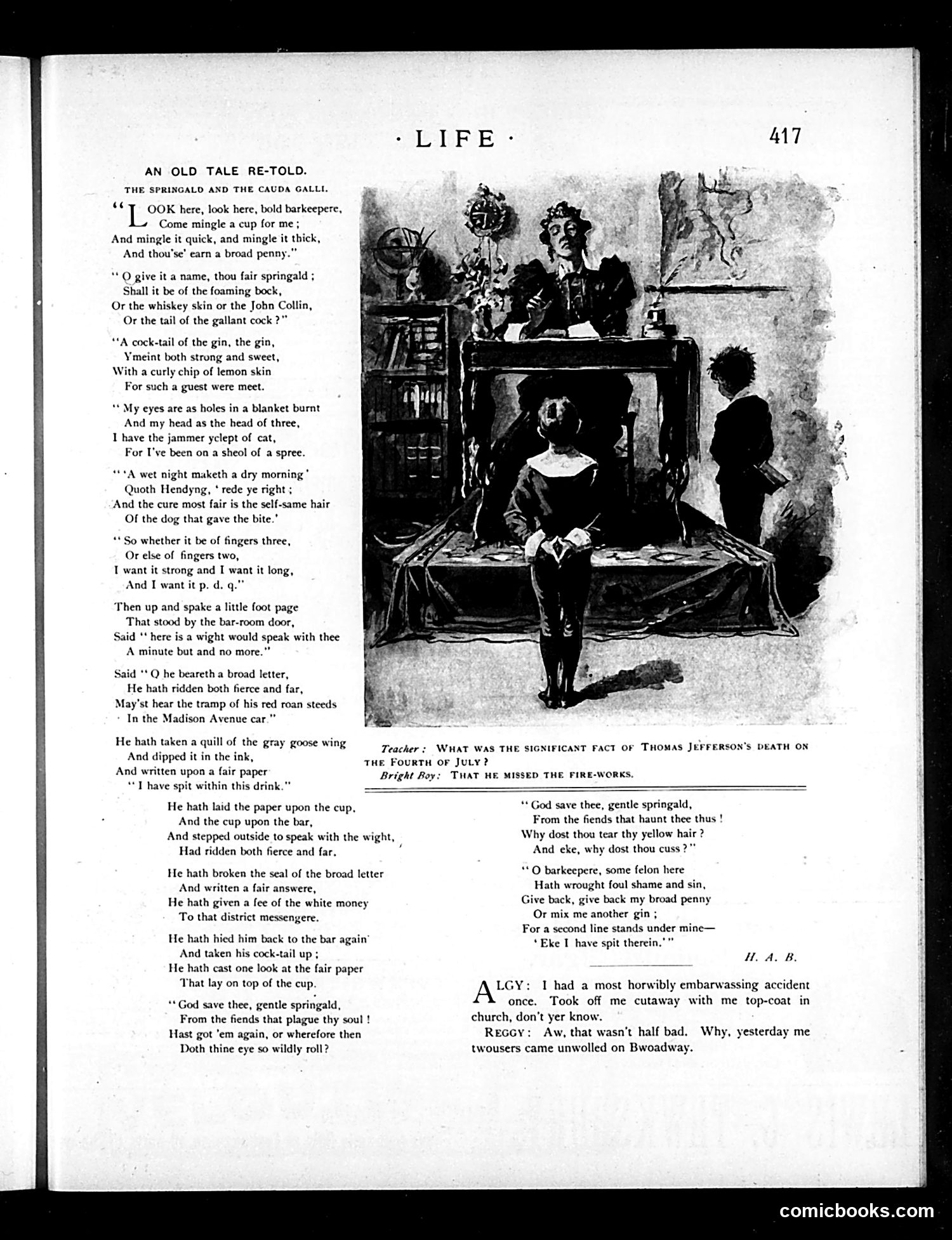
This page contains two separate pieces of satire from Life magazine. **"An Old Tale Re-Told"** (main text): A humorous poem mocking Victorian affectation by rendering a bar scene in deliberately archaic, pseudo-Chaucerian language. A hung-over patron orders a "cock-tail" (gin cocktail) using flowery medieval speech. The joke lies in the contrast between the elevated, fussy language and the mundane, unglamorous setting of a bar and a drunk man. The poisoned drink punchline—someone spits in his drink—subverts the mock-heroic tone. **"Teacher/Bright Boy" section** (bottom right): A classroom joke contrasting a teacher's question about Thomas Jefferson's death on July 4th with a student's answer: Jefferson "missed the fire-works." The humor plays on the double meaning—fire-works (fireworks celebration) versus literally missing pyrotechnics because he died. **"Algy and Reggy" (bottom): Two upper-class British characters commiserate about embarrassing wardrobe malfunctions in humorous affected accents, satirizing affected British society types.
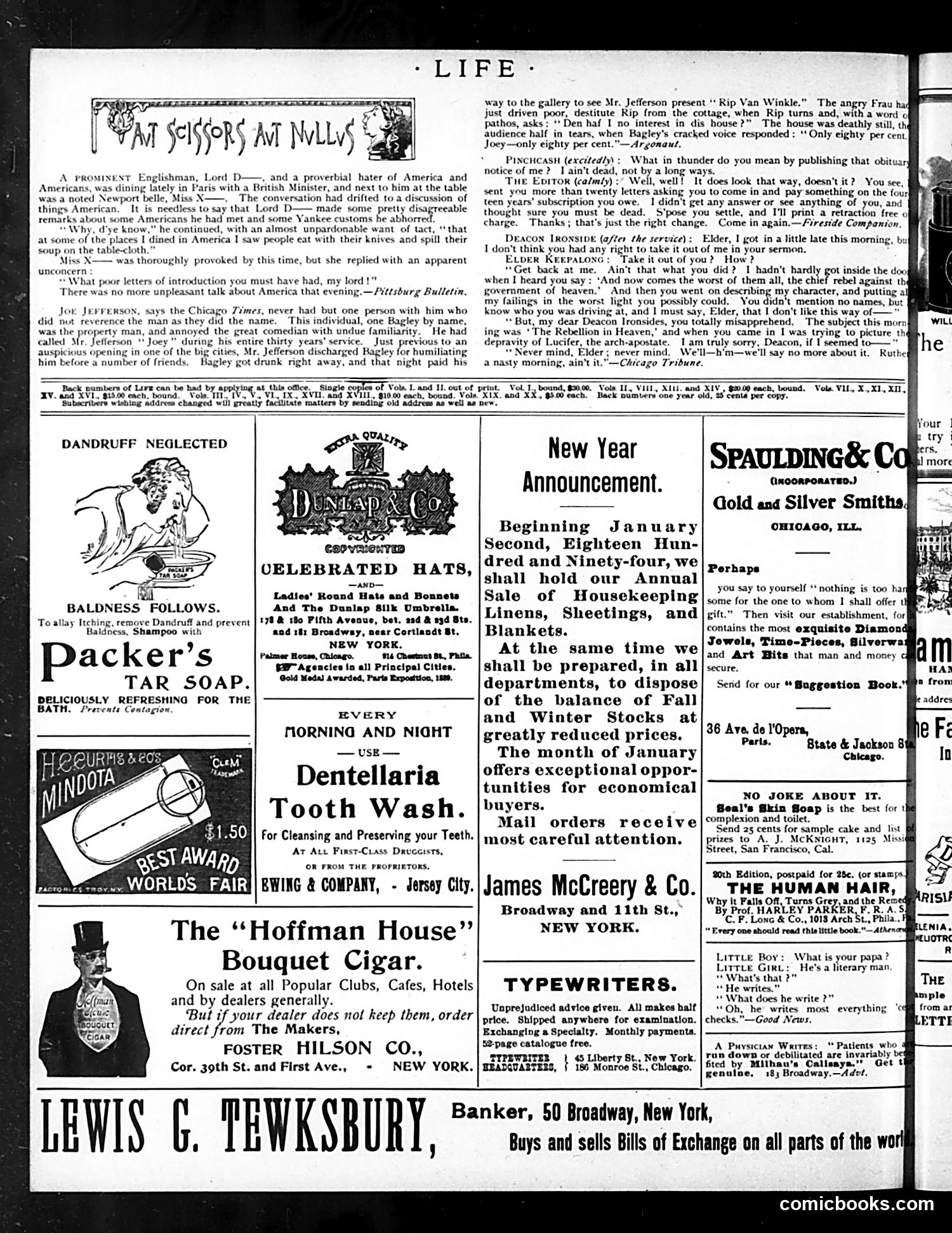
This page contains three brief satirical anecdotes typical of Life magazine's humor: 1. **Lord D—'s comeuppance**: A snobbish English nobleman insults American manners at a Paris dinner, claiming Americans eat with knives and spill soup. A Newport belle (Miss X) deflates him by suggesting his poor letters of introduction reflect badly on *him*, not Americans—a genteel putdown. 2. **Joseph Jefferson's property man**: The famous actor fires an employee (Bagley) after thirty years for disrespect. When Bagley later drunkenly heckles Jefferson's performance of "Rip Van Winkle," Jefferson responds with theatrical wit: "Joey—only eighty per cent," implying the drunk version is still mostly acceptable. 3. **The "Pinchcash" anecdote**: A man complains about a newspaper publishing his obituary while alive. The editor casually suggests he pay his subscription debt first—a joke about indifference and delinquent accounts. Each story showcases witty retorts deflating pomposity or incompetence—typical of Life's satirical style for educated readers.
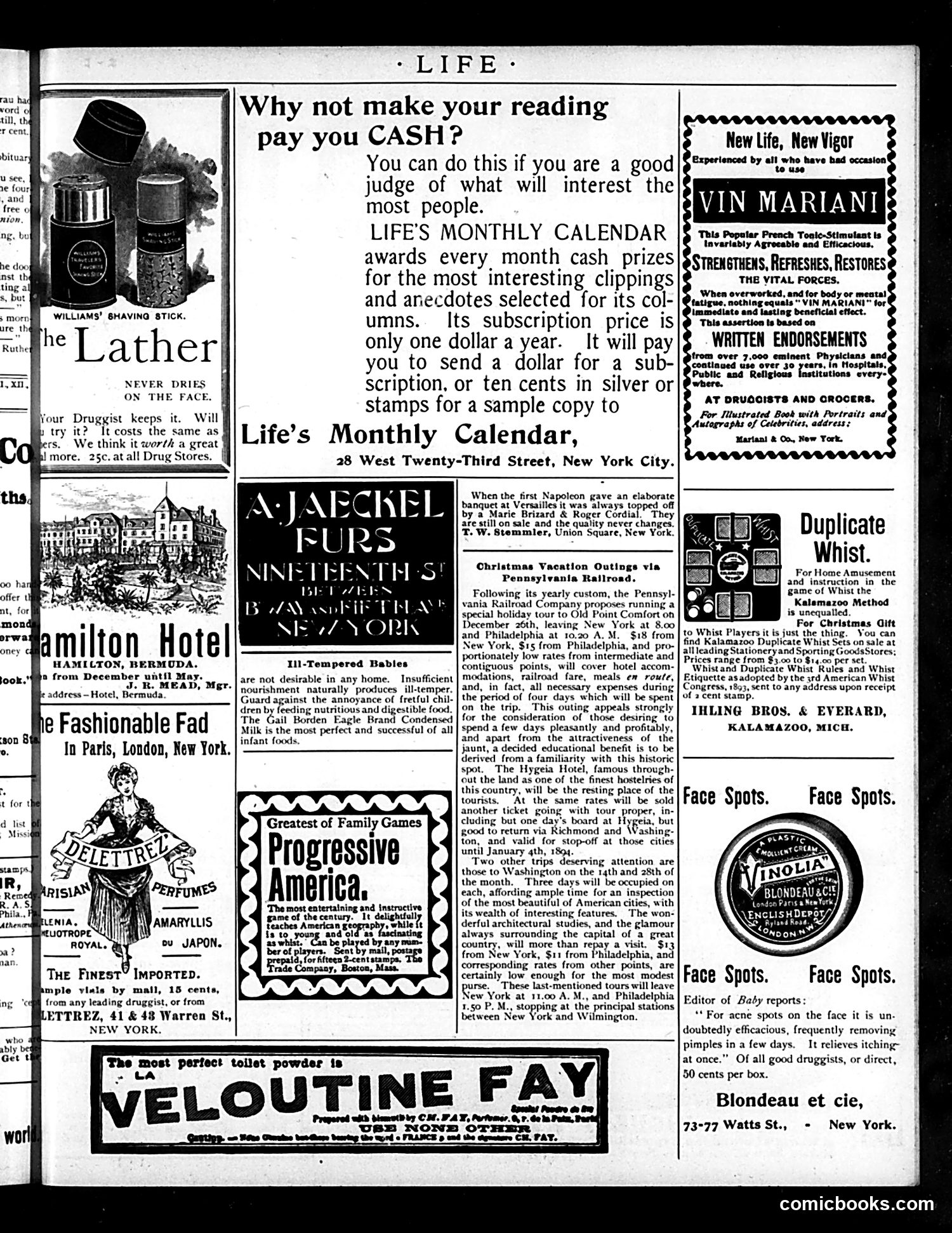
This page is primarily **advertising** with no political cartoons. It comprises commercial announcements for consumer products and services typical of the 1890s. The ads promote: Williams' Shaving Stick, the Hamilton Hotel in Bermuda, Delettrez Perfumes (marketed as a fashionable Parisian trend), and Jaeckel Furs. Educational/service ads include Life's Monthly Calendar (a competition offering cash prizes for submitted clippings), Gail Borden Eagle Brand Condensed Milk, the board game "Progressive America," toilet powder, Marie Brizard cordials, and Pennsylvania Railroad holiday excursions to Old Point Comfort and Washington, D.C. The only illustrated elements are product logos and a small fashion illustration. There is **no satire or political commentary** visible—this is a straightforward commercial page reflecting Gilded Age consumer culture and advertising strategies targeting affluent readers.
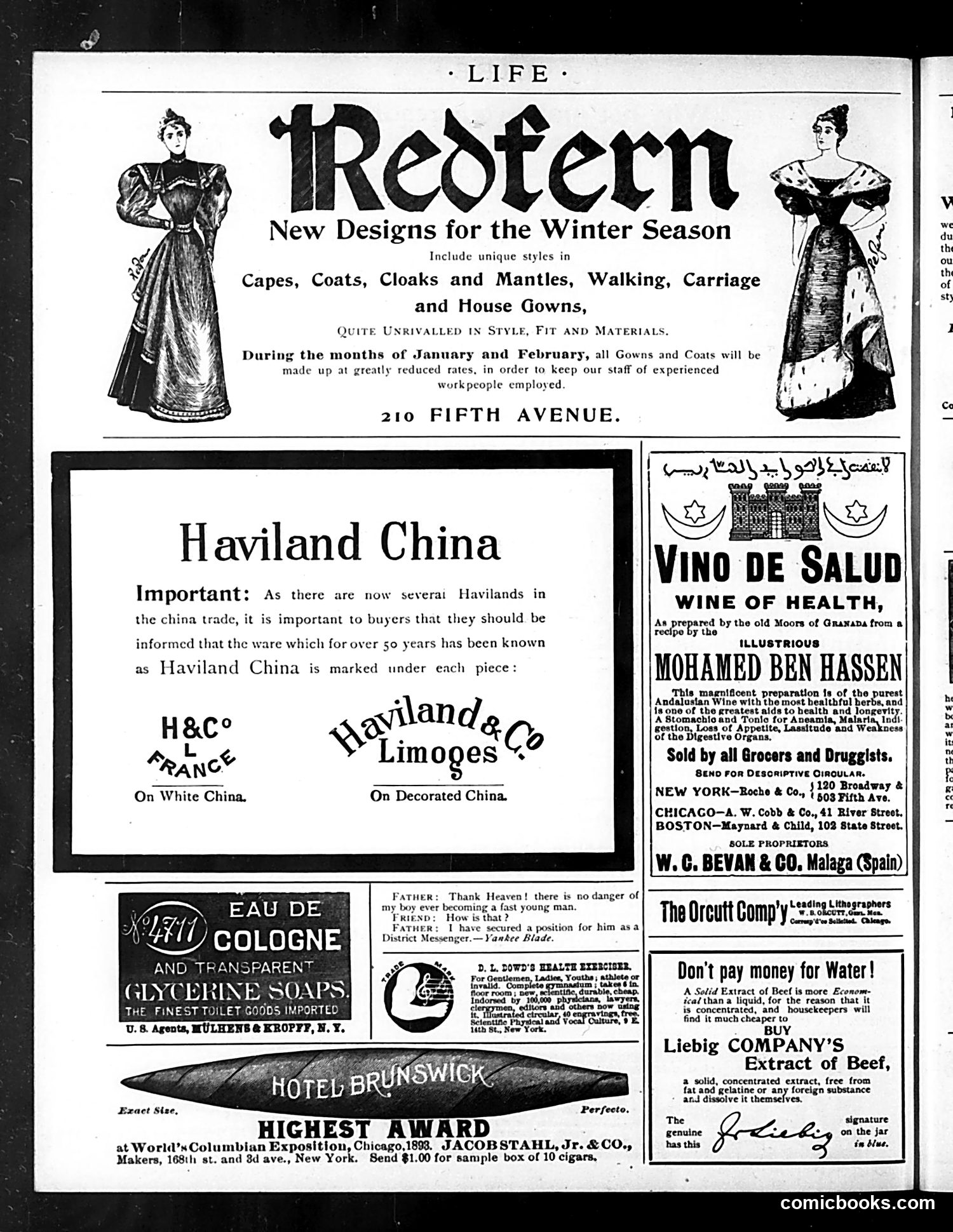
This is primarily an **advertising page** with minimal editorial content. The page features: **Main Advertisements:** - **Redfern** (fashion): Winter clothing designs for women, offering reduced rates in January-February to retain staff - **Haviland China**: A notice distinguishing authentic Haviland china (marked H&C° on white pieces, "Haviland & Co Limoges" on decorated) from competitors using the similar name - Various patent medicines and food products (Vino de Salud wine, Liebig's Beef Extract, Eau de Cologne soap) - Hotel Brunswick cigars and other goods **Minor Comic Content:** A brief joke about a father securing a messenger position for his son to prevent him becoming a "fast young man" — a period term for dissolute or morally loose behavior. The page reflects late 19th-century consumer culture, with emphasis on imported luxury goods (French china, Spanish wine) and the emerging market for concentrated/processed foods marketed as health solutions.
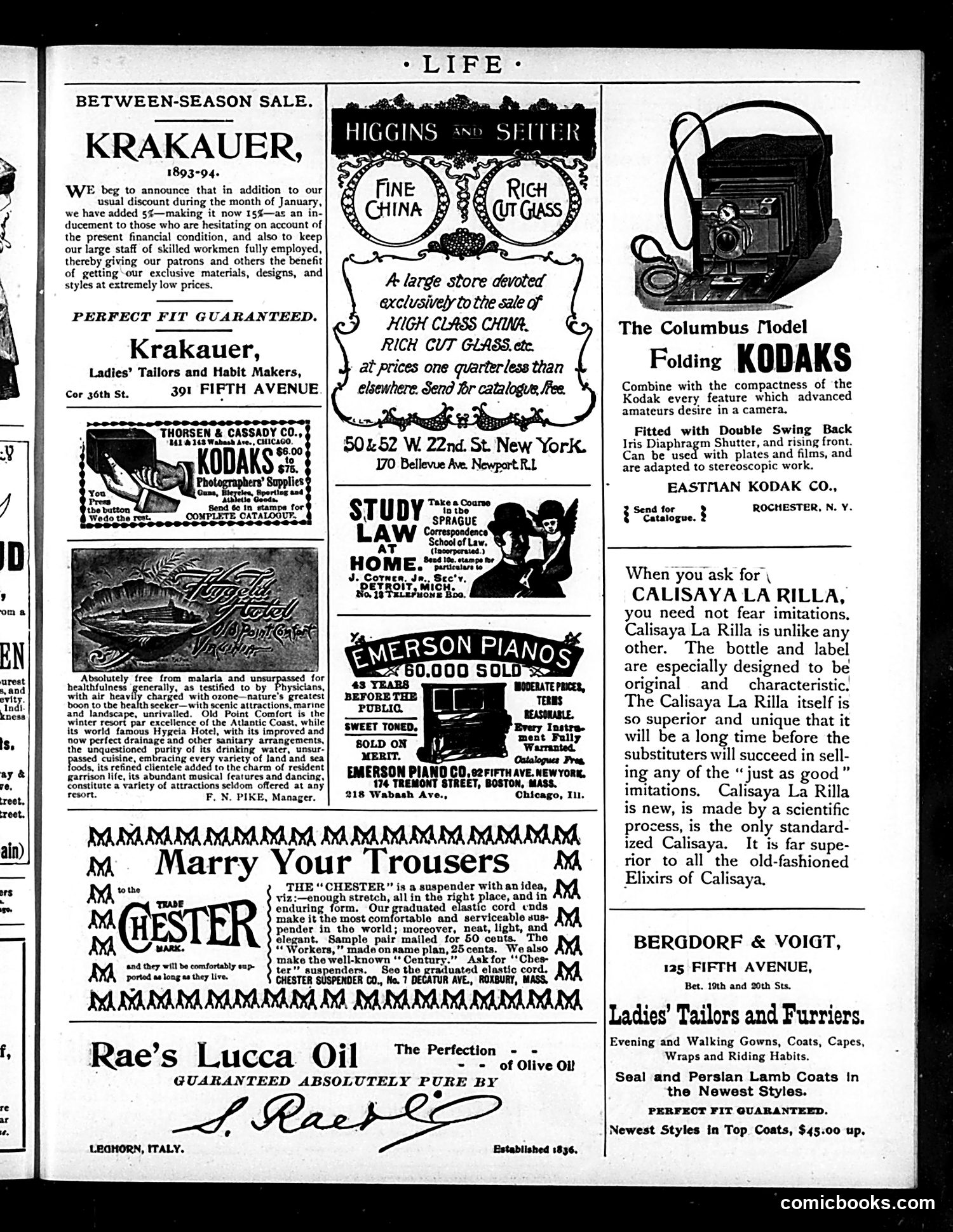
This page is primarily **advertising**, not editorial or satirical content. It collects commercial announcements from January 1893–94, during a period of severe economic depression in America. The ads themselves offer social context: Krakauer (tailor) explicitly appeals to customers hesitant due to "present financial condition," offering extra discounts to keep workers employed. Other advertisements—for pianos, suspenders, kodaks, clothing, olive oil, and patent tonics—target middle and upper-class consumers. The "Chester" suspender ad includes a minor visual joke ("Marry Your Trousers"), using the pun to advertise their elastic-cord product. Otherwise, there are no political cartoons or satirical illustrations on this page. The entire content is commercial promotion aimed at affluent urban readers seeking quality goods at reduced prices during economic hardship.
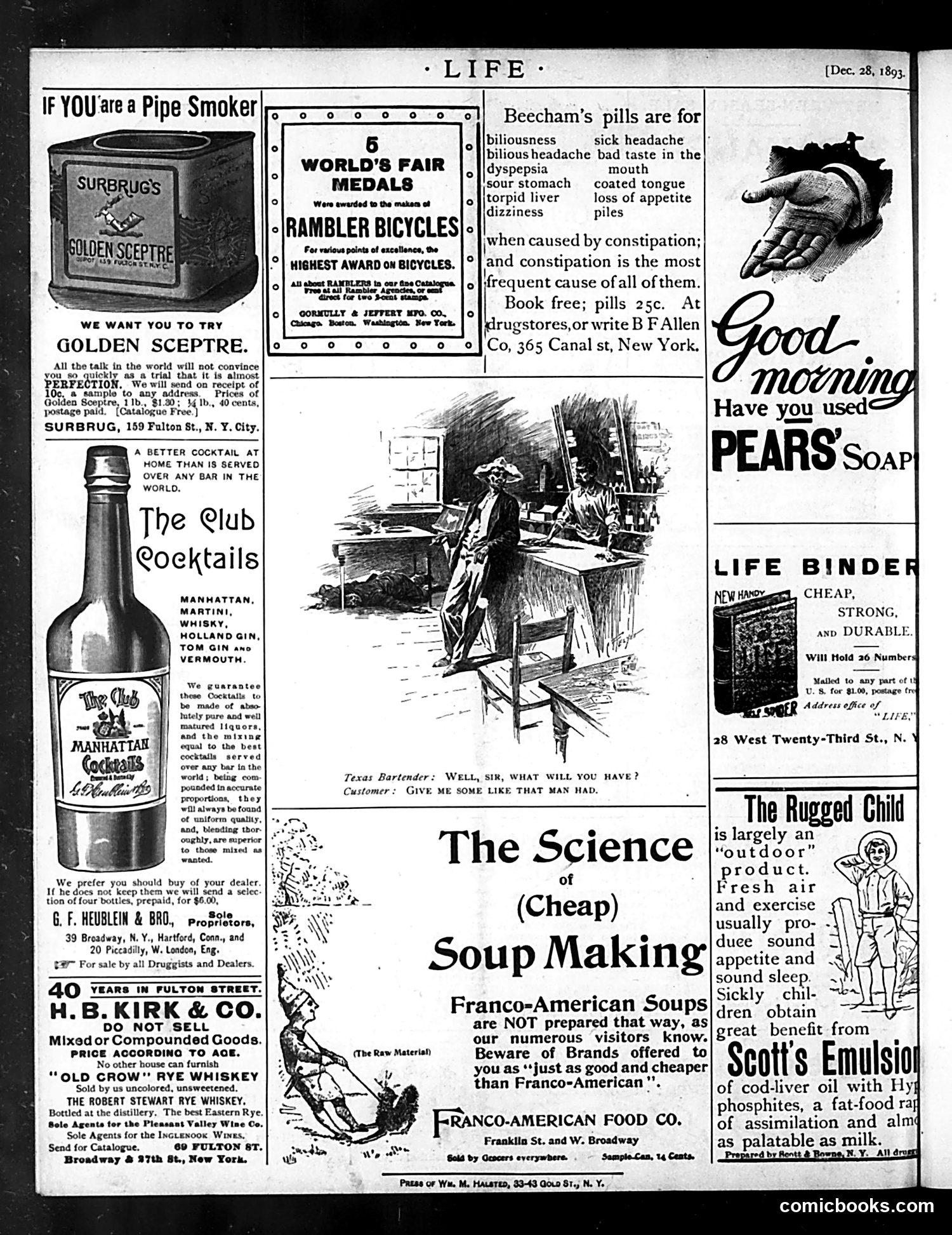
This page is primarily **advertising**, with one notable cartoon. The main satirical element is a single-panel cartoon titled "Texas Bartender" depicting a customer asking a bartender to serve "some like that man had" — referencing another patron's drink. The joke appears to be about imitation or copycat consumption, a simple comedic scenario. The rest of the page contains period product advertisements: tobacco, cocktail mixers, whiskey, patent medicines (Beecham's pills for constipation), bicycles, soap, and food products. One ad humorously boasts that Franco-American Soup is superior to cheaper imitations claiming to be "just as good." Notable context: This reflects the 1890s commercial landscape, including unregulated patent medicines, aggressive advertising, and the World's Fair era (referenced in the bicycle ad). The products advertised — particularly the whiskeys and medicinal tonics — represent what modern readers would recognize as often dubious or harmful goods marketed with exaggerated health claims.
I can see this is a page from Life magazine (dated 1893 based on the visible date marker), but the page itself appears to be almost entirely blank or blank. While there are partial text fragments visible along the left margin (including references to "SOAP," "DER," "ABLE," "Numbers," and what appears to be an illustration or logo at the bottom left), the main content area contains no discernible cartoon, text, or imagery that I can reliably interpret. Without clear visual or textual content on the actual page, I cannot identify specific figures, political references, or satirical points. This appears to be either a title page, advertisement page, or a scanning/preservation issue where the primary content is not visible.
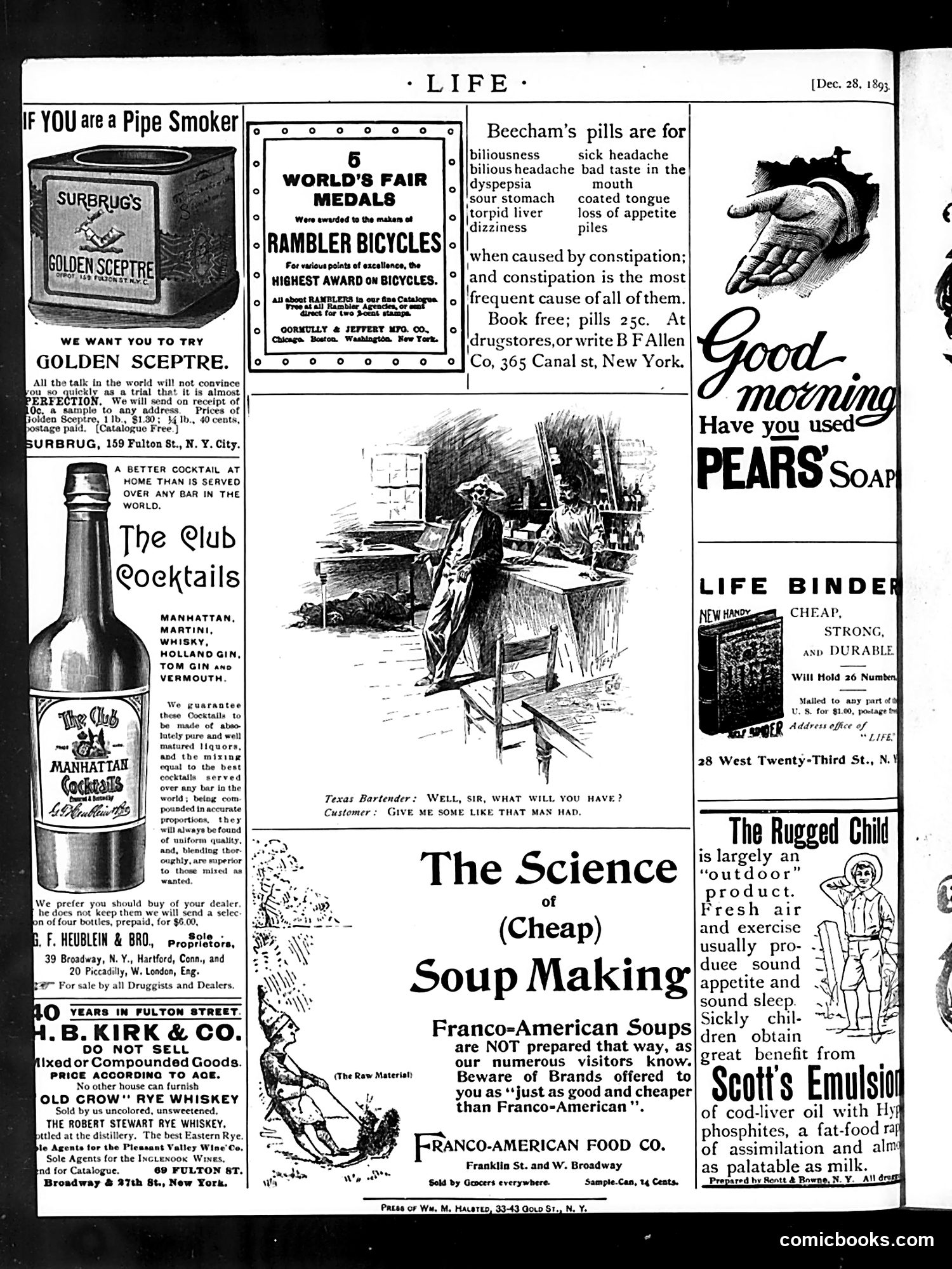
This is primarily an **advertising page** with one small cartoon. The main cartoon shows a Texas bartender and customer in dialogue. The customer asks "What will you have?" and the customer responds "Give me some like that man had"—a joke about intoxication. The humor suggests someone drank so much they're now inebriated and the customer wants the same effect, likely mocking excessive drinking culture or the potency of the bartender's drinks. The page is dominated by advertisements for alcohol (Club Cocktails, Old Crow Whiskey), tobacco (Golden Sceptre pipe tobacco), medicines (Beecham's pills for constipation), and various consumer goods (Rambler bicycles, Pears soap, Scott's Emulsion). The Franco-American Soups ad explicitly warns against cheaper imitations, positioning their brand as superior quality—reflecting emerging consumer brand consciousness of the 1890s.
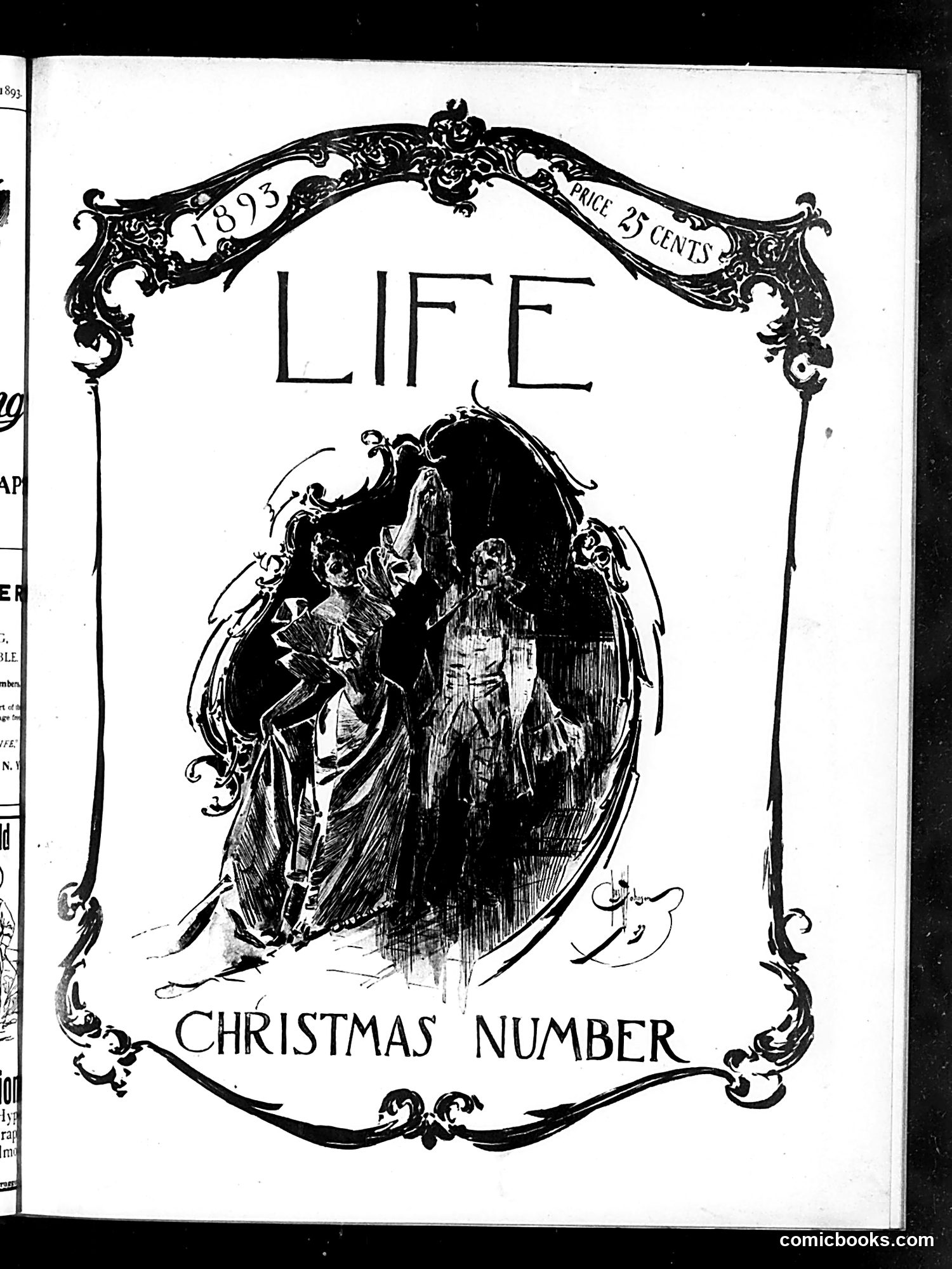
This is a title page for Life magazine's 1893 Christmas issue (priced at 25 cents). The ornate decorative border frames an illustration of what appears to be angelic or spiritual figures—likely depicting a Christmas or religious theme appropriate to the holiday special edition. The detailed engraving style and composition suggest this was a premium, festive publication. Without additional visible text or context identifying specific figures or satirical commentary, this appears primarily to be a decorative cover announcing the special Christmas issue rather than a political cartoon with particular targets or social commentary. The artistic quality and elaborate ornamentation indicate Life positioned itself as a sophisticated publication for educated readers of the 1890s.
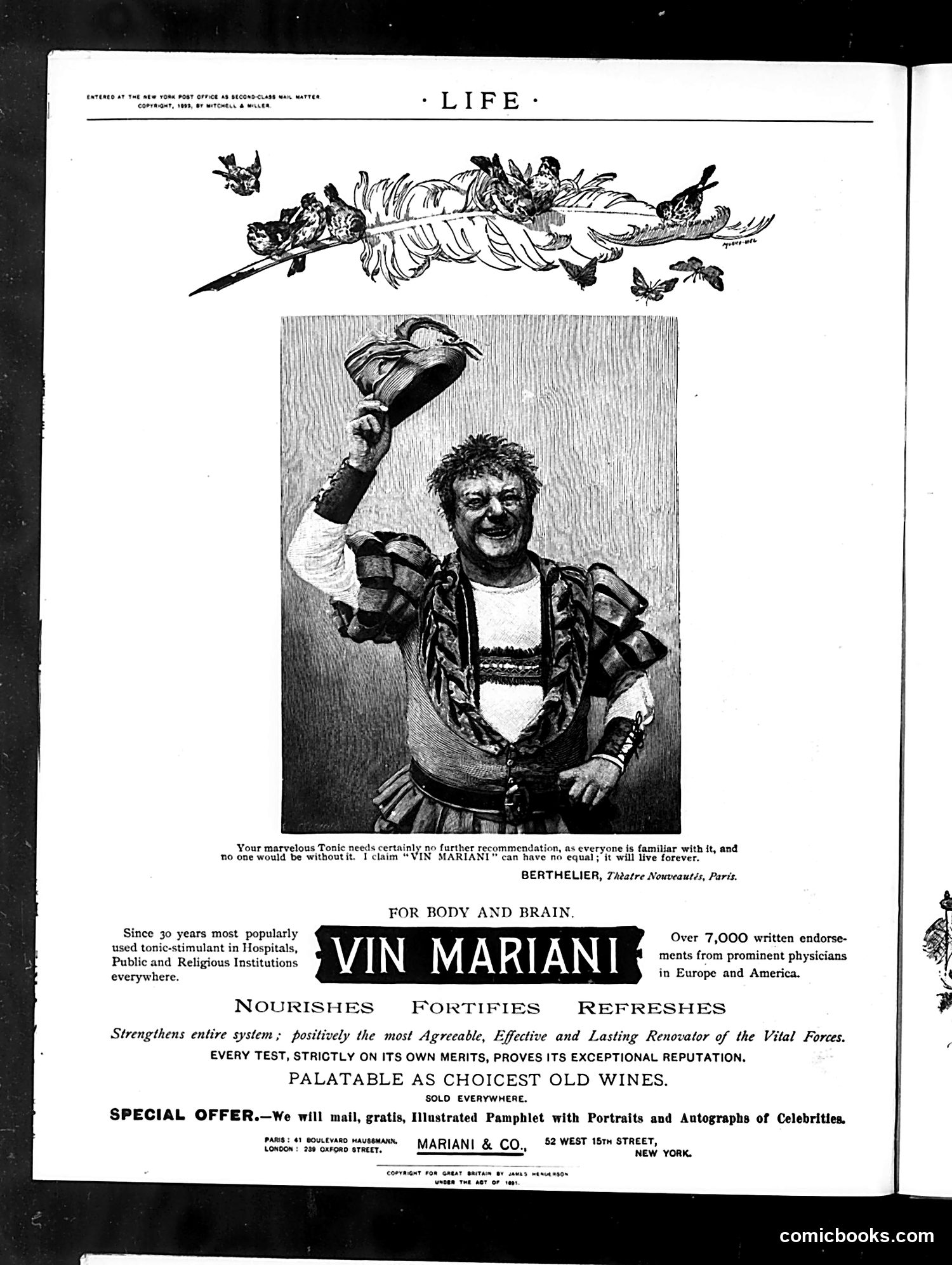
This is primarily a **patent medicine advertisement**, not political satire. The page promotes Vin Mariani, a coca wine tonic popular in the late 19th/early 20th century. **Key elements:** - **The illustrated figure** appears to be an actor or performer (Berthelier from Théâtre Nouveautés in Paris) endorsing the product with an exuberant gesture - **The decorative top image** shows cherubs and plants—typical ornamental advertising imagery suggesting vitality and natural ingredients - **The claims**: The tonic allegedly strengthens "body and brain," has 7,000+ physician endorsements, and has been used in hospitals for 30 years - **The joke/satire** (if any) lies in the absurdly grandiose health claims—characteristic of unregulated patent medicines of this era, many of which contained dubious or harmful ingredients This reflects an era before FDA regulation when such tonics could make sweeping medical claims through celebrity testimonials. The page is essentially an advertisement masquerading as editorial content.
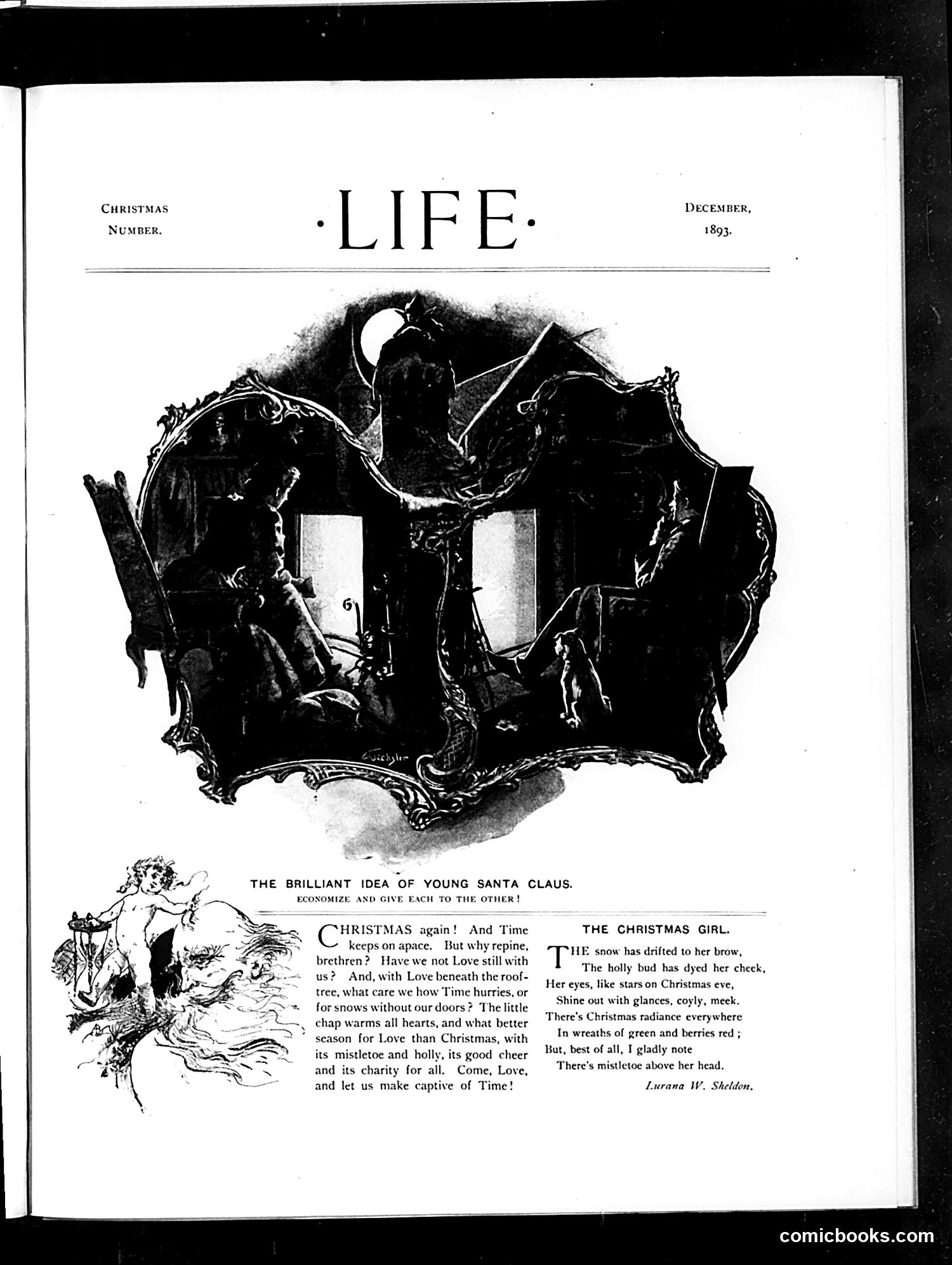
This page presents Christmas-themed content mixing sentiment with gentle satire. The main cartoon shows a ruined house with two windows glowing warmly—illustrating "Young Santa Claus's" idea to economize by giving to each other rather than purchasing gifts. This reflects 1890s economic concerns, likely referencing financial hardship or recession. Below are two poems: one addressing "Time" and "Love" during Christmas in romantic, philosophical language; the second, "The Christmas Girl," is a sentimental verse about a young woman's beauty enhanced by winter and Christmas imagery, culminating in a flirtatious reference to mistletoe. The overall message appears to be satirical commentary on commercialized Christmas spending, while simultaneously indulging in the era's characteristic sentimentality about love, domesticity, and seasonal romance. The contrast between economic hardship (the ruined house) and romantic idealism is the central tension.
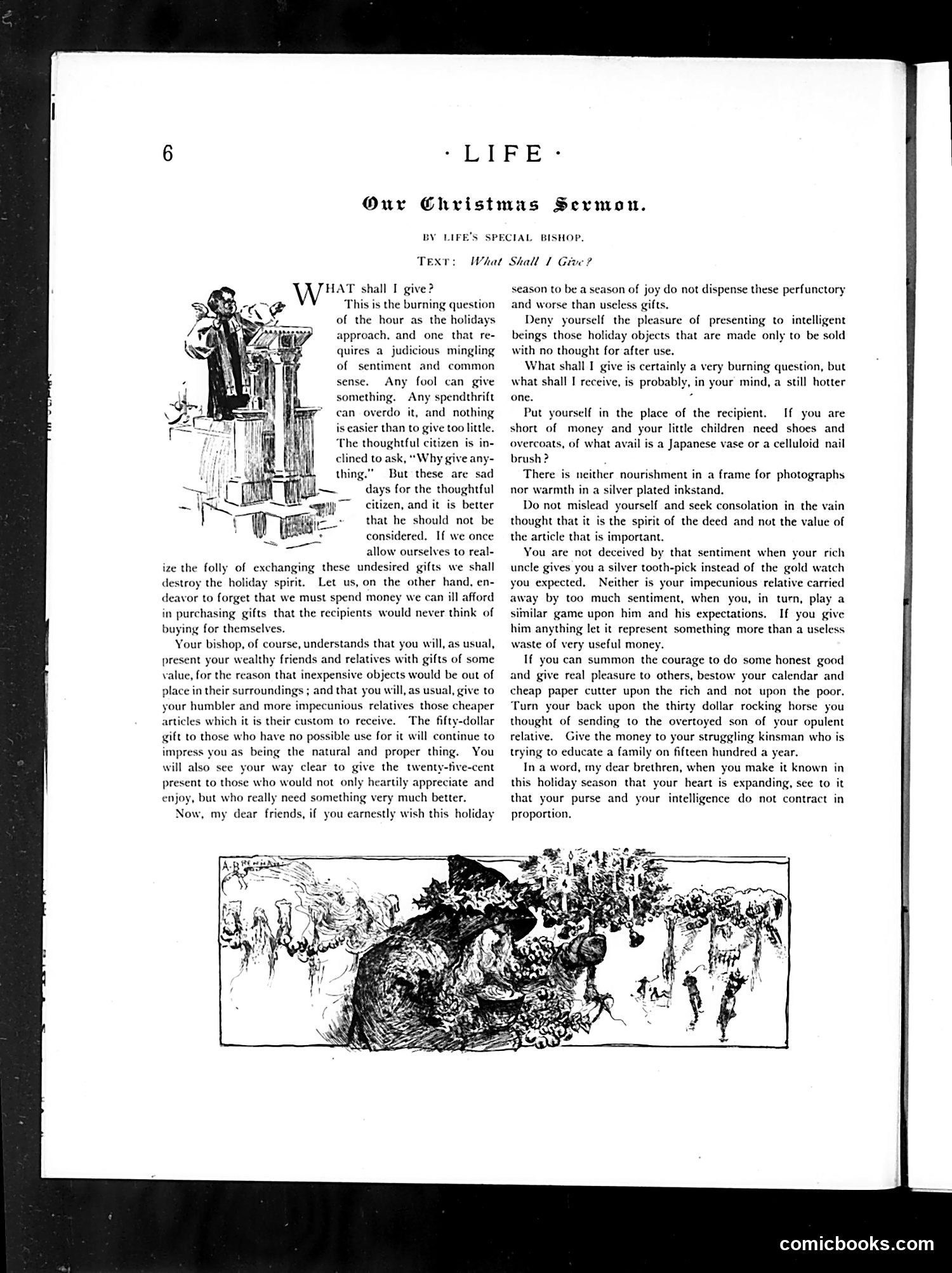
This is a satirical Christmas editorial disguised as a moral sermon, attacking the hypocrisy and class-based absurdity of American gift-giving customs. **The Satire:** Life's "Special Bishop" employs heavy irony throughout. While appearing to offer genuine holiday advice, the sermon actually mocks wealthy givers who spend lavishly on the rich (fifty-dollar gifts) while offering cheap, useless trinkets to the poor (twenty-five-cent presents). The author sarcastically notes that giving expensive objects to those who don't need them "impresses" the giver—exposing pure vanity. **The Point:** The sermon critiques the disconnect between professed generosity and actual practice. It argues that a silver toothpick instead of an expected gold watch reveals the hypocrisy in gift-giving, and that impoverished relatives see through such "sentiment" just as clearly. **The Radical Proposal:** Life concludes by suggesting the truly generous alternative: give money directly to struggling working families trying to educate children on modest wages, rather than sending thirty-dollar rocking horses to wealthy relatives' sons. This reflects Progressive Era concerns about economic inequality and authentic charity versus performative gift-giving.
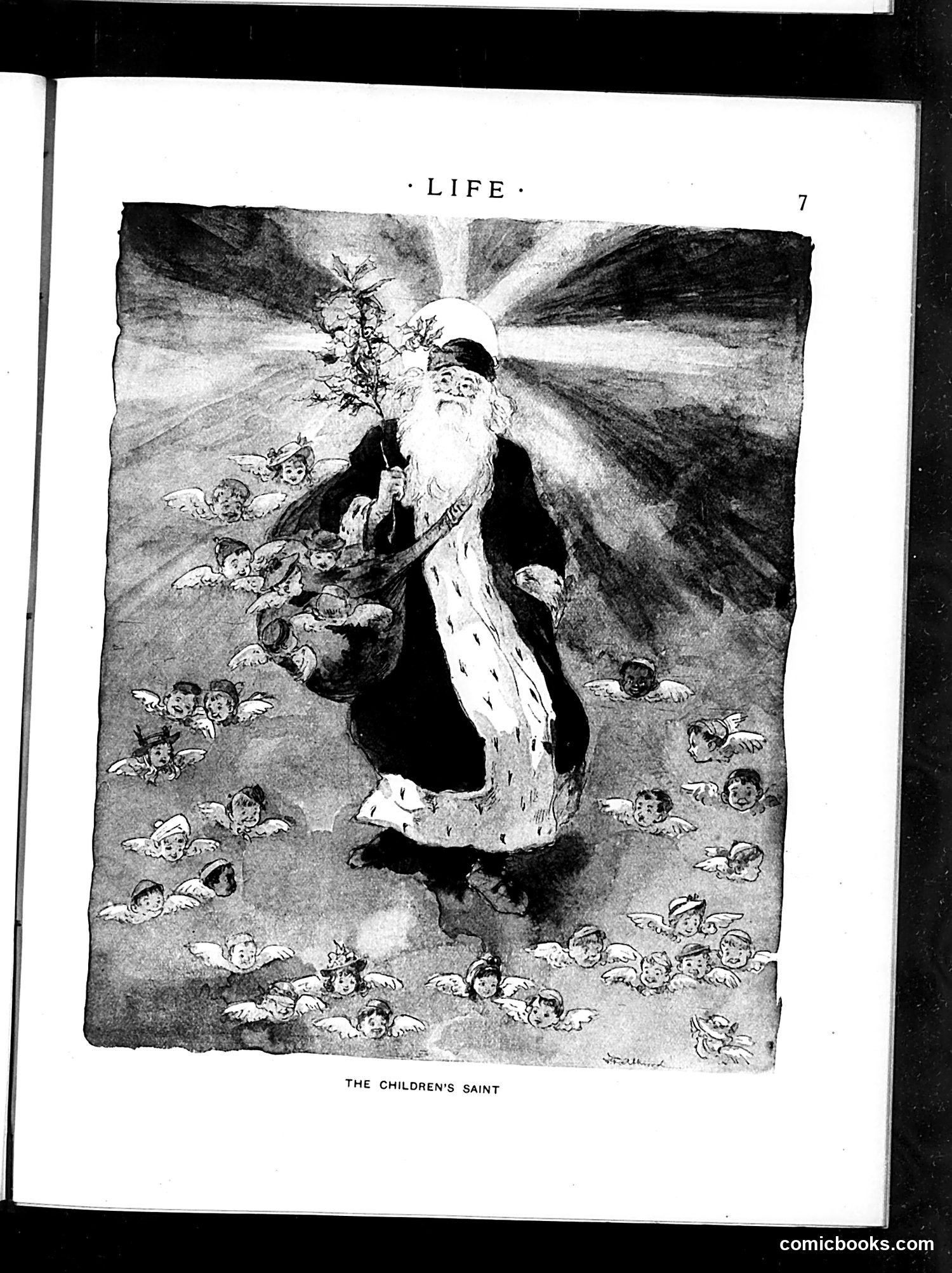
This illustration depicts an elderly bearded man in robes holding a small evergreen tree, surrounded by cherub heads in a heavenly setting with radiating light. The caption identifies him as "The Children's Saint." The figure appears to be **Santa Claus or Saint Nicholas**, presented in a religious/saintly context. The visual style—with the haloed figure, angels, and divine rays—treats Santa as a sacred figure worthy of veneration. This is likely satirizing the **commercialization and quasi-religious status Santa had acquired in American culture by the early 20th century**, when he was increasingly central to children's Christmas celebrations. The cartoon may gently mock how Santa had become almost a saint-like figure in secular American life, particularly through commercial promotion during the holiday season.
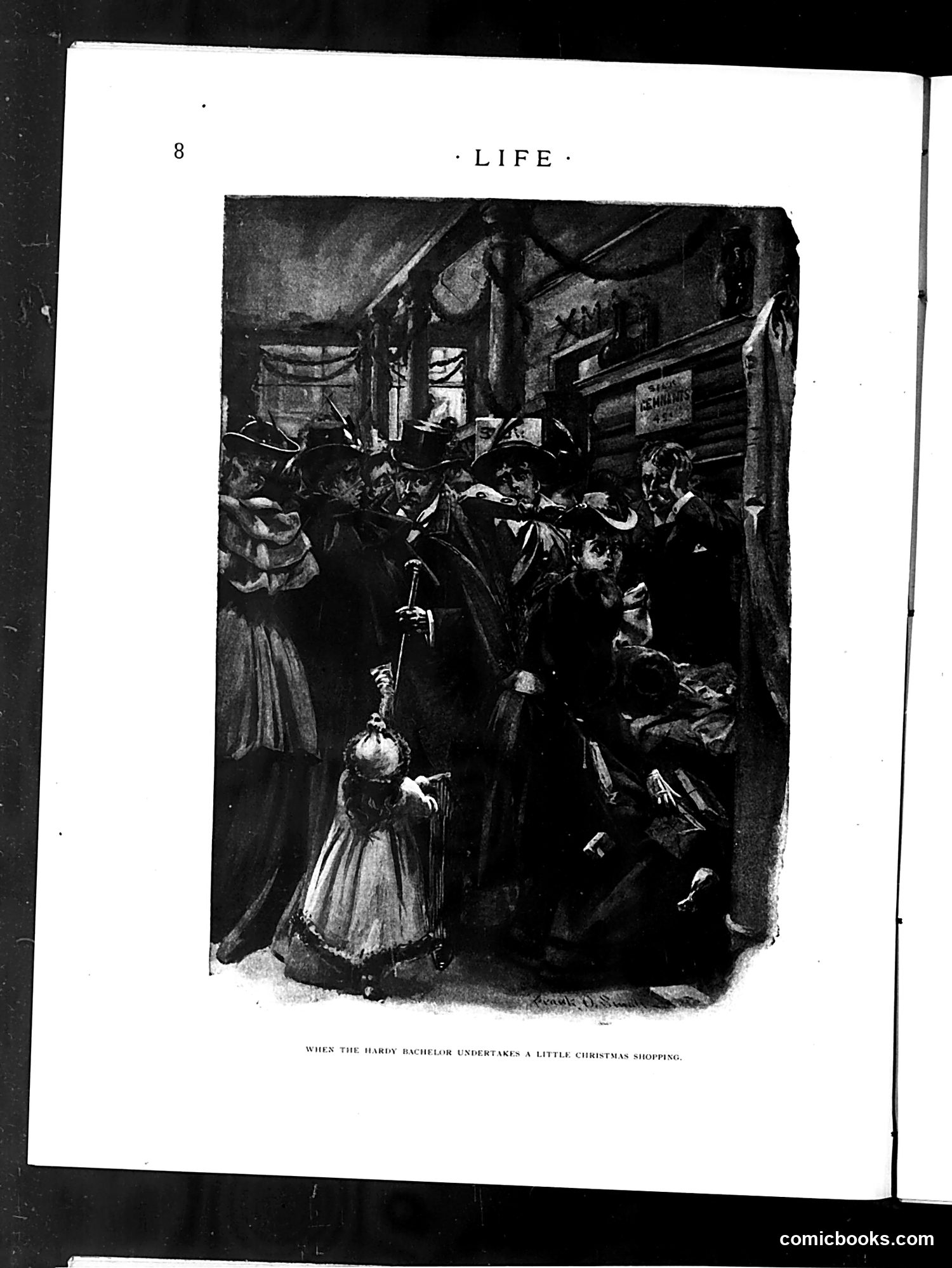
This illustration depicts a chaotic Christmas shopping scene, likely from the early 20th century. The caption references "the hardy bachelor" undertaking holiday shopping, suggesting humor about an unmarried man navigating the commercial Christmas rush. The image shows a crowded, indoor shopping environment with multiple figures in period dress (long coats, hats) jostling together. The scene appears deliberately congested and frantic, capturing the social satire of holiday consumerism and shopping crowds. The joke likely mocks both the "bachelor" stereotype—an unmarried man assumed awkward in domestic matters—and the broader phenomenon of Christmas shopping as a chaotic, overwhelming social experience. The crowded composition emphasizes the madness of seasonal retail activity, a theme Life magazine frequently satirized during this era.
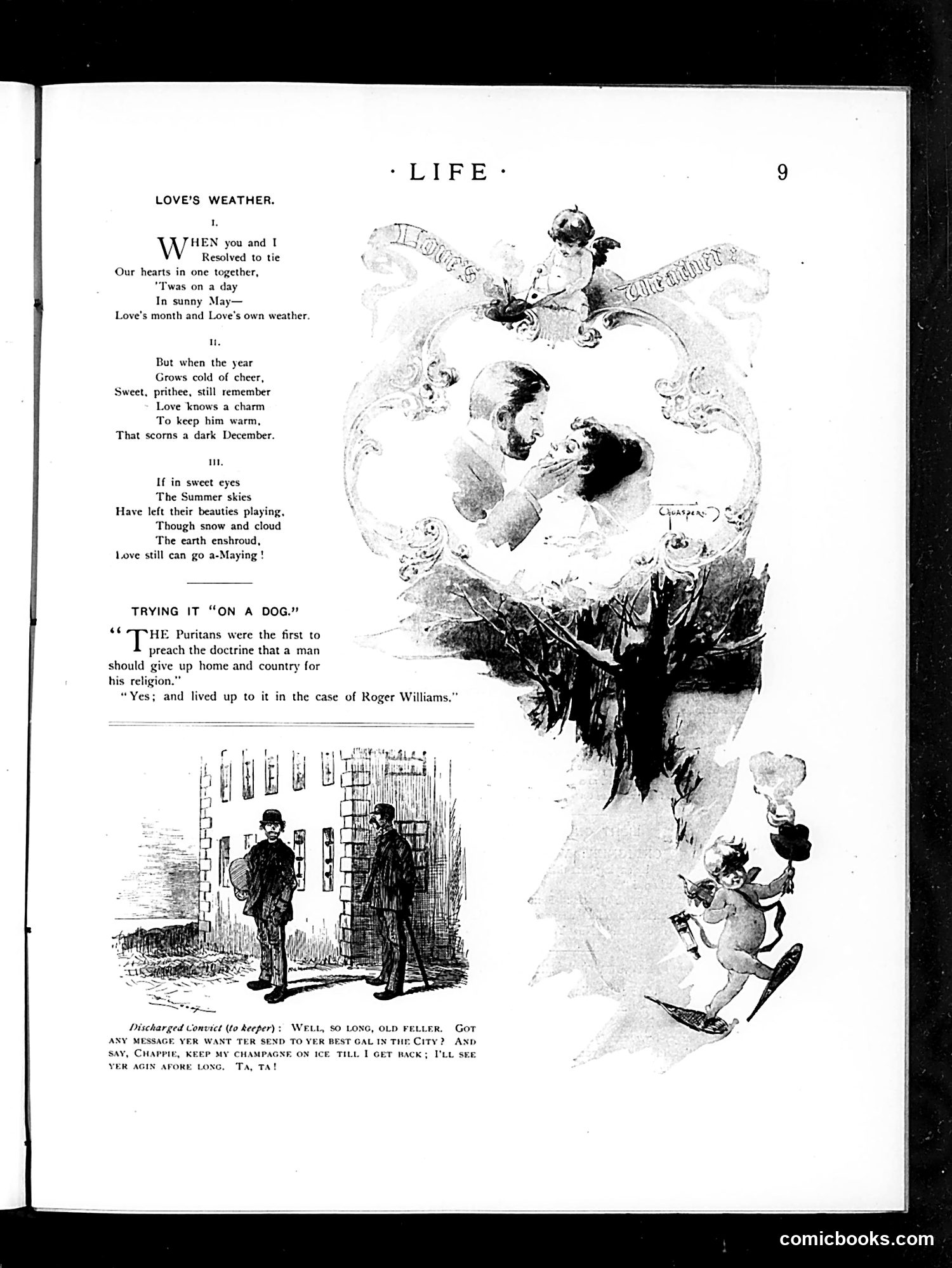
This page contains romantic poetry and two satirical cartoons. **"Love's Weather"** is sentimental verse about enduring romantic love through seasons of hardship—a common Victorian theme. **"Trying It 'On a Dog'"** references the Puritan doctrine requiring religious sacrifice of home and country, exemplified by Roger Williams (the religious dissenter exiled from Massachusetts Bay Colony). The phrase "trying it on a dog" likely means testing an idea on someone gullible or powerless. **The cartoon below** depicts a discharged convict cheerfully bidding farewell to his prison keeper, casually instructing him to keep his champagne on ice and promising to return soon. The satire is obvious: a supposed criminal with such refined tastes (champagne) and casual confidence suggests either that prisons held wealthy criminals or that the entire penal system was corrupt/ineffective. The convict treats his release as temporary—he fully expects to return, implying inevitable recidivism or that imprisonment poses no real deterrent.
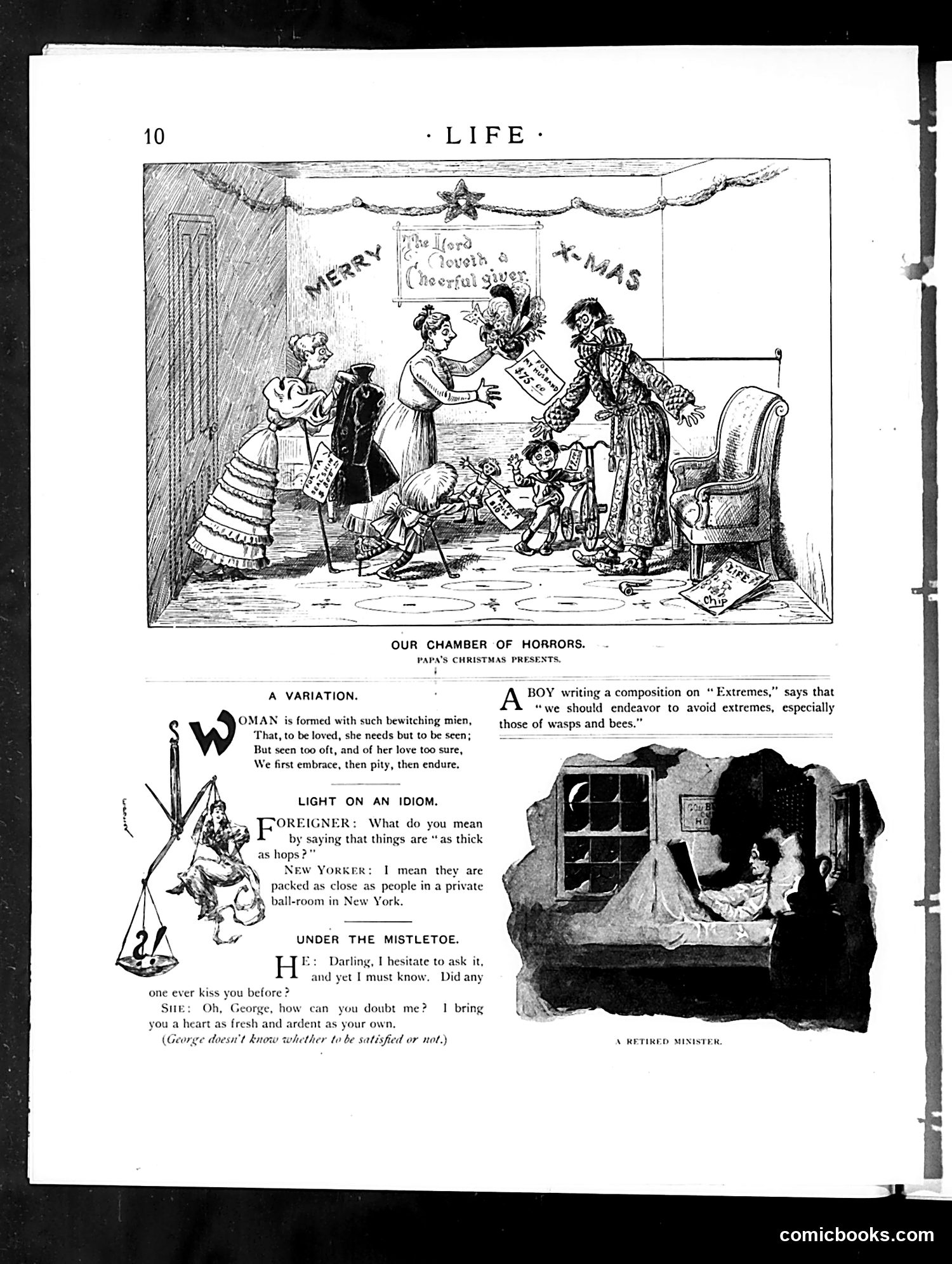
**"Our Chamber of Horrors: Papa's Christmas Presents"** (top cartoon) depicts a Victorian family chaos scene—children and adults in disarray amid holiday decorations and gifts. The title satirizes how children's Christmas presents often create mayhem rather than joy, a common domestic complaint. **"A Variation"** presents a poem about women's nature—conventional Victorian sentiment about how familiarity breeds indifference in romance ("embrace, then pity, then endure"). **"Light on an Idiom"** is a joke: A foreigner asks what "thick as..." means; a New Yorker explains by reference to overcrowded NYC ballrooms—topical humor about urban congestion. **"Under the Mistletoe"** plays on courtship anxieties: A man asks his fiancée if anyone kissed her before; she offers reassurance, but the caption notes George remains uncertain—satire of male insecurity and the inadequacy of such promises. **"A Retired Minister"** (photograph) appears unrelated—likely an illustration for another piece. The page mixes domestic humor, social observation, and romance satire typical of early 20th-century American magazines.
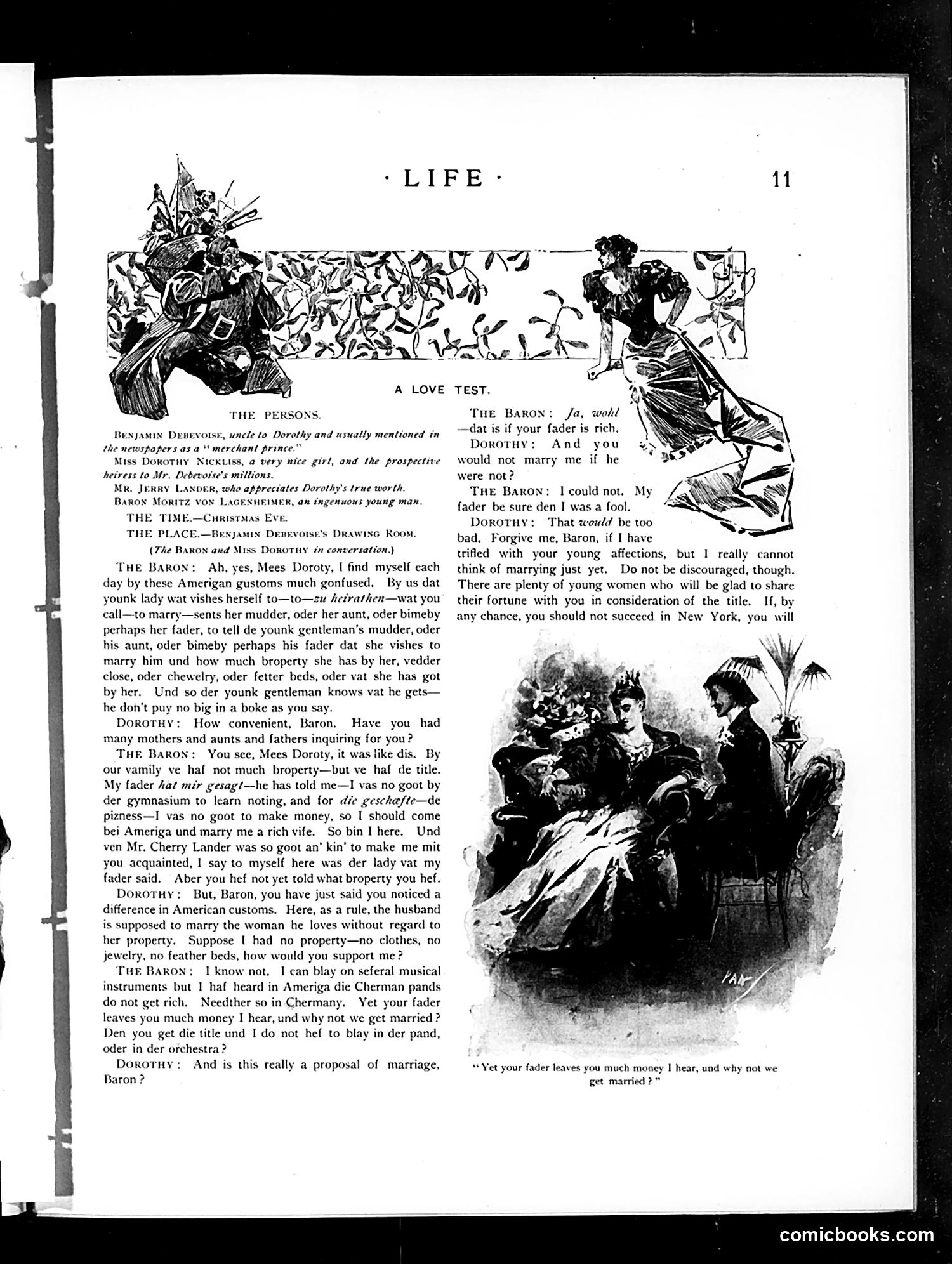
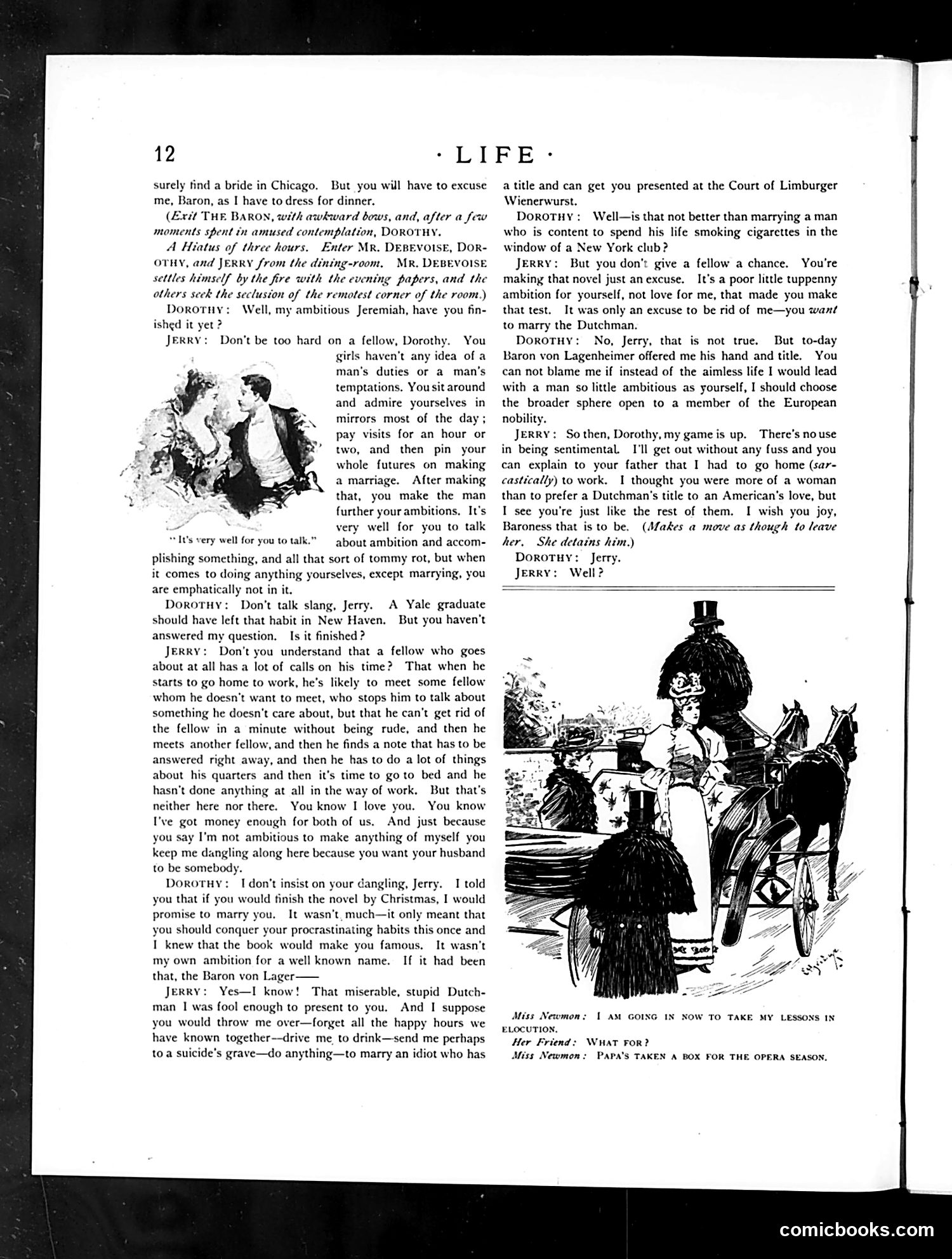
This page depicts a dramatic dialogue between Dorothy and Jerry, a young couple at an impasse. Jerry is a Yale graduate writer who hasn't finished his novel despite Dorothy's Christmas deadline—a condition for marriage. He makes excuses about social obligations preventing work. Dorothy has received a proposal from "Baron von Lagenheimer," a German nobleman (the joke "Court of Limburger Wienerwurst" mocks German pretension). Jerry dismisses this suitor as an "idiot" and "miserable, stupid Dutchman." The satire targets young, ambitionless men of leisure and female social-climbing. Dorothy chooses European aristocratic status over an American man content merely "smoking cigarettes in the window of a New York club." The cartoon critiques both masculine procrastination and feminine materialism—neither character behaves admirably, but Dorothy's pragmatism trumps Jerry's romantic excuses.
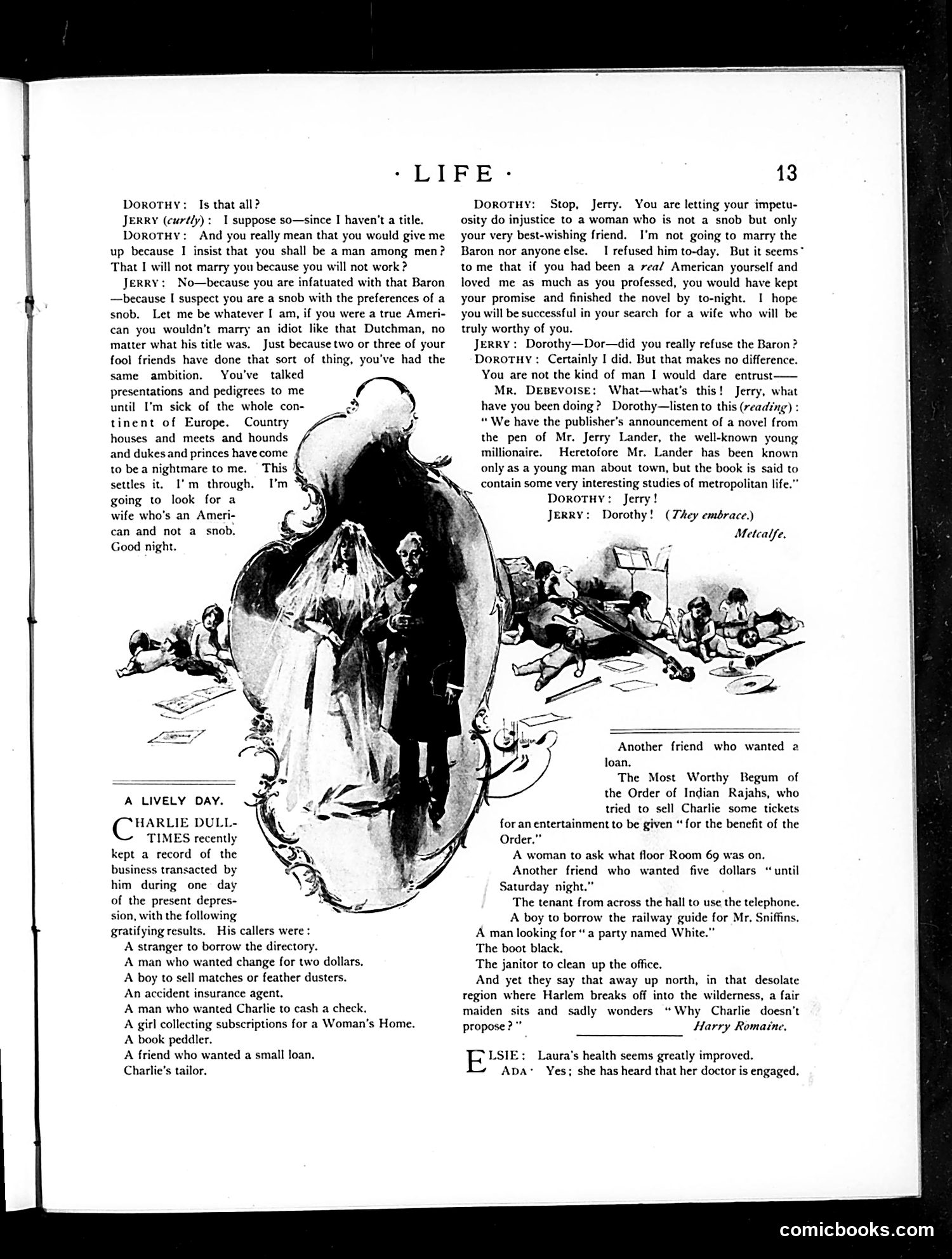
**"A Lively Day"** (bottom section): A humorous list chronicling the various interruptions and solicitations that beset Charlie Dull during a single business day—borrowers, salesmen, charity collectors, and loan seekers. The joke is that despite this constant parade of demands, a woman upstate mysteriously wonders why Charlie won't propose to her. The satire targets both the relentless petty annoyances of urban life during economic depression and the obliviousness of romantic expectations. **Main dialogue (top)**: Jerry and Dorothy break up over her social ambitions. Dorothy wants to marry a titled European ("that Baron"), which Jerry sees as snobbish Anglophilia—a common American anxiety of the era. The resolution: Jerry has secretly written a novel about metropolitan life, making him worthy. Dorothy refuses the Baron and accepts Jerry, and her father approves. The satire mocks both American social climbing and the redemptive fantasy that artistic/literary success solves romantic problems.
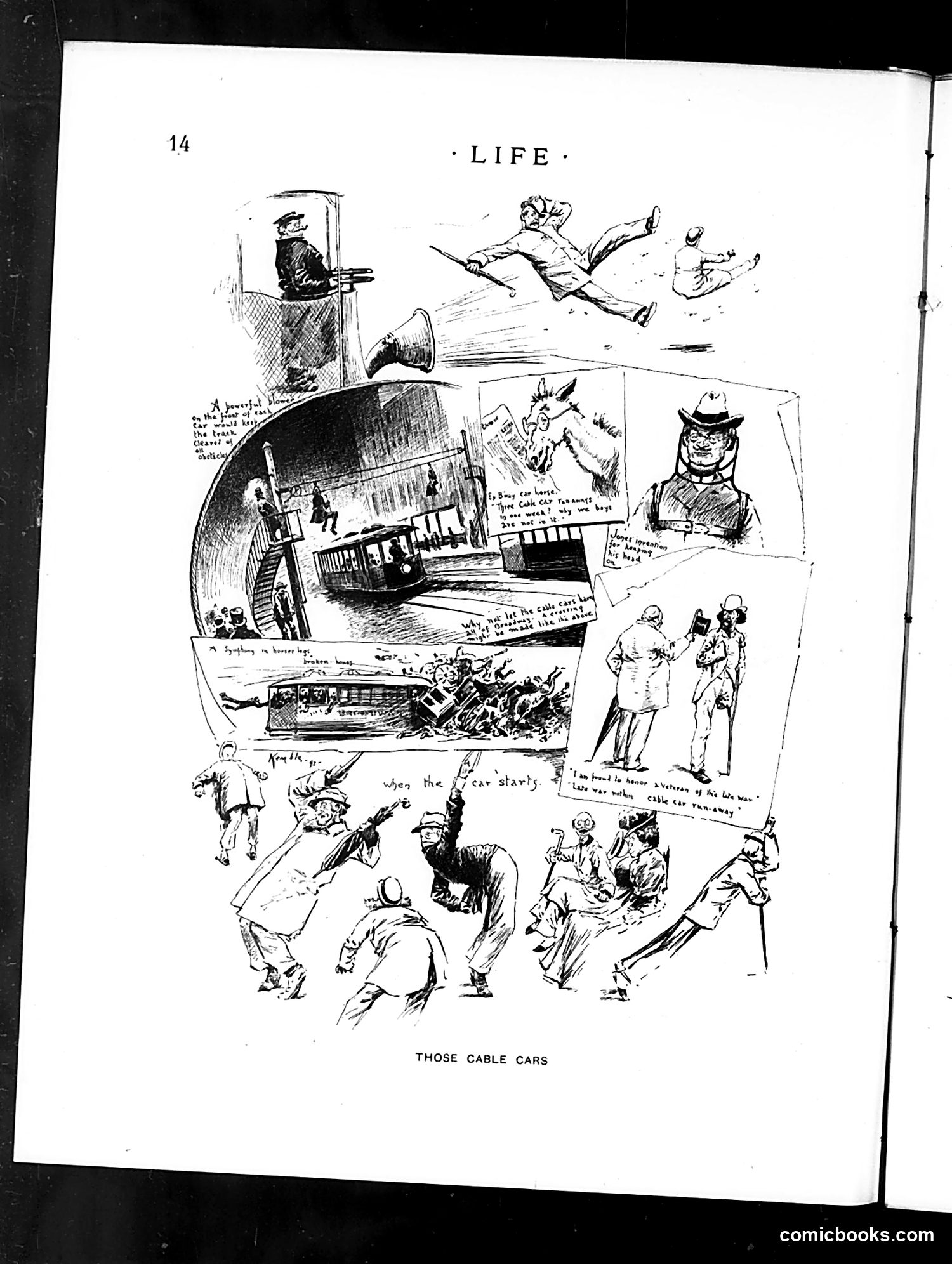
This page presents a satirical collage about San Francisco's famous cable cars. The central image shows a large cable car with various vignettes arranged around it depicting accidents and mishaps—people being thrown from cars, colliding, tumbling through the air, and generally suffering comic misfortune. The satire targets cable cars as dangerous urban transportation. Various sketched scenes show operators, passengers, and bystanders in perilous situations, suggesting the vehicles were hazardous to ride and be around. The overall composition critiques cable cars as chaotic, poorly-controlled public transit that endangers everyone involved—a commentary on San Francisco's public safety infrastructure and transit reliability during this era.
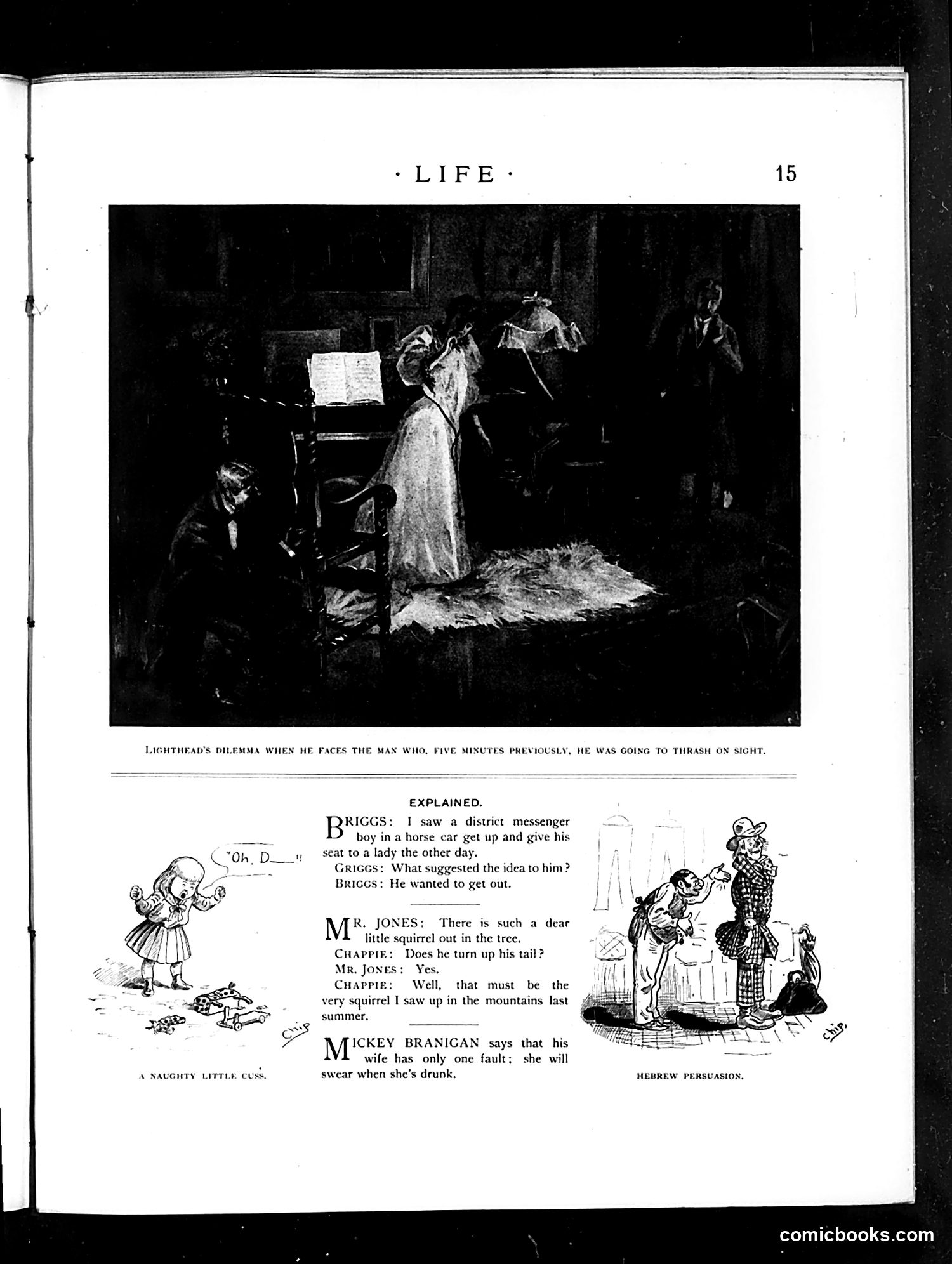
The page contains three distinct items: **Main Image (top):** A dramatic theatrical scene labeled "Lighthead's dilemma when he faces the man who, five minutes previously, he was going to thrash on sight." The scene depicts what appears to be a stage confrontation, suggesting a character who lost his nerve or resolve upon actually encountering his intended opponent. **"Explained" Section (bottom):** Three brief humorous anecdotes: - A messenger boy story about wanting to "get out" - Mr. Jones discussing a "dear little squirrel" with Chappie - Mickey Branigan's wife's drinking problem The cartoons accompanying these items are simple line drawings illustrating the jokes. The overall tone is satirical commentary on human nature—cowardice, small talk about nature, and domestic faults—typical of early-20th-century American humor magazines.
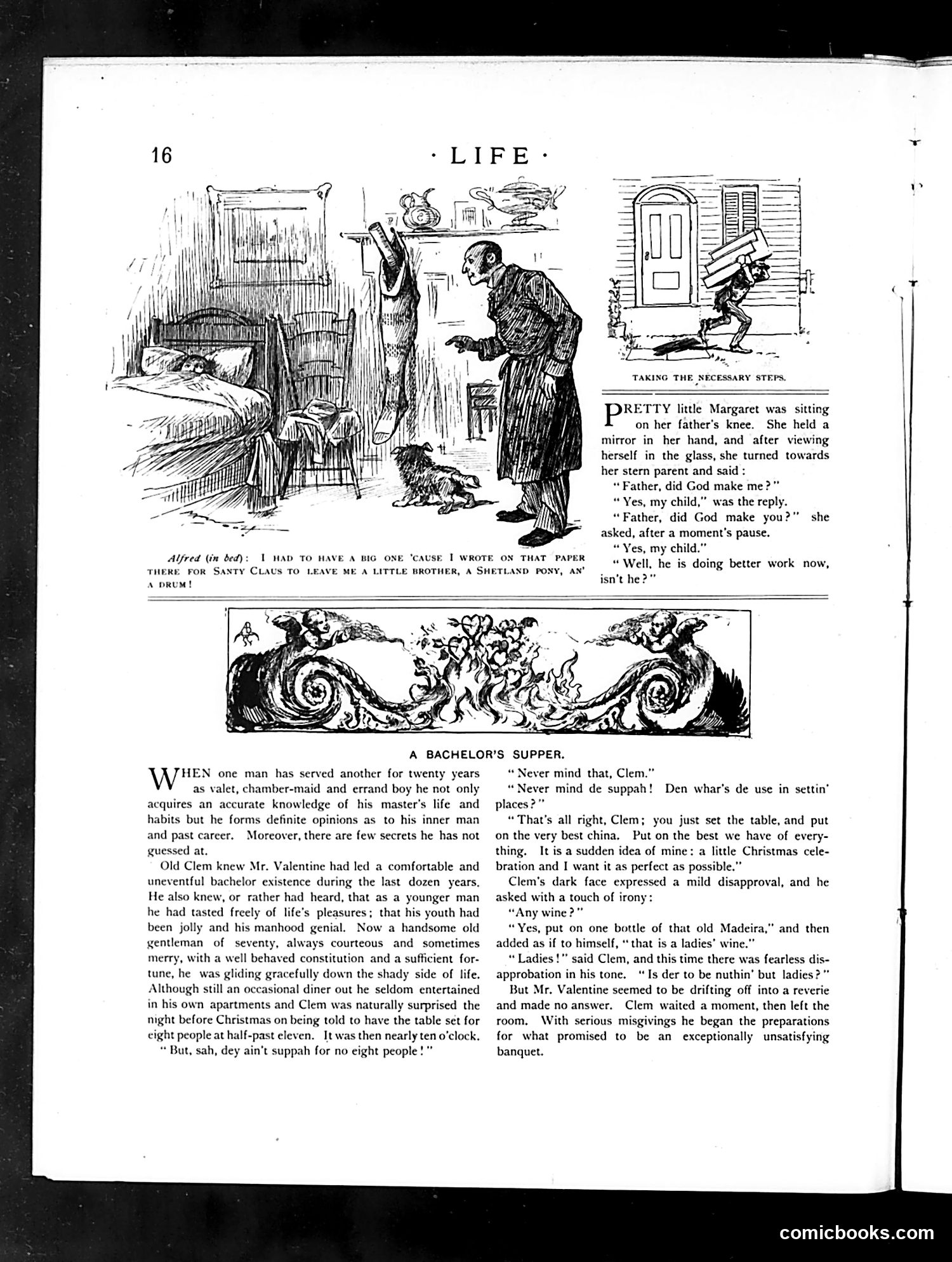
This page contains three humorous domestic vignettes typical of early 20th-century American humor: **Top cartoon**: A child (Alfred) has written Santa requesting a large drum, prompting his exasperated father to complain he had to write a note requesting a Shetland pony instead—satirizing parental desperation to redirect children's destructive wishes. **Middle joke**: A young girl (Margaret) asks her father if God made him, then observes "he is doing better work now"—a child's innocent insult about his aging appearance. **Main story ("A Bachelor's Supper")**: An elderly bachelor (Mr. Valentine) surprises his longtime African American servant Clem by ordering a formal Christmas dinner for eight people at the last minute. Clem's dialect-heavy dialogue expresses disapproval, particularly when learning wine will be served "to ladies"—suggesting Valentine may be hosting women, which the proper servant finds scandalous or unseemly for his respectable employer. The humor relies on period assumptions about propriety, class relations, and servant-employer dynamics. Clem's character uses offensive racial dialect stereotyping common to the era.
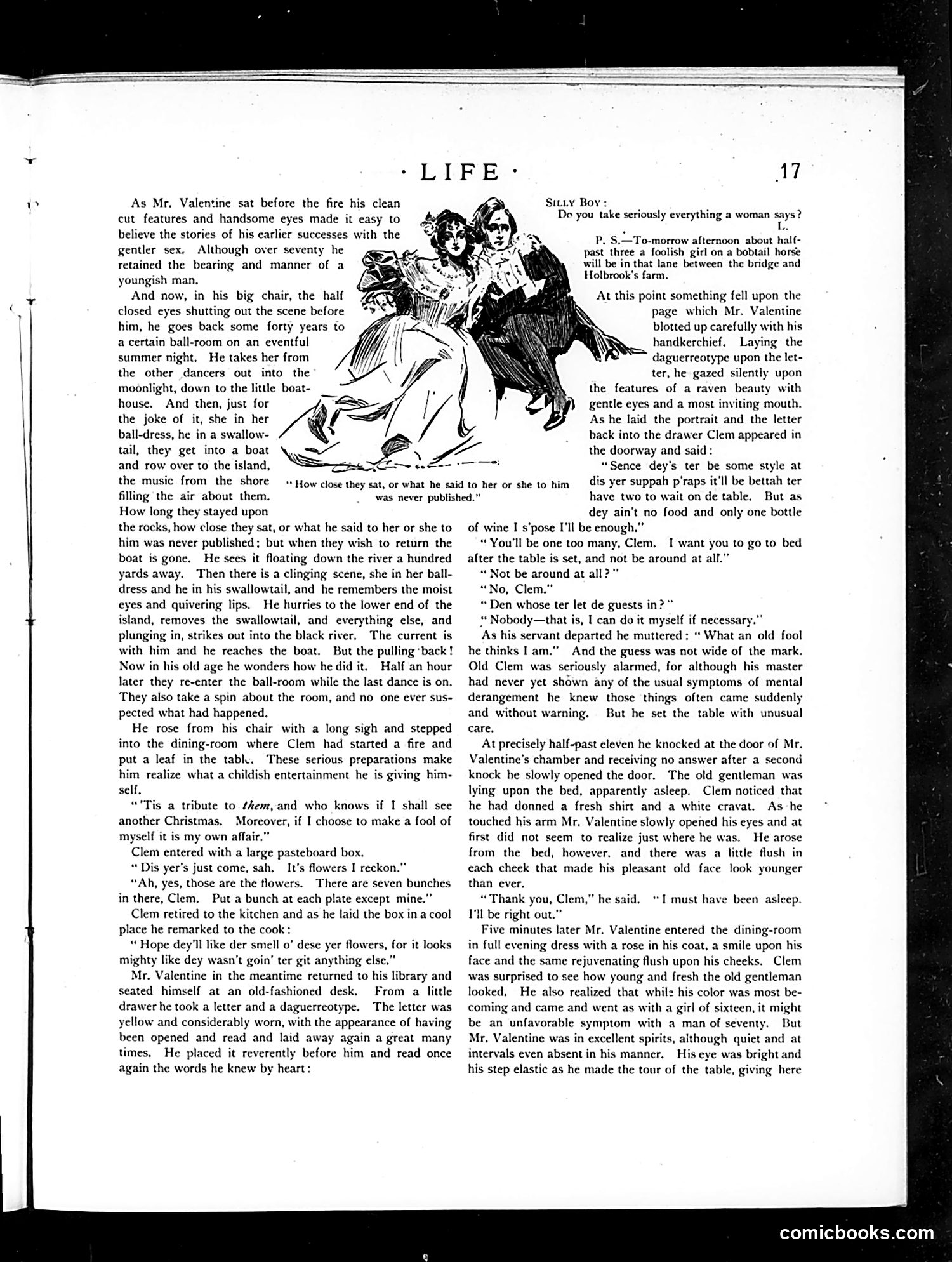
This page illustrates a sentimental narrative about an aging gentleman, Mr. Valentine, reminiscing about a romantic youthful adventure. The small illustration shows a couple in formal dress (ball gown and tuxedo) in a boat, referencing the story's central anecdote: forty years earlier, he rescued a woman after their boat drifted away, swimming back to retrieve it while she waited. The story is framed as bittersweet nostalgia—Valentine keeps a yellowed letter and daguerreotype from this woman, suggesting unfulfilled romance. The inserted "P.S." note hints the woman still thinks of him. The narrative suggests this is a common *Life* magazine theme: romance, class dynamics (note the servant "Clem" speaking in dialect), and the poignancy of aging. The story celebrates Victorian-era courtship while gently mocking Valentine's sentimental preparations for a lonely dinner, suggesting wealthy men's romantic fantasies sustained them through old age.
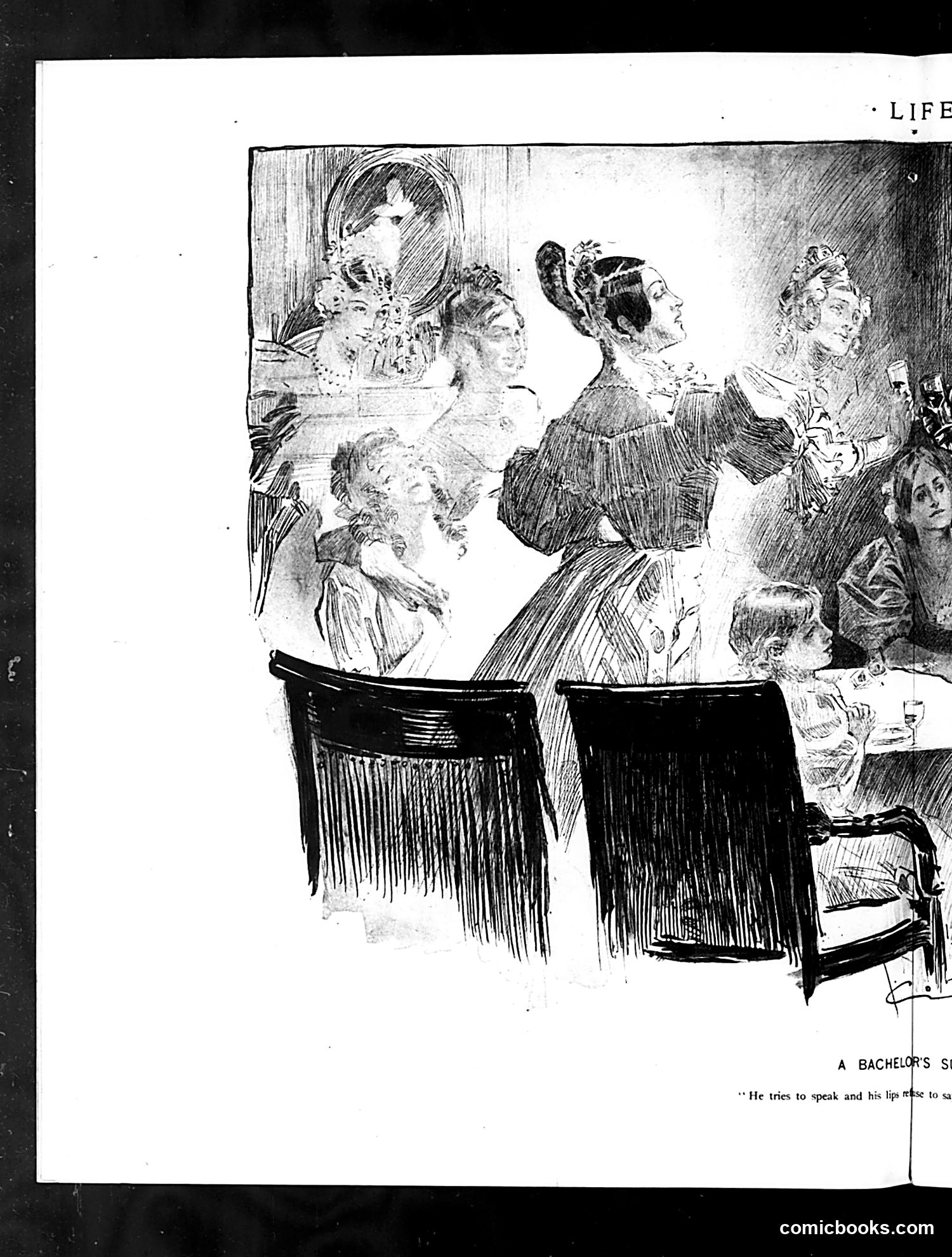
This appears to be a social satire cartoon from *Life* magazine depicting a bachelor entertaining female guests at dinner. The sketch shows several elegantly dressed women in early 20th-century attire gathered around a dining table with empty chairs in the foreground. The incomplete caption—"He tries to speak and his lips rise to sa[y]"—suggests the humor involves a bachelor's awkward attempts at conversation or courtship with his female guests. The cartoon satirizes the social awkwardness of unmarried men hosting formal dinner parties, a common theme in period humor about bachelor life and gender relations. The specific joke likely plays on his nervousness or inability to impress the women present, mocking genteel social conventions of the era.
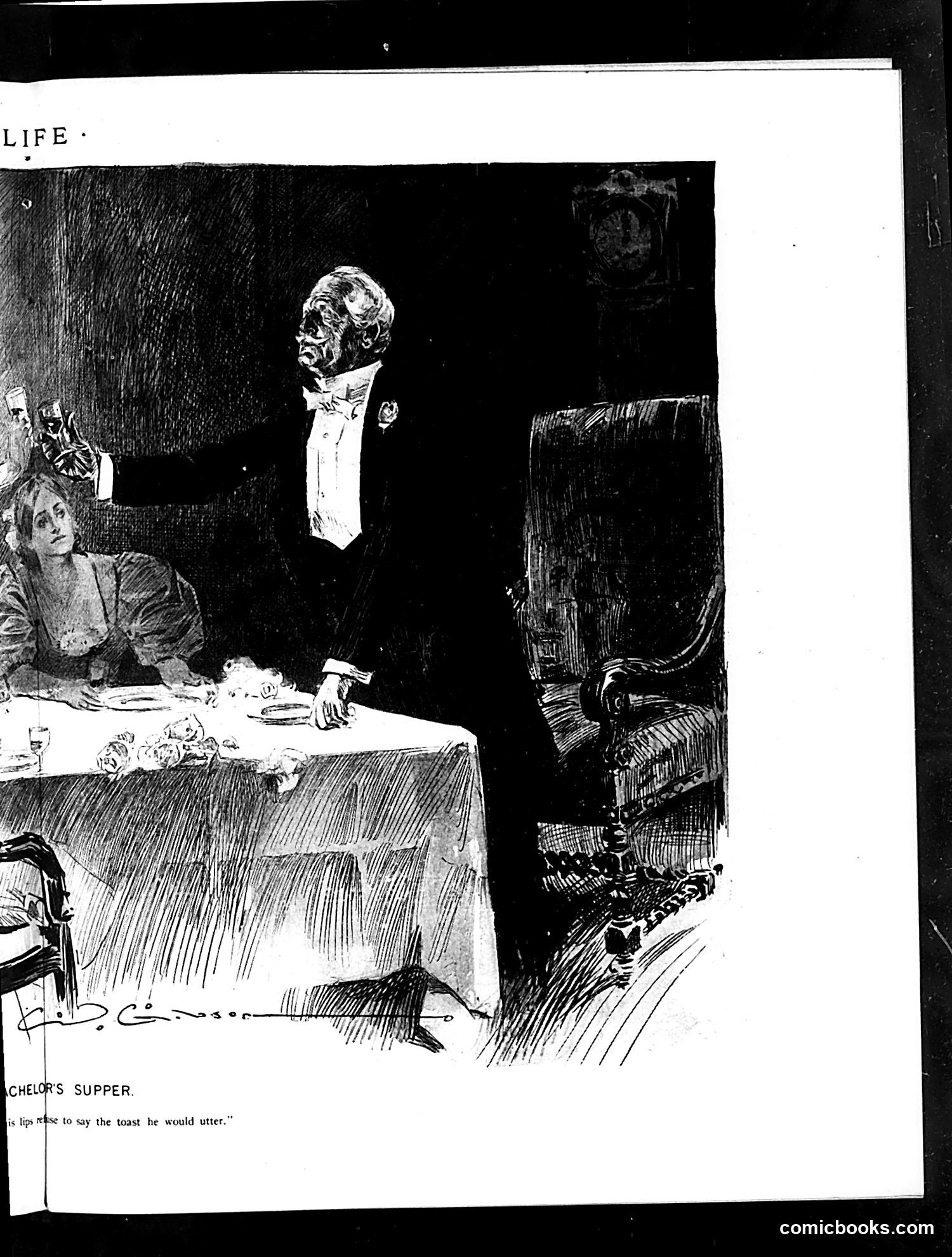
This sketch depicts a formal dinner scene with a well-dressed older gentleman in evening wear (tuxedo and white shirt) standing to propose a toast. A woman sits at the table looking up at him with apparent concern or apprehension. The caption indicates he's about to make some kind of significant statement. The satire appears to target the social awkwardness or tension of formal bachelor dining customs. The woman's anxious expression suggests she's uncertain—or dreading—what he might say. The joke likely plays on the stereotype of bachelor toasts being either inappropriately ribald, embarrassingly sentimental, or otherwise socially uncomfortable. The title and setup mock the formality of such occasions while hinting at the anxiety they could produce among guests awaiting the speaker's words.
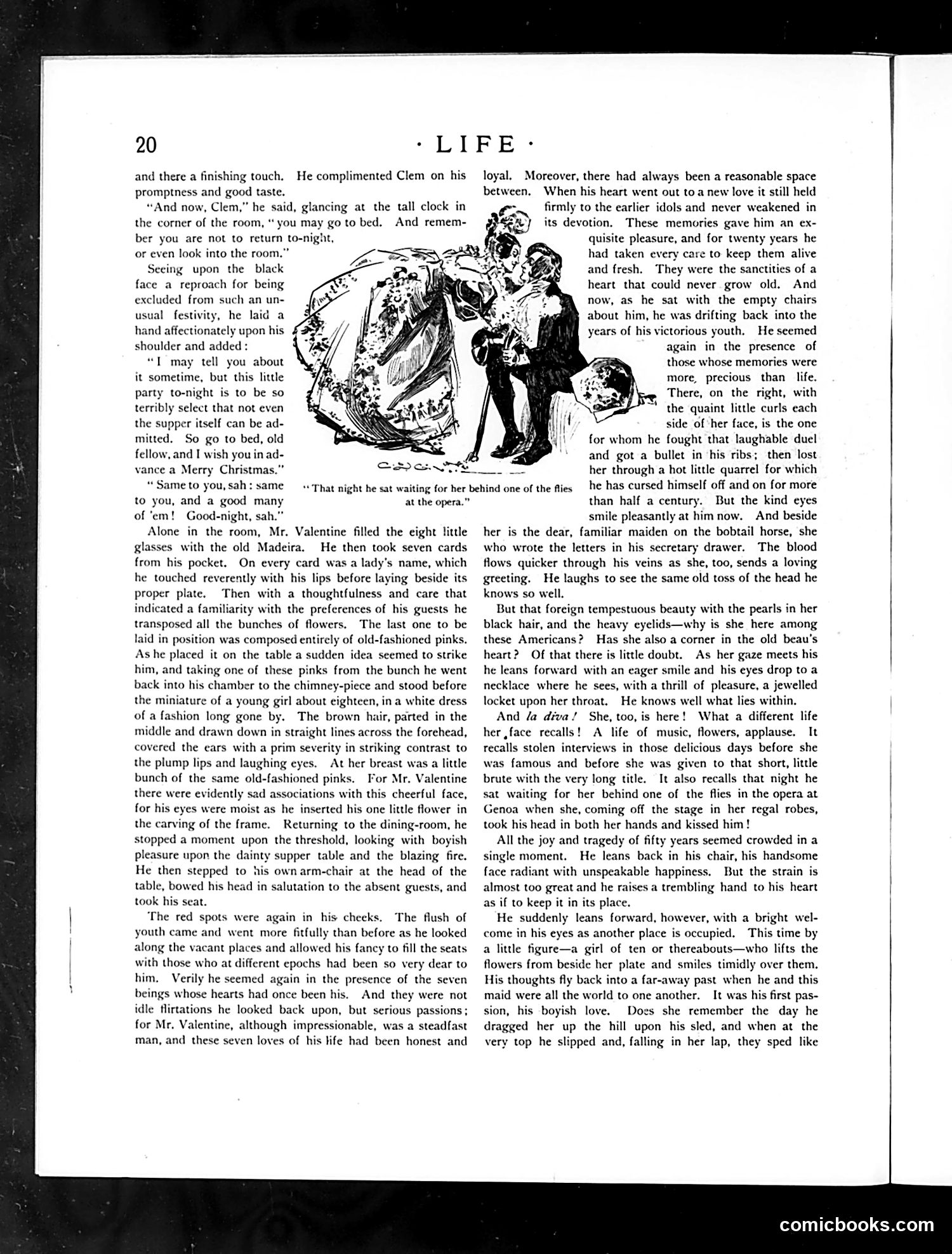
This page depicts a sentimental Christmas Eve scene from a serialized story about an elderly gentleman, Mr. Valentine, who hosts a nostalgic dinner party. The illustration shows him arranging an elaborate table with seven place settings and flowers—each representing a woman from his romantic past. The narrative reveals Valentine as a man of refined sentiment who has loved deeply seven times throughout his life, maintaining genuine devotion to each woman while never weakening his earlier attachments. The text emphasizes his honorable character: these were "serious passions," not "idle flirtations." The poignant detail is a miniature portrait of a young woman he keeps in his chamber—the one for whom he fought a duel and was wounded. He places old-fashioned pink flowers at her place setting, suggesting she may be deceased or otherwise unavailable. **The satire appears gentle**: Life presents this as touching rather than ridiculous—a romantic idealist whose faithful heart transcends time and age. The piece celebrates sincere emotion over cynicism.
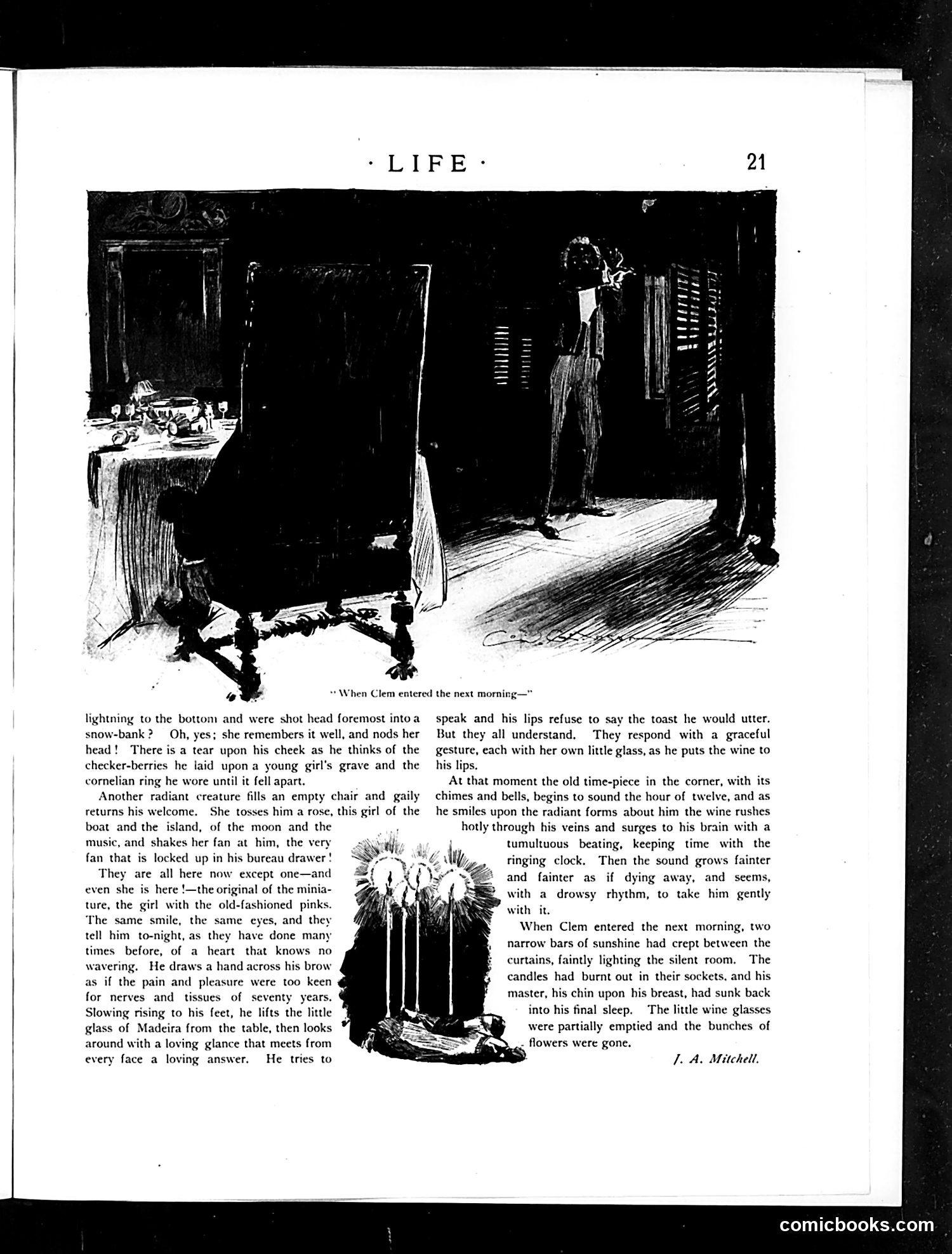
This is a sentimental literary illustration accompanying a short story by J.A. Mitchell titled "When Clem entered the next morning—" (the title revealing the ending). The narrative depicts an elderly man's final evening, surrounded by women from his past—former loves and companions represented by objects (a rose, a fan, a ring, flowers). Through their presence and shared wine, he experiences a bittersweet reunion with his memories. The old clock striking midnight, the wine's warmth, and the gathering darkness signal his peaceful death. The illustration shows his modest bedroom with a mirror, furnishings, and the women's ghostly or memory-like presences. The accompanying image of flowers in a vase emphasizes the story's melancholic beauty. This is **not satire or political commentary**, but rather romantic, nostalgic fiction typical of *Life* magazine's literary content—celebrating memory, love, and graceful mortality rather than mocking anything. The emotional tone is wistful and elegiac.
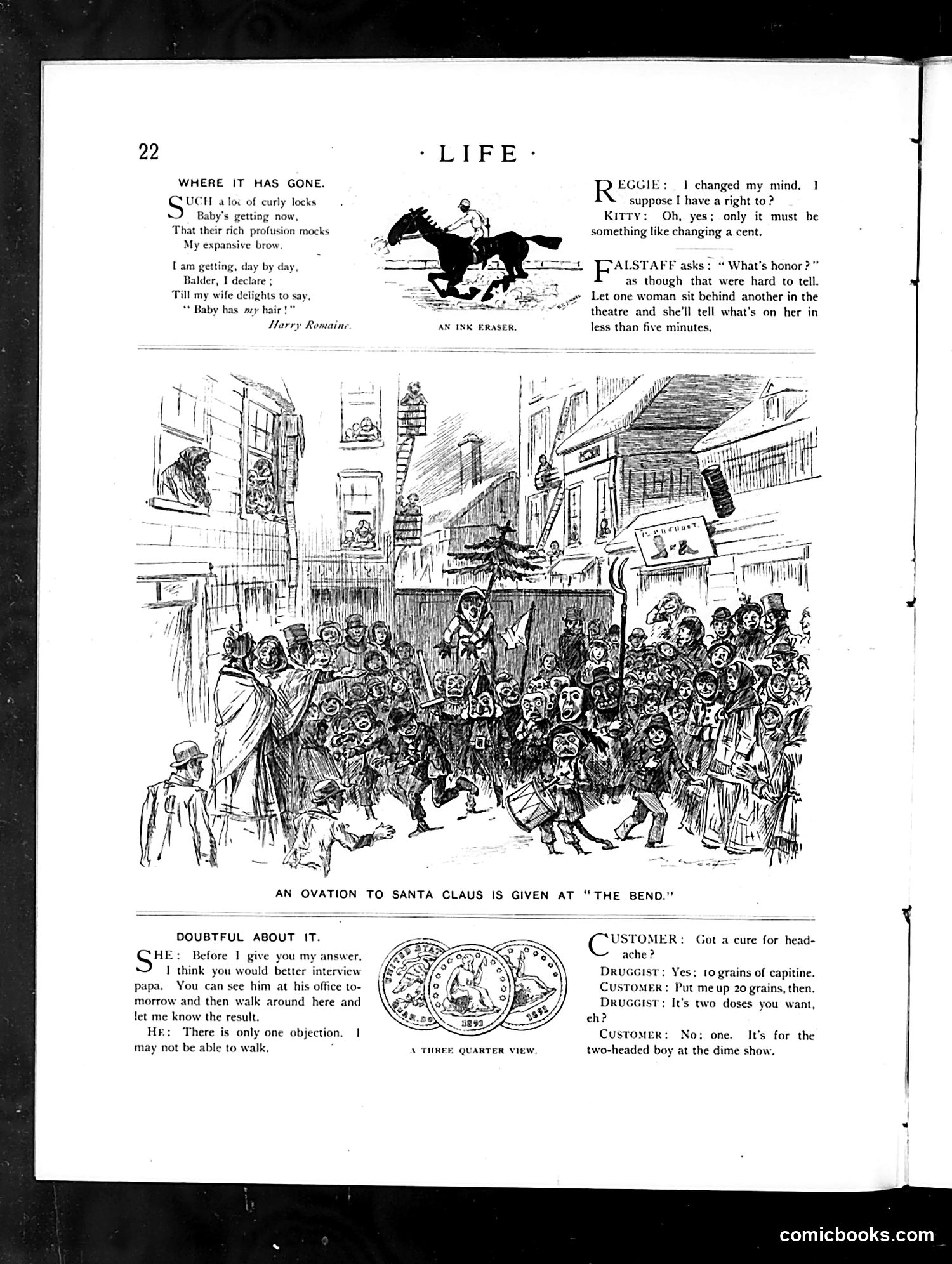
This page contains several unrelated humorous sketches typical of early 20th-century satirical magazines: **"Where It Has Gone"** jokes about male baldness—a husband laments losing his curly hair while his wife jokes he's given it all to their baby. **"An Ovation to Santa Claus is Given at 'The Bend'"** depicts a crowded street scene, likely referencing a specific venue or neighborhood ("The Bend") known to contemporary readers. **"Doubtful About It"** presents a comedic exchange where a man must consult his prospective father-in-law before proposing, then admits he may not be able to walk afterward—implying he fears the father's response. **The Druggist dialogue** features dark humor: a customer requests medicine for a "two-headed boy at the dime show"—likely a carnival attraction. The druggist's suggestion of capítaine (possibly quinine) is played for absurdist comedy. **"A Three Quarter View"** shows coins, possibly mocking currency or financial matters. The page emphasizes period humor about marriage, medicine, baldness, and carnival curiosities rather than explicit political content.
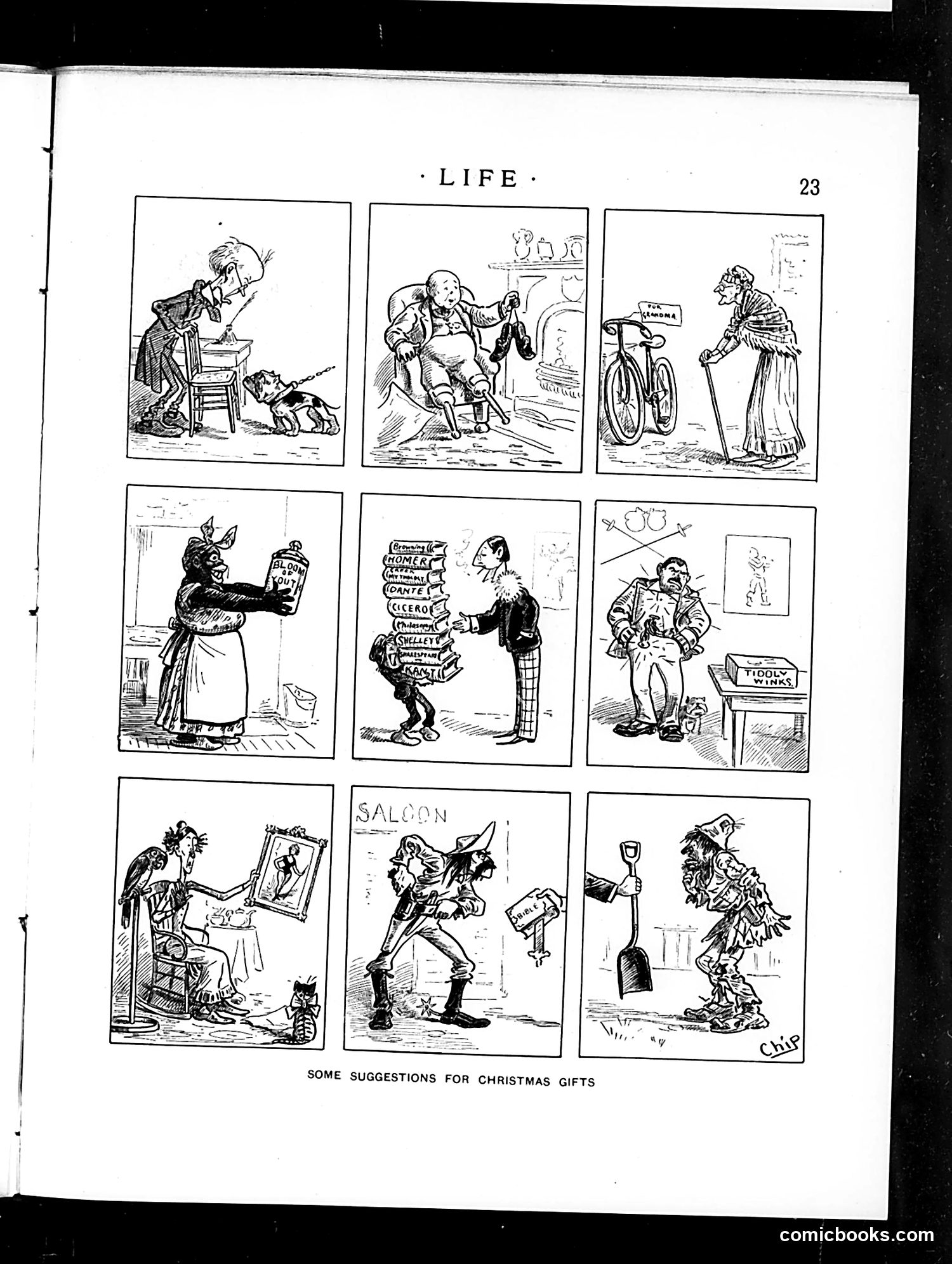
This page presents nine satirical cartoon panels mocking various gift-giving ideas, likely from the early 20th century. The humor targets different recipient types and their stereotypical interests: - A woman receiving a small dog - A man with stacks of classical literature (Homer, Dante, Cicero) - A man receiving a bicycle - Various other domestic and personal gift scenarios The cartoons use exaggerated character types and situations to joke about unsuitable or ironic Christmas presents. For instance, one panel shows someone with a "Saloon" sign, while another features someone with a shovel labeled "Fiddlys" (unclear reference). The satirical intent appears to be gently mocking both gift-givers' assumptions and recipients' reactions to unwanted or incongruous presents—a timeless source of humor about holiday gift-giving customs.
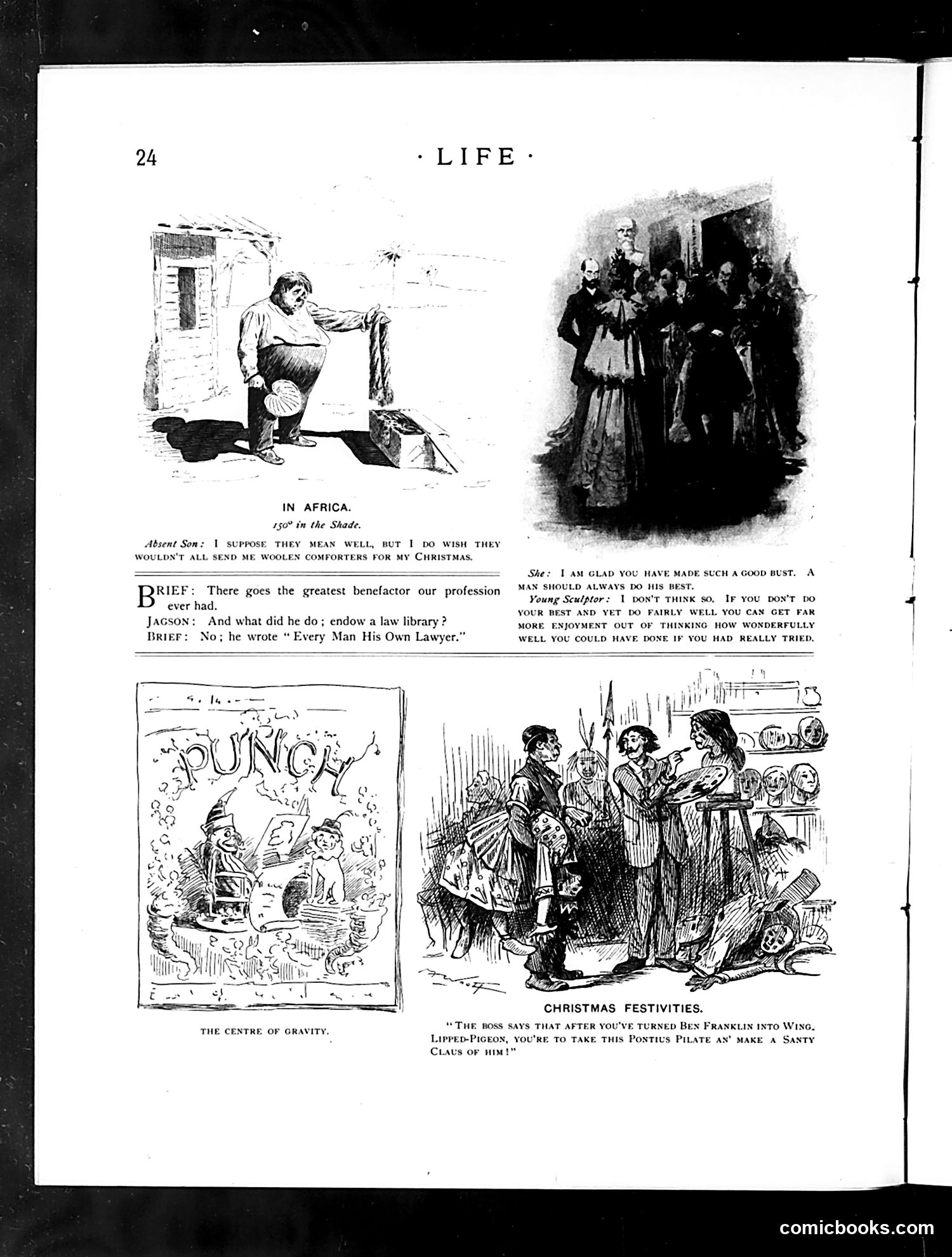
This page contains three satirical sketches typical of early Life magazine's humor: **"In Africa"**: A soldier in extreme heat complains that well-meaning relatives send wool comforters for Christmas—absurd gifts for a 150-degree climate. The satire mocks both sentimental home-front gestures and the disconnect between donors' intentions and recipients' actual needs. **"The Centre of Gravity"**: Two lawyers discuss a deceased colleague who wrote "Every Man His Own Lawyer." The joke: his greatest contribution to the profession was encouraging laypeople to represent themselves, thereby ensuring ongoing legal business. **"Christmas Festivities"**: A boss assigns workers to transform famous historical/religious figures (Ben Franklin, Pontius Pilate) into department-store Christmas decorations and Santa Claus. This satirizes commercialized Christmas and how retail strips serious figures of meaning for profit. All three sketches mock American society's absurdities—thoughtless generosity, professional self-interest, and commercialism—through gentle humor.
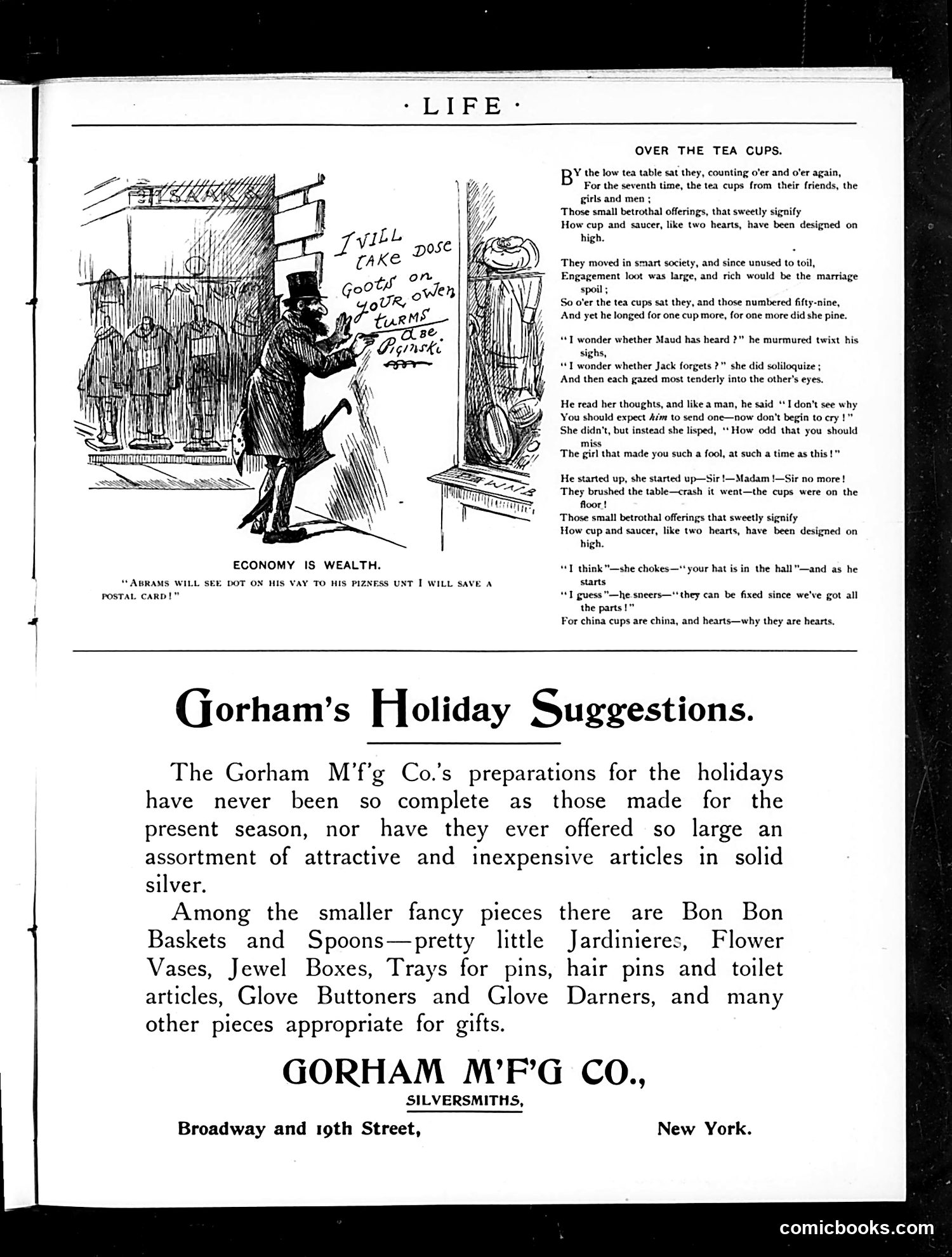
This satirical poem and illustration mock wealthy engaged couples obsessing over engagement gifts. The narrative follows an engaged pair counting fifty-nine tea cup sets received from friends—prestigious engagement "loot" in their smart society circles. They anxiously await a sixtieth set, but tension erupts when he questions why she expects another gift from a particular woman. Their quarrel escalates into an argument about past relationships, culminating in them knocking the table over and shattering all the cups. The satire targets the materialism and superficiality of upper-class engagements, where couples accumulate luxury goods rather than focusing on genuine affection. The ironic ending—that "china cups are china, and hearts...are hearts"—suggests their shallow preoccupation with possessions destroys what should matter most: love itself. The accompanying Gorham silverware advertisement appears deliberately placed for comedic contrast, promoting expensive gift items to the very audience being mocked.
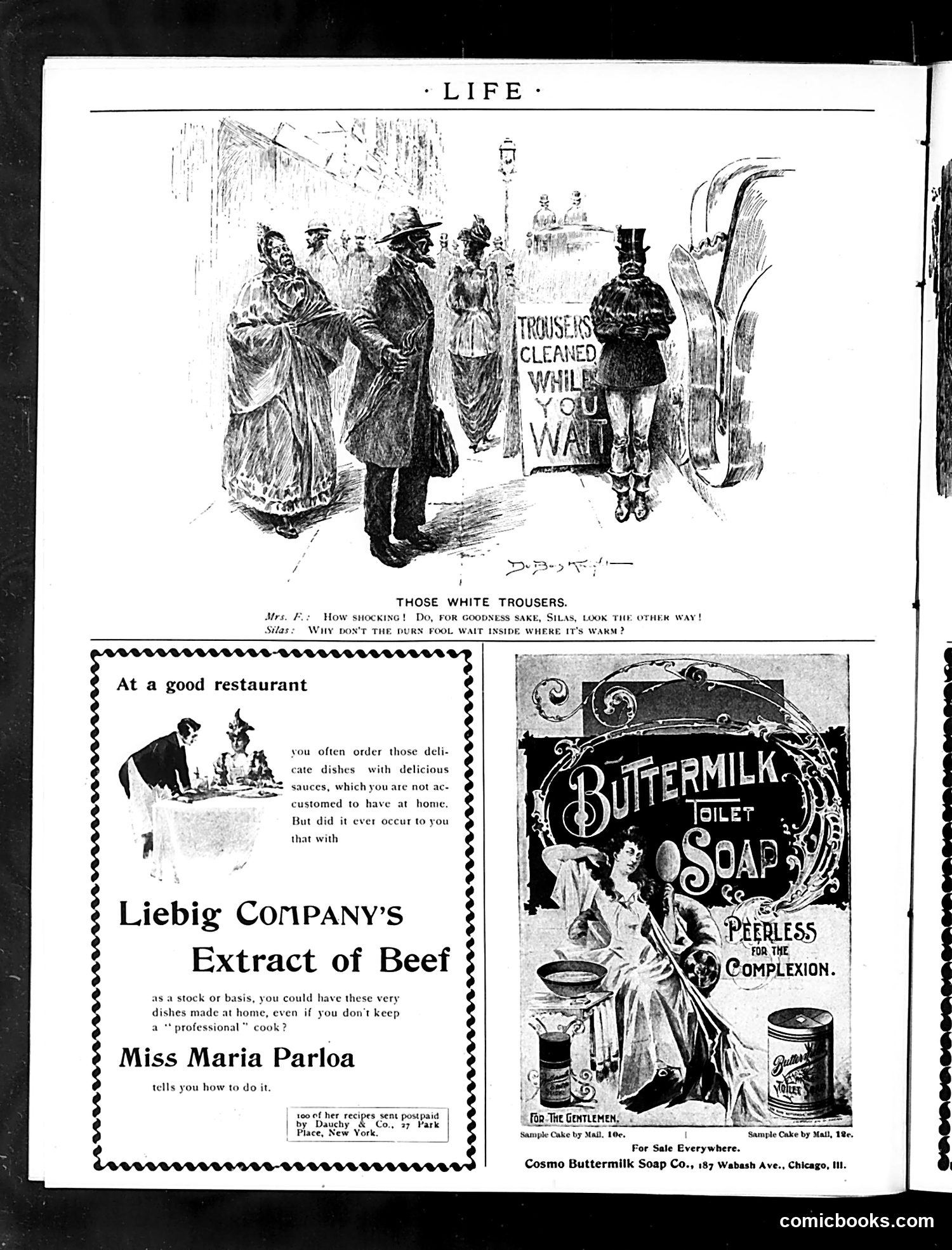
This cartoon satirizes Victorian-era social propriety and the absurdity of rigid etiquette rules. The central figure—a man wearing conspicuous white trousers—stands outside a restaurant in winter weather, apparently unwilling to enter because his white pants would be improper indoors or might soil easily. Mrs. F. is shocked by the sight ("How shocking!"), while Silas expresses exasperation that the man doesn't simply wait inside where it's warm rather than standing exposed to the cold, suggesting the "fool" prioritizes fashion rules over basic comfort. The joke mocks the era's obsession with dress codes and social conventions that override practical sense. White trousers were considered seasonally or contextually inappropriate, making the man's stubborn adherence to fashion rules ridiculous when weighed against obvious physical discomfort. The page's advertisements (Liebig beef extract and buttermilk soap) are incidental to the cartoon's social satire.
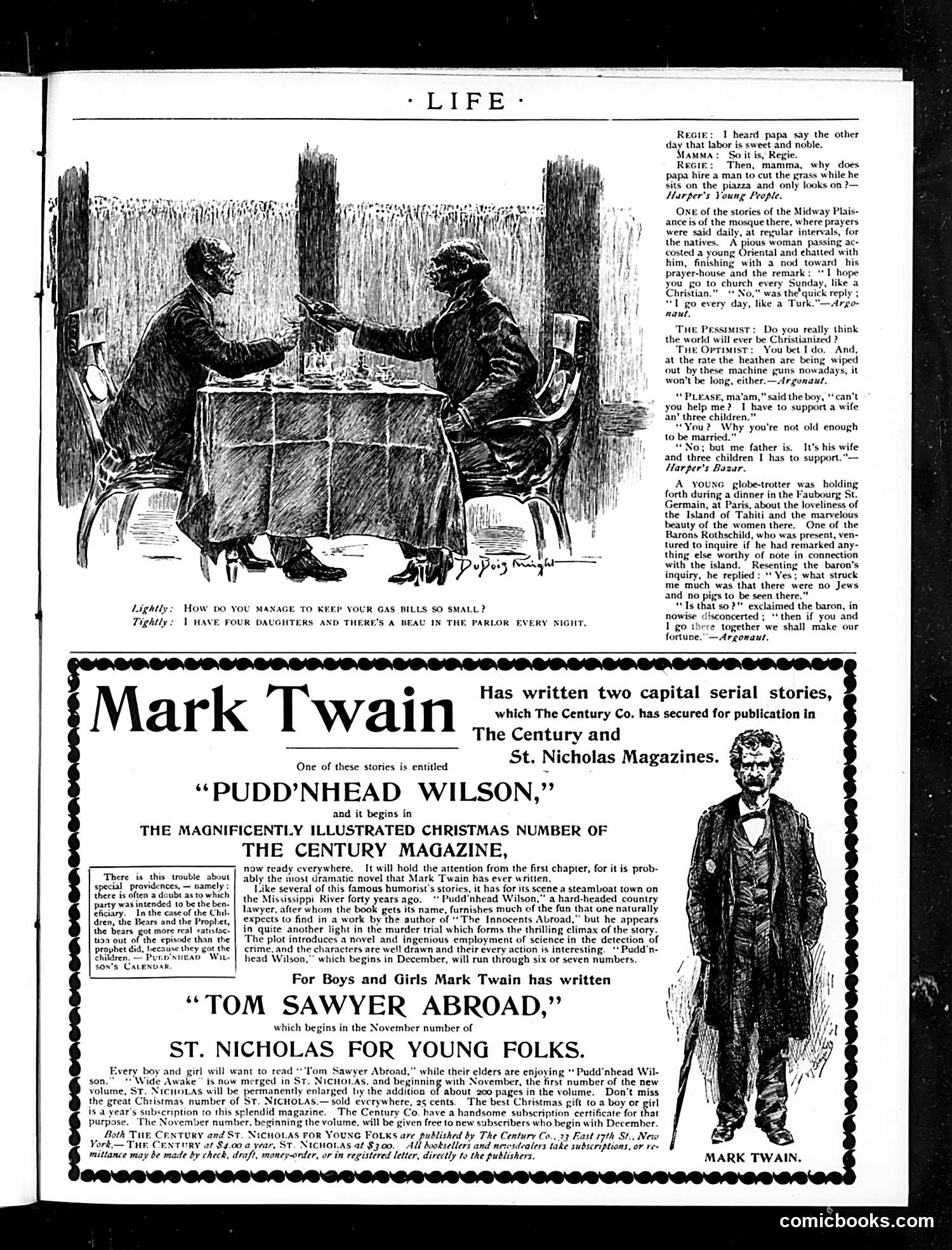
This page contains **multiple short joke cartoons** rather than a single political cartoon. The main illustrated joke shows two well-dressed figures at a dining table—captioned "Lightly" and "Tightly"—discussing gas bills. The humor is domestic and class-based: "Tightly" keeps bills low by having four daughters with beaux (boyfriends) constantly visiting the parlor, implying these young men provide free entertainment, reducing need for gas lighting. The surrounding text consists of brief anecdotes mocking hypocrisy and social pretense: a child questioning why his father avoids labor despite calling it "noble"; pessimistic and optimistic views on Christian conversion; and an anti-Semitic joke where a Rothschild baron cleverly counters a traveler's boast about Tahiti having "no Jews and no pigs." The page's lower half advertises Mark Twain's serialized stories for *Century* and *St. Nicholas* magazines.
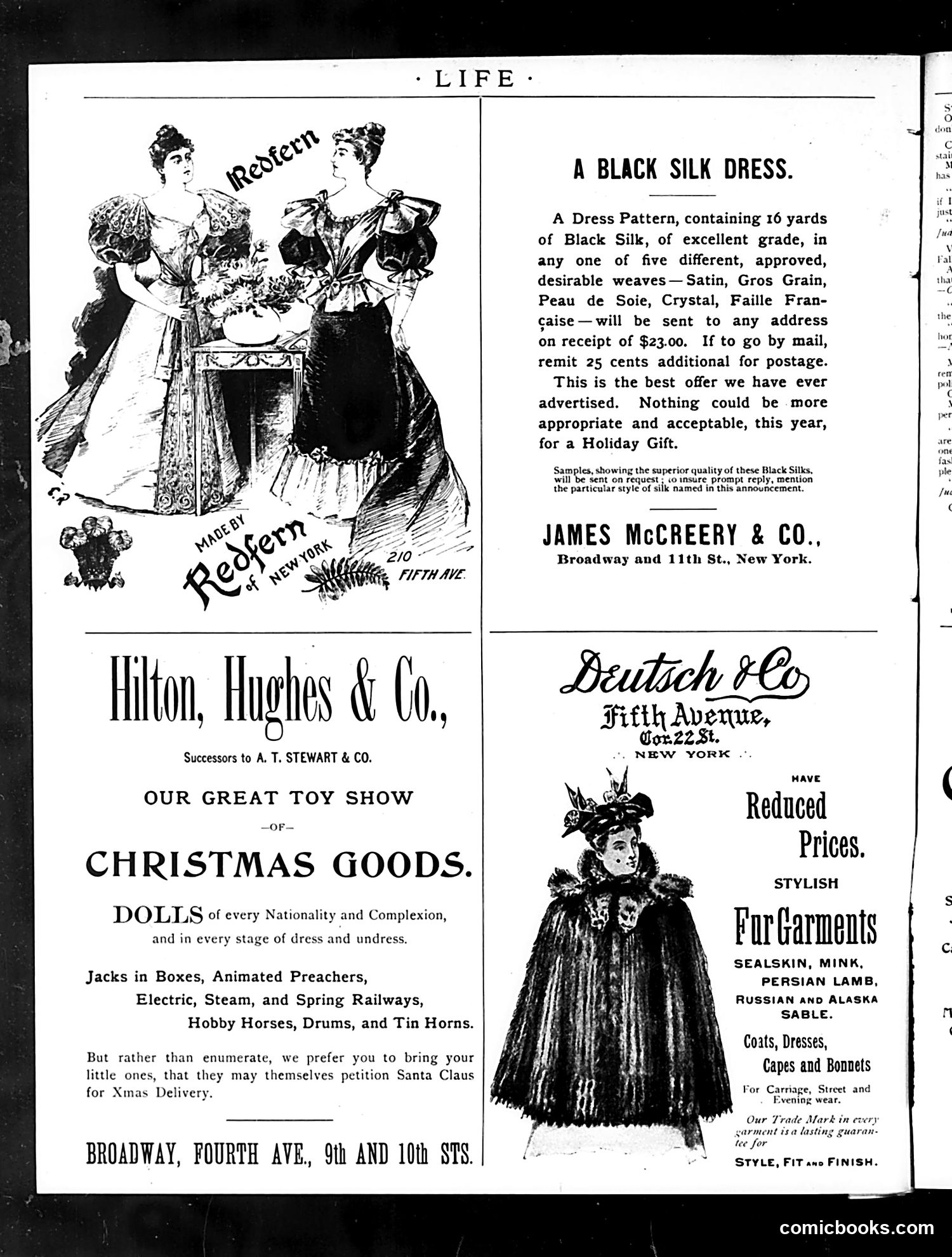
This is primarily a **advertisements page**, not satirical content. It features four luxury department store ads from late 19th-century New York targeting wealthy consumers. **Notable content:** - **Hilton, Hughes & Co.** advertises a Christmas toy show with an illustration of two fashionable women labeled "Redfern" (a famous designer). The ad humorously suggests letting children "petition Santa Claus" rather than listing inventory. - **James McCreery & Co.** promotes a black silk dress pattern (16 yards) for $23—presented as an exceptional holiday gift offer. - **Deutsch & Co.** showcases fur garments (sealskin, mink, Persian lamb) with reduced prices for carriages and evening wear. The page reflects **Gilded Age consumerism**: luxury goods marketed to affluent New Yorkers, emphasis on fashionable European materials, and gift-giving as status display. The "Redfern" reference signals that high fashion authority matters to the target audience.
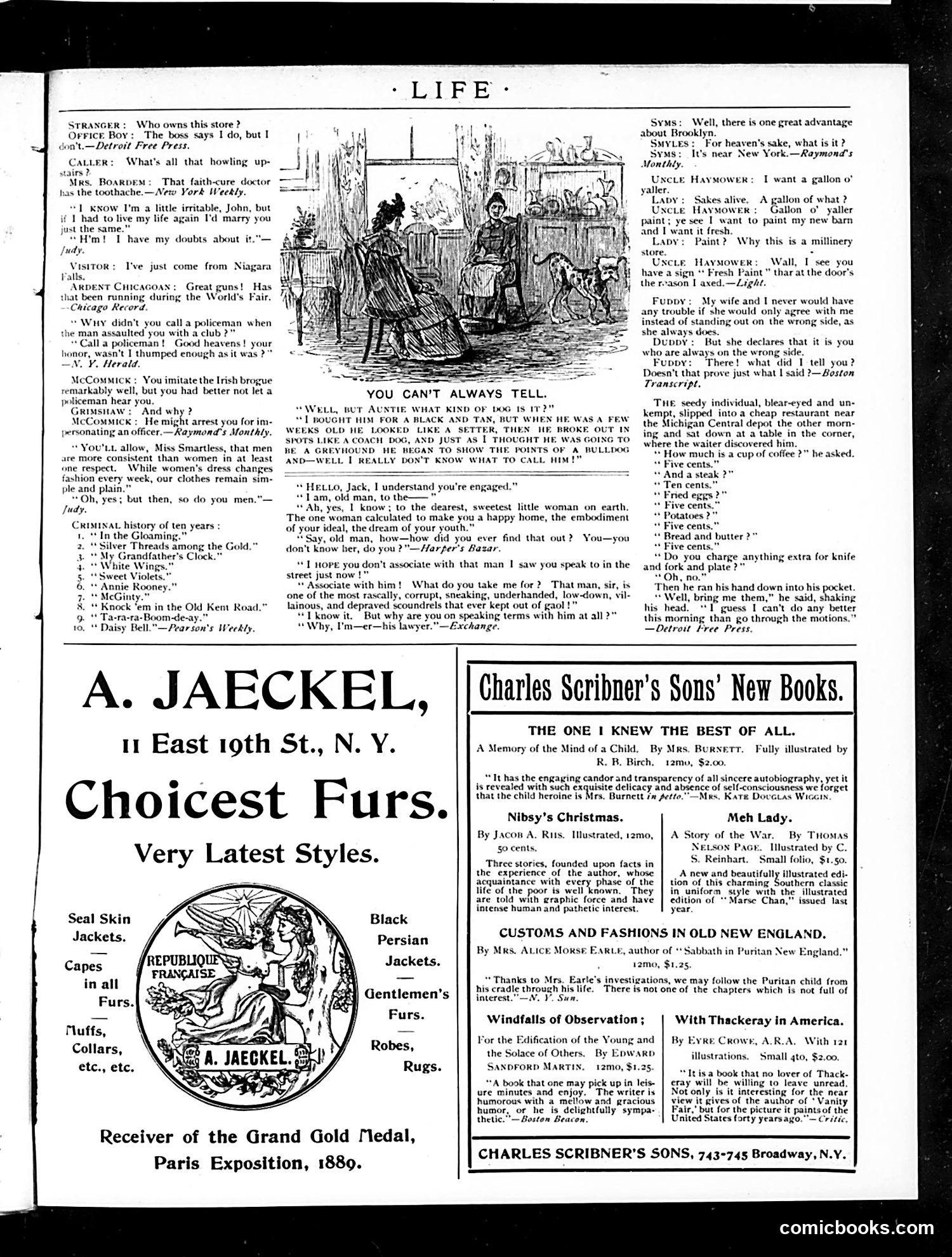
This page from *Life* magazine features several brief comedic sketches, with the main cartoon titled "You Can't Always Tell" illustrating the central joke: a man describes buying what he thought was a valuable dog breed, but the animal's appearance changed dramatically as it matured—looking first like a setter, then a greyhound—leaving him unable to identify what he actually owns. The cartoon satirizes the difficulty of judging value, quality, or truth by outward appearance alone. This reflects broader Victorian anxieties about authenticity in an increasingly commercial society where deceptive marketing and social pretense were common concerns. The surrounding text includes other brief humorous anecdotes about marital discord, Irish immigrants, and social misunderstandings—typical satirical fare mocking everyday human folly and miscommunication.
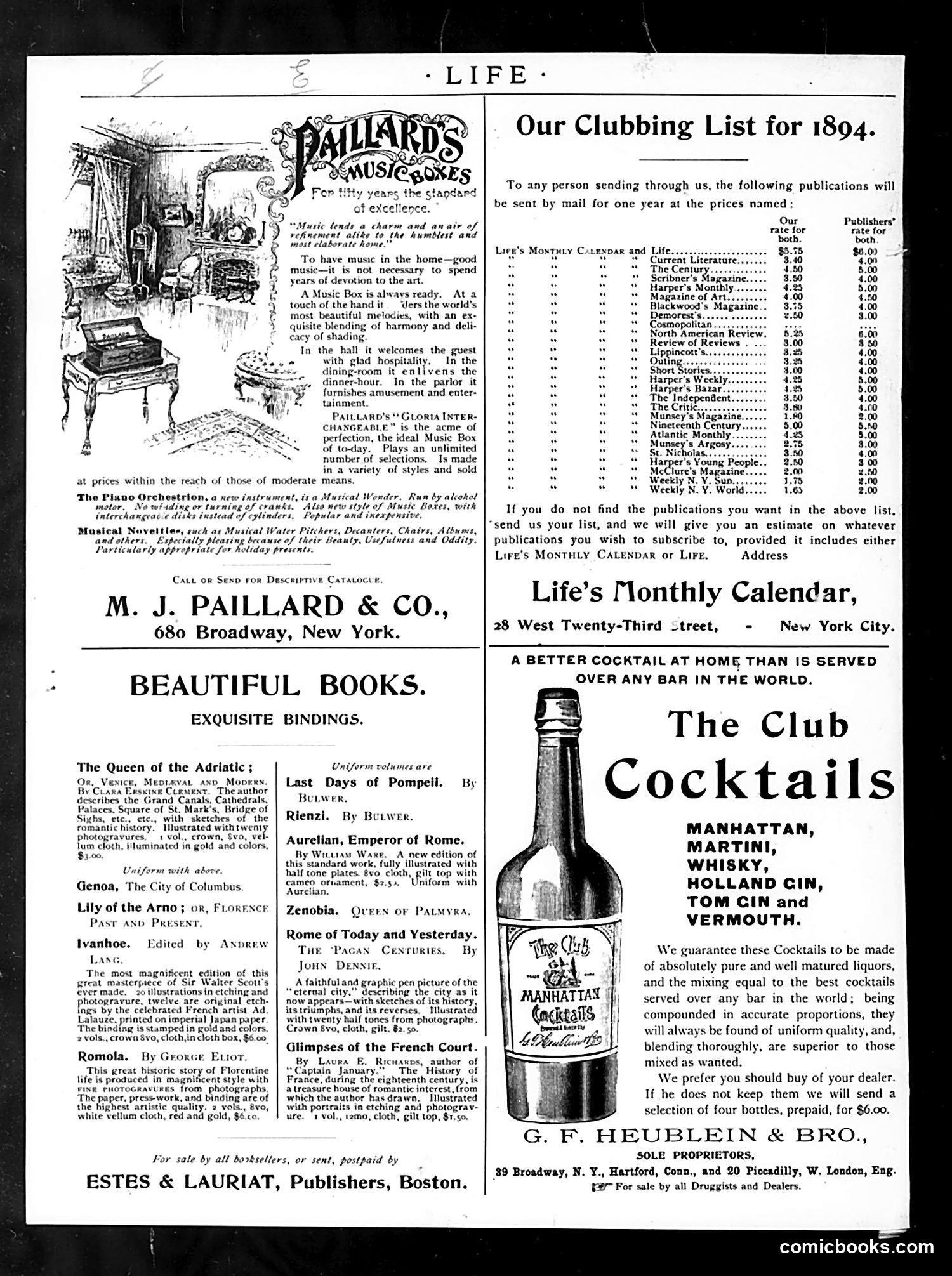
This page is primarily **advertising and subscription information**, not political satire. The left side promotes **Paillard's Music Boxes**—mechanical devices that played pre-recorded music from interchangeable disks. The illustration shows an ornate parlor music box, and the text emphasizes how these machines brought "good music" into homes without requiring musical skill or years of training. This reflects the **1890s fascination with new mechanical entertainment technology**. The center presents **Life's clubbing list for 1894**—bulk subscription offers combining Life magazine with other publications (Harper's Monthly, The Century, etc.) at discounted rates. This was common practice for magazines of the era. The right side advertises **The Club Cocktails** brand liqueur, guaranteeing pure ingredients and proper cocktail proportions for home bartenders. The bottom features **exquisite illustrated books** from publisher Estes & Lauriat—ornate, beautifully-bound editions of classics like *Ivanhoe*, *Romola*, and historical works, targeting affluent readers who valued fine craftsmanship and decoration. The page reflects **Gilded Age consumer culture**: mechanical novelties, subscription services, quality spirits, and luxury books for the educated middle and upper classes.

I can see this is a mostly black page from what appears to be a historical publication, with "comicbooks.com" visible at the bottom. The image quality is too poor to discern specific cartoon content, illustrations, or readable text beyond scattered fragments on the left margin. The page appears heavily degraded or improperly scanned, making it impossible to identify political figures, satirical subjects, or the intended message. To provide accurate historical analysis as requested, I would need a clearer, higher-contrast image where the actual cartoon illustrations and OCR text are legible. I cannot responsibly speculate about content I cannot see.