
Life, 1893-12-28 · page 8 of 53
Life — December 28, 1893 — page 8: what you’re looking at
What you’re looking at
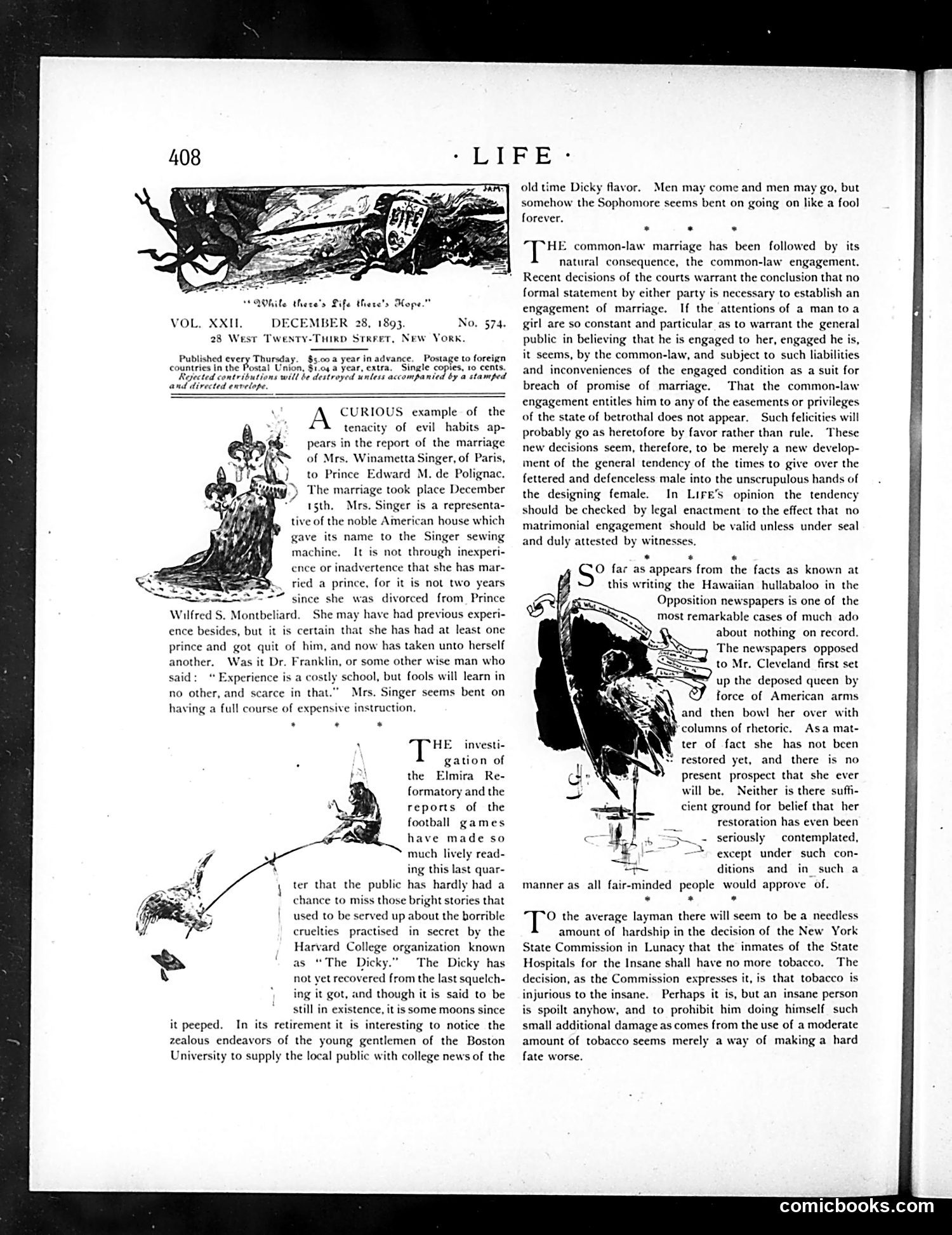
This page contains three distinct articles with accompanying illustrations rather than unified political cartoons. The first discusses Mrs. Winnametta Singer's marriage to Prince Edward M. de Polignac, satirizing her marital history by suggesting repeated divorces have given her expensive "instruction" in relationships. The second addresses Harvard College's "Dicky" newspaper, apparently a problematic student publication known for cruel hazing practices that the university struggled to suppress. The third critiques a New York State Commission decision banning tobacco use by insane asylum patients, arguing the restriction seems excessive—that prohibiting a "moderate" vice is counterproductively harsh. The illustrations are decorative rather than sharply satirical political commentary, using period-appropriate caricature styles typical of 1890s satirical journalism.
📄 Transcribed text from this page (OCR, searchable)
Machine-transcribed from the original scan — historical spelling and the odd misread are preserved.
> LIFE: + Qhite there's Life there's Hope.” VOL. XXII. DECEMBER 28, 1893. No. 574. 28 West Twenty-Tuikp Srrret, New York. Published every Thursday. §5.00 a year in advance, Postage to foreign countries in the Postal Union, $1.04 a year, extra. Single copies, to cents. Rejected contributions will be destroyed unless accompanied by a stamped and directed envelope CURIOUS example of the tenacity of evil habits ap- pears in the report of the marriage of Mrs, Winametta Singer, of Paris, to Prince Edward M. de Polignac. The marriage took place December sth. Mrs. Singer is a representa- tive of the noble American house which gave its name to the Singer sewing machine. It is not through inexperi- ence or inadvertence that she has mar- ried a prince, for it is not two years since she was divorced from Prince Wilfred S. Montbeliard. She may had previous experi- ence besides, but it is certain that she has had at least one prince and got quit of him, and now has taken unto herself another. Was it Dr. Franklin, or some other wise man who said: “ Experience is a costly school, but fools will learn in no other, and scarce in that.” Mrs. Singer seems bent on having a full course of expensive instruction. Tt! invest! gation of the Elmira Re- formatory and the reports of the football games have made so much lively read- ing this last quar- ter that the public has hardly had a chance to miss those bright stories that used to be served up about the borrible cruelties practised in secret by the Harvard College organization known as “The Dicky.” The Dicky not yet recovered from the last squelch- ing it got, and though it is said to be still in existence, it is some moons since it peeped. In its retirement it is interesting to notice the zealous endeavors of the young gentlemen of the Boston University to supply the local public with college news of the . . . old time Dicky flavor. Men may come and men may go, but somehow the Sophomore seems bent on going on like a fool forever. * . . HE common-law marriage has been followed by its natural consequence, the common-law engagement. Recent decisions of the courts warrant the conclusion that no formal statement by either party is necessary to establish an engagement of marriage. If the attentions of a man toa girl are so constant and particular as to warrant the general public in believing that he is engaged to her, engaged he is, it seems, by the common-law, and subject to such liabilities and inconveniences of the engaged condition as a suit for breach of promise of marriage. That the common-law engagement entitles him to any of the easements or privileges of the state of betrothal does not appear. Such felicities will probably go as heretofore by favor rather than rule, These new decisions seem, therefore, to be merely a new develop- ment of the general tendency of the times to give over the fettered and defenceless male into the unscrupulous hands of the designing femal In Lire’s opinion the tendency should be checked by legal enactment to the effect that no matrimonial engagement should be valid unless under seal and duly attested by witnesses, . . « O far as appears from the facts as known at this writing the Hawaiian hullabaloo in the Opposition newspapers is one of the most remarkable cases of much ado about nothing on record. The newspapers opposed to Mr. Cleveland first set up the deposed queen by force of American arms and then bowl her over with columns of rhetoric. Asa mat- ter of fact she has not been restored yet, and there is no Present prospect that she ever will be. Neither is there suffi- cient ground for belief that her restoration has even been seriously contemplated, except under such con- t ditions and in such a manner as all fair-minded people would approve of. . * * ‘O the average layman there will seem to be a needless amount of hardship in the decision of the New York State Commission in Lunacy that the inmates of the State Hospitals for the Insane shall have no more tobacco. The decision, as the Commission expresses it, is that tobacco is injurious to the insane. Perhaps it is, but an insane person is spoilt anyhow, and to prohibit him doing himself such small additional damage as comes from the use of a moderate amount of tobacco seems merely a way of making a hard fate worse. comicbooks.com