
A complete issue · 14 pages · 1893
Life — November 16, 1893
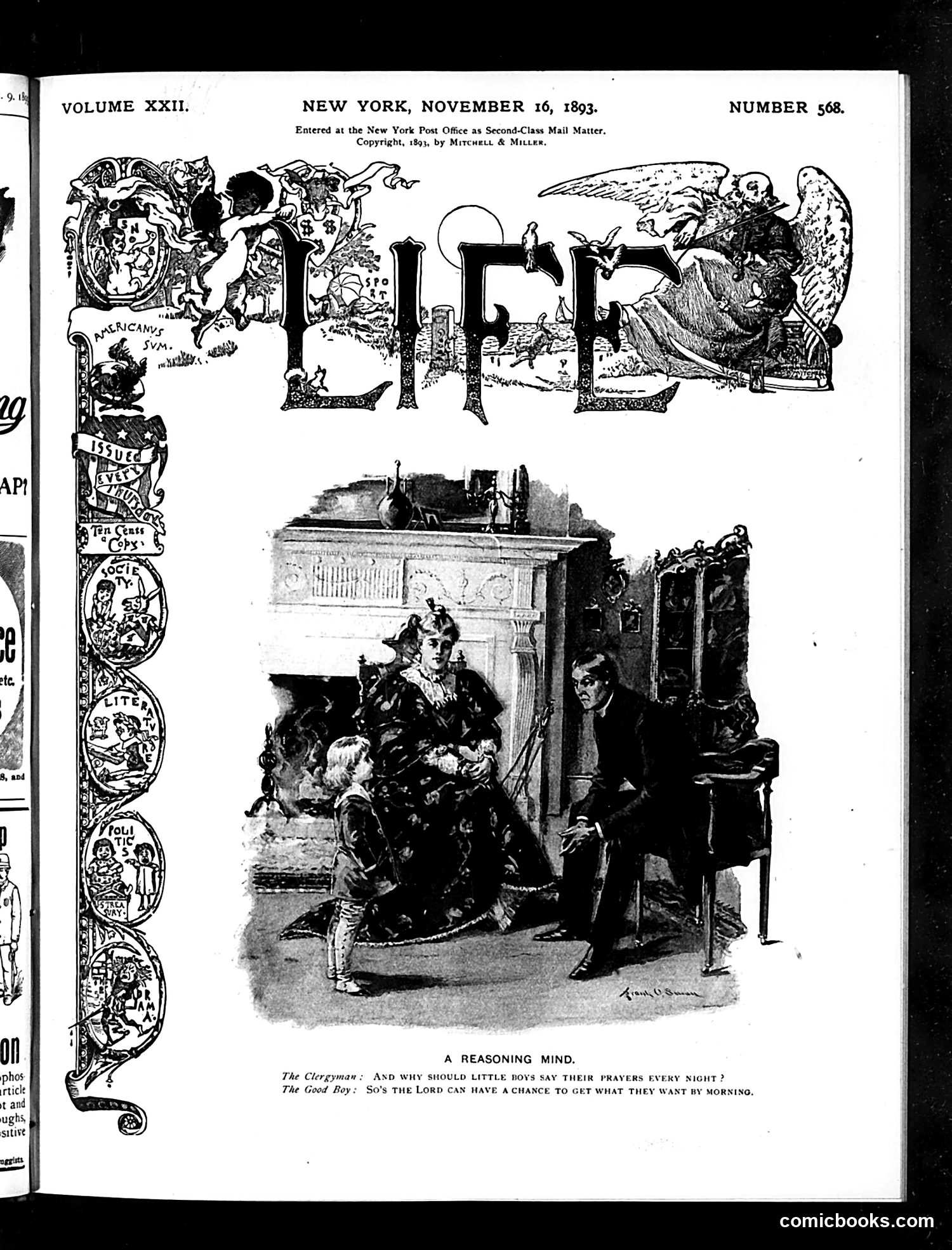
This cartoon satirizes religious instruction of children. The dialogue presents a debate between a clergyman and a "good boy": **The Clergyman** asks why children should say prayers nightly. **The Good Boy** responds logically: "So the Lord can have a chance to get what they want by morning." The satire mocks both blind religious faith and precocious childhood rationalism. The boy's "reasoning" reframes prayer as a transactional negotiation with God rather than spiritual devotion—suggesting that if God is omnipotent, overnight prayers seem redundant. The cartoon likely critiques either excessive childhood piety being taught without encouraging critical thinking, or conversely, the modern tendency of children to approach even sacred practices with mercenary logic. The illustration's formal indoor setting emphasizes the clash between religious authority and secular reasoning.
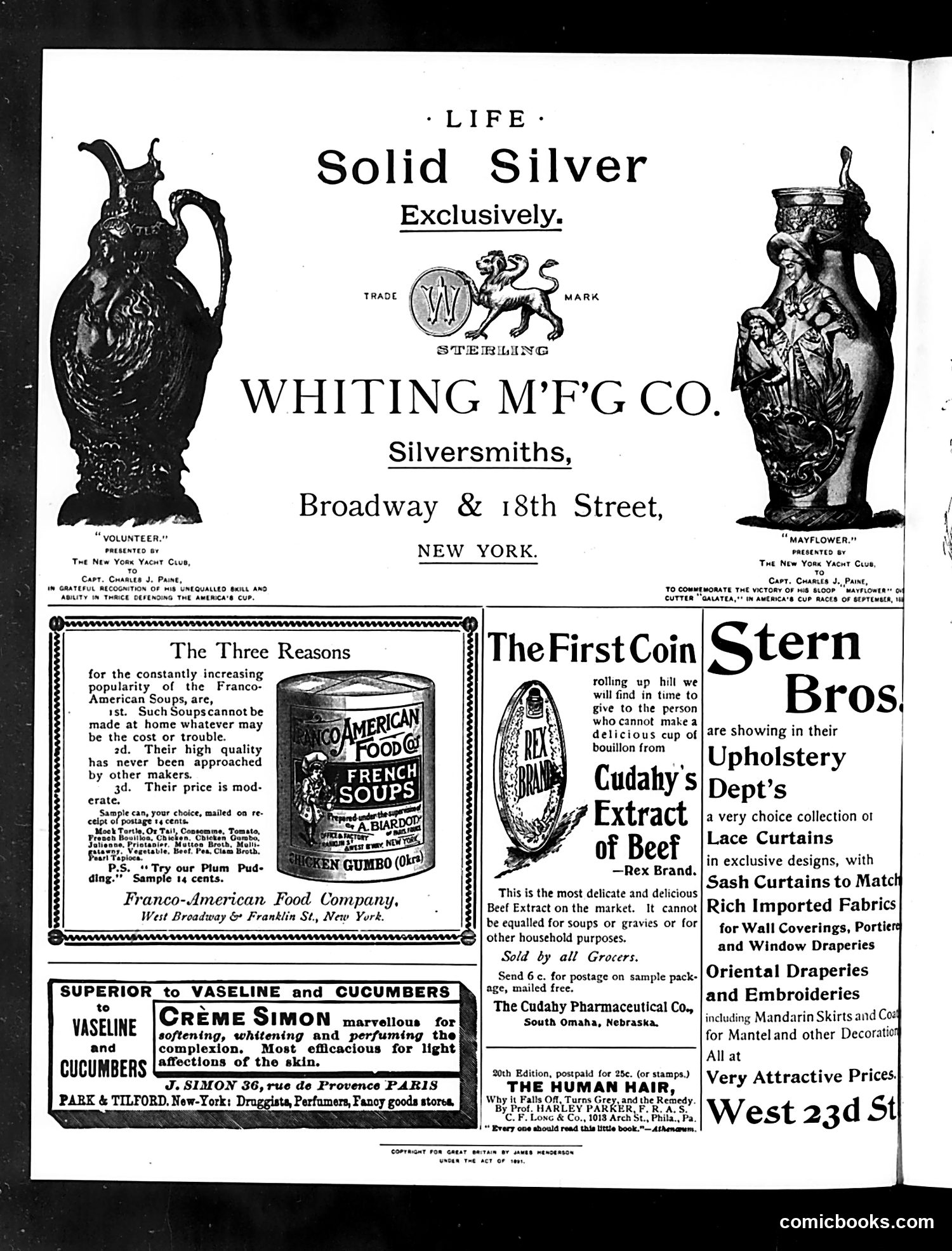
This page is **primarily advertising**, not political satire. It contains four commercial advertisements from the early 1900s: 1. **Whiting M'FG Co.** - Solid silver serving pieces (two ornate pitchers named "Volunteer" and "Mayflower," presented to the New York Yacht Club) 2. **Franco-American Food Company** - "The Three Reasons" for their soups' popularity: high quality, low cost, and high quality 3. **Crème Simon** - Skin care product claiming superiority to vaseline 4. **Cudahy's Extract of Beef** - Food product 5. **Stern Bros.** - Department store advertising lace curtains and imported fabrics There are no political cartoons or satirical commentary visible. This is a standard advertising page from *Life* magazine's commercial section.
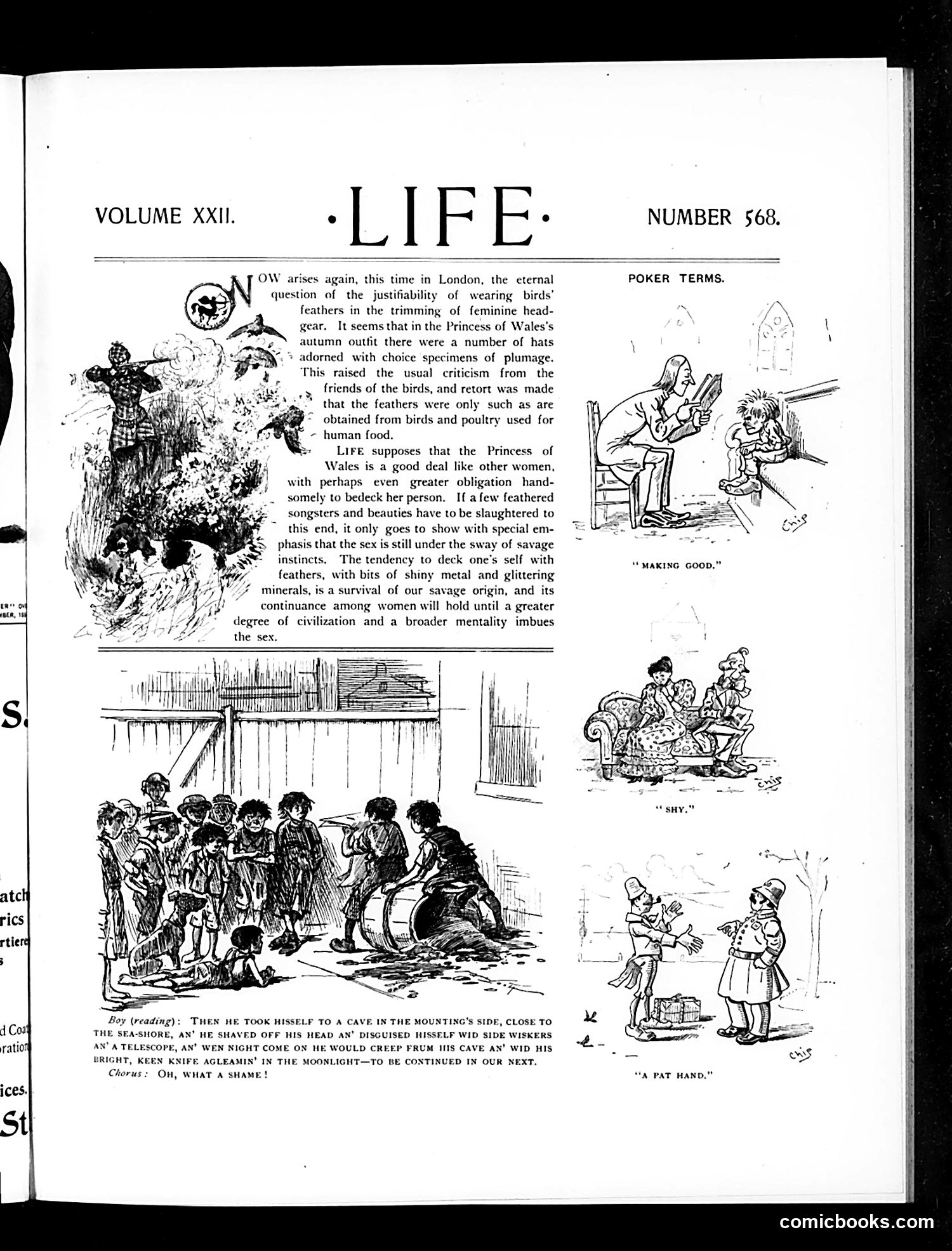
The main editorial content criticizes the Princess of Wales for wearing bird feathers in her headwear. The article argues this practice—requiring slaughter of songbirds and exotic species—reflects savage instincts incompatible with civilized society. It sarcastically suggests that even the Princess, like other women, has an obligation to "bedeck her person," implying women's vanity drives this cruel fashion trend. The accompanying illustrations appear to be unrelated humorous sketches labeled "Poker Terms" ("Making Good," "Shy," "A Fat Hand"), depicting people in various social situations—likely generic comic vignettes rather than political commentary. The satire targets fashionable women's complicity in animal cruelty through their demand for decorative feathers.
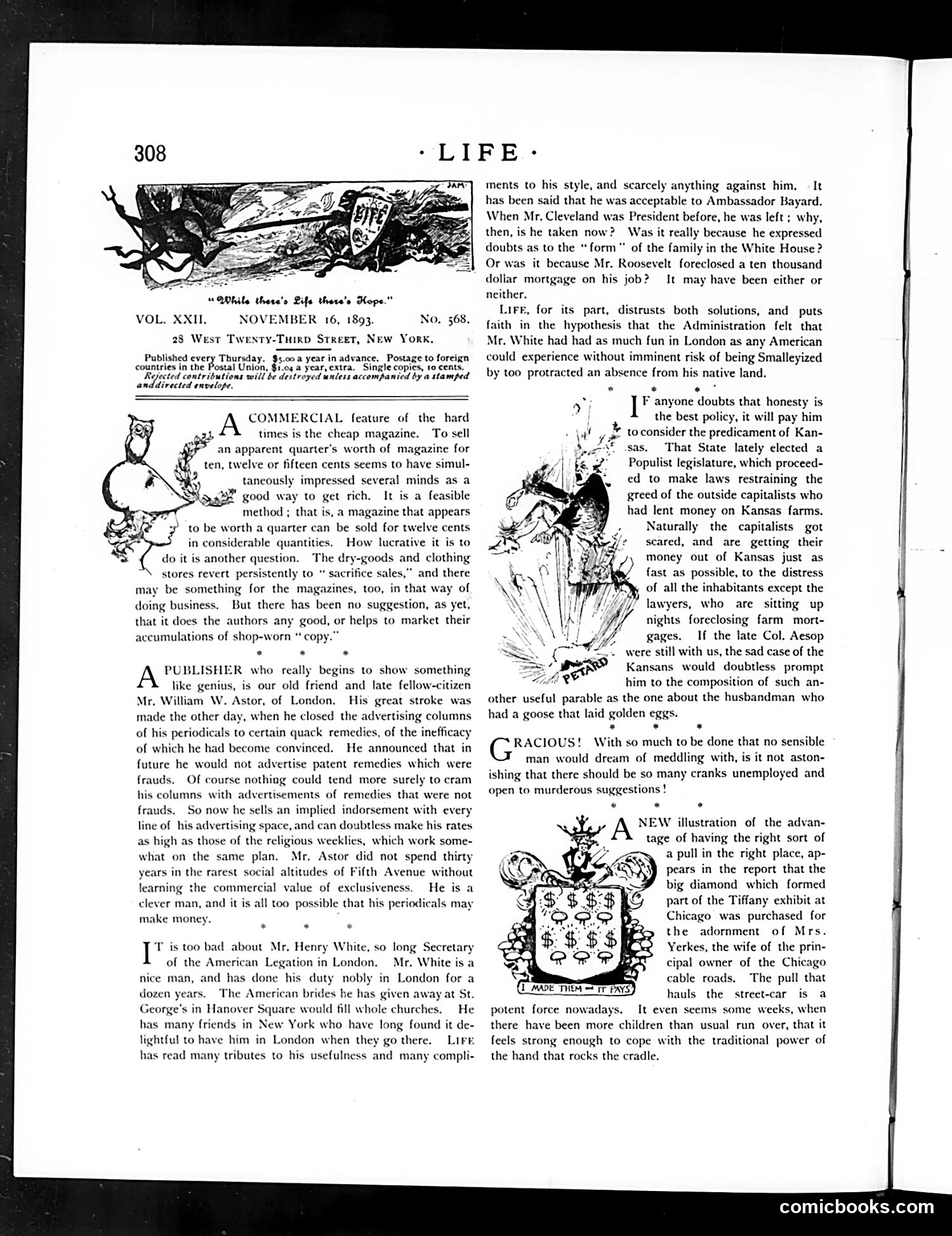
This page contains several satirical editorial pieces rather than single cartoons. The visible content discusses: **Henry White** (top section): A critique of the American Legion's Secretary in London, praising his diplomatic work but with implied sarcasm about his extended absence from America. **Kansas capitalism** (middle): Satire about Kansas legislators passing laws to restrain outside capitalists from foreclosing on farmers' mortgages. The piece mocks capitalists for being "scared" of losing money and fleeing the state, presenting this as both humorous and socially significant. **Tiffany diamond** (bottom): Commentary on a large diamond from the Tiffany exhibit in Chicago being purchased to adorn Mrs. Yerkes, wife of a Chicago cable-road owner, illustrating wealth inequality. The overall tone critiques American political and economic hypocrisy of the 1893 period.
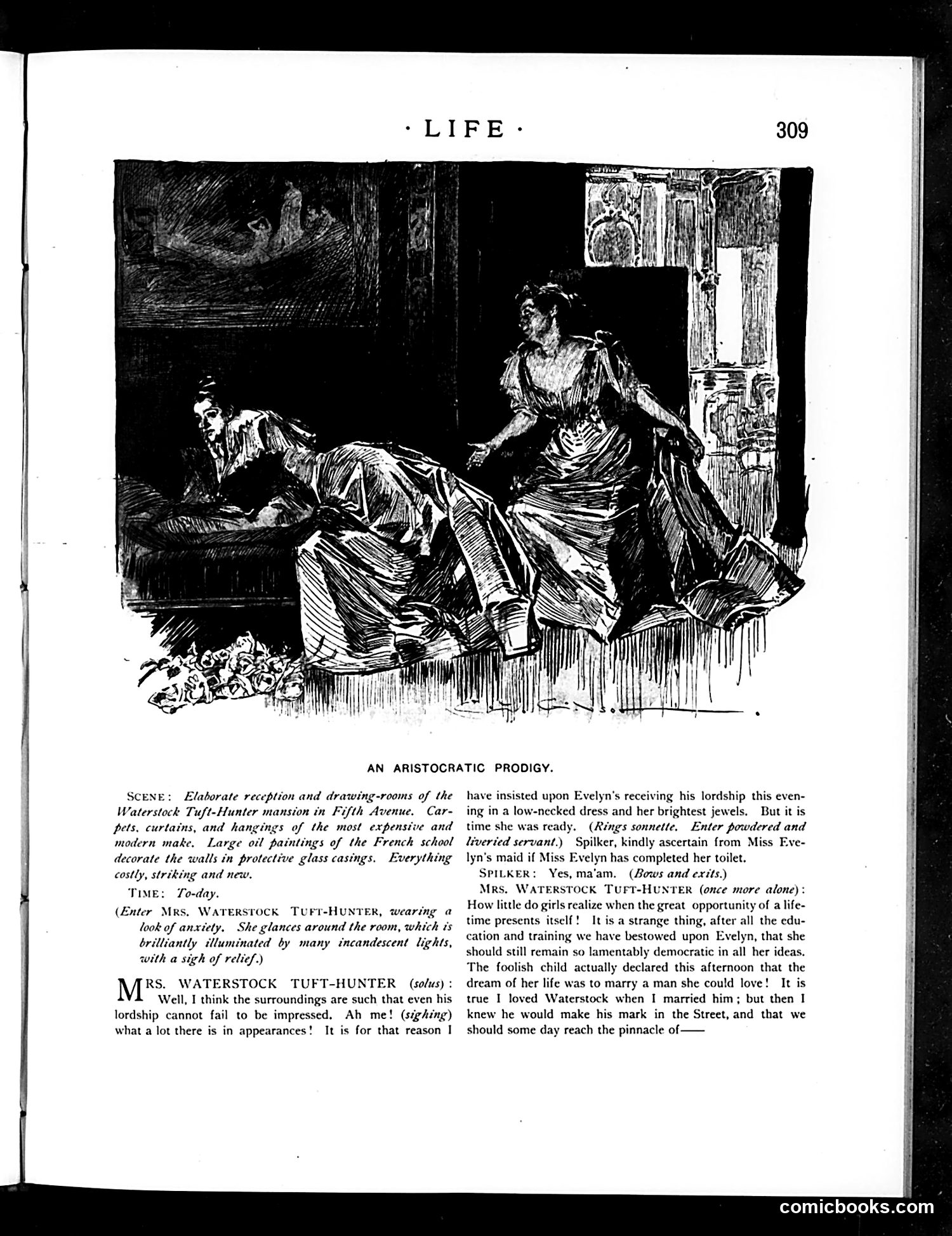
This satirical sketch depicts a scene in the drawing rooms of a wealthy Fifth Avenue mansion. The title and dialogue mock upper-class pretensions, specifically the notion that aristocratic birth automatically confers superiority. Mrs. Waterstock Tufft-Hunter, a society matron, expresses anxiety about her daughter Evelyn's appearance, insisting on formal dress and jewels for the evening. The humor targets the disconnect between democratic ideals and actual aristocratic behavior: Evelyn, despite being raised with "education and training," remains "lamentably democratic in all her ideas" and foolishly dreams of marrying for love rather than social advancement. The satire critiques how wealthy families' pretensions to superiority clash with their daughters' potentially rebellious independence and romantic ideals—a common theme in early 20th-century American social comedy.
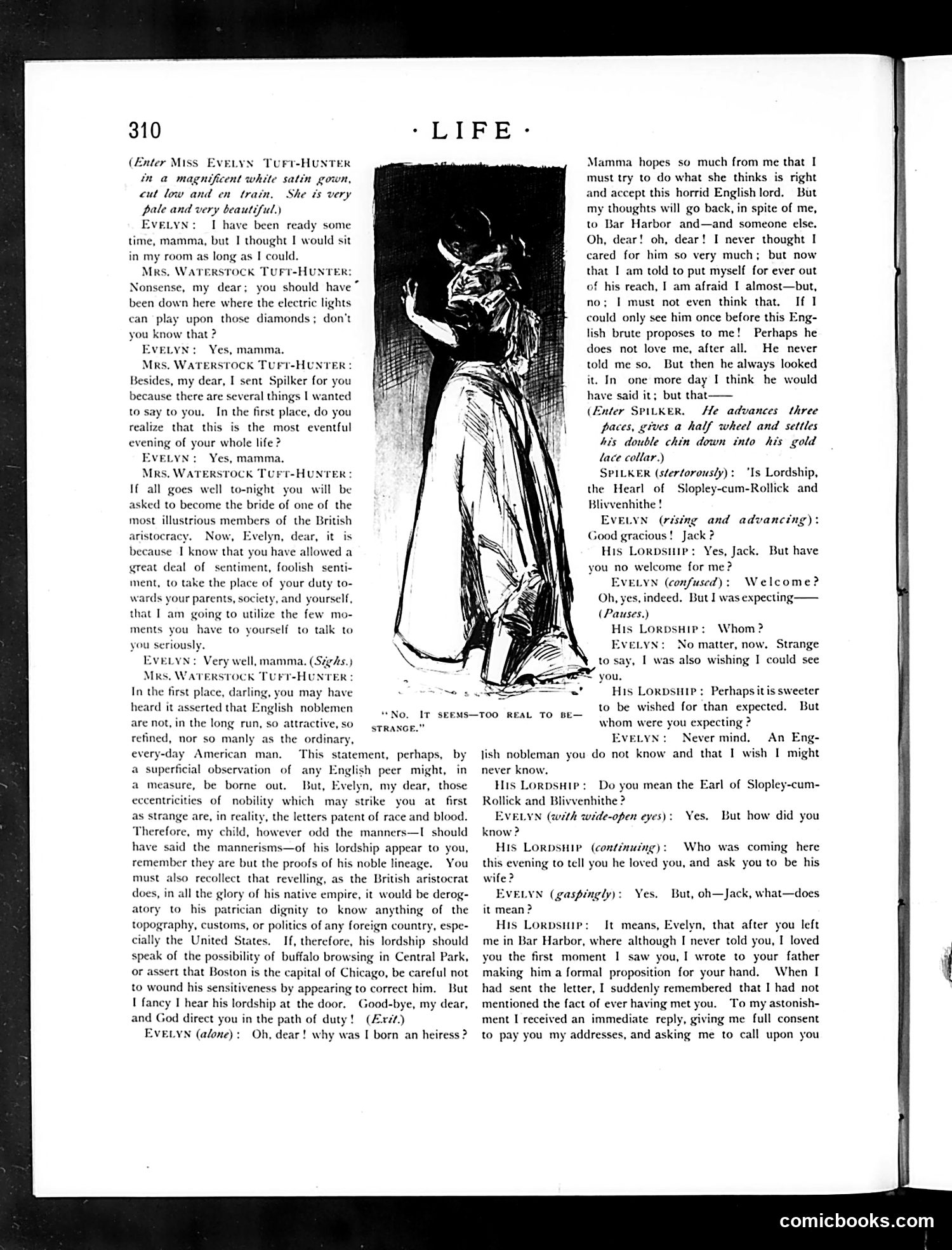
This page from *Life* magazine presents a dramatic scene from what appears to be a theatrical play or serialized fiction. The illustration shows a woman in an elegant white satin gown, depicted in a moment of emotional distress or revelation. The dialogue reveals a plot involving Evelyn, a young heiress, and her unexpected encounter with an English nobleman (the Earl of Stopley-cum-Rollick). The satire targets British aristocratic pretensions—the lordship's verbose explanations about "buffalo browsing in Central Park" and defensive justifications for his surprise appearance mock the pompous, self-important manner of titled English gentry attempting to navigate American society. The humor lies in the contrast between aristocratic formality and genuine human emotion, suggesting contemporary anxieties about transatlantic class relations and marriage prospects.
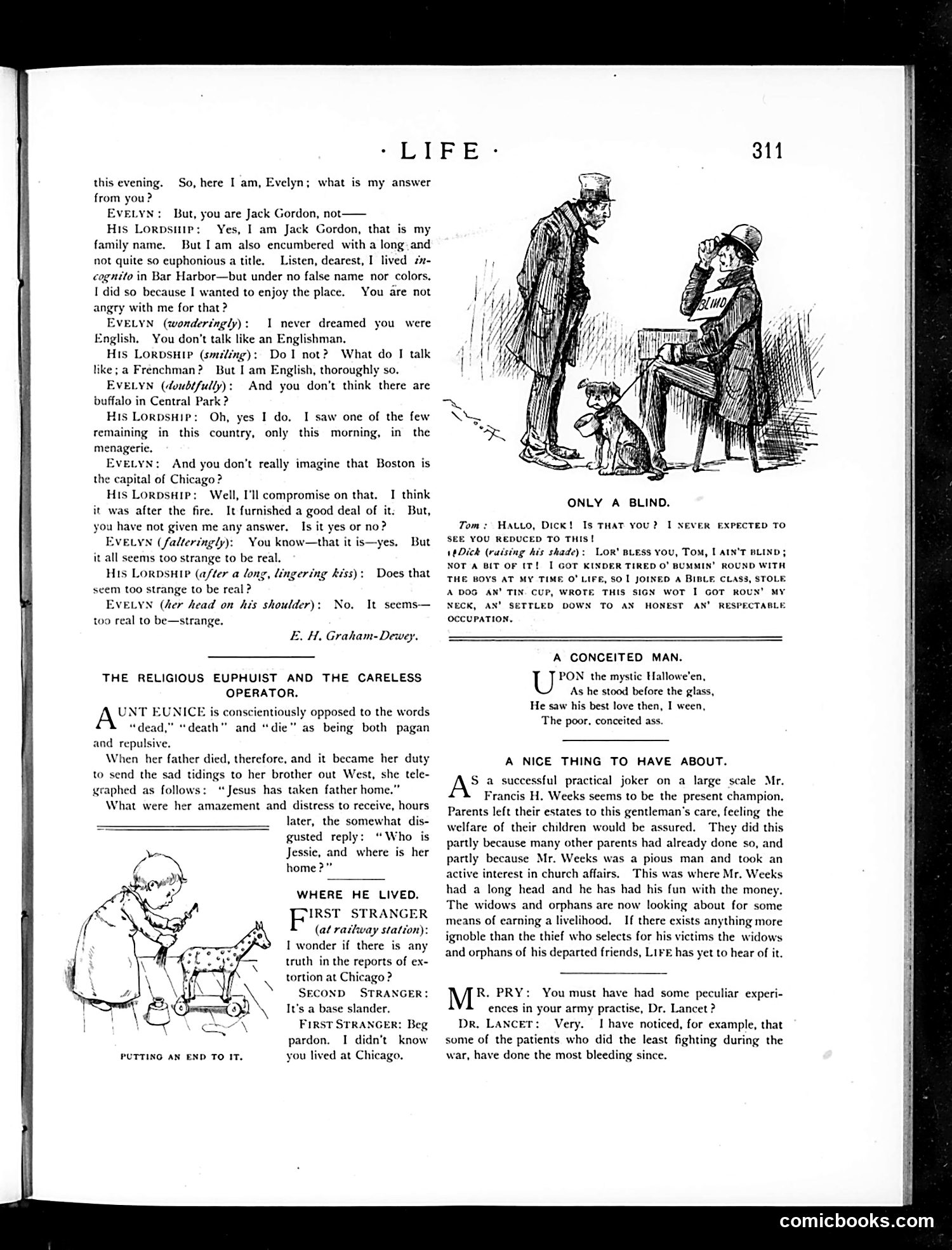
This page contains three separate satirical pieces: 1. **"Only a Blind"** (top): A sketch showing a well-dressed man encountering a blind beggar and his dog. The blind man's sign claims he became blind through honest work, but Tom (the beggar) sarcastically lists dubious causes—bumming around with boys, joining the circus, getting a stole dog and tin cup. The satire targets professional beggars and street cons who fabricate sob stories to solicit charity. 2. **"The Religious Euphemist and the Careless Pastor"**: Mocks a minister's aunt who euphemistically says her dead father was "taken home" rather than using direct language. The satire critiques overly delicate religious speech. 3. **"A Conceited Man"** and **"A Nice Thing to Have About"**: Brief moral or social commentary pieces, likely critiquing vanity and inheritance practices among the wealthy. The overall tone targets fraud, pretension, and social hypocrisy of the era.
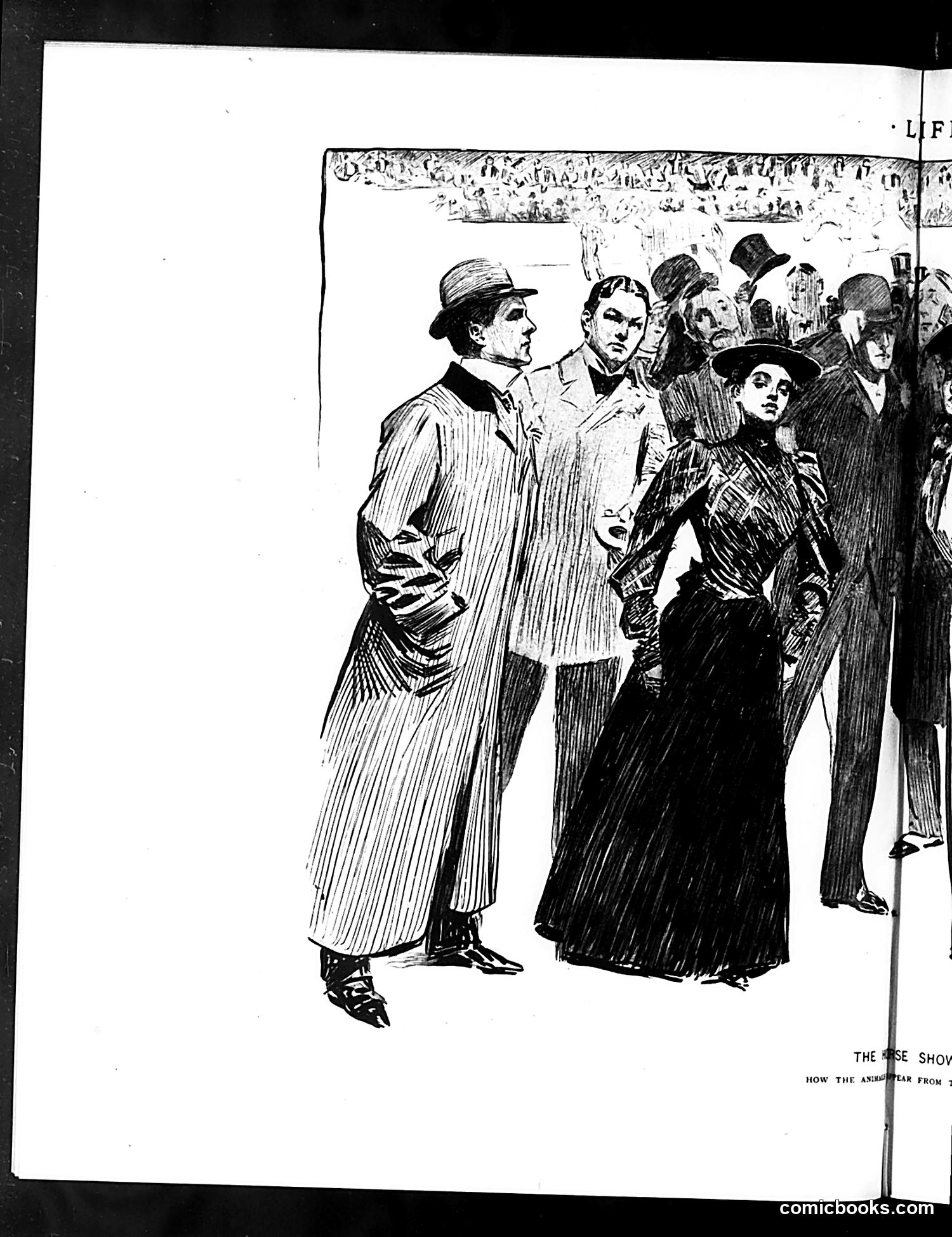
This appears to be a satirical illustration from *Life* magazine showing a social gathering or public event. The drawing depicts well-dressed men in overcoats and hats alongside a woman in dark clothing, rendered in the magazine's characteristic line-art style. The visible caption fragment reads "THE CASE SHOW" and "HOW THE ARM[...]TAR FROM [...]," though the complete text is cut off, making the specific satirical point unclear. Without the full caption and context, I cannot definitively identify the figures or the social/political situation being mocked. The formal dress and crowded composition suggest commentary on upper-class society or a notable public event, but the exact target of satire remains uncertain from this image alone.
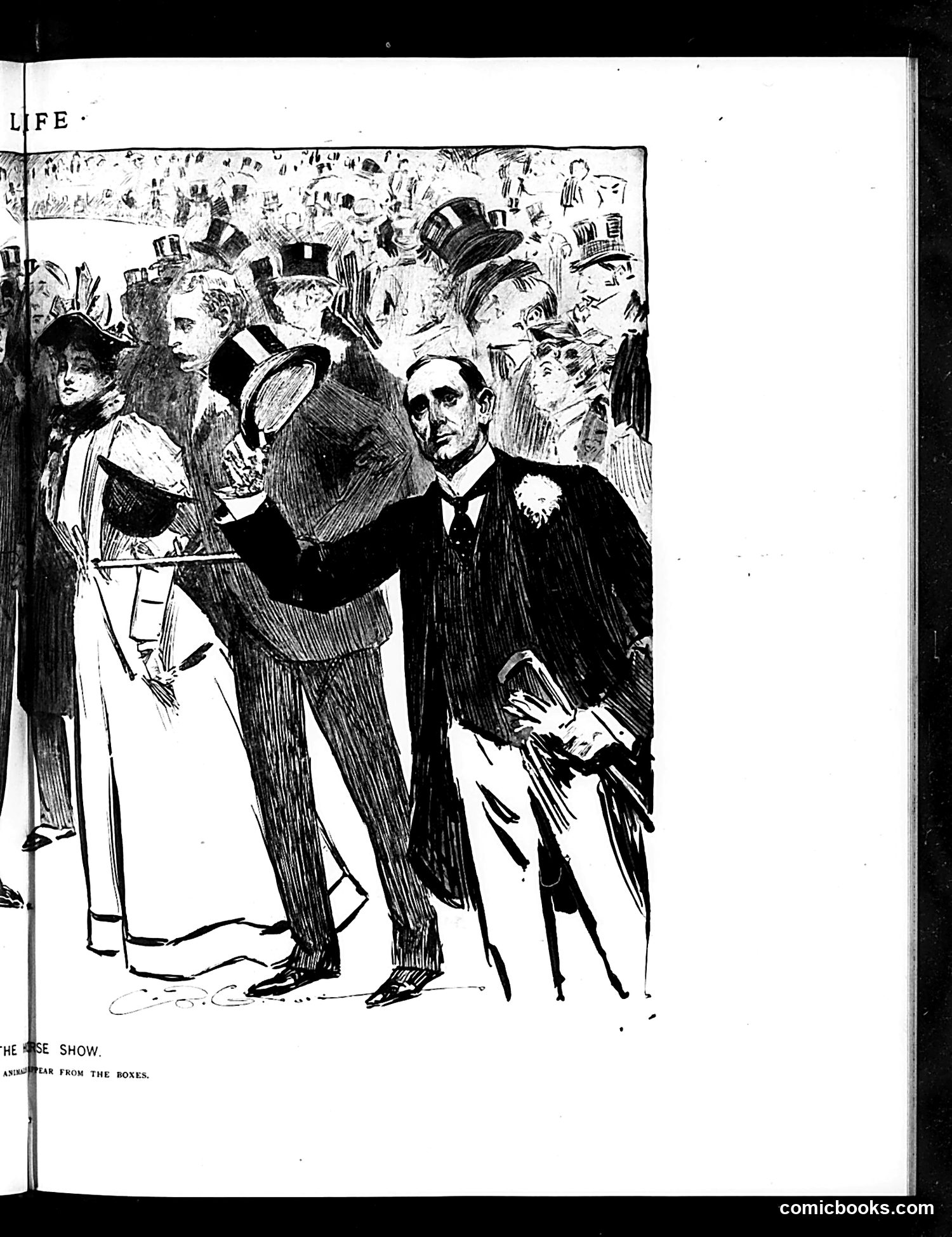
This appears to be a satirical illustration titled "THE HORSE SHOW" with a subtitle reading "A FAMILIAR TEAR FROM THE BOXES." The cartoon depicts well-dressed upper-class spectators at a horse show event. The figures wear formal attire including top hats and elegant gowns, characteristic of late 19th or early 20th-century high society. The crowded background suggests the social prominence of such events. The satire likely mocks the pretension and social hierarchy of wealthy spectators at fashionable public events. The phrase "familiar tear from the boxes" suggests emotional display or sentimental reactions among the elite audience members, possibly satirizing their affected manners. The detailed rendering of formal dress emphasizes the class consciousness and social performance inherent in such exclusive gatherings.
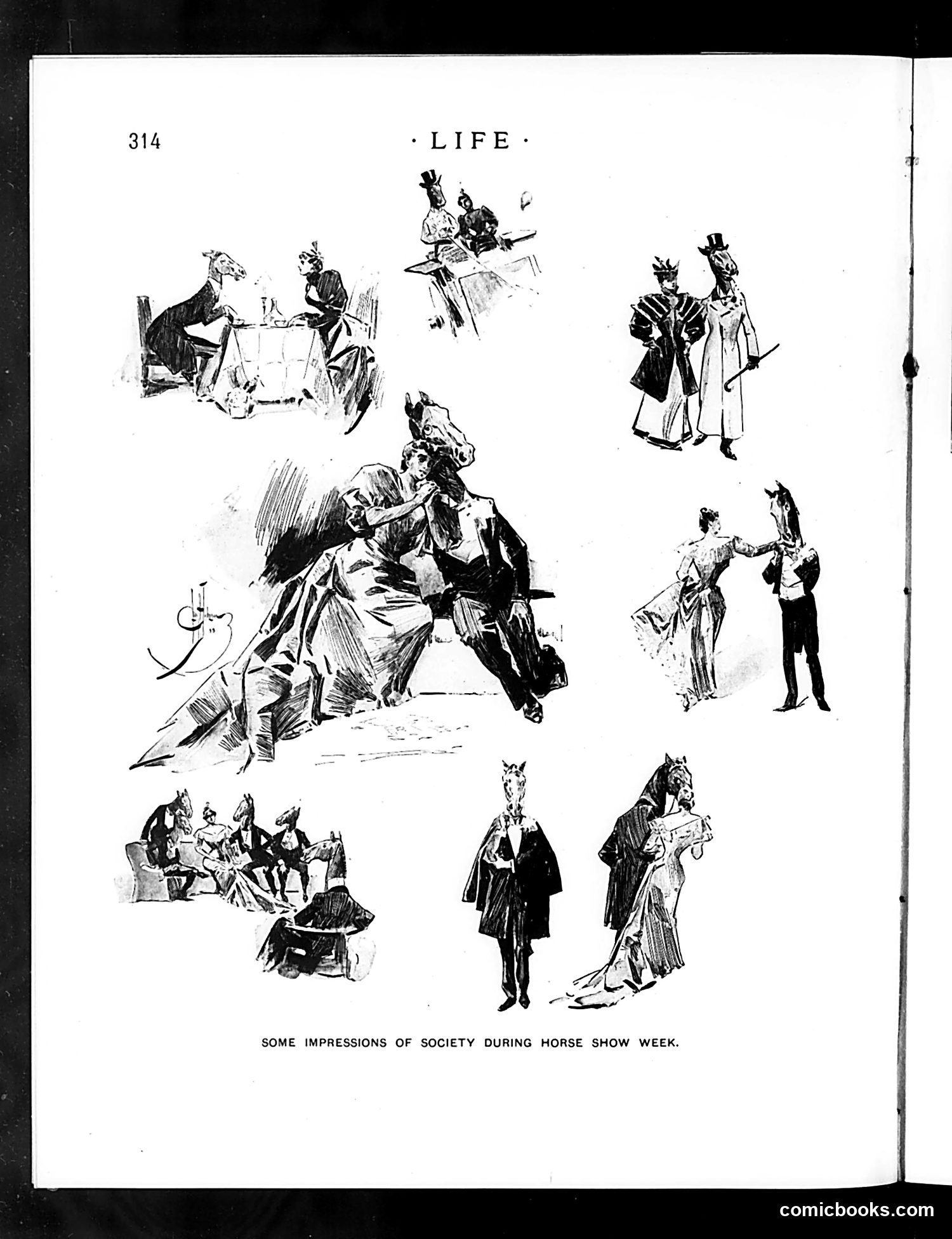
This page from *Life* magazine presents satirical sketches of high society during "Horse Show Week"—an annual event where wealthy elites gathered to display horses and themselves. The caption reads: "Some Impressions of Society During Horse Show Week." The sketches mock various social behaviors: couples dining, fashionable attendees in formal dress, women in elaborate gowns, men in top hats, and what appears to be socializing and romantic encounters. The drawings capture the pretension and frivolity of the upper class during this social season. The satire targets the superficiality of high society—the focus on display, fashion, courtship rituals, and leisure activities rather than substance. The loose, expressive drawing style emphasizes the humorous exaggeration of postures and interactions, suggesting these socialites are vain and ridiculous.
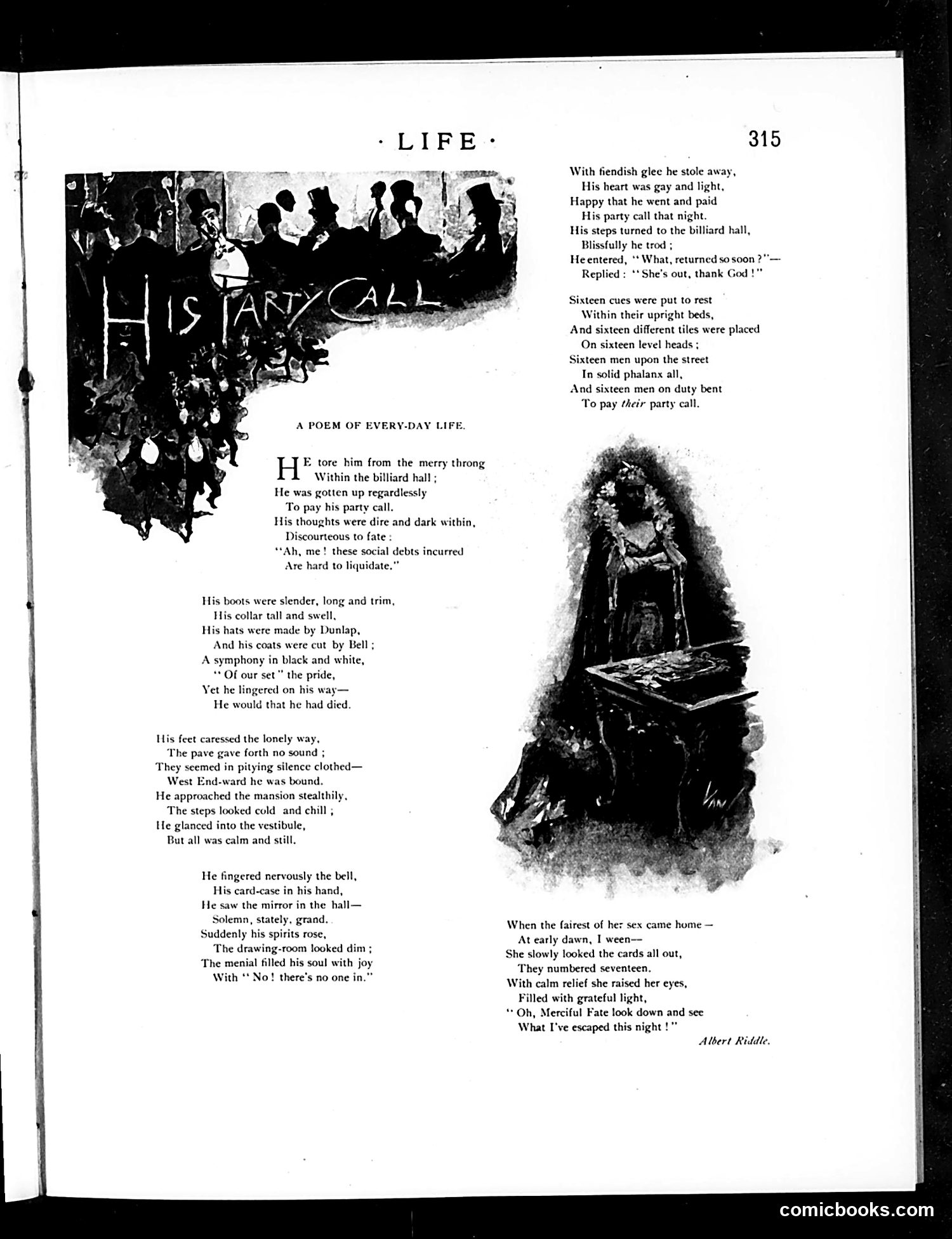
This page contains a humorous poem by Albert Riddle about a man reluctantly attending a social obligation—a "party call." The illustrations show his internal conflict: the upper left depicts the lively party scene he's escaping, while the lower right shows a woman (likely his wife or female companion) at home, waiting and reading tarot cards to divine his whereabouts. The satire targets the tedium of Victorian-era social duties and gender dynamics. The man resents the "social debts incurred" that require attending parties, while the woman at home anxiously consults fortune-telling—a period detail suggesting feminine worry and superstition. The poem mocks both the artificiality of social conventions and the domestic tensions they create.
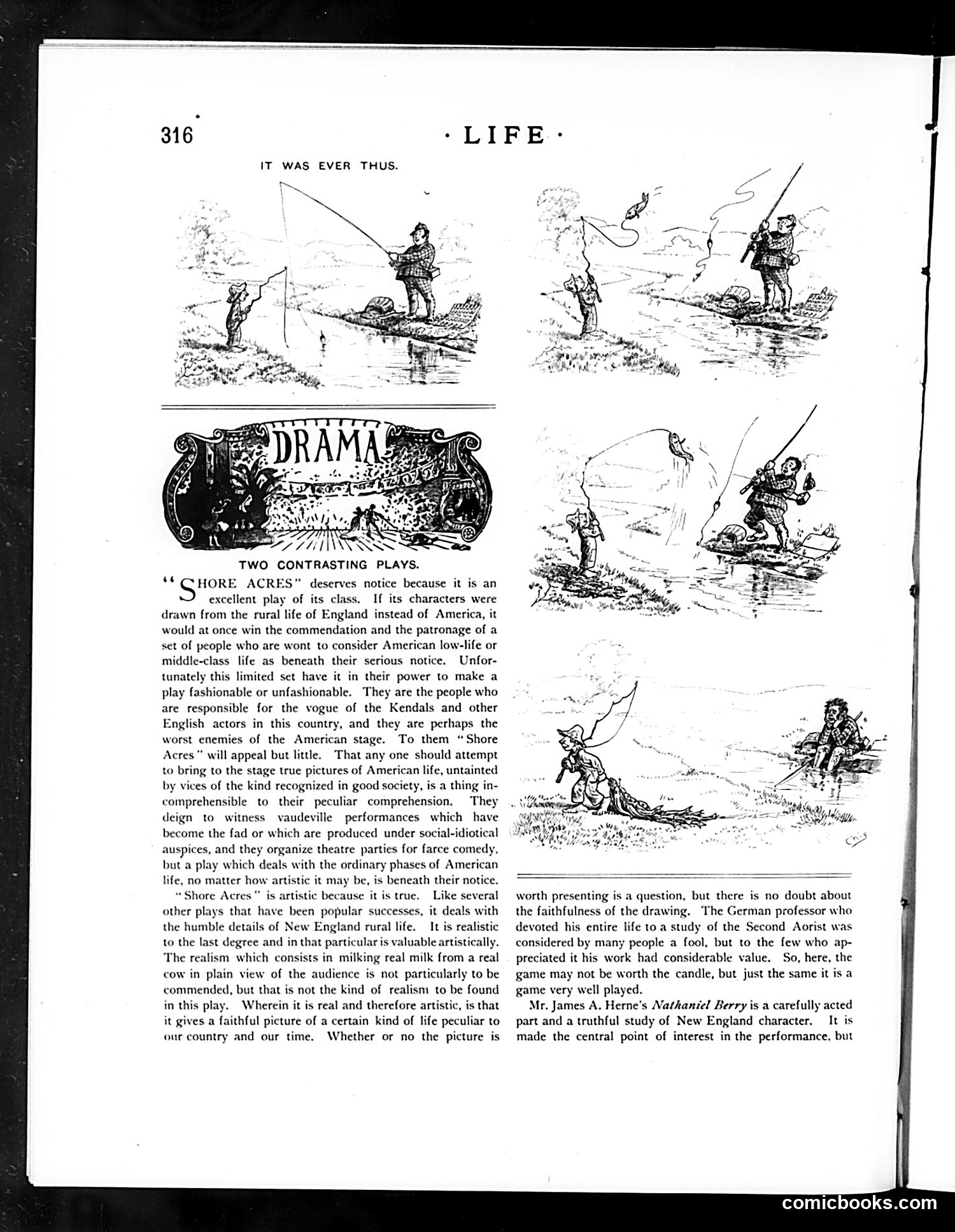
This page critiques American theater snobbery through two contrasting plays. The sketches at top show fishing scenes, illustrating the caption "It Was Ever Thus"—suggesting timeless class distinctions. The text defends "Shore Acres," a realistic play about New England rural life, against cultural elitism. Life argues that wealthy American audiences dismissively prefer English actors and artificial farce comedy over honest depictions of American working-class life. These tastemakers consider American "low-life" beneath serious notice. The review praises "Shore Acres" precisely *because* it's artistically true and realistic—not because the subject matter is inherently important (comparing it to a German scholar studying obscure grammar). The criticism targets the cultural gatekeepers who control what becomes "fashionable" on American stages, arguing their prejudice against American subject matter damages American theater itself.
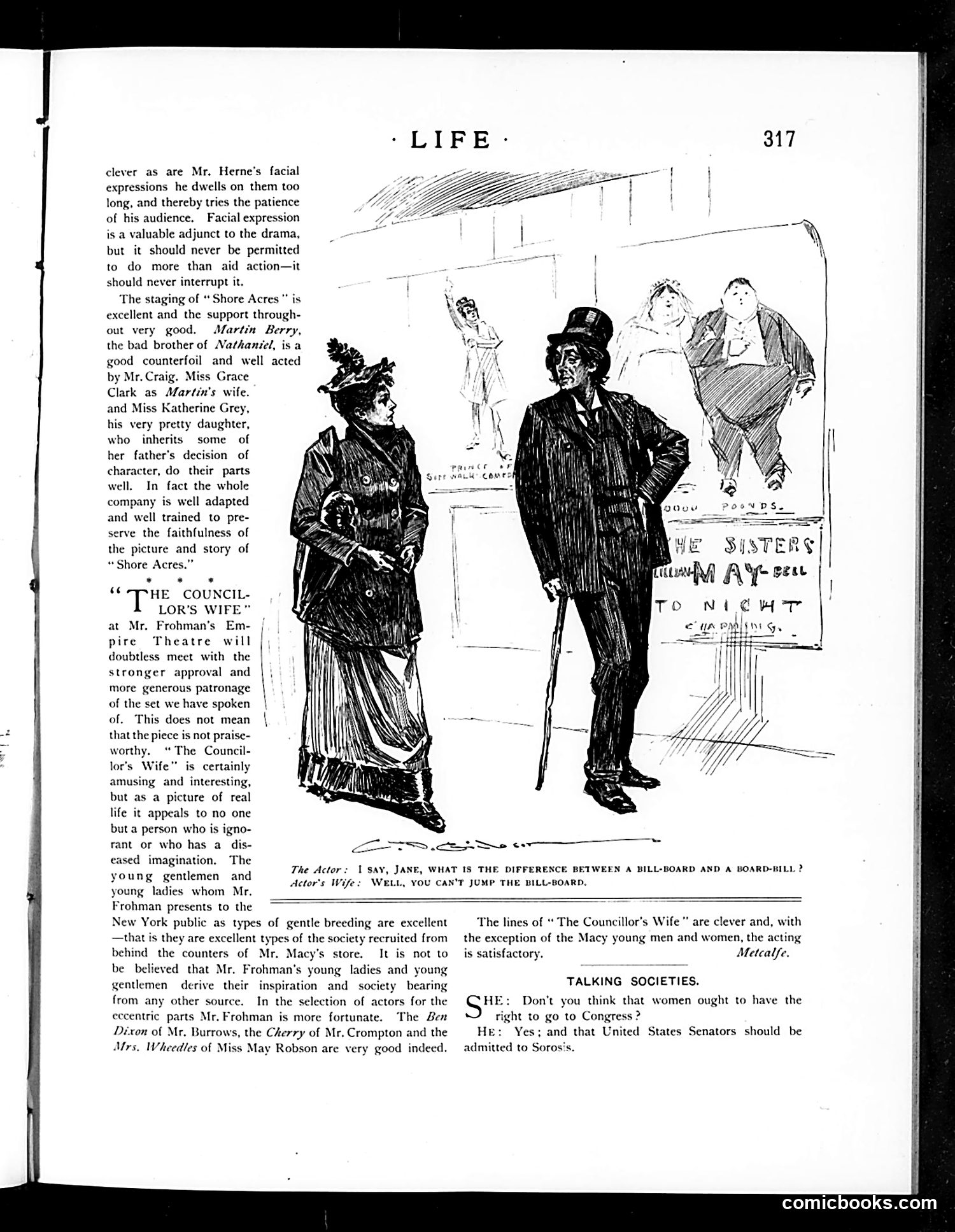
This page contains theater criticism and a small cartoon joke about gender and social pretension. **The Main Cartoon:** Shows an actor and actress in conversation. The actor asks Jane about the difference between a "bill-board" and a "board-bill"—she responds that you can't "jump the bill-board." This is a pun playing on theatrical terminology: a "board-bill" refers to unpaid lodging expenses (common financial struggles for actors), while a billboard advertises shows. The joke satirizes actors' chronic debt and poverty. **The Bottom Section ("Talking Societies"):** A brief, biting joke about women's suffrage and social hierarchies. A man agrees women should enter Congress and that senators should join "Soros's" (likely a gentlemen's social club). The satire mocks how some men would grant women political power only if excluded from exclusive male social spaces—revealing that real equality threatens male privilege more than voting rights do. Both pieces use humor to critique theatrical economics and gender inequality.
This page contains **multiple short humorous anecdotes** rather than a political cartoon. The main pieces satirize social pretension and misunderstanding: 1. **The Zola/Wilde anecdote**: French author Émile Zola, unfamiliar with English pronunciation, receives flowers from Oscar Wilde but doesn't recognize the name "Oscawoile," dismissing it as nonsense. The joke mocks both Zola's ignorance and the absurdity of not knowing the famous aestheticist Wilde—a prominent cultural figure of the era. 2. **The banker identification story**: An English judge cannot convince a bank to cash a check despite producing extensive credentials, until the banker recognizes his name from Oscar Wilde's writing. 3. **The loving cup joke**: A child innocently reveals that the third handle on a loving cup (a ceremonial drinking vessel) is "for the chaperon"—sardonically commenting on strict Victorian courtship supervision. All three pieces play on recognition, identity, and social conventions of the period.