
Life, 1893-11-16 · page 11 of 14
Life — November 16, 1893 — page 11: what you’re looking at
What you’re looking at
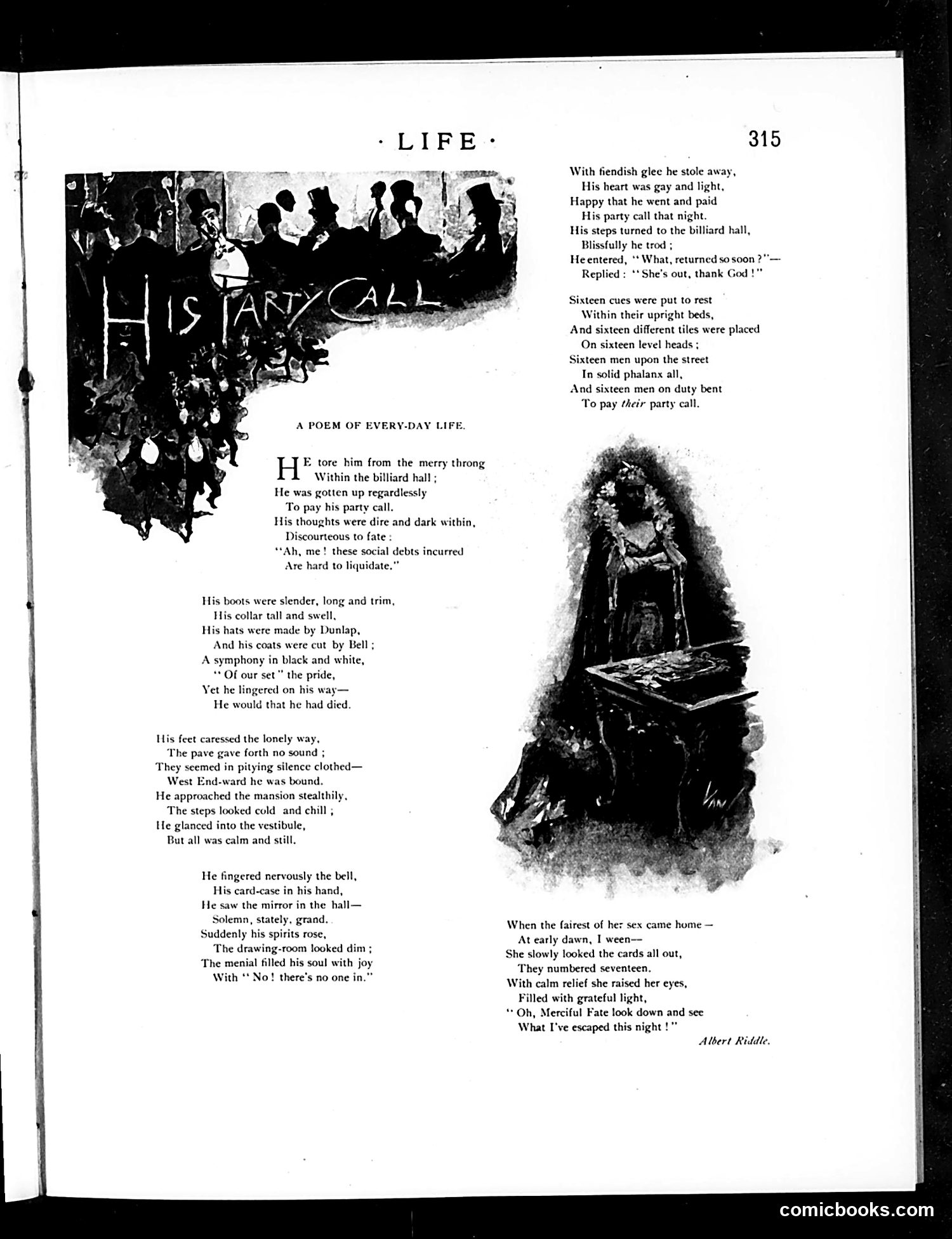
This page contains a humorous poem by Albert Riddle about a man reluctantly attending a social obligation—a "party call." The illustrations show his internal conflict: the upper left depicts the lively party scene he's escaping, while the lower right shows a woman (likely his wife or female companion) at home, waiting and reading tarot cards to divine his whereabouts. The satire targets the tedium of Victorian-era social duties and gender dynamics. The man resents the "social debts incurred" that require attending parties, while the woman at home anxiously consults fortune-telling—a period detail suggesting feminine worry and superstition. The poem mocks both the artificiality of social conventions and the domestic tensions they create.
📄 Transcribed text from this page (OCR, searchable)
Machine-transcribed from the original scan — historical spelling and the odd misread are preserved.
With fiendish glee he stole away, His heart was gay and light, Happy that he went and paid His party call that night. His steps turned to the billiard hall, Blissfully he trod ; Heentered, ** What, returned so soon ?”°— Replied : ** She's out, thank God !"" Sixteen cues were put to rest Within their upright beds, And sixteen different tiles were placed On sixteen level heads ; Sixteen men upon the street In solid phalanx all, And sixteen men on duty bent To pay their party call. A POEM OF EVERY-DAY LIFE. H E tore him from the merry throng Within the billiard hall ; He was gotten up regardlessly To pay his party call. His thoughts were dire and dark within, Discourteous to fate : Ah, me! these social debts incurred Are hard to liquidate,” His boots were slender, long and trim, His collar tall and swell, His hats were made by Dunlap, And his coats were cut by Bell ; A symphony in black and white, ** Of our set” the pride, Yet he lingered on his wa He would that he had died. Lis feet caressed the lonely way, ‘The pave gave forth no sound ; They scemed in pitying silence clothed— West End-ward he was bound. He approached the mansion stealthily, The steps looked cold and chill ; He glanced into the vestibule, But all was calm and still. He fingered nervously the bell, His card-case in his hand, He saw the mirror in the hall— lemn, stately, grand. Suddenly his spirits rose, The drawing-room looked dim ; ‘The menial filled his soul with joy With ‘* No! there's no one in.” When the fairest of her sex came home — At early dawn, I ween— She slowly looked the cards all out, They numbered seventeen. With calm relief she raised her eyes, Filled with grateful light, “Oh, Merciful Fate look down and see What I've escaped this night !" Albert Riddle, comicbooks.com