
Life, 1893-11-16 · page 4 of 14
Life — November 16, 1893 — page 4: what you’re looking at
What you’re looking at
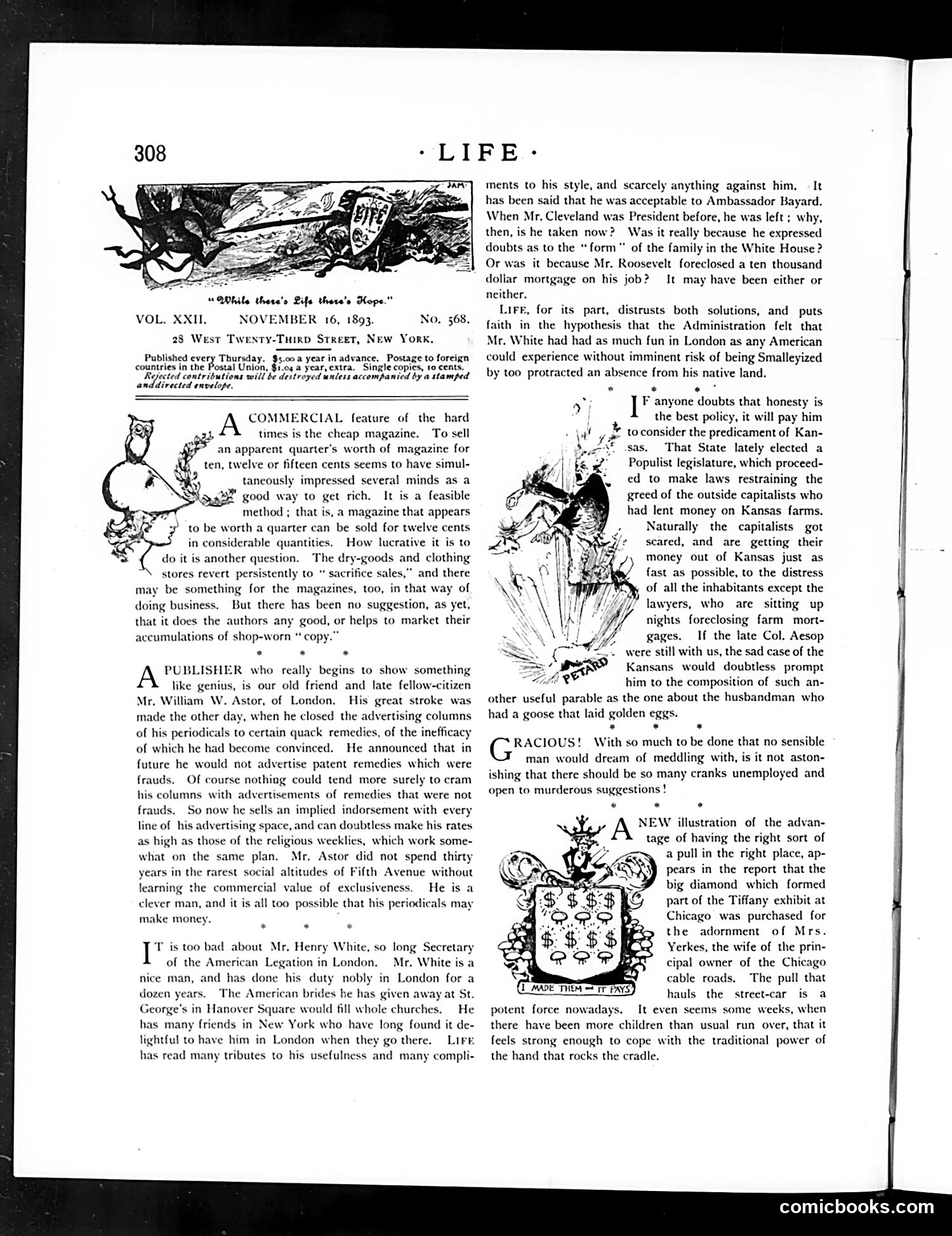
This page contains several satirical editorial pieces rather than single cartoons. The visible content discusses: **Henry White** (top section): A critique of the American Legion's Secretary in London, praising his diplomatic work but with implied sarcasm about his extended absence from America. **Kansas capitalism** (middle): Satire about Kansas legislators passing laws to restrain outside capitalists from foreclosing on farmers' mortgages. The piece mocks capitalists for being "scared" of losing money and fleeing the state, presenting this as both humorous and socially significant. **Tiffany diamond** (bottom): Commentary on a large diamond from the Tiffany exhibit in Chicago being purchased to adorn Mrs. Yerkes, wife of a Chicago cable-road owner, illustrating wealth inequality. The overall tone critiques American political and economic hypocrisy of the 1893 period.
📄 Transcribed text from this page (OCR, searchable)
Machine-transcribed from the original scan — historical spelling and the odd misread are preserved.
gs, - LIFE: “Dhile there's Life there's Hope.” VOL. XXII. NOVEMBER 16, 1893. No. 568. 28 West Twenty-Tuirp Street, New York, countries in ite Bosial Unies, Sines dear, extra: Single conten no cenie Rejected contributions will be destroyed unless accompanied by a stamped anddirected envelope, COMMERCIAL feature of the hard times is the cheap magazine. To sell an apparent quarter's worth of magazine for ten, twelve or fifteen cents seems to have simul- 4) tancously impressed several minds as a Sow? good way to get rich. It is a feasible ‘ method ; that is, a magazine that appears zy to be worth a quarter can be sold for twelve cents in considerable quantities. How lucrative it is to do it is another question. The dry-goods and clothing ‘stores revert persistently to “ sacrifice sales,” and there may be something for the magazines, too, in that way of doing business, But there has been no suggestion, as yet, that it does the authors any good, or helps to market their accumulations of shop-worn “ copy.” zs . . . PUBLISHER who really begins to show something like genius, is our old friend and late fellow-citizen Mr, William W. Astor, of London, His great stroke was made the other day, when he closed the advertising columns of his periodicals to certain quack remedies, of the inefficacy of which he had become convinced. He announced that in future he would not advertise patent remedies which were frauds. Of course nothing could tend more surely to cram his columns with advertisements of remedies that were not frauds. So now he sells an implied indorsement with every line of his advertising space, and can doubtless make his rates as high as those of the religious weekl which work some- what on the same plan. Mr. Astor did not spend thirty years in the rarest social altitudes of Fifth Avenue without learning the commercial value of exclusiveness. He is a clever man, and it iodicals may make mon all too possible that his pei * . « J is too bad about Mr. Henry White, so long Secretary of the American Legation in London, Mr. White is a nice man, and has done his duty nobly in London for a The American brides be has given away at St. George's in Hanover Square would fill whole church He has many friends in New York who have long found it de- lightful to have him in London when they go there. LIFE has read many tributes to his usefulness and many compli- dozen years, ments to his style, and scarcely anything against him, | It has been said that he was acceptable to Ambassador Bayard. When Mr. Cleveland was President before, he was left; why, then, is he taken now? Was it really because he expressed doubts as to the “form” of the family in the White House ? Or was it because Mr. Roosevelt foreclosed a ten thousand dollar mortgage on his job? It may have been either or neither. Lire, for its part, distrusts both solutions, and puts faith in the hypothesis that the Administration felt that Mr. White had had as much fun in London as any American could experience without imminent risk of being Smalleyized by too protracted an absence from his native land. * . . I * anyone doubts that honesty is the best policy, it will pay him to consider the predicament of Kan- sas. That State lately elected a Populist legislature, which proceed- ed to make laws restraining the greed of the outside capitalists who had lent money on Kansas farms. Naturally the capitalists got seared, and are getting their money out of Kansas just as fast as possible, to the distress of all the inhabitants except the lawyers, who are sitting up nights foreclosing farm mort- gages. If the late Col. Aesop ( were still with us, the sad case of the 27° BeeRSP Kansans would doubtless prompt ARE him to the composition of such an- other useful parable as the one about the husbandman who had a goose that laid golden eggs. . . * RACIOUS! With so much to be done that no sensible man would dream of meddling with, is it not aston- ishing that there should be so many cranks unemployed and open to murderous suggestions ! LE EW illustration of the advan- tage of having the right sort of a pull in the right place, ap- pears in the report that the big diamond which formed part of the Tiffany exhibit at Chicago was purchased for the adornment of Mrs. Yerkes, the wife of the prin- cipal owner of the Chicago cable roads, The pull that hauls the street-car is a potent force nowadays. It even seems some wecks, when there have been more children than usual run over, that it feels strong enough to cope with the traditional power of the hand that rocks the cradle. comicbooks.com